Latest Entries »

TAXONOMY
Kingdom: Animalia
Phylum: Chordata
Class: Actinopterygii   (ray-finned fishes)
Order:  Perciformes      (Perch-likes)
Family: Acanthuridae  (Surgeonfishes, Tangs, and Unicornfishes)

Genus/species:   Paracanthurus hepatus
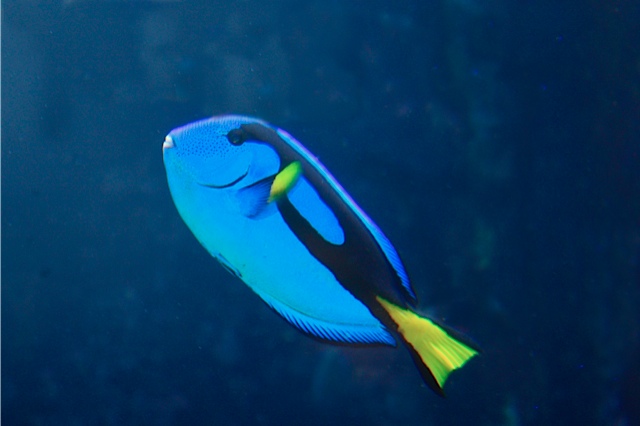
 

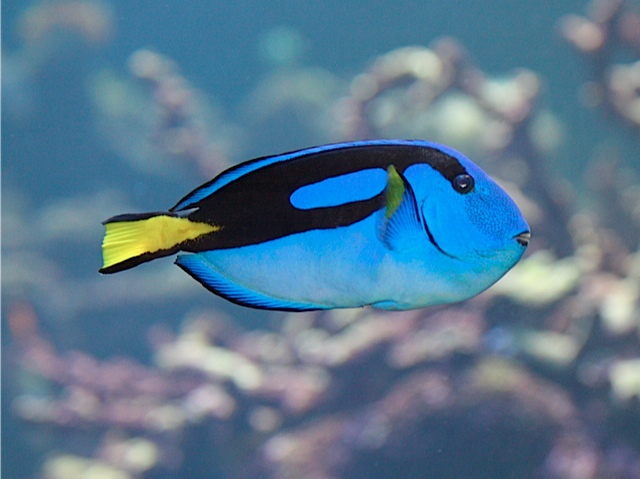
GENERAL CHARACTERISTICS: The color of their oval-shaped bodies is sky blue enhanced by reflective pigment cells called iridophores. The tail fin is yellow extending into a “V” shape from the caudal fin to a point just beyond the caudal spine. A black oval extends under dorsal fin to caudal peduncle. Color changes as they mature; juveniles are bright yellow with blue spots near their eyes, and their dorsal and anal fins are tipped in light blue. Their body becomes blue as they mature.

Length up to 31 cm (12 in)
Weigh on average 600 g. (1.3 pounds)

DISTRIBUTION/HABITAT: Indo-Pacific in clear, current-swept terraces of seaward reefs, 2–40 m (6-120ft). Typically in loose groups 1–3 m (3-9 ft) above substrate.  Shelters among branches of Procillopora corals or in crevices of rocks.  

DIET IN THE WILD: Zooplankton. 

REPRODUCTION: P. hepatus is oviparous with external fertilization.  They are open water egg scatterers on substrate and are nonguarders.        

CONSERVATION: IUCN Least concern         

REMARKS: P. hepatus like other surgeonfishes has a razor-sharp caudal spine located at the base of their caudal fin. This spine contains toxins that can cause a debilitating pain to small predators and uncomfortable irritation and pain in humans. This spine is in a groove below the surface of the skin and can be extended from the body for defensive purposes.

Dory, the co-star of Finding Nemo, with the voice of Ellen DeGeneres’ “spaced-out” fish, is a hepatus tang. Most kids now recognize this fish as Dory.  
 

References

California Academy of Sciences Steinhart Aquarium Philippine Coral reef 2016

Ron’s WordPress shortlink  wp.me/p1DZ4b-Ab

Ron’s flickr   http://www.flickr.com/photos/cas_docents/sets/72157608332652056/

Encyclopedia of Life   http://eol.org/pages/222042/details

Animal Diversity Web: http://animaldiversity.ummz.umich.edu/accounts/Paracanthurus_hepatus/

fishbase: http://www.fishbase.org/summary/6017
TAXONOMY
Kingdom: Animalia
Phylum: Chordata
Class: Actinopterygii
Order: Perciformes
Family: Monodactylidae (Moonyfishes or fingerfishes)

Genus/species: Monodactylus argenteus


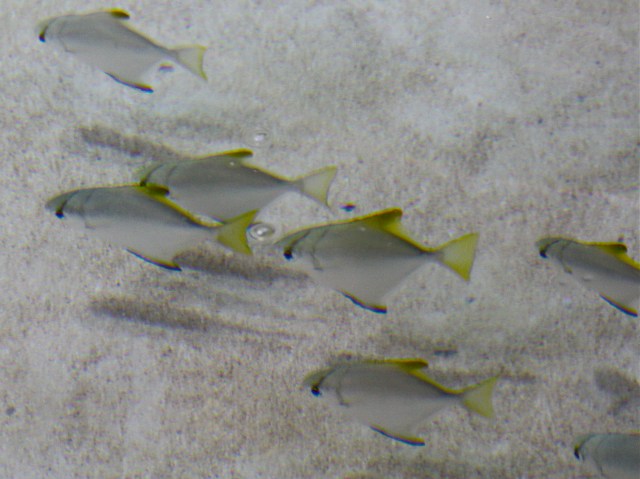
GENERAL CHARACTERISTICS: Adults are bright silver with yellowish dorsal and tail fins. Round to triangular-shaped, laterally compressed body. Small juveniles more colorful with yellow over most of the dorsal fin and two vertical black bands over the head.

Length to 27 cm (11 in)

DISTRIBUTION/HABITAT: Indo-West Pacific: Red Sea and East Africa south to New Caledonia and Australia in bays, mangrove estuaries, tidal creeks, and lower reaches of freshwater streams occasionally in silty coastal reefs.

DIET IN THE WILD: Omnivorous, feeding on plankton, a variety of plant matter, detritus, and insects.

4889665817_815d686e0b_o

MORTALITY: About 7-10 years.

CONSERVATION: IUCN Red List  Not Evaluated

REMARKS: Mono are seen in large fast swimming groups in bays, mangrove estuaries and tidal creeks, in the wild.

References

California Academy of Sciences Steinhart Aquarium Reef Lagoon 2016

Ron’s WordPress Shortlink http://wp.me/p1DZ4b-WT

Ron’s flickr  http://www.flickr.com/photos/cas_docents/sets/72157608440659805/with/4889666339/

fishbase fishbase.org/summary/Monodactylus-argenteus.html

Encyclopedia of Life eol.org/pages/206099/details

TAXONOMY
Kingdom: Animalia
Phylum: Chordata
Class: Actinopterygii (ray-finned fishes)
Order: Perciformes (Perch-likes)
Family: Carangidae ((Jacks and pompanos)

Genus/species: Trachinotus mookalee

GENERAL CHARACTERISTICS: Dorsal snout profile very steep. Pompano may also refer to various other, similarly shaped members of Carangidae, or the order Perciformes. Their appearance is deep bodied and mackerel-like, typically silver and toothless with a forked tail and narrow base. There are twenty described species and most are valued as food.
Common length : 90.0 cm (35 inches). Max. wt. 8.1kg (17.85 lbs)

Indian Pompano19251381660_2573191e7a_k

DISTRIBUTION/HABITAT: Indo-West Pacific found in tropical shallow coastal waters.

Indian Pompano8396538496_c3d6f271a5_k


DIET IN THE WILD: Pompano are primarily bottom feeders that opportunistically “graze” preferred species.  Well developed pharyngeal plates are present, and indicate that hard-shelled organisms such as crabs and mollusks are important in the diet. 

CONSERVATION: IUCN Red List Not Evaluated

References

California Academy of Sciences Reef Lagoon 2016

Ron’s WordPress shortlink http://wp.me/p1DZ4b-1Eg

Ron’s flickr  https://www.flickr.com/photos/cas_docents/19251381660/in/album-72157627919810858/

fishbase  http://fishbase.org/summary/SpeciesSummary.php?ID=1964&AT=Indian+Pompano

EOL http://www.eol.org/pages/26259/details

TAXONOMY
Kingdom: Animalia
Phylum: Chordata
Class: Elasmobranchii (sharks and rays)
Order; Orectolobiformes (Carpet sharks) Most carpet sharks feed on the seabed in shallow to medium-depth waters and have ornate patterns reminiscent of carpets.
Family: Stegostomatidae (Zebra sharks)

Genus/species: Stegastoma fasciatum ( juvenile)

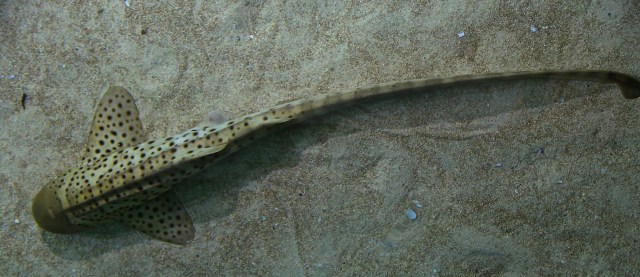
GENERAL CHARACTERISTICS: S. fasciatum has a cylindrical body with a large, slightly flattened head and a short, blunt snout and is yellow-brown with dark brown spots. Young less than 70 cm (2,3 feet) in length are black with yellow bars. Adults have longitudinal skin ridges. The head has 5 small gill slits, the last three behind pectoral fin origin; nostrils close to front of snout, with short barbels.  Pectoral fins are large and broadly rounded and body has a long caudal fin, almost as long as the rest of the body.

Length up to 354 cm (11.7 feet) 

Zebra Shark 16235954845_08c3bb04f1_k

DISTRIBUTION/HABITAT: Tropical marine. Indo-West Pacific. Found near coral reefs with sandy bottoms and remain at the reef at where they were hatched or reefs that are closely connected to their natal area.

Depth range 0 – 63 m (206 feet).

DIET IN THE WILD: Feeds mainly on mollusks, but also small bony fishes, crustaceans (crabs and shrimps) and sea snakes.

REPRODUCTION: Oviparous S. fasciatum has large purplish-black eggs or dark brown egg cases with longitudinal striations.

Lifespan: Ave. 25 years. 

CONSERVATION: IUCN Red List; Vulnerable (VU)     Decreasing numbers secondary to heavily fished shallow coral reef habitat throughout all its range except Australia.

Remarks: Like other bottom dwelling sharks, it can pump water across its gills through its mouth, which allows the shark to respire while stationary. 

It was tank bred at the Shedd Aquarium.

References

California Academy of Sciences Reef Lagoon 2016

fishbase: www.fishbase.org/summary/5374

IUCN Red List  www.iucnredlist.org/details/41878/0

Arkive  www.arkive.org/leopard-shark/stegostoma-fasciatum/

Animal diversity web http://animaldiversity.org/site/accounts/information/Stegostoma_fasciatum.html

Marinebio marinebio.org/species.asp?id=56

Ron’s flickr https://www.flickr.com/photos/cas_docents/16235954845/

Ron’s WordPress shortlink  http://wp.me/p1DZ4b-1rb

TAXONOMY
Kingdom: Animalia
Phylum: Chordata
Class: Chondrichthyes
Subclass: Elasmobranchii
Order: Myliobatiformes
Family:Dasyatidae Family: Dasyatidae  Whiptail Stingrays; whip-like tails, which are much longer than the disc and lack dorsaland caudal fins. They also have one or more venomous spines near the base of the tail.

Genus/species: Dasyatis kuhlii

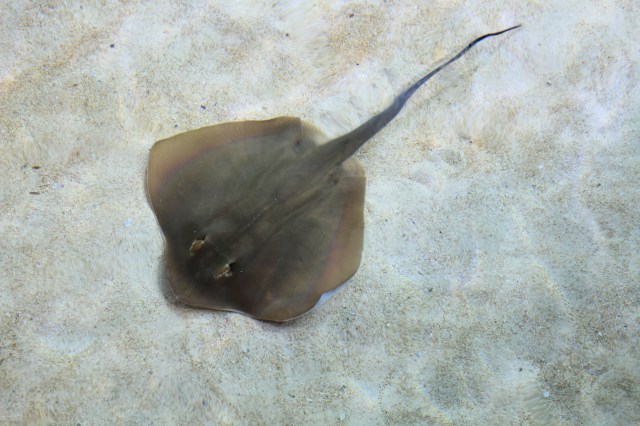
IMG_7263

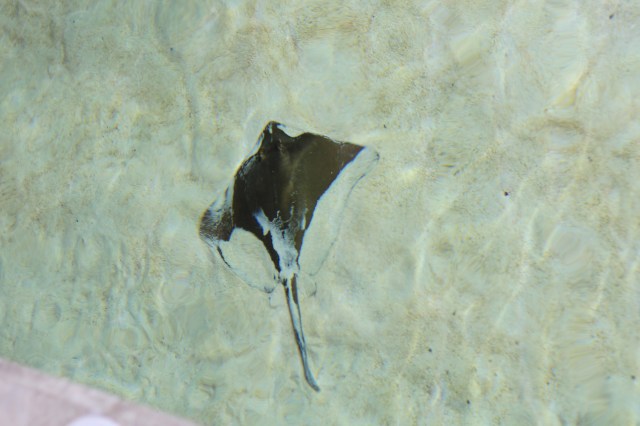
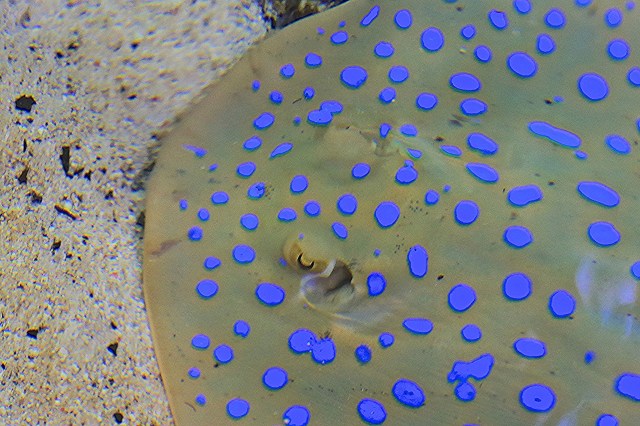
GENERAL/CHARACTERISTICS: Angular disc. Dorsal color reddish-brown to olive drab with blue spots and smaller black spots, ventral side white. Tail with black and white bands is about as long as the body and usually has one stinging spine.

Maximum disc width: 50 cm (20 inches).

DISTRIBUTION/ HABITAT: Tropical Indo-West Pacific from the Red Sea east to the Philippines, Japan, and south to Australia. Found on sandy bottoms near coral and rocky reefs, from intertidal zone to 50 m (160 feet). Moves onto reef flats and into shallow lagoon waters at high tide.

IMG_7261

DIET IN THE WILD: Crabs and shrimp, also small fishes.

REPRODUCTION: Ovoviviparous; eggs retained in the female’s body; embryos receive nourishment from a yolk sac.

REMARKS: The Bluespotted Whiptail Stingray is venomous tail can deliver a painful wound. Like many other rays that wound humans, it usually stings only when inadvertently stepped on: it is difficult to see in turbid waters, especially when covered by sand with only the eyes visible.

References

California Academy of Sciences Reef Lagoon 2016

Ron’s WordPress shortlink  http://wp.me/p1DZ4b-YD

Ron’s flickr https://www.flickr.com/photos/cas_docents/5035114327/in/album-72157627919810858/

TAXONOMY
Kingdom: Animalia
Phylum: Chordata
Class: Chondrichthyes
Subclass: Elasmobranchii (sharks and rays)
Order: Rajiformes (Skates and rays)
Family: Myliobatidae (Cownose and Manta Rays)

Genus/species: Rhinoptera javanica


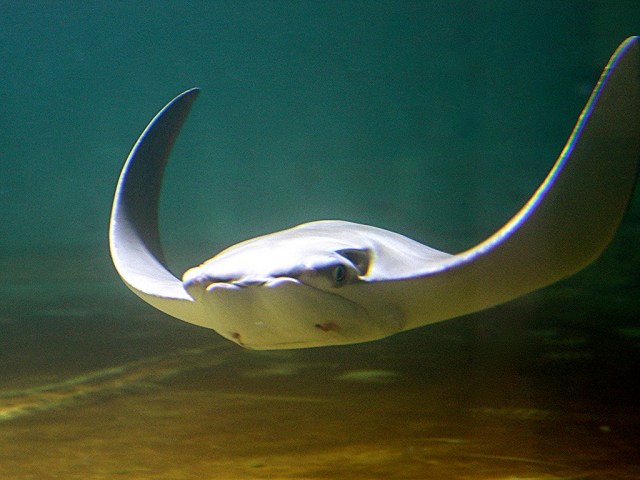
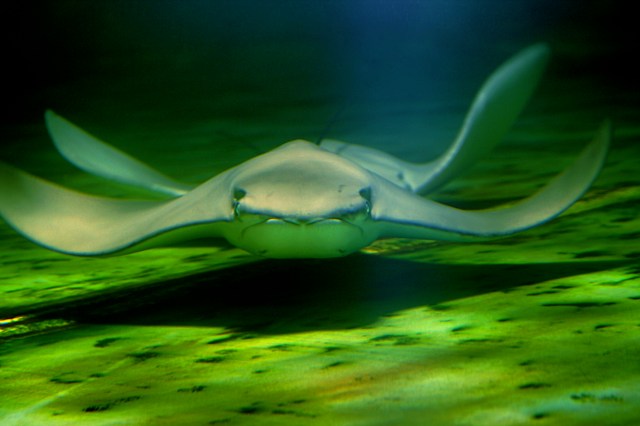
GENERAL CHARACTERISTICS: R. javanica is a cartilaginous fish with bat-like, swept back pectoral fins. Double-lobed snout and indented forehead. Long, slender tail. Brown above, white below. The stinger is located at base of the tail rather than half way or more down the tail as in the whiptail rays
Width up to 1.5 m (5 ft), weight up to 45 kg (100 lbs).

Rhinoptera javanica2981790284_a7f88eab35_b

DISTRIBUTION/HABITAT: Tropical, Indo-West Pacific from South Africa north to India and possibly Thailand, Indonesia and southern China. Also in Okinawa, Ryukyu Islands.  The Javanese Cownose Ray inhabits tropical bays, estuaries, among mangroves, and near coral reefs over sand and mud bottoms. It can also tolerate brackish water.

JAVANESE COWNOSE RAY (Rhinoptera javanica) IMG_1769

DIET IN THE WILD: Feeds on clams, oysters and crustaceans. The ray sucks in sand and expels it out of its gills, blowing off sand covering its prey. (Looking for prey below)

Javanese Cownose Ray Rhinoptera javanica (Myliobatidae) eating IMG_0015

REPRODUCTION: Mating pair orient in a venter to venter position, and the male inserts one or both claspers. Ovoviviparous, 1–2 pups per litter. Females have been known to leap out of the water and slam into the surface; this action seems to be an aid in birthing.

CONSERVATION STATUS: IUCN Red List  Vulnerable

A declining population is inferred from the unregulated nature of inshore fisheries as well as small litter size.


REMARKS:  Like its pelagic relatives the manta and devil rays, it swims by flapping its pectoral fins like wings, enabling it to swim at greater speeds than most bottom dwelling stingrays. Sometimes these “wings” protrude above the water, bearing a frightening resemblance to a shark.

References

California Academy of Sciences Reef Lagoon 2016

ARKive www.arkive.org/javanese-cownose-ray/rhinoptera-javanica/

fishbase www.fishbase.org/summary/SpeciesSummary.php?id=7971

IUCN Red List www.iucnredlist.org/details/60129/0

Ron’s WordPress Shortlink  http://wp.me/p1DZ4b-RK

Ron’s flickr http://www.flickr.com/photos/cas_docents/sets/72157608440813109/with/2981790284/

TAXONOMY
Kingdom: Animalia
Phylum: Chordata
Subphylum: Vertebrata
Class: Reptilia
Order: Squamata (scaled reptiles, all lizards and snakes)
Suborder: Serpentes (snakes are elongated, legless, carnivorous reptiles)
Family: Viperidae  (vipers, venomous snakes)
Subfamily: Crotalinae (Pit Vipers, crotaline snakes, or pit adders)

Genus/species: Agkistrodon contortrix

GENERAL CHARACTERISTICS: They have distinctive reddish-brown bodies with a crossband pattern consisting of tan, copper, and brown colors that extending throughout its body. Its colors enhance its camouflage in leaf litter in wooded habitats. Heat sensitive pit organs are present between the eye and the nostril.
Length up to 53 inches

24836741386_49dde98dc0_k

DISTRIBUTION/HABITAT: Found in deciduous forest and mixed woodlands in the central and eastern U.S.A. They are also found in swamps. Subspecies are recognized by slight changes in color pattern shape and hue. The Southern Copperhead extends through Massachusetts, westward to Texas and southeastern Nebraska.

DIET IN THE WILD: Diurnal, ambush predators feeding on small mammals (rodents primarily), birds, reptiles, amphibians and insects.

REPRODUCTION: Usually viviparous but Southern Copperheads can reproduce asexually through parthenogenesis. Females kept in captivity in the absence of males periodically produce one fully developed neonate along with a group of aborted ova.

LONGEVITY: Up to 29 years in captivity. Average 15 years in the wild.

CONSERVATION: IUCN Least Concern

REMARKS: Copperheads are venomous but their venom is somewhat mild compared to other snake species. It usually not fatal to healthy human adults.

References

California Academy Of Sciences Swamp Feb. 5, 2016

Ron’s flickr https://www.flickr.com/photos/cas_docents/24836741386/in/photostream/

Ron’s WordPress shortlink  http://wp.me/p1DZ4b-1E

Animal Diversity Web  animaldiversity.org/accounts/Agkistrodon_contortrix/


TAXONOMY

Kingdom: Animalia
Phylum: Chordata
Class: Chondrichthyes
Subclass: Elasmobranchii (sharks and rays)
Order: Myliobatiformes (Stingrays)
Family: Dasyatidae (Stingrays)

Genus/species: Taeniura lymma

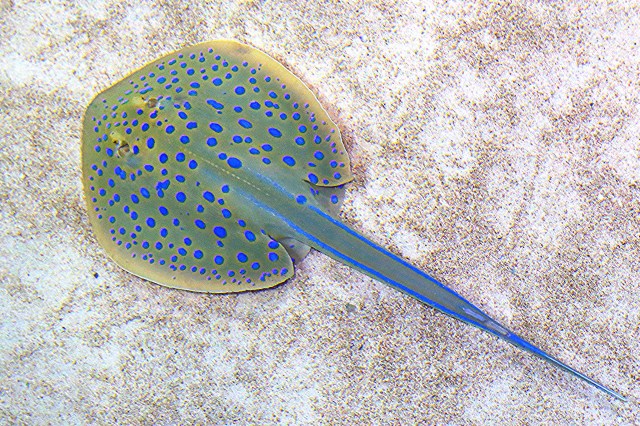
GENERAL CHARACTERISTICS: large bright blue spots on a grey-brown to yellow, olive-green or reddish-brown oval, elongated disc with lateral blue side-stripes along the tail. The snout is rounded and angular. Disc diameter to 25 cm (9.8 inches).

18360786662_f310c46cc9_k

DISTRIBUTION/HABITAT: Indo-West Pacific around coral reefs and sandy bottoms to a debt of 20 meters (66 feet).

DIET IN THE WILD: Prey is often detected through electroreception, a system which senses the electrical fields produced by the prey. Within the mouth are two plates, which are used for crushing mollusks, worms, shrimps, and crabs.

Taeniura lymma9830767635_6774f7ae7d_k

REPRODUCTION: T. lymma is ovoviviparous; the egg-shell is weakly formed and young hatch inside the female; they are nourished by their yolk sac and then ‘born’ live.

PREDATION: The hammerhead shark uses the cartilaginous projections form the side of their heads to pin them down to the bottom of the substrate while taking bites from the stingray’s disc. The hammerhead is able to avoid being stung by the poisonous spines on the rays tail by pinning the stingray down.

16087475307_e885bf6ee9_k

CONSERVATION: IUCN Red List: Near threatened

REMARKS: At the tip of the tail are two sharp venomous spines (can be regenerated) which permit this ray to strike at enemies forward of its head. Venom is produced and delivered into narrow groves running lengthwise along the underside of the stinger. The entire structure is covered by a thin layer of skin which, when broken, releases its venom into its victim.

References

California Academy of Sciences Steinhart Aquarium Reef Lagoon 2016

fishbase fishbase.org/summary/Taeniura-lymma.html

Ron’s WordPress shortlink wp.me/p1DZ4b-16f

Ron’s flickr www.flickr.com/photos/cas_docents/sets/72157608440813109/

ARKive    www.arkive.org/ribbontailed-stingray/taeniura-lymma/


TAXONOMY

Kingdom: Animalia
Phylum: Chordata
Class: Chondrichthyes
Subclass: Elasmobranchii
Order: Myliobatiformes
Family: Dasyatidae (Whiptail Stingrays, whip-like tails, which are much longer than the disc)

Genus/species: Himantura uarnak


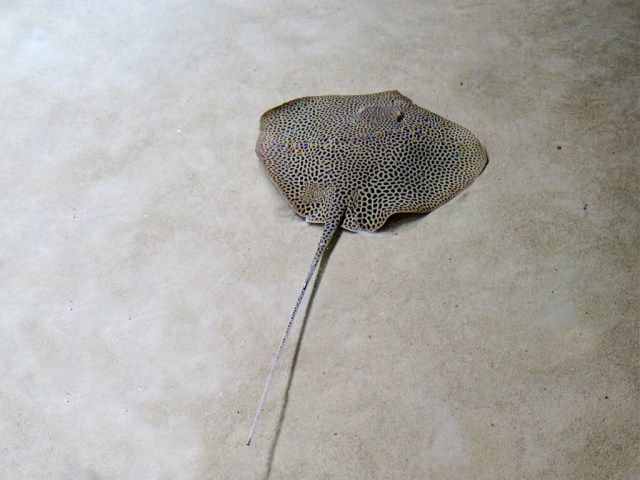
GENERAL CHARACTERISTICS: Disc light brown above with conspicuous dark spots, white ventrally. Tail with bands of black and white, three times the body length. One tail spine. The dark spots are separated in the young ray; in the adult they become crowded together, forming the reticulated pattern from which it gets its name. Snout sharply pointed. Band of flat denticles down the back.
Width up to 2 m (6.5 ft), weigh up to 120 kg (265 lbs).

 Himantura uarnak 18366435141_1e263bfff2_k

DISTRIBUTION/HABITAT: Subtropical, Indo-West Pacific, Red Sea, to southern Africa and French Polynesia, north to Taiwan, south to Australia.

Benthic, found in surf zone, sandy beaches, sandy areas of coral reefs, shallow estuaries and lagoons, down to 90 m (295 ft). It can tolerate brackish water and in India, has been found in the fresh water of Chilka Lake and the Hoogly River, a tributary of the Ganges River.

3300565561_c2b08f97ab_b

DIET IN THE WILD: Main foods: small fish, also bivalves crabs, shrimps, worms and jellies.

REPRODUCTION: Ovoviviparous. Embryos feeding initially on yolk, then receiving additional nourishment from the mother by indirect absorption of uterine fluid enriched with mucus, fat or protein through specialised structures

3300566493_c6e0f406ba_b

REMARKS: Although venomous, it is a popular angling fish due to its being a powerful fighter. It is not a food fish but is used in Chinese medicine.

CONSERVATION: IUCN Red list Vulnerable (VU)

REMARKS: Since their mouths are directed downward and often placed against the sand, stingrays use their spiracles rather than their mouths for water intake.

Stingrays have a spiral valve in their intestine that increases food absorption, and lack a swim bladder.

Although venomous, it is a popular angling fish due to its being a powerful fighter. It is not a food fish but is used in Chinese medicine.

References

California Academy of Sciences, Steinhart Aquarium, Reef Lagoon 2016

Ron’s flickr http://www.flickr.com/photos/cas_docents/sets/72157627919810858/

Ron’s WordPress Shortlink  http://wp.me/p1DZ4b-P8

fishbase  www.fishbase.us/summary/5507

IUCN www.iucnredlist.org/details/161692/0

Encyclopedia of Life  eol.org/pages/1859/details

TAXONOMY
Kingdom: Animalia
Phylum: Chordata
Class:Class: Chondrichthyes (sharks and rays)
Order: Carcharhiniformes (Ground sharks)
Family: Carcharhinidae (Requiem sharks eg migratory, live-bearing sharks of warm seas)

Genus/species: Carcharhinus melanopterus

GENERAL CHARACTERISTICS:
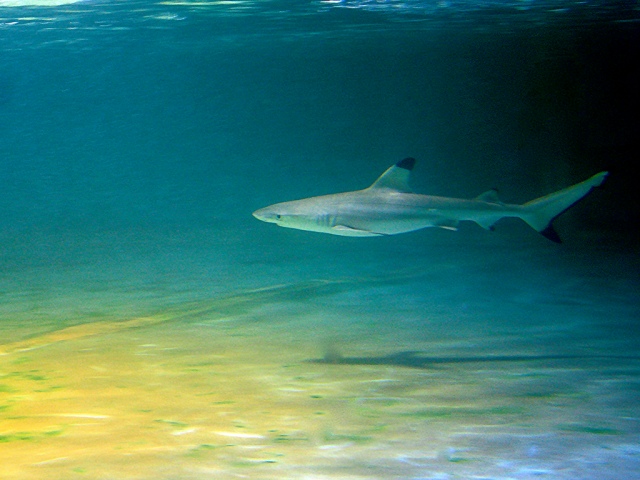
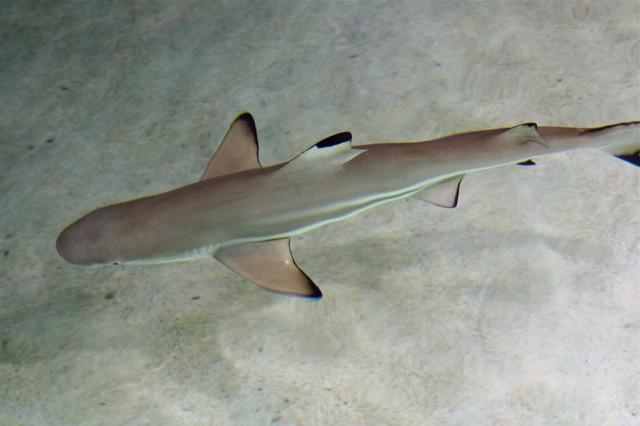
All fins tipped with black, the large dorsal fin with a white band beneath the black tip, conspicuous white bands along flanks, sometimes edged with black. Otherwise, yellowish-tan above, white below.
Length up to 2 m (6.5 ft) long and weight up to 13.6 kg (30 lbs)

Carcharhinus melanopterus2979831615_73451da081_b

DISTRIBUTION: Subtropical from Red Sea and East Africa to the Hawaiian Islands and the Tuamoto Archipelago. Also enters the Mediterranean from the Red Sea (via the Suez Canal). Prefers inshore coral reefs and the intertidal zone. Has been observed in mangrove areas and fresh water, traveling in and out with the tide.

DIET IN THE WILD: Teleost fishes sea snakes. Predation upon other elasmobranchs was rare.

REPRODUCTION: C. melanopterus is viviparous, incubating young for up to 16 months, producing 2–4 pups per litter. In a fashion not uncommon in sharks, the male takes the female’s pectoral fin in his teeth and the two mate belly to belly.

3267104972_6214b0cc45_b

PREDATORS: Preyed upon by other sharks as well as large groupers. Average lifespan c. 12 years

CONSERVATION: IUCN Near threatened (NT) 2015-4
The Blacktip Reef Shark is not a target of major fisheries, but is regularly caught by inshore fisheries in India and Thailand. It is caught for human consumption, fishmeal, and their fins enter the oriental sharkfin trade, for sharkfin soup. Their livers are also sought as a rich source of oil.

REMARKS: Often hunt in packs, driving prey into a tight ball and then attacking the ball in a feeding frenzy, even leaping out of the water. Its distinctive appearance and active swimming habit make it a favorite specimen for aquariums. It has been known to bite people wading in shallow water and is aggressive towards spear fishers.

References

Californiua Academy of Sciences Steinhart Aquarium Reef Lagoon 2-2-16

References

Californiua Academy of Sciences Steinhart Aquarium Reef Lagoon 2-2-16

Ron’s flickr https://www.flickr.com/photos/cas_docents/2979831615/in/album-72157627919810858/

Ron’s WordPress shortlink  http://wp.me/p1DZ4b-1DM

arkive  www.arkive.org/blacktip-reef-shark/carcharhinus-melanopte…

fishbase www.fishbase.org/summary/SpeciesSummary.php?&genusnam…

IUCN: www.iucnredlist.org/details/39375/0

fishbase www.fishbase.org/summary/SpeciesSummary.php?&genusnam…