Latest Entries »

TAXONOMY
Kingdom: Animalia
Phylum: Chordata
Class: Actinopterygii
Order: Perciformes
Family: Embiotocidae (Surfperches)

Genus/species: Amphistichus rhodoterus

 GENERAL CHARACTERISTICS: The body of the Redtail Surfperch is a deep oval shape and is compressed from side to side. All fins reddish or pink. Faded brown bars on the side. Silvery overall with pale olive shading above and 9 to 11 narrow vertical dark bars, posteriorly, broken and staggered along the lateral line. Caudal (tail) fin broadly forked; dorsal fin distinctive for the long dorsal spines that contrast with shorter soft rays.

Length up to: 41 cm (16 in) and 2.1 kg (4.5 lbs.) in weight.


DISTRIBUTION/HABITAT: Temperate marine. Vancouver Island to Monterey Bay around sand beaches and rocky shores in surf.

DIET IN THE WILD:  A. rhodoterus feeds on worms, crabs, other small crustaceans, and fishes.

LONGEVITY: Life span: up to 9 years.

REPRODUCTION: The Redtail Surfperch females are viviparous and reproductively mature at 3–4 years; males mature at 2 years. The females enter bays and estuaries to spawn.

REMARKS: This shallow water schooling surfperch is most often caught from central California northward.  A. rhodoterus omprises 10–30% of the total recreational catch in this area. Redtails also support a sizable commercial fishery, and comprise almost 75% of the commercial surfperch catch.

References

Ron’s flickr https://www.flickr.com/photos/cas_docents/7800132290/in/album-72157608359804936/

fishbase www.fishbase.org/summary/3624

California Academy of Sciences Steinhart Aquarium California Rocky Coast 2017

WashingtonDept. of Fish and Wildlife wdfw.wa.gov/fishing/bottomfish/identification/perch/a_rho…

Ron’s WordPress shortlink  http://wp.me/p1DZ4b-1jC


TAXONOMY:
Kingdom: Animalia
Phylum: Chordata
Class: Actinopterygii
Order: Gasterosteiformes (sea horsespipefishes)
Family: Syngnathidae  (seahorses, the pipefishes, the pipehorses, and the leafyruby, and weedy seadragons all have fused jaws)

Genus/species: Hippocampus ingens

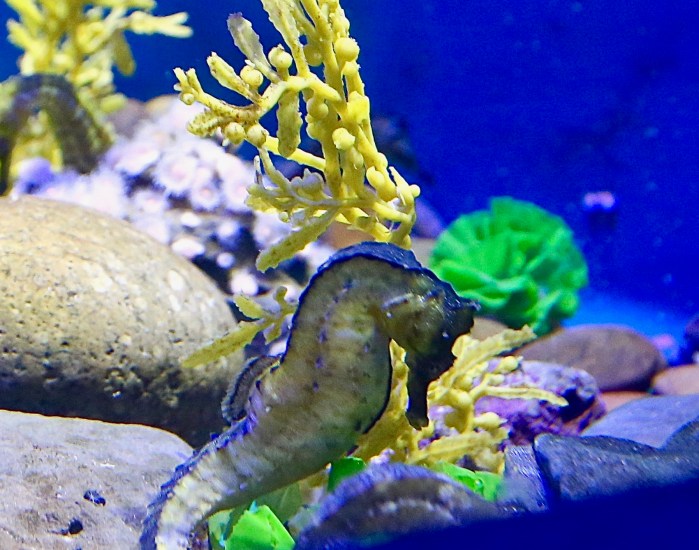
GENERAL CHARACTERISTICS: Their color is variable and can change their body color, depending on the environment. Body colors include maroon, yellow, and muddled brownish-green. adults have thin close set scrubby lines along the head and body.
The tail prehensile and flexible and able to coil around seagrass and other objects.

Length up to 12 inches long.

DISTRIBUTION:HABITAT: Southern California to Peru including the Galapagos Islands. Found on temperate reefs clinging to sponges, branching coral, sea-whips and inhabits weed beds, usually at depths of 1—20 m (3.28-65 ft).

DIET IN THE WILD: Small shrimp, mysids and other plankton. Seahorses lack teeth and jaws instead suck prey through their tube-like snouts.

REPRODUCTION: H. ingens males and females perform a mating “dance” by bobbing up and down together lasting for three days. Finally, a male will display his empty breeding pouch, which the female will fill with eggs using her ovipositor. Males carry fertilized eggs in a brood pouch for 2-3 weeks up and then releases up to 1000 hatched individuals.

LIFESPAN: Estimated range is 3-5 years. The Pacific Seahorse’s camouflage abilities are its best defense to avoiding predation.

PREDATORS: Pacific Seahorses are also known to be associated with flotsam as it has been collected at the surface and from the stomachs of the Pacific Yellowfin Tuna and Bluefin Tuna.

CONSERVATION: IUCN: Vulnerable
Declines result from targeted catch, incidental capture, and habitat degradation from coastal development. Once caught, H. ingens are used throughout Latin America for curios, occasionally in traditional medicine, and in the live aquarium trade. The vast majority are exported internationally for use in traditional medicine.

REMARKS: Academy individuals were captive raised in the Cabrillo Aquarium, Cabrillo, CA.

References

Ron’s flickr  https://www.flickr.com/photos/cas_docents/35417467820/in/album-72157608359804936/

California Academy of Sciences Steinhart Aquarium Water Planet 2017

Animal Diversity Web  animaldiversity.org/accounts/Hippocampus_ingens/

IUCN www.iucnredlist.org/details/10072/0

Ron’s WordPress Shortlink wp.me/p1DZ4b-1QX

TAXONOMY
Kingdom: Animalia
Phylum: Arthropoda
Class:Insecta
Order: Lepidoptera
Family: Nymphalidae

Genus/species: Catonephele numilia

GENERAL CHARACTERISTICS:The males are dark brown on the upperside with dazzling reflective orange patches which vary in size and shape from species to species. Females are entirely different in appearance. In most species they have dark brown wings marked with linear rows of cream spots.
Both sexes of all species have cryptic undersides in shades of brown.

DISTRIBUTION/HABITAT: C. numilia breeds in wet rainforest and cloudforest at elevations up to about 1800m (5900 ft).

DIET IN THE WILD: Adults feed on rotten fruits, while caterpillars feed on Alchornea species.

References

Ron’s flickr https://www.flickr.com/photos/cas_docents/35513496662/in/album-72157608449327886/

California Academy of Sciences Rainforest 2017

EOL eol.org/pages/164956/details

Learn About butterflies  http://www.learnaboutbutterflies.com/Amazon%20-%20Catonephele%20numilia.htm

Ron’s WordPress Shortlink  http://wp.me/p1DZ4b-1QS

TAXONOMY
Kingdom: Animalia
Phylum: Arthropoda
Class: Insecta
Order: Mantodea
Family: Mantidae
Subfamily: Deroplatyinae

Genus/species: Deroplats desiccata

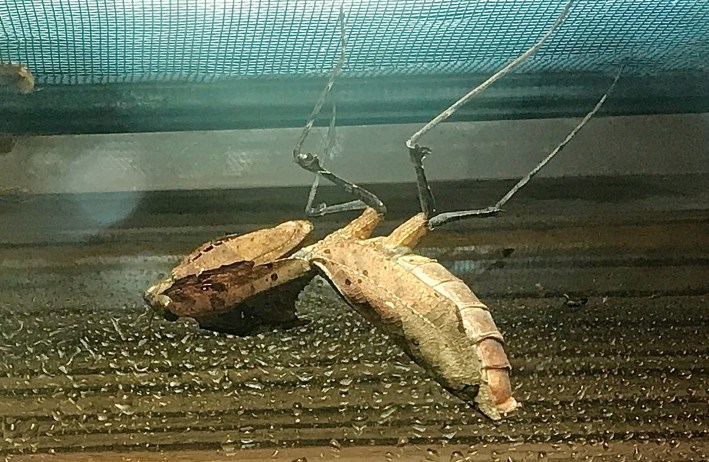
GENERAL CHARACTERISTICS: D. desiccata is brown in color with “leaf patterns” on its wings and has a broad prothorax that looks ripped and crumpled like a dead leaf. When threatened it drops to the ground with all legs folded resembling a dead leaf.
It can also react with a threatening display consisting of “black underwings” splayed out, with large eyespots, frightening away unsuspecting predators

Length females up to 80 mm
Length males up to 70 mm

DISTRIBUTION/HABITAT: Indonesia and Malaysia in trees among leaves.

DIET IN THE WILD: Prefers flying insects like moths.

References

California Academy of Sciences Rainforest 2017

Ron’s flickr   https://www.flickr.com/photos/cas_docents/35513498372/in/dateposted-public/

Ron’s WordPress Shortlink  http://wp.me/p1DZ4b-1QM

Animal Diversity Web   animaldiversity.org/accounts/Deroplatys_desiccata/classif…

TAXONOMY
Kingdom:Animalia
Phylum: Chordata
Class: Actinopterygii (ray-finned fishes)
Order: Perciformes (Perch-likes)
Family: Cirrhitidae (Hawkfishes)

Genus/species: Neocirrhites armatus

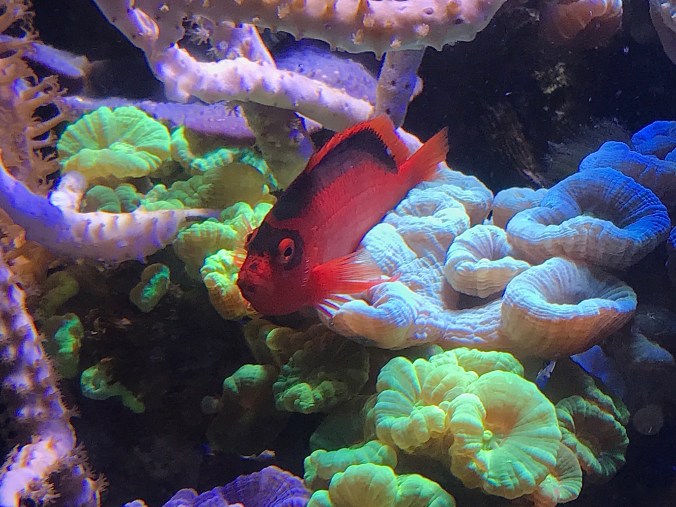
GENERAL CHARACTERISTICS: Hawkfishes are bottom feeders without swim bladders usually found in coral branches. Cirri at the tips of their dorsal fins identifies them.

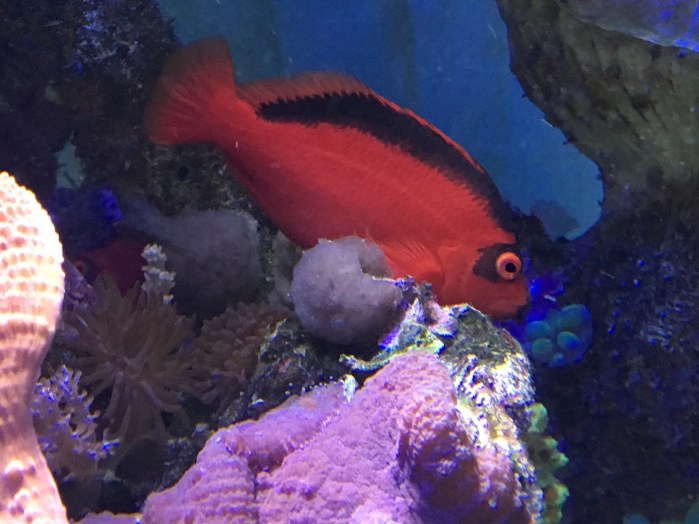
The Flame hawkfish has brilliant red color with a black stripe that runs along the base of their dorsal fin, as well as black circles around their eyes.

Length up to 9 cm (3.5 in)

DISTRIBUTION/HABITAT: Found in the Pacific Ocean: Great Barrier reef to Micronesia on corals.

DIET IN THE WILD: Small crustaceans

REPRODUCTION: Oviparous, monogamous

CONSERVATION: IUCN Not Evaluated

References

Ron’s flickr https://www.flickr.com/photos/cas_docents/32538479733/in/album-72157629304397467/

California Academy of Sciences Steinhart Aquarium Animal Attractions 2017

fishbase fishbase.org/summary/5832

EOL eol.org/pages/204618/details

reef keeping www.reefkeeping.com/issues/2002-06/hcs3/

Ron’s WordPress Shortlink http://wp.me/p1DZ4b-1QC


TAXONOMY
Kingdom: Animalia
Phylum: Chordata
Class: Actinopterygii (ray-finned fishes)
Order: Perciformes (Perch-likes)
Family: Acanthuridae (Surgeonfishes, tangs, unicornfishes)

Genus/species: Acanthurus triostegus

Convict surgeonfish 8156826256_a90f659c94_o

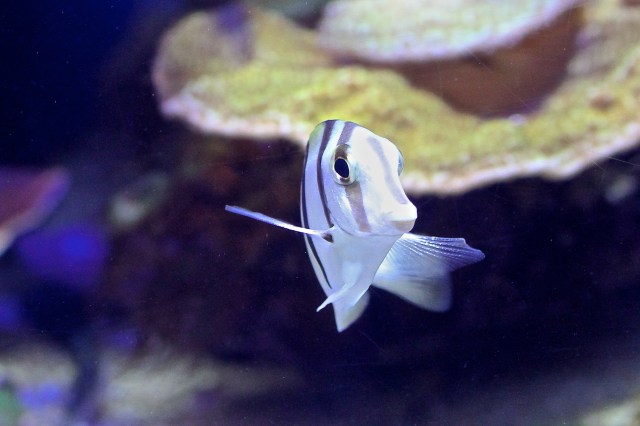
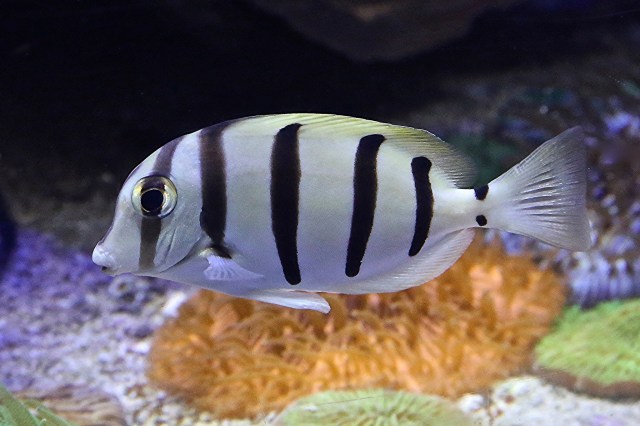
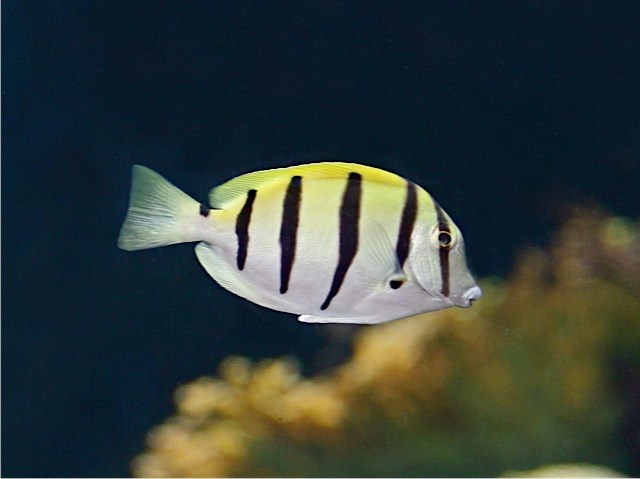
GENERAL CHARACTERISTICS: The Convict Tang is a very common surgeonfish.  It is oval in profile and laterally compressed, gray with 4 vertical stripes (1 stripe on head across the yellow eye; 1 on caudal peduncle). The erectile spine on each side of caudal peduncle which folds down into a groove.  This scalpel like spine causes a nasty cut if the fish is treated roughly by a predator or a human. 

Common length : 17.0 cm (6.7 inches).

DISTRIBUTION/HABITAT:  A. triostegus is found in lagoons and seaward reefs in areas of hard substrates from sea level to 90 m (300 feet) in the Indo-Pacific.

Typically occurs in shallows to 5 m (16 feet).

DIET IN THE WILD: It is a herbivore which uses its serrated teeth along creating saw-like motion to remove filamentous algae from the substrate.

ConvictTang8358632069_43f1bc0004_k

REPRODUCTION: The Convict Tang spawns at dusk with females broadcasting eggs into open water where the males fertilize them.  Larvae drift ~75 days. Post-larvae settle in intertidal areas of benches and reef flats.

PREDATORS: Eggs and sperm are preyed upon by eagle rays, which are often present during spawning.

CONSERVATION: IUCN, Least concern.

REMARKS: This black-barred fish’s common name presumably alludes to the coloration of many prison uniforms of the previous century.


References

Ron’s Flickr http://www.flickr.com/photos/cas_docents/3185789781/in/set-72157608332652056/

California Academy of Sciences Steinhart Aquarium Philippine Coral Reef 2016

fishbase  www.fishbase.org/summary/1260

Aquarium of the Pacific www.aquariumofpacific.org/onlinelearningcenter/species/co…

Monterey Bay Aquarium www.montereybayaquarium.org/animals/AnimalDetails.aspx?en…

EOL eol.org/pages/203984/overview

Ron’s WordPress shortlink  http://wp.me/p1DZ4b-lR


TAXONOMY
Kingdom: Animalia
Phylum: Chordata
Class: Actinopterygii
Order: Perciformes  (Perch-likes)
Family: Labridae  (Wrasses)

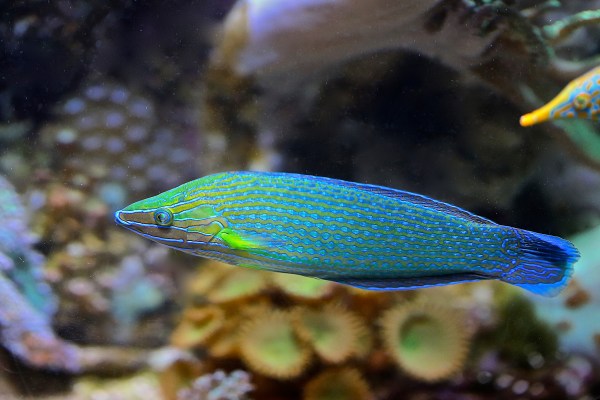
Genus/species: Halichoeres richmondi

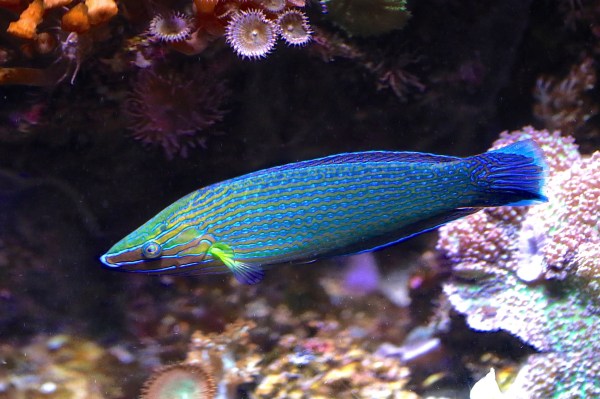
GENERAL CHARACTERISTICS: They have stunning horizontal chain like stripes going down the full length of their bodies. Male Richmond’s Wrasses tend to be more blue and green in color while females are more orange. Juvenile Richmond’s Wrasses have eye spots on their dorsal fins as well.

Length up to 17 cm (6.7 inches)

DISTRIBUTION/HABITAT: Richmond’s Wrasse are found in the Western Pacific from Java to the Philippines inhabiting shallow lagoons and coral reefs, up to a depth of at least 20 m (65.5 feet).

REPRODUCTION: Pair during spawning

REMARKS: Wrasses are most easily identified by their pointed snouts and prominent canine teeth that protrude in front of the jaw. Other common characteristics include their form of propulsion, which depends mostly on the winglike motion of the pectoral fins with only an occasional burst of speed provided by the caudal fin.

CONSERVATION: IUCN least concern.

References

Ron’s flickr  https://www.flickr.com/photos/cas_docents/35513954125/in/album-72157629304397467/

California Academy of Sciences Steinhart Aquarium Animal Attractions Rich Ross 2017

Ron’s WordPress Shortlink  http://wp.me/p1DZ4b-YM

fishbase www.fishbase.se/summary/Halichoeres-richmondi.html

IUCN www.iucnredlist.org/details/187507/0

EOL eol.org/pages/212051/details


TAXONOMY
Kingdom: Animalia
Phylum: Chordata
Class: Aves
Order: Passeriformes (toes, three pointing forward and one back, which facilitates perching).
Family: Estrildidae (weaver-finches)

Genus/species: Erythrura gouldiae

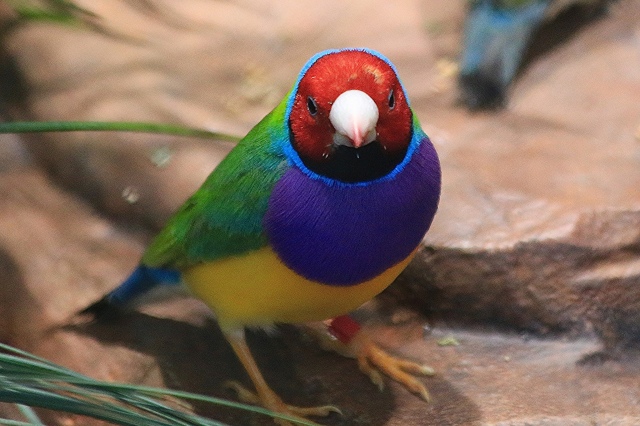
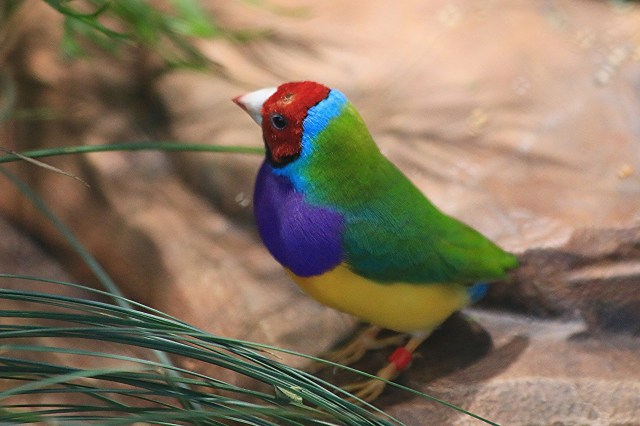
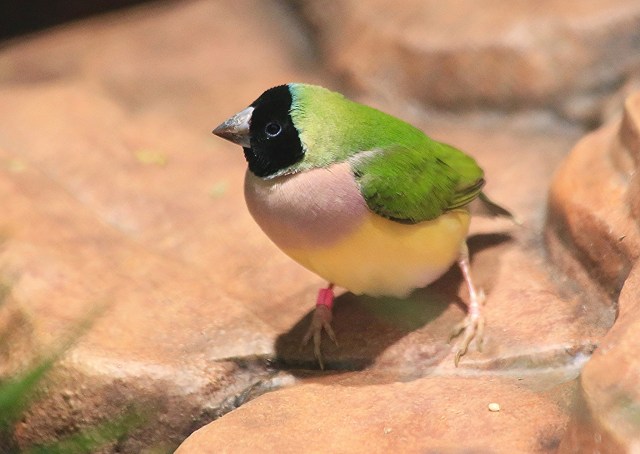
GENERAL CHARACTERISTICS: The upper body (dorsal) is grass-green from the lower nape to the back and wings. The rump is pale blue and the breast is purple. Ventrally the belly is bright yellow, and the bill is whitish, with a red or yellow tip.
The three distinct color variations are individuals having either a red, black or yellow head (all the same species).

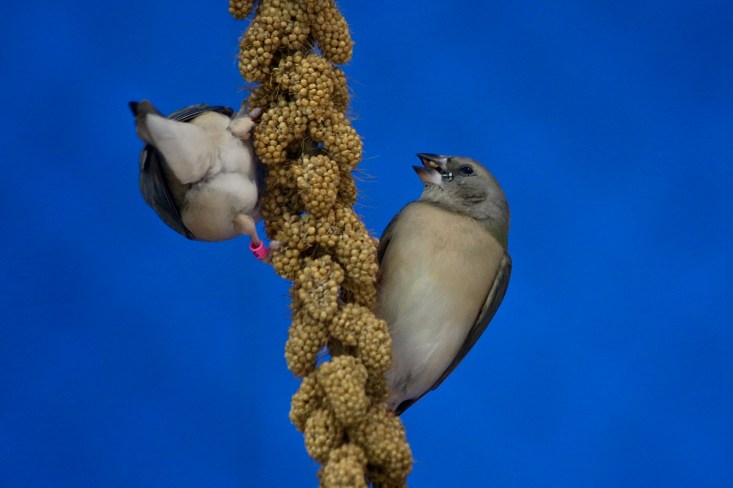
Young Gouldian Finches are dull ashy grey on the head and hind neck, becoming olive on the back and tail. The underparts are brown white, paler on chin, and have a faint yellow tinge on the belly. The upper bill is blackish and the lower bill is pinkish. white. Adult colors appear after several months.

(male, red-head)

Gouldian Finch 19577587499_daaa661dd8_k

DISTRIBUTION/HABITAT: Predominantly northern Australia tropical savannah woodland with grassy understory and open wide plains with hollow-bearing Eucalyptus trees.

(male, red-head)

Gouldian Finch Gouldian Finch 19738034016_fc07c6e883_k

DIET IN THE WILD: Grass seeds. In addition they feed on a variety of insects including beetles, termites, flies, flying ants, and spiders.

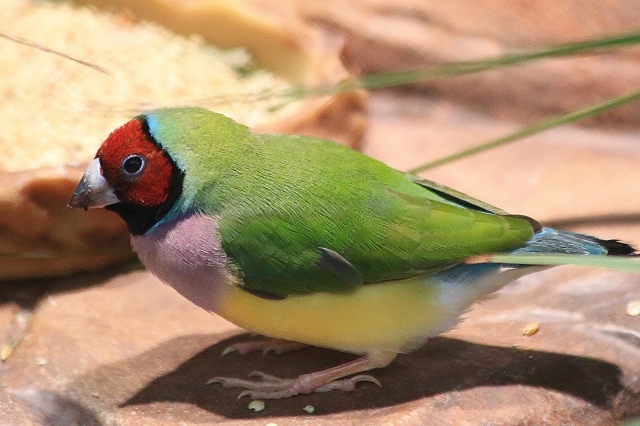
(female red-head)


Gouldian Finch 19141610094_37add50720_k

REPRODUCTION: E. gouldiae nest in tree hollows. Males and females incubate the eggs and help to raise the young. Gouldian finches may produce both the adults incubate the eggs and help to raise the young. Gouldian finches may produce four to eight eggs per clutch.

(young birds, immature colors)

CONSERVATION: IUCN Near Threatened (NT) by habitat modification due to cattle grazing, wildfires and increasing human developments. There are presently estimated to be only 2,500 to 10,000 mature individuals in the wild.

(female black-head)

19141609684_ed98ac2735_k

Color of Life note Sexual Selection
Sexual dichromatism is a form of sexual dimorphism in which males and females differ in color.
The male Gouldian finch is more brightly colors to impress prospective female partners. Ref: California Academy of Sciences, Color of Life exhibit.

References

Ron’s flickr https://www.flickr.com/photos/cas_docents/19576167410/in/album-72157652559028013/

California Academy of Sciences Color of Life 2017

ARKive  www.arkive.org/gouldian-finch/erythrura-gouldiae/

Birdlife International www.birdlife.org/datazone/speciesfactsheet.php?id=8695

IUCN  www.iucnredlist.org/details/biblio/22719744/0

Encyclopedia of Life  eol.org/pages/1050437/details

Ron’s WordPress shortlink  http://wp.me/p1DZ4b-1y1

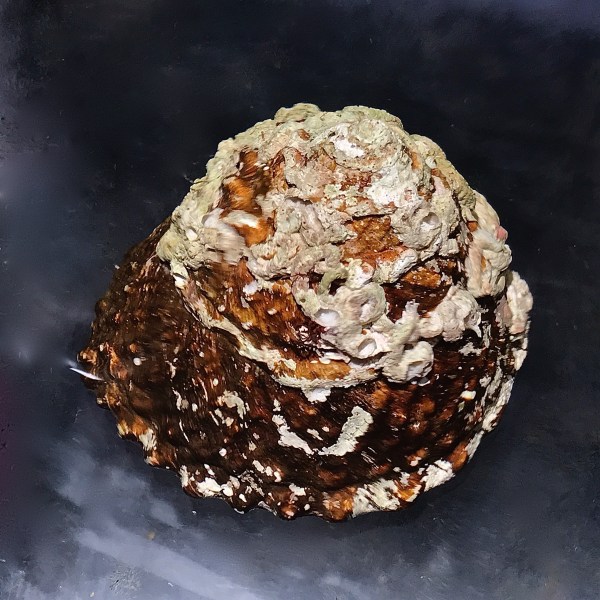
TAXONOMY
Kingdom: Animalia
Phylum: Mollusca
Class: Gastropoda
Clade: Vetigastropoda
Superfamily: Trochoidea
Family: Turbinidae

Genus/specie: Megastraea undosa

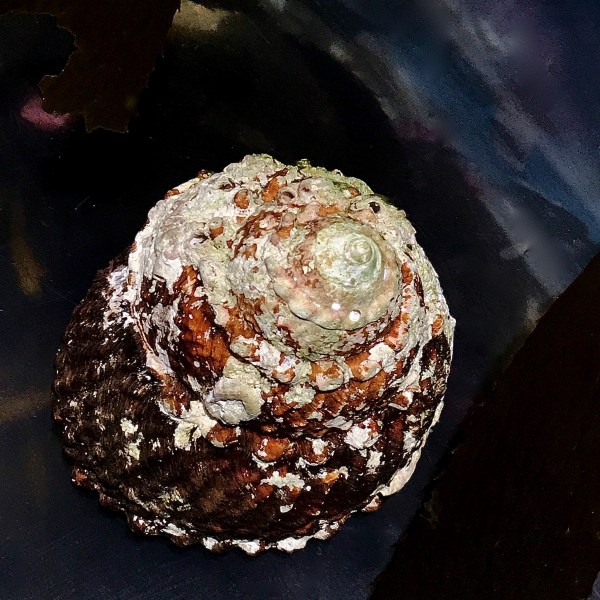
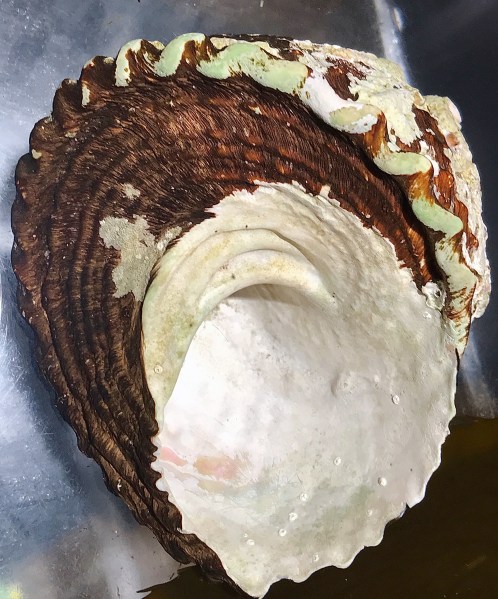
GENERAL CHARACTERISTICS: The Wavy Turbin Snail has a heavy, sculptured shell with undulating ridges in a turbinate-conical shape with a thick, pearly lining.
The light brown or tan shell color is caused by the fibrous periostracum covered with coralline algae and other epiphytes.

Size: up to 6 inches

DISTRIBUTION/HABITAT: Found from Point Conception and the coastal Channel Islands to northern Baja California, Mexico. They range from the intertidal zone down to depths of over 250 feet.

DIET IN THE WILD: M. undosa are herbivores feeding on various types of algae.

REPRODUCTION; Year around with peaks in spring and fall.

CONSERVATION: Because wavy turban snails are hand-picked by divers, the fishery is at low risk for bycatch .
Wavy turban snails are abundantly available and have a high productivity rate, so over- harvesting is less likely.

REMARKS: The shells of wavy turban snails are used to make buttons!

The meat has an abalone-like texture and taste; foot of the snail is processed and sold to restaurants as an abalone-like product, “wav alone”.  They can be prepared many ways: grilled, sautéed, battered and fried, in pastas, in chowders and soups, and in stir fries.

References

California Academy of Sciences Steinhart Aquarium Tidepool 2017

Ron’s flickr https://www.flickr.com/photos/cas_docents/34539982943/in/dateposted-public/

Spearboard.com www.spearboard.com/showthread.php?t=99314

U of CA San Diego caseagrant.ucsd.edu/sites/default/files/fact-sheet-wavy-t…

Gastropods.com www.gastropods.com/2/Shell_292.shtml

Ron’s WordPress Shortlink  http://wp.me/p1DZ4b-1Qf

TAXONOMY
Kingdom: Animalia
Phylum: Chordata
Class: Actinopterygii (ray-finned fishes)
Order: Tetraodontiformes (Puffers and filefishes)
Family: Monacanthidae (Filefishes)

Genus/species: Oxymonacanthus longirostris

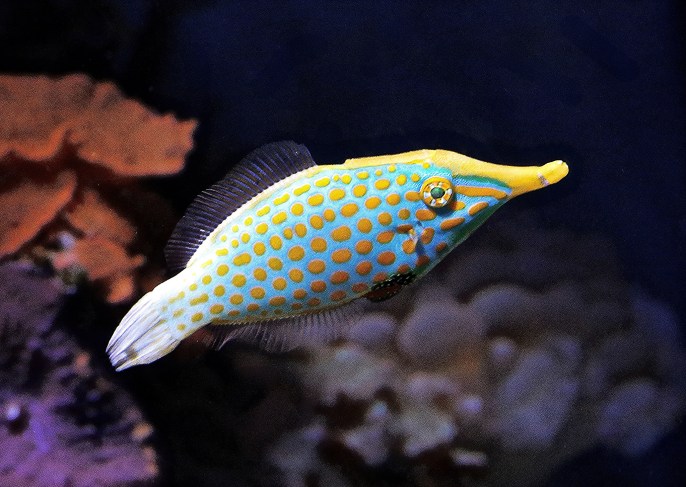
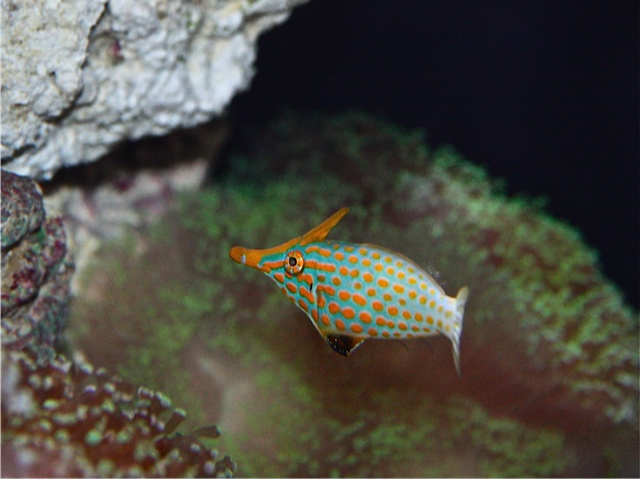
GENERAL CHARACTERISTICS: their color is pale blue with about eight longitudinal rows of orange-yellow patches, or green with small dark-edged yellow to orange spots.Their is a dark spot on the caudal fin. The snout is long with a small upturned mouth;

Length up to 12 cm (4.72 in)

DISTRIBUTION/ HABITAT: They are found in the Indo-Pacific. in clear lagoons and seaward reefs.

DIET IN THE WILD: Feeds almost exclusively on Acropora polyps throughout the day. The protruding snout and teeth that project from small mouth, permit them to snip off coral polyps. In captivity they can be fed a number of other food items, such as fish eggs, tiny mysid shrimp, and flake and pellet food.


REPRODUCTION: The Orange Spotted Filefish are found in pairs or small groups and nests near the bases of dead corals, often on clumps of algae. Monogamous except if the male population dwindles, then the largest males, become polygamous, breeding with more than one female. The male chatters his mouth along the underside of the female’s jaw presumably to synchronize the spawn. The female places her abdomen into the algae, and the male joins her alongside to fertilize. Non-guarders.

REMARKS: O.longirostris feeds on Acropora corals in Australia, ingesting coral chemicals which cause them to take on the scent of their food (Acropora).  This is the first time scientists have discovered a vertebrate chemically camouflaging itself via its diet, The cod were less active and spent less time hunting around the filefish that ate Acropora than around the fish that ate Pocillopora, indicating that the cod could not detect the Acropora-eating filefish.

References

California Academy of Sciences Animal Attractions Rich Ross 2017

Ron’s flickr http://www.flickr.com/photos/cas_docents/4540304067/in/set-72157625020091079/

News National Geographic.com  news.nationalgeographic.com/news/fish-smell-like-the-cora…

fishbase www.fishbase.org/summary/Oxymonacanthus-longirostris.html

EOL eol.org/pages/204726/details

Ron’s WordPress Shortlink  http://wp.me/p1DZ4b-oY