Category: TROPICAL MARINE


TAXONOMY
Kingdom: Animalia
Phylum: Chordata
Class: Actinopterygii (ray-finned fishes)
Order: Perciformes (Perch-likes)
Family: Pomacentridae (Damselfishes, Chromis, Aneomonefishes)

Genus/species: Amphiprion latezonatus

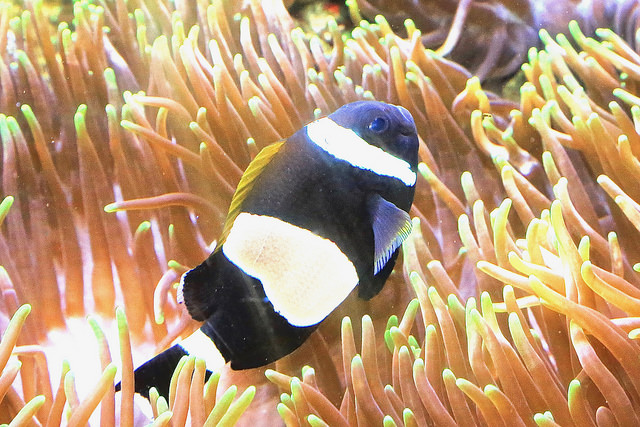
GENERAL CHARACTERISTICS:  The very wide mid-body bar is much narrower at the top than at the bottom. The body is dark brown with three white bars, middle bar very wide, more than twice the width of the mid-body bar of most other anemonefishes. A. latezonatus often has bright blue markings on the upper lip and the edges of the bars. Has blue lips as well as a broad bar on the sides of the body. The dorsal fin may be orange or yellow. The caudal fin has a pale posterior margin.
Length up to 15 cm (6 in)

DISTRIBUTION/HABITAT: The Wide-Band Clownfish is found on the Western Pacific: Australia and New Caledonia inhabiting rocky and coral reefs. Depth to 5-45 metres (16-150 feet).
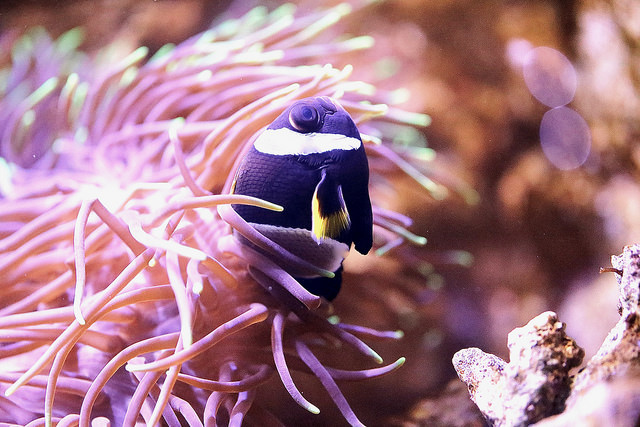
DIET IN THE WILD: Carnivore, feeds mainly on planktonic crustaceans (copepods, mysis, and shrimp larvae and some algae.

            Juveniles below note the different color.  NOT CURRENTLY ON EXHIBIT
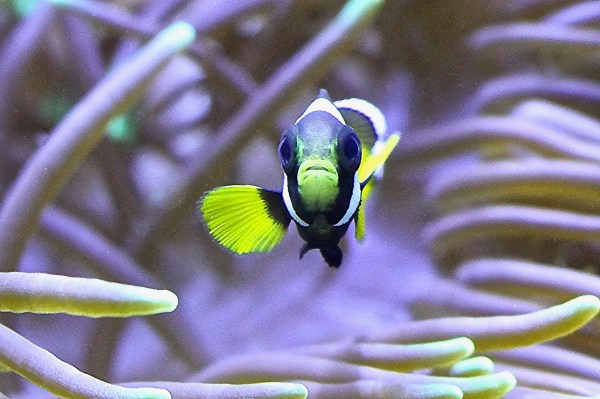
REPRODUCTION: Clownfish are oviparous with distinct pairing during breeding. Eggs are demersal and adhere to the substrate. Males guard and aerate the eggs.
Protandry refers to organisms that are born male and at some point in their lifespan change sex to female. Protandrous animals include clownfish. If the female clownfish is removed from the group, such as by death, one of the largest and most dominant males will become a female. The remaining males will move up a rank in the hierarchy.

Juveniles below note the different color.  NOT CURRENTLY ON EXHIBIT
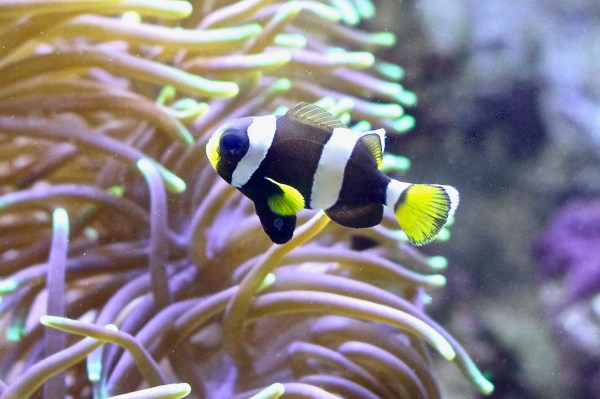
REMARKS: Associated with the anemone Heteractis crispa in the wild.

Academy captive Entacmaea sp.
References

California Academy of Sciences Steinhart Aquarium Hidden Reef 2018 Vetted Curator Charles Delbeek

fishbase fishbase.org/summary/Amphiprion-latezonatus.html

Ron’s flickr  https://www.flickr.com/photos/cas_docents/39139992210/in/album-72157659465376212/

Ron’s WordPress Shortlink  http://wp.me/p1DZ4b-MR

EOL eol.org/pages/24566/details

TAXONOMY
Kingdom: Animalia
Phylum: Chordata
Class: Actinopterygii (ray-finned fishes)
Order: Anguilliformes (Eels and morays)
Family: Congridae (Conger and garden eels)
Subfamily: Heterocongrinae

Genus/species: Heteroconger hassi

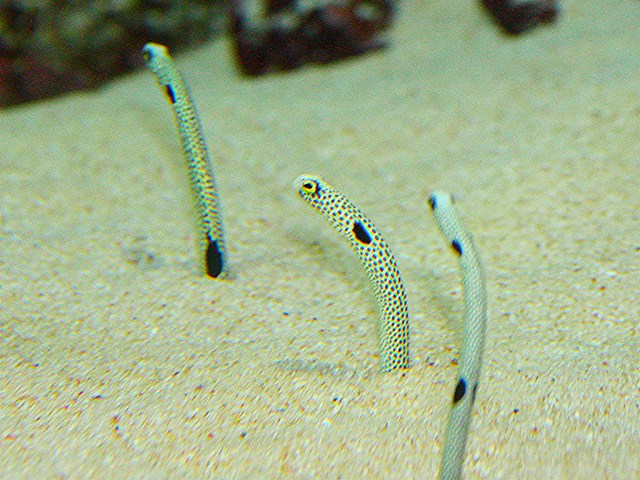
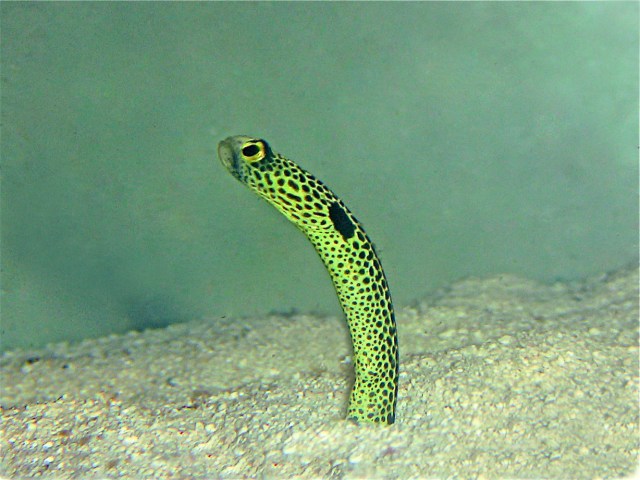
GENERAL CHARACTERISTICS: The color is variable with tiny spots covering the body including three large black spots, two of which are usually visible. The third spot is on the anus, which is usually in the burro. The pectoral fins are minute.

Length up to 40 cm (16 in), body diameter of about 14 mm (1/2 in)

SPOTTED GARDEN EEL Heteroconger hassi FAM (Congridae) ,IMG_0193_2

DISTRIBUTION/HABITAT: Tropical Indo-Pacific: Red Sea and East Africa to the Society Islands. Found on sandy bottoms with some current near a reef at depths of 7–45 m (22-140 ft).

DIET IN THE WILD:  H. hassi feeds on microscopic animals in the water column.

REPRODUCTION: During mating season, males and females move their burrows closer together. With tails remaining in their burrows, they meet and entwine bodies. Males defend the females they have chosen. After mating the fertilized eggs are released into the current and float near the surface in the open ocean. The eggs hatch out and the larvae float until the eels are large enough to swim down and make a burrow.

Heteroconger hassi3302264315_77ea9161f9_b

CONSERVATION: IUCN Not Evaluated

REMARKS: Garden eels are usually found in colonies containing up to several hundred. The garden eel drives its pointy tail into the sand to create a burrow. Secretions from the skin harden and stabilize burrow sides. Part of the eel’s body remains in the burrow as it faces the current to feed. When approached, the animal withdraws into its burrow for protection.

References

California Academy of Sciences Steinhart Aquarium Hidden Reef 2018

Ron’s WordPress shortlink  http://wp.me/p1DZ4b-1dF

fishbase www.fishbase.org/summary/12619

Ron’s flickr https://www.flickr.com/photos/cas_docents/3266269153/in/album-72157625992053826/

EOL eol.org/pages/205986/hierarchy_entries/44704953/details

Georgia Aquarium animalguide.georgiaaquarium.org/home/galleries/tropical-d…

TAXONOMY
Kingdom:Animalia
Phylum: Chordata
Class: Actinopterygii (ray-finned fishes)
Order: Perciformes (Perch-likes)
Family: Chaetodontidae (Butterflyfishes)

Genus/species: Chelmon rostratus

GENERAL CHARACTERISTICS: All species have a deep, laterally compressed body with a continuous dorsal fin and distinctive rounded anal fin. Many have a band across the eye and/or a false eyespot, patterns that may lure a predator to attack the tail
rather than the head.
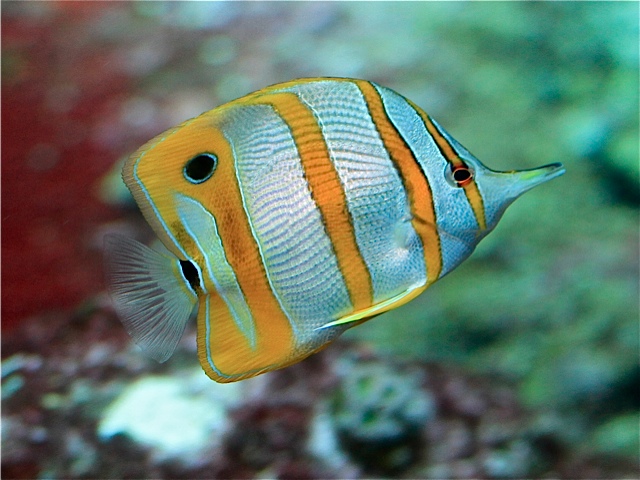
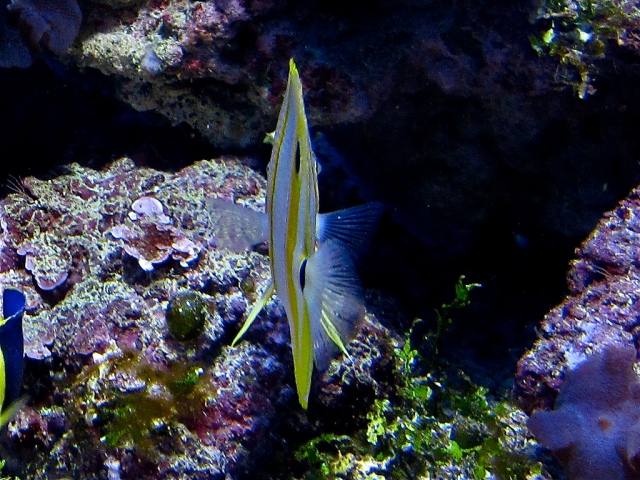
The C.rostratus has a whitish body with 4 vertical orange bands and a black false eyespot on the terminal orange band. The snout is long with beak-like mouth.

Length to 19 cm (7.5 in).

DISTRIBUTION/HABITAT: They are found in the Andaman Sea to Papua New Guinea, north to Ryukyu Island, south to Northwest Australia and Great Barrier Reef in estuaries and coastal reefs.

DIET IN THE WILD: Though the diet of the Copperband Butterflyfish is well documented, they are believed to feed heavily on tube worms and small crustaceans using their long snout for prying into the crevices of coral.

REPRODUCTION: Butterflyfishes unlike most fishes are usually monogamous, forming pairs and are often seen swimming together.   They are broadcast spawners an external method of reproduction where the female releases unfertilized eggs into the water. At the same time, a male release sperm into the water which fertilizes the eggs which contain a drop of nutrient oil to sustain the embryo  developing inside the egg case. Oil also provides buoyancy, so the eggs float and drift with the current.  Planktonic eggs hatch within a few days becoming the larval stage lasts from several weeks up to 2 months.  During the late larval stage the head and body are covered with bony plates which mature into small fry fish.

Copperband Butterflyfish8387609757_79c1b099a9_b

CONSERVATION: IUCN; Least Concern (LC)

REMARKS: The Copperbanded Butterflyfish is a food fish marketed locally. and is reported to be “not good” from a culinary standpoint.

Color of Life, Color Conceals.   The Copperband Butterflyfish helps conceals its head by having a vertical line through the eye which matching the 3 other vertical orange bands. A large false spot on its terminal orange band (a less vital portion of its body) confuses predators.

References

Ron’s flickr http://www.flickr.com/photos/cas_docents/3380844264/in/set-72157625119200613/

California Academy of Sciences Steinhart Aquarium Philippine Coral Reef and Hidden Reef 2018

Ron’s WordPress shortlink: http://wp.me/p1DZ4b-mS

EOL eol.org/pages/339397/details

fishbase fishbase.org/summary/SpeciesSummary.php?id=5483

Australian Museum australianmuseum.net.au/Beaked-Coralfish-Chelmon-rostratus

TAXONOMY
Kingdom: Animalia
Phylum: Chordata
Class: Actinopterygii  (ray-finned fishes)
Order: Perciformes (Perch-likes)
Family: Acanthuridae (Surgeonfishes, Tangs, Unicornfishes)

Genus/species   Zebrasoma scopas

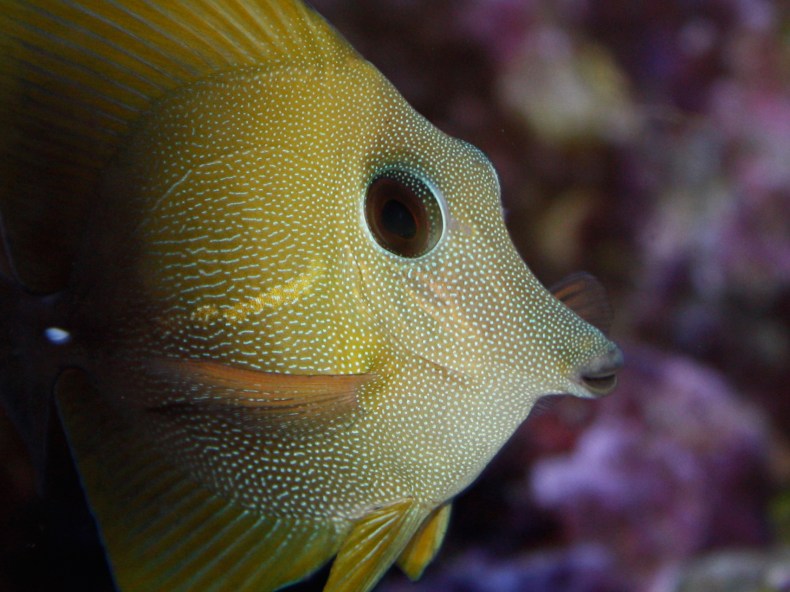
GENERAL CHARACTERISTICS: Zebrasoma spp. is a small genus of tangs characterized by round, laterally compressed bodies, large dorsal sail-like fins, and pointed snouts. Because of their snouts, they are able to eat filamentous algae that grow in spots other fishes cannot reach, a talent that also makes them popular in aquariums large and small. Males and females are similar. Color can be variable; most often are shades of gray and brown with a greenish tinge running along the dorsal spine.

A distinguishing feature of surgeonfishes, tangs, and unicornfishes is a modified scale on the caudal peduncle, which forms a scalpel-like sharp blade often covered with toxic slime. These spines are used for species recognition, defense, and competition for mates. They are white in the Brown Scopes Tang. Note: Acanthus means “thorn” or “spine”. Length to 20 cm (8 in)


DISTRIBUTION/HABITAT: Widespread throughout the Indo-Pacific from Africa to Japan in lagoons and outer reefs to 50 m (150 ft). Particularly well suited to large aquaria where they can roam.

Brown Scopas Tang

DIET IN THE WILD: Z. scopas graze on algae, usually in groups of 20 individuals. Its numerous, small pharyngeal teeth may have evolved in response to a shift in diet from macroalgae to filamentous algae.

REPRODUCTION: Group and pair spawning have been observed scattering eggs and sperm into the water column.

CONSERVATION: IUCN Red List Least Concern (LC)

REMARKS: Zebrasoma spp. are known to irritate some stony corals to induce the release of zooxanthellae, evidently a sailfin delicacy. 

References

California Academy of Sciences Steinhart Aquarium Philippine Coral Reef and Hidden Reef 2018

Ron’s WordPress Shortlink wp.me/p1DZ4b-BO

fishbase  www.fishbase.org/summary/Zebrasoma-scopas.html

IUCN www.iucnredlist.org/details/178005/0

EOL eol.org/pages/204517/details

Ron’s flickr http://www.flickr.com/photos/cas_docents/4770058557/in/set-72157625992053826/

fishbase http://www.fishbase.org/summary/Zebrasoma-scopas.html


TAXONOMY
Kingdom: Animalia
Phylum: Chordata
Class: Actinopterygii (Ray-finned fishes)
Order: Elopiformes (Tarpons and tenpounders)
Family: Megalopidae (Tarpons).

Genus/species: Megalops atlanticus

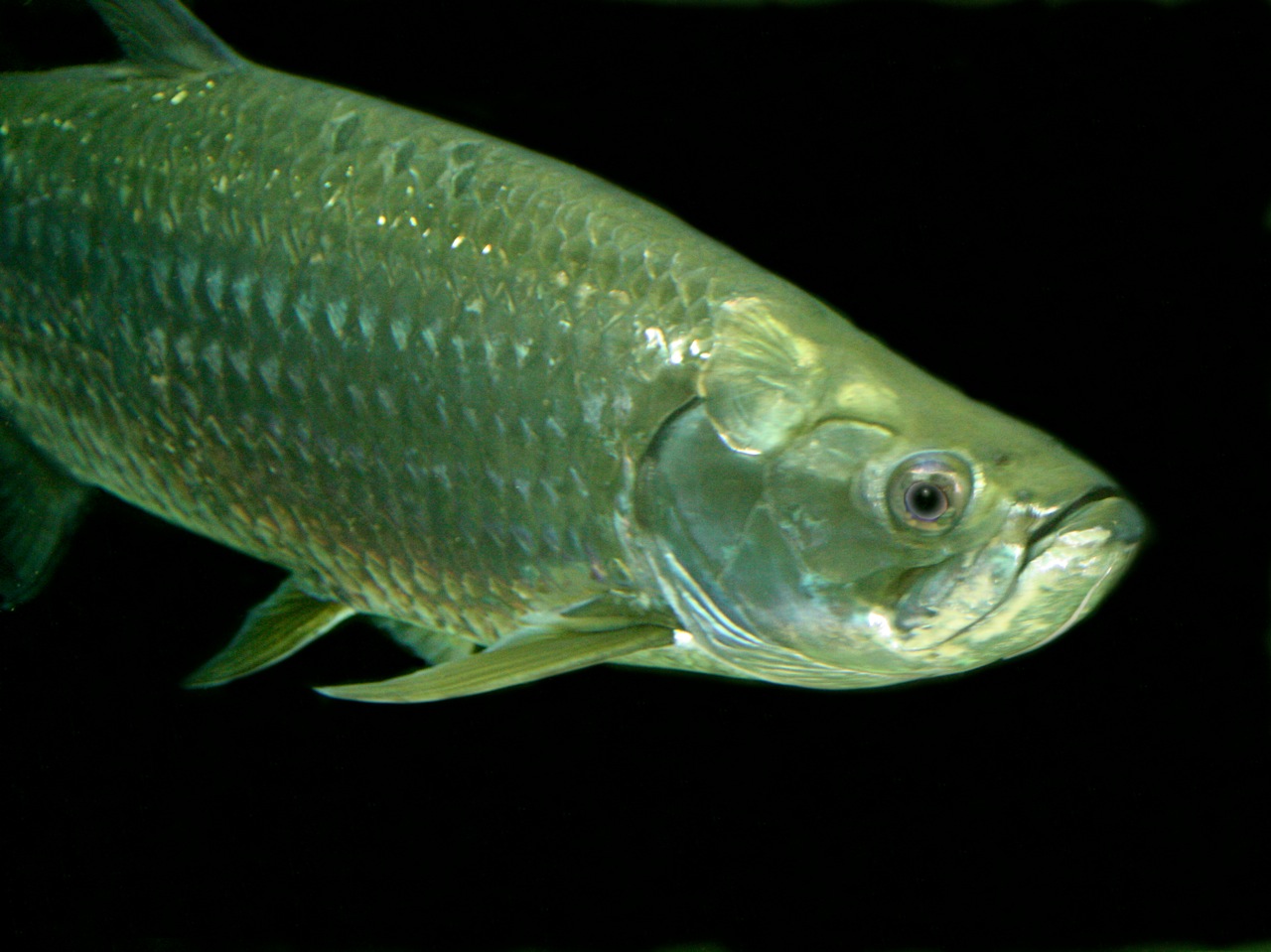
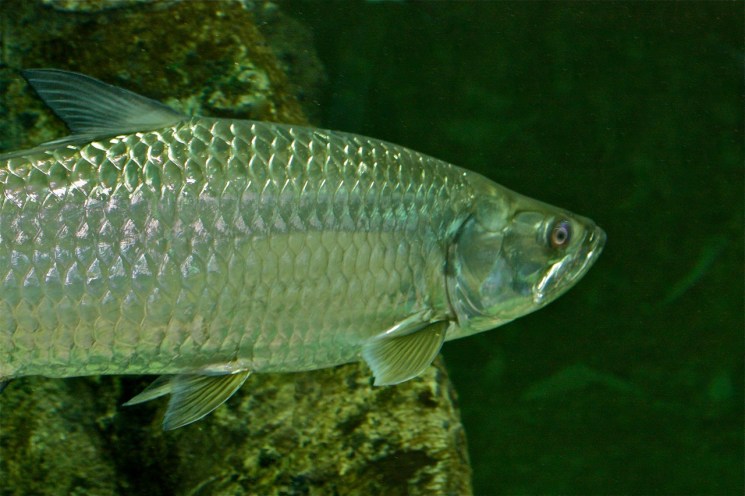
GENERAL CHARACTERISTICS: The Tarpon has a large, elongated, moderately deep and compressed body. Sides and belly are silvery and back blue-gray. The caudal fin is deeply forked. They “roll” at the water surface taking in air into their lunglike swimbladder which is attached to the esophagus allowing it to fill directly with air permitting the fish to live in oxygen-poor waters.

Length up to 2.5 m (8 ft) and weight up to 160 kg (350 lbs)

DISTRIBUTION/HABITAT: Nova Scotia south to Brazil, including the Gulf of Mexico, Caribbean and the West coast of Africa. Though the majority of its life is spent in the open ocean, M. atlanticus tolerates fluctuating salinities and may be found in coastal waters, bays, estuaries, mangrove-lined lagoons, and rivers, such as the Amazon.

Some populations of M. atlanticus may complete their life cycle in freshwater lakes or as in the California Academy of Sciences flooded Amazon.

DIET IN THE WILD: They feed on sardines, anchovies, and other fishes as well as shrimp, crabs, and other crustaceans.

REPRODUCTION and DEVELOPMENT:  Spawn offshore. High fecundity; a 2.3 m (7.5 ft) female is estimated to produce over 12 million eggs. Spawn in waters which can be temporarily isolated from the open sea. Larvae develop inshore and are leptocephalic in shape (flattened, transparent, and eel-like).

PREDATORS: Natural predators are sharks.

REPRODUCTION: They spawn offshore and exhibit high fecundity, a 2.3 m (7.5 ft) female is estimated to produce over 12 million eggs. They can also spawn in waters that are temporarily isolated from the open sea. Larvae develop inshore and are leptocephalic in shape (flattened, transparent, and eel-like). Life span: at least 55 years.

CONSERVATION: IUCN Red list; Vulnerable

REMARKS: Tarpon are among the most “primitive” existent bony fish.

It is a popular game fish of sportfishers, due to its dynamic reaction once hooked. Since the flesh is of poor quality, they are usually released, though another source states, “The flesh is highly appreciated despite its being bony.” It is marketed fresh or salted.

Their large (up to 8 cm (3 in) diameter) silvery scales are fashioned into jewelry.

References

Ron’s WordPress shortlink  http://wp.me/p1DZ4b-9e

Ron’s flickr  https://www.flickr.com/photos/cas_docents/3458838683/in/set-72157620568438047/

“It’s Easy Being Green” Docent Course. California Academy of Sciences 2014 

 fishbase fishbase.org/summary/1079

 Encyclopedia of Life  eol.org/pages/339927/details


TAXONOMY
Kingdom: Animalia
Phylum: Echinodermata
Class: Echinoidea
Order: Temnopleuroida
Family: oxopneustidae

Genus/species: Tripneustes sp.

GENERAL CHARACTERISTICS: The white sea urchin is a typical, although large, member of the sea urchin (Echinoidea) group. Anatomy is similar to all urchins,
The mouth is a complex protrusible structure known as the Aristotle’s lantern

DISTRIBUTION/HABITAT: It is found along the west coast of Africa and along the western central Atlantic Ocean from Bermuda, to the Carolina coast of the United States of America, and the Caribbean to Brazil. They live in a variety of shallow water habitats including rocky rubble, algal rock flats and seagrass beds.

DIET: Algae

REPRODUCTION: The reproductive system of the white sea urchin consists of five gonads, The gonads are not only the source of eggs or sperm, which are referred to as roe, but also serve as the main nutrient storage organ.

CONSERVATION: The White Sea Urchin is fished heavily. leading to increasing scarcity. Restrictions apply in most areas.

References

California Academy of Sciences Steinhart Aquarium, Shallow Coral Reef 2018

Ron’s flickr  https://www.flickr.com/photos/cas_docents/25651292438/in/album-72157623903687834/

Ron’Wordpress Shortlink wp.me/p1DZ4b-1U3

FOOD AND AGRICULTURE ORGANIZATION OF THE UNITED NATIONS www.fao.org/docrep/013/i1751e/i1751e.pdf

atj.net.au/marineaquaria/Tripneustes_sp_.html

TAXONOMY
Kingdom:Animalia
Phylum: Chordata
Class: Actinopterygii (ray-finned fishes)
Order: Perciformes (Perch-likes)
Family: Cirrhitidae (Hawkfishes)

Genus/species: Neocirrhites armatus

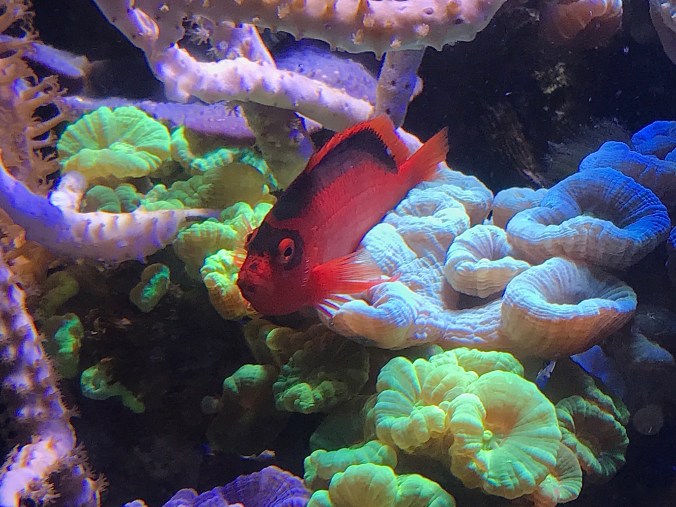
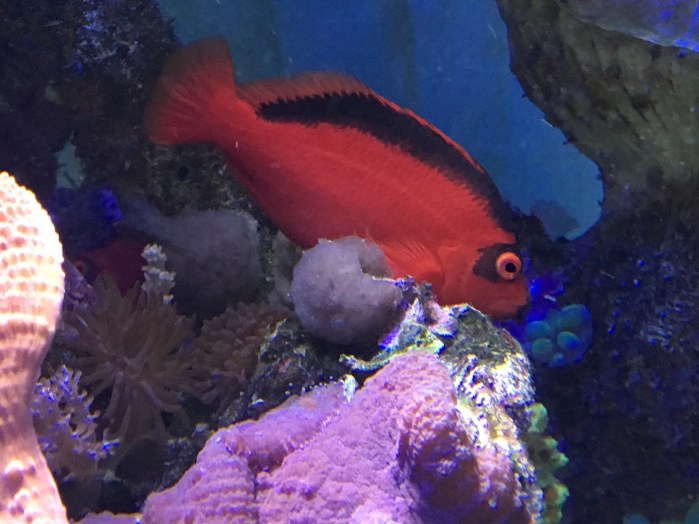
GENERAL CHARACTERISTICS: Hawkfishes are bottom feeders without swim bladders usually found in coral branches. Cirri at the tips of their dorsal fins identifies them.

The Flame hawkfish has brilliant red color with a black stripe that runs along the base of their dorsal fin, as well as black circles around their eyes.

Length up to 9 cm (3.5 in)

DISTRIBUTION/HABITAT: Found in the Pacific Ocean: Great Barrier reef to Micronesia on corals.

DIET IN THE WILD: Small crustaceans

REPRODUCTION: Oviparous, monogamous

CONSERVATION: IUCN Not Evaluated

References

Ron’s flickr https://www.flickr.com/photos/cas_docents/32538479733/in/album-72157629304397467/

California Academy of Sciences Steinhart Aquarium Animal Attractions 2017

fishbase fishbase.org/summary/5832

EOL eol.org/pages/204618/details

reef keeping www.reefkeeping.com/issues/2002-06/hcs3/

Ron’s WordPress Shortlink http://wp.me/p1DZ4b-1QC


TAXONOMY
Kingdom: Animalia
Phylum: Chordata
Class: Actinopterygii (ray-finned fishes)
Order: Perciformes (Perch-likes)
Family: Acanthuridae (Surgeonfishes, tangs, unicornfishes)

Genus/species: Acanthurus triostegus

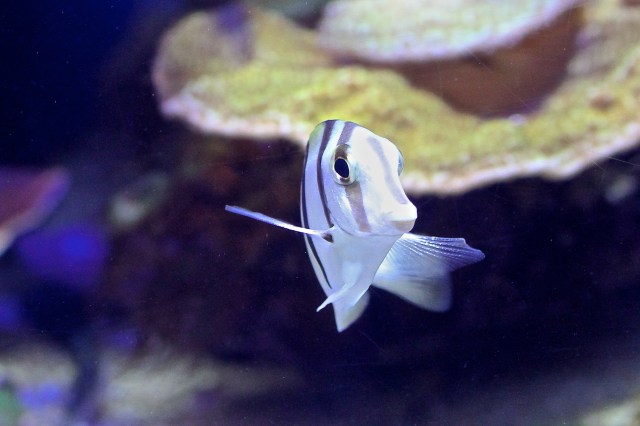
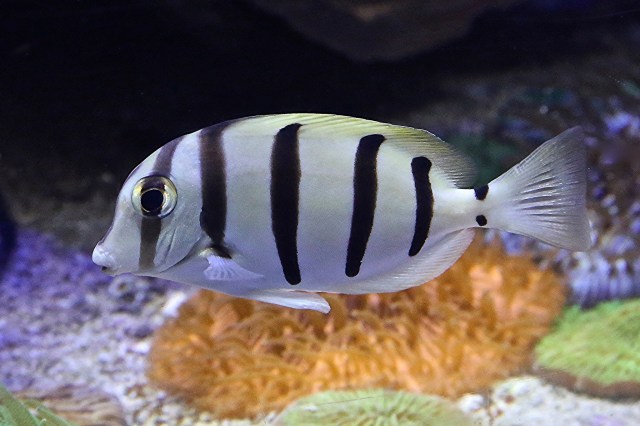
Convict surgeonfish 8156826256_a90f659c94_o

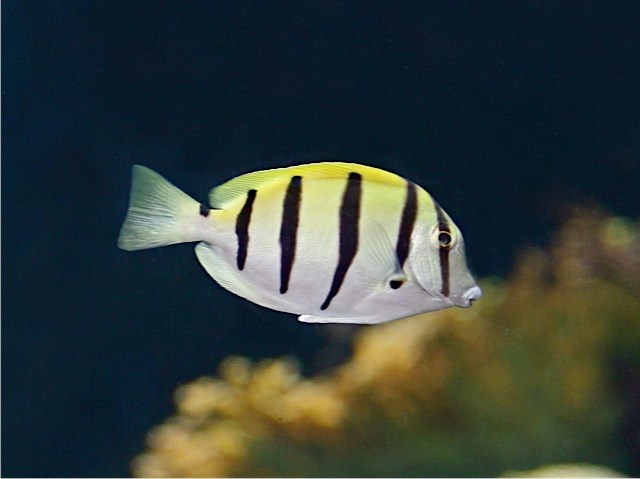
GENERAL CHARACTERISTICS: The Convict Tang is a very common surgeonfish.  It is oval in profile and laterally compressed, gray with 4 vertical stripes (1 stripe on head across the yellow eye; 1 on caudal peduncle). The erectile spine on each side of caudal peduncle which folds down into a groove.  This scalpel like spine causes a nasty cut if the fish is treated roughly by a predator or a human. 

Common length : 17.0 cm (6.7 inches).

DISTRIBUTION/HABITAT:  A. triostegus is found in lagoons and seaward reefs in areas of hard substrates from sea level to 90 m (300 feet) in the Indo-Pacific.

Typically occurs in shallows to 5 m (16 feet).

DIET IN THE WILD: It is a herbivore which uses its serrated teeth along creating saw-like motion to remove filamentous algae from the substrate.

ConvictTang8358632069_43f1bc0004_k

REPRODUCTION: The Convict Tang spawns at dusk with females broadcasting eggs into open water where the males fertilize them.  Larvae drift ~75 days. Post-larvae settle in intertidal areas of benches and reef flats.

PREDATORS: Eggs and sperm are preyed upon by eagle rays, which are often present during spawning.

CONSERVATION: IUCN, Least concern.

REMARKS: This black-barred fish’s common name presumably alludes to the coloration of many prison uniforms of the previous century.


References

Ron’s Flickr http://www.flickr.com/photos/cas_docents/3185789781/in/set-72157608332652056/

California Academy of Sciences Steinhart Aquarium Philippine Coral Reef 2016

fishbase  www.fishbase.org/summary/1260

Aquarium of the Pacific www.aquariumofpacific.org/onlinelearningcenter/species/co…

Monterey Bay Aquarium www.montereybayaquarium.org/animals/AnimalDetails.aspx?en…

EOL eol.org/pages/203984/overview

Ron’s WordPress shortlink  http://wp.me/p1DZ4b-lR


TAXONOMY
Kingdom: Animalia
Phylum: Chordata
Class: Actinopterygii
Order: Perciformes  (Perch-likes)
Family: Labridae  (Wrasses)

Genus/species: Halichoeres richmondi

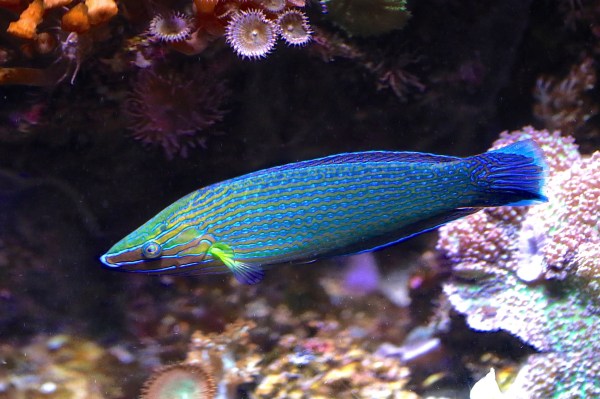
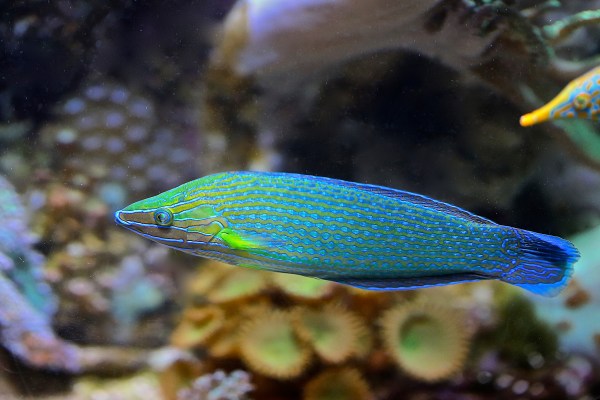
GENERAL CHARACTERISTICS: They have stunning horizontal chain like stripes going down the full length of their bodies. Male Richmond’s Wrasses tend to be more blue and green in color while females are more orange. Juvenile Richmond’s Wrasses have eye spots on their dorsal fins as well.

Length up to 17 cm (6.7 inches)

DISTRIBUTION/HABITAT: Richmond’s Wrasse are found in the Western Pacific from Java to the Philippines inhabiting shallow lagoons and coral reefs, up to a depth of at least 20 m (65.5 feet).

REPRODUCTION: Pair during spawning

REMARKS: Wrasses are most easily identified by their pointed snouts and prominent canine teeth that protrude in front of the jaw. Other common characteristics include their form of propulsion, which depends mostly on the winglike motion of the pectoral fins with only an occasional burst of speed provided by the caudal fin.

CONSERVATION: IUCN least concern.

References

Ron’s flickr  https://www.flickr.com/photos/cas_docents/35513954125/in/album-72157629304397467/

California Academy of Sciences Steinhart Aquarium Animal Attractions Rich Ross 2017

Ron’s WordPress Shortlink  http://wp.me/p1DZ4b-YM

fishbase www.fishbase.se/summary/Halichoeres-richmondi.html

IUCN www.iucnredlist.org/details/187507/0

EOL eol.org/pages/212051/details


TAXONOMY
Kingdom: Animalia
Phylum: Chordata
Class: Actinopterygii (ray-finned fishes)
Order: Tetraodontiformes (Puffers and filefishes)
Family: Monacanthidae (Filefishes)

Genus/species: Oxymonacanthus longirostris

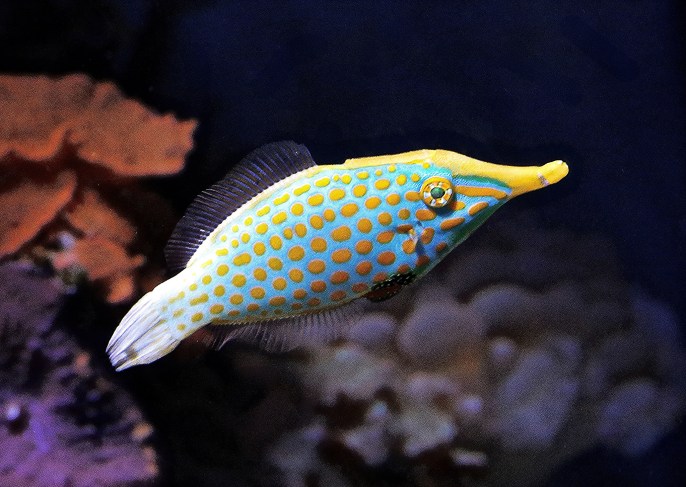
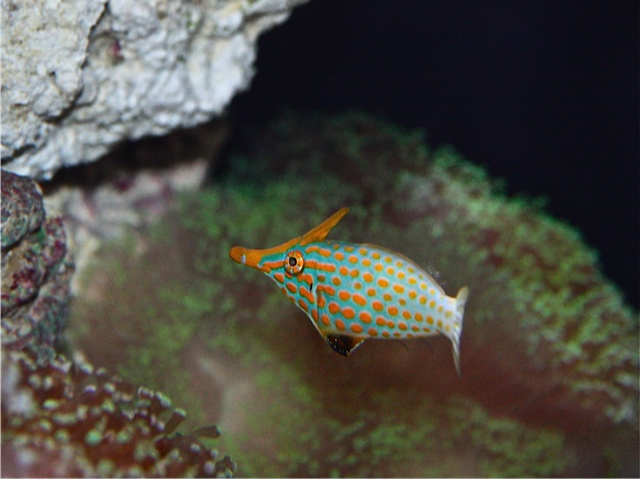
GENERAL CHARACTERISTICS: their color is pale blue with about eight longitudinal rows of orange-yellow patches, or green with small dark-edged yellow to orange spots.Their is a dark spot on the caudal fin. The snout is long with a small upturned mouth;

Length up to 12 cm (4.72 in)

DISTRIBUTION/ HABITAT: They are found in the Indo-Pacific. in clear lagoons and seaward reefs.

DIET IN THE WILD: Feeds almost exclusively on Acropora polyps throughout the day. The protruding snout and teeth that project from small mouth, permit them to snip off coral polyps. In captivity they can be fed a number of other food items, such as fish eggs, tiny mysid shrimp, and flake and pellet food.


REPRODUCTION: The Orange Spotted Filefish are found in pairs or small groups and nests near the bases of dead corals, often on clumps of algae. Monogamous except if the male population dwindles, then the largest males, become polygamous, breeding with more than one female. The male chatters his mouth along the underside of the female’s jaw presumably to synchronize the spawn. The female places her abdomen into the algae, and the male joins her alongside to fertilize. Non-guarders.

REMARKS: O.longirostris feeds on Acropora corals in Australia, ingesting coral chemicals which cause them to take on the scent of their food (Acropora).  This is the first time scientists have discovered a vertebrate chemically camouflaging itself via its diet, The cod were less active and spent less time hunting around the filefish that ate Acropora than around the fish that ate Pocillopora, indicating that the cod could not detect the Acropora-eating filefish.

References

California Academy of Sciences Animal Attractions Rich Ross 2017

Ron’s flickr http://www.flickr.com/photos/cas_docents/4540304067/in/set-72157625020091079/

News National Geographic.com  news.nationalgeographic.com/news/fish-smell-like-the-cora…

fishbase www.fishbase.org/summary/Oxymonacanthus-longirostris.html

EOL eol.org/pages/204726/details

Ron’s WordPress Shortlink  http://wp.me/p1DZ4b-oY