Category: TROPICAL MARINE


TAXONOMY
Class: Actinopterygii (ray-finned fishes)
Order: Perciformes (Perch-likes)
Family: Blenniidae (Combtooth blennies

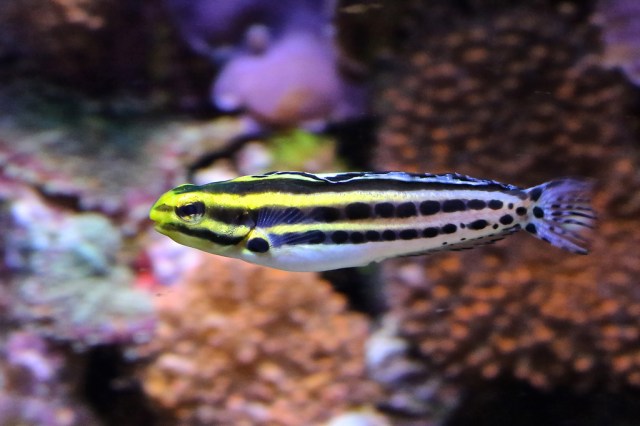
Genus/species: Meiacanthus grammistes
8393608989_a6c74ab647_b

GENERAL CHARACTERISTICS: Deep-bodied with a pointed snout and long continues dorsal fin. It is brown with tan wavy bands stretches the length of its body. On the dorsal fin near the head is a small blue spot. It grows to a size of 10 cm (4 inches) in length. Lined pattern on the body that ends in spots on the tail-fin base.

DISTRIBUTION/HABITAT: Western Pacific and Eastern Atlantic Ocean in sheltered lagoons and seaward reefs.

DIET IN THE WILD: DIET IN THE WILD: Omnivorous; small invertebrates and plant material. Remarks: About 50 blenny spp., including the 22 Meiacanthus spp., have evolved glands that produce venom and fangs to deliver it. The fangs are very large canines in the lower jaw that are grooved to inject venom when the fish bites, usually only in self-defense. Reports indicate that the fang blenny will bite the inside of a predator’s mouth and is quickly spit out.

IMG_9302

REPRODUCTION: Oviparous. Eggs are demersal and adhesive

Animal Attractions

flickr http://www.flickr.com/photos/cas_docents/8393608989/in/set-72157623764848303

WordPress Shortlink:  http://wp.me/p1DZ4b-NB

TAXONOMY

Class: Actinopterygii (ray-finned fishes)
Order: Perciformes (Perch-likes)
Family: (Labridae) Wrasses

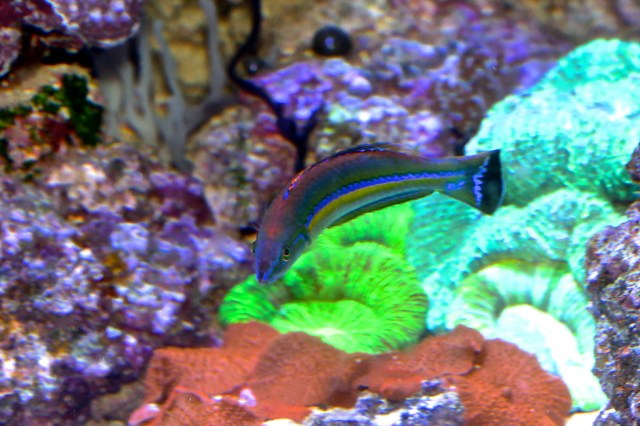
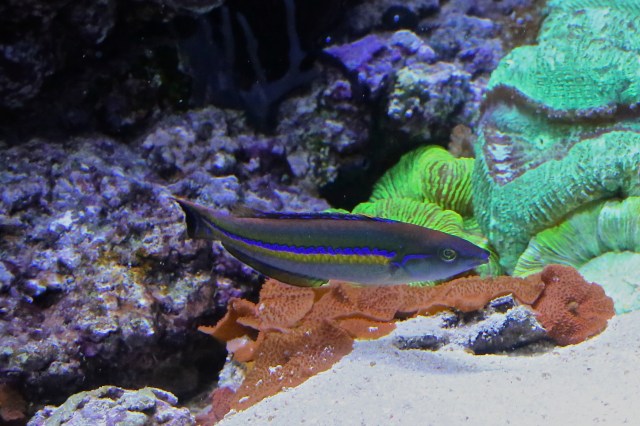
Genus/species: Pseudojuloides cerasinus

IMG_3347

GENERAL CHARACTERISTICS: Green upper body, bicolor blue and yellow mid-body stripe; blue below. Length to 12 cm (5 in).

DISTRIBUTION AND HABITAT: East Africa to Samoa and Hawaii. S. Japan to Australia. Found among rubble, weed and coral areas of lagoon and seaward reefs to 61 m.

8362948295_de913680af_b

Reef Partners Cluster, Shrimpfish Exhibit

PR31

flickr  http://www.flickr.com/photos/cas_docents/sets/72157608208133134/with/7601888754/

WordPress Shortlink  http://wp.me/p1DZ4b-MI

TAXONOMY
Kingdom: Animalia
Phylum: Arthropoda
Subphylum: Crustacea
Class: Malacostraca
Order: Decapoda
Infraorder: Caridea
Family: Hippolytidae

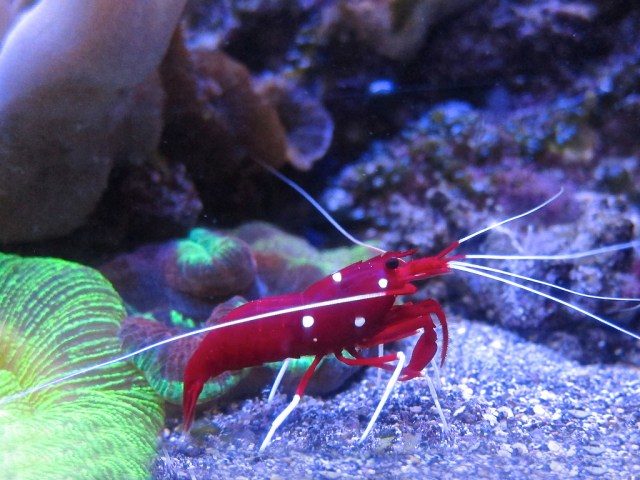
Genus/species: Lysmata debelius

GENERAL CHARACTERISTICS: Length up to 3 centimetres (1.2 in) long, with males and females appearing similar. It has a deep blood red body, with conspicuous white antennae and white tips to the third to fifth pereiopods. There are white dots on the cephalothorax and legs; white dots on the abdomen distinguish L. splendida from L. debelius

DISTRIBUTION/HABITAT: Widespread throughout the Indo-Pacific and Indian Ocean coral reefs. Often found lingering around an Eel’s hole where it will clean the face of the eel when it sticks its head out.

DIET IN THE WILD: Carnivore. As a “cleaner shrimp,” it will set up cleaning stations and remove dead tissue and parasites from fish that present themselves. It will also scavenge for meaty bits along the substrate bottom.

REPRODUCTION: Pairs of fire shrimps will reproduce continually. Hermaphrodite, therefore any two individuals may mate. The greenish egg mass is held beneath the abdomen of the female until the larvae hatch which become free swimming, entering the plankton undergoing several weeks of development.

Water Planet

WordPress Shortlink http://wp.me/p1DZ4b-KS

flickr  http://www.flickr.com/photos/cas_docents/with/8192327370/#photo_8192327370

TAXONOMY
Kingdom: Animalia
Phylum: Chordata
Class: Actinopterygii (ray-finned fishes) 
Order: Perciformes (Perch-likes) 
Family: Labridae (Wrasses)

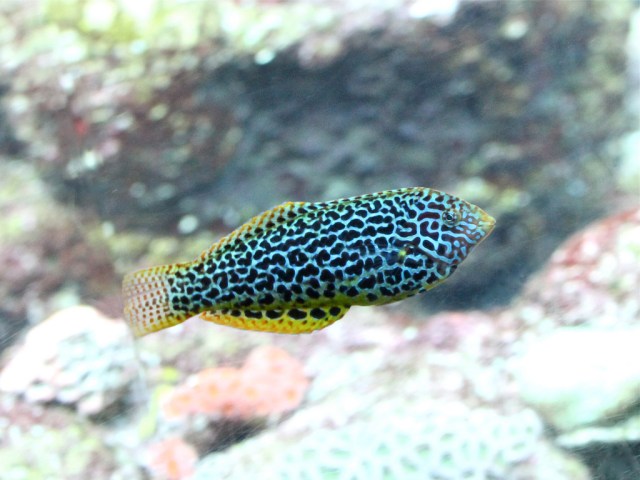
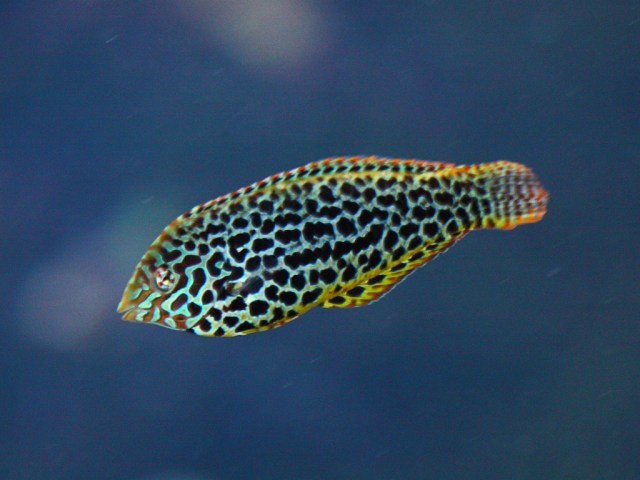
Genus/species: Macropharyngodon meleagris

GENERAL CHARACTERISTICS: Sexual dichromism. Females are white with black or brown irregular spots with white to blue margins over the body. Males have orangey-red background with green mottling. Max. length: 15 cm (6 inches).

DISTRIBUTION/HABITAT: Indo Pacific: Eastern Indian Ocean to western Pacific and the islands of Oceania. Habitat: Subtidal reefs and outer lagoons, at depths of 0–30 meters (98 feet).

DIET IN THE WILD: Feed on gastropods, hard shelled prey and foraminiferans.

REMARKS: Wrasses are most easily identified by their pointed snouts and prominent canine teeth that protrude in front of the jaw. Other common characteristics include their form of propulsion, which depends mostly on the winglike motion of the pectoral fins with only an occasional burst of speed provided by the caudal fin. Color, markings and body shapes change during maturation.

Philippine Coral Reef PR04

flickr http://www.flickr.com/photos/cas_docents/sets/72157608208133134/with/4770699386/

WordPress Shortlink  http://wp.me/p1DZ4b-KA

TAXONOMY
Kingdom: Animalia
Phylum: Chordata
Class: Actinopterygii (ray-finned fishes)
Order: Perciformes (Perch-likes)
Family: Labridae (Wrasses)

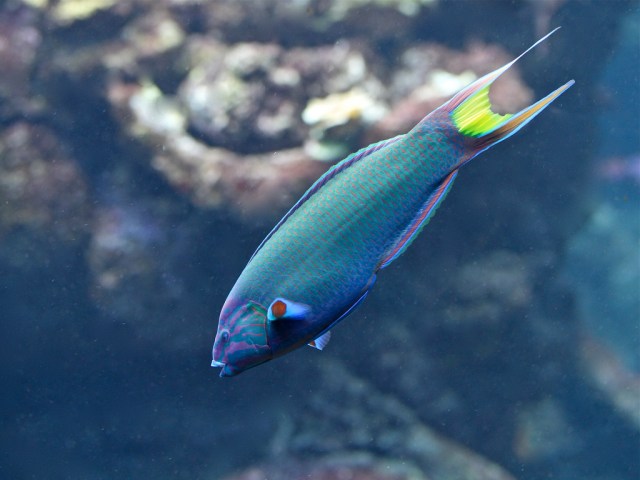
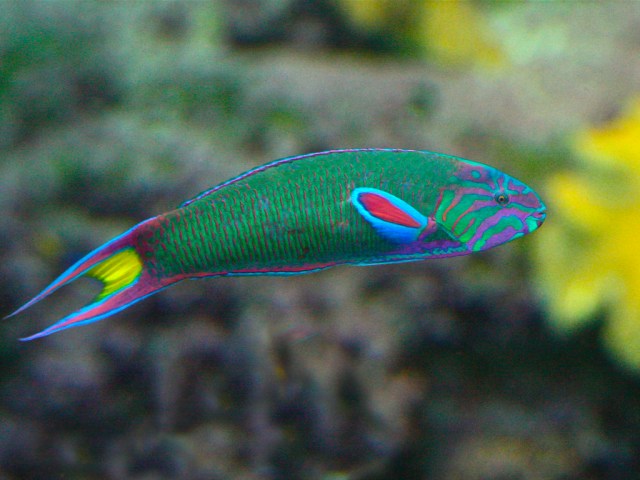
Genus/species: Thalassoma lunare

GENERAL CHACTERISTICS: Adult’s caudal fin is a large yellow crescent edged in purple and blue, the source of the species common name. Body dark green to blue with vertical red lines on scales; pectoral fins a bright pink surrounded by neon blue. The head is distinctive for its bright irregular pink and violet bands radiating from the mouth towards the body, a kind of fluorescent camouflage. Max. length: 25 cm or 10 inches.

DISTRIBUTION/HABITAT: Indo-Pacific; Red Sea to East Africa to the Line Islands, northwest to southern Japan, and southwest to northern New Zealand. Found on marine reefs to a depth of 20 m or 65.5 ft. Also lagoons, coastal reefs, protected seaward reefs, and estuaries.

DIET IN THE WILD: Feeds mainly on small benthic invertebrates and fish eggs

REPRODUCTION: Protogynous hermaphrodite

REMARKS: When frightened this fish will hide in the reef or bury itself in the sand; also buries in sand to sleep.

Philippine Coral Reef PR04

flickr http://www.flickr.com/photos/cas_docents/sets/72157608208133134/with/2989886808/

WORDPRESS SHORTLINK:  http://wp.me/p1DZ4b-Is

TAXONOMY
Kingdom: Animalia
Phylum: Chordata
Class: Actinopterygii 
Order: Perciformes
Family: Siganidae (Rabbitfishes and Spinefoots)

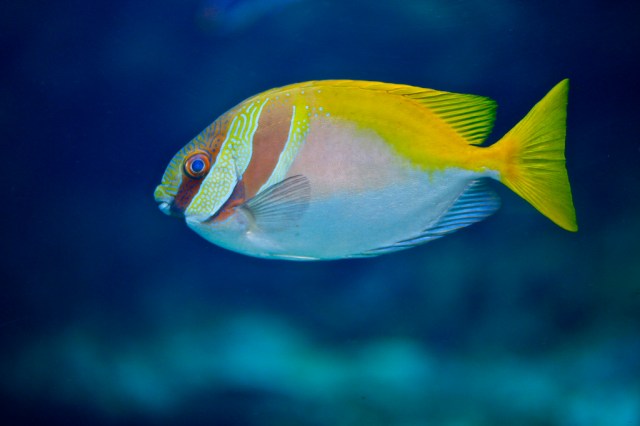
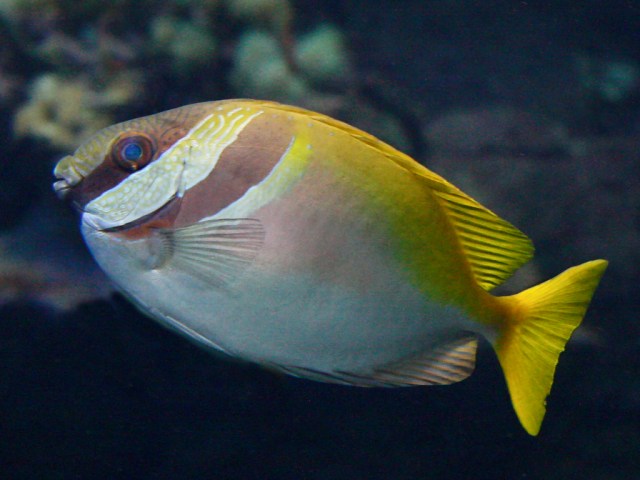
Genus/species: Siganus doliatus

GENERAL CHARACTERISTICS: Length to 25 cm (9.5 in). Light blue body above, silvery below with intricate patterns of thin blue and yellow lines; pair of brown bars on head and forebody; yellow tail.

DISTRIBUTION/HABITAT: Tropical west Pacific in coral rich areas of channels and lagoon slopes, reef flats and seaward reefs. Depth 1–15 m (3-45 ft).

DIET IN THE WILD: Feeds on benthic seaweeds Reproduction and Development: Pelagic spawner. Mortality/Longevity: Stout venomous spines discourage would-be predators.

REPRODUCTION: Pelagic spawner. Juveniles form schools. Pairs form at 7 cm (2.75 inches) which continue to form loose schools to feed in areas being flooded by the tide.

REMARKS : Fins and spines are venomous. Caution must be used when handling. Reactions can range from mild to severe
Named rabbitfish due to their voracious appetite.

Phillipine Coral Reef PR04

flickr http://www.flickr.com/photos/cas_docents/sets/72157608339530941/with/4533131275/

WordPress Shortlink http://wp.me/p1DZ4b-H6

Kingdom: Animalia
Phylum: Chordata
Class: Actinopterygii
Order: Perciformes
Family: Pomacentridae  Damselfishes

Amphiprion clarkii  

GENERAL CHARACTERISTICS:  To 12 cm (4.75 in). Black to entirely orange with pair of white or pale blue bars. Second bar wide; tail white or yellowish; other fins variably black to yellow-orange. There is also an orange variation: some are entirely pale orange, other than the two white bands; others have a dark patch on rear body.  (See remarks)

DISTRIBUTION/HABITAT: Indo-Pacific: Persian Gulf to Micronesia, New Caledonia and Fiji. Also Southwest Japan to northern Australia. Depth 1–55 meters (3-180 ft.) in outer reef slopes, less typically inhabit lagoons. Symbiotic with 10 species of sea anemones. Non-migratory.

DIET IN THE WILD:  Primarily planktonic copepods and benthic algae.

REPRODUCTION:  Monogamous; oviparous. Fertilization is external; benthic spawners; parents create a nest and male guards eggs. Are protandrous hermaphrodites; all mature as males In the absence of a female, the largest juvenile will mature within 5–6 months into the breeding male. The maturation of the smaller (all male) juveniles is stunted by the adult pair’s presence.

REMARKS: Coloration is apparently influenced by the host sea anemone species. Symbiotic with several anemones found in the Steinhart including Entacmaea quadricolor, Heteractis crispa, H. magnifica.

Philippine Coral Reef PR04 and Water Planet

flickr  http://www.flickr.com/photos/cas_docents/3057754480/in/set-72157608339622313/

WORDPRESS SHORTLINK: http://wp.me/p1DZ4b-Fn

TAXONOMY

Kingdom:   Animalia

Phylum:     Chordata

Class:         Actinopterygii

Order:        Perciformes

Family:      Acanthuridae

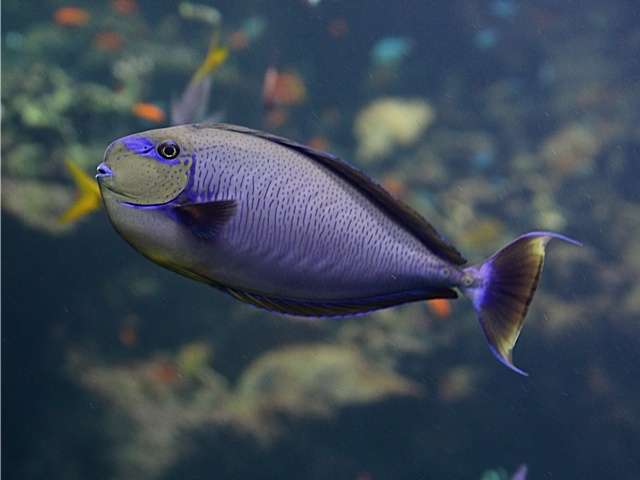
Genus/Species    Naso vlamingii

GENERAL CHARACTERISTICS

Length to 60 cm (23 in). Adults develop a convexly rounded prominent snout and extremely tall dorsal and anal fins. Gray ovate compressed body with bright blue markings. Tips of the tail fin are unusually long. Courting males are able to instantaneously turn iridescent blue.

DISTRIBUTIN/HABITAT


Indo-Pacific in deep lagoon and seaward reefs from 4–50 m (12-150 ft). Diurnally in conspecific groups midwater off steep slopes.

DIET IN THE WILD


Zooplankton.

REPRODUCTION


External fertilization. Egg scatterers, non-guarding. Remarks: Courting males are able to instantaneously turn iridescent blue.

Main Coral Reef Exhibit PR04

flickr www.flickr.com/photos/cas_docents/3120136472/in/set-72157625992053826

WordPress Shortlink http://wp.me/p1DZ4b-BI

TAXONOMY

KINGDOM Animalia

PHYLUM Cnidaria (possess cnidocytes)

CLASS Anthozoa (Sea Anemones and Corals)

SUBCLASS Hexacorallia (water-based organisms formed of colonial polyps generally with 6-fold symmetry)

ORDER Scleractinia (Stony Corals)

FAMILY Merulinidae

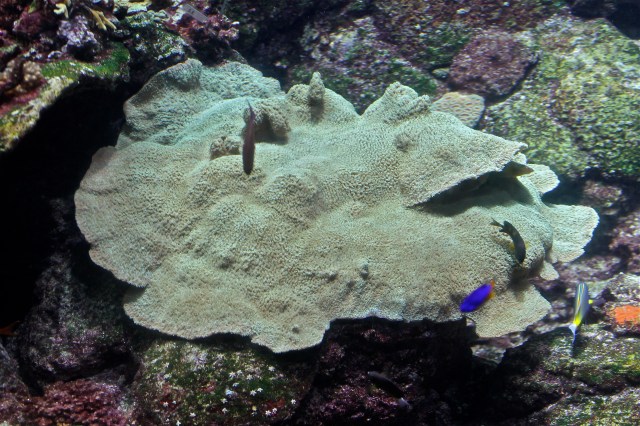
GENUS Hydnophora sp.

GENERAL CHARACTERISTICS
Hexacoral or stonycorals with colonies that may be massive, encrusting, or branched; usually brown, greenish, or yellowish. Conical protuberances over the entire colony’s surface. Tentacles often partially extended during the day.

DISTRIBUTION/HABITAT
Widely distributed in the Indo- Pacific. Common in variety of reef habitats.

DIET IN THE WILD
Nutrition mostly provided by symbiotic zooxanthellae, but also take other food sources, such as plankton.

REPRODUCTION: The small polyp stony (SPS) corals are male and female and can reproduce both sexually and asexually. They reproduce sexually by releasing eggs and sperm at the same time (spawning), resulting in a fertilized egg which then forms into a free-swimming planula larva. Eventually the planula larvae settles onto the substrate, becoming plankters. This then forms a tiny polyp which begins to excrete calcium carbonate and develops into a coral. Planula larvae are extremely vulnerable to predation, and very few survive. Hydnophoras reproduce asexually from breakage due to storms resulting in fragmentation.

REMARKS: Hydnophora are very aggressive and can extend sweeper polyps and sting or basically eat other corals it touches.

LOCATION; Main Philippine Coral Reef Tank PR04

flickr http://www.flickr.com/photos/cas_docents/4673421321/in/set-72157623778757037/

WORDPRESS SHORTLINK  http://wp.me/p1DZ4b-nP

PHYLUM  Chorada

CLASS     Actinopterygii (ray-finned fishes)

ORDER    Anguilliformes (Eels and morays)

FAMILY    Muraenidae (Moray eels)

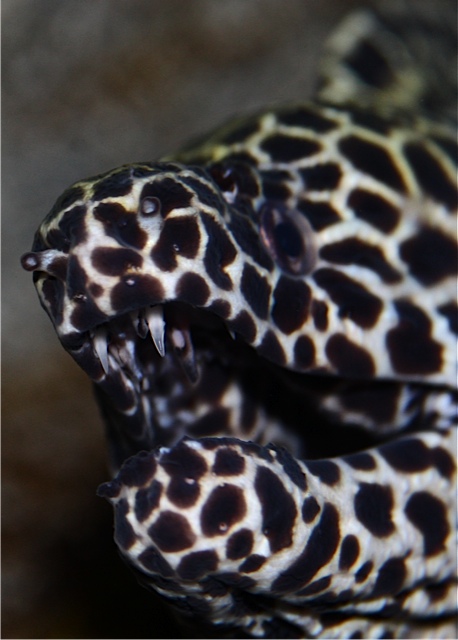
GENUS/SPECIES   Gymnothorax favagineus


GENERAL CHARACTERISTICS

This diverse group is noted for large mouths with numerous teeth, small gill openings, and the absence of pectoral and pelvic fins.  The anal and dorsal fins extend along much of the body and are continuous with the caudal fin. Gill openings are small and roundish and situated on the side of the head.

G. favagineus grows to 3 m, thus it is one of the two largest of Indo-Pacific moray eels. Spots variable between individuals and size.  The surface is covered with dark spots the size of their eye that form a honeycomb pattern. Some individuals colored almost totally black (those found in turbid water).    


DISTRIBUTION/HABITAT

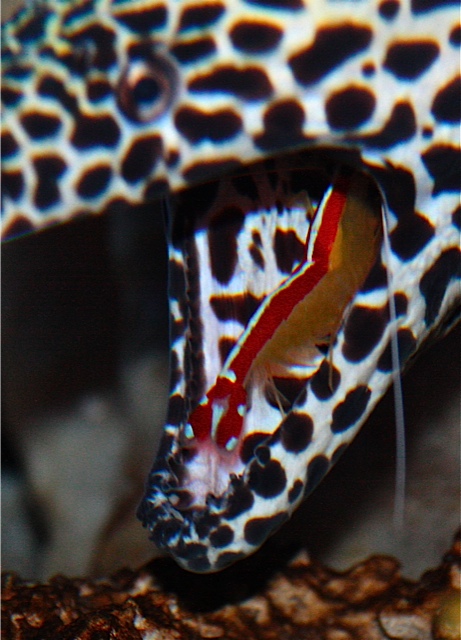
Red Sea, East. Africa to Papua, New Guinea and Great Barrier Reef.  Usually rests in  reef flat rubble and outer reef slopes of  continental reefs, 1–45 m (3-150) in depth. Often found in crevasses with cleaner wrasses or cleaner shrimps.

                                   PHOTO BELOW: Symbiotic relationship with a cleaner shrimp.  

DIET IN THE WILD

Predator upon cephalopods, crustaceans and small fishes.


REPRODUCTION

Leptocephalus larvae.


LOCATION

Dark Cluster  PR22  


WORDPRESS SHORTLINK  http://wp.me/p1DZ4b-AN

Flickr http://www.flickr.com/photos/cas_docents/sets/72157608402401040/