Category: TROPICAL MARINE


Kingdom: Animalia
Phylum: Chordata
Class: Actinopterygii (ray-finned fishes)
Order: Perciformes (Perch likes)
Family: Chaetodontidae (Butterflyfishes) The name “Chaetodontidae” means “bristle-tooth”.

Genus/species: Chaetodon sedentarius.
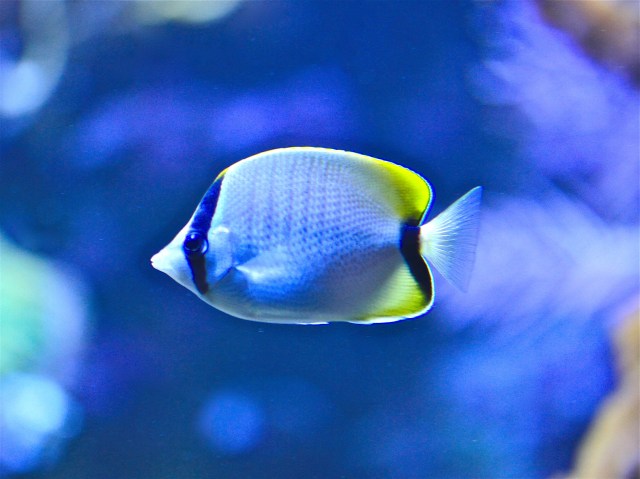
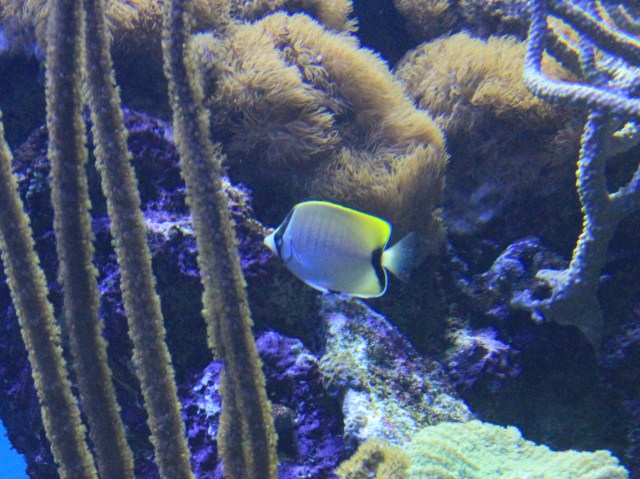
Reef butterflyfish  Chaetodon sedentarius ChaetodontidaeIMG_5652

GENERAL CHARACTERISTICS: Silver body, yellow and black dorsal fin, and yellow tail; two vertical black bars, one on the head through the eye and a black bar across the caudal peduncle. Max length: 6 inches (15 cm). 

DISTRIBUTION/HABITAT: a tropical western Atlantic species, found in the waters of the Carolinas to northern South America, including the Gulf of Mexico and the Caribbean Lives in the shallows and as deep as the light restricts coral growth. ( 48-130 feet deep).

DIET IN THE WILD: Coral polyps, polychaete worms, shrimps, amphipods and hydroids. Can be quite acrobatic in its feeding, often swimming upside down to get into crevices where prey might be hiding.

REPRODUCTION: Found in pairs, suggesting monogamy. The larvae of butterflyfishes are unique from all other species of fish. The head is encased in bony armor and large bony plates extend backwards from the head. These larvae, called “tholichthys,” grow to about 20mm, after which they settle on the bottom during the night.

PREDATORS: Preyed upon by larger fish, such as moray eels, snappers, and groupers. If it can’t find cover, will defend itself by facing its predator with dorsal spines erected, suggesting a sharply distasteful meal.
IMG_2594

CONSERVATION: IUCN:  Least concern (LC)

REMARKS: Gets its name from its flitting movements about the reef and its beautiful color pattern that resembles the movements and appearance of the insect. 

Caribbean reef,  Currently not on exhibit

References 

WordPress shortlink  http://wp.me/p1DZ4b-1ds

flickr http://www.flickr.com/photos/cas_docents/4329888679/in/set-72157625119200613

fishbase http://www.fishbase.org/summary/3605

Florida Museum of Natural History: http://www.flmnh.ufl.edu/fish/Gallery/Descript/ButterflyReef/ButterflyReef.htm

TAXONOMY
Kingdom: Animalia
Phylum:Chordata
Class: Actinopterygii (ray-finned fishes)
Order: Perciformes (Perch-likes)
FamilyChaetodontidae (Butterflyfishes)

Genus/Species: Chaetodon mitratus 

Chaetodon mitratus or Indian Butterflyfish SP07IMG_0103

GENERAL CHARACTERISTICS: Head and body yellow, diagonal stripes two very broad black from dorsal to ventral contour eye bar black to orange. Snout length 2.7-3.3 in. . Body depth 1.7-1.9 .

DISTRIBUTION/HABITAT: Western Indian Ocean. Found in deep tropical marine coral reefs. 22-80 meters (70-260 ft)

DIET IN THE WILD: Coral polyps, zooplankton

REPRODUCTION: Oviparous. Form pairs during breeding

CONSERVATION: IUCN Least Concern (LC)

Chaetodon.mitratusIndian ButterflyfishSP07low.IMG_0100.IMG_0100

REMARKS: Little is known of C. mitratus

References

WordPress shortlink  http://wp.me/p1DZ4b-1dl

flickr  http://www.flickr.com/photos/cas_docents/12918681523/in/set-72157625119200613/

fishbase www.fishbase.org/summary/speciessummary.php?id=8927

EOL eol.org/pages/215193/overview

TAXONOMY
Kingdom: Animalia
Phylum: Chordata
Class: Actinopterygii (ray-finned fishes)
Order: Perciformes (Perch-likes)
Family: Chaetodontidae (Butterflyfishes)

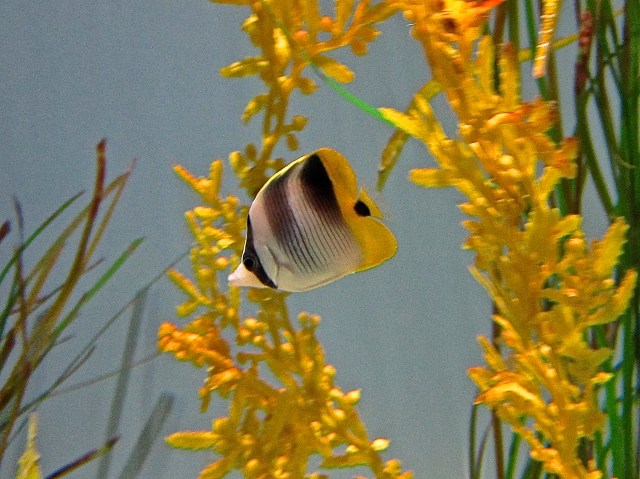
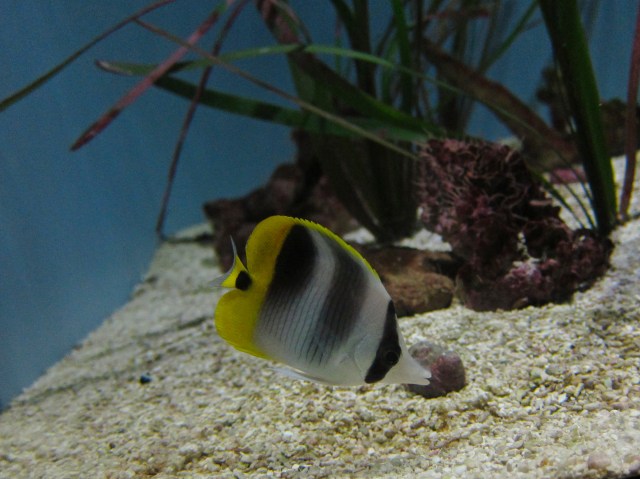
Genus/species: Chaetodon ulietensis

IMG_0142

GENERAL CHARACTERISTICS White for and mid-body and a bright yellow rear. A pair of diffuse dark saddles are across the back with a black spot on the base of the tail and black bar through the eye. Size to 15 cm (6 in).

DISTRIBUTION/HABITAT: Central and Western Pacific in coral-rich areas of lagoons and seaward reefs to 30 m (100 ft).

DIET IN THE WILD Wide range of foods including invertebrates and algae.

REPRODUCTION Monogamous usually seen in pairs.. Oviparous.

CONSERVATION: IUCN, Least Concern (LC)

IMG_0161

Color Cluster

WordPress shortlink http://wp.me/p1DZ4b-Uf

flickr http://www.flickr.com/photos/cas_docents/sets/72157625119200613/with/8599840724/

flickr www.flickr.com/photos/cas_docents/sets/72157625119200613/…

Australian Museum australianmuseum.net.au/Doublesaddle-Butterflyfish-Chaeto…

EOL eol.org/pages/1012794/details

TAXONOMY
Phylum: Chordata
Class: Actinopterygii (ray-finned fishes)
Order: Perciformes (Perch-likes)
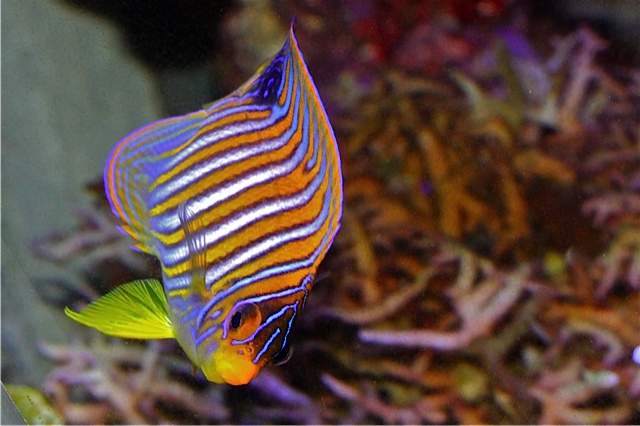
Family: Pomacanthidae (Angelfishes)

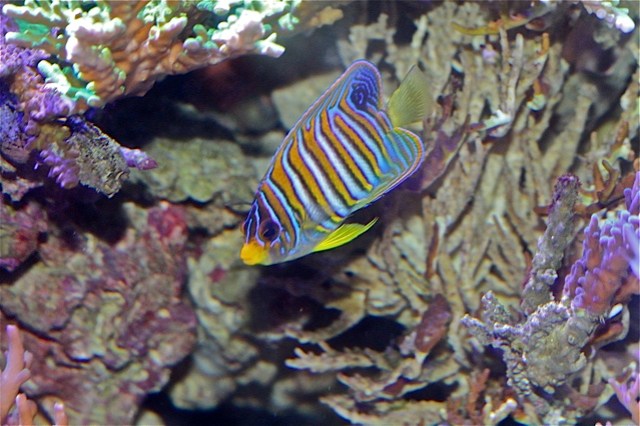
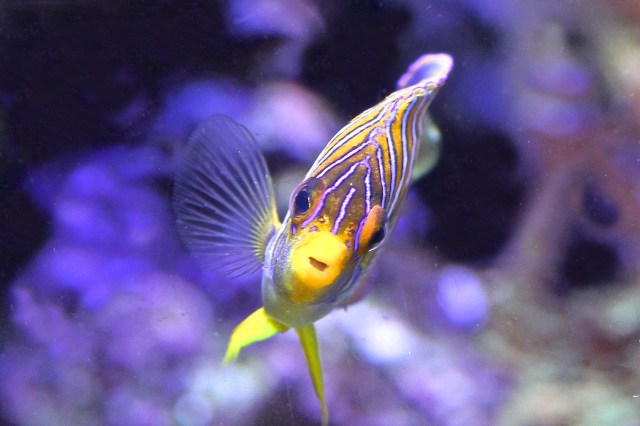
Genus/species: Pygoplites diacanthus

GENERAL CHARACTERISTICS: Identified by 7 or 8 dark edged bluish-white bars that run horizontally down its body. Its body is yellow with blue coloration on the rear of the dorsal fin and it has a small dark patch over its eye. It has a strong preopercular spine. The anal fin has yellow and blue stripes. Juveniles are similarly colored to adults except for a large false eye-spot at the base of the dorsal fin. This fades as the fish matures and it’s gone by the time the fish reaches a length of 6-7 cm. The maximum adult size is reported to be between 20 and 30 cm (8 and 12 inches).

Regal Angelfish Pygoplites diacanthus

DISTRIBUTION/HABITAT: P. diacanthus is found throughout the Northern and Western Indian Ocean, the Red Sea, and the Indo- Pacific Ocean. They are commonly observed as solitary individuals and in pairs and never stray far from a reef crevice. The maximum adult size is reported to be between 20 and 30 cm (8 and 12 inches).
They are always on the move swimming from crevice to crevice in search of food. Found at depths from 1-20 meters (3-66 ft.)

DIET IN THE WILD: Sponges and tunicates.

CONSERVATION: IUCN Least concerned.

Location: Water planet coral exhibit WP33

References

flickr http://www.flickr.com/photos/cas_docents/sets/72157606840726733/

WordPress shortlink  http://wp.me/p1DZ4b-xt

Australian Museum australianmuseum.net.au/Regal-Angelfish-Pygoplites-diacan…

fishbase fishbase.sinica.edu.tw/summary/SpeciesSummary.php?id=6572


TAXONOMY
Kingdom: Animalia
Phylum: Chordata
Class: Actinopterygii (ray-finned fishes)
Order: Perciformes (Perch likes)
Family: Chaetodontidae (Butterflyfishes)

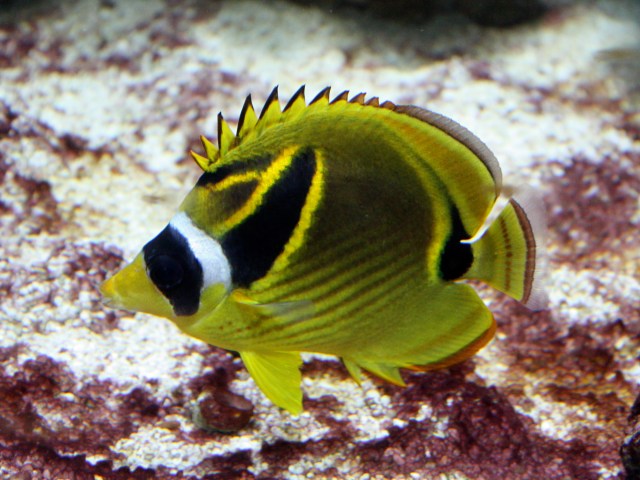
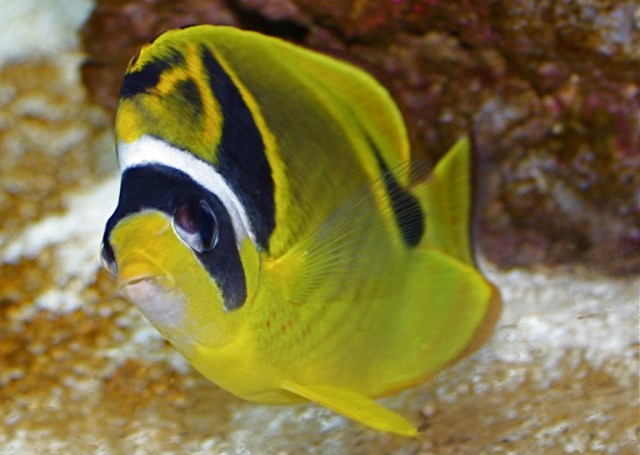
Genus/species: Chaetodon lunula

3120146362_b277962165_o

GENERAL CHARACTERISTICS: Yellow-orange with darker upper half of the body. It has a black patch around its eyes (similar to a Raccoon masked face) with a broad white stripe posterior to it. Two black stripes bordered in yellow reach from the white stripe to the dorsal fin. Black markings around its eyes suggestive of a Racoon. Maximum length to 8 inches.

DISTRIBUTION/HABITAT: From East Africa throughout the Indo-Pacific, south to Australia, east to Hawaii. Found in shallow reef flats of lagoon and seaward reefs, to depth of 30 m (98 ft).

DIET IN THE WILD: Nocturnal omnivore feeding on coral polyps, worms, crustaceans, plankton, algae

REPRODUCTION: Oviparous forming pairs during breeding.

CONSERVATION: IUCN Least Concern (LC)

REMARKS: Chaetodon means “bristletooth,” and has a dental array well-suited to its diet. Has a great fondness for coral polyps, which makes our Steinhart denizen a better fit for the Reef Lagoon which contains no corals. There it feeds on other invertebrates.

Color Cluster PR12

2870252479_2fcdbb9d1f_o

Color Cluster PR12

flickr http://www.flickr.com/photos/cas_docents/sets/72157625119200613/

WordPress Shortlink http://wp.me/p1DZ4b-R3

www.fishbase.org/summary/5565

EOL eol.org/pages/204383/details

Australian museum australianmuseum.net.au/movie/Racoon-Butterflyfish-Chaeto…

TAXONOMY
Kingdom:Animalia
Phylum: Chordata
Class: Actinopterygii (ray-finned fishes)
Order: Perciformes (Perch-likes)
Family: Serranidae (Sea basses: groupers and fairy basslets)

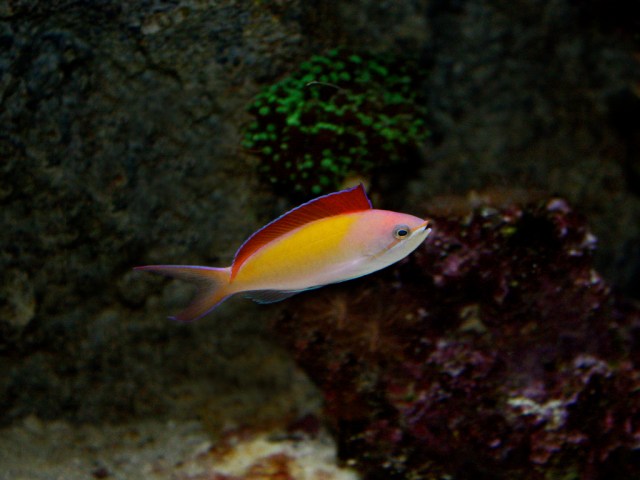
Genus/species: Pseudanthias dispar

Peach Fairy Basslet aka Redfin Anthias 2989036131_c7b264ace3_b

GENERAL CHARACTERISTICS: Sexes dichromatic. Male: orange to yellow body, lavender to pink head and bright red dorsal fin. Female: orange to peach upper head, body, and fins; pink line from the tip of the snout angling down, passing through the lower part of the eye .. Max. size: 9.5 cm (3.75 inches).

DISTRIBUTION: East Indo-Pacific along upper edge of steep reef slopes 1 – 15 m (3.25 – 50 feet) .

DIET IN THE WILD: Zooplankton. Occur in large feeding aggregations.

REPRODUCTION: Protogynous hermaphrodites. If a dominant male dies, the largest female of the group will change sex to take its place.   Males erect dorsal fin as courtship display.
Anthias gather in huge schools of hundreds. Schools are made up of smaller “harems” consisting of a single dominant male, a few less dominant males, and many females.

PREDATORS: Taken by many larger predators.

CONSERVATION: Not evaluated.

Philippine Coral Reef PR04 5-22-13

Animal Attractions SP14 3-15-12

Ref: Fishbase , EOL.

TAXONOMY
Kingdom: Animalia
Phylum: Chordata
Class: Actinopterygii (ray-finned fishes)
Order: Perciformes (Perch-likes) 
Family: Pomacentridae (Damselfishes)

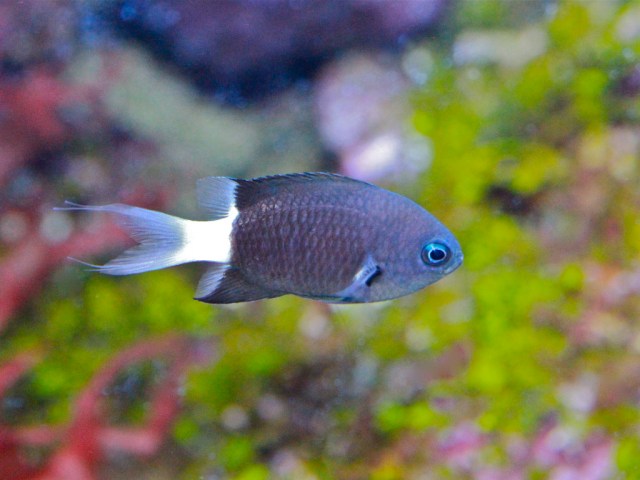
Genus/species Chromis margaritifer

GENERAL CHARACTERISTICS: Dark brown, almost black, with white rear body including tail and rear dorsal and anal fins. Caudal fin lobes end in two filaments. Black spot at base of pectoral fin. Spine tips of the dorsal fin are blue. Max length: 9 cm or 3.5 in.

DISTRIBUTION/HABITAT: Pacific Ocean: Christmas Island and northwestern Australia in the eastern Indian Ocean on exposed seaward reefs; less abundant in lagoons and channels.

DIET IN THE WILD: Zooplankton, algae. Feeds in large groups.

REPRODUCTION: Oviparous, distinct pairing during breeding with the males guarding and aerating the eggs.

Commensalism Cluster PR34, Philippine Coral Reef PR04

Ref. fishbase, EOL, Reef Fish ID Tropical Pacific, Allen et al, 2003.

flickr http://www.flickr.com/photos/cas_docents/8075332727/in/set-72157608339622313

WORDPRESS SHORTLINK  http://wp.me/p1DZ4b-Fu

TAXONOMY
Kingdom:Animalia
Phylum: Chordata
Class: Actinopterygii (ray-finned fishes)
Order: Perciformes (Perch-likes)
Family: Pomacentridae (Damselfishes)

Genus/species Pomacentrus auriventris

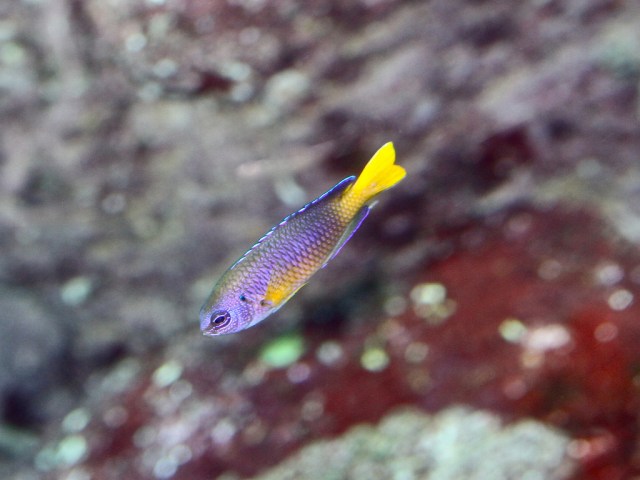
GENERAL CHARACTERISTICS: Neon-blue head and upper body, yellow lower and rear body, anal and tail fins. Length to 5.5 cm ( 2 inches).

Goldbelly Damselfish 4770698270_7ccdac2124_b

DISTRIBUTION/HABITAT: Western Central Pacific: Found on inner coral reef slopes with mixed rubble, coral and algae. depth range 6 – 35 feet (2 – 11 m).

DIET IN THE WILD: Omnivore.

REPRODUCTION: Oviparous, distinct pairing during breeding. Eggs are demersal (just above the sea bed) and adhere to the substrate.. Males guard and aerate the eggs

CONSERVATION: Not evaluated.

Ref. fishbase, EOL. Reef Fish Identification, Tropical Pacific, Allen et at.2003.

Philippine Coral Reef PR04

flickr http://www.flickr.com/photos/cas_docents/4770698270/in/set-72157608339622313

WordPress Shortlink http://wp.me/p1DZ4b-19p

TAXONOMY
Kingdom: Animalia
Phylum: Chordata
Class: Actinopterygii (ray-finned fishes)
Order: Perciformes (Perch-likes)
Family: Pomacentridae (Damselfish)

Genus/species: Chrysiptera parasema

GENERAL APPEARANCES:: Small, blue-bodied fish with a yellow tail; 7–9 cm (2.75 – 3.5 inches) long. Colors become less contrasting with age.

Yellow-tail Blue Damselfish 4533756786_58d0151ab2_o

DISTRIBUTION/HABITAT: Western Pacific in coral-rich areas of sheltered lagoon and inshore coral reefs. Inhabits rubble beds on lagoon reefs to 16 meters (52 feet) deep. Occurs in small groups on Acropora patches.

DIET IN THE WILD: Omnivore.

REPRODUCTION: Oviparous, distinct pairing during breeding. Eggs are demersal and adhere to the substrate.

Ref: fishbase, EOL, Reef Fish Identification, Tropical pacific, Allen et al. 2003

Philippine Coral Reef PR04

flickr http://www.flickr.com/photos/cas_docents/sets/72157608339622313/with/4533756786/

WordPress Shortlink  http://wp.me/p1DZ4b-19h

TAXONOMY
Kingdom: Animalia 
Phylum: Chordata
Class: Actinopterygii (ray-finned fishes) 
Order: Perciformes (Perch-likes) 
Family: Serranidae (Sea basses: groupers and fairy basslets)
Subfamily: Anthiinae (Anthias)

Genus/species: Serranocirrhitus lathus

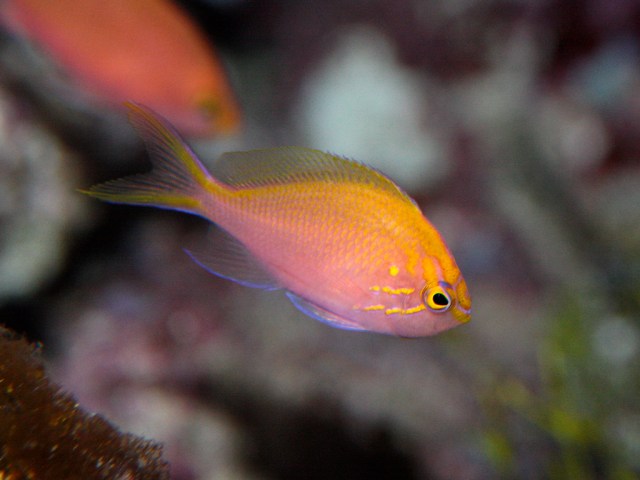
4482852401_4ab3a860ab_b

GENERAL CHARACTERISTICS: Unlike its cousins the Pseudanthias species, the Flathead Anthias has a deep body and elongate pectoral fins that extend back as far as the posterior part of the anal fin.. Predominantly pink, with heavy yellow-to-orange scale margins and facial markings. Max.length: 10 cm (4 inches).

DISTRIBUTION/HABITAT: Western Pacific. Found near coral reefs usually at depths of 18 m (60 feet) or more, either solitarily or in small haremic groups; also found near caves, ledges, and drop-offs, usually close to crevices where they retreat if threatened.

DIET IN THE WILD: Zooplankton

REMARKS; First described in 1949 as a hawkfish in the family Cirritidae but in 1978 it was placed in the subfamily Anthiinae (Anthias).

Animal Attractions Staff Picks SP14

flickr http://www.flickr.com/photos/cas_docents/4482852401/in/set-72157608545590153/

WordPress Shortlink http://wp.me/p1DZ4b-Zl