Category: TEMPERATE MARINE


TAXONOMY
Class: Actinopterygii (ray-finned fishes)
Order: Perciformes (Perch-likes)
Family: Labridae (Wrasses)

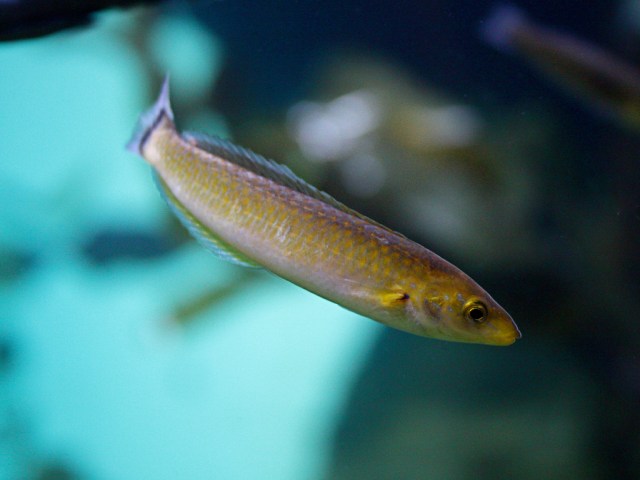
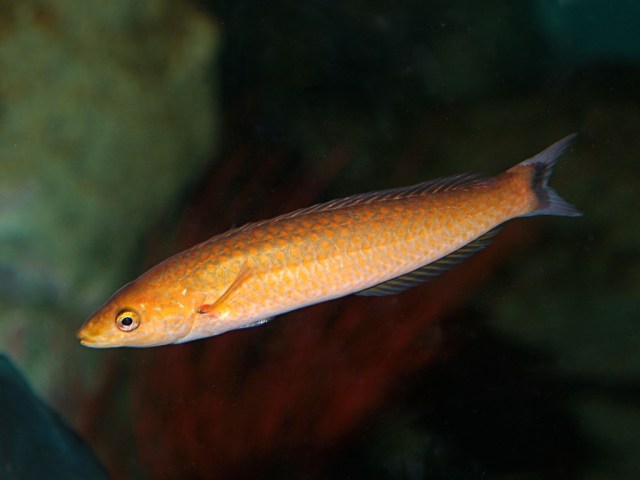
Genus/species: Oxyjulis californica

Senorita Wrasse 3995255581_88e76a0033_b

GENERAL CHARACTERISTICS Length to 10 inches (25 cm). Cigar-shaped fish with large scales and protruding teeth. Orange to brownish, a few are more pink or yellow. Large black marking at base of caudal fin.

DISTRIBUTION/HABITAT: Salt Point, northern California to south-central Baja California. Habitat: Found in kelp and other seaweeds and over rocky reefs, usually at shallow depths. Five to 240 feet (1.5 m-76 m) deep.

DIET IN THE WILD: Hydroids, bryozoans, amphipods, parasitic copepods, and isopods

REMARKS: Popular in the aquarium trade. At night, señoritas seek out a nearby sandy area and bury themselves with a headfirst dive into the sand, ultimately sleeping with head protruding.
Señoritas cleaner fish. picking external parasites and copepods from the skin of other fishes.

Senorita Wrasse 3996018576_6967b7abb5_b-1

Southern California Kelp Exhibit CC14

WordPress Shortlink http://wp.me/p1DZ4b-Y8

flickr http://www.flickr.com/photos/cas_docents/sets/72157633391356187/

TAXONOMY
Kingdom: Animalia
Phylum: Chordata
Class: Actinopterygii (ray-finned fishes)
Order: Perciformes (Perch-likes)
Family: Pomacentridae (Damselfishes)

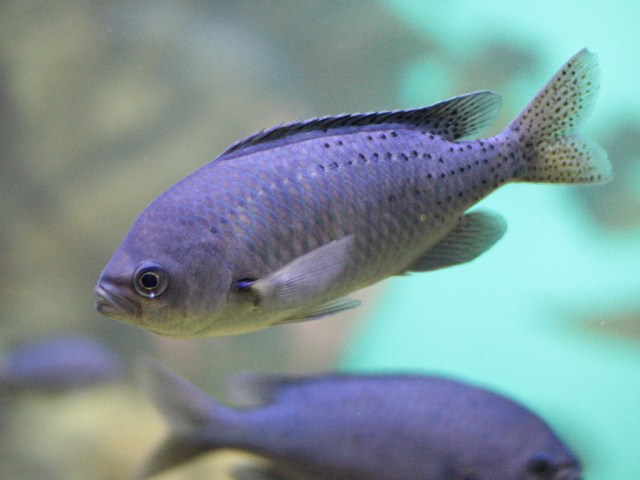
Genus/species: Chromis punctipinnis

Blacksmith  4020282794_5437a61f15_b

GENERAL CHARACTERISTICS: Gray-blue or gray on sides with black spots on rear of body. Length about 30 cm or 12 inches.

DISTRIBUTION/HABITAT: Monterey Bay to central Baja California, most common from Pt. Conception south. Habitat: Large schools of hundreds of individuals are common during the day above nearshore rocky reefs to 45 m or 150 feet. Shelters night on or near crevices, again often in large groups.

DIET IN THE WILD: Zooplankton (copepods and other crustacean larvae and eggs).

REPRODUCTION: Males prepare nest sites in overhangs or small caves of reefs, and guard eggs. Females oviparous. Spawn summer or fall.

PREDATORS: Other fishes (including kelp bass, moray eels, and lingcod), marine mammals (harbor seals, California sea lions), and birds.

REMARKS: Turns until it is perpendicular to the ground. Senorita fish will then commence cleaning the blacksmith. Not only does the senorita get a meal, but the blacksmith gets groomed in this symbiotic relationship.

3399374199_3ffcf124b8_b

Southern California Kelp Forest CC14

WordPress Shortlink  http://wp.me/p1DZ4b-Xj

flickr http://www.flickr.com/photos/cas_docents/sets/72157608359804936/with/3399374199/

TAXONOMY
Kingdom: Animalia
Phylum: Chordata
Class: Actinopterygii (ray-finned fishes)
Order: Perciformes (Perch-likes)
Family: Labridae (Wrasses)

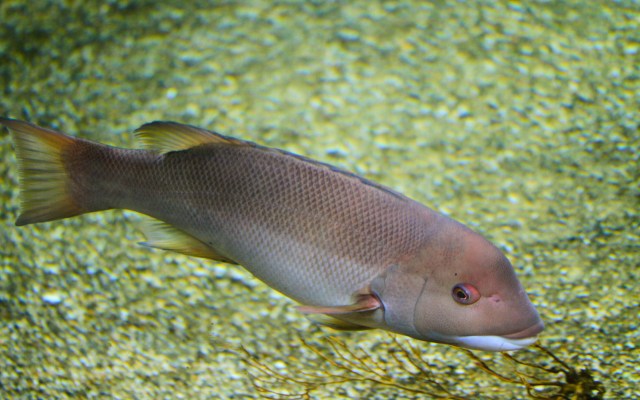
Genus/species: Semicossyphus pulcher

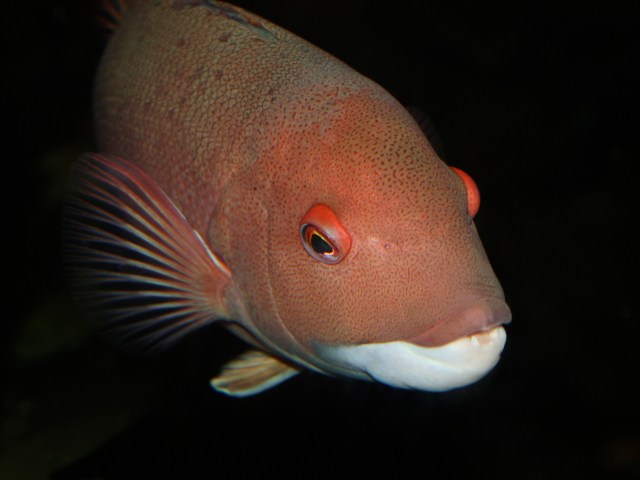
California sheephead IMG_5773

GENERAL CHARACTERISTICS: Length to 91 cm (36 in), weight to 16kg (35 lbs). Body is fusiform, deeply, compressed. Males are larger, with black tail and head sections with wide, reddish-orange midriff and white chins,. Adult females reddish-brown. Caudal fin almost square. Juveniles are brick-red on sides with white stripe and a black spot on its tail.

DISTRIBUTION/HABITAT: Monterey Bay, California to Baja California, Mexico on rocky bottoms or in kelp forests and shallow reefs to 55 m, typically 3 (10 ft)–30 m (!00 ft).

DIET IN THE WILD: Hard-shelled prey (sea urchins, barnacles, clams, gastropods, mussels, lobsters and crabs) crushed with tooth-plates in rear of mouth. Also take octopuses and various worms; can pry prey from substrate with canine teeth.

CALIFORNIA SHEEPHEAD 1

REPRODUCTION: Protogynous hermaphrodite. Individuals initially female, change to males at about 30 cm and 8 years old. Sex change metamorphosis takes less than one year.

PREDATORS/MORTALITY: Can live to more than 50 years, in ideal areas although this rarely happens now. During the night, they move to crevices and wrap themselves in a mucus cocoon so predators can’t detect them.

CONSERVATION: The California Department of Fish and Game restricts the catch size to prevent over fishing.

REMARKS: Large teeth can cause serious bite wounds.

California Coast CC19

WordPress Shortlink  http://wp.me/p1DZ4b-WZ

flickr http://www.flickr.com/photos/cas_docents/sets/72157608359804936/

TAXONOMY
Kingdom: Animalia
Phylum: Cnidaria
Class: Scyphozoa
Order: Semaeostomeae
Family: Pelagiidae

Genus/species: Chrysaora fuscescens

4330825373_e4d12ba6ca_b

GENERAL CHARACTERISTICS: The sea nettle is a giant, semitransparent jellyfish, with an amber-colored, swimming bell commonly as large as 30 cm (12 inches) in diameter, with some measuring more than a meter. In addition to four oral arms attached to the underside of the mouth, the sea nettle has 24 long tentacles around the perimeter of the bell that extend up to 4 m (13 ft).

DISTRIBUTION/HABITAT: Marine, found along the westcoast of North America from Mexico to British Columbia.

DIET IN THE WILD: Carnivorous; feeds on zooplankton, small crustaceans, comb jellies, fish eggs and larvae. Sea nettles sting their prey with their tentacles, which have millions of microscopic stinging cells that inject toxins to stun or kill tiny animals. The main oral arms then transport food to the heart-shaped gastric pouches in the bell, where digestion occurs.

PREDATORS: In the medusa stage, sea nettles live from 2–6 mos, usually perishing in rough waters or being eaten by predators— ocean sunfish and leatherback turtles are two of the most prevalent jellyfish predators.

4798725394_c1fc6938ab_b

REMARKS: Question: What has no heart, bones, eyes or brain, is made up of 95% water, and yet
is still a remarkably efficient ocean predator? (The jellyfish) Some jellies commute 1,000 m up and down in the water column daily! Sea nettle stings can result in extreme localized pain. Fortunately this jelly is not aggressive. The bell of this and other jellies is called a “medusa” because, with its long, fringing tentacles, it resembles the snake-haired Gorgon Medusa of Greek mythology.

Venomous

Plankton/Sea Drifters CC24

flickr http://www.flickr.com/photos/cas_docents/sets/72157610031545571/with/4330825373/

WordPress Shortlist  http://wp.me/p1DZ4b-PM

TAXONOMY

Kingdom Animalia

Phylum: Cnidaria (anemones, corals and jellyfish)

Classis: Scyphozoa
Order: Semaeostomeae
Familia: Pelagiidae

Genus/species: Chrysaora Pacifica

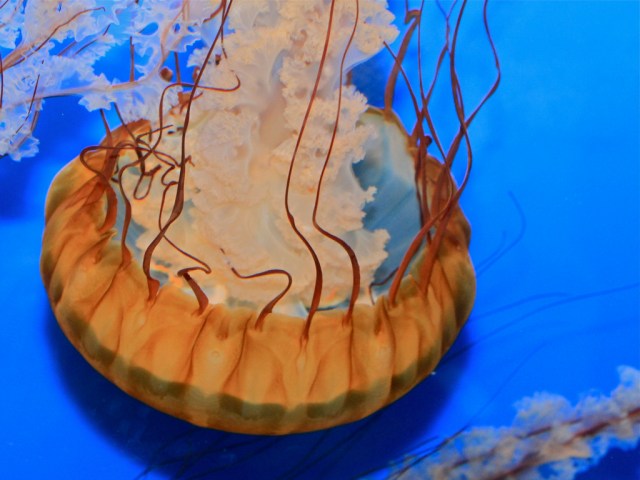
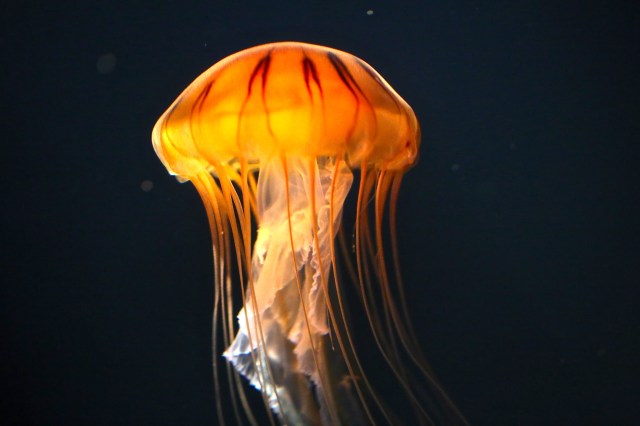
IMG_5334

GENERAL CHARACTERISTICS: APPEARANCE: Bells can grow up to 12 inches across and tentacles can stretch 10 feet or more. Their bells are white with brown-to-orange stripes, containing up to 32 very long orange-red tentacles and four long lips. One of C. Pacifica’s most distinguishing characteristics can be found on their undersides, where they have 16 brown stripes and eight stomach pouches.

DISTRIBUTION/ HABITAT: Deep open waters of the northern Pacific Ocean, Arctic Ocean and the Bering Sea. Found at the ocean surface to 200 meters (650 feet) below the surface.

DIET IN THE WILD: Other jellies, small crustaceans called copepods, and small fishes.

REPRODUCTION and DEVELOPMENT: The life cycle made up of five stages. They go through a metamorphosis or change in shape as they grow.
1.lifecycle begins when males broadcast or release sperm into the water and the females catch the sperm to fertilize the eggs she has produced and is holding in her mouth.
2. The fertilized eggs remain attached to the mother’s oral arms and grow into a flat jelly bean-shaped planula.
3. The planula then grows into flower-shaped polyps and the mother releases them into the ocean.
4. The polyps attach to a solid surface and undergo asexual reproduction through which they make an exact copy of themselves without eggs and sperm. The polyp makes these identical animals by budding where the new polyp grows out of its side.
5.After the new polyp is fully formed, it is released into the ocean and starts to change shape, looking more like the adult nettle. The nettle develops a bell, arms and tentacles until it is a fully formed medusa or adult. (Shedd AQ).

IMG_5338

REMARKS: Like many jellies, Japanese sea nettles use stinging cells to defend themselves and stun their prey. While not especially poisonous, their stings can cause intense skin irritation and burning sensations in humans. Some people can have allergic reactions to their venom. If you see one in the water, stay away because there’s a good chance more of them are nearby. Japanese sea nettles travel in swarms, which increases your chance of being stung if you encounter one.

 Animal Attractions

flickr http://www.flickr.com/photos/cas_docents/sets/72157610031545571/

WordPress Shortlink http://wp.me/p1DZ4b-Ps


TAXONOMY
Kingdom: Animalia
Phylum: Chordata
Class: Actinopterygii (ray-finned fishes)
Order: Scorpaeniformes (Scorpionfishes and flatheads)
Scorpaenidae (Scorpionfishes or rockfishes)

Genus/species: Scorpaena guttata

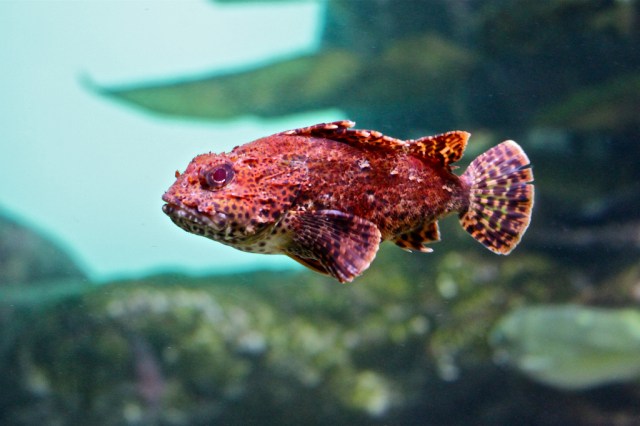
7422497262_688fa2ed80_b

GENERAL CHARACTERISTICS: Stocky, large mouth; large spiny head and large fan-shaped pectoral fin. Red to brown, pale mottled brown spots on body and fins. Length to 43 cm (17 inches).

DISTRIBUTION: Santa Cruz, California to the Gulf of California in tide pools to 183 m (600 ft), usually at depth less than 30 m (100 ft). Typically found in rocky areas of bays and along shore. Most active at night.

DIET IN THE WILD: Small crabs, also shrimp, octopuses and small fishes.

MORTALITY/LONGEVITY: Live to at least 21 years.

4428612388_9882ee919e_b

REPRODUCTION: Migrate extensivelyduring summer in order to form large spawning aggregations. Mature at two years old. Fertilization is internal. Females produce eggs imbedded in gelatinous walls of hollow pear-shaped structures, which are transparent or green. The “balloons” float near the surface and the eggs hatch in around five days.

REMARKS: Spines are venomous.

Southern California Marine CC14

flickr http://www.flickr.com/photos/cas_docents/7422497262/in/set-72157608333101710/

WordPress Shortlink http://wp.me/p1DZ4b-OX

TAXONOMY
Kingdom:  Animalia
Phylum:  Chordata
Class:  Actinopterygii (ray-finned fishes)
Order:  Perciformes (Perch-likes)
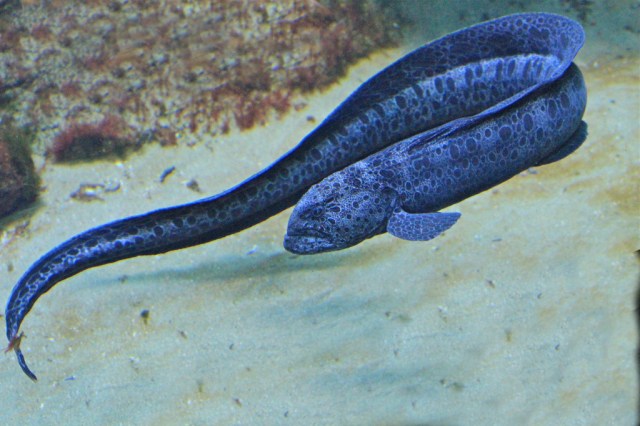
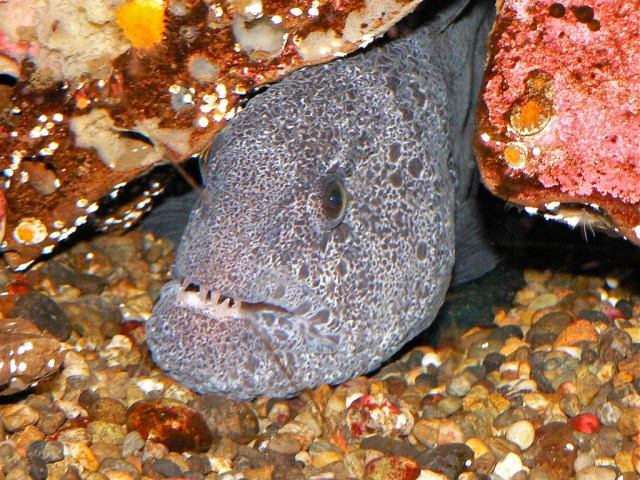
Family:  Anarhichadidae (Wolffishes)

Genus/Species:  Anarrhichthys ocellatus

GENERALCHARACTERISTICS
An eel-like fish (large, elongate, compressed body) with no pelvic fins. Large pectoral fins. Colored mostly gray to brown, occasionally greenish. Round dark spots with pale rings on body and fins. Length to 2.4 m (7.2 ft). Weight to 18 kg 41 lb. Not a true eel of the Order Anguilliformes.

DISTRIBUTION/HABITAT
Sea of Japan and Aleutian Islands to Imperial Beach, California. Adults live on bottom, usually among rocks in subtidal locations; often in dens.

DIET IN THE WILD
Crabs, sand dollars, marine snails and fishes.

REPRODUCTION
Both male and female wrap their body around the egg mass to keep the eggs in place and to deter predators .

PREDATORS
Predators of eggs include benthic rockfish and kelp greenlings.

REMARKS: Can inflict a painful bite. An edible food fish

LOCATION: California Rocky Coast CC06

flickr http://www.flickr.com/photos/cas_docents/4673324895/in/set-72157608359804936/

WORDPRESS SHORTLINK  http://wp.me/p1DZ4b-Ff

TAXONOMY

KINGDOM      Animalia

PHYLUM        Arthropoda  (External skeleton, segmented body and jointed appendages)

SUBPHYLUM  Crustacea

CLASS          Malacostraca

ORDER         Decapoda  (ten legged)

FAMILY        Hippidae  (mole crabs or sand crabs)

GENUS/SPECIES  Emerita analoga
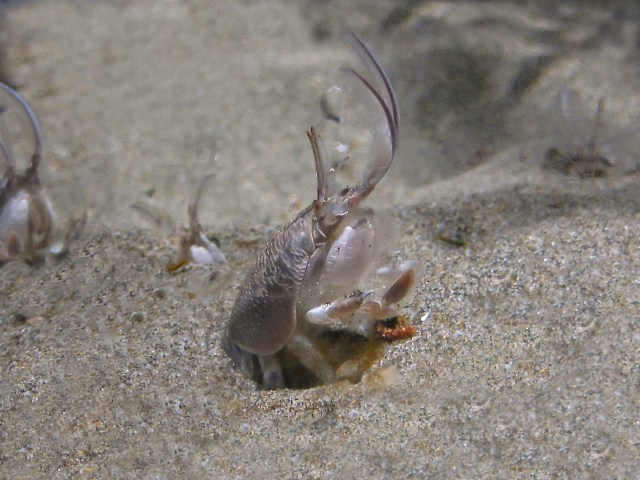
 

GENERAL CHARACTERISTICS

 Grey or sand colored exoskeleton without spines or claws.  The eyes are on long stalks and the antennae are also elongated so as to project above the surface of the sand. The legs and uropods have hairy margins to assist in digging and for use in collecting food and transferring it to the mouth.  The first pair of antennae reach above the sand for respiration, and the second pair, resembling feathers, are extended when the crab feeds. The female is nearly twice as large as the male up to 35 mm  (1.4 in) long and 25 mm (1.0 in) wide.

The sand crab always moves backwards when burrowing or crawling.

DISTRIBUTION/HABITAT

Pacific coast from Alaska to Baja California in the northern hemisphere and between Ecuador and Argentina in the southern hemisphere. E. analoga live in the swash zone (area of breaking waves) of the sandy beach intertidal zone.

DIET IN THE WILD

Antennae collect small organisms, mostly dinoflagellates which are brought to the mouth and consumed.

 REPRODUCTION

During the reproductive season (February-October), females can produce one clutch per month of 50-45,000 eggs, which take approximately 30 days to develop. Once the eggs hatch, the larvae are planktonic for 4-5 months.

PREDATORS

Fish, water birds, and shorebirds.

The barred surfperch is a very common fish in the surf zone, and sand crabs have been found to make up 90% of its diet.

Emerita analoga are  also used as bait by fishermen.


REMARKS

Sand crabs are known to carry parasites. They are an intermediate host of parasitic worms which are passed on to the predators of sand crabs. Sea otters and birds can eat many crabs per day, and the ingested parasites have been known to kill these predators.

Researchers monitor levels of DDT and domoic acid (a diatome neurotoxin) on a regular basis to assess the health of the ocean.

LOCATION Tidepool

WordPress Shortlink  http://wp.me/p1DZ4b-zq

flickr  http://www.flickr.com/photos/cas_docents/sets/72157608602469734/

TAXONOMY


Kingdom:  Animalia

Phylum:     Arthopoda

Class:          Malacostraca

Order:        Decapoda

Family:      Epialtidae

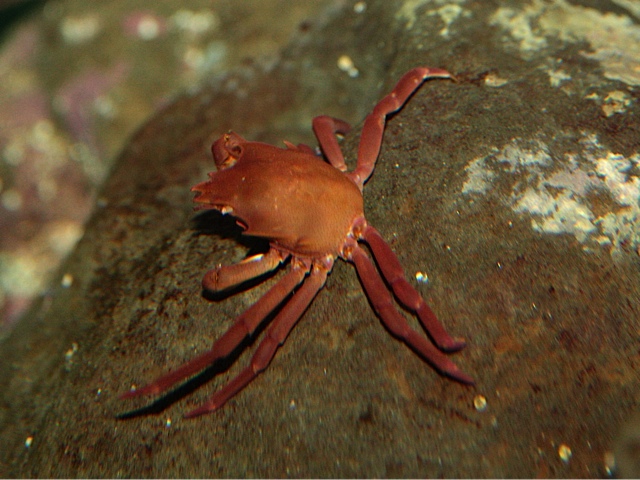
Genus/species;  Pugettia producta


GENERAL CHARACTERISTICS

 Mostly dark brown to green varying depending on the type of algae consumed. Like other members of its family, noted for its unique, elongated carapace with extended rostrum like an upside down shovel with the handle end towards its mouth. and four pairs of relatively long, slender walking legs. Because of these features, the family common name is “spider crabs.”

Most crabs in this family are called masking crabs; they attach fragments of shells and algae to their carapace for camouflage. P.producta, a large active crab, maintains a clean surface, perhaps for ease of movement.  It is a feisty animal; long legs are dextrous, and claws pinch hard.

DISTRIBUTION/HABITAT

 Alaska to Baja California in rocky intertidal in kelp beds and tidepools with abundant surfgrass or algae.  The crab uses the vegetation as protection from  sun and predators. Subtidal to 70 m (230 ft).

 DIET IN WILD

Mainly a nocturnal vegetarian feeding on bull kelp, sea lettuce, rockweed and other kelp. Occasionally will take barnacles, mussels, hydroids, and bryozoans in winter when vegetation is scarce.

 REPRODUCTION

Reproduction and Development: Females usually mate June to July, though can mate year round. Fertilized eggs develop for several months underneath the female’s abdomen.

 PREDATORS


Preyed upon by sculpins, gulls, cabezon, and sea otters among others.

LOCATION: CC15  TIDEPOOL

Flickr http://www.flickr.com/photos/cas_docents/sets/72157626486149324/

WORDPRESS SHORTLINK  http://wp.me/p1DZ4b-xc

TAXONOMY

CLASS   Actinopterygii (ray-finned fishes)

ORDER    Atheriniformes (Silversides)

FAMILY    Atherinopsidae (Neotropical silversides

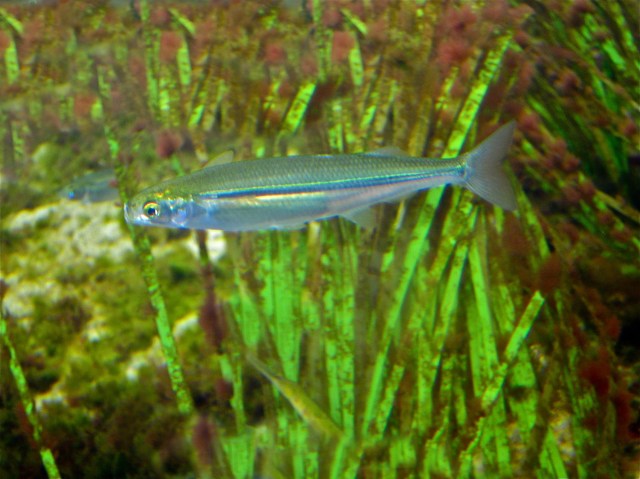
GENUS/SPECIES    Atherinops affinis

GENERAL CHACTERISTICS

Blue gray to green above, silvery below; a striking silver band bordered above with blue extends the full length of the body.

DISTRIBUTION/HABITAT

Marine; brackish; pelagic-neritic..  Eastern Pacific: Vancouver Island in British Columbia, Canada to Baja California, Mexico and the Gulf of California. Subtropical; 55°N – 23°N.Common in bays, muddy and rocky areas and kelp beds, also in estuaries forming schools.

 DIET:

 A.  affinis adults feed on zooplankton while juveniles feed on algae and kelp fly larvae.

REPRODUCTION: 

Demersal spawner in nearshore habitats. Oviparous, with planktonic, primarily neustonic larvae  Eggs are attached to spawning substrate and to one another by adhesive filaments

PREDATORS

Other fishes, birds and people.

REMARKS

Called “topsmelt” for their habit of swimming up near the surface and schooling near shore.

LOCATION

Salt Marsh Pop-up CC03

flickr;  http://www.flickr.com/photos/cas_docents/sets/72157625063185432/

WORDPRESS SHORTLINK  http://wp.me/p1DZ4b-x5