Category: TEMPERATE MARINE


TAXONOMY
Kingdom:Animalia
Phylum: Echinodermata
Class: Echinoidea
Order: Echinoida
Family: Strongylocentrotidae

Genus/species: Strongylocentrotus franciscanus

GENERAL CHARACTERISTICS: Largest urchin found in the Pacific Northwest. Color of spines varies–may be red, brick-red, pink, purple, or even maroon. Tube feet are dark, often wine red. The largest recorded test diameters approaching 19 cm (7.5 inches). Spines up to 7 cm (2.75 inches) long. (deters predators and facilitates movement).

(Strongylocentrotus purpuratus is smaller and a strong purple color. )
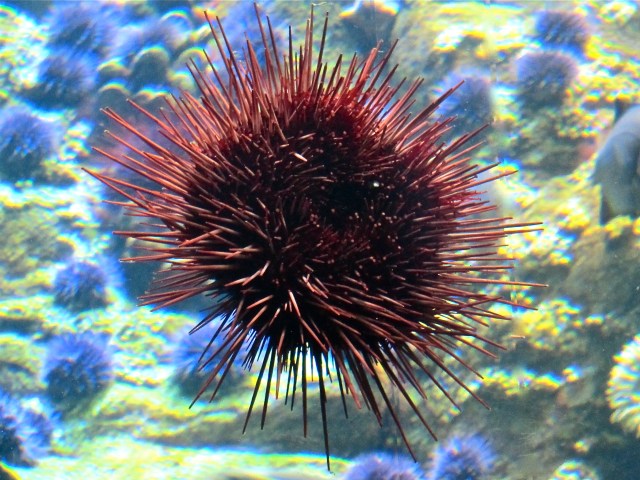
Strongylocentrotus franciscanus6063267260_280398b0bb_o

DISTRIBUTION/HABITAT: N. Japan and Alaska to Isla Cedros, Baja California. Found in very low intertidal on open, coastal rocky substrates; more abundant subtidally to 90 m deep. Juveniles often shelter among the rigid outer spines of adults.
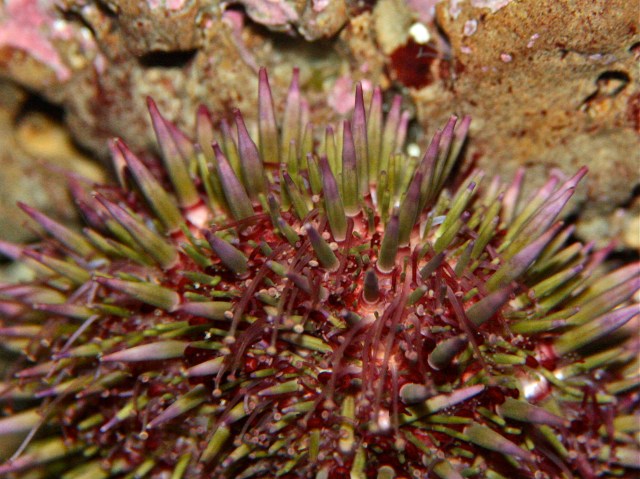
Strongylocentrotus franciscanus3750941637_8fa3f8704a_o

DIET IN THE WILD: Herbivorous upon red and brown algae; preference is for the giant brown kelp Macrocystis. Their grazing can cause “barren grounds” in which no algae remain.
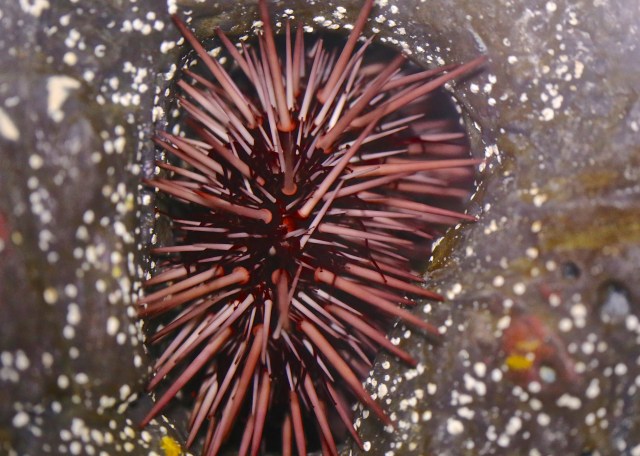
Strongylocentrotus franciscanus8519677227_2871028244_k

REPRODUCTION: Broadcast spawners. Fertilized eggs develop into planktonic larvae, known as echinoplutei, which go through a number of stages of development over 6-10 weeks then settle to substrate.

MORTALITY: Can live more than 100 years. A favored treat of sea otters. Other predators include the sunflower star Pycnopodia helianthoides, leather star Dermasterias imbricata, red rock crab Cancer productus, spiny lobster Panulirus interruptus and sheepshead fish. Starfish may swallow red sea urchins whole or split the animals open along their vertical axis.

CONSERVATION: IUCN; Not Evaluated

REMARKS: Raw gonads (uni) are considered gastronomic delicacies by some people. Removal of sea urchins promotes growth of kelp and thus improves habitat for many other species, including rockfish juveniles .

Small urchins (less than 5 cm test diameter) often hide under the adults.

Have been known to bore holes into metal pier pilings.

Tube feet of red sea urchins are chemo-receptive, allowing them to detect food sources and predators.

They may reabsorb their own tissues if no other source of energy is present. (“Red Sea Urchins”, 2013; Kato and Schroeter, 1985)

LOCATION California Rocky Coast

References

Ron’s flickr https://www.flickr.com/photos/cas_docents/6063267260/in/set-72157608501343477/

Walla Walla University www.wallawalla.edu/academics/departments/biology/rosario/…

Oregon State University fishbull.noaa.gov/1014/19ebertf.pdf

University of Michigan Animal Diversity  Web.http://animaldiversity.ummz.umich.edu/accounts/Strongylocentrotus_franciscanus/

Ron’s WordPress shortlink  https://fishoncomputer.wordpress.com/wp-admin/post-new.php
TAXONOMY
Kingdom: Animalia
Phylum: Cnidaria
Class: Anthozoa
Order: Actiniaria
Family: Actiniidae

Genus/species: Urticina lofotensis

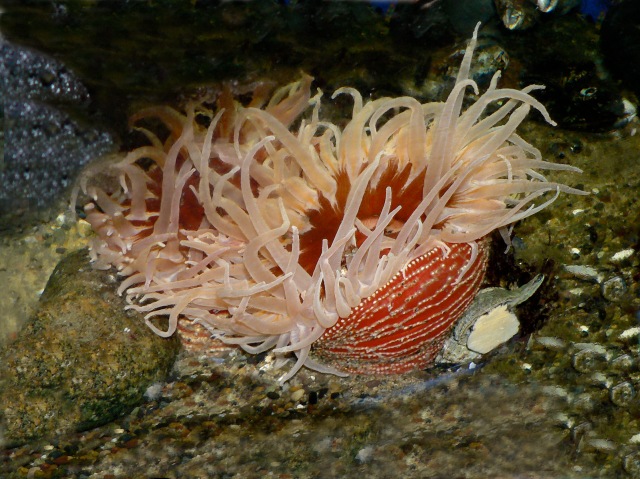
 GENERAL CHARACTERISTICS: Column diameter to 10 cm (4 inches), height to 15 cm (6 inches). Column bright scarlet or crimson with white warty spots in longitudinal rows; tentacles slender, elongate, scarlet to crimson.

 White-spotted Rose Anemone3005754146_b9c9c195c5_o

DISTRIBUTION/HABITAT: SE Alaska to San Diego, CA. Found on rocks and walls of surge channels, low intertidal to 15 m (49 feet) on exposed outer coast.

 DIET IN THE WILD: Carnivorous.

REMARKS: Shells or debris rarely found adhered to the tubercles. Juvenile painted greenlings and adults may sleep near its base.

References

 eol eol.org/pages/2549638/details

 Walla Walla Universitywww.wallawalla.edu/academics/departments/biology/rosario/…

 Washing state Universitywww.beachwatchers.wsu.edu/ezidweb/animals/Urticinalofoten…

 Ron’s flickr  https://www.flickr.com/photos/cas_docents/3005754146/in/set-72157625127345346/

Ron’s WordPress shortlink   http://wp.me/p1DZ4b-1ly


Location; California Rocky Coast, Giants, Octopus exhibit

TAXONOMY
Kingdom: Animalia
Phylum: Cnidaria
Class: Anthozoa
Order: Actiniaria
Family: Metridiidae

Genus/species: Metridium senile

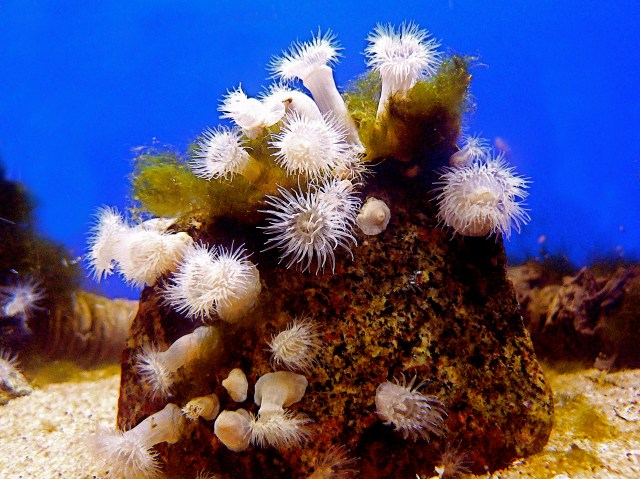
GENERAL CHARACTERISTICS: M. senile is colored white, cream, tan, orange or brown. Height to 5 cm (2 inches). Tentacular crown diameter to 25 cm (9.75 inches), Up to one hundred small, slender tentacles give a feathery (plumose) appearance.

 Metridium senile 3074666433_ab584596e9_o

DISTRIBUTION/HABITAT: Southern Alaska to Southern California and both Atlantic coasts. Found live in groups of up to 500 specimens per square meter at depths to 166 m (540 feet). M. senile lives on rocks, shells, wood pilings and stony breakwaters in bays and harbors in the low intertidal and subtidal zones. Plumose anemones crawl slowly along the substrate by muscular waves of the pedal disk.

DIET IN THE WILD: Mostly small zooplankton, though they may also eat small benthic polychaetes, fish, and squid.

REPRODUCTION: Protandric hermaphrodite starting life as one sex and changes to the other when it is older. Eggs or sperm develop in the gonads embedded in the mesentery that lines the coelom. They are ejected through the mouth, and when fertilised develop into planula larvae which settle and become juveniles.

They also reproduce asexually by binary fission, budding and fragmentation.

PREDATORS: Nudibranch Aeolidia papillosa (on small individuals), and the seastars Hippasteria spinosa and Dermasterias imbricata, which can eat even quite large individuals.  Attacked individuals may detach and drift to a new location.

Location: California Rocky Coast and tide pool

References

Walla Walla University: www.wallawalla.edu/academics/departments/biology/rosario/…

eol  eol.org/pages/421495/details 

Ron’s flickr   https://www.flickr.com/photos/cas_docents/3074666433/in/set-72157625127345346/

Ron’s WordPress shortlink  http://wp.me/p1DZ4b-1ls 

TAXONOMY
Kingdom: Animalia (animals)
Phylum: Cnidaria
Class: Anthozoa
Subclass: Ceriantipatharia,
Order: Ceriantharia
Family: Cerianthidae

Genus/species: Pachycerianthus fimbriatus

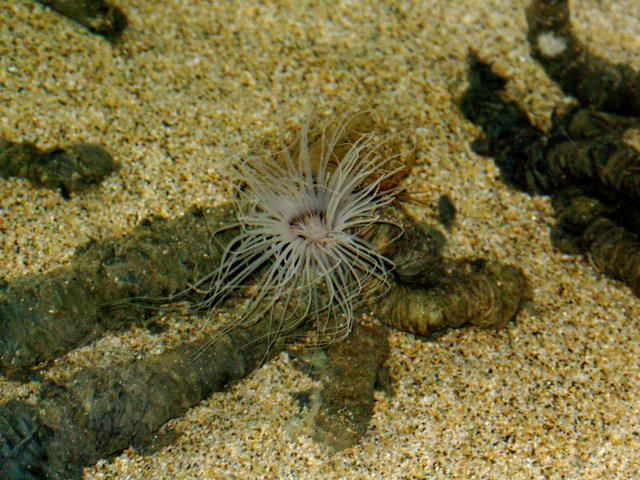
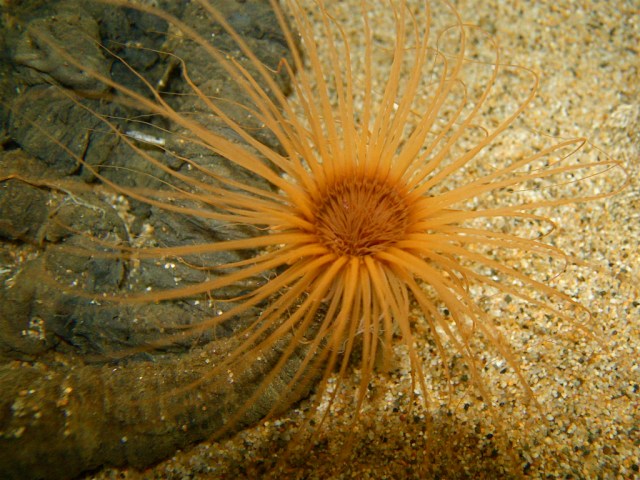
GENERAL CHARACTERISTICS: Solitary tube to 35 cm (14 inches) long when expanded. The tough, slippery, black, secreted tube projects above the mud substrate. Tentacular crown with two circles of translucent whitish to brown-gold tentacles. The inner
circle usually held over the mouth, the outer circle projecting up or out. Like most anemones, the tube-dwelling anemone contains stinging cells or nematocytes along its tentacles.

Tube Anemone  3236526239_4f6bd4f600_o

DISTRIBUTION/HABITAT: California (total distribution poorly known). Fairly common in soft mud bottoms of bays and harbors and protected sandy substrates of the outer coast. Low intertidal and subtidal in S. California; subtidal only in N. California to at least 54 m (177 feet).

Tube Anemone 3288842115_73a426d48d_b

DIET IN THE WILD: Small invertebrates, hydromedusae, small crustaceans and plankton

PREDATORS: Barber slugs clip off its tentacles, resulting in P. fimbriatus retreating quickly down the tube—sometimes pulling the slug in with it. The tentacles grow back after an attack.

REMARKS: Unlike sea anemones the anal pore is at the end of the body.

References

eol eol.org/pages/199417/details

 Walla Walla Universitywww.wallawalla.edu/academics/departments/biology/rosario/…

 Monterey Bay Aquarium www.montereybayaquarium.org/animal-guide/invertebrates/tu…

Ron’s WordPress Shortlink  http://wp.me/p1DZ4b-1kM

Ron’s flickr  https://www.flickr.com/photos/cas_docents/3236526239/in/set-72157625127345346


TAXONOMY
Kingdom:Animalia (animals)
Phylum; Chordata (chordates)
Class: Actinopterygii (ray-finned fishes)
Order: Scorpaeniformes (Scorpionfishes and flatheads)
Family: Hemitripteridae (Sea ravens or sailfin sculpins)

Genus/species: Nautichthys oculofasciatus

8552927419_f503e4fa76_b

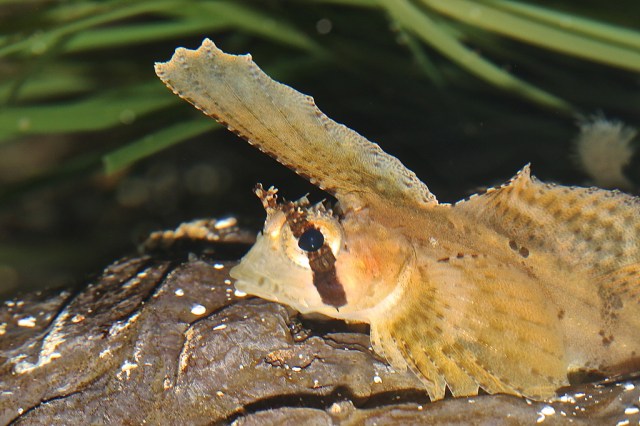
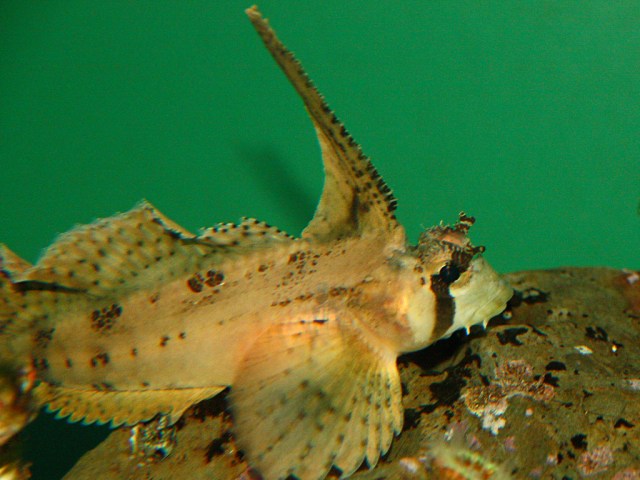
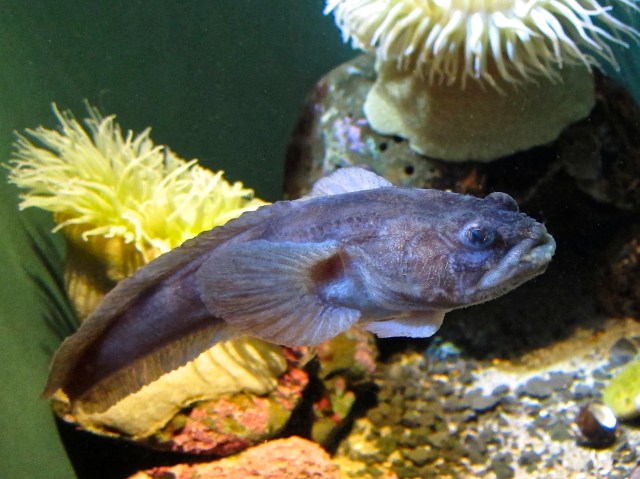
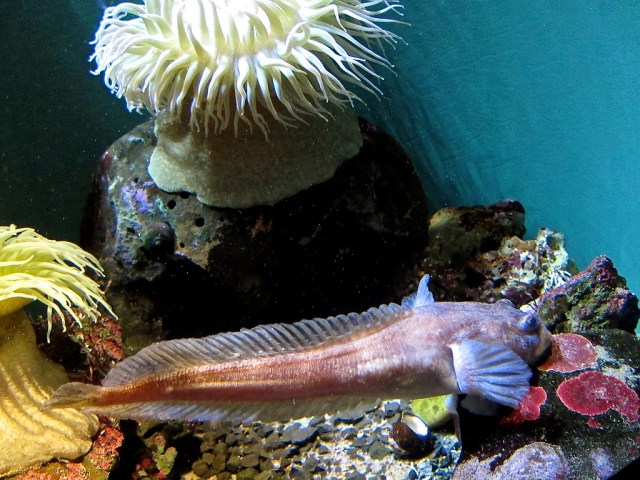
GENERAL CHARACTERISTICS:  The tall, first dorsal fin is extended in front of the head as the fish swims  which resembles a sail. Color varies, grayish on top with variously hued markings and occasionally red markings on dorsal fin. Caudal fin rounded, directed upward. A black band runs diagonally down and back through eye . To 20 cm (8 inches).

Sailfin Sculpin14972884586_258b21dea7_h

DISTRIBUTION/HABITAT: Alaska to San Miguel Island, southern California. Habitat: Found at about 90 m (300 ft) most often on rocky bottoms with algae; occasionally seen hanging upside down in rock crevices.

DIET IN THE WILD: Small invertebrates

REPRODUCTION: Female spawns in winter and spring, when eggs are laid on rocks and often among mussel beds. The male guards the eggs.

Sailfin Sculpin

CONSERVATION: IUCN; not evaluated

Remarks: Common derived from the tall anterior dorsal fin which is extended in front of the head as the fish swims  which resembles a sail. Often the sailfin moves back and forth in the same rhythm as the movement of nearby seaweeds. Coupled with its cryptic coloration, this behavior disguises it from predators.

References

fishbase www.fishbase.org/summary/Nautichthys-oculofasciatus.html

 eol eol.org/pages/204301/hierarchy_entries/44730883/details

Ron’s WordPress Shortlink  http://wp.me/p1DZ4b-Tg

Ron’s flickr  http://www.flickr.com/photos/cas_docents/sets/72157608359804936/with/8552927419/

TAXONOMY
Kingdom: Animalia
Phylum: Chordata
Class: Actinopterygii (ray-finned fishes)
Order: Scorpaeniformes (Scorpionfishes and flatheads)
Family: Hemitripteridae (Sea ravens or sailfin sculpins)

Genus/species: Blepsias cirrhosis

GENERAL CHARACTERISTICS: There is a depression at the back of the head and some long cirri hang from the chin. The front edge of the first dorsal fin is high, the second dorsal and anal fins are long and approximately the same size. Coloration is usually brown mottled above with a light spot near the pectoral fins and pale below. Max length : 20.0 cm (8 inches)

 DISTRIBUTION AND HABITAT: North Pacific: Sea of Japan to the Bering Sea and to San Simeon, central California, USA.  Temperate Marine  Occurs in intertidal areas and to 37 m (120 ft) depth, but more common in subtidal areas. Often found among algae.

DIET IN THE WILD: Nekton and benthic crustaceans.

REPRODUCTION: Fecundity is low, 234–404 eggs. Adult B. cirrhosus  inject eggs into the tissue near the gastral cavity of  the sponge Mycale adhaerens  using it as a spawning bed.  The eggs are hidden by the sponge which is minimally damaged with the sponge also providing constant oxygen and an environment free of most bacteria.

CONSERVATION: IUCN; Not evaluated

LOCATION: Rocky Reef Cluster Sculpins

eol eol.org/pages/206919/details

 fishbase www.fishbase.us/summary/4054

 Ron’s flickr  www.flickr.com/photos/cas_docents/7207822582/in/photolist…

Ron’s WordPress shortlink:  http://wp.me/p1DZ4b-wY


TAXONOMY
Kingdom: Animalia
Phylum: Chordata
Class: Actinopterygii (ray-finned fishes)
Order: Scorpaeniformes (Scorpionfishes and flatheads)
Family: Sebastidae (Rockfishes, rockcods and thornyheads)

Genus/species: Sebastes maliger

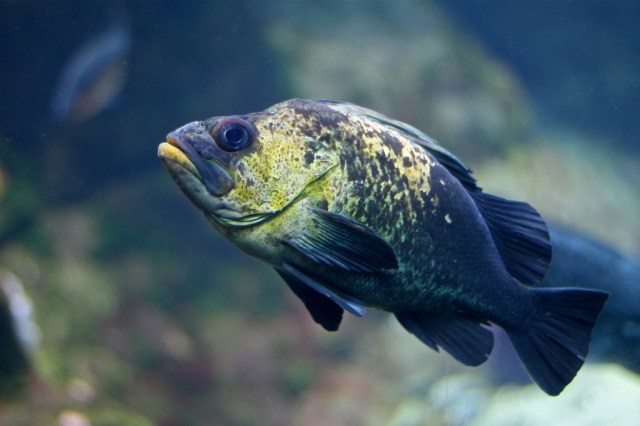
GENERAL CHARACTERISTICS: Brown, with yellow to orange ventral mottling. They have light-colored dorsal saddle patches on the anterior part of the body with vague bands over the head and through the dorsal fin. Often have freckles on head. The dorsal fin spines have deeply incised membranes and are very long.  All fins are dark brown to black except for the first dorsal fin, which has a yellow streak. Length To 61 cm (24 in).

DISTRIBUTION/HABITAT: Gulf of Alaska to Anacapa Passage in southern California. Bottom dwellers perching on rocks or hiding in rock crevices in subtidal waters to depths of 274 m (900 ft).

DIET IN THE WILD: Herring, demersal, pelagic crustaceans, crabs, amphipods, euphasiids, and copepods.

REPRODUCTION: Viviparous as in other Sebastes sp.

LONGEVITY: Live to 95 years.

PREDATORS: Larger fish such as sharks.

CONSERVATION: IUCN Not evaluated

California Rocky Coast CC06

References

 fishbase www.fishbase.org/summary/Sebastes-maliger.html

 eol Encyclopedia of Life eol.org/pages/211614/details 

Washington Dept of Fish and Wildlifewdfw.wa.gov/fishing/bottomfish/identification/rockfish/s_…

flickr http://www.flickr.com/photos/cas_docents/sets/72157608359804936/with/7793249686/

WORDPRESS SHORTLINK  http://wp.me/p1DZ4b-Eu

Kingdom: Animalia
Phylum: Chordata
Class: Actinopterygii (ray-finned fishes)
Order: Perciformes (Perch likes)
Family: Chaetodontidae (Butterflyfishes) The name “Chaetodontidae” means “bristle-tooth”.

Genus/species: Chaetodon sedentarius.

Reef butterflyfish  Chaetodon sedentarius ChaetodontidaeIMG_5652

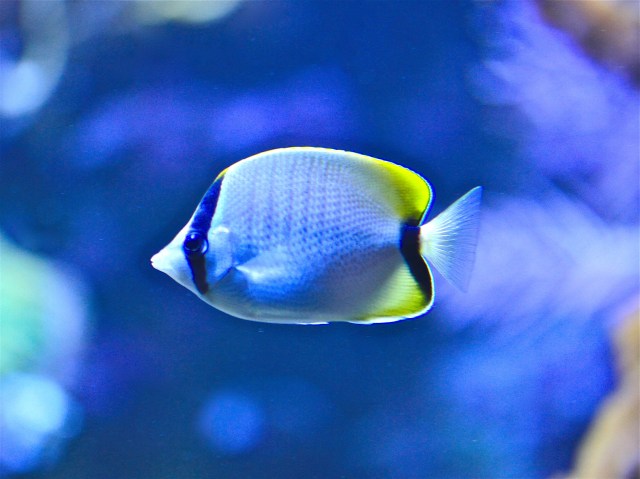
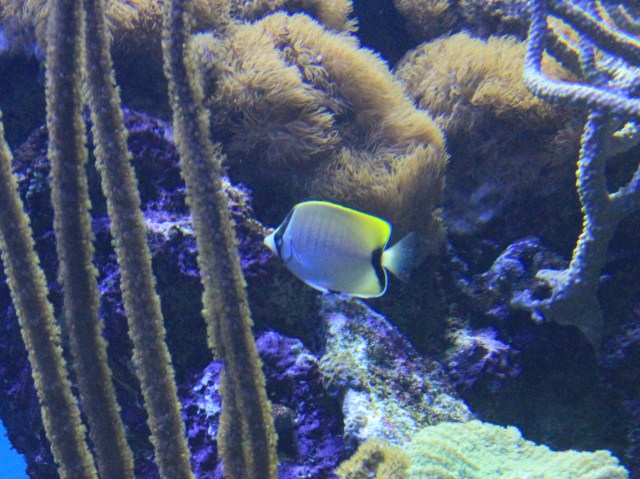
GENERAL CHARACTERISTICS: Silver body, yellow and black dorsal fin, and yellow tail; two vertical black bars, one on the head through the eye and a black bar across the caudal peduncle. Max length: 6 inches (15 cm). 

DISTRIBUTION/HABITAT: a tropical western Atlantic species, found in the waters of the Carolinas to northern South America, including the Gulf of Mexico and the Caribbean Lives in the shallows and as deep as the light restricts coral growth. ( 48-130 feet deep).

DIET IN THE WILD: Coral polyps, polychaete worms, shrimps, amphipods and hydroids. Can be quite acrobatic in its feeding, often swimming upside down to get into crevices where prey might be hiding.

REPRODUCTION: Found in pairs, suggesting monogamy. The larvae of butterflyfishes are unique from all other species of fish. The head is encased in bony armor and large bony plates extend backwards from the head. These larvae, called “tholichthys,” grow to about 20mm, after which they settle on the bottom during the night.

PREDATORS: Preyed upon by larger fish, such as moray eels, snappers, and groupers. If it can’t find cover, will defend itself by facing its predator with dorsal spines erected, suggesting a sharply distasteful meal.

IMG_2594

CONSERVATION: IUCN:  Least concern (LC)

REMARKS: Gets its name from its flitting movements about the reef and its beautiful color pattern that resembles the movements and appearance of the insect. 

Caribbean reef,  Currently not on exhibit

References 

WordPress shortlink  http://wp.me/p1DZ4b-1ds

flickr http://www.flickr.com/photos/cas_docents/4329888679/in/set-72157625119200613

fishbase http://www.fishbase.org/summary/3605

Florida Museum of Natural History: http://www.flmnh.ufl.edu/fish/Gallery/Descript/ButterflyReef/ButterflyReef.htm

TAXONOMY
Kingdom: Animalia
Phylum: Chordata
Class: Actinopterygii (Ray-finned or Bony Fishes)
Order: Batrachoidformes (Only family is below)
Family: Batrachoididae (Toadfishes)

Genus/species: Porichthys notatus

Humming Toadfish 8413703014_a4877b2eaa_o

GENERAL CHARACTERISTICS Toadfishes have large flattened heads and tapered bodies and are the only family in the order. The humming toadfish (aka plainfin midshipman) is scaleless with four lateral lines and eyes high on a large head with a large mouth. The toadfish can be up to 30 cm (1 ft) long; the dorsal fin holds a mild poison. The toadfish possesses photophores (light organs), which are arranged on the underside of the head in a U-shape and are used primarily to attract prey.

DISTRIBUTION/HABITAT Found from Alaska to the Gulf of California. Its habitat ranges from intertidal areas to deeper water over sand and mud bottoms. The toadfish returns to shallow intertidal waters to reproduce and is seasonally common in San Francisco, Suisun, and San Pablo Bays.

Humming Toadfish 2984289639_0f3b1556df_b

DIET IN THE WILD Omnivore: eats worms, crustaceans, mollusks and other fish. Hides in rock crevices among bottom vegetation, or digs dens in bottom sediments to ambush prey. Diet provides the ingredients for fluorescence.

PREDATORS They are prey for seals and sea lions.

REPRODUCTION After building and guarding a nest of rocks, the male entices females by humming his “love song,” a loud sound produced by vibrating a set of sonic muscles on its air bladder 6,000
times a minute for more than an hour at a time. The female chooses her mate, deposits her eggs in the nest, and the male fertilizes and guards them. Males try to attract several females to the same nest.

CONSERVATION Toadfish are not endangered though they are taken by local fishermen as a food fish and by trawlers as a source of fish meal and oil. They are prey for seals and sea lions.

Humming Toadfish 8412481779_4cbf3f513b_b

REMARKS For many years Sausalito residents complained of an annoying noise that kept them awake at night during the summer months. The cause was uncertain, but theories were rampant: underwater surveillance equipment, secret weapons testing, extraterrestrial intrusions were all put forth. Then in the early 1990s the Academy’s Senior Curator and then Director of Steinhart Aquarium, John McCosker, investigated and ultimately reassured irritated residents that the sound had no destructive intent, only a reproductive one.
The remarkable endurance of the toadfish’s sonic muscles are the subject of ongoing research and may lead to clues to fighting human muscle disease as well as general insights into muscle structure and function.

Water planet Senses Cluster Sound WP40

flickr  http://www.flickr.com/photos/cas_docents/sets/72157625020091079/with/8412481695/

WordPress Shortlink  http://wp.me/p1DZ4b-11t

TAXONOMY
Kingdom: Animalia
Phylum: Chordata
Class: Actinopterygii (ray-finned fishes)
Order: Perciformes (Perch-likes)
Family: (Labridae) Wrasses

Genus/speces: Halichoeres semicinctus

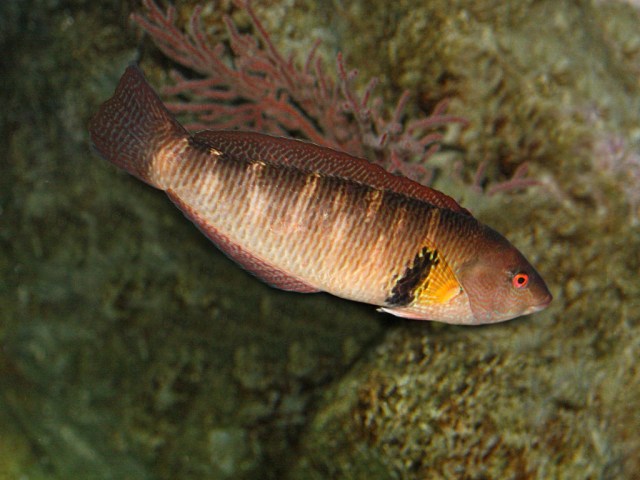
Rock Wrasse (male) below:

Rock Wrasse Male 3995256931_9e14b0f8ab_b

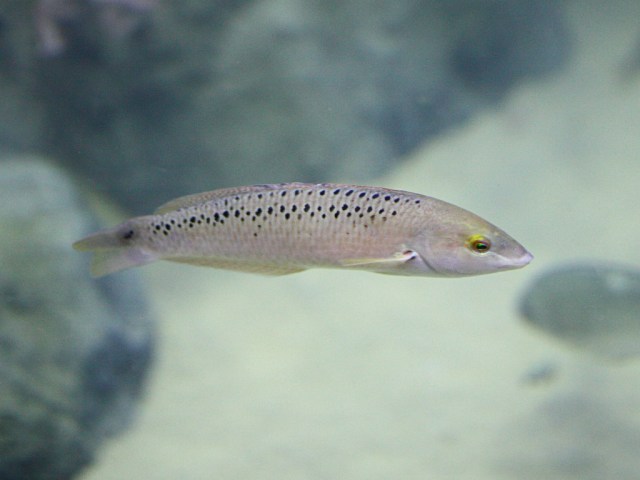
GENERAL CHARACTERISTICS: Length to 38 cm (15 inches). Terminal phase males are characterized by a partial dark stripe behind yellow pectoral fins and pink eyes, while females and immature male rock wrasses are similar in appearance having ranging from brown to yellow to orange. 

Rock Wrasse (female or immature male) below:

Rock Wrasse (female or immature male)  3995255809_8f686dbab8_b

DISTRIBUTION/HABITAT: Pt. Conception, California to Guadalupe Island off central Baja California, Mexico. Habitat: Close to rocks near patches of sand; tidepools and down to 24 m (79 feet).

DIET IN THE WILD: Small invertebrates, taken during the day.

REPRODUCTION: Each individual starts as female then changes to a male at length of about 30 cm. Pelagic spawners

CONSERVATION: IUCN: Least concern.

REMARKS : Sleeps at night buried in sand, with head protruding, and will dart to a sandy refuge during the day if startled.

Rock Wrasse (female or immature male) below:

Rock Wrasse (female or immature male)  2972940984_0ce80884d9_b

Southern California Kelp Tank CC14

WordPress Shortlink http://wp.me/p1DZ4b-Yk

flickr http://www.flickr.com/photos/cas_docents/sets/72157633391356187/with/3995255809/