Category: TEMPERATE MARINE


TAXONOMY
Kingdom: Animalia
Phylum: Chordata
Class: Actinopterygii (ray-finned fishes)
Order: Scorpaeniformes (Scorpionfishes and flatheads)
Family: Sebastidae (Rockfishes, rockcods and thornyheads)

Genus/species: Sebastes pinniger

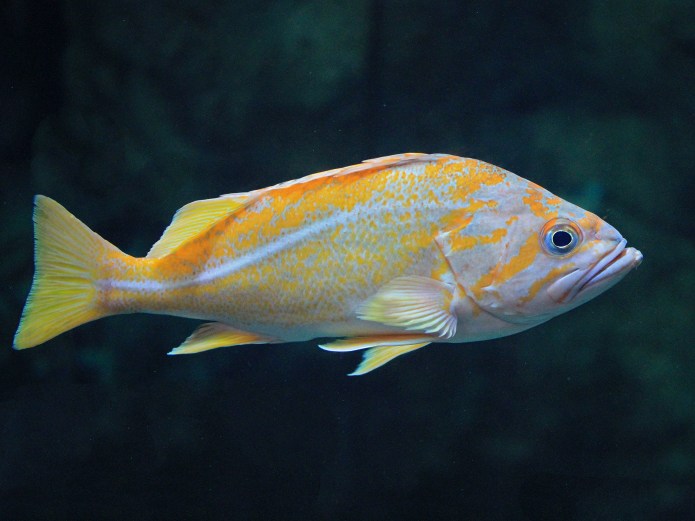
GENERAL CHARACTERISTICS: The Canary Rockfish is bright yellow to orange mottled on a light gray background with 3 orange stripes across head and orange fins. The Lateral line is in a clear area. The pectoral, pelvic, and anal fins are moderately pointed and are large.

Length up to 76 cm (2.5 ft)


DISTRIBUTION/HABITAT: They are found from Alaska to Baja California, Mexico.
S. pinniger adults hover in loose groups above rocky bottoms at average depths of 80–200 m (264-660 ft).

DIET IN THE WILD: They feed on small fishes and krill.

REPRODUCTION: they are mature at 14 in (36 cm) or 5-6 years old., Fertilization: Internal fertilization, ovoviviparous

LONGEVITY: Up to 75 years

CONSERVATION: IUCN Not Evaluated
Minimum population doubling time 4.5 – 14 years. Various state restrictions on fishing have been put in place over the years, including banning retention of canary rockfish in Washington in 2003. Because this species is slow-growing, late to mature, and long-lived, recovery from these threats will take many years, even if the threats are no longer affecting the species.

REMARKS: The Vermillion Rockfish which is similar is more reddish and the lateral one is not in the grey zone.

References

Ron’s flickr Rockfishes https://www.flickr.com/photos/cas_docents/7786389830/in/album-72157608359804936/

Ron’s flickr Canary Rockfish http://www.flickr.com/photos/cas_docents/sets/72157608359804936/with/7564182434/

California Academy of Sciences Steinhart Aquarium California Rocky Reef 2017

PacificCoast Fishes Eschmeyer and Herald 1983 Easton Press page 146

fishbase www.fishbase.org/summary/3989

NOAA FISHERIES 2-3-17 www.fisheries.noaa.gov/pr/species/fish/canary-rockfish.html

Ron’s WordPress shortlink wp.me/p1DZ4b-Dm


TAXONOMY
Kingdom: Animalia
Phylum: Chordata
Class: Actinopterygii (ray-finned fishes)
Order: Perciformes (Perch-likes)
Family: Embiotocidae (Surfperches)

Genus/species; Hyperprosopon argenteum

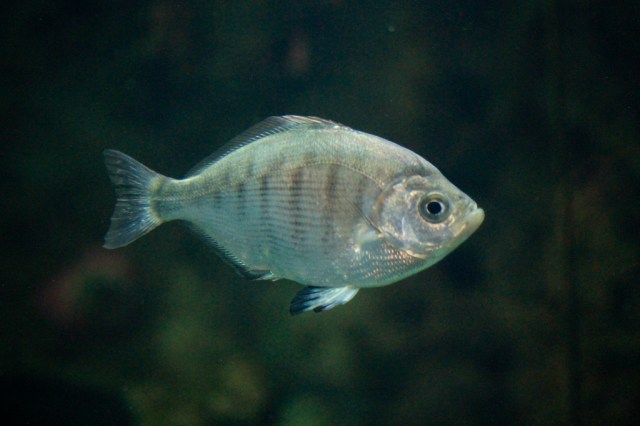
GENERAL CHARACTERISTICS: Thin-bodied, football-shaped profile with large eyes (about 1/3 of head length). Silver, often with bluish or greenish tints; may display dusky bars and black edges on caudal and anal fins. The caudal (tail) fin is forked. Dorsal fins are continuous, not notched and the pelvic fins have black tips.

Length to 30 cm (12 inches).

WalleyedSurfperch4330632348_5a0a951c76_b

DISTRIBUTION/HABITAT: H. argenteum are found from Vancouver Island, British Columbia, Canada to central Baja California, Mexico. They are located in the surf on sand beaches and over sand near rocks, to 18 m (60 ft) often in dense rapidly swimming schools.

DIET IN THE WILD: Small crustaceans

REPRODUCTION: Fertilization is internal. Viviparous; bear 5–12 young; newborns about 3.8 cm (1.5 in) long

LONGEVITY: Up to 6 years

CONSERVATION: IUCN: Not evaluated

REMARKS: Walleye Surfperch are important commercial and sport fish.

References

Ron’s WordPress shortlink  http://wp.me/p1DZ4b-1jZ

California Academy of Sciences Steinhart Aquarium California Rocky Coast 2017

PacificCoast Fishes Eschmeyer and Herald, Easton Press 1983, page 230

Ron’s flickr  https://www.flickr.com/photos/cas_docents/36360564855/in/album-72157608359804936/

CA Dept. of Fish and Wildlife  www.dfg.ca.gov/marine/sfmp/surfperch-id.asp

eol  eol.org/pages/207481/details

fishbase  www.fishbase.org/summary/3631


TAXONOMY
Kingdom: Animalia
Phylum: Chordata
Class: Actinopterygii
Order: Perciformes
Family: Embiotocidae (Surfperches)

Genus/species: Amphistichus rhodoterus

 GENERAL CHARACTERISTICS: The body of the Redtail Surfperch is a deep oval shape and is compressed from side to side. All fins reddish or pink. Faded brown bars on the side. Silvery overall with pale olive shading above and 9 to 11 narrow vertical dark bars, posteriorly, broken and staggered along the lateral line. Caudal (tail) fin broadly forked; dorsal fin distinctive for the long dorsal spines that contrast with shorter soft rays.

Length up to: 41 cm (16 in) and 2.1 kg (4.5 lbs.) in weight.


DISTRIBUTION/HABITAT: Temperate marine. Vancouver Island to Monterey Bay around sand beaches and rocky shores in surf.

DIET IN THE WILD:  A. rhodoterus feeds on worms, crabs, other small crustaceans, and fishes.

LONGEVITY: Life span: up to 9 years.

REPRODUCTION: The Redtail Surfperch females are viviparous and reproductively mature at 3–4 years; males mature at 2 years. The females enter bays and estuaries to spawn.

REMARKS: This shallow water schooling surfperch is most often caught from central California northward.  A. rhodoterus omprises 10–30% of the total recreational catch in this area. Redtails also support a sizable commercial fishery, and comprise almost 75% of the commercial surfperch catch.

References

Ron’s flickr https://www.flickr.com/photos/cas_docents/7800132290/in/album-72157608359804936/

fishbase www.fishbase.org/summary/3624

California Academy of Sciences Steinhart Aquarium California Rocky Coast 2017

WashingtonDept. of Fish and Wildlife wdfw.wa.gov/fishing/bottomfish/identification/perch/a_rho…

Ron’s WordPress shortlink  http://wp.me/p1DZ4b-1jC


TAXONOMY:
Kingdom: Animalia
Phylum: Chordata
Class: Actinopterygii
Order: Gasterosteiformes (sea horsespipefishes)
Family: Syngnathidae  (seahorses, the pipefishes, the pipehorses, and the leafyruby, and weedy seadragons all have fused jaws)

Genus/species: Hippocampus ingens

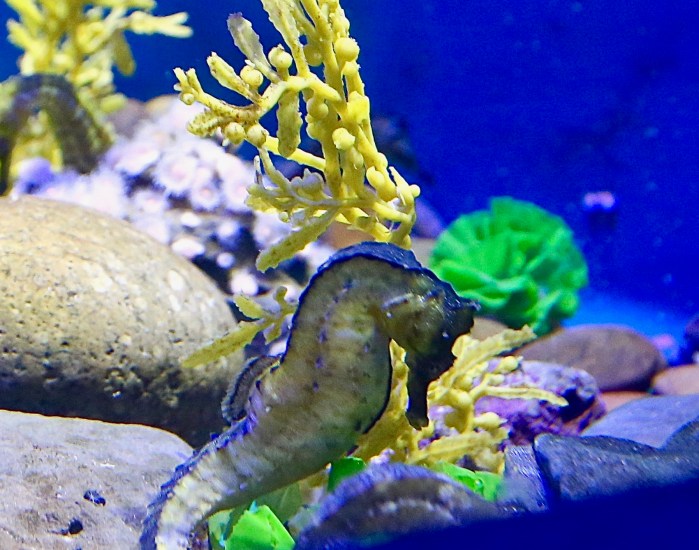
GENERAL CHARACTERISTICS: Their color is variable and can change their body color, depending on the environment. Body colors include maroon, yellow, and muddled brownish-green. adults have thin close set scrubby lines along the head and body.
The tail prehensile and flexible and able to coil around seagrass and other objects.

Length up to 12 inches long.

DISTRIBUTION:HABITAT: Southern California to Peru including the Galapagos Islands. Found on temperate reefs clinging to sponges, branching coral, sea-whips and inhabits weed beds, usually at depths of 1—20 m (3.28-65 ft).

DIET IN THE WILD: Small shrimp, mysids and other plankton. Seahorses lack teeth and jaws instead suck prey through their tube-like snouts.

REPRODUCTION: H. ingens males and females perform a mating “dance” by bobbing up and down together lasting for three days. Finally, a male will display his empty breeding pouch, which the female will fill with eggs using her ovipositor. Males carry fertilized eggs in a brood pouch for 2-3 weeks up and then releases up to 1000 hatched individuals.

LIFESPAN: Estimated range is 3-5 years. The Pacific Seahorse’s camouflage abilities are its best defense to avoiding predation.

PREDATORS: Pacific Seahorses are also known to be associated with flotsam as it has been collected at the surface and from the stomachs of the Pacific Yellowfin Tuna and Bluefin Tuna.

CONSERVATION: IUCN: Vulnerable
Declines result from targeted catch, incidental capture, and habitat degradation from coastal development. Once caught, H. ingens are used throughout Latin America for curios, occasionally in traditional medicine, and in the live aquarium trade. The vast majority are exported internationally for use in traditional medicine.

REMARKS: Academy individuals were captive raised in the Cabrillo Aquarium, Cabrillo, CA.

References

Ron’s flickr  https://www.flickr.com/photos/cas_docents/35417467820/in/album-72157608359804936/

California Academy of Sciences Steinhart Aquarium Water Planet 2017

Animal Diversity Web  animaldiversity.org/accounts/Hippocampus_ingens/

IUCN www.iucnredlist.org/details/10072/0

Ron’s WordPress Shortlink wp.me/p1DZ4b-1QX

TAXONOMY
Kingdom: Animalia
Phylum: Mollusca
Class: Gastropoda
Clade: Vetigastropoda
Superfamily: Trochoidea
Family: Turbinidae

Genus/specie: Megastraea undosa

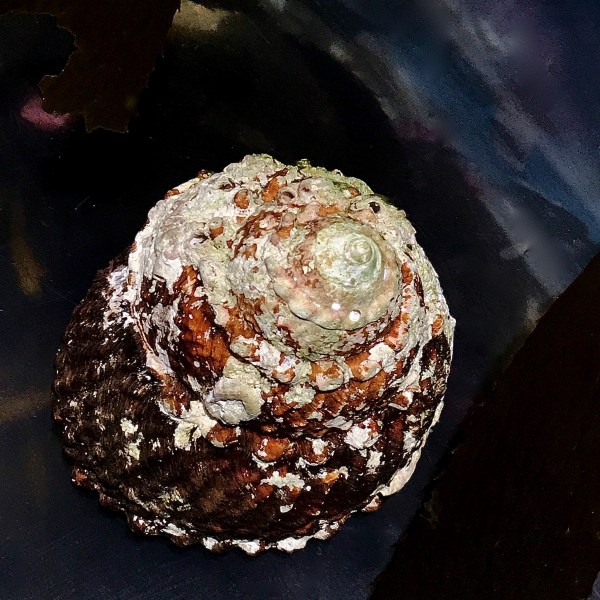
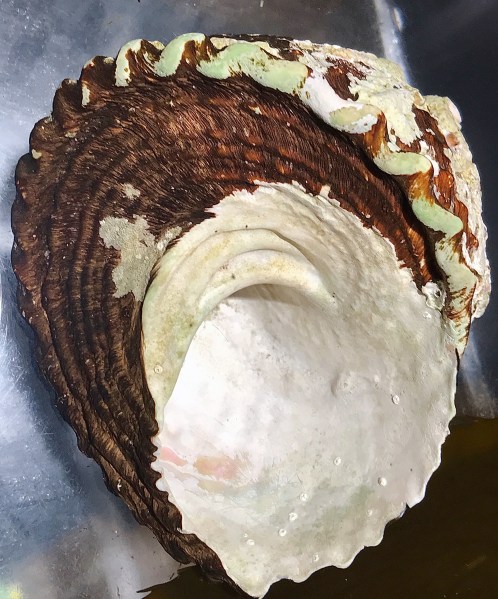
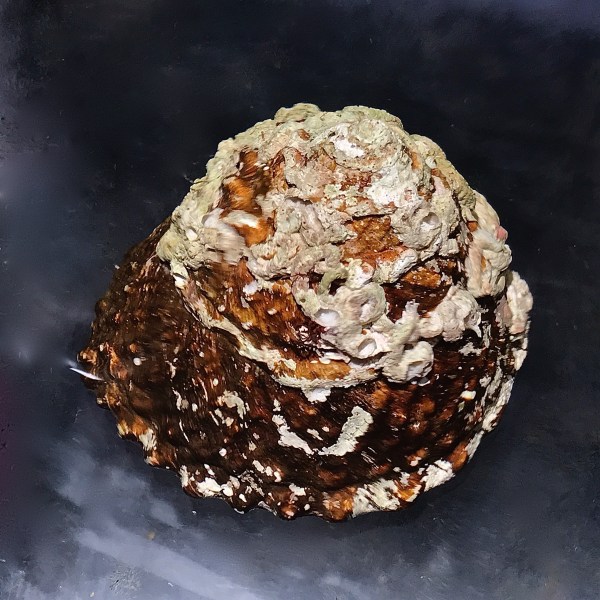
GENERAL CHARACTERISTICS: The Wavy Turbin Snail has a heavy, sculptured shell with undulating ridges in a turbinate-conical shape with a thick, pearly lining.
The light brown or tan shell color is caused by the fibrous periostracum covered with coralline algae and other epiphytes.

Size: up to 6 inches

DISTRIBUTION/HABITAT: Found from Point Conception and the coastal Channel Islands to northern Baja California, Mexico. They range from the intertidal zone down to depths of over 250 feet.

DIET IN THE WILD: M. undosa are herbivores feeding on various types of algae.

REPRODUCTION; Year around with peaks in spring and fall.

CONSERVATION: Because wavy turban snails are hand-picked by divers, the fishery is at low risk for bycatch .
Wavy turban snails are abundantly available and have a high productivity rate, so over- harvesting is less likely.

REMARKS: The shells of wavy turban snails are used to make buttons!

The meat has an abalone-like texture and taste; foot of the snail is processed and sold to restaurants as an abalone-like product, “wav alone”.  They can be prepared many ways: grilled, sautéed, battered and fried, in pastas, in chowders and soups, and in stir fries.

References

California Academy of Sciences Steinhart Aquarium Tidepool 2017

Ron’s flickr https://www.flickr.com/photos/cas_docents/34539982943/in/dateposted-public/

Spearboard.com www.spearboard.com/showthread.php?t=99314

U of CA San Diego caseagrant.ucsd.edu/sites/default/files/fact-sheet-wavy-t…

Gastropods.com www.gastropods.com/2/Shell_292.shtml

Ron’s WordPress Shortlink  http://wp.me/p1DZ4b-1Qf

TAXONOMY
Kingdom:Animalia
Phylum: Mollusca
Class: Polyplacophora
Order: Neolocrcata
Family: Acanthochitonidae

Genus/species: Cryptochiton stelleri

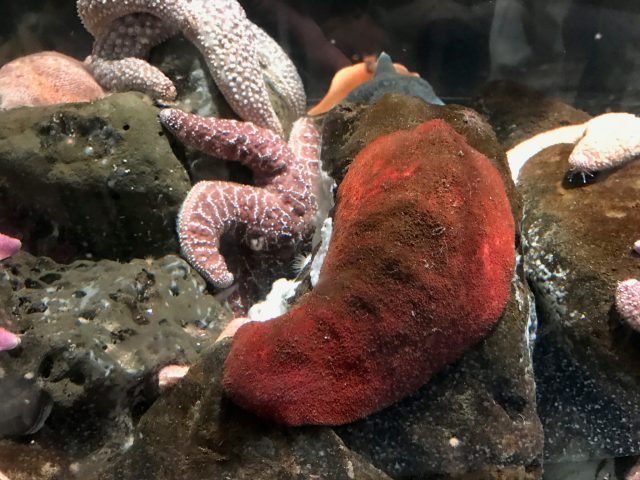
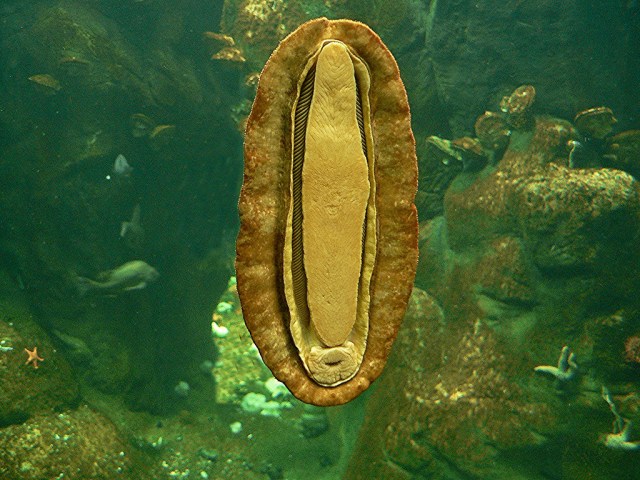
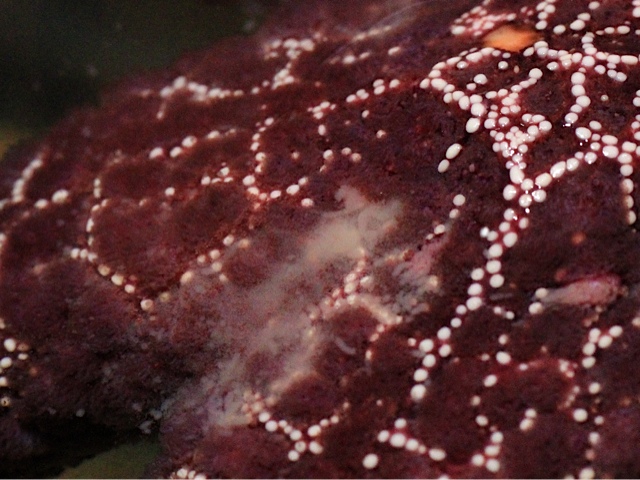
GENERAL CHARACTERISTICS: The gumboot is a long, meatloaf-like chiton with a brick-red mantle covering the eight plates of their jointed shell. The shell plates are completely internal in adults. This is the largest chiton in the world; it grows to 33 cm (13 in). It may live up to 20 years.

Gumboot Chiton32905300616_5519787bf4_k

DISTRIBUTION/HABITAT: Found from Alaska west to Japan and south to the Channel Islands, the gumboot chiton inhabits rocky intertidal areas to 80 feet, often among kelp.

DIET IN THE WILD: A nocturnal grazer, it used its long, tongue like radula to scrape off the upper tissue of soft red algae and various coralline algae, giant kelp and oarweed, in the process getting nutrition from the tiny organisms that live on the algae’s surface. The radula is covered with tiny, very hard teeth that give it the texture of rough sandpaper.

2997683294_70ce9df050_b

PREDATORS: Its only known predator is the large rock snail Ocenebra lurida, which drills through the chiton’s outer covering with its radula to feed on the flesh below.

REPRODUCTION: The sexes are separate; eggs and sperm are broadcast into the sea.

CONSERVATION: IUCN Not Evaluated

REMARKS: California coastal Native Americans may have eaten them, as shell plates have been found in middens. An Academy researcher states that this chiton was a food of the last resort, “tastes ghastly!”

The radulae of chitons and limpets are unique in having a high percentage of iron magnetite incorporated into the feeding teeth. Magnetite is so named because it is strongly attracted to magnets, and you can actually pick up this chiton’s teeth and radula with a magnet!
When exposed to air during low tide, the gumboot chiton can breathe at a reduced rate by absorbing oxygen from the atmosphere.

The red fuzzy stuff often on the surface is red algae. About 20 species of red algae are known to live on subtidal individuals. This chiton’s diet of red algae also contributes to its color.

Chitons are among the most ancient living mollusk groups, dating back to 400–500 million years ago.

References

California Academy of Sciences Steinhart Aquarium Tidepool 2017

Monterey Bay Aquarium www.montereybayaquarium.org/animal-guide/invertebrates/gu…

ADW animaldiversity.org/accounts/Cryptochiton_stelleri/

EOL eol.org/pages/403806/details

Ron’s WordPress shortlink  http://wp.me/p1DZ4b-1LP

Ron’s flickr https://www.flickr.com/photos/cas_docents/32905300616/in/album-72157660640336765/


TAXONOMY
Kingdom: Animalia
Phylum: Echinodermata
Class: Asteroidea
Order: Forcipulatida
Family: Asteriidae

Genus/species: Pisaster ochraceus

GENERAL CHARACTERISTICS: Color varies from orange, violet, dark brown or mottled, but very rarely ochre. One study showed that less than two percent of the individuals in three local Northern California populations were “ochre” in color. When dead and dry they become ochre in color.
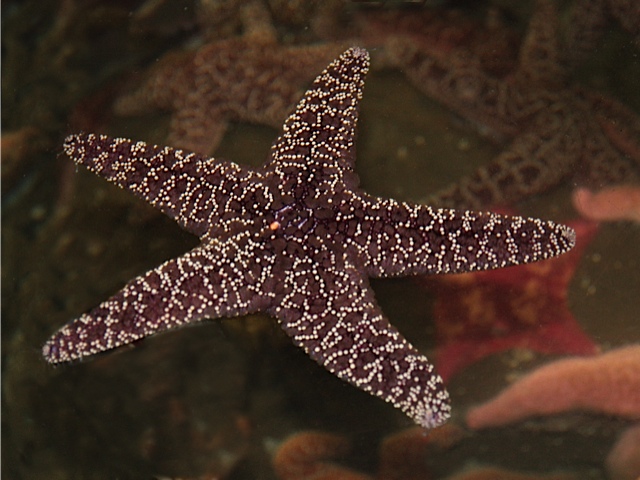

The aboral surface contains many small spines (ossicles) that are arranged in a netlike or pentagonal pattern. Papulae or coelomic pouches give the seastar’s surface a soft, fuzzy appearance. They are used for respiration and waste excretion. P. ochraceus may have an arm radius of up to 28 cm (11 in), but the more common radius is half that figure. They typically have five arms or rays, but the number can range from four to seven. Like all sea stars, an adult P. ochraceus has tube feet which they use for locomotion and for handling prey.

DISTRIBUTION/HABITAT: Ochre stars range from Alaska to Santa Barbara County, California. They prefer the low-to-mid intertidal zones on rocky shores, especially on mussel beds, and are also found in the subtidal zone to a depth of 88 m (288 ft). Juveniles are found in crevices and under rocks.

DIET IN THE WILD: California mussels are the favored and locally abundant prey. They also consume acorn barnacles, emarginated dogwinkles, gooseneck barnacles, owl limpets, etc. They can insert their stomach into slits as narrow as 0.1 mm between the valves of bivalves and begin digestion.

ACADEMY DIET: Manila clams, chopped fish, large krill, chopped squid; it also eats other exhibit inhabitants.
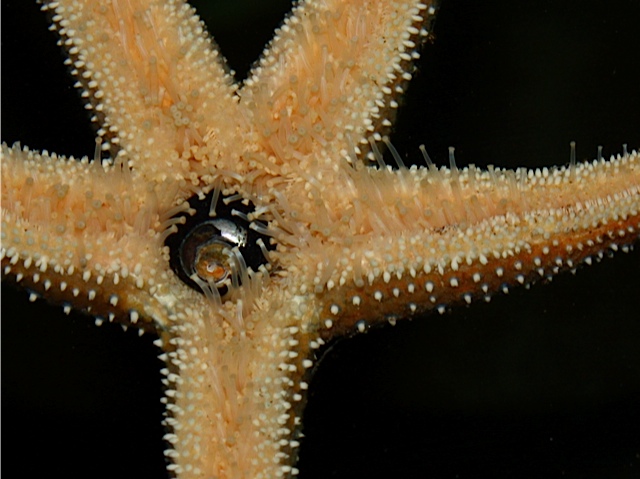
REPRODUCTION: They are mainly dioecious (separate sexes). Male gametes are produced, but at a later date only females gametes are produced. During a transitional period, both eggs and sperm are produced. The gonopores of the individual gonads open at the bases of the arms. Fertilization is external. Larvae are free-swimming and plankton-feeding.

LIFESPAN: Up to 20 years
PREDATORS: Adults are eaten by sea otters and seagulls. According to Dr. Thomas Niesen, the sea otter can crunch them up but is also known to bite off the tips of the arms and suck out the gonads.

REMARKS:  One study showed that less than 2% of the individuals in three local Northern California populations were “ochre” in color. When dead and dry they become ochre in color.

P. ochraceus tolerate strong surges, large temperature changes, dilution by rainfall. It is resistant to desiccation and it can tolerate a loss of thirty-percent of its body weight in body fluids.

Sea stars can regenerate lost arms with a portion of the central disc intact and in some species from a single arm.

NOTE:   SEA STAR WASTING SYNDROME has become a major issue in both the Pacific and Atlantic Oceans since 2013. For an excellent summary check this link to the University of Santa Cruz 9-9-14.  http://www.eeb.ucsc.edu/pacificrockyintertidal/data-products/sea-star-wasting/updates.htm

Fitzgerald Marine Reserve. www.fitzgeraldreserve.org/newffmrsite/wp-content/uploads/...

11-17-14 Recent research identifies a virus (Parvoviridae) to be responsible for the wasting disease. Introduced virus was able to infect healthy sea stars with the virus, which then leads to the wasting symptoms. Published in the Proceedings of the National Academy of Science. http://theconversation.com/mystery-virus-that-turned-millions-of-starfish-into-goo-is-finally-identified-34336


Additional References

California Academy of Sciences Docent Tidepool Guide 2015

Woods Hole www.whoi.edu/science/B/people/kamaral/SeaStar.html

Bishop Museum hbs.bishopmuseum.org/pubs-online/pdf/op11-8.pdf

Encyclopedia of Life  eol.org/pages/598469/details

Animal Diversity Web, U of Michigan  animaldiversity.ummz.umich.edu/accounts/Pisaster_ochraceus/

Ron’s WordPress Shortlink  http://wp.me/p1DZ4b-sC

Ron’s flickr  https://www.flickr.com/photos/cas_docents/3407968572/in/set-72157608501343477/


TAXONOMY
Kingdom: Animalia
Phylum: Cnidaria
Class: Anthozoa
Subclass: Zoantharia
Order: Actiniara (anemones)
Family: Actiniidae

Genus/species: Urticina piscivora

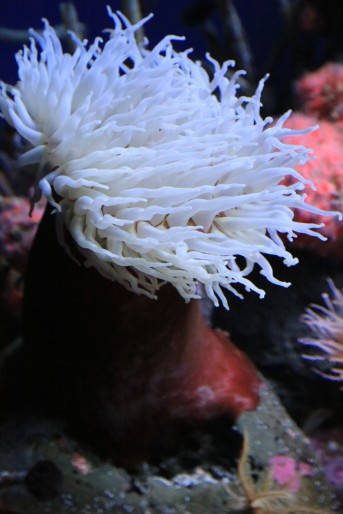
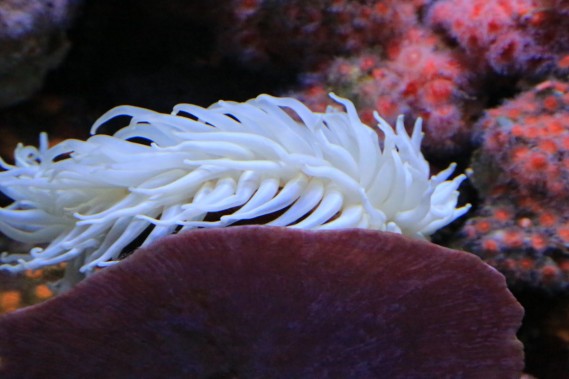
GENERAL CHARACTERISTICS: Large to 20 cm (8 inches) high and 26 cm (10 inches) across. The column is red (without spots) with white. Tentacles are white, and the oral disc is creamy yellow. Normally they do not accumulate debris such as shells and sand.

IMG_9525 

DISTRIBUTION/HABITAT: Alaska to southern California. Found in low intertidal areas with rocky attachment sites and at least moderate current. Depth to about 50 m (160 feet)

IMG_9523

DIET IN THE WILD: Invertebrates, shrimp and small fishes. U. piscivora have no zooxanthellae and depend wholly on capturing their food, a strategy aided by their exceptionally virulent nematocysts (stinging cells), which can cause long-lasting lesions on humans. Food items are usually swept into the central mouth by the tentacles where enzymes digest the food. Non digested items are expelled out through the mouth.


Genus/species: Urticina piscivora3702912695_1708579b2e_b 

CONSERVATION: IUCN Not evaluated

REMARKS: One fish species, the painted greenling (Oxylebius pictus), has been observed lying unharmed in this anemone much as clownfish do in tropical anemones. 

References

California Academy of Sciences Steinhart Aquarium California Coastal Marine Reef Exhibit

eol eol.org/pages/2549643/details

Walla Walla Universitywww.wallawalla.edu/academics/departments/biology/rosario/…

Georgia Aquariumanimalguide.georgiaaquarium.org/home/galleries/cold-water…

Ron’s flickr www.flickr.com/photos/cas_docents/3702912695/in/set-72157…

Ron’s WordPress shortlink http://wp.me/p1DZ4b-1l6


TAXONOMY
Kingdom: Animalia
Phylum: Cnidaria
Class: Anthozoa
Order: Actiniaria
Family: Metridiidae

Genus/species: Metridium farcimen  aka Metridium giganteum
Metridium farcimen4545409258_06cac3dd83_b

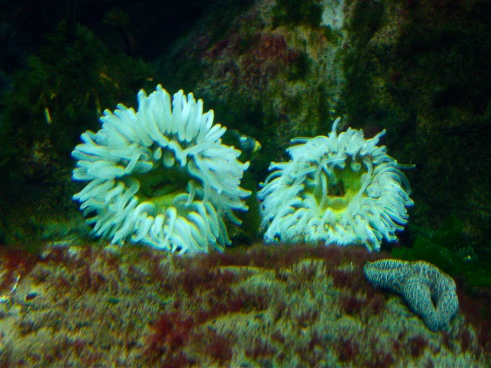
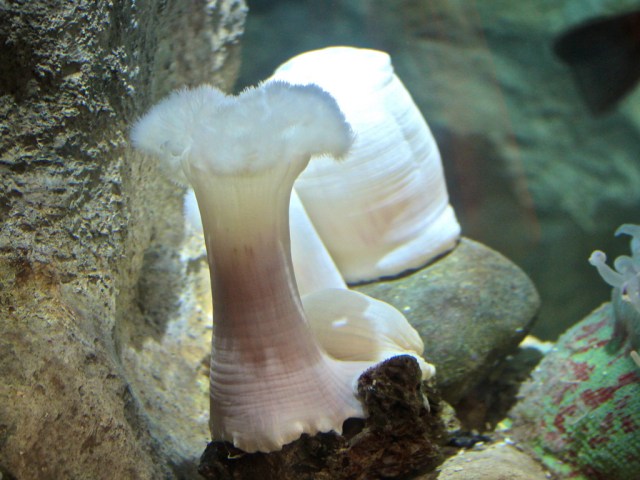
GENERAL CHARACTERISTICS: Erect smooth column. Usually 50 cm (20 in) or less in height The column is slender, smooth and studded with acontia. These are openings through which thread-like nematocysts from inside the body wall can protrude. The oral disc is lobed and deeply convoluted at the edge and bears well over 100 fine, short, tapering tentacles. Color variable from white through cream to tan, brown and orange. Carries short, feathery tentacles in white, brown or gray.

 Metridium farcimenIMG_9548

DISTRIBUTION/HABITAT: Eastern North Pacific: Alaska to Baja California. Found in sub tidal areas attached to rocky substrate. Individuals usually aggregate in groups on deeper rocky reefs.

 Metridium farcimen4673318353_928bfcd2f0_o

DIET IN THE WILD: Plankton—whatever drifts by or is carried in by the tide; predators include Pisaster spp. sea star and some species of nudibranchs.

REPRODUCTION: Eggs and sperm from the gonads embedded in the body wall which are ejected through the mouth. Fertilised eggs develop into planula larvae which settle and metamorphose into polyps.                   

PREDATORS: Pisaster spp. sea star and some species of nudibranchs.

REMARKS: When attacked, they contract suddenly, extruding specialized nematocysts through the mouth and body wall that, much larger than those found in the tentacles, can deter or even kill predators.

 Location: California Rocky Coast and Giant Pacific Octopus exhibits

 References

 The University of Kansas kuscholarworks.ku.edu/dspace/handle/1808/6043

 eol eol.org/pages/704280/details#type_information

 racerocks:www.racerocks.com/racerock/eco/taxalab/ensy02/bend.htm

 Ron’s flickr  https://www.flickr.com/photos/cas_docents/3400331201/in/set-72157625127345346/

Ron’s WordPress shortlink  http://wp.me/p1DZ4b-1lg


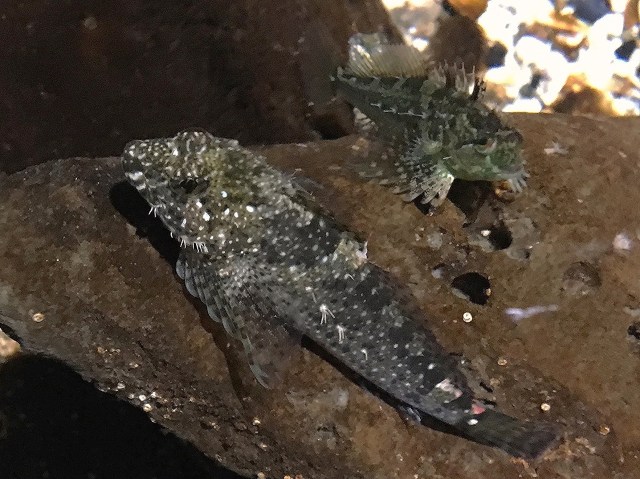
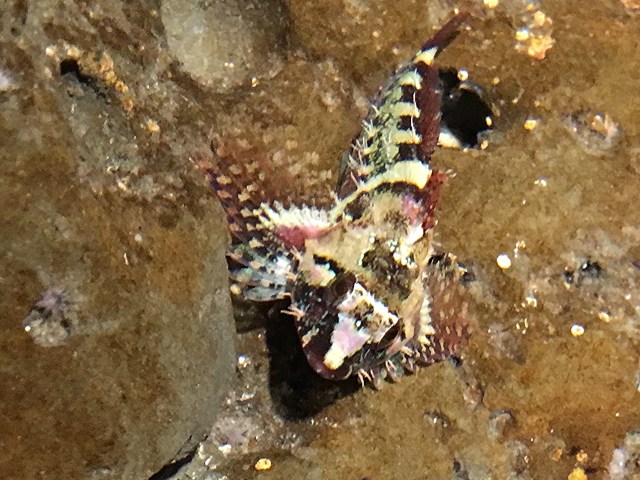
Sculpins are small fish of the family Cottidae (order Scorpaeniformes).

GENERAL CHARACTERISTICS: Sculpins are elongated, tapered fish, usually with wide, heavy heads. The gill covers have one or more spines, the pectoral fins are large and fan like, and the skin is either naked or provided with small spines.

26443280072_865a4ff4c5_o

DISTRIBUTION/HABITAT: Marine tidepools, California coast.

Sculpins26443283022_e0865caf03_o

References

California Academy of Sciences Steinhart Aquarium Tidepool 2016