Category: INVERTEBRATES


TAXONOMY
Kingdom:Animalia
Phylum: Mollusca
Class: Polyplacophora
Order: Neolocrcata
Family: Acanthochitonidae

Genus/species: Cryptochiton stelleri

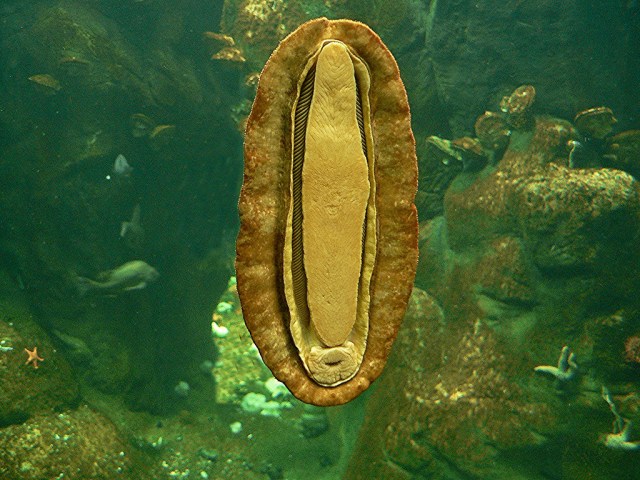
GENERAL CHARACTERISTICS: The gumboot is a long, meatloaf-like chiton with a brick-red mantle covering the eight plates of their jointed shell. The shell plates are completely internal in adults. This is the largest chiton in the world; it grows to 33 cm (13 in). It may live up to 20 years.
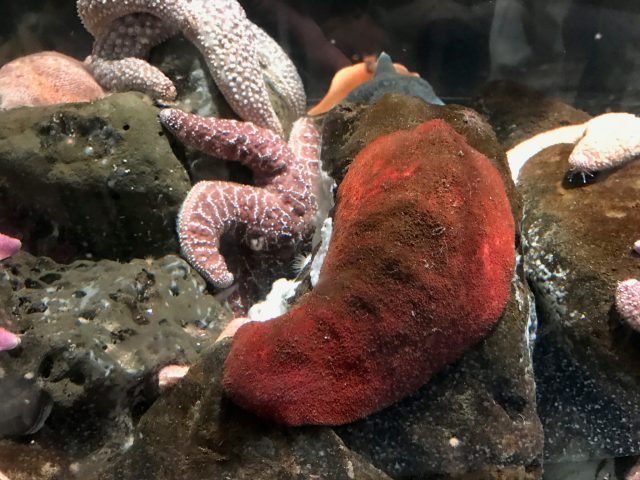
Gumboot Chiton32905300616_5519787bf4_k

DISTRIBUTION/HABITAT: Found from Alaska west to Japan and south to the Channel Islands, the gumboot chiton inhabits rocky intertidal areas to 80 feet, often among kelp.

DIET IN THE WILD: A nocturnal grazer, it used its long, tongue like radula to scrape off the upper tissue of soft red algae and various coralline algae, giant kelp and oarweed, in the process getting nutrition from the tiny organisms that live on the algae’s surface. The radula is covered with tiny, very hard teeth that give it the texture of rough sandpaper.
2997683294_70ce9df050_b

PREDATORS: Its only known predator is the large rock snail Ocenebra lurida, which drills through the chiton’s outer covering with its radula to feed on the flesh below.

REPRODUCTION: The sexes are separate; eggs and sperm are broadcast into the sea.

CONSERVATION: IUCN Not Evaluated

REMARKS: California coastal Native Americans may have eaten them, as shell plates have been found in middens. An Academy researcher states that this chiton was a food of the last resort, “tastes ghastly!”

The radulae of chitons and limpets are unique in having a high percentage of iron magnetite incorporated into the feeding teeth. Magnetite is so named because it is strongly attracted to magnets, and you can actually pick up this chiton’s teeth and radula with a magnet!
When exposed to air during low tide, the gumboot chiton can breathe at a reduced rate by absorbing oxygen from the atmosphere.

The red fuzzy stuff often on the surface is red algae. About 20 species of red algae are known to live on subtidal individuals. This chiton’s diet of red algae also contributes to its color.

Chitons are among the most ancient living mollusk groups, dating back to 400–500 million years ago.

References

California Academy of Sciences Steinhart Aquarium Tidepool 2017

Monterey Bay Aquarium www.montereybayaquarium.org/animal-guide/invertebrates/gu…

ADW animaldiversity.org/accounts/Cryptochiton_stelleri/

EOL eol.org/pages/403806/details

Ron’s WordPress shortlink  http://wp.me/p1DZ4b-1LP

Ron’s flickr https://www.flickr.com/photos/cas_docents/32905300616/in/album-72157660640336765/


TAXONOMY
Phylum: Cnidaria
Class: Anthozoa
Subclass: Hexacorallia
Order: Corallimorpharia
Family: Corallimorphidae

Genus/species: Corynactis sp.

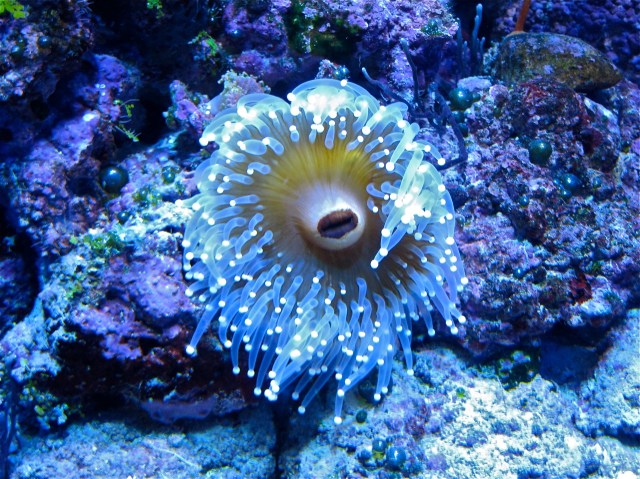
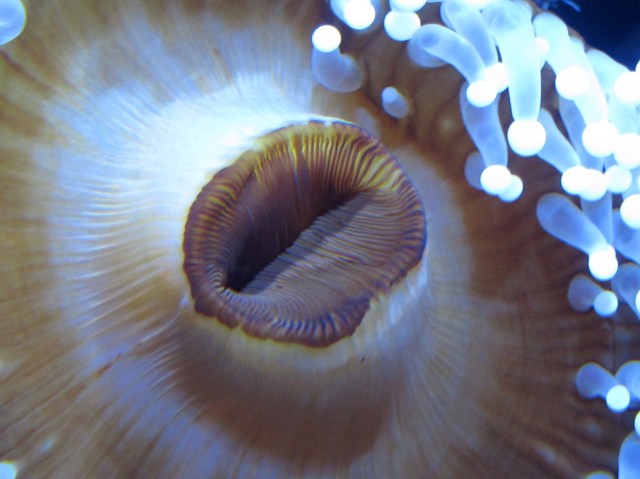
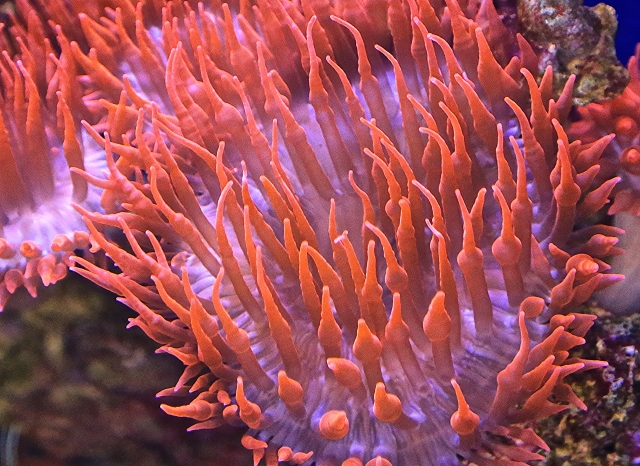
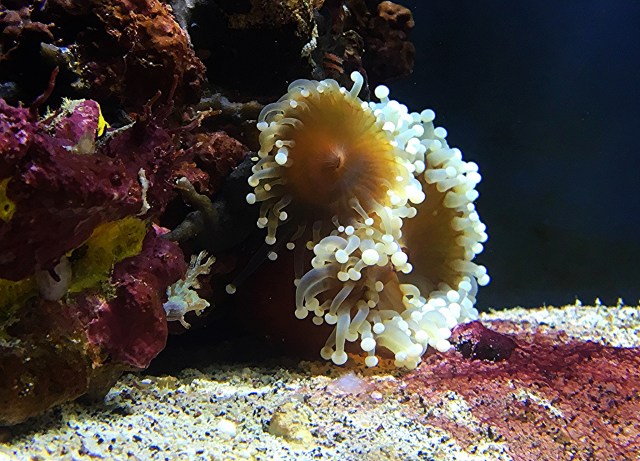
GENERAL CHARACTERISTICS: Note ball tipped tentacles. 

BallAnemone31690177025_2d4172bda6_k 


DISTRIBUTION: Tropical Indian, Central and Western Pacific Oceans

HABITAT: Reef associated

DIET: Small fish and zooplankton

REMARKS: This close relative of sea anemones has sticky ball-tipped tentacles.  Some species of shrimps and fish are immune to the stickiness and live within the tentacles.

Corallimorpharia (Corallimorph) is an order of marine cnidarians closely related to the true sea anemones (Actiniaria). They are mostly tropical, with a narrow column topped with a wide oral disc. The tentacles are usually short or very short, arranged in rows radiating from the mouth. Many species occur together in large groups. In many respects, they resemble the stony corals, except for the absence of a stony skeleton. 

References

California Academy of Sciences Steinhart Aquarium Color on the Reef 2017 AQA17 Charles Delbeek

EOL eol.org/pages/75554/names

WordPress Shortlink  http://wp.me/p1DZ4b-ji

flickr https://www.flickr.com/photos/cas_docents/31690177025/in/album-72157659465376212/


TAXONOMY
Kingdom: Animalia
Phylum: Cnidaria
Class: Anthozoa
Order: Alcyonacea
Family: Nephtheidae

Genus: Capnella sp. (Tree-like soft coral)

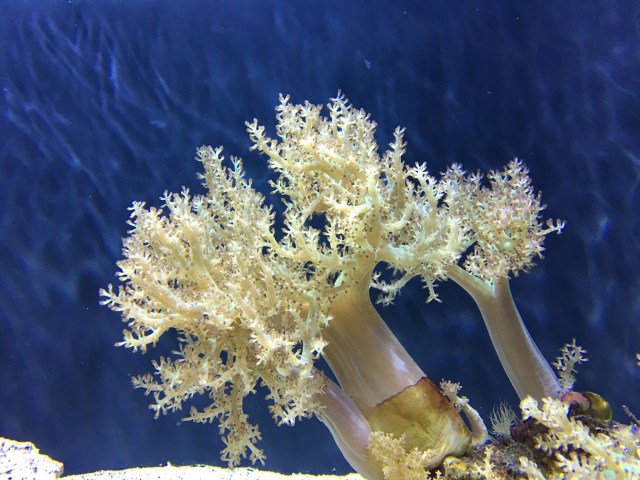
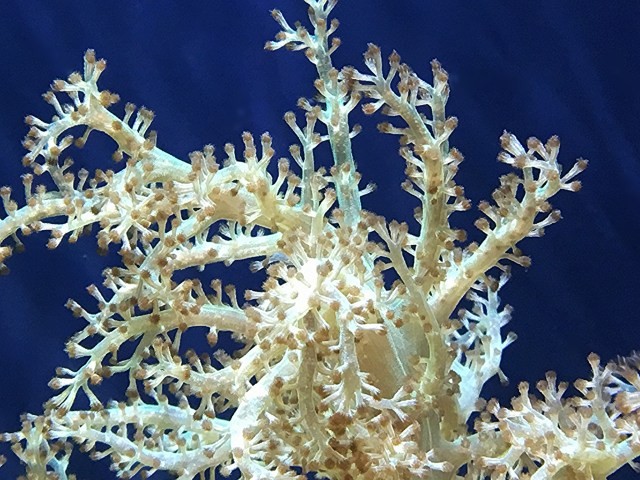
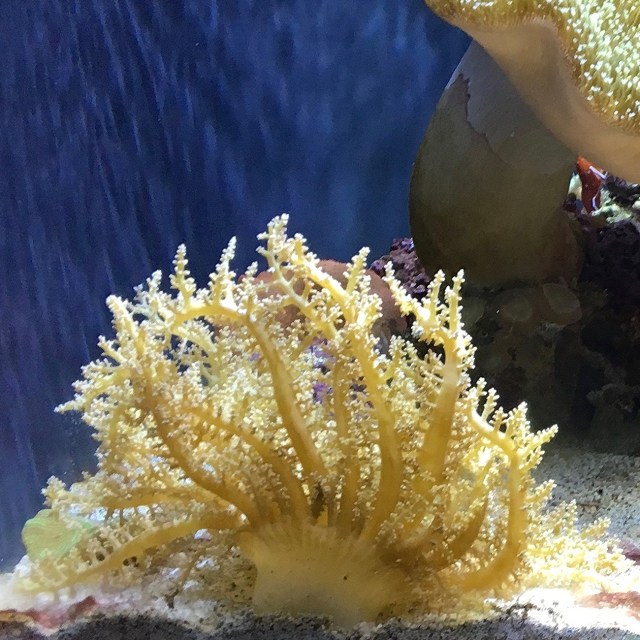
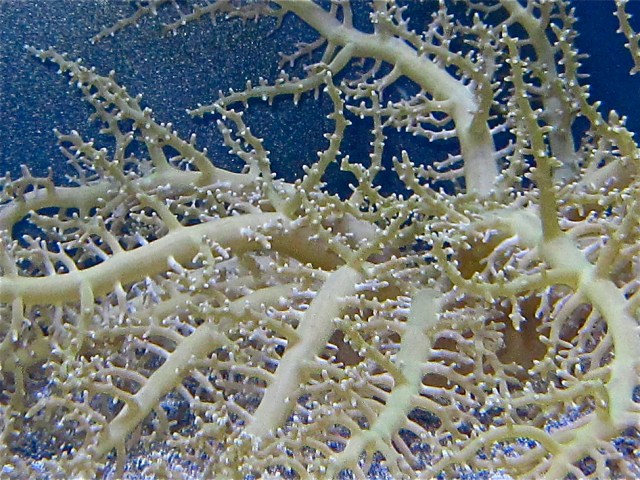
GENERAL CHARACTERISTICS: It has a stalk that is usually cream to brown, with some having a tint of green. Their color is usually cream to brown. The Capnella genus has an erect tree-like structure with lateral branches that are heavily forked. On the top of the branches there are clusters of non-retractable polyps. The base or stalk is without polyps and appears smooth.
(Sinularia spp polyps can retract fully)

Finger Leather Coral24467607171_d42dc69a98_k

DISTRIBUTION/HABITAT: Tropical Indo-West Pacific and Red Sea.
Tend to grow in clear water with stronger currents on deeper reef slopes.

Finger Leather Coral25692244975_89523fbc07_k

DIET IN THE WILD: They capture microscopic food particles from the water column, can absorb dissolved organic matter, and have a symbiotic relationship with a marine algae known as zooxanthellae, where they also receive some of their nutrients.

REPRODUCTION: By budding, fission, and dropping little branches

CONSERVATION: Not on IUCN Red List

References

California Academy of Sciences Steinhart Aquarium Color Cluster 2017 AQA17 Charles Delbeek

Ron’s flickr https://www.flickr.com/photos/cas_docents/24467607171/in/album-72157659465376212/

Aquarium Corals E H Borneman TFH Publications 2001 page 135

Ron’s WordPress shortlink http://wp.me/p1DZ4b-1Lu

EOL eol.org/pages/1761/details

TAXONOMY
Kingdom: Animalia
Phylum: Cnidaria
Class: Anthozoa
Order: Scleractinia
Family: Caryophylliidae (Hexacoral or stony polyped coral)

Genus/species: Plerogyra sinuosa

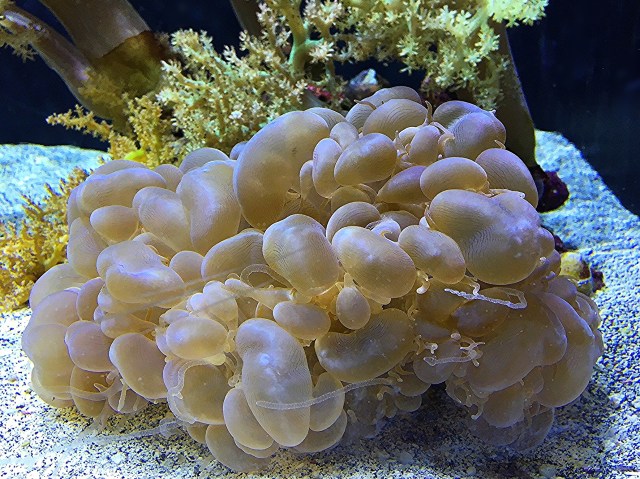
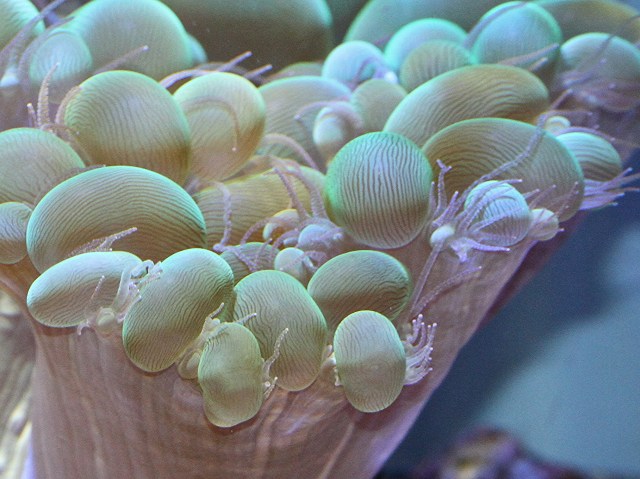
GENERAL CHARACTERISTICS: Colonial corals often covered
with clusters of bubble-like structures (thus the common name), each over 1 cm in length. Tentacles extend at night to capture small prey. Colored gray, bluish, greenish, brownish or rich cream. The skeleton is a mineral aragonite.

bubble coral23923123353_354a13e35d_o

DISTRIBUTION/HABITAT: Indo-Pacific and Australia region.Found in turbid bays and lagoons, on reefs in deep water or under overhangs.

DIET IN THE WILD: Light-capturing bubble-like vesicles extend during the day to support the photosynthesis of the algal symbionts. Tentacles extend at night to capture small prey.

Bubble Coral4561883874_27975403aa_o

CONSERVATION: IUCN Red List Near threatened (NT)

REMARKS: This is a stony coral, despite the soft appearance the “bubbles” give during the day.

References

California Academy of Sciences Steinhart Aquarium Color on the Reef AQA17  Charles Delbeek

Aquarium Corals E H Borneman TFH Publications 2001 Page 311

EOL  eol.org/pages/1006618/details

IUCN Red List www.iucnredlist.org/details/133258/0

WordPress shortlink http://wp.me/p1DZ4b-1Lo

Ron’s Flickr  https://www.flickr.com/photos/cas_docents/23923123353/in/album-72157659465376212/

TAXONOMY
Kingdom: Animalia
Phylum: Cnidaria
Class: Anthozoa
Order: Scleractinia
Family: Fungiidae

Genus/species: Herpolitha sp.

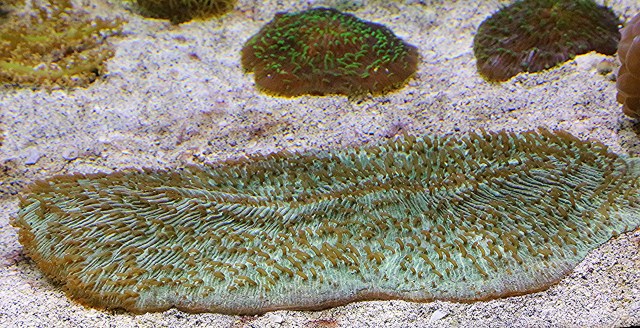
GENERAL CHARACTERISTICS: Color is usually brown, cream or green tones. The Herpolitha genus is noted for short, tapering tentacles with a very long grove with several mouths. The structure is home to a single polyp which sits in a calcareous cup, the corallite. Many septae stretch from the central groove. Form may be nearly circular but mainly elongate.
Length up to 1m (39 inches)

Slipper Coral25262228054_8ba6012bc8_o

DISTRIBUTION/HABITAT: Throughout the tropical Indo-Pacific: from Africa and the Red Sea to Polynesia.
Found among reef slopes and lagoons

DIET IN THE WILD: Herpolitha sp. obtains energy from sunlight via photosynthetic symbionts (zooxanthellae) and plankton captured using nematocysts

CONSERVATION: Minimal risk for over collection

REMARKS: Rather than forming colonies like most corals, Fungia corals are usually solitary and free-living. Because they are unattached, Fungia can be easily moved by waves, and so are most often found in protected places, often at depths where wave action is reduced.

References

California Academy of Sciences Steinhart Aquarium Water is life Color on the Reef 2016 AQA17

Aquarium Corals E H Borneman TFH Publications 2001 page 260

Ron’s flickr  https://www.flickr.com/photos/cas_docents/25262228054/in/album-72157659465376212/

Ron’s WordPress Shortlink  http://wp.me/p1DZ4b-1Lj


TAXONOMY
Kingdom: Animalia
Phylum: Cnidaria
Class: Anthozoa
Order: Scleractinia
Family: Fungiidae

Genus/species: Fungia sp.

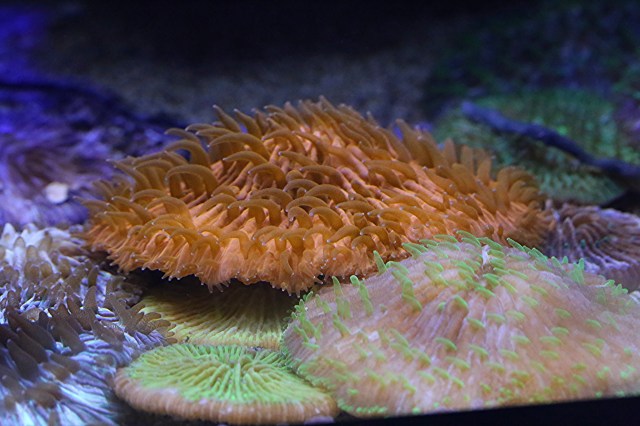
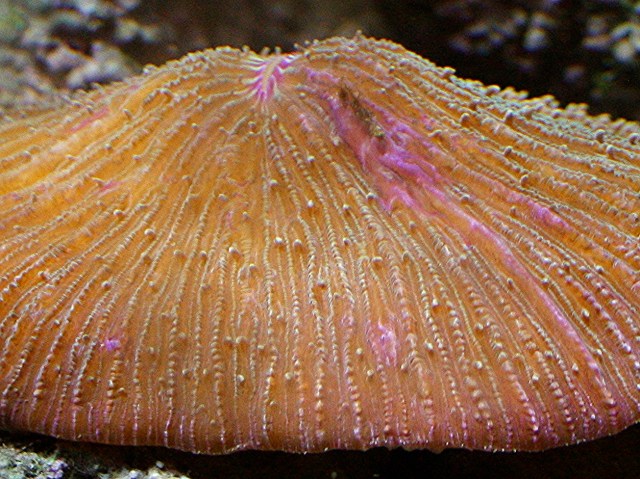
GENERAL CHARACTERISTICS: Hexacoral Genus noted for short, tapering tentacles and a very large mouth opening. The structure is home to a single polyp which sits in a calcareous cup, the corallite. Many septae stretch from the central mouth to sides of the polyp. Usually the form is nearly circular. 

This specimen has its tentacles retracted.

Diameter up to 28 cm (11 inches

Mushroom Coral24651024753_5ace92aaf6_k

DISTRIBUTION/HABITAT: Indo-Pacific from the Red Sea and east Africa, west to Hawaii in tropical and subtropical latitudes. Found among other coral, rubble, or on sand.

DIET IN THE WILD: Plankton, jellies (using nematocysts), proteins (using sticky cilia)

REPRODUCTION: Fungia corals can reproduce sexually or asexually. During sexual reproduction, eggs and sperm are released into the water where the egg is fertilised and develops into larvae. Juvenile Fungia are attached, but become free-living with age, Budding and fragmentation.also can occur.

This specimen has its tentacles retracted.

Mushroom Coral5064192598_beeff0e593_o

CONSERVATION: IUCN Red List Least Concern (LC)

REMARKS: Rather than forming colonies like most corals, Fungia corals are usually solitary and free-living. Because they are unattached, Fungia can be easily moved by waves, and so are most often found in protected places, often at depths where wave action is reduced.

By inflating the body cavity, mushroom corals are able to upright themselves after being overturned. They will travel by inflating their tissue and using current to move.

When Fungi are in immediate contact with other hard corals, they secrete a mucus that can damage coral tissues and prevents the over growth of these neighbouring corals.

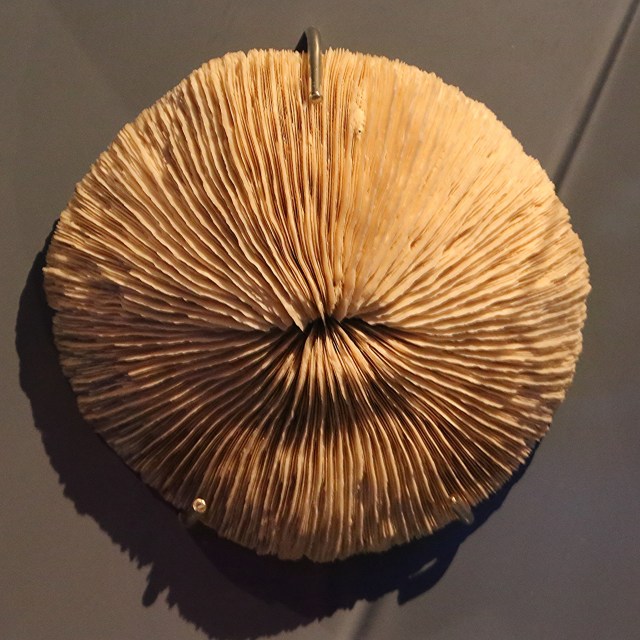
Mushroom coral skeleton below


Mushroom Coral24929915125_850e98ad03_k

References

California Academy of Sciences Steinhart Aquarium Water is life Color on the Reef 2017

Aquarium Corals E H Borneman TFH Publications 2001 page253-257

Ron’s flickr  https://www.flickr.com/photos/cas_docents/5063580569/in/album-72157659465376212/

Ron’s WordPress shortlink http://wp.me/p1DZ4b-1Lb

Arkive www.arkive.org/mushroom-corals/fungia-spp/

Animal World animal-world.com/Aquarium-Coral-Reefs/Plate-Coral

TAXONOMY
Kingdom: Animalia
Phylum: Cnidaria
Class: Anthozoa
Order: Scleractinia
Family: Faviidae

Genus: Caulastrea sp.

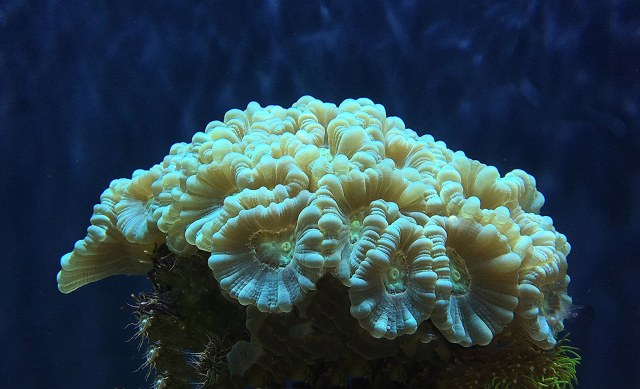
GENERAL CHARACTERISTICS: Stony coral with a lightweight phaceloid skeleton which gives rise to plump circular polyps clustered on the end of branched stalks. Colors vary, usually green or brown.

 Caulastrea sp.32548578421_33e20ddf0b_k

DISTRIBUTION/HABITAT: Found in the Indo-West Pacific in tropical, protected, shallow reef slopes where the substrate is partly sandy,

REPRODUCTION: Can be easily fragmented and also reproduce by budding.

Remarks: One of the most remarkable and ecologically important features of these corals is that the polyps secrete a hard skeleton, called a ‘corallite’, which over successive generations contributes to the formation of a coral reef. The coral skeleton forms the bulk of the colony, with the living polyp tissue comprising only a thin veneer.

References

California Academy of Sciences Steinhart, Color on the Reef AQA17

Aquarium Corals E H Borneman TFH Publications 2001 pages 285-286.

Ron’s flickr https://www.flickr.com/photos/cas_docents/32548578421/in/album-72157659465376212/

Ron’s WordPress Shortlink  http://wp.me/p1DZ4b-1KX

Arkive: www.arkive.org/caulastrea/caulastrea-furcata/


TAXONOMY
Kingdom: Animalia
Phylum:Cnidaria
Class: Anthozoa
Subclass: Hexacorallia
Order: Actiniaria
Family: Actinodendronidae

Genus/species: Actinodendron plumosum

GENERAL CHARACTERISTICS: The Hell’s Fire Anemone is poorly described. It looks more like a coral than and anemone. The color of  A. plumosum can be light yellowish-green, tan, brown, light green or gray. They have an oral disc that is drawn out into branched tentacles tipped with white swellings resembling globular spheres. Their tree like shape is unique in comparison to other anemones. Size: up to 12″ (30 cm).

Hell fire anemone31862717602_e9e55aaff4_o

DISTRIBUTION/HABITAT: Indo-Pacific on coral rich slopes and drop offs with coral gravel, or in shallow sandy and muddy areas. They bury their foot and body into the substrate and adhere their foot to hard surfaces underneath, having only their oral disc and tentacles emerging. When disturbed they can retract their entire body into the sand and be virtually invisible.

REMARKS: The sting from these anemones can damage and even kill other corals and fish. They use their very powerful and venomous nematocyst found in their tentacles to sting and deflect any possible threats or attacks, as well as for capturing prey. In humans the stings can cause ulcers at the site which last for months.

IMG_3633

References

California Academy of Sciences Steinhart Aquarium Color on the Reef AQA17  2017

Ron’s flickr https://www.flickr.com/photos/cas_docents/31862717602/in/album-72157659465376212/

EOL eol.org/pages/421192/details#habitat

Animal-World  animal-world.com/Aquarium-Coral-Reefs/Hells-Fire-Anemone

Ron’s WordPress Shortlink, http://wp.me/p1DZ4b-8C

TAXONOMY
Kingdom: Animalia
Phylum: Cnidaria
Class: Anthozoa
Order: Actiniaria
Family: Actiniidae (the largest family of sea anemones)

Genus/species: Entacmaea quadricolor

GENERAL CHARACTERISTICS: The Bubbletip Sea Anemone has an adherent base which attaches to the shape of the substratum. At the top of the column is a flattened oral disc with an oval mouth in the middle. The oral disc and column are smooth and brown, green, or occasionally a fluorescent reddish-orange. Tentacles are up to 10 cm (4 inches) length, often but not always inflated and balloonlike at the tips. 

Length up to 40 cm (16 inches)

Bubble tip anemone5389669474_fb02a667dc_o

DISTRIBUTION/HABITAT: Found in the Indo-Pacific, usually in deep crevices with only the tentacles visible.

Bubble tip anemone16122486362_7ee3a9b81d_o

DIET IN THE WILD: E. quadricolor obtains the majority of its energy from solar radiation via its symbiotic zooxanthellae.
Thet are also opportunistic carnivores that capture prey using cnidocytes on their tentacles which contain many “stinging organs” known as nematocysts (or cnidae).

REPRODUCTION: Bubbletip Sea Anemones are broadcast spawners releasing gametes directly into water.

The most common means of asexual reproduction for these anemones is called longitudinal fission, which amounts to them splitting down the middle to make two anemones from one. When it reproduces it will begin to pinch in at two points opposite each other on their base. Then the indentions will draw closer until it splits in two.

CONSERVATION: IUCN Red List Not Evaluated

REMARKS: They are symbiotic with many species of anemonefishes, such as the common clownfish (Amphiprion ocellaris)

E. quadricolor has obligate photosynthetic zooxanthellae, brown algae, which live inside the anemone acting as a carbon and nitrogen source.

This anemone also exhibits biofluorescence.

References

California Academy of Sciences Steinhart Aquarium Color on the Reef 2017 AQA16

Ron’s flickr https://www.flickr.com/photos/cas_docents/31483022142/in/album-72157659465376212/

Ron’s Worldpress shortlink http://wp.me/p1DZ4b-1Kv

The University of Queensland

http://www.gbri.org.au/SpeciesList/Entacmaeaquadricolor%7CNicolaWood.aspx

SeaLifebase www.sealifebase.org/summary/Entacmaea-quadricolor.html

taxo4254.wikispaces.com/Entacmaea+quadricolor


TAXONOMY
Kingdom: Animalia
Phylum: Cnidaria
Class: Scyphozoa
Order: Semaeostomeae
Family: Pelagiidae

Genus: Sanderia sp.

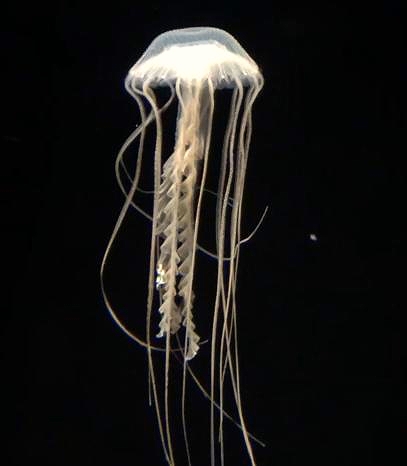
LOCOMOTION: Movement occurs when muscular contraction of the dome forces water out of the medusa. Refilling of the medusa occurs with muscular contraction.

Water currents control direction of the jelly thus they are considered plankton.

31575650231_48de03b9a4_o

REPRODUCTION: Alternation of life cycles—polyp, medusa
The drifting jellies shown here represents just one phase of a sea nettle’s life. As adults pulsing through the water, these jellies reproduce sexually. But in another stage of life, on the seafloor, they reproduce without sex.
When spawning, adults release clouds of sperm and tens of thousands of eggs a day. Their larvae sink and become polyps (like mini anemones) carpeting the seafloor. As they grow, each polyp buds off scores of tiny jellies and will become sexual adults.

References

Cailifornia Academy of Sciences Steinhart Aquarium Animal Attractions 2017

The Marine Biology Coloring Book Thomas Niesen 2000

Ron’s WordPress shortlink  wp.me/p1DZ4b-1Ka

Ron’s flickr https://www.flickr.com/photos/cas_docents/31575650231/in/album-72157629304397467/