Category: INVERTEBRATES


3-6-12 Banana Slug from Ron’s Animal Attraction Series (Exhibit)

Phylum Molluska, Class Gastropoda, Family Arionidae

Ariolimax californicus

DISTRIBUTION; Central California

HABITAT:  Require moist surroundings. Damp forest floors and crevices in rotting trees.

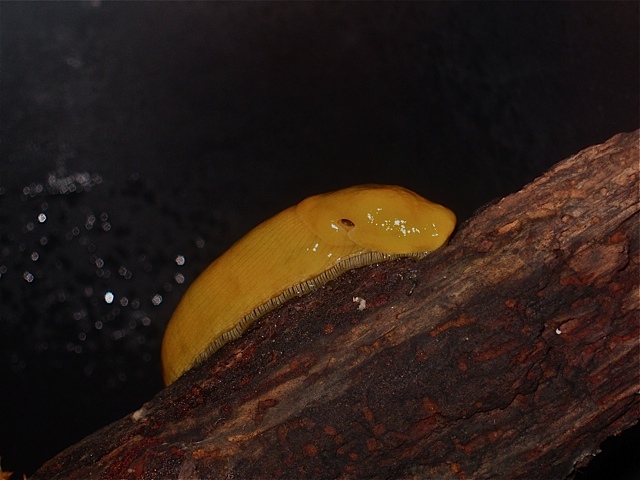
APPEARANCE: Snails that have lost their external shell. Banana slugs derive their common name from their bright yellow color, although they can also be green, black, brown, or white.  Have two sets of retractable tentacles on the head. The first and larger pair is used for sensing light; the smaller pair detects odors. The mouth is on the underside of the head with the anal and genital pores close by.

DIET: Detritivores and herbivores, they eat dead and decomposing plant and animal matter, including feces. They also eat living plants, particularly mushrooms.

REPRODUCTION/DEVELOPMENT: As hermaphrodites, each individual has both male and female organs. While they are known to self-fertilize, for the most part they cross-fertilize.  Courtship behavior of the banana slug is elaborate, with both partners engaged in ritualized bouts of lunging, nipping, and sideswiping with their tails until the two eventually line up side by side, genital pore to genital pore. The pair may intertwine for several hours before copulation begins. Each pair alternately releases and receives sperm, which is stored until the eggs are laid and fertilized in the rainy season.

Separation is even more dramatic than copulation since the slugs penises often as long their bodies may become entangled. The pair may resort to apophallation, a fancy term for the deliberate amputation of the penis with one or the other copulating individual gnawing off his or his partner’s penis. The dismembered slug, unable to deliver sperm, functions solely as a female.
MORTALITY/LONGEVITY:  Predators include birds, raccoons, snakes, and salamanders. Life span is thought to be 3–6  years. 

WORDPRESS SHORTLINK http://wp.me/p1DZ4b-qn

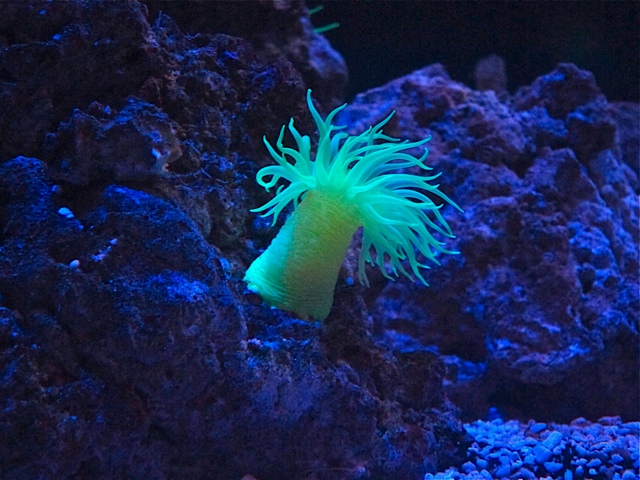
Kingdom Animalia, Phylum Cnidaria, Class Anthoza, Subclass Hexacorillia, Order Actiniara, Family Haluridae.

Halcurias carlgreni 

DISTRIBUTION: West North Pacific

HABITAT: From Japans deeper, cooler waters.

REMARKS:  From Rich Ross California Academy of Sciences Biologist.  http://packedhead.net/Last December when Koji Wada of the renowned Blue Harbor visited the Steinhart Aquarium he was kind enough to bring us two stunning Halcurias carlgreni anemones. From Japans deeper, cooler waters, these anemones are jaw droppingly bright and colorful. Currently, they are being kept at 66 degrees in our Nautilus exhibit and both animals seem to be getting along just fine with each other. The Halcurias are being fed thawed frozen mysis via ‘Julians Thing’ every other day, and we hope they will be so happy and full of food that we will have more of them in the near future. They are of course non-photosynthetic.

LOCATION: Nautilus Exhibit

WORDPRESS SHORTLINK  http://wp.me/p1DZ4b-pX


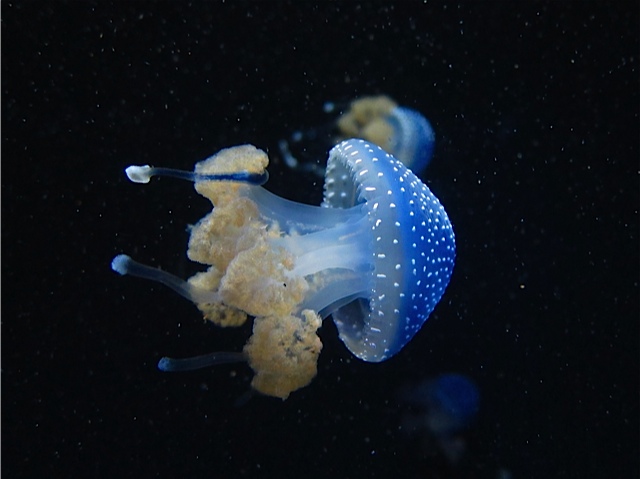
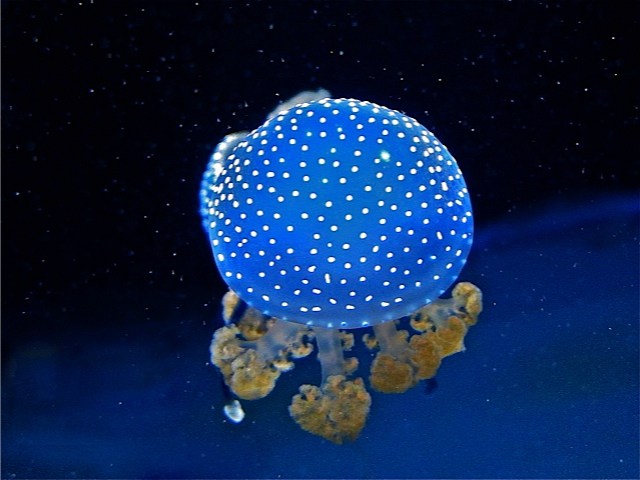
1-17-12  White-spotted Jelly from Ron’s Jellies Series

Kingdom: Animalia,  Phylum: Cnidaria,  Class:Scyphozoa,  Order: Rhizostomae,   Family: Mastigiidae

Phyllorhiza punctata   

DISTRIBUTION:  Native to Southwestern Pacific and introduced widely. 

HABITAT: P. punctata is a coastal and estuarine jellyfish.

APPEARANCE; P. punctuate is a large jellyfish with a rounded and somewhat flattened gelatinous bell that is clear or possibly tinted brown with many small white crystalline refractive spots close to the surface. As is characteristic of members of Order Rhizostomae, the bell margin lacks tentacles and the central mouth area is ringed by eight highly dichotomous (branching) oral arms that each bear 14 lappets (flaps of tissue) and become fused near their bases.  Within it’s native range and in certain introduced localities, symbiotic zooxanthellae reside in the tissue of the animal, giving these jellyfish a brownish tint.

DIET: Like most members of Phylum Cnidaria, the tentacles of Phillorhiza are equipped with stinging cells called cnidocytes. Within these cells are stinging organelles called nematocysts. When discharged, nematocysts can immobilize small prey items that are subsequently ingested. Nematocysts are also used as a defense mechanism. The planktonic egg and larval stages of several fish species (including commercially important species such as red snapper in the gulf of Mexico) are probably important as prey items.  Additionally, throughout its native range and much of its introduced range, P. punctata also harbor endosymbiotic zooxanthellae within their bell. In a relationship analogous to that of reef-building tropical corals and their resident zooxanthellae, primary production of the photosynthetic zooxanthellae likely fulfills a large proportion of the nutritional needs of the host jellyfish.   

REPRODUCTION and DEVELOPMENT: Scyphozoans have a life cycle that can be broadly divided into two parts: a free-living medusa and an attached, sessile polyp stage.  Sexes are separate in the medusae and these produce haploid gametes that combine through external fertilization to form free-swimming planula larvae.  Planulae search out suitable settlement sites and leave the water column to assume a sessile benthic existence.  Once on the bottom a polyp form occurs and this form reproduces asexually by “cloning” or dividing itself into other polyps. These polyps or scyphistomae then give rise to new offspring in the form of free-swimming medusa.  Jellyfish can live for up to five years in the polyp stage and up to two years in the medusa stage.

REMARKS: An invasive species now found in the Caribbean, Hawaii, and southern Brazil.  Phyllorhiza consumes large amounts of small zooplankton (including fish eggs and larvae) and directly impacts the shrimp industry because nets were becoming clogged with jellyfish.  (after Smithsonian Marine Station at Fort Pierce)  

LOCATION: Color Cluster 1-17-12

flickr site  http://www.flickr.com/photos/cas_docents/sets/72157610031545571/

WORDPRESS SHORTLINK  http://wp.me/p1DZ4b-lE

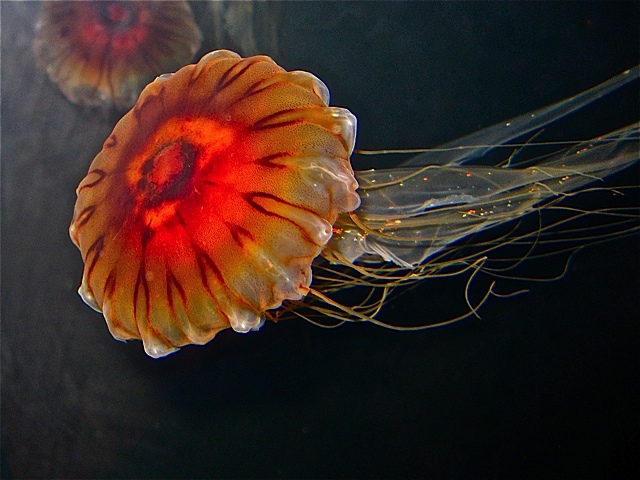
Kingdom Animalia, Phylum: Cnidaria (anemones, corals and jellyfish), Class: Scyphozoa,  Order: Semaeostomeae,  Family: Pelagiidae 

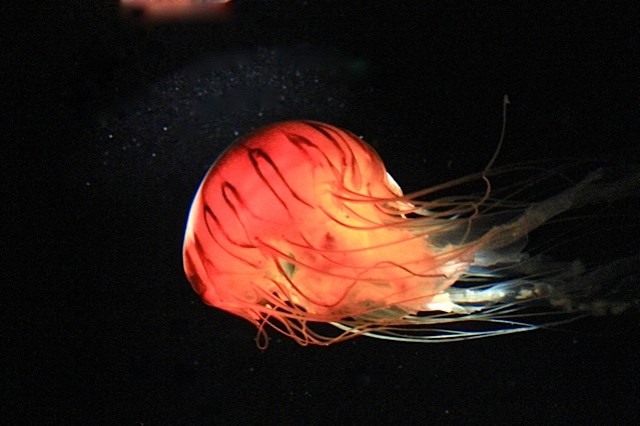
Chrysaora Pacifica

DISTRIBUTION: Deep open waters of the northern Pacific Ocean, Arctic Ocean and the Bering Sea. 

HABITAT: Ocean surface to 200 meters below the surface. 

APPEARANCE:  Bells can grow up to 12 inches across and tentacles can stretch 10 feet or more. Their bells are white with brown-to-orange stripes, containing up to 32 very long orange-red tentacles and four long lips.  One of C. Pacifica’s most distinguishing characteristics can be found on their undersides, where they have 16 brown stripes and eight stomach pouches.

DIET: Other jellies, small crustaceans called copepods, and small fishes. 

REPRODUCTION and DEVELOPMENT: The life cycle made up of five stages. They go through a metamorphosis or change in shape as they grow . 

1.lifecycle begins when males broadcast or release sperm into the water and the females catch the sperm to fertilize the eggs she has produced and is holding in her mouth.

2. The fertilized eggs remain attached to the mother’s oral arms and grow into a flat jelly bean-shaped planula.

3. The planula then grows into flower-shaped polyps and the mother releases them into the ocean.

4. The polyps attach to a solid surface and undergo asexual reproduction through which they make an exact copy of themselves without eggs and sperm. The polyp makes these identical animals by budding where the new polyp grows out of its side. 

5.After the new polyp is fully formed, it is released into the ocean and starts to change shape, looking more like the adult nettle. The nettle develops a bell, arms and tentacles until it is a fully formed medusa or adult.

REMARKS: Like many jellies, Japanese sea nettles use stinging cells to defend themselves and stun their prey. While not especially poisonous, their stings can cause intense skin irritation and burning sensations in humans. Some people can have allergic reactions to their venom. If you see one in the water, stay away because there’s a good chance more of them are nearby. Japanese sea nettles travel in swarms, which increases your chance of being stung if you encounter one.

 LOCATION: Staff Picks

flickr site  http://www.flickr.com/photos/cas_docents/sets/72157610031545571/

WORDPRESS SHORT LINK  http://wp.me/p1DZ4b-lo

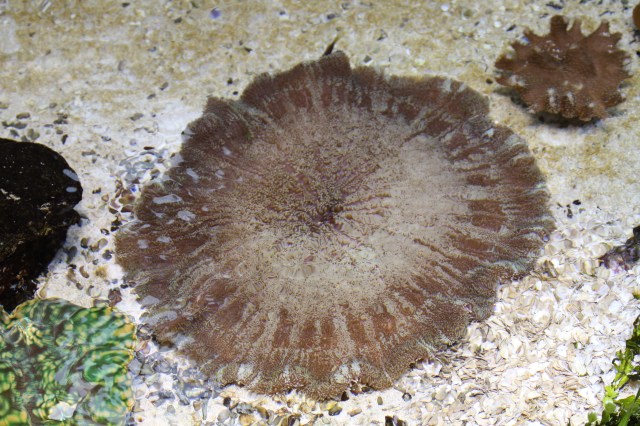
1-5-12 Haddon’s Carpet Anemone from Ron’s Anemone Series

Stichodactyla haddoni    (Stichodactylidae).

DISTRIBUTION:  Indo Pacific and Red Sea.  

HABITAT: Outside of the reef it resides in soft muddy or sandy substrate.  

APPEARANCE: Identified by its thick central column with large pedal disc, very short, stubby tentacles and tentacle-free oral area, and attains a diameter of about 60 cm.  Can be distinguished from their close relatives Stichodactyla gigantea and Stichodactyla mertensii by the lack of any coloration, spots or markings on the underside of the anemone and down its column

DIET: It consumes any and all animal matter that comes in contact with its tentacles. 

REMARKS: serves as a host for many types of Clownfish in the wild including: Amphiprion clarkii shown here.   S. haddoni has a very potent venomous sting and may harm corals, other anemones and fish.   Most animals that come in contact with the tentacles of Haddon’s anemone will stick to the anemone and be killed by its nematocysts in a few seconds to a few minutes.  May bury itself in sand if threatened.

LOCATION PR03  Seagrass shallows

WORDPRESS SHORTLINK  http://wp.me/p1DZ4b-kJ


flickr site  http://www.flickr.com/photos/cas_docents/sets/72157623903687834/

Phylum: Cnidaria, Class: Anthozoa, Order; Actinaria (Anemones), Family: Actinodendronidae.

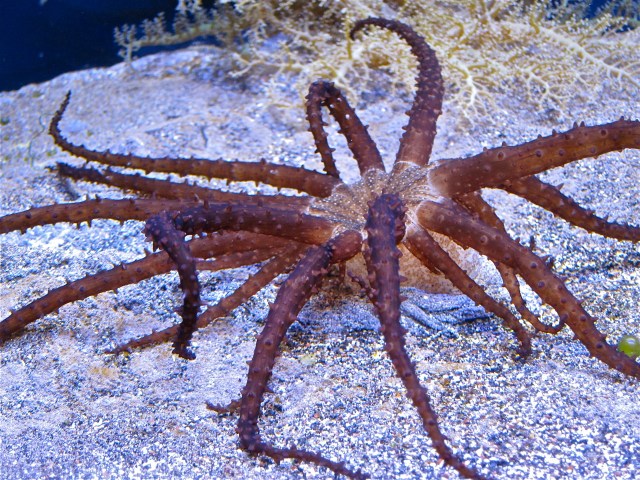
Actinostephanus haeckeli    

DISTRIBUTION: Western Pacific Ocean

HABITAT; Found on sandy bottoms in lagoons and bays with 12 or more tentacles, and buried during day and active at night.

APPEARANCE: 10-20cm in diameter. It has about 12 long fat cylindrical tentacles that taper at the tips, and below these, another ring of much shorter, slimmer tentacles. The tentacles are studded with bumps. They have a and a flat oral disc. Those seen were a uniform dark brown to black.

DIET: Plankton. 

REMARKS: This anemone could be confused with sea stars.  The projections are tentacles not arms.  they reach out of the mud and sand in which the anemone lives.   

They can move fairly rapidly along the ocean floor leaving a trail in the sand.   

Venoms Cluster PR 25      11-17-11

WORDPRESS BLOG  http://wp.me/p1DZ4b-ho

Flickr sea anemone series.  http://www.flickr.com/photos/cas_docents/sets/72157625127345346/


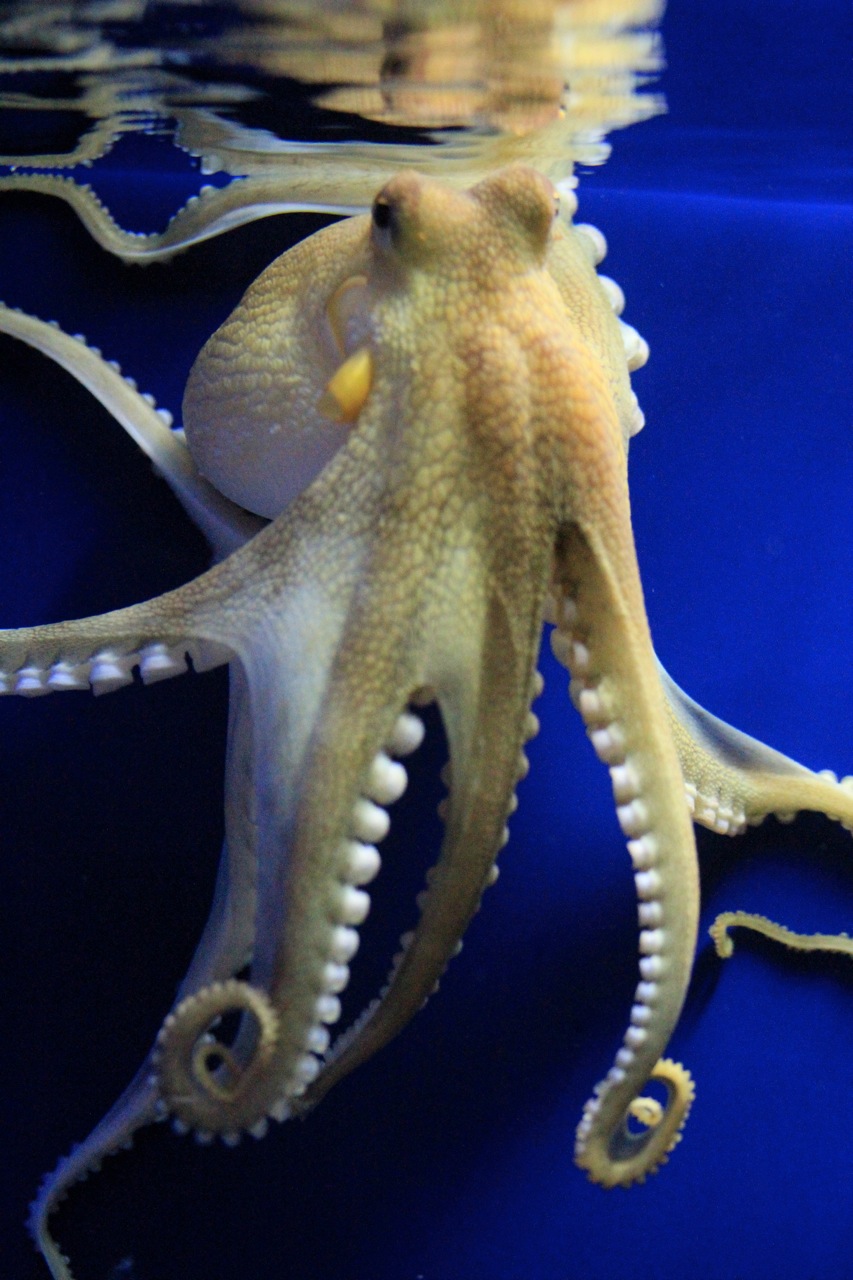
Amphioctopus marginatus

Kingdom: Animalia, Phylum: Mollusca. Class: Cephalopoda, Order: Octopoda, Family: Octopodidae                                        

DISTRIBUTION: Tropical waters of the western of the western Pacific Ocean.

HABITAT: Sandy bottoms in bays or lagoons.

APPEARANCE: The main body of the octopus is typically around 8 centimeters (3 in) in size, and, with arms, approximately 15 centimeters (6 in) long. The octopus displays a typical color pattern with dark divergent lines similar to veins, usually with a yellow siphon The arms are usually dark in color, with contrasting white suckers. In many color displays, a lighter trapezoidal area can be seen immediately below the eye.

DIET: Shrimp, clams and crabs.

REMARKS: A. marginatus  is one of only two octopus species known to display such behavior, the other being Abdopus aculeatus.   A. marginatus  has been observed using discarded coconut shells as a shelter.

LINK  to National Geographic video  http://www.indiesquidkid.com/tag/amphioctopus/

 LOCATION: STAFF PICK  SP04

 WORDPRESS SHORTLINK  http://wp.me/p1DZ4b-aU

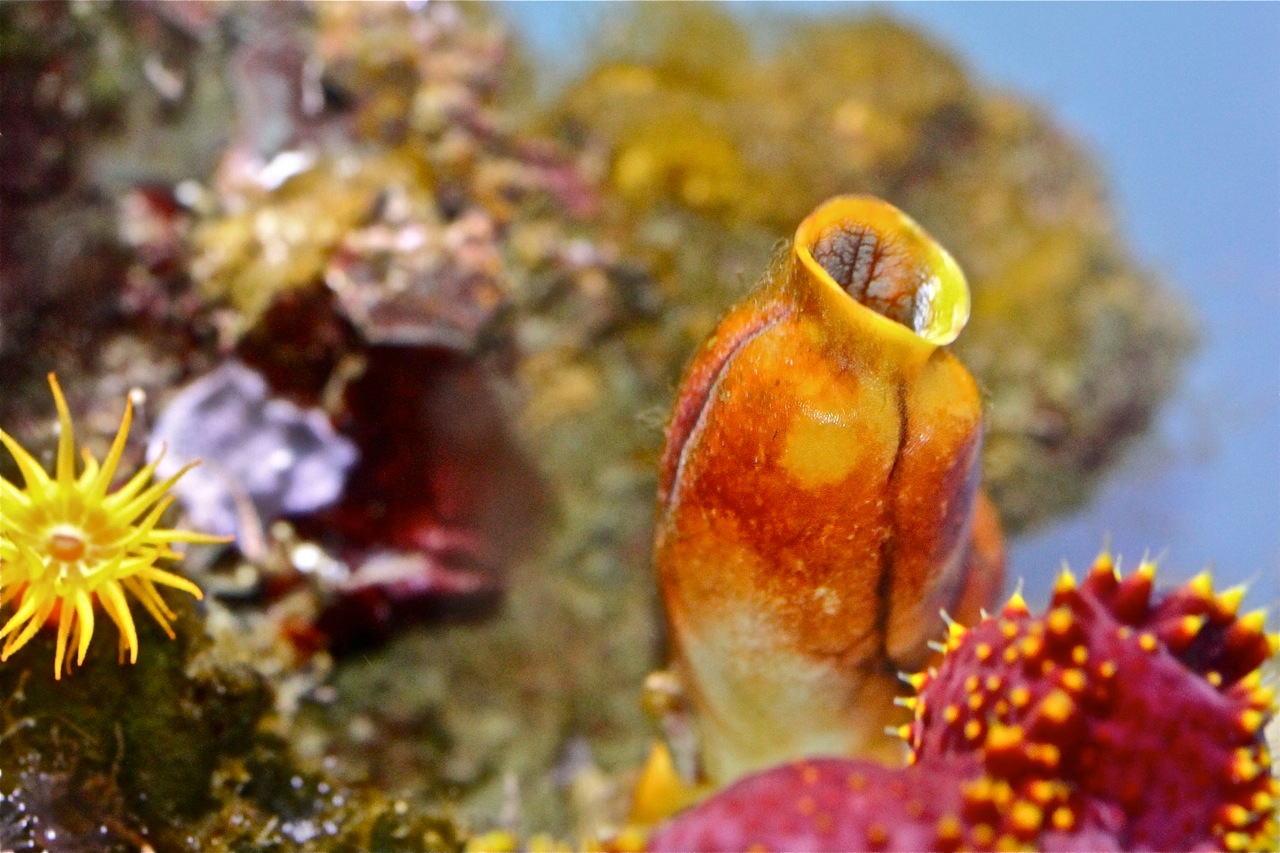
Polycarpa aurata

PHYLUM CHORDATA, CLASS ASCIDIACEA, ORDER STOLIDOBRANCHIA, FAMILY STTYELIDAE.

DISTRUBITION: Western Pacific

HABITAT: All tunicates are marine. It attaches itself to rocky surfaces or exposed dead coral under ledges between 10-20 meters.  

APPEARANCE: Sessile barrel-shaped with a mature size 5 in.  It is usually bright yellow or yellow-orange, and is smooth and leather-like to the touch. Tunicate bodies are covered by a complex skin, properly called a tunic, which is the source for their name. Most tunicates have two main openings, one to “inhale” water and the other to “exhale”.

DIET:  Filter feeder on plankton and detritis. A single tunicate can filter thousands of gallons a day.

REPRODUCTION AND DEVELOPMENT: Tunicates use broadcast spawning to reproduce sexually, and most are hermaphroditic. They have a seemingly backwards maturation process as one of the few invertebrate chordates. They lose their dorsal nerve and notochord as they become adults, or zooids. Larval and zooid forms are markedly different. Larvae are free-swimming and resemble tad-poles. They have a mouth, called the incurrent siphon and an excurrent siphon and an anus. They possess internal gill structures, a muscular tail, a dorsal nerve, and a notochord. They even have a heart, a stomach, and an eye. Adult tunicates, on the other hand, are mainly sessile (attached) filter feeders. Their bodies, may even house photosynthetic bacteria called Prochloron, which helps to provide nutrition for its host. Mature sea squirts lose much of their vertebrate likenesses, by taking on a barrel-like body shape and eliminating the rudimentary spine and eye. Their siphons become much more pronounced, as does the pharynx (the filtering mechanism/stomach). Adults maintain a small nerve ganglion, grow gonads, and develop a  layer  outer tissue the tunic.

REMARKS: The tunic is strengthened by numerous structural fibers made of a unique compound called tunicin.  P. aurata is known as a “sea squirt” because most will squirt water from their openings if threatened.

LOCATION; COLOR CLUSTER  PR09

WORDPRESS SHORTLINK: http://wp.me/p1DZ4b-aK


TAXONOMY

KINGDOM   Animalia 

PHYLUM   Mollusca 

CLASS  Cephalopoda 

ORDER   Sepiida 

FAMILY  Sepiidae   

GENUS/SPECIES   Sepia latimanus 


DISTRIBUTION/HABITAT

Indo-Pacific

 They are found in waters up to 30 m near tropical coral reefs.

APPEARANCE

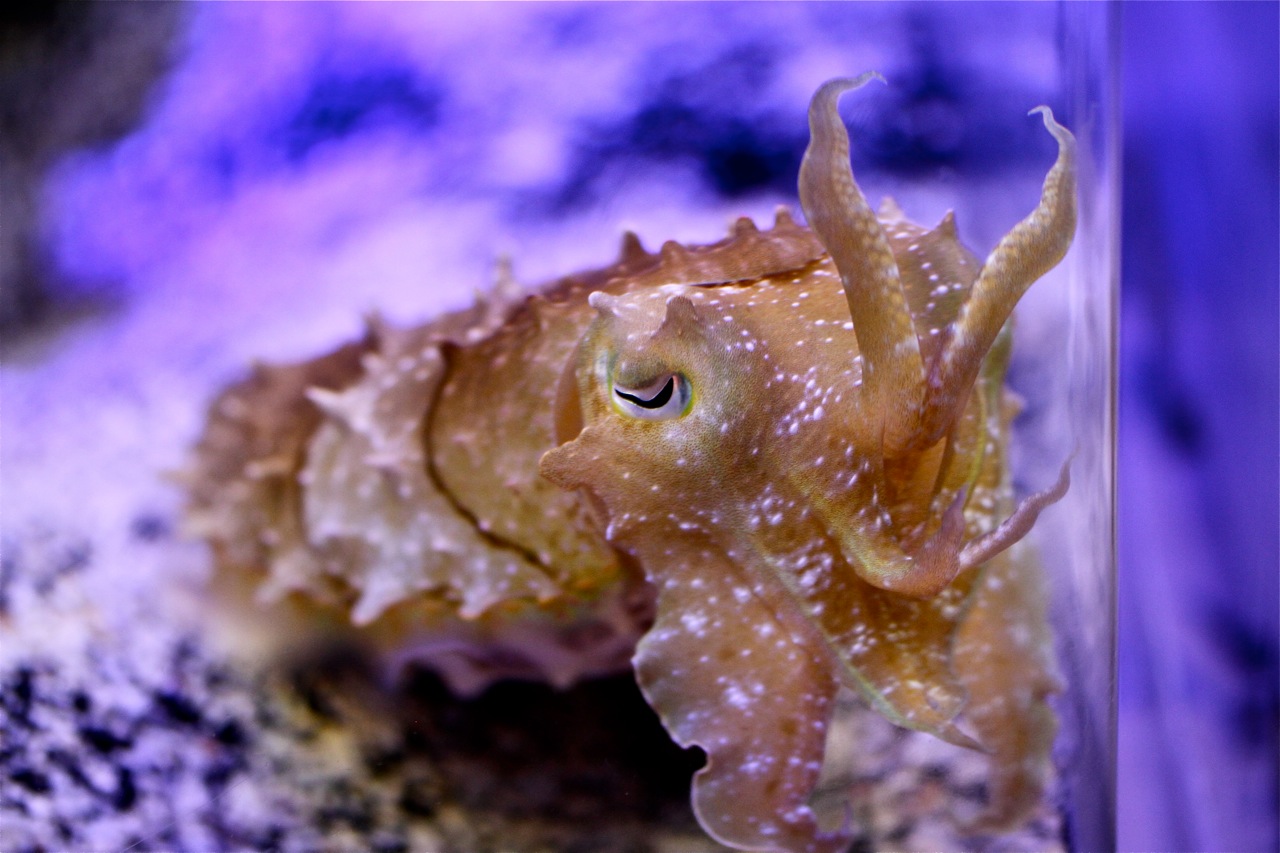
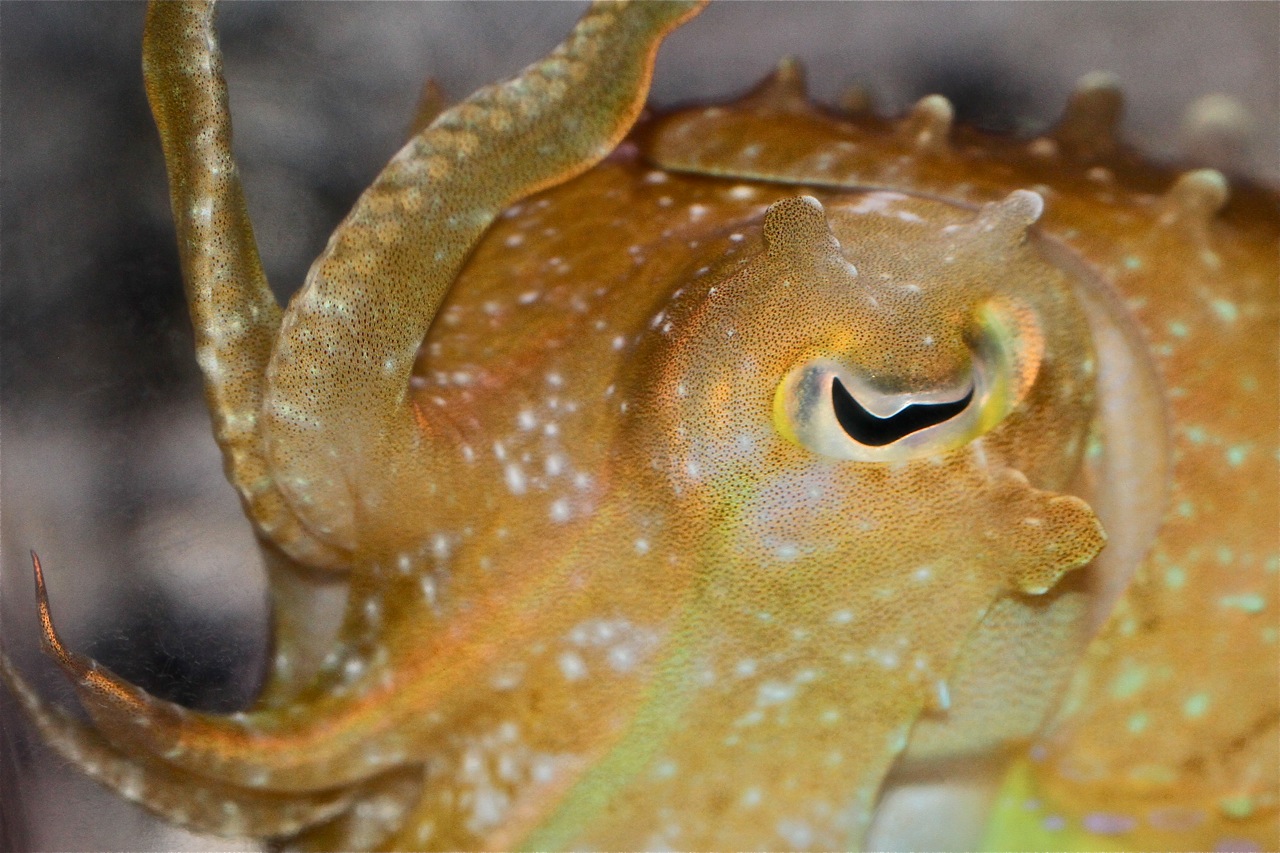
Large fascinating cephalopods with oval mantles  and crescent-shaped clubs .  This species can reach up to 50 cm in mantle length and weigh up to 10 kg. Like many cephalopods, broadclub cuttlefishes can be seen displaying a range of colors and textures. Commonly they are light brown or yellowish with white mottled markings. Males are sometimes dark brown, particularly during courtship and mating. Their arms have longitudinal white bands that appear as broad white blotches when extended. Some of their arms have longitudinal brown bands that extend to their heads. Their dorsal (upper) mantle can sometimes be seen with a saddle mark with small white and brown spots. Their dorsal mantle also has narrow brown transverse bands, and bold, white, transverse stripes and spots. Their eyes are yellow around the ventral (lower) margins and their fins are pale with white, transverse stripes extending onto their mantle and narrow, white bands along their outer margins.

Sepia latimanus  has a variety of different sucker sizes, some that are significantly larger than others. Their cuttlebone is bluntly rounded on either end, with a convex dorsal (curved upper) surface that flattens at the anterior (front) end. Their dorsal mantle is also covered with numerous large papillae and elongate papillae along the sides adjacent to base of each fin.

DIET IN THE WILD

Hunt during the day and appear to mesmerize prey with its rhythmic colored bands. They feed on small fishes and crustaceans.

REMARKS

 Sepia latimanus  is an important species to fisheries throughout their range and are taken by trawls, hand lines, and spears. They are also caught as bycatch in southeast Asian trawl fisheries.


 LOCATION: Not currently on exhibit 7-12-12

WORDPRESS SHORTLINK:    http://wp.me/p1DZ4b-8J