Category: CORAL REEF


TAXONOMY
Kingdom: Animalia
Phylum: Cnidaria
Class: Anthozoa
Order: Scleractinia
Family: Faviidae

Genus: Caulastrea sp.

GENERAL CHARACTERISTICS: Stony coral with a lightweight phaceloid skeleton which gives rise to plump circular polyps clustered on the end of branched stalks. Colors vary, usually green or brown.
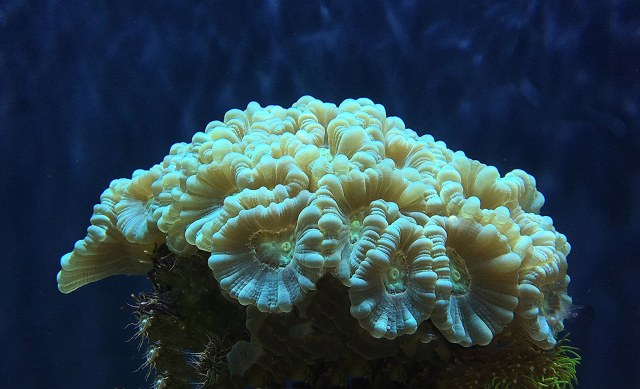
 Caulastrea sp.32548578421_33e20ddf0b_k

DISTRIBUTION/HABITAT: Found in the Indo-West Pacific in tropical, protected, shallow reef slopes where the substrate is partly sandy,

REPRODUCTION: Can be easily fragmented and also reproduce by budding.

Remarks: One of the most remarkable and ecologically important features of these corals is that the polyps secrete a hard skeleton, called a ‘corallite’, which over successive generations contributes to the formation of a coral reef. The coral skeleton forms the bulk of the colony, with the living polyp tissue comprising only a thin veneer.

References

California Academy of Sciences Steinhart, Color on the Reef AQA17

Aquarium Corals E H Borneman TFH Publications 2001 pages 285-286.

Ron’s flickr https://www.flickr.com/photos/cas_docents/32548578421/in/album-72157659465376212/

Ron’s WordPress Shortlink  http://wp.me/p1DZ4b-1KX

Arkive: www.arkive.org/caulastrea/caulastrea-furcata/
 

TAXONOMY
Kingdom: Animalia
Phylum: Cnidaria
Class: Anthozoa
Order: Alcyonacea
Family; Alcyoniidae

Genus/species: Sarcophyton sp.

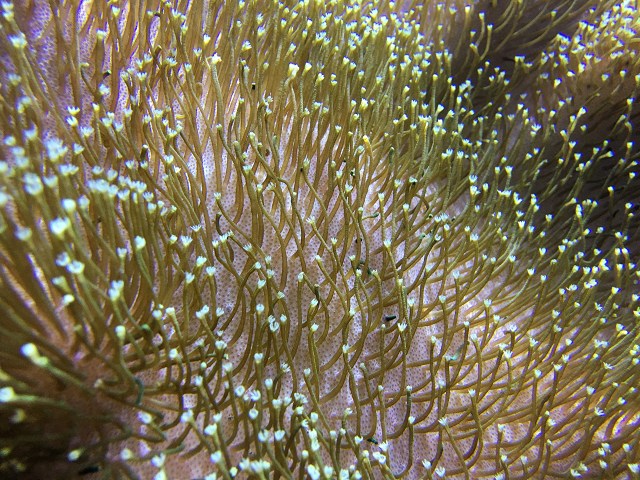
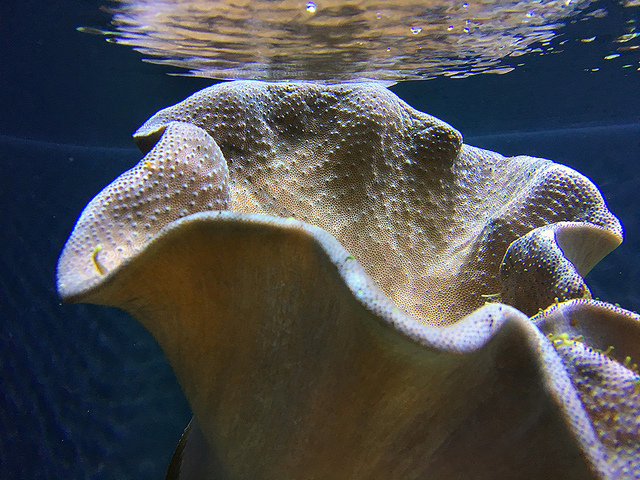
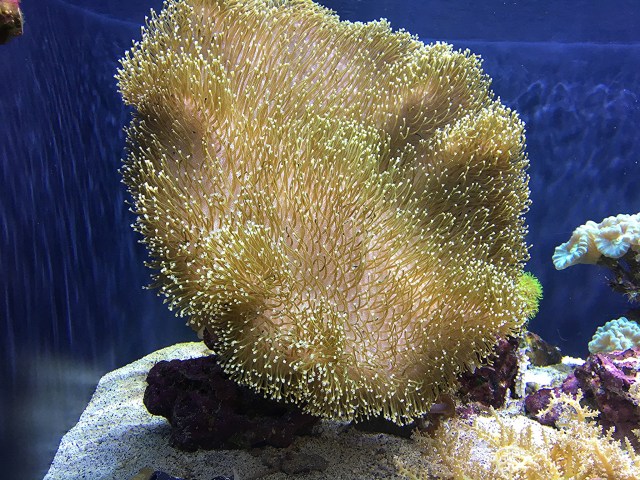
GENERAL CHARACTERISTICS: This octocoral (soft coral) is the largest species in the genus reaching a height of 1 m (3 ft). It is also the largest species in the family Alcyoniidae. Colors vary among species: white, grey, yellowish-green, green. Colonies mushroom, funnel, or cup-shaped, often with a folded margin. Typically have a thick, rubbery appearance with tentacles that extend from the large, often convoluted upper surface. Main stalk, often visible, bears no polyps.

Leather coral25932701823_e4bf21f882_k

DISTRIBUTION/HABITAT: Leather Coral is found in the Indo-Pacific and Red Sea in tropical coral reefs in shallow water reef flats.

Leather Coral25930631984_0dde63aa15_o

DIET IN THE WILD: Microcarnivore of plankton and nutrition from algal photosynthesis.

Polyps retracted below

Leather coral29642268604_b9f76b741a_z

REPRODUCTION: Typically reproduces asexually by budding or fragmentation.

References

California Academy of Sciences Steinhart Aquarium Color on the Reef 4-14-16 AQA17

Aquarium Corals E H Borneman TFH Publications 2001 page 131-132

Animal Diversity Web animaldiversity.org/accounts/Sarcophyton/classification/

Ron’s WordPress Shortlink  http://wp.me/p1DZ4b-1KP

Ron’s flickr https://www.flickr.com/photos/cas_docents/25932701823/in/album-72157659465376212/


TAXONOMY
Kingdom: Animalia
Phylum:Cnidaria
Class: Anthozoa
Subclass: Hexacorallia
Order: Actiniaria
Family: Actinodendronidae

Genus/species: Actinodendron plumosum

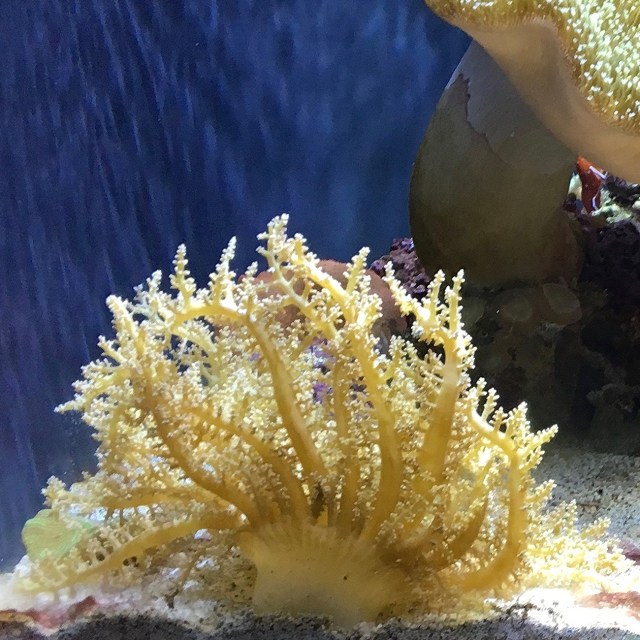
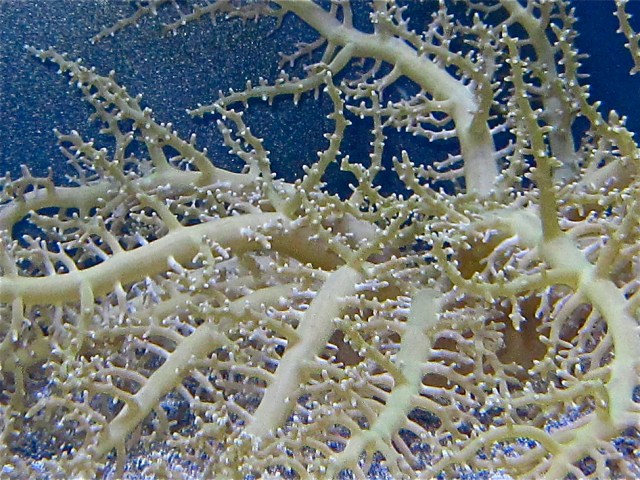
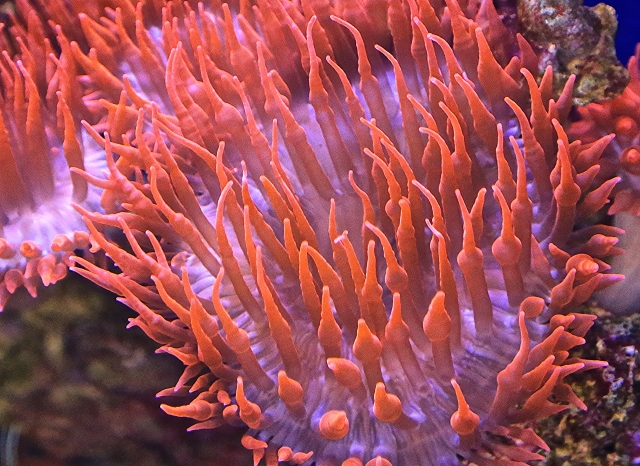
GENERAL CHARACTERISTICS: The Hell’s Fire Anemone is poorly described. It looks more like a coral than and anemone. The color of  A. plumosum can be light yellowish-green, tan, brown, light green or gray. They have an oral disc that is drawn out into branched tentacles tipped with white swellings resembling globular spheres. Their tree like shape is unique in comparison to other anemones. Size: up to 12″ (30 cm).

Hell fire anemone31862717602_e9e55aaff4_o

DISTRIBUTION/HABITAT: Indo-Pacific on coral rich slopes and drop offs with coral gravel, or in shallow sandy and muddy areas. They bury their foot and body into the substrate and adhere their foot to hard surfaces underneath, having only their oral disc and tentacles emerging. When disturbed they can retract their entire body into the sand and be virtually invisible.

REMARKS: The sting from these anemones can damage and even kill other corals and fish. They use their very powerful and venomous nematocyst found in their tentacles to sting and deflect any possible threats or attacks, as well as for capturing prey. In humans the stings can cause ulcers at the site which last for months.

IMG_3633

References

California Academy of Sciences Steinhart Aquarium Color on the Reef AQA17  2017

Ron’s flickr https://www.flickr.com/photos/cas_docents/31862717602/in/album-72157659465376212/

EOL eol.org/pages/421192/details#habitat

Animal-World  animal-world.com/Aquarium-Coral-Reefs/Hells-Fire-Anemone

Ron’s WordPress Shortlink, http://wp.me/p1DZ4b-8C

TAXONOMY
Kingdom: Animalia
Phylum: Cnidaria
Class: Anthozoa
Order: Actiniaria
Family: Actiniidae (the largest family of sea anemones)

Genus/species: Entacmaea quadricolor

GENERAL CHARACTERISTICS: The Bubbletip Sea Anemone has an adherent base which attaches to the shape of the substratum. At the top of the column is a flattened oral disc with an oval mouth in the middle. The oral disc and column are smooth and brown, green, or occasionally a fluorescent reddish-orange. Tentacles are up to 10 cm (4 inches) length, often but not always inflated and balloonlike at the tips. 

Length up to 40 cm (16 inches)

Bubble tip anemone5389669474_fb02a667dc_o

DISTRIBUTION/HABITAT: Found in the Indo-Pacific, usually in deep crevices with only the tentacles visible.

Bubble tip anemone16122486362_7ee3a9b81d_o

DIET IN THE WILD: E. quadricolor obtains the majority of its energy from solar radiation via its symbiotic zooxanthellae.
Thet are also opportunistic carnivores that capture prey using cnidocytes on their tentacles which contain many “stinging organs” known as nematocysts (or cnidae).

REPRODUCTION: Bubbletip Sea Anemones are broadcast spawners releasing gametes directly into water.

The most common means of asexual reproduction for these anemones is called longitudinal fission, which amounts to them splitting down the middle to make two anemones from one. When it reproduces it will begin to pinch in at two points opposite each other on their base. Then the indentions will draw closer until it splits in two.

CONSERVATION: IUCN Red List Not Evaluated

REMARKS: They are symbiotic with many species of anemonefishes, such as the common clownfish (Amphiprion ocellaris)

E. quadricolor has obligate photosynthetic zooxanthellae, brown algae, which live inside the anemone acting as a carbon and nitrogen source.

This anemone also exhibits biofluorescence.

References

California Academy of Sciences Steinhart Aquarium Color on the Reef 2017 AQA16

Ron’s flickr https://www.flickr.com/photos/cas_docents/31483022142/in/album-72157659465376212/

Ron’s Worldpress shortlink http://wp.me/p1DZ4b-1Kv

The University of Queensland

http://www.gbri.org.au/SpeciesList/Entacmaeaquadricolor%7CNicolaWood.aspx

SeaLifebase www.sealifebase.org/summary/Entacmaea-quadricolor.html

taxo4254.wikispaces.com/Entacmaea+quadricolor


TAXONOMY
Kingdom: Animalia
Phylum: Arthropoda
Subphylum: Crustacea
Class: Malacostraca
Order: Decapoda
Infraorder: Caridea
Family: Hippolytidae

Genus/species: Lysmata amboinensis

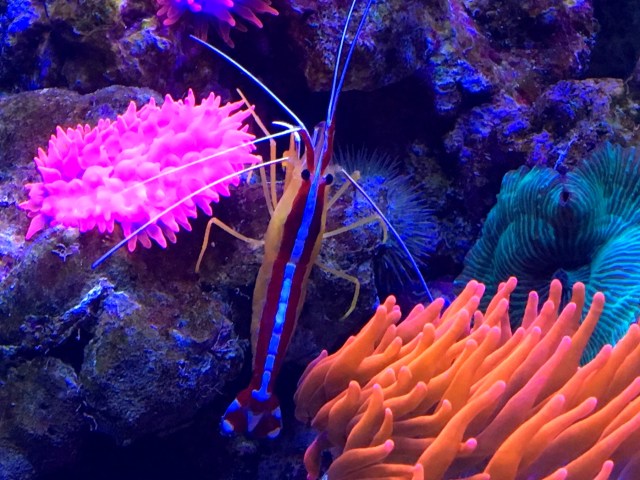
GENERAL CHARACTERISTICS: Dorsal redline on tan body. Long white antennae.

DISTRIBUTION/HABITAT: Red Sea to Australia; Indonesia, Society Islands. Active day and night at cleaning stations on coral and rocky reefs, 8–25 m. Reside in pairs or groups (to 100 individuals) in caves and crevices.

cleaner shrimp24441637412_8890f98e21_oDIET IN THE WILD: It has been observed that fish with parasites may come to cleaning stations. in the reef. Certain species of fish and several types of cleaner shrimp may assist the fish in large numbers and even go inside the mouth (and then to the gill cavity) without being eaten.
cleaner shrimp4337509985_c72ab0aedf_o

REPRODUCTION: L. amboinensis initially develop and reproduce as males then develop female reproductive organs to become hermaphrodites and function as both males and females throughout the reproductive cycle. This system called protandric simultaneous hermaphroditism is so far known only from caridean shrimp in the closely related genera Lysmata and Exhippolysmata.

REMARKS: Cleaner shrimp advertise their services by their bright coloration and by waving their very long antennae, which contrast with the dark recess of their station.

Jacques, a character in Finding Nemo, is a humpback cleaner shrimp. In aquaria, cleaner shrimp are valued because they clean not only the fish, but the tank as well.

References

California Academy of Sciences Steinhart Aquarium Color on the Reef AQA17 2017

EOL www.eol.org/pages/128343/details

Ron’s WordPress shortlink http://wp.me/p1DZ4b-1KD

Ron’s flickr https://www.flickr.com/photos/cas_docents/24441637412/in/album-72157659465376212/

TAXONOMY
Kingdom: Animalia
Phylum: Chordata
Class: Actinopterygii (ray-finned fishes)
Order: Perciformes (Perch-likes)
Family: Callionymidae (Dragonets)

Genus/species: Synchiropus picturatus

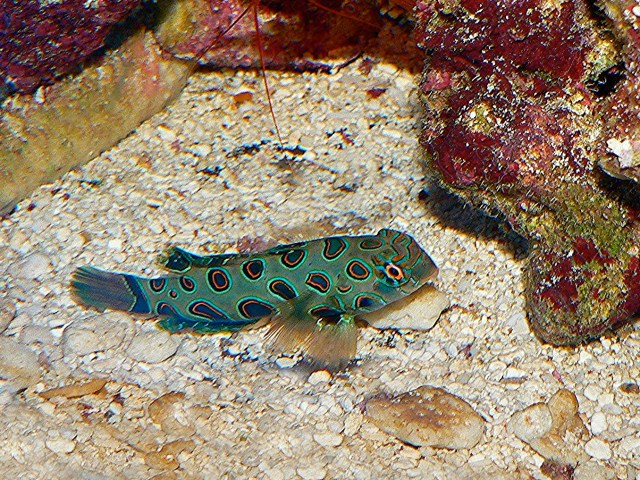
GENERAL CHARACTERISTICS: Elongate, moderately depressed, broad-headed. Pale brown to green, covered with large dark spots ringed with orange and green, turquoise band markings around eye.

Length up to 7 cm (2.75 inches)

dragonet2985463647_2857fa8c1f_o

DISTRIBUTION/HABITAT: Northwest Australia, Indonesia and Philippines. Found in rubble patches and sandy bottoms near living corals of coastal reefs at depths of 2–20 m.

DIET IN THE WILD: Small benthic invertebrates, especially live zooplankton, such as copepods and amphipods.

3289664960_03a882a295_o

IUCN RED LIST Not evaluated

References

California Academy of Sciences Steinhart Aquarium Color on the Reef AQA13

Ron’s flickr https://www.flickr.com/photos/cas_docents/2985463647/in/album-72157659465376212/

Fishbase  www.fishbase.org/summary/Synchiropus-picturatus.html

EOL eol.org/pages/339917/overview

Ron’s WordPress shortlink  http://wp.me/p1DZ4b-1JF


TAXONOMY
Kingdom: Animalia
Phylum: Chordata
Class: Actinopterygii (ray-finned fishes)
Order: Syngnathiformes (Pipefishes and seahorses)
Family: Centriscidae (Snipefishes and shrimpfishes)

Genus/species: Aeoliscus strigatus


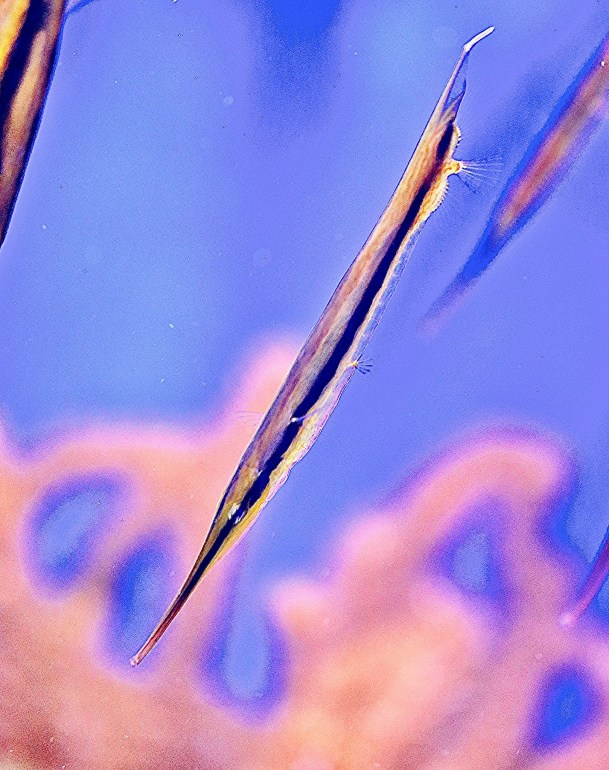
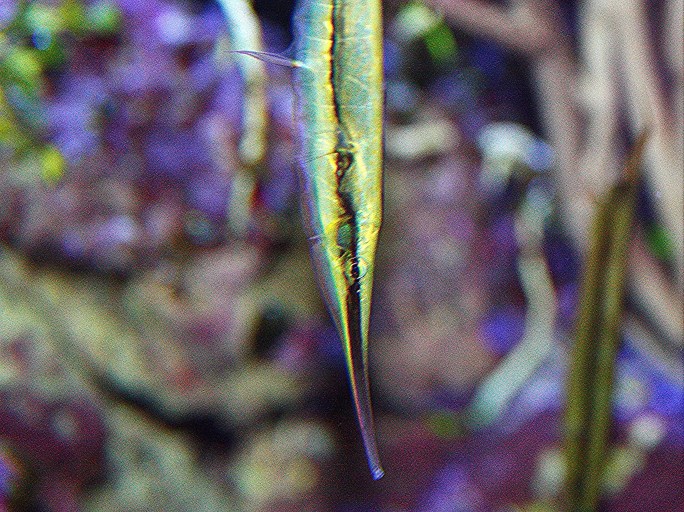
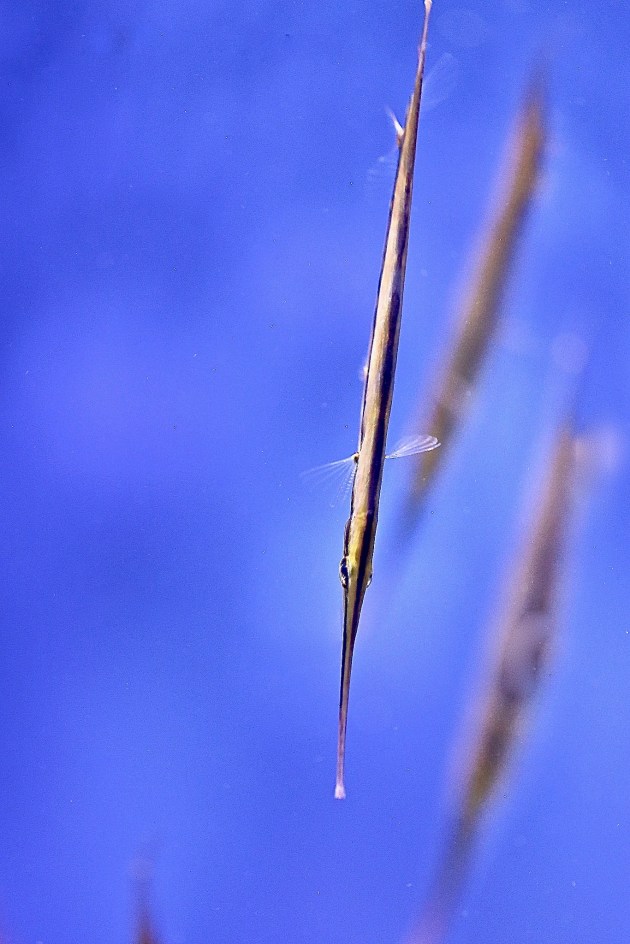
GENERAL CHARACTERISTICS: The body is encased in an armor of thin, transparent plates; they swim in synchronized groups, each fish in a vertical position with the snout pointing downwards. Color is golden-yellow with a dark band running the length of the body. The tail fin, terminates in a sharp spine.

Length up to 15 cm (6 in)

DISTRIBUTION/HABITAT: Tropical Indian and western Pacific oceans. Inhabits clear coastal reefs and leeward fringing reefs around offshore islands. Found In small groups swimming and resting with head down near long-spined sea urchins, branching corals or other hiding places to 42 m (140 feet).

DIET IN THE WILD: Minute planktonic crustaceans.

CONSERVATION: IUCN Not Evaluated

REMARKS: A. striates occurs  has been observed hiding in the spines of sea urchins, both as a defense mechanism and as a hunting mechanism. Swims horizontally only when hunting. Otherwise, swim with head down and back facing the direction of travel. If a rival enters their territory, they aim the sharp edge of the belly toward the adversary.

References

California Academy of Sciences Steinhart Aquarium Hidden Reef 2018

Ron’s WordPress Shortlink. https://brianeyes21comcast.net/2017/01/05/4-19-13-shrimpfish-aka-razorfish-from-rons-tropical-marine-series/

fishbase  http://www.fishbase.org/summary/6503

Animal Diversity Web http://animaldiversity.org/accounts/Aeoliscus_strigatus/classification/

Ron’s flickr. https://www.flickr.com/photos/cas_docents/30467635696/in/album-72157659465376212/

Fishes of Australia.  http://fishesofaustralia.net.au/home/species/3163#moreinfo

EOL eol.org/pages/205823/details#distribution


TAXONOMY
Kingdom:Animalia
Phylum: Chordata
Class: Actinopterygii (ray-finned fishes)
Order: Perciformes (Perch-likes)
Family: Labridae (Wrasses)

Genus/species: Stethojulis bandanensis

Stethojulis bandanensisIMG_8597

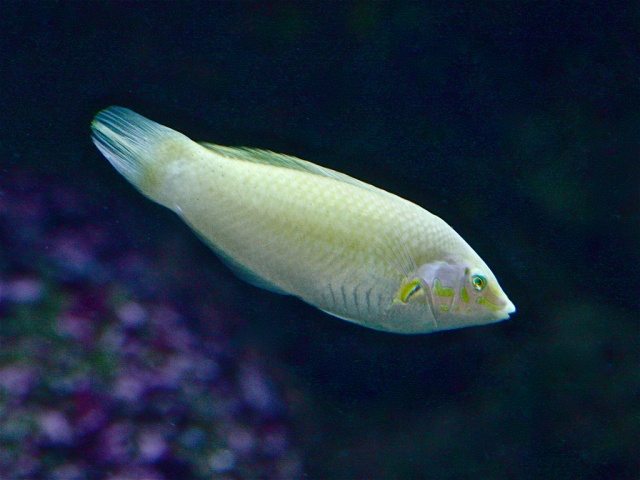
GENERAL CHARACTERISTICS: The body is elongate and fusiform with a pointed head and small mouth. Primary phase individuals are brown with hundreds of tiny white specks, a white belly, yellowish cheeks, and an orange shoulder patch. Terminal males typically have a series of partial to complete longitudinal thin blue lines on their sides. Females mainly bluish grey with fine white spotting over upper sides and a small red spot at axil of pectoral fin. They have a blue-green on upper half and bluish below.

Length up to 15 cm (6 inches)

DISTRIBUTION/HABITAT: Tropical Indo-Pacific: eastern Indian Ocean to western Australia, Found in shallow clear water of reef flats and lagoon and seaward reefs, in areas of mixed sand, rubble and coral. Depth 3-30m (10-100 feet).

DIET IN THE WILD: Zoobenthos ( small benthic invertebrates living on, in, or near the seabed, also known as the benthic zone)

REPRODUCTION: Oviparous with distinct pairing during breeding

CONSERVATION: IUCN Least concern LC

References

California Academy of Sciences Philippine coral reef 2016
Vetted J. Charles Delbeek, M.Sc.
Assistant Curator, Steinhart Aquarium

fishbase www.fishbase.se/summary/5640

EOL eol.org/pages/994413/details

Ron’s flickr www.flickr.com/photos/cas_docents/13226075944/

IUCN  www.iucnredlist.org/details/full/187424/0

Ron’s WordPress Shortlink  http://wp.me/p1DZ4b-1e5


www.guammarinelab.com/fish/species_html/stethojulis.banda…

TAXONOMY
Kingdom:Animalia
Phylum: Chordata
Subphylum: Vertebrata
Class: Actinopterygii (ray-finned fishes)
Order: Perciformes (Perch-likes)
Family: Labridae (Wrasses)

Genus/species: Cirrhilabrus rubrimarginatus


GENERAL CHARACTERISTICS: Body shape is fusiform. The male is more brilliantly colored compared to the female and the juvenile, Has a red margin on both the tail and dorsal fin.

length up to 5 inchesRed-Margin Wrasse

DISTRIBUTION/HABITAT: Western Pacific: north to the Ryukyu Islands, through the Philippines, Palau, and Indonesia. Adults found in deep coastal to outer reef drop-offs and steep slopes to 40 m (130 feet) or more, usually in loose aggregations.

CONSERVATION: IUCN; Least concern.

REMARKS: Fairy wrasses, along with 4 other closely related genera, have an unusual eye structure. The cornea is divided into two segments, basically forming a double pupil. It is theorized that the center pupil acts like a close-up lens to give the fish a clear view of its small prey. Fairy wrasses are active during the day, and sleep at night wedged into crevasses protected by a mucous cocoon they secrete around themselves.

References

California Academy of Sciences Philippine coral reef 2016      Charles Delbeek, M.Sc  Assistant Curator, Steinhart Aquarium  California Academy of Sciences

Ron’s WordPress shortlink http://wp.me/p1DZ4b-1en

Ron’s flickr www.flickr.com/photos/cas_docents/13277420973/in/set-7215…

fishbase www.fishbase.org/summary/Cirrhilabrus-rubrimarginatus.html

EOL eol.org/pages/213476/hierarchy_entries/44698464/details

Reef Keeping  http://www.reefkeeping.com/issues/2003-01/hcs3/

TAXONOMY
Kingdom: Animalia
Phylum: Chordata
Class: Actinopterygii (ray-finned fishes)
Order: Perciformes (Perch-likes)
Family: Labridae (Wrasses)

Genus/species: Halichoeres chloropterus

13392429345_0df197f614_b

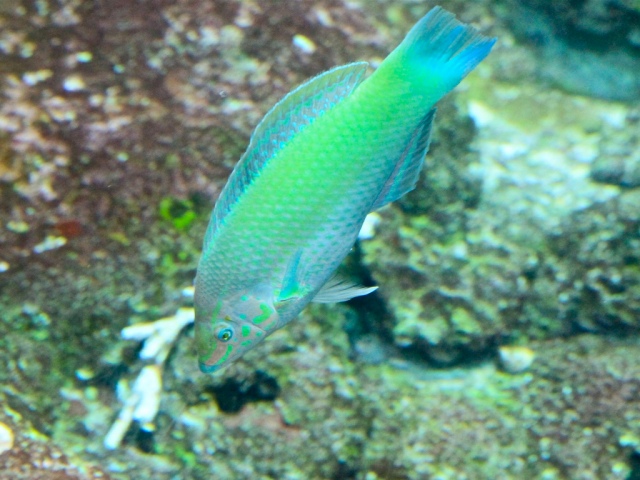
GENERAL CHARACTERISTICS: Juveniles lime green; females pale green above and white below, with a thin dark line on the base of the pectoral fin. Terminal males head of male with intricate reticulate pattern of bands that varies from one individual to another; small blackish spot on anus.

Length up to 19 cm (7.5 inches).

DISTRIBUTION/HABITAT: West Central Pacific: Philippines to the Great Barrier Reef. Found in shallow protected coral reef on silt, sand and rubble bottom. Depth to 10 meters (33 feet)

Pastel-green wrasse4391731072_b36a014eca_b

DIET IN THE WILD: Hard-shelled prey, including mollusks, crustaceans, and sea urchins.

CONSERVATION: IUCN Least concern.

References

California Academy of Sciences Philippine coral reef 201

Ron’s flickr  https://www.flickr.com/photos/cas_docents/3332103036/in/set-72157608208133134/

Ron’s WordPress shortlink  http://wp.me/p1DZ4b-1eI

fishbase: www.fishbase.org/summary/Halichoeres-chloropterus.html

EOL eol.org/pages/223761/details