Category: CORAL REEF


TAXONOMY
Kingdom:Animalia
Phylum: Chordata
Class: Actinopterygii (ray-finned fishes)
Order: Perciformes (Perch-likes)
Family: Chaetodontidae (Butterflyfishes)

Genus/species: Chelmon rostratus

GENERAL CHARACTERISTICS: All species have a deep, laterally compressed body with a continuous dorsal fin and distinctive rounded anal fin. Many have a band across the eye and/or a false eyespot, patterns that may lure a predator to attack the tail
rather than the head.
The C.rostratus has a whitish body with 4 vertical orange bands and a black false eyespot on the terminal orange band. The snout is long with beak-like mouth.

Length to 19 cm (7.5 in).
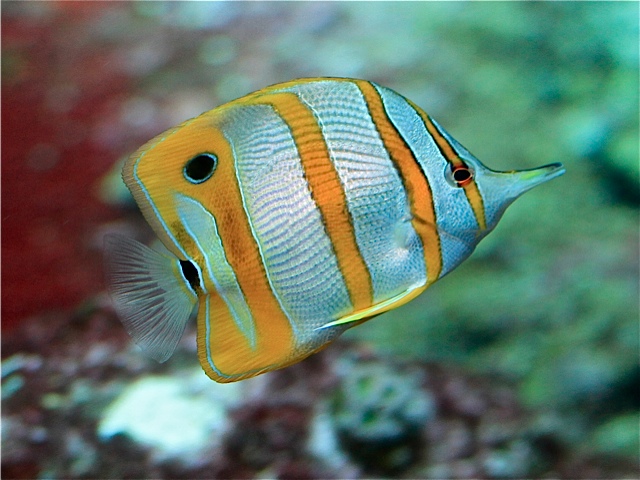
DISTRIBUTION/HABITAT: They are found in the Andaman Sea to Papua New Guinea, north to Ryukyu Island, south to Northwest Australia and Great Barrier Reef in estuaries and coastal reefs.

DIET IN THE WILD: Though the diet of the Copperband Butterflyfish is well documented, they are believed to feed heavily on tube worms and small crustaceans using their long snout for prying into the crevices of coral.

REPRODUCTION: Butterflyfishes unlike most fishes are usually monogamous, forming pairs and are often seen swimming together.   They are broadcast spawners an external method of reproduction where the female releases unfertilized eggs into the water. At the same time, a male release sperm into the water which fertilizes the eggs which contain a drop of nutrient oil to sustain the embryo  developing inside the egg case. Oil also provides buoyancy, so the eggs float and drift with the current.  Planktonic eggs hatch within a few days becoming the larval stage lasts from several weeks up to 2 months.  During the late larval stage the head and body are covered with bony plates which mature into small fry fish.
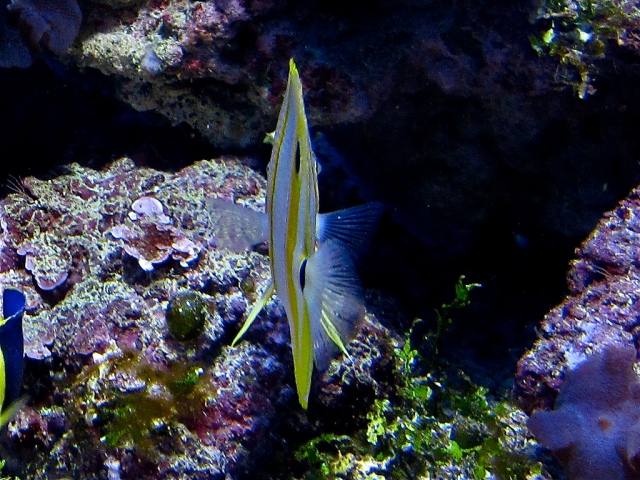
Copperband Butterflyfish8387609757_79c1b099a9_b

CONSERVATION: IUCN; Least Concern (LC)

REMARKS: The Copperbanded Butterflyfish is a food fish marketed locally. and is reported to be “not good” from a culinary standpoint.

Color of Life, Color Conceals.   The Copperband Butterflyfish helps conceals its head by having a vertical line through the eye which matching the 3 other vertical orange bands. A large false spot on its terminal orange band (a less vital portion of its body) confuses predators.

References

Ron’s flickr http://www.flickr.com/photos/cas_docents/3380844264/in/set-72157625119200613/

California Academy of Sciences Steinhart Aquarium Philippine Coral Reef and Hidden Reef 2018

Ron’s WordPress shortlink: http://wp.me/p1DZ4b-mS

EOL eol.org/pages/339397/details

fishbase fishbase.org/summary/SpeciesSummary.php?id=5483

Australian Museum australianmuseum.net.au/Beaked-Coralfish-Chelmon-rostratus

TAXONOMY
Kingdom: Animalia
Phylum: Chordata
Class: Actinopterygii  (ray-finned fishes)
Order: Perciformes (Perch-likes)
Family: Acanthuridae (Surgeonfishes, Tangs, Unicornfishes)

Genus/species   Zebrasoma scopas

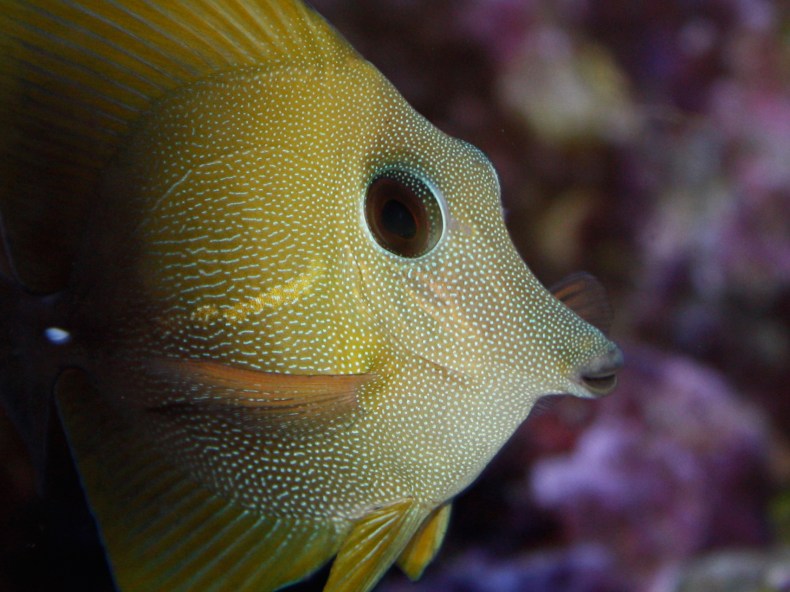
GENERAL CHARACTERISTICS: Zebrasoma spp. is a small genus of tangs characterized by round, laterally compressed bodies, large dorsal sail-like fins, and pointed snouts. Because of their snouts, they are able to eat filamentous algae that grow in spots other fishes cannot reach, a talent that also makes them popular in aquariums large and small. Males and females are similar. Color can be variable; most often are shades of gray and brown with a greenish tinge running along the dorsal spine.

A distinguishing feature of surgeonfishes, tangs, and unicornfishes is a modified scale on the caudal peduncle, which forms a scalpel-like sharp blade often covered with toxic slime. These spines are used for species recognition, defense, and competition for mates. They are white in the Brown Scopes Tang. Note: Acanthus means “thorn” or “spine”. Length to 20 cm (8 in)


DISTRIBUTION/HABITAT: Widespread throughout the Indo-Pacific from Africa to Japan in lagoons and outer reefs to 50 m (150 ft). Particularly well suited to large aquaria where they can roam.

Brown Scopas Tang

DIET IN THE WILD: Z. scopas graze on algae, usually in groups of 20 individuals. Its numerous, small pharyngeal teeth may have evolved in response to a shift in diet from macroalgae to filamentous algae.

REPRODUCTION: Group and pair spawning have been observed scattering eggs and sperm into the water column.

CONSERVATION: IUCN Red List Least Concern (LC)

REMARKS: Zebrasoma spp. are known to irritate some stony corals to induce the release of zooxanthellae, evidently a sailfin delicacy. 

References

California Academy of Sciences Steinhart Aquarium Philippine Coral Reef and Hidden Reef 2018

Ron’s WordPress Shortlink wp.me/p1DZ4b-BO

fishbase  www.fishbase.org/summary/Zebrasoma-scopas.html

IUCN www.iucnredlist.org/details/178005/0

EOL eol.org/pages/204517/details

Ron’s flickr http://www.flickr.com/photos/cas_docents/4770058557/in/set-72157625992053826/

fishbase http://www.fishbase.org/summary/Zebrasoma-scopas.html


TAXONOMY
Kingdom:Animalia
Phylum: Cnidaria
Class: Anthozoa
Order: Corallimorpharia
Family: Discosomatidae (Corallimorphian)

Genus/species: Discosoma spp.

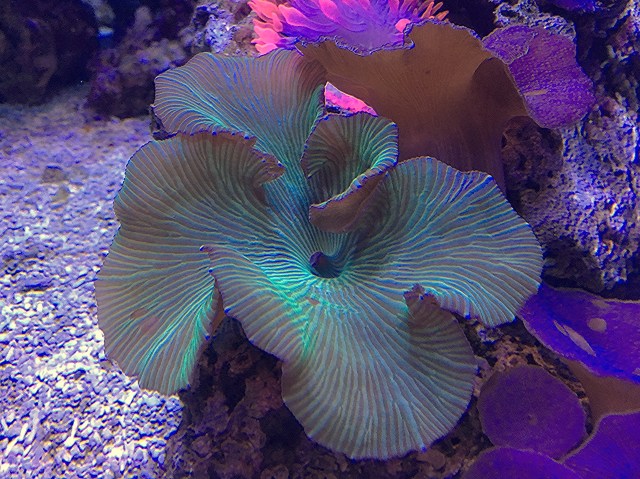
GENERAL CHARACTERISTICS: Generally they are disc shaped with a conical mouth, and the oral disc may be smooth, ribbed, with small or large pseudo tentacles or none at all. Unlike Rhodactus spp., most Discosoma spp. have smooth disc surfaces that lack obvious tentacles, though some may have small or rudimentary tentacles that are visible as rows of knobs.  Discosoma spp.  have many different colors such as blue, red, green and purple and some comes in stripes and spotted pattern,

The consistency of the tissues is thick and, due to copious mucus production, they are slippery to the touch.

26535600445_40b1028ba7_o

Diameter up to 8–15 cm (3-6 in)

DISTRIBUTION/HABITAT: Widespread in Indo-Pacific; also common in the Caribbean. Found in tropical coral reefs, typically in dense aggregations.

2999123527_d91c88eb75_o

DIET IN THE WILD: Discosoma spp. is a microcarnivore of plankton; may also possess zooxanthellae.

REPRODUCTION: Sexual and asexual, mostly through budding and pedal laceration. Formation of colonies of clones is common for most species.

5063052164_42df453911_o

REMARKS:

Corallimorphs are, as their name implies, very coral-like, but they do not secrete a skeleton.

Aquarists commonly use the generic term Actinodiscus.

REFERENCES

California Academy of Sciences Steinhart Aquarium Color on the Reef 2018

Aquarium Corals E H Borneman TFH Publications 2001 page 201-3

Ron’s flickr https://www.flickr.com/photos/cas_docents/26535600445/in/album-72157659465376212/

Ron’s WordPress shortlink wp.me/p1DZ4b-1Kn

Advanced Aquarist www.advancedaquarist.com/2002/10/inverts#section-0

TAXONOMY
Kingdom: Animalia
Phylum: Cnidaria
Class: Anthozoa
Order: Actiniaria
Family: Stichodactylidae

Genus/species: Stichodactyla tapetum  (aka Discosoma tapetum in the past)


GENERAL CHARACTERISTICS: Tentacles are short bulbous variegated in a multicolored pattern and densely packed. They are often arrayed in fields on the entire disc. 

Diameter is up to 4 inches.

DISTRIBUTION/HABITAT: S. tapetum are found in the Indo-Pacific and Red Sea covering the sand or reef like a carpet.

DIET IN THE WILD: Feed primarily on nutrients of symbiotic zooxanthellae living in their tissues as well as drifting plankton. 

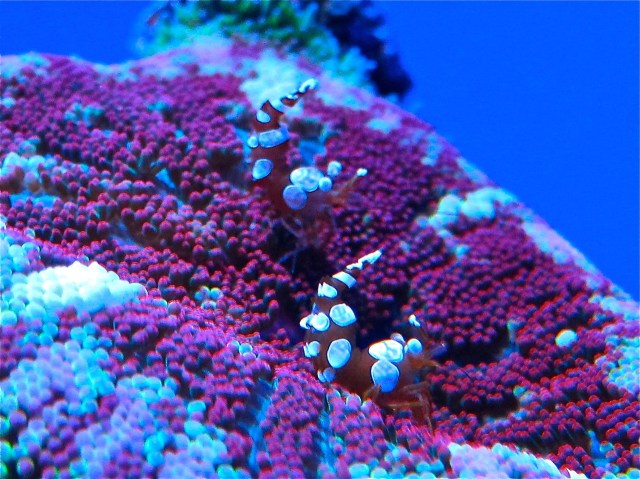
REMARKS:  They are not known to host clown fish, but they are attractive to anemone shrimp and anemone crabs. In the wild, they are favored by Sexy Shrimp (Thor amboinensis) and Periclimenes spp. commensal shrimps.

They can give a potent sting if touched.


References

California Academy of Sciences Steinhart Aquarium Hidden Reef 2018

Animal Diversity Web animaldiversity.org/accounts/Stichodactyla_tapetum/classi…

Ron’s flickr  https://www.flickr.com/photos/cas_docents/24745127802/in/album-72157659465376212/

Ron’s WordPress Shortlink  http://wp.me/p1DZ4b-iW

TAXONOMY
Kingdom: Animalia
Phylum: Chordata
Class: Actinopterygii
Order: Perciformes (Perch-likes)
Family: Gobiidae (Gobies)
Subfamily: Gobiinae

Genus/species: Stonogobiops yasha

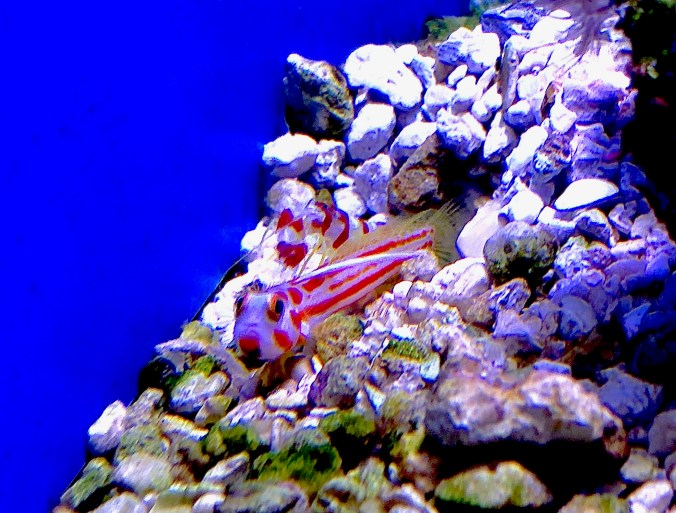
GENERAL CHARACTERISTICS: Body white, with 3 reddish-orange stripes.

Video links

DISTRIBUTION/HABITAT: They are found in Western Pacific in the outer reef slopes; often in pairs, hovering a few centimeters above the sandy bottom at the entrance of its burrow. Symbiotic with the red-and-white barred shrimp, Alpheus randalli

DIET IN THE WILD: The shrimp goby feeds on zooplankton and small benthic invertebrates.

Video link.  https://www.flickr.com/photos/cas_docents/39444680840/in/album-72157659465376212/

CONSERVATION: NOT EVALUATED
They are captive bred making them available to aquariums.

REMARKS: For a discussion of gobies and their commensal relationships (both parties in the relationship benefit). (see link below).
The goby benefits from the shrimp’s digging and construction skills, having access to a well-built burrow. Pistol shrimps have poor eyesight and they use gobies as an early warning system to detect predators. Gobies tend to hover just outside the shared burrow, catching passing zooplankton or small benthic invertebrates. In many cases the shrimps maintain contact with the gobies by using their long antennae.

Tropical Fish Mag.  www.tfhmagazine.com/saltwater-reef/feature-articles/pisto…

REFERENCES

California Academy of Sciences Steinhart Aquarium Hidden Reef 2018

Ron’s flickr https://www.flickr.com/photos/cas_docents/41253989801/in/album-72157659465376212/

fishbase.  www.fishbase.se/summary/Stonogobiops-yasha.html

Ron’s WordPress Shortlink wp.me/p1DZ4b-1W8

TAXONOMY
Kingdom: Animalia
Phylum: Arthropoda
Subphylum: Crustacea
Class: Malacostraca
Order: Decapoda
Infraorder: Caridea
Family: Hippolytidae

Genus/species: Thor amboinensis

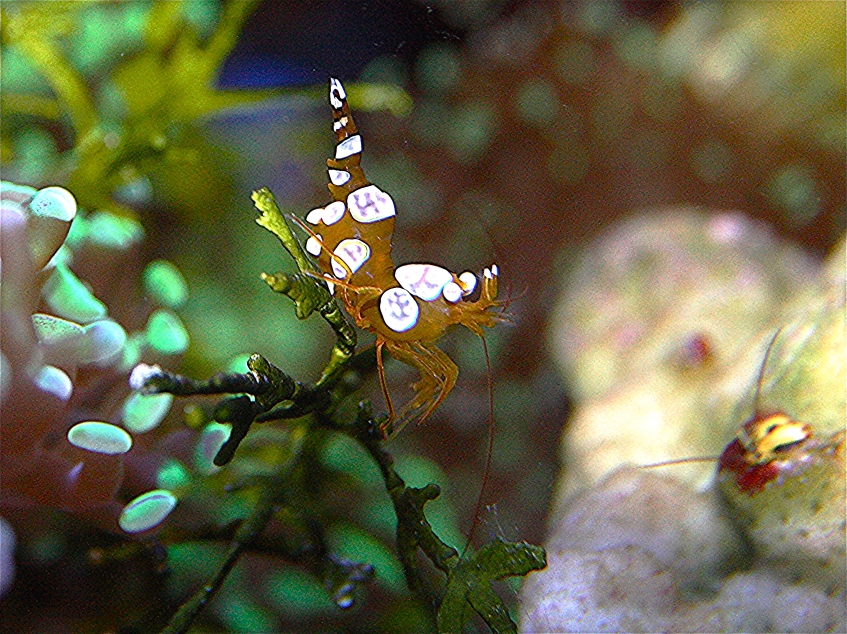
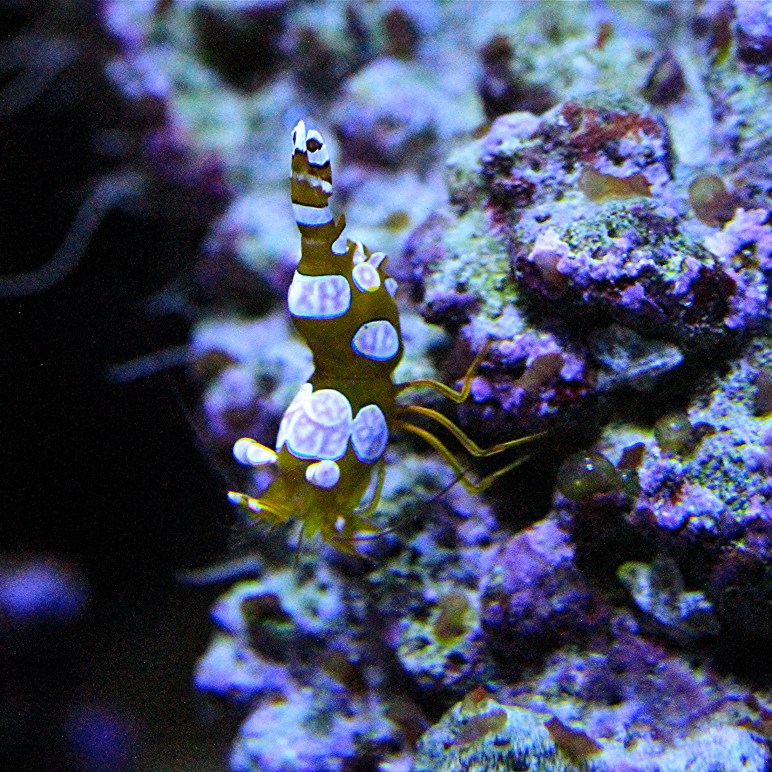
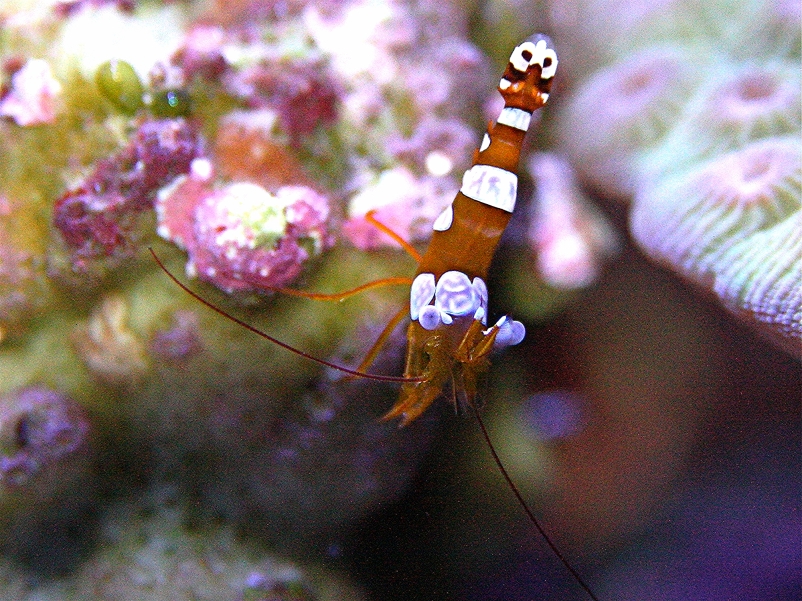
GENERAL CHARACTERISTICS: Base body color is drab (olive or brown), with iridescent yellow-white spots bordered by thin white and blue bands, symmetrically arranged over their bodies. The distinctive vertical position and movement of the abdomen earn this shrimp its common name of “sexy.”

Length up to 2 cm. (0.8 inches)


3574925860_fd0f1a8f63_o

Length up to 2 cm. (0.8 inches)

DISTRIBUTION/HABITAT: Common in tropical seas worldwide. Found in Coral reefs; in association with anemones such as form symbiotic relationships with anemones such as Entacmaea quadricolor, Macrodactyla doreensis, Stichodactyla tapetum, and Zoanthus sp., living on and around their oral discs, tentacles, or substrate very near to anemone bases.

Sexy shrimp4104005971_290c048ff2_o
DIET IN THE WILD: Sexy shrimp are carnivorous feeding on matter trapped in a host anemone’s mucus, including plankton. Their diet may also include other small crustaceans, such as brine shrimp and krill. When resources are scarce, shrimp may resort to feeding on the tentacles of their hosts.

REPRODUCTION: These shrimp are protandric hermaprhodites; they are born male and may change into females later in life.
Mating is polygynandrous (promiscuous) T. amboinensis are sexually dimorphic. Males are typically smaller than females and have white spots on their pleopods (appendages). During copulation, a male transfers sperm cells from his gonopores (located on his fifth pereopods) to a female’s gonopores (on her third pereopods).
Females carry, and oxygenate eggs under their forward tail section, on the pleopods. While bearing eggs, they hold their legs under the tail to protect them.

3288692919_9aa8f9db8a_o

Lifespan ave. 3.5 years

CONSERVATION: IUCN RED LIST Not Evaluated

REMARKS: Sexy shrimp are known to vibrate their abdomen to signal or warn others. They are capable of moving very quickly, at rates of 10-15 cm/s, to escape perceived threats.

They will endure the attacks from the anemones’ nematocysts. Some studies state that a shrimp acclimates to an anemone by collecting its mucus, which camouflages it from the anemone or other studies say that a shrimp acclimates by building up chemicals that inhibit the excretions of nematocysts from anemones.

References

California Academy of Sciences, Steinhart Aquarium, Hidden Reef 2018

Ron’s flickr  https://www.flickr.com/photos/cas_docents/3574925860/in/album-72157659465376212/

ADW animaldiversity.org/accounts/Thor_amboinensis/

Ron’s WordPress shortlink  http://wp.me/p1DZ4b-1Jv

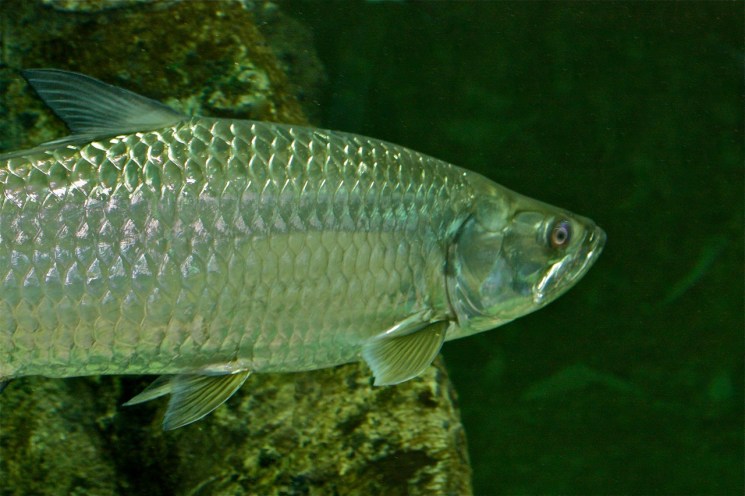
TAXONOMY
Kingdom: Animalia
Phylum: Chordata
Class: Actinopterygii (Ray-finned fishes)
Order: Elopiformes (Tarpons and tenpounders)
Family: Megalopidae (Tarpons).

Genus/species: Megalops atlanticus

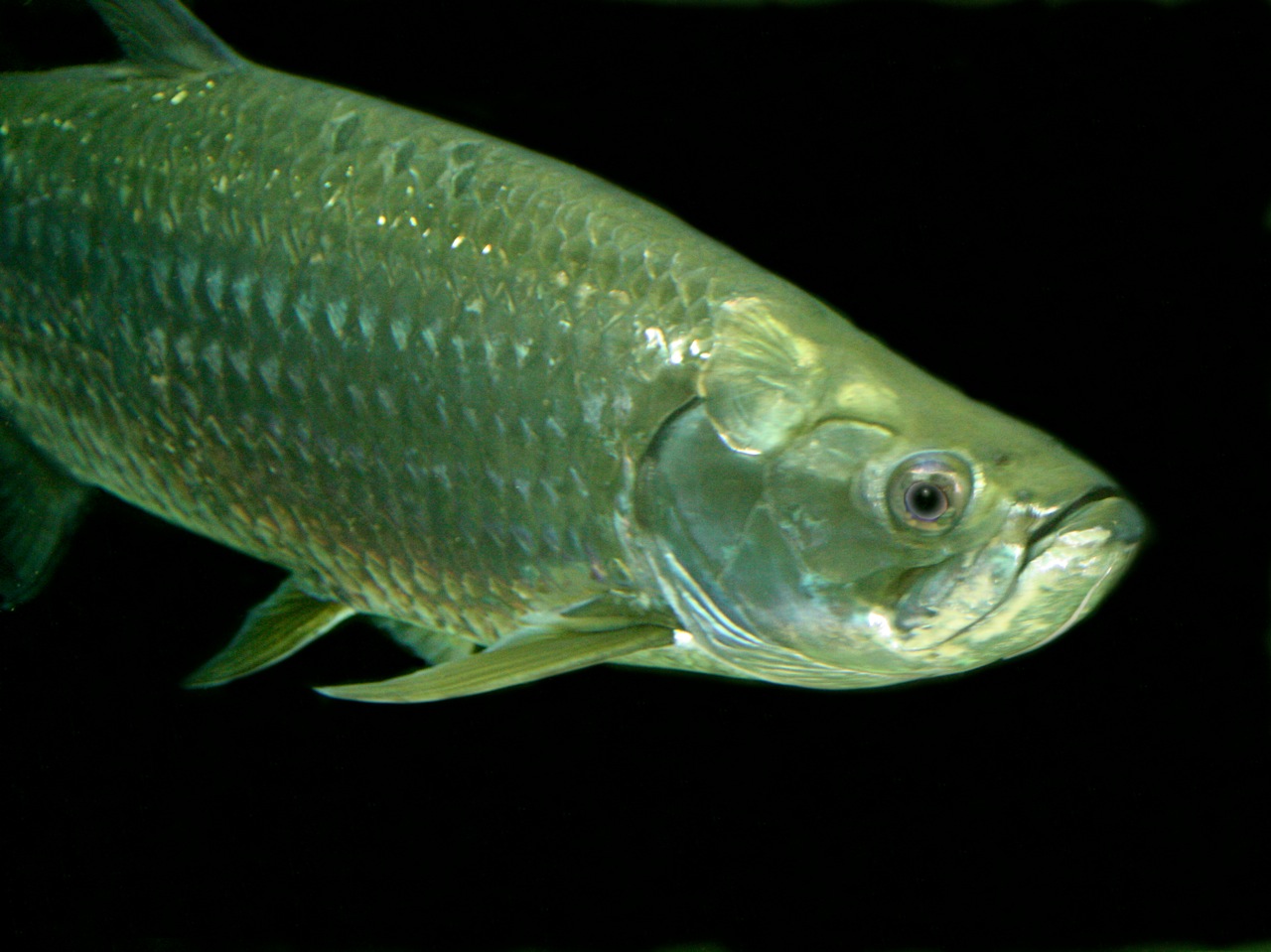
GENERAL CHARACTERISTICS: The Tarpon has a large, elongated, moderately deep and compressed body. Sides and belly are silvery and back blue-gray. The caudal fin is deeply forked. They “roll” at the water surface taking in air into their lunglike swimbladder which is attached to the esophagus allowing it to fill directly with air permitting the fish to live in oxygen-poor waters.

Length up to 2.5 m (8 ft) and weight up to 160 kg (350 lbs)

DISTRIBUTION/HABITAT: Nova Scotia south to Brazil, including the Gulf of Mexico, Caribbean and the West coast of Africa. Though the majority of its life is spent in the open ocean, M. atlanticus tolerates fluctuating salinities and may be found in coastal waters, bays, estuaries, mangrove-lined lagoons, and rivers, such as the Amazon.

Some populations of M. atlanticus may complete their life cycle in freshwater lakes or as in the California Academy of Sciences flooded Amazon.

DIET IN THE WILD: They feed on sardines, anchovies, and other fishes as well as shrimp, crabs, and other crustaceans.

REPRODUCTION and DEVELOPMENT:  Spawn offshore. High fecundity; a 2.3 m (7.5 ft) female is estimated to produce over 12 million eggs. Spawn in waters which can be temporarily isolated from the open sea. Larvae develop inshore and are leptocephalic in shape (flattened, transparent, and eel-like).

PREDATORS: Natural predators are sharks.

REPRODUCTION: They spawn offshore and exhibit high fecundity, a 2.3 m (7.5 ft) female is estimated to produce over 12 million eggs. They can also spawn in waters that are temporarily isolated from the open sea. Larvae develop inshore and are leptocephalic in shape (flattened, transparent, and eel-like). Life span: at least 55 years.

CONSERVATION: IUCN Red list; Vulnerable

REMARKS: Tarpon are among the most “primitive” existent bony fish.

It is a popular game fish of sportfishers, due to its dynamic reaction once hooked. Since the flesh is of poor quality, they are usually released, though another source states, “The flesh is highly appreciated despite its being bony.” It is marketed fresh or salted.

Their large (up to 8 cm (3 in) diameter) silvery scales are fashioned into jewelry.

References

Ron’s WordPress shortlink  http://wp.me/p1DZ4b-9e

Ron’s flickr  https://www.flickr.com/photos/cas_docents/3458838683/in/set-72157620568438047/

“It’s Easy Being Green” Docent Course. California Academy of Sciences 2014 

 fishbase fishbase.org/summary/1079

 Encyclopedia of Life  eol.org/pages/339927/details


TAXONOMY
Kingdom:Animalia
Phylum: Chordata
Class: Actinopterygii (ray-finned fishes)
Order: Perciformes (Perch-likes)
Family: Cirrhitidae (Hawkfishes)

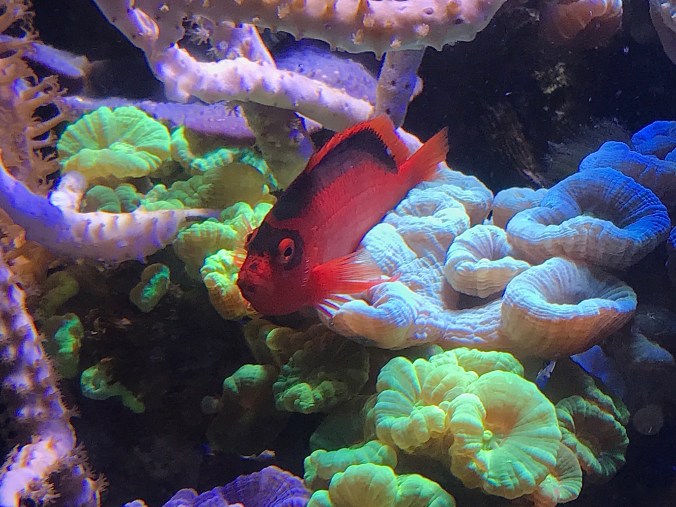
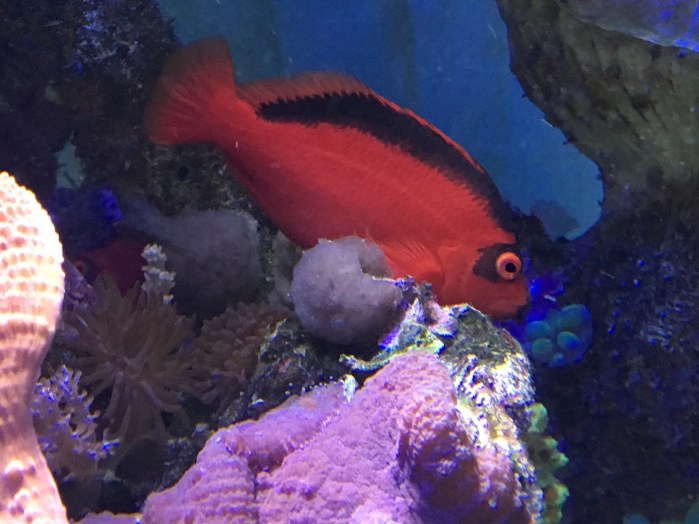
Genus/species: Neocirrhites armatus

GENERAL CHARACTERISTICS: Hawkfishes are bottom feeders without swim bladders usually found in coral branches. Cirri at the tips of their dorsal fins identifies them.

The Flame hawkfish has brilliant red color with a black stripe that runs along the base of their dorsal fin, as well as black circles around their eyes.

Length up to 9 cm (3.5 in)

DISTRIBUTION/HABITAT: Found in the Pacific Ocean: Great Barrier reef to Micronesia on corals.

DIET IN THE WILD: Small crustaceans

REPRODUCTION: Oviparous, monogamous

CONSERVATION: IUCN Not Evaluated

References

Ron’s flickr https://www.flickr.com/photos/cas_docents/32538479733/in/album-72157629304397467/

California Academy of Sciences Steinhart Aquarium Animal Attractions 2017

fishbase fishbase.org/summary/5832

EOL eol.org/pages/204618/details

reef keeping www.reefkeeping.com/issues/2002-06/hcs3/

Ron’s WordPress Shortlink http://wp.me/p1DZ4b-1QC


TAXONOMY
Kingdom: Animalia
Phylum: Chordata
Class: Actinopterygii (ray-finned fishes)
Order: Perciformes (Perch-likes)
Family: Acanthuridae (Surgeonfishes, tangs, unicornfishes)

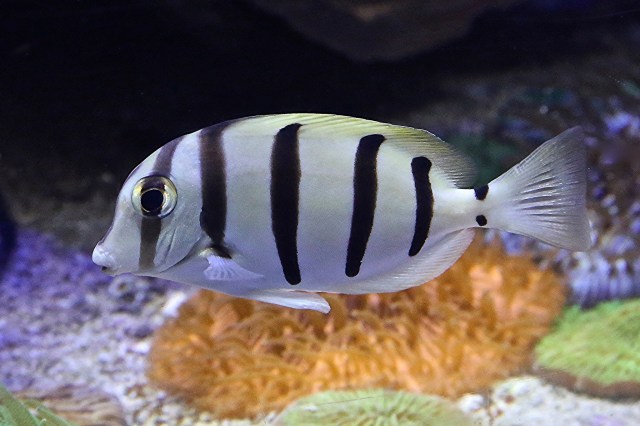
Genus/species: Acanthurus triostegus

Convict surgeonfish 8156826256_a90f659c94_o

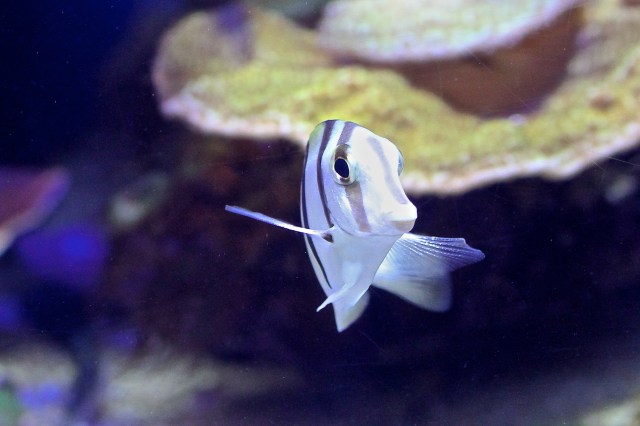
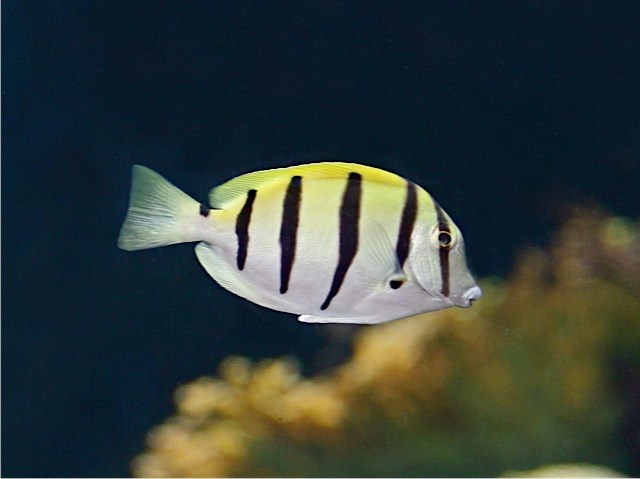
GENERAL CHARACTERISTICS: The Convict Tang is a very common surgeonfish.  It is oval in profile and laterally compressed, gray with 4 vertical stripes (1 stripe on head across the yellow eye; 1 on caudal peduncle). The erectile spine on each side of caudal peduncle which folds down into a groove.  This scalpel like spine causes a nasty cut if the fish is treated roughly by a predator or a human. 

Common length : 17.0 cm (6.7 inches).

DISTRIBUTION/HABITAT:  A. triostegus is found in lagoons and seaward reefs in areas of hard substrates from sea level to 90 m (300 feet) in the Indo-Pacific.

Typically occurs in shallows to 5 m (16 feet).

DIET IN THE WILD: It is a herbivore which uses its serrated teeth along creating saw-like motion to remove filamentous algae from the substrate.

ConvictTang8358632069_43f1bc0004_k

REPRODUCTION: The Convict Tang spawns at dusk with females broadcasting eggs into open water where the males fertilize them.  Larvae drift ~75 days. Post-larvae settle in intertidal areas of benches and reef flats.

PREDATORS: Eggs and sperm are preyed upon by eagle rays, which are often present during spawning.

CONSERVATION: IUCN, Least concern.

REMARKS: This black-barred fish’s common name presumably alludes to the coloration of many prison uniforms of the previous century.


References

Ron’s Flickr http://www.flickr.com/photos/cas_docents/3185789781/in/set-72157608332652056/

California Academy of Sciences Steinhart Aquarium Philippine Coral Reef 2016

fishbase  www.fishbase.org/summary/1260

Aquarium of the Pacific www.aquariumofpacific.org/onlinelearningcenter/species/co…

Monterey Bay Aquarium www.montereybayaquarium.org/animals/AnimalDetails.aspx?en…

EOL eol.org/pages/203984/overview

Ron’s WordPress shortlink  http://wp.me/p1DZ4b-lR


TAXONOMY
Kingdom: Animalia
Phylum: Chordata
Class: Actinopterygii (ray-finned fishes)
Order: Tetraodontiformes (Puffers and filefishes)
Family: Monacanthidae (Filefishes)

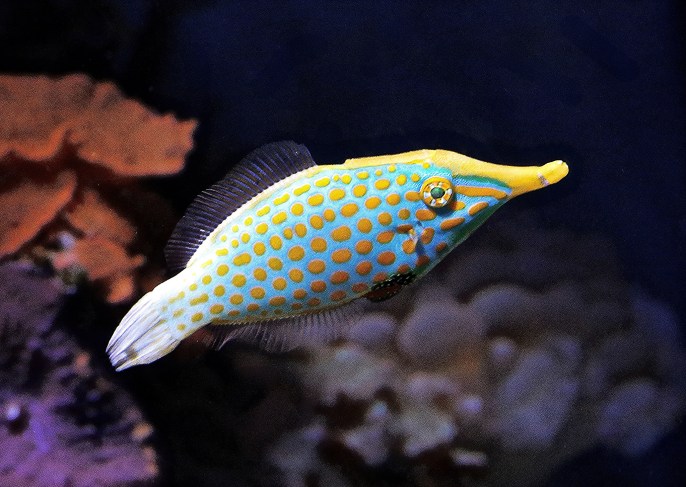
Genus/species: Oxymonacanthus longirostris

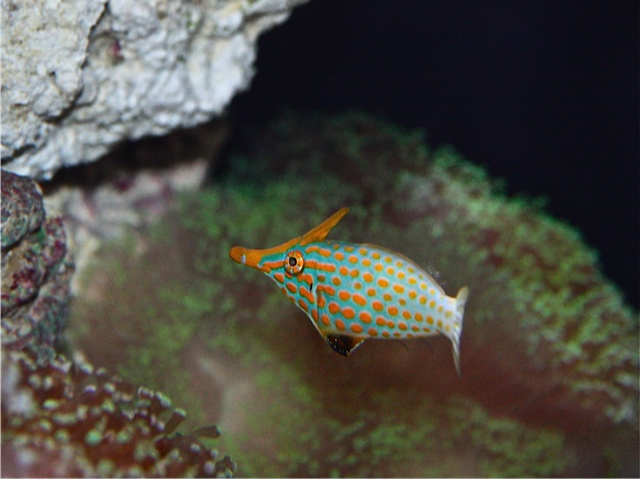
GENERAL CHARACTERISTICS: their color is pale blue with about eight longitudinal rows of orange-yellow patches, or green with small dark-edged yellow to orange spots.Their is a dark spot on the caudal fin. The snout is long with a small upturned mouth;

Length up to 12 cm (4.72 in)

DISTRIBUTION/ HABITAT: They are found in the Indo-Pacific. in clear lagoons and seaward reefs.

DIET IN THE WILD: Feeds almost exclusively on Acropora polyps throughout the day. The protruding snout and teeth that project from small mouth, permit them to snip off coral polyps. In captivity they can be fed a number of other food items, such as fish eggs, tiny mysid shrimp, and flake and pellet food.


REPRODUCTION: The Orange Spotted Filefish are found in pairs or small groups and nests near the bases of dead corals, often on clumps of algae. Monogamous except if the male population dwindles, then the largest males, become polygamous, breeding with more than one female. The male chatters his mouth along the underside of the female’s jaw presumably to synchronize the spawn. The female places her abdomen into the algae, and the male joins her alongside to fertilize. Non-guarders.

REMARKS: O.longirostris feeds on Acropora corals in Australia, ingesting coral chemicals which cause them to take on the scent of their food (Acropora).  This is the first time scientists have discovered a vertebrate chemically camouflaging itself via its diet, The cod were less active and spent less time hunting around the filefish that ate Acropora than around the fish that ate Pocillopora, indicating that the cod could not detect the Acropora-eating filefish.

References

California Academy of Sciences Animal Attractions Rich Ross 2017

Ron’s flickr http://www.flickr.com/photos/cas_docents/4540304067/in/set-72157625020091079/

News National Geographic.com  news.nationalgeographic.com/news/fish-smell-like-the-cora…

fishbase www.fishbase.org/summary/Oxymonacanthus-longirostris.html

EOL eol.org/pages/204726/details

Ron’s WordPress Shortlink  http://wp.me/p1DZ4b-oY