Category: CORAL REEF


TAXONOMY
Kingdom:  Animalia
Phylum: Chordata
Class: Actinopterygii (Ray-finned fishes)
Order: Pectiformes (Perch-likes)
Family: Pomacanthidae (Angelfishes).

Genus/species: Centropyge bicolor

GENERAL CHARACTERISTICS: One of the  most striking of the Centropyge group of dwarf or pygmy angelfish.  The forebody is yellow with a blue saddle across its nape and the rearbody is blue with a bright yellow tailfin. They are distinguished from the similarly shaped butterflyfish by strong preopercle spines found on each of the lower gill covers of angelfishes.

Length up to 6 inches (15.2cm)

DISTRIBUTION/HABITAT: Indo-Pacific in shallow, coral-rich reefs in rubble areas. Range 1 – 25 m (3-82 feet) deep.

DIET IN THE WILD: Varied diet algae, small crustaceans and worms.


MORTALITY/LONGEVITY; Average Lifespan of 12 years.

REPRODUCTION: As with other dwarf angels the Bicolor Angelfish are synchronous protogynic hermaphrodites. They start out sexually undifferentiated, develop into females, and with environmental influences will develop into males. Males are typically larger.

CONSERVATION : IUCN, Least concern

REMARKS: C. bicolor are very active darting from one hiding place to the next.

REFERENCES

California Academy of Sciences Steinhart Aquarium Color on the Reef 2016 AQA16

Ron’s flickr site http://www.flickr.com/photos/cas_docents/sets/72157606840726733/

Ron’s WordPress Shortlink:  http://wp.me/p1DZ4b-hR

fishbase  http://www.fishbase.org/summary/5454

EOL  http://eol.org/pages/211527/details

Animal world  https://animal-world.com/encyclo/marine/angels/angels.php

TAXONOMY
Kingdom: Animalia
Phylum: Chordata
Class: Actinopterygii (ray-finned fishes)
Order: Perciformes (Perch-likes)
Family: Plesiopidae (Roundheads, spiny basslets)
Subfamily: Plesiopinae

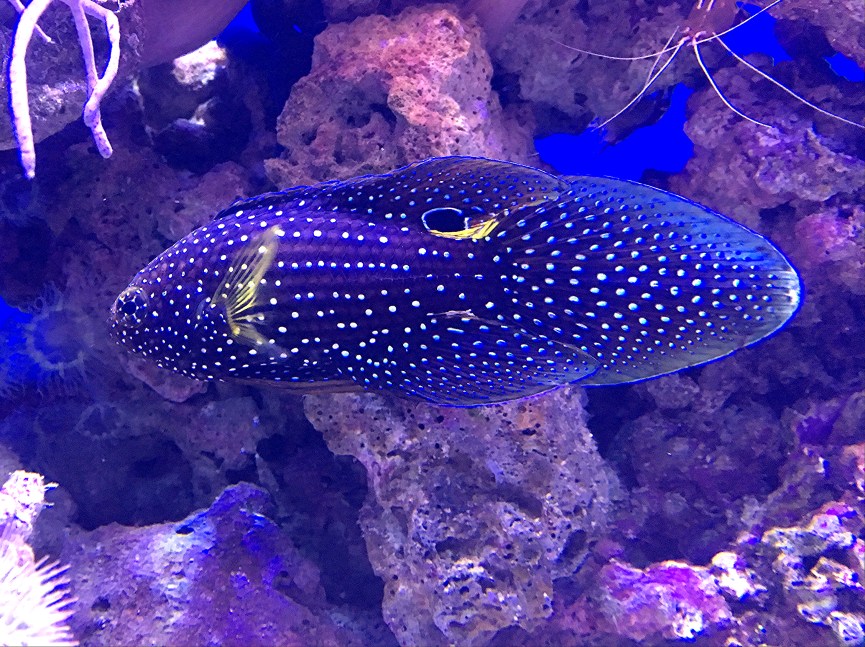
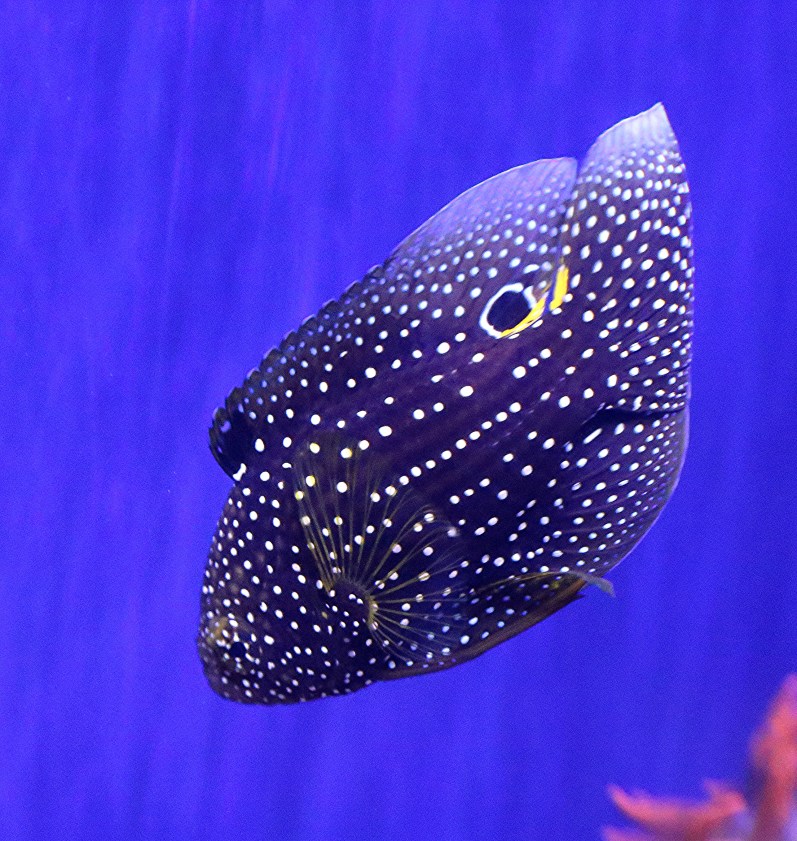
Genus/species: Calloplesiops altivelis

GENERAL CHARACTERISTICS: Head and body brownish black with small pale blue spots; vertical and pelvic fins dark orange-brown, with many small blue spots; blue ringed black ocellus above base of last 3 dorsal rays; yellow spots at base of upper caudal rays; pectoral rays bright yellow, fin membrane transparent.

Length to 16 cm (6.30 in)


DISTRIBUTION/HABITAT: Indo-Pacific: Red Sea and East Africa to Tonga and the Line Islands Found in rocky crevasses, at depth range 4 to 30 m (13.12 to 98.43 ft).

DIET IN THE WILD: C. altivelis is a predator of crustaceans and small fish. It assumes ahead down position, with its false eye spot near the tail resembling the head of a moray eel.

REPRODUCTION: Marine Betta eggs are guarded by the male parent.

CONSERVATION: IUCN Red List; Not Evaluated

COLOR OF LIFE NOTE: Color Communicates: Anti-predator Adaptations, Batesian mimicry  (a harmless species evolved to imitate the warning signals of a harmful species directed at a predator of them both). 
An apparent mimetic relationship exists between this fish and the whitemouth moray (Gymnothorax meleagris). When threatened, a comet will raise all of its median fins and swim into a hole or crevice. But rather than disappearing completely, it typically stops in the entrance of its sanctuary and leaves the posterior part of its body exposed.
Also note the false eyespot posteriorly.

References

California Academy of Sciences Steinhart Aquarium Water is Life Hidden Reef 2018

Animal Diversity Web   animaldiversity.org/accounts/Calloplesiops_altivelis/

fishbase  www.fishbase.org/summary/Calloplesiops-altivelis.html

EOL eol.org/pages/205993/details

Ron’s flickr https://www.flickr.com/photos/cas_docents/5118860448/in/album-72157652559028013/

Ron’s WordPress shortlink  http://wp.me/p1DZ4b-1B1


TAXONOMY
Kingdom:Animalia
Phylum: Chordata
Class: Actinopterygii (ray-finned fishes)
Order: Perciformes (Perch-likes)
Family: Opistognathidae (Jawfishes)

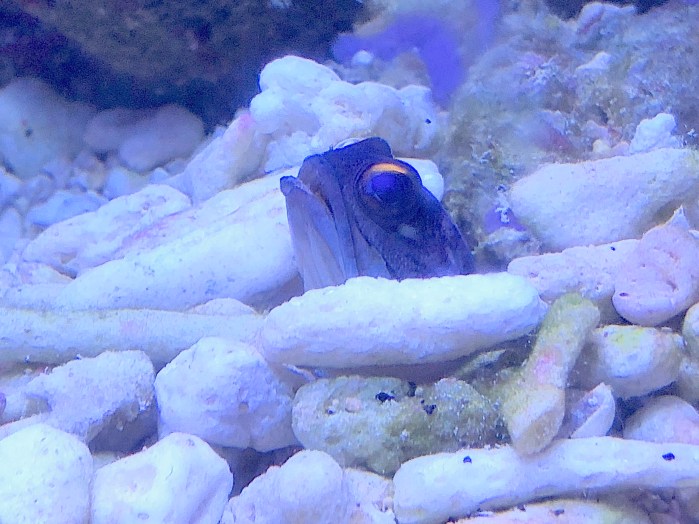
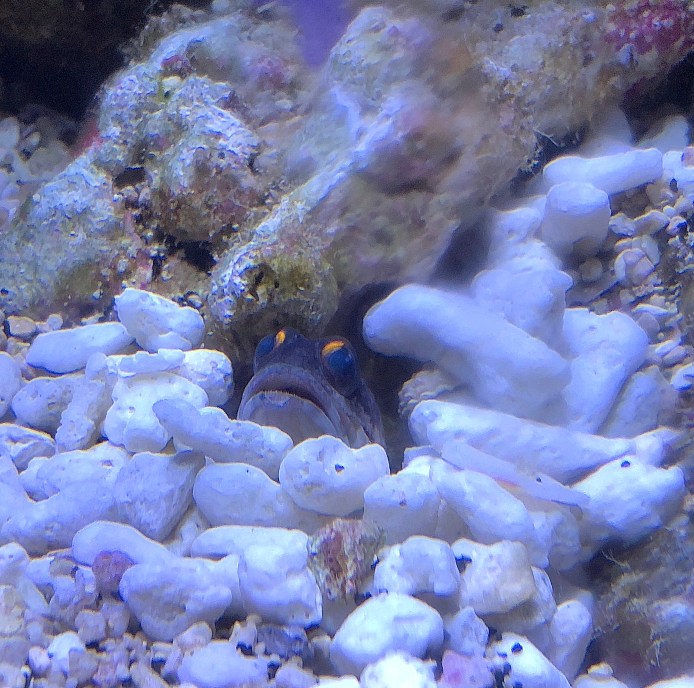
Genus/species: Opistognathus randalli

GENERAL CHARACTERISTICS Has two large bulging eyes to peak to of its burrow. They use their large mouths to dig the burrow and reinforce the walls with stones and shells.

Length up to 10.4 cm (4 inches)

DISTRIBUTION/HABITAT: Found in the tropical marine Western Pacific: pelagic-sublittoral zone; the part of the ocean extending from the low tide mark to the edge of the continental shelf, with a relatively shallow depth extending to about 200 meters. They are located in the sand/rubble bottoms near reefs.

Depth range 5 – 32 m (16-105 ft)

DIET IN THE WILD: Small crustaceans, fish and invertebrates

REPRODUCTION: Jawfish are mouthbrooders. Males of this species are strongly territorial and frequently engage in jaw locking combat.

IUCN Not evaluated.

Reference

California Academy of Sciences, Steinhart Aquarium Hidden reels 2018

fishbase fishbase.org/summary/Opistognathus-randalli.html

Ron’s flickr  https://www.flickr.com/photos/cas_docents/40146951615/in/album-72157659465376212/

Ron’s WordPress Shortlink. https://wp.me/p1DZ4b-1X8

TAXONOMY
Kingdom: Animalia
Phylum: Arthropoda
Subphylum: Crustacea
Class: Malacostraca
Order: Decapoda (crayfish, crabs, lobsters, prawns, and shrimp)
Infraorder: Caridea
Family: Hymenoceridae

Genus/species: Hymenocera picta

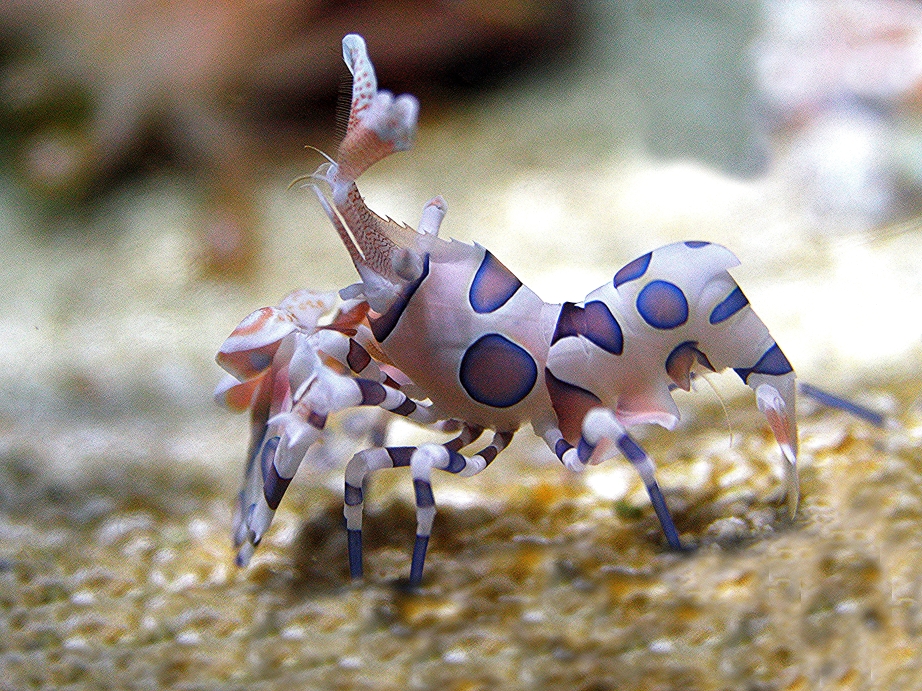
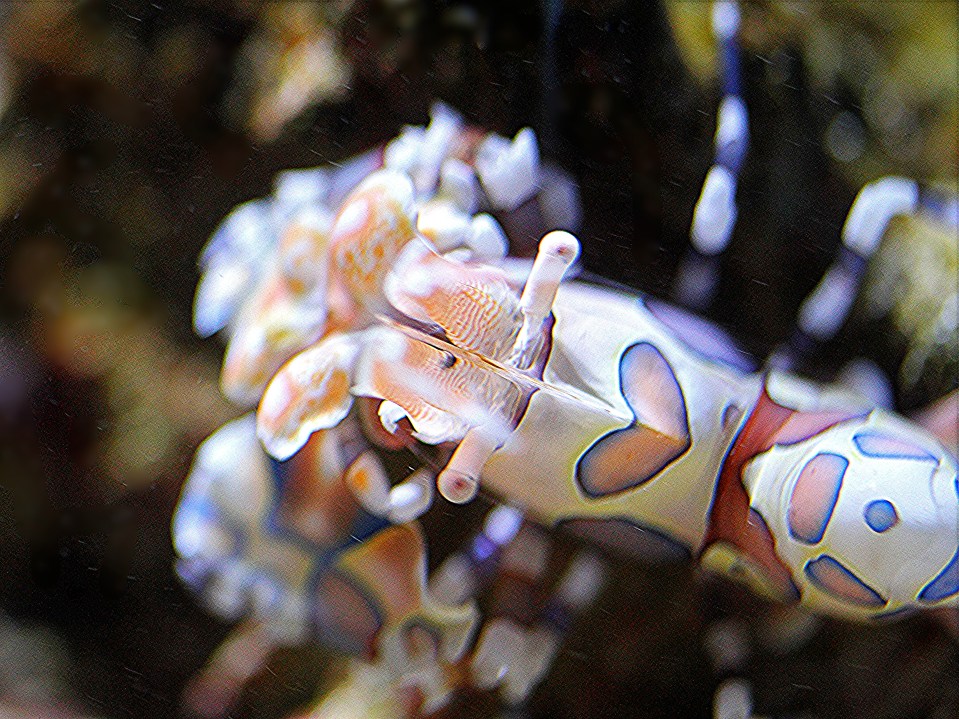
GENERAL CHARACTERISTICS: Pinkish white body color with splashes of purple-edged pink spots. Stalked eyes and antennae flattened and leaf-shaped.

Length up to 5 cm (2 inches)

3270612381_97f047b272_o

DISTRIBUTION/HABITAT: Along the shores of East Africa, the Red Sea, to Indonesia, south to northern Australia and as far east as the Galapagos. Found on hard rocky or coral substrates, with lots of hiding places.

4405902944_fe87f480fe_o

DIET IN THE WILD: It is a nocturnal feeder hunting in pairs for sea stars, using its claws to pry sea stars off coral reefs flipping them on their back. They then take them to their dwelling-place on the reef, where they consume their the tube feet of sea stars.

Harlequin Shrimps eating a Linka Seastar below

REMARKS: H. picta is known to feed on crown-of-thorns sea stars, so perhaps it should be considered a reef preservationists.

References

California Academy of Sciences Steinhart Aquarium Hidden Reef

Ron’s flickr https://www.flickr.com/photos/cas_docents/3270612381/in/album-72157659465376212/

Ron’s WordPress Shortlink  http://wp.me/p1DZ4b-1K1

ADW animaldiversity.org/accounts/Hymenocera_picta/classificat…

EOL eol.org/pages/126747/details

TAXONOMY
Kingdom: Animalia
Phylum: Chordata
Class: Actinopterygii (ray-finned fishes)
Order: Perciformes (Perch-likes)
Family: Pomacentridae (Damselfishes, Chromis, Aneomonefishes)

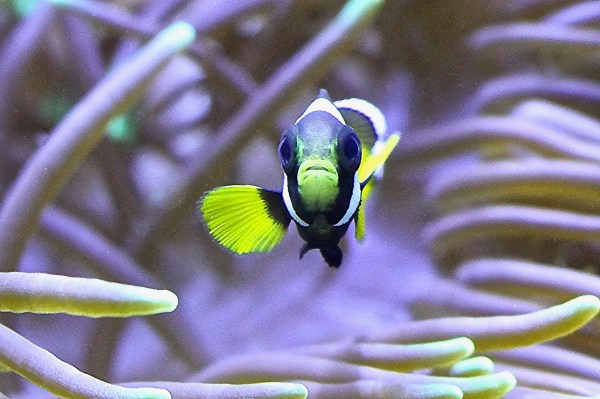
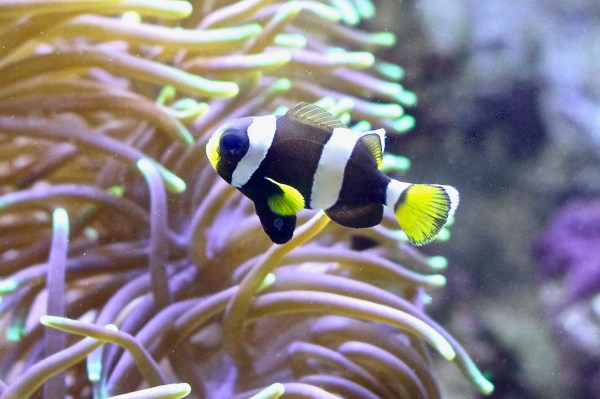
Genus/species: Amphiprion latezonatus

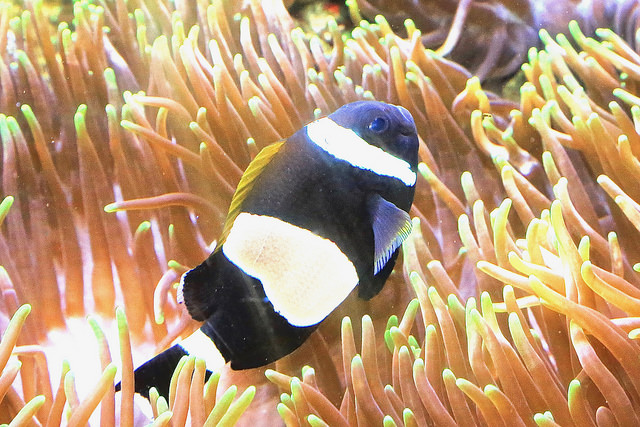
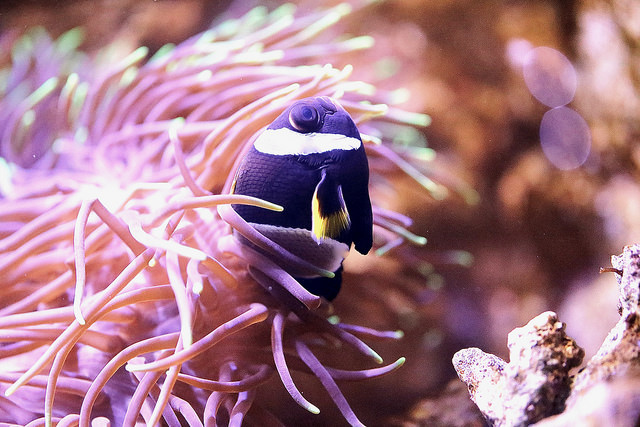
GENERAL CHARACTERISTICS:  The very wide mid-body bar is much narrower at the top than at the bottom. The body is dark brown with three white bars, middle bar very wide, more than twice the width of the mid-body bar of most other anemonefishes. A. latezonatus often has bright blue markings on the upper lip and the edges of the bars. Has blue lips as well as a broad bar on the sides of the body. The dorsal fin may be orange or yellow. The caudal fin has a pale posterior margin.

Length up to 15 cm (6 in)

DISTRIBUTION/HABITAT: The Wide-Band Clownfish is found on the Western Pacific: Australia and New Caledonia inhabiting rocky and coral reefs. Depth to 5-45 metres (16-150 feet).

DIET IN THE WILD: Carnivore, feeds mainly on planktonic crustaceans (copepods, mysis, and shrimp larvae and some algae.

            Juveniles below note the different color.  NOT CURRENTLY ON EXHIBIT

REPRODUCTION: Clownfish are oviparous with distinct pairing during breeding. Eggs are demersal and adhere to the substrate. Males guard and aerate the eggs.
Protandry refers to organisms that are born male and at some point in their lifespan change sex to female. Protandrous animals include clownfish. If the female clownfish is removed from the group, such as by death, one of the largest and most dominant males will become a female. The remaining males will move up a rank in the hierarchy.

Juveniles below note the different color.  NOT CURRENTLY ON EXHIBIT

REMARKS: Associated with the anemone Heteractis crispa in the wild.

Academy captive Entacmaea sp.

References

California Academy of Sciences Steinhart Aquarium Hidden Reef 2018 Vetted Curator Charles Delbeek

fishbase fishbase.org/summary/Amphiprion-latezonatus.html

Ron’s flickr  https://www.flickr.com/photos/cas_docents/39139992210/in/album-72157659465376212/

Ron’s WordPress Shortlink  http://wp.me/p1DZ4b-MR

EOL eol.org/pages/24566/details

TAXONOMY
Kingdom: Animalia
Phylum: Chordata
Class: Actinopterygii
Order: Scorpaeniformes. (Scorpionfishes and flatheads)
Family: Scorpaenidae (Scorpionfishes or rockfishes)
Subfamily: Scorpaeninae

Genus/species: Taenianotus triacanthus

GENERAL CHARACTERISTICS: The Leaf Scorpionfish is tan to reddish or brown in color. It has prickly papillae instead of scales. Inhabits reef flats, outer reef slopes, current-swept channels, and rarely on lagoon reefs. They have venomous spines.

Length up to 10.0 cm (4 in)

DISTRIBUTION/HABITAT: The are found in the Indo-Pacific: East Africa to the Galapagos Islands, north to Ryukyu and Hawaiian islands, south to Australia and the Tuamoto Islands. Inhabits reef flats, outer reef slopes, current-swept channels, and rarely on lagoon reefs.

DIET IN THE WILD: Feeds on small crustaceans and fishes

CONSERVATION: IUCN: Least Concern

REMARKS: T. triacanthus are solitary and usually immobile among algae or seagrass but has hip movements resembling that of a leaf falling down from a tree. They molt twice a month with the skin breaking off first in the head region.

References

California Academy of Sciences Steinhart Aquarium Hidden Reef 2018

fishbase http://fishbase.org/summary/5824

IUCN  http://www.iucnredlist.org/details/79800214/0

EOL eol.org/pages/212250/details

Ron’s WordPress Shortlink https://wp.me/p1DZ4b-1WK

TAXONOMY
Kingdom:Animalia
Phylum: Cnidaria
Class: Anthozoa
Order: Alcyonacea (soft corals)
Family: Alcyoniidae

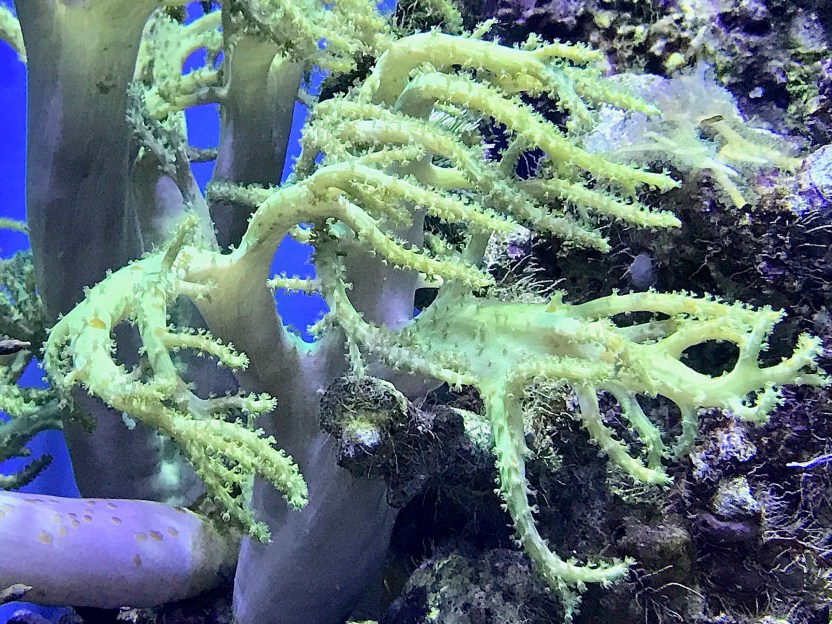
Genus: Sinularia notanda (Tree-like soft coral)

GENERAL CHARACTERISTICS: Colors include purple, pink, gray, green, and yellow, but are usually brown to cream. They have stalks with tree-like branches, and from those form little branchlets. The branchlets have small autozooid (feeding) polyps which have the ability to retract fully.

DISTRIBUTION/HABITAT: Tropical Indo West Pacific on coral reefs in fairly strong currents.

DIET IN THE WILD: Phytoplankton and very small zooplankton
(Harbors symbiotic zooxanthellae which adds nutrition to its tissues from the algae’s photosynthesis.

References

California Academy of Sciences Steinhart Aquarium Color Cluster 2016 AQA17 Pam Montbach

Ron’s flickr https://www.flickr.com/photos/cas_docents/27838187418/in/album-72157659465376212/

Aquarium Corals E H Borneman TFH Publications 2001 page 132

WoRMS http://www.marinespecies.org/aphia.php?p=taxdetails&id=29991

TAXONOMY
Kingdom: Animalia
Phylum: Cnidaria
Class: Anthozoa
Order: Scleractinia (stony corals or hard corals)
Family: Dendrophylliidae

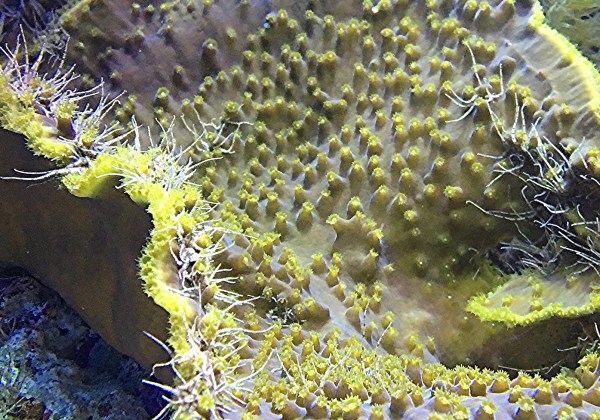
Genus/species: Turbinaria reniformis

(Brain coral Platygyra sp. on the right)

GENERAL CHARACTERISTICS: T. reniformis may form cup, vase, or spreading scroll-like plates, Color yellow, brown, or sometimes green. The corallites widely spaced apart from each other with the polyps like short tufts sprouting from the surface.

Diameter of plates up to 1 meter (3 ft)

turbinaria32394123080_1e4c866324_o

DISTRIBUTION/HABITAT: Yellow Cup Cora are found throughout the Indo-Pacific from shallow turbid water to clear reef flats and deeper reef slopes ( 2 to 15 metres)

DIET IN THE WILD: Zooxanthellae provide nutrients and energy, and help remove metabolic wastes.

REPRODUCTION: T. reniformis unlike most corals which are hermaphroditic (have both male and female sex organs releasing gametes for external fertilization), Yellow Cup Coral have separate male and female sexes.

CONSERVATION: IUCN Red List Vulnerable (VU) T. reniformisis is susceptible to bleaching and disease due to a more restricted depth range,

REMARKS: When irritated, it can produce large amounts of clear mucus which can damage other corals; the mucus is presumed to contain nematocysts or a toxin.

References

California Academy of Sciences Steinhart Aquarium Shrimpfish exhibit and Philippine Coral Reef Exhibit, 2017 Pam Montbach

Aquarium Corals E.H. Borneman 2001 ppg 318-321

EOL eol.org/pages/1016035/details

ARKIVE  www.arkive.org/yellow-scroll-coral/turbinaria-reniformis/

Ron’s WordPress Shortlink http://wp.me/p1DZ4b-1LJ

Ron’s flickr https://www.flickr.com/photos/cas_docents/32428403365/in/album-72157659465376212/

TAXONOMY
Kingdom: Animalia
Phylum: Cnidaria
Class: Anthozoa
Order: Scleractinia (stony corals or hard corals)
Family: Faviidae

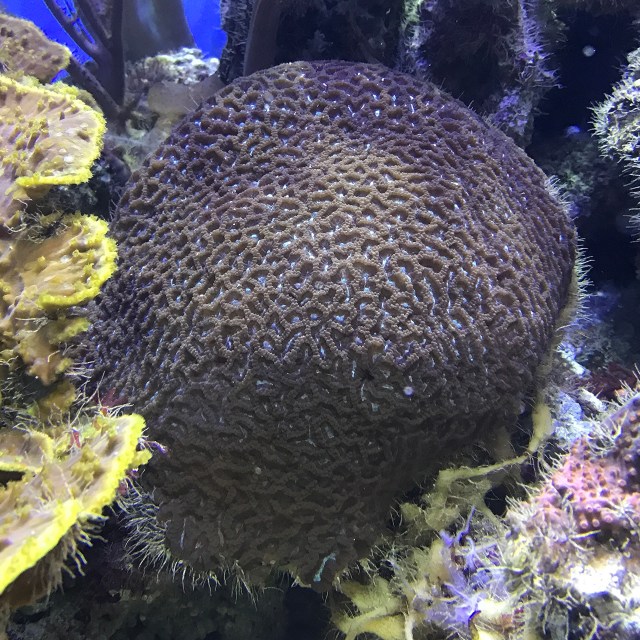
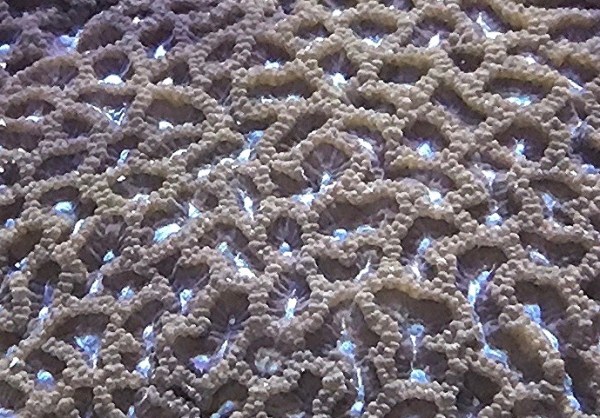
Genus: Platygyra sp.

GENERAL CHARACTERISTICS: Colonies can be massive, encrusting, dome-shaped or flattened. Corallites (the skeletal cup, formed by an individual stony coral polyp, in which the polyp sits) form meandering walls of brown, green, or gray surrounding contrasting valleys of cream, pink, gray, or even fluorescent green.  Easily confused with Goniastrea and Leptoria.

Platygyra32394124350_d187cacd4e_o

DISTRIBUTION/HABITAT: Indo-Pacific, including the Red Sea and around Australia and Southeast Asia. Inhabits a variety of reef locations, including reef flats, back reefs, and deeper waters.

DIET: Primary nutrition received from the photosynthesis of symbiotic zooxanthellae. Supplemental diet from capture of microplankton by stinging tentacles.
REPRODUCTION: Sexually by spawning and asexually by budding (polyps divide to form new polyps)

CONSERVATION: IUCN Least Concern (LC)

References

California Academy of Steinhart Aquarium Sciences Color Hidden Reef Shrimpfish exhibit 2018

Ron’s flickr  https://www.flickr.com/photos/cas_docents/32394124350/in/album-72157659465376212/

Aquarium Corals E H Borneman 2001 ppg 298-99

Arkive  www.arkive.org/brain-coral/platygyra-daedalea/

Carpenter, K.E. (1998) An introduction to the oceanography Corals ftp://ftp.fao.org/docrep/fao/009/w7191e/w7191e10.pdf

IUCN Red List 2009 www.iucnredlist.org/

Ron’s WordPress Shortlink  http://wp.me/p1DZ4b-1LE

TAXONOMY
Kingdom: Animalia
Phylum: Chordata
Class: Actinopterygii
Order: Perciformes
Family: Labridae (Wrasses)

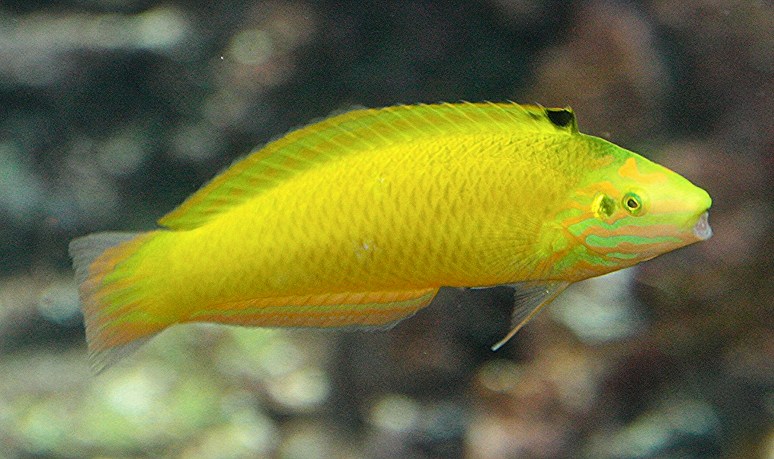
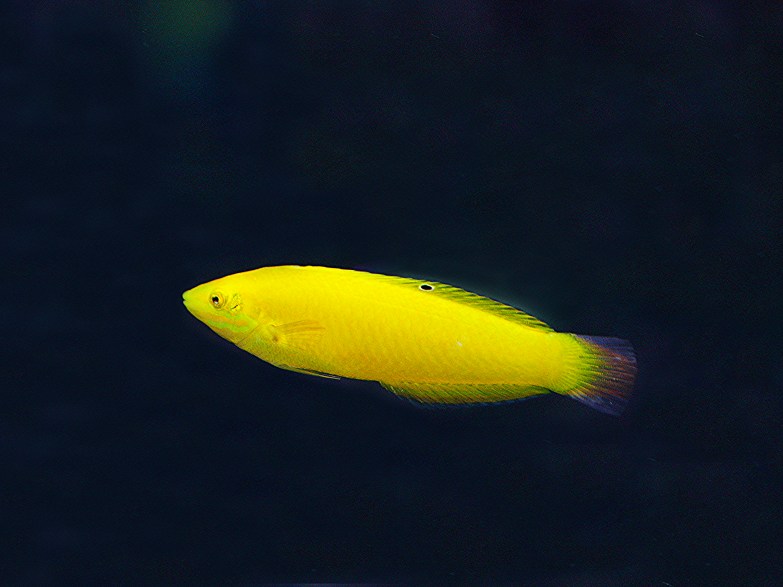
Genus/species: Halichoeres chrysus

GENERAL CHARACTERISTICS: The body is elongated and canary yellow in color, with distinctive light-green bands on the head. Males have a single white-rimmed
black spot on dorsal fin; females have two black, light yellow-rimmed spots.

Length up to 12 cm (4.75 in).

DISTRIBUTION/HABITAT: East Indo-Pacific: Christmas Island to Marshall Islands; north to Japan, south to Australia. Found on sand and rubble edges of reefs.

DIET IN THE WILD: The Yellow Wrasse is a carnivore; small worms, snails, crustaceans;
also may eat parasites off of other fishes.

REPRODUCTION: H. chrysus is a protogynous hermaphrodite They start life as females with the capability of turning male later. Distinct pairing during breeding has been noted.

CONSERVATION: IUCN

REMARKS: Most species of wrasse are elongated and relatively slender with pointed snouts. Characteristic features of the wrasses include thick lips, smooth scales, long dorsal and anal fins, and large, often protruding canine teeth in the front of the jaw.

Other common characteristics include their form of propulsion, which depends mostly on the winglike motion of the pectoral fins with only an occasional burst of speed provided by the caudal fin.

References
California Academy of Sciences Steinhart Aquarium Hidden Reef 2016
Vetted J. Charles Delbeek, M.Sc.
Assistant Curator, Steinhart Aquarium

Ron’s flickr https://www.flickr.com/photos/cas_docents/3380012747/in/album-72157659465376212/

fishbase. http://fishbase.org/summary/Halichoeres-chrysus.html

EOL  http://eol.org/pages/212334/details

ADW  http://animaldiversity.org/accounts/Halichoeres_chrysus/classification/