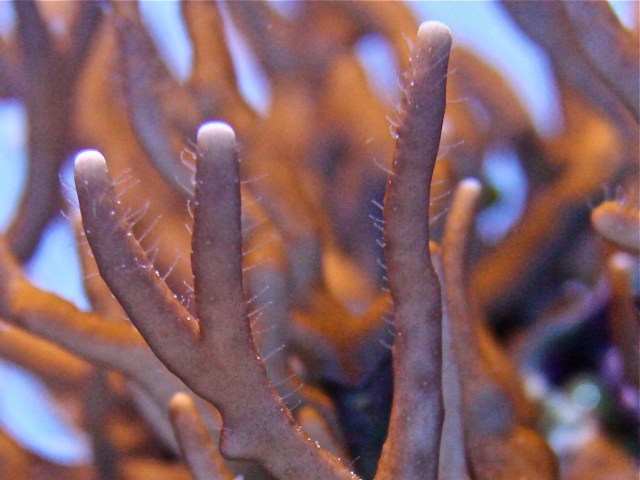
Category: CORAL REEF


Kingdom: Animalia
Phylum: Chordata
Class: Actinopterygii (ray-finned fishes)
Order: Perciformes (Perch-likes)
Family: Pomacanthidae (Angelfishes)

Genus/species:  Pomacanthus xanthometopon
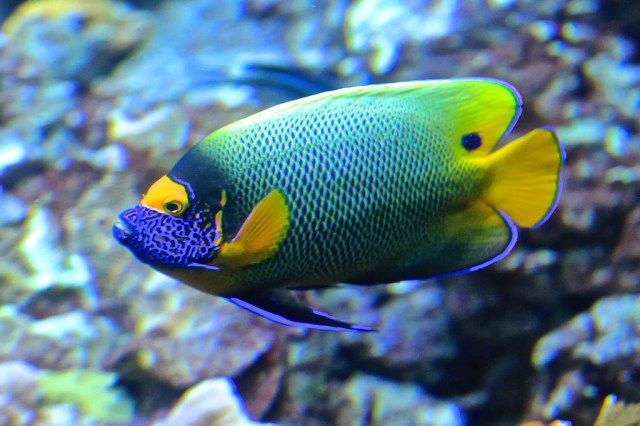
Yellow Mask Angelfish13298710574_515d270046_b

GENERAL CHARACTERISTICS: The head is blue with a yellow eye mask. Scales are blue with a yellow margin creating a network pattern. The yellow dorsal fin has a spot black large posteriorly and the caudal fin is also yellow. Body depth 1.7-1.9 in. Length 6-9 inches.

DISTRIBUTION/HABITAT: Indo-Asian Pacific. Found in lagoons and coral reefs 5-30 meters (16-100 feet).

Yellow Mask Angelfish13298332785_879178297f_b

DIET IN THE WILD: Encrusting organisms such as sponges and tunicates.

CONSERVATION: IUCN Least concern

On exhibit at the Long Beach Aquarium 2016

References

California Academy of Sciences Steinhart Aquarium Philippine coral reef 2016

WordPress shortlink  http://wp.me/p1DZ4b-1et

fishbase www.fishbase.org/summary/Pomacanthus-xanthometopon.html

EOL eol.org/pages/994431/overview

Australian museum australianmuseum.net.au/Blueface-Angelfish-Pomacanthus-xa…
TAXONOMY
Kingdom:Animalia
Phylum: Chordata
Class: Actinopterygii (ray-finned fishes)
Order: Perciformes (Perch-likes) 
Family: Labridae (Wrasses)

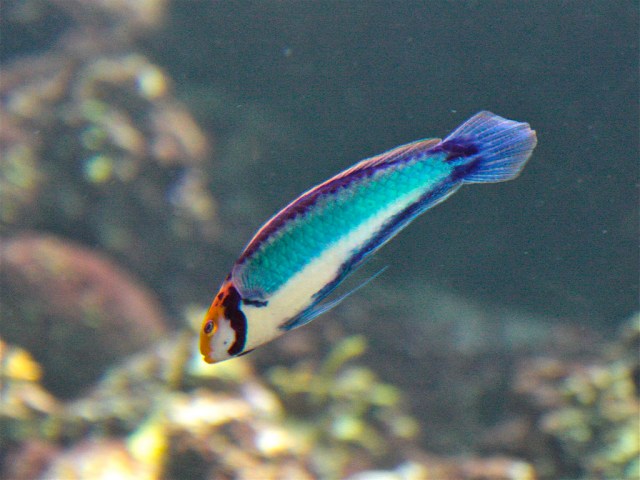
Genus/species: Cirrhilabrus solorensis

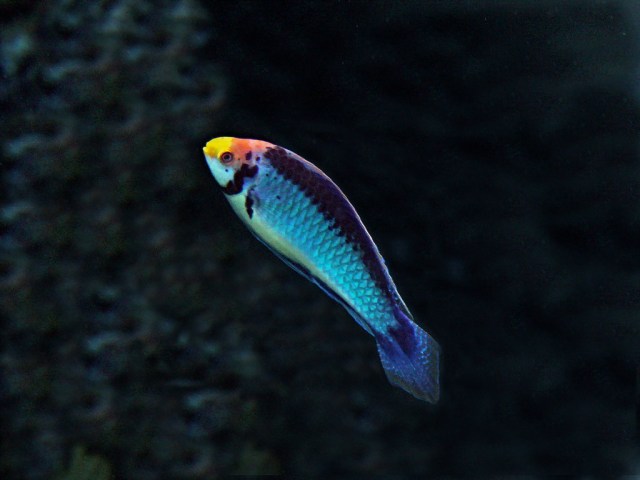
Cirrhilabrus solorensis3380013623_6c8c3e586c_b

GENERAL CHARACTERISTICS: Highly variable. The eye is bright red. Males usually have a dark band along the end of the gill covering. Change color and sex with growth. Females are able to change sex into an often brilliantly colored terminal male phase. Max. size: 11 cm (4.3 inches).

DISTRIBUTION/HABITAT: Found in the Western Central Pacific and Indonesia. in coastal to outer reef lagoons on rubble and coral habitats.

DIET IN THE WILD: Zooplankton.

Cirrhilabrus solorensis3813060378_a4f75890b9_b

REMARKS: The cornea of the eye of fairy wrasses is divided into two segments, essentially forming a double pupil. It is thought that the center pupil is a close-up lens that lets the fish have a magnified view of their small prey.

Philippine Coral Reef PR04

References:

flickr http://www.flickr.com/photos/cas_docents/3380013623/in/set-72157608208133134/

WordPress shortlink http://wp.me/p1DZ4b-1ef

fishbase www.fishbase.org/Summary/SpeciesSummary.php?id=60815

EOL eol.org/pages/210468/details

TAXONOMY
Kingdom: Animalia
Phylum: Chordata
Superclass: Osteichthyes
Class: Actinopterygii (ray-finned fishes)
Order: Perciformes (Perch-likes)
Family: Acanthuridae (Surgeonfishes, Tangs, and Unicornfishes)

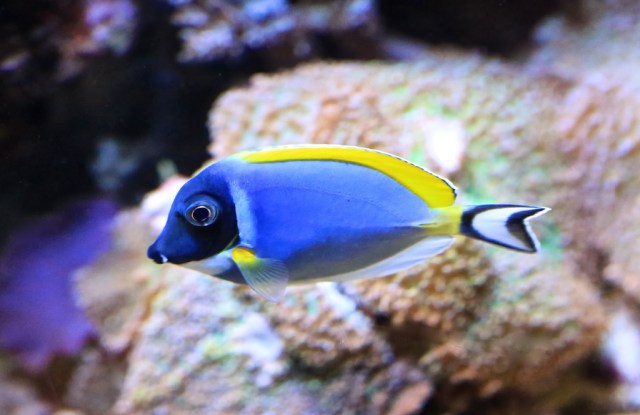
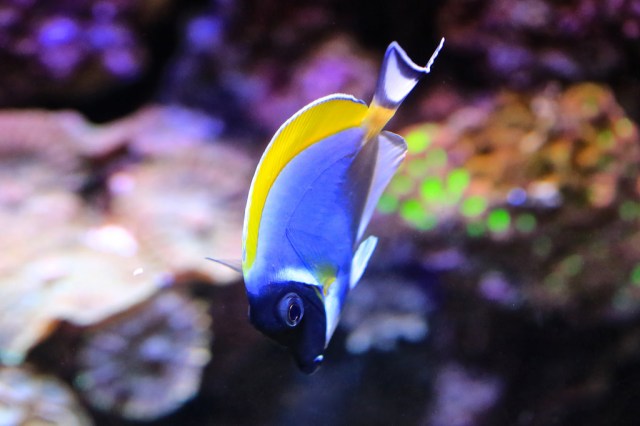
Genus/species; Acanthurus leucosternon

Acanthurus leucosternon 13140534045_d29f009b4f_b

GENERAL CHARACTERISTICS: Blue with a white chest. Head black with a broad white band from pectoral-fin base to throat.Also has a white band at base of lips. Dorsal fin yellow (except white margin and black submarginal line). Anal and pelvic fins white. Common length 19 cm (7.5 inches).

DISTRIBUTION/HABITAT: Indian Ocean in shallow, clear coastal and island reefs, 0.5-25 m (1.5-80 feet) . Usually on reef flats and along upper seaward slopes; sometimes in huge aggregations.

DIET IN THE WILD: benthic algae.

REPRODUCTION: Monogamous, open water/substratum egg scatterers

CONSERVATION: IUCN Least concern.

Acanthurus leucosternon13140818894_48010cf40c_b

Animal attractions Rich Ross

3-14-14

References

flickr www.flickr.com/photos/cas_docents/2978892415/in/set-72157…

WordPress shortlink  http://wp.me/p1DZ4b-1dQ

fishbase fishbase.org/summary/1257

EOL eol.org/pages/206882/details

TAXONOMY
Kingdom: Animalia
Phylum:Chordata
Class: Actinopterygii (ray-finned fishes)
Order: Perciformes (Perch-likes)
FamilyChaetodontidae (Butterflyfishes)

Genus/Species: Chaetodon mitratus 

Chaetodon mitratus or Indian Butterflyfish SP07IMG_0103

GENERAL CHARACTERISTICS: Head and body yellow, diagonal stripes two very broad black from dorsal to ventral contour eye bar black to orange. Snout length 2.7-3.3 in. . Body depth 1.7-1.9 .

DISTRIBUTION/HABITAT: Western Indian Ocean. Found in deep tropical marine coral reefs. 22-80 meters (70-260 ft)

DIET IN THE WILD: Coral polyps, zooplankton

REPRODUCTION: Oviparous. Form pairs during breeding

CONSERVATION: IUCN Least Concern (LC)

Chaetodon.mitratusIndian ButterflyfishSP07low.IMG_0100.IMG_0100

REMARKS: Little is known of C. mitratus

References

WordPress shortlink  http://wp.me/p1DZ4b-1dl

flickr  http://www.flickr.com/photos/cas_docents/12918681523/in/set-72157625119200613/

fishbase www.fishbase.org/summary/speciessummary.php?id=8927

EOL eol.org/pages/215193/overview

TAXONOMY
Phylum: Chordata
Class: Actinopterygii (ray-finned fishes)
Order: Perciformes (Perch-likes)
Family: Pomacanthidae (Angelfishes)

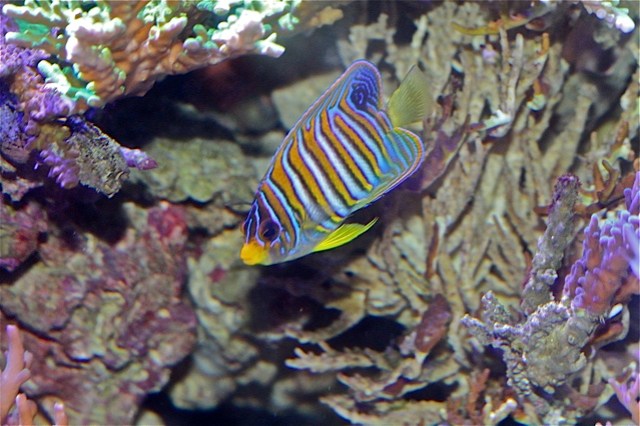
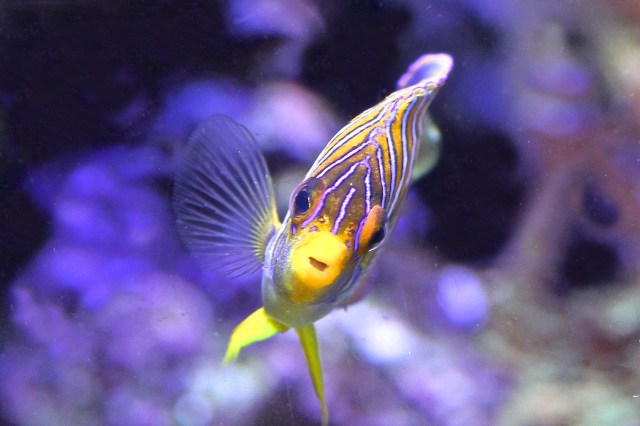
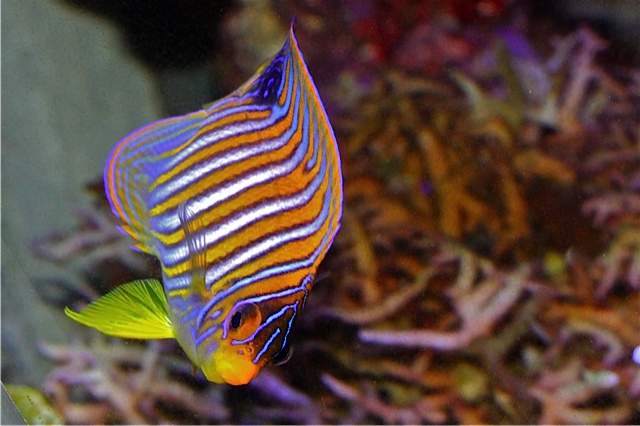
Genus/species: Pygoplites diacanthus

GENERAL CHARACTERISTICS: Identified by 7 or 8 dark edged bluish-white bars that run horizontally down its body. Its body is yellow with blue coloration on the rear of the dorsal fin and it has a small dark patch over its eye. It has a strong preopercular spine. The anal fin has yellow and blue stripes. Juveniles are similarly colored to adults except for a large false eye-spot at the base of the dorsal fin. This fades as the fish matures and it’s gone by the time the fish reaches a length of 6-7 cm. The maximum adult size is reported to be between 20 and 30 cm (8 and 12 inches).

Regal Angelfish Pygoplites diacanthus

DISTRIBUTION/HABITAT: P. diacanthus is found throughout the Northern and Western Indian Ocean, the Red Sea, and the Indo- Pacific Ocean. They are commonly observed as solitary individuals and in pairs and never stray far from a reef crevice. The maximum adult size is reported to be between 20 and 30 cm (8 and 12 inches).
They are always on the move swimming from crevice to crevice in search of food. Found at depths from 1-20 meters (3-66 ft.)

DIET IN THE WILD: Sponges and tunicates.

CONSERVATION: IUCN Least concerned.

Location: Water planet coral exhibit WP33

References

flickr http://www.flickr.com/photos/cas_docents/sets/72157606840726733/

WordPress shortlink  http://wp.me/p1DZ4b-xt

Australian Museum australianmuseum.net.au/Regal-Angelfish-Pygoplites-diacan…

fishbase fishbase.sinica.edu.tw/summary/SpeciesSummary.php?id=6572


TAXONOMY
Kingdom: Animalia
Phylum: Chordata
Class: Actinopterygii (ray-finned fishes)
Order: Perciformes (Perch-likes) 
Family: Pomacentridae (Damselfishes)

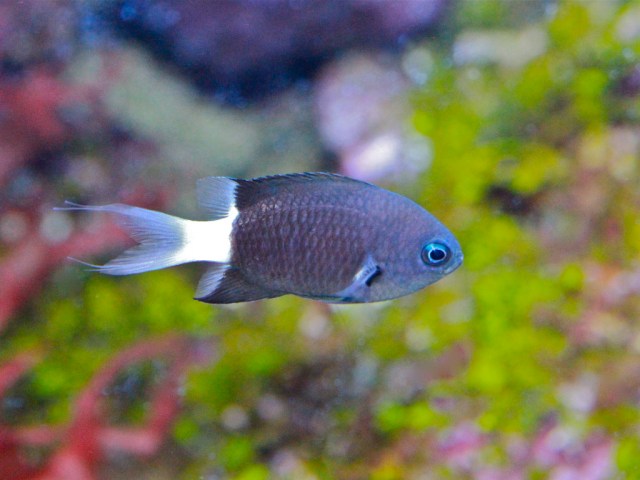
Genus/species Chromis margaritifer

GENERAL CHARACTERISTICS: Dark brown, almost black, with white rear body including tail and rear dorsal and anal fins. Caudal fin lobes end in two filaments. Black spot at base of pectoral fin. Spine tips of the dorsal fin are blue. Max length: 9 cm or 3.5 in.

DISTRIBUTION/HABITAT: Pacific Ocean: Christmas Island and northwestern Australia in the eastern Indian Ocean on exposed seaward reefs; less abundant in lagoons and channels.

DIET IN THE WILD: Zooplankton, algae. Feeds in large groups.

REPRODUCTION: Oviparous, distinct pairing during breeding with the males guarding and aerating the eggs.

Commensalism Cluster PR34, Philippine Coral Reef PR04

Ref. fishbase, EOL, Reef Fish ID Tropical Pacific, Allen et al, 2003.

flickr http://www.flickr.com/photos/cas_docents/8075332727/in/set-72157608339622313

WORDPRESS SHORTLINK  http://wp.me/p1DZ4b-Fu

TAXONOMY
Kingdom:Animalia
Phylum: Chordata
Class: Actinopterygii (ray-finned fishes)
Order: Perciformes (Perch-likes)
Family: Pomacentridae (Damselfishes)

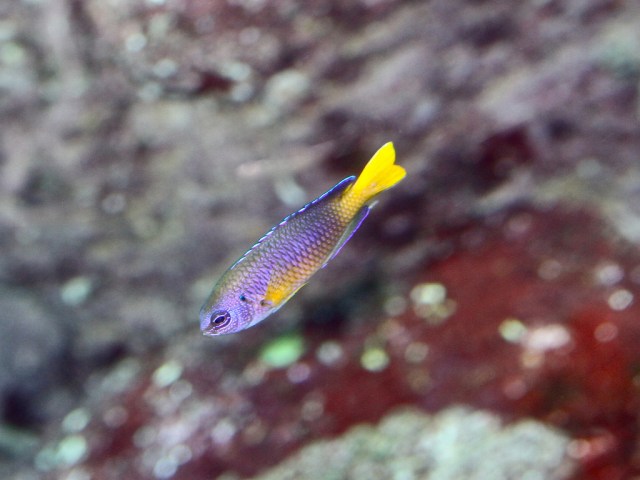
Genus/species Pomacentrus auriventris

GENERAL CHARACTERISTICS: Neon-blue head and upper body, yellow lower and rear body, anal and tail fins. Length to 5.5 cm ( 2 inches).

Goldbelly Damselfish 4770698270_7ccdac2124_b

DISTRIBUTION/HABITAT: Western Central Pacific: Found on inner coral reef slopes with mixed rubble, coral and algae. depth range 6 – 35 feet (2 – 11 m).

DIET IN THE WILD: Omnivore.

REPRODUCTION: Oviparous, distinct pairing during breeding. Eggs are demersal (just above the sea bed) and adhere to the substrate.. Males guard and aerate the eggs

CONSERVATION: Not evaluated.

Ref. fishbase, EOL. Reef Fish Identification, Tropical Pacific, Allen et at.2003.

Philippine Coral Reef PR04

flickr http://www.flickr.com/photos/cas_docents/4770698270/in/set-72157608339622313

WordPress Shortlink http://wp.me/p1DZ4b-19p

TAXONOMY
Kingdom: Animalia
Phylum: Chordata
Class: Actinopterygii (ray-finned fishes)
Order: Perciformes (Perch-likes)
Family: (Labridae) Wrasses

Genus/species: Pseudojuloides cerasinus

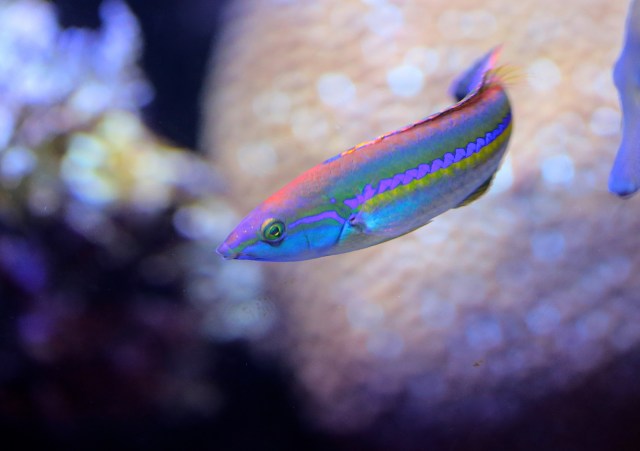
Pencil Wrasse  8362948295_4f3b9c4930_h

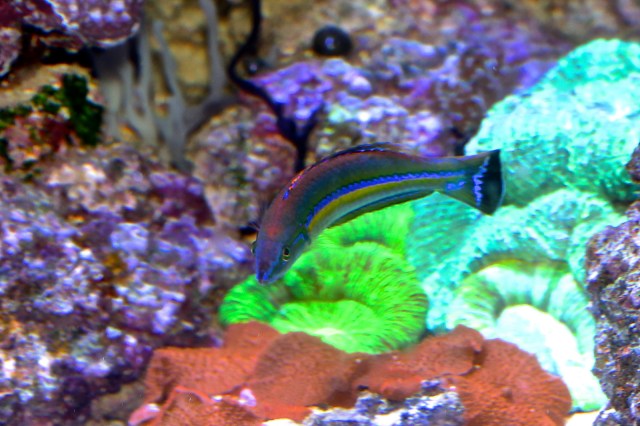
GENERAL CHARACTERISTICS: Long slender bodies and pointed snouts. Body color of males and females differ; geographic variation exists Initial phase (IP) fish are white with a copper-colored dorsum. Terminal phase (TP) green upper body, bicolor blue and yellow mid-body stripe; blue below. Length to 12 cm (5 in).

DISTRIBUTION AND HABITAT: East Africa to Samoa and Hawaii. S. Japan to Australia. Found among rubble, weed and coral areas of lagoon and seaward reefs to 61m (201 ft).

DIET IN THE WILD: Small benthic invertebrates (including fan worms, small crustaceans).

8644493886_4619144611_h

Reef Partners Cluster,  Shrimpfish Exhibit PR31

WordPress Shortlink  http://wp.me/p1DZ4b-VM

flickr  http://www.flickr.com/photos/cas_docents/sets/72157608208133134/with/8358672657/

TAXONOMY
Kingdom: Animalia
Phylum: Mollusca
Class: Gastropoda
Family: Conidae

Genus/species: Conus marmoreus

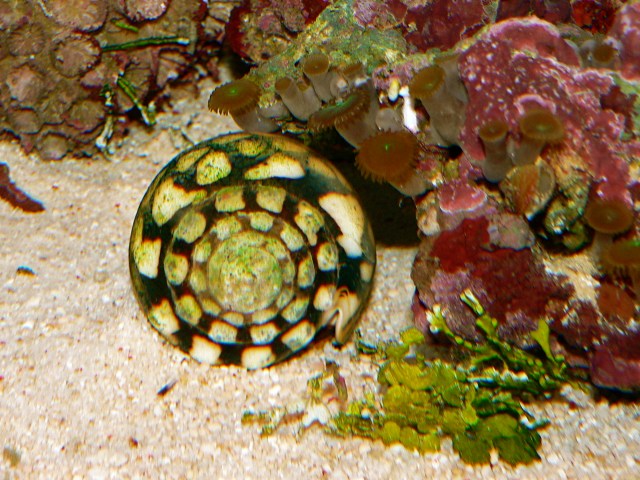
Marble Cone Snail IMG_8764

GENERAL CHARACTERISTICS: Shell length to 10 cm or 4 inches. Flat, noduled spire. Reticulated pattern of black or dark brown with white patches overall.

DISTRIBUTION/HABITAT: Red Sea, Indo-Pacific in shallow water to 90 m or 300 ft in depth on coral reef platforms or lagoon pinnacles, as well as in sand, under rocks or sea grass.

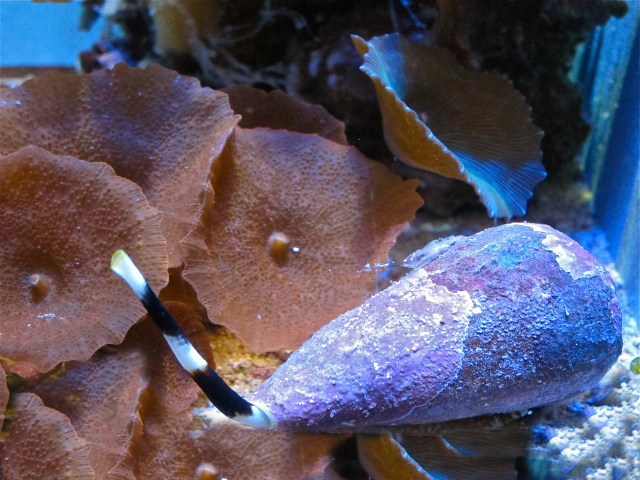
DIET IN THE WILD: Molluscivore  A predator of predators; harpoons fishes, worms and other mollusks. Its “harpoon” is a single, specialized modified radula tooth equipped with a spearlike barbed tip. The barbed tooth has a groove through which the snail injects a neurotoxic peptide poison into its victim. The prey is paralyzed then the snail devours it.

Marble Cone Snail  Conus marmoreus (Conidae)

REMARKS: Small cone snails pose little danger to humans beyond a beelike sting; however, large cone snails inject enough toxin to be deadly. About 30 human deaths have been attributed to cone snail envenomation
Research on cone snail peptide conotoxin toxins is an active field and has resulted in a new highly effective painkiller recently approved by the FDA that, unlike opium-derived medications, has a low risk of addiction.

Venoms Cluster PR26

flickr http://www.flickr.com/photos/cas_docents/sets/72157608597736188/

WordPress Shortlink http://wp.me/p1DZ4b-Oi

TAXONOMY
Kingdom: Animalia
Phylum: Cnidaria
Class: Hydrozoa
Order: Anthomedusae
Family: Milleporidae

Genus/species: Millepora sp. 

3271264676_0c4fd03cd3_b

GENERAL CHARACTERISTICS: Colored brownish, greenish or
grayish, often with a yellow hue and light tips. Skeleton calcareous with diverse growth-forms from fine branching, to domes, encrusting, or sheet-like. May form extensive colonies to 2 m diameter.

DISTRIBUTION/HABITAT: Pantropical, shallow reefs.

DIET IN THE WILD: Microplankton; zooxanthellae also provide nutrition.

REPRODUCTION: Sexual reproduction, with both medusa and polyp
stages; asexual reproduction via budding. Note Anthozoan corals have only a polyp stage.

IMG_1517

CONSERVATION STATUS: All coral reef species are threatened due to global warming. 

REMARKS: Fire corals are important reef-building organisms, though they are not closely related to the most common group of reef-building hard corals (Scleractinians), which belong to an entirely different class (Anthozoa). Unlike octocorals or hexacorals, fire corals possess polyps so small they are almost microscopic. One type is armed with nematocysts for food-capture and defense; the other type are capable of sexual reproduction. Potent nematocysts are also used to clear the coral of organisms that might shade zooxanthellae and can inflict a painful, burning sting to humans, hence the common name. Fire corals can outcompete many other corals by growing large quickly. and dominating the available space.

Venoms Cluster

Fire Coral PR24

flickr  http://www.flickr.com/photos/cas_docents/sets/72157623828845591/with/3271264676/

WordPress Shortlink: http://wp.me/p1DZ4b-NT