Category: ARTHROPODS


Phylum Arthropoda, Class Arachnida, Order Scorpiones, Family Scorpanidae, Scorpions

Pandinus imperator
DISTRIBUTION: West Africa

HABITAT: Tropical forest and open savanna where it hides under rocks, burrows beneath the soil, or cohabits termite mounds.

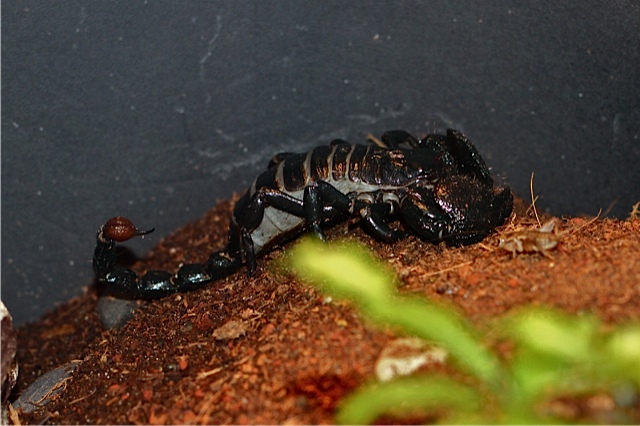
APPEARANCE: The largest scorpion known, (length to 20 cm (8 in); weight to 30 g (1 oz). Its black body bears large, blackish-red pincers with a granular appearance. The long tail, which arches back over the body, is tipped with a sharp curved stinger that delivers venom produced from a gland in the attached bulb.

DIET:  It preys upon ground-dwelling insects, spiders, and other invertebrates as well as an occasional baby lizard, snake, or mouse. These large scorpions rarely sting small prey; instead they grasp the prey in powerful pincers and tear it apart. The venom is reserved for larger prey or defense.

REPRODUCTION/DEVELOPMENT:  During mating, the male finds a suitable spot where he deposits his sperm packet, called a spermatophore. He then engages the female in an elaborate mating dance above the spermatophore with the male holding up the pincers of the female with his own, and carefully maneuvering her over the spermatophore, which she draws up into her genital pore. The eggs are fertilized, and the female carries them internally. After a 7 to 9 month gestation period, she gives birth to between 9 to 32 live young. The newborn climb onto the mother’s back, protected from predators by her size and aggressive behavior. Until the young are capable of hunting on their own, the mother feeds them by killing insects which are left on the floor of the burrow or other enclosure where the young can climb down and feed in safety.

MORTALITY/LONGEVITY:  Predators include birds, bats, small mammals, large spiders, centipedes, large lizards, and other scorpions. Life span: 5 to 8 years.
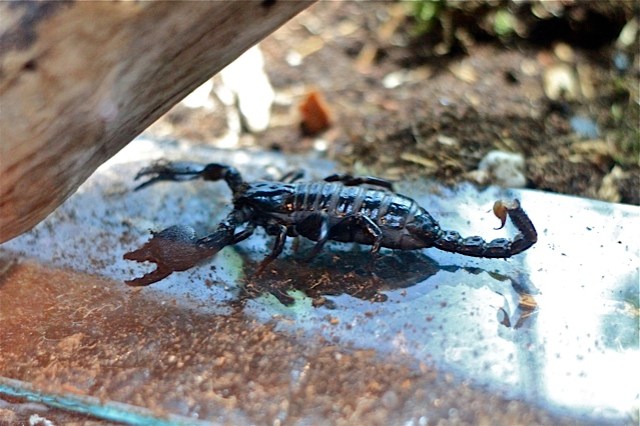
REMARKS: Sensory hairs on the pincers and tail enable the scorpion to detect prey and danger through vibrations from the air and ground. Like all scorpions, it has poor eyesight (despite having 6 to 12 eyes), good hearing, and a good sense of touch.

flickr http://www.flickr.com/photos/cas_docents/6976512905/in/set-72157629304397467/

WORDPRESS SHORTLINK http://wp.me/p1DZ4b-qK
Phylum Arthropoda, Class Arachnida, Order Araneae, Family Theraphosidae

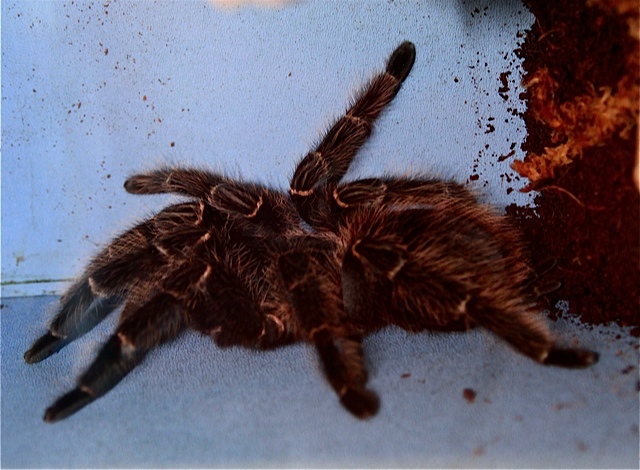
Lasiodora parahybana

DISTRIBUTION: Throughout northeastern Brazil.

HABITAT:  Tropical forest floor

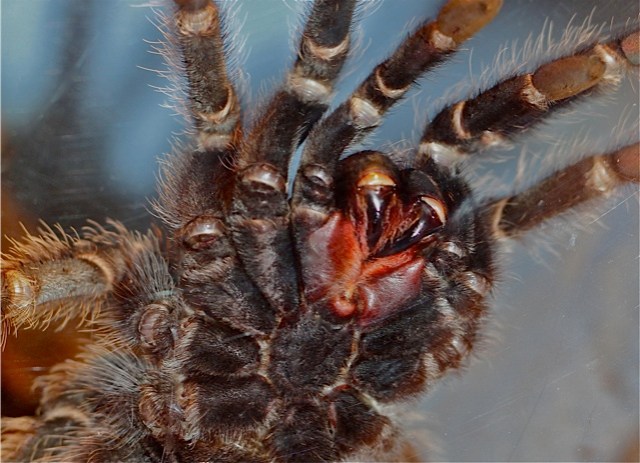
APPEARANCE: Said to be the third largest spider in the world, this is a large-bodied tarantula with abdomen and legs covered with sensitive, long, and partially pink or salmon-colored hairs.   Maximum size: body, 9-10 cm (3.5–4 in); leg span, 20-25 cm (8–10 in).

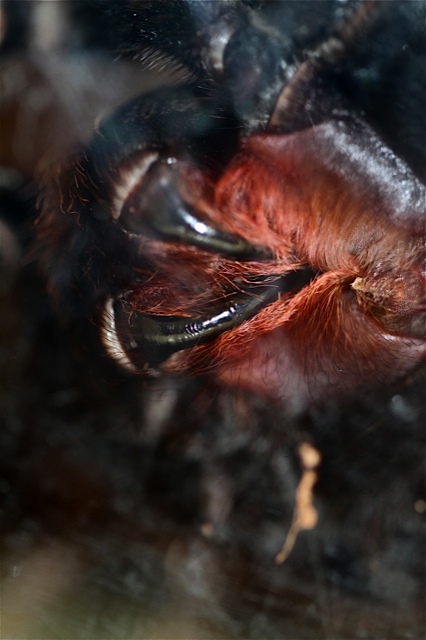
DIET: Lie and wait carnivore, eating large crawling insects and other invertebrates, small rodents, lizards, and frogs rarely seen eating birds like newly hatched chicks of ground-dwelling birds. Venom injected by chelicerae that liquefy the kill, which is then sucked in by the mouthparts.

REPRODUCTION and DEVELOPMENT: The male spins a small area of silk onto which he deposits his sperm. The sperm is then absorbed into the pedipalps, which during mating are inserted into the genital opening of the female, transferring the sperm, which remains viable. After insemination, the male makes a swift retreat as the much smaller males occasionally become a sacrifice to the female’s need to maintain the nutritional viability of a mother-to-be. The female lays up to 2000 fertilized eggs in a thick, silken sac which she guards fiercely. Young spiderlings are born about 3 weeks later. Voracious feeders, they grow quickly.

MORTALITY/LONGEVITY: Tarantulas have few enemies except tarantula hawk wasps. Members of this wasp family use their sting to paralyze species specific tarantulas. The wasp lays an egg on the tarantula’s abdomen and then seals the spider in its burrow. The wasp larva hatches and feeds on the immobile and doomed tarantula. Males usually die shortly after maturity and mating. Females can live over 20 years in the wild, perhaps significantly longer.

REMARKS: Like most tarantulas and some other spiders, if this spider loses one of its legs and is still in a growth stage, it can regrow the lost appendage,

While not highly aggressive and bites are not fatal to humans (most tarantula bites are similar to a bee sting in toxicity), this big bruiser, because of its long fangs, can inflict a serious wound which one researcher defined as “capable of medically significant mechanical damage”!

If pursued by a potential foe, the spider rubs its legs against its abdomen, throwing tiny, barbed hairs that become imbedded in the attacker. The barbs can cause significant irritation, especially if lodged in the eyes or nasal passages.

flickr http://www.flickr.com/photos/cas_docents/6962229021/in/set-72157608653175263/

WORDPRESS SHORTLINK  http://wp.me/p1DZ4b-qx

Phylum Arthropoda,  Subphylum Crustacea, Class Malacostraca, Order Decapoda, Family Stenopodidae

Stenopus sp.

DISTRIBUTION: tropical coral reefs worldwide

HABITAT: Male and female coral banded shrimp pair up when young, claim a territory, and never travel outside the small patch of reef they call home.

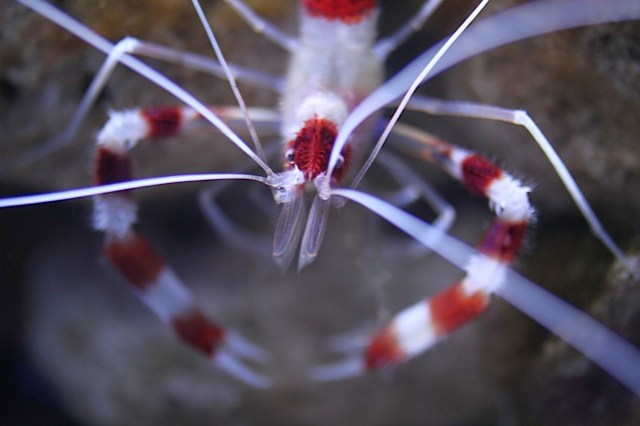
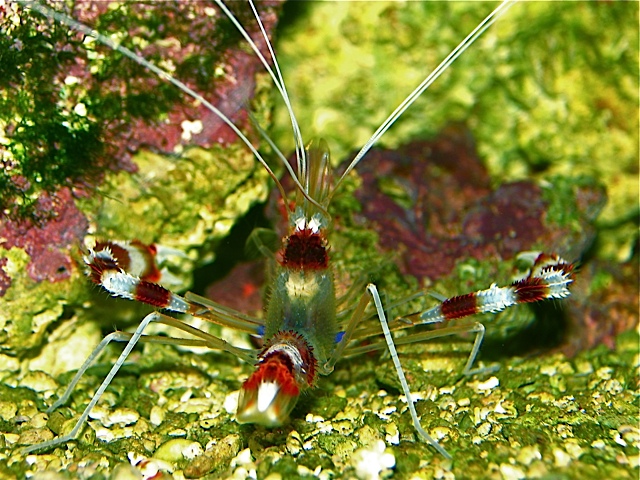
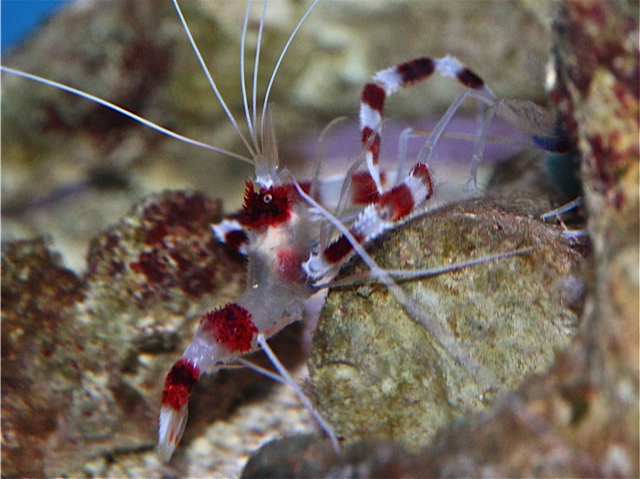
APPEARANCE: Strikingly colorful, they have a white body with contrasting red and white bands, bluish legs, slender pincers, and extremely long white antennae. Short spines cover the body and are used for defense. Males are smaller, more slender than females.

DIET: A cleaner shrimp, it removes dead tissue, algae and parasites from fish waving their long antennae to advertise their services. They are known to perform a dancing behavior, perched on a conspicuous spot near their home and whipping the antennae while swaying from side to side.  A fish ready for cleaning remains still in the water, allowing the shrimp to clean the scales and even enter the mouth and gills. They have been known to clean under the fingernails of divers’ hands!

REPRODUCTION: They are committed monogamists mating for life, a breeding strategy rare among most animal groups. Stenopus sp. defend their territory aggressively attacking and sometimes killing intruding shrimps. Mating occurs when the female is receptive. The male approaches her and transfers a packet of sperm to a specialized receptacle on her abdomen. With a few hours, the female begins to produce eggs, which are fertilized as released and then carried on her abdomen until they hatch into larvae, become part of the plankton, and eventually settle.

flickr http://www.flickr.com/photos/cas_docents/3067708530/in/set-72157608602469734/

 WORDPRESS SHORTLINK  http://wp.me/p1DZ4b-pj

TAXONOMY

Phylum Arthropoda, Class Insecta, Order Mantodea, Family Empuisidea

Genus/species: Idolomantis diabolica

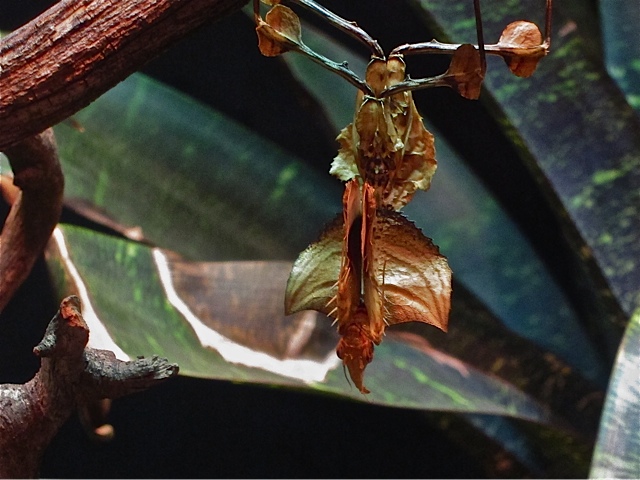
GENERAL CHARACTERISTICS: Its leafy color and leg flaps make this flower mimic a master of disguise.  Females, like this one, have straight antennae; males have feathery antennae.

DISTRIBUTION/HABITAT: Grasslands and savannas in Tanzania

DIET: flies, other flying insects

GENERAL CHARACTERISTICS: Its leafy color and leg flaps make this flower mimic a master of disguise.  Females, like this one, have straight antennae; males have feathery antennae.

Devil’s Flower Mantid IMG_6834

REPRODUCTION:  Like other mantids, this species is a voracious predator. It’s a cannibal as well. After mating, a female sometimes eats her partner.  If you’re afraid your mate might devour you after sex, you want to be careful. Male mantids seem to heed the dangers they face when mating. They seek to avoid detection by sneaking up on females from the rear or very, very slowly from the front.

REMARKS;  If threatened, this mantid rises up and spreads its arms to frighten predators.

Ref. California academy of Sciences, Animal Attractions 2012

flickr

WORDPRESS SHORTLINK  http://wp.me/p1DZ4b-om

Phylum Arthropoda, Subphylum Crustacea, Class Malacostraca. Order Decapoda, Family Porcellanidae

Neopetrolisthes maculosus

VIDEO LINK http://www.flickr.com/photos/cas_docents/5389598848/in/set-72157608602469734

DISTRIBUTION: tropical seas confined to the western Pacific and Indo Australian. 

HABITAT: Often be found hiding in amongst its host anemone.  When disturbed they will hide under the anemone away from predators.  Pairs of the species can be often seen living in the same anemone and quite often they will try to defend their territory from anemonefish although the anemonefish generally prevails due to its large size.

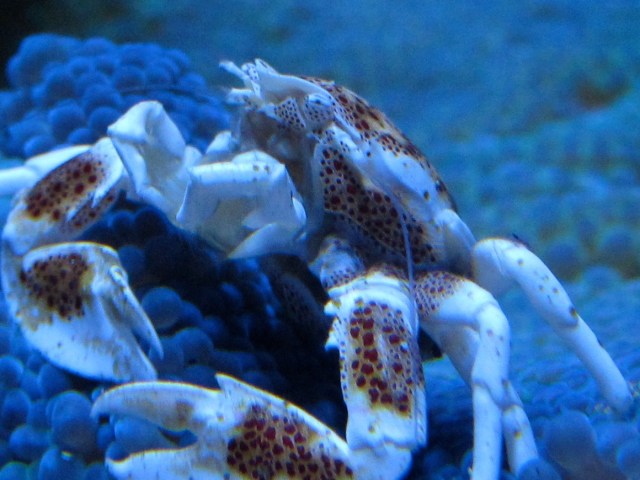
APPEARANCE: Color may be varied. N. maculosus body cream white with ground red peas.  The body is round, claws large and flat, sharp.  Males will generally grow larger than the females and the crab is generally less than 5cm (2 in) in width, 2.5cm length (1 in).

DIET: They feed by combing plankton and other organic particles from the water using long setae (feathery hair or bristle-like structures) on the mouthparts. These animals will also scavenge on the sea floor for detritus.

REMARKS: They share the general body plan of a squat lobster, but their bodies are more compact and flattened, an adaptation for living and hiding under rocks. Porcelain crabs are quite fragile animals, and will often shed their limbs to escape predators, hence their name. The lost appendage can grow back over several moults. Porcelain crabs have large chelae (claws), which are used for territorial struggles, but not for catching food. The fifth pair of pereiopods are reduced and are used for cleaning.

Reef Partners Cluster PR33 Small Giant Clams Exhibit

WORDPRESS SHORTLINK  http://wp.me/p1DZ4b-hd