Category: ANIMAL ATTRACTIONS


TAXONOMY

Phylum Arthropoda, Class Insecta, Order Mantodea, Family Empuisidea

Genus/species: Idolomantis diabolica
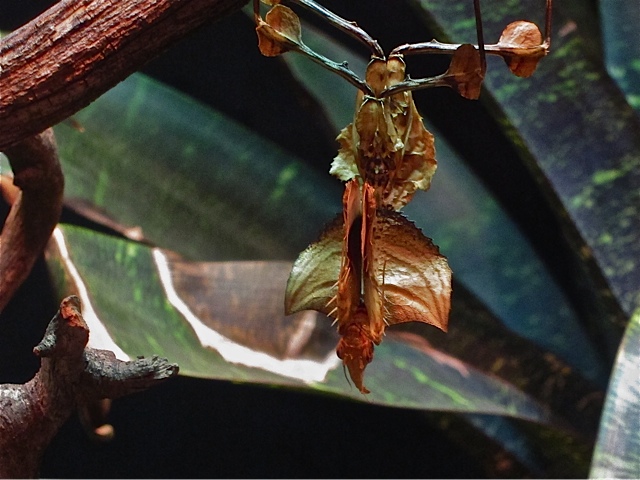
GENERAL CHARACTERISTICS: Its leafy color and leg flaps make this flower mimic a master of disguise.  Females, like this one, have straight antennae; males have feathery antennae.

DISTRIBUTION/HABITAT: Grasslands and savannas in Tanzania

DIET: flies, other flying insects

GENERAL CHARACTERISTICS: Its leafy color and leg flaps make this flower mimic a master of disguise.  Females, like this one, have straight antennae; males have feathery antennae.

Devil’s Flower Mantid IMG_6834

REPRODUCTION:  Like other mantids, this species is a voracious predator. It’s a cannibal as well. After mating, a female sometimes eats her partner.  If you’re afraid your mate might devour you after sex, you want to be careful. Male mantids seem to heed the dangers they face when mating. They seek to avoid detection by sneaking up on females from the rear or very, very slowly from the front.

REMARKS;  If threatened, this mantid rises up and spreads its arms to frighten predators.

Ref. California academy of Sciences, Animal Attractions 2012

flickr

WORDPRESS SHORTLINK  http://wp.me/p1DZ4b-om
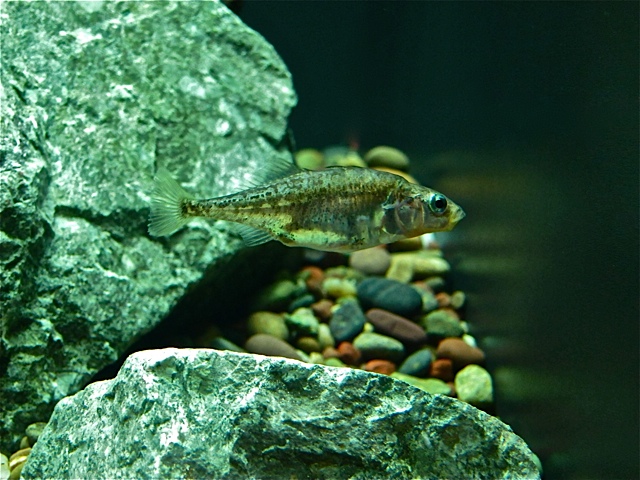
TAXONOMY

KINGDOM Animalia
PHYLUM Chordata
CLASS  Actinopterygii (ray-finned fishes)
ORDER Gasterosteiformes (Sticklebacks and seamoths)
FAMILY Gasterosteidae (Sticklebacks and tubesnouts)
GENUS/SPECIES  Gasterosteus aculeatus


GENERAL CHARACTERISTICS

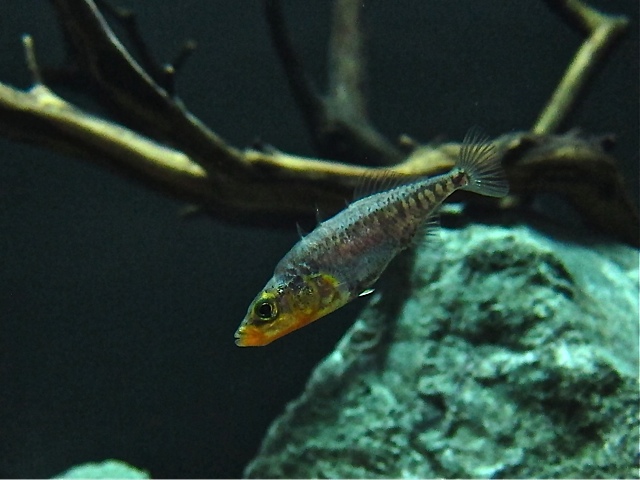
Common length : 5.1 cm or 2 in.  Identified by the 3 to 4 sharp, free spines before the dorsal fin, the pelvic fin reduced to a sharp spine and a small ray, the series of plates along the sides of the body and are usually mottled brown or greenish.


DISTRIBUTION/HABITAT 

 Coastal oceans in northern Europe, Asia and North America

 Freshwater streams, estuaries


DIET: worms, aquatic insects, fish eggs and fry


REPRODUCTION:  Red means ready.  At mating time, the chin and belly of male sticklebacks turn red. The brighter the red, the more enticing they are to the females they’re courting. Male sticklebacks weave rounded nests of algae, leaves and pebbles.   The neater the nest, the more likely a male is to woo a mate to lay her eggs inside. Once she does, he drives her out, guards and aerates the eggs until the hatch.

LOCATION

Salt Marsh Pop_up CC03
Animal Attractions


flickr http://www.flickr.com/photos/cas_docents/6870766417/in/set-72157629304397467

WORDPRESS SHORTLINK  http://wp.me/p1DZ4b-oa

Actinopterygii (ray-finned fishes),  Anguilliformes (Eels and morays),  Muraenidae (Moray eels)

Rhinomuraena quaesita

DISTRIBUTION: Indo-Pacific from East Africa to the Tuamota Archipelago (French Polynesia).

HABITAT: Lagoons and associated reefs at depths up to 57 m.

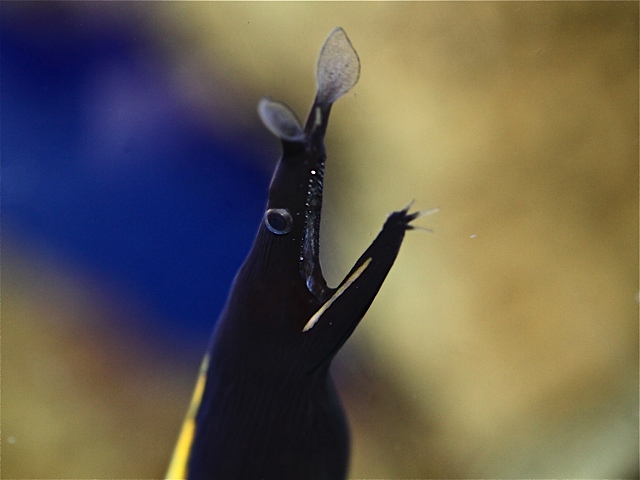
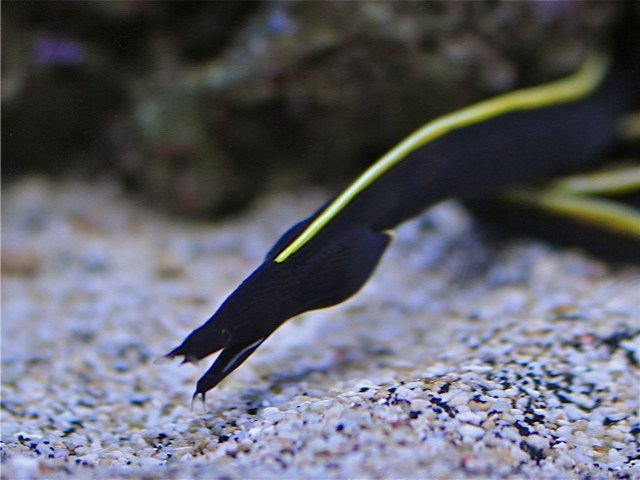
APPEARANCE: Long thin body and high dorsal fins. Has three fleshy tentacles on the tip of its lower jaw, a single fleshy pointed projection at the tip of its snout, and tubular anterior nostrils ending in gaudy, fanlike expansions. Juveniles are black with a yellow dorsal fin, males are mostly blue, and females are mostly yellow. Length up to 130 cm (51 in).

DIET: Mostly small fishes, some invertebrates.

REPRODUCTION and DEVELOPMENT: External fertilization nonguarder.  R. quaesita is a protandrous hermaphrodite, i.e., functioning males reverse sex to become females.  It is the only moray that undergoes abrupt changes in coloration and sex.  Protandry is diagnosed based on coloration, but not confirmed.

MORTALITY/LONGEVITY May have lifespan up to 20 years.

REMARKS: The ribbon eel buries itself in sand or hides in rocks or reefs, sometimes with head protruding, lying in wait or emerging to hunt for small fish. Like all morays, it rests with mouth open, displaying sharp teeth that appear ready for use. Actually, ribbon eels are among the least aggressive of morays, the gaping mouth simply aiding breathing by allowing oxygenated water to enter and pass over the gills.

flickr  http://www.flickr.com/photos/cas_docents/4405139265/in/set-72157608402401040/

WORDPRESS SHORTLINK  http://wp.me/p1DZ4b-o0

Phylum:Chordata, Superclass: Osteichthyes,  Class:Actinopterygii (Ray-finned fishes), Order: Characiformes (Characins) Family: Lebiasinidae (Pencilfishes). .

Copella arnoldi

DISTRIBUTION: Guyana, Suriname, French Guiana and Brazil

HABITAT: Streams and tributaries off main river channels, and also occurs in flooded forests during the wet season with large amounts of overhanging vegetation.

APPEARANCE: Length 1.6″ (4cm).  The male grows larger than the female, and is more brightly coloured. Mature males also develop extended fins.

DIET: Feeds on worms, insects and crustaceans.

REPRODUCTION and DEVELOPMENTC. arnoldi   spawn on the underside of plant leaves or other surfaces that, are always above the water surface. The spawning site is selected by the male who once a site has been chosen will display at and follow a female forming a pair. At the climax of courtship, the pair lock themselves together using their fins, and jump out of the water, landing on the spawning site. Using their ventral fins, they can hold themselves here for up to 10 seconds, as eggs and sperm are released. Up to 12 eggs may be laid and fertilized, and the process is then repeated. Usual brood size is approximately 50.

LOCATION: Animal Attraction Series, Staff picks

flickr site  http://www.flickr.com/photos/cas_docents/6699435185/in/set-72157620568438047

WORDPRESS SHORTLINK  http://wp.me/p1DZ4b-lz