Archive for August, 2013


TAXONOMY
Kingdom: Animalia
Phylum: Chordata
Class: Aves
Order: Passeriformes
Family: Thraupidae

Genus/species: Tangara chilensis paradisea 
2981087747_5d4a822642_o

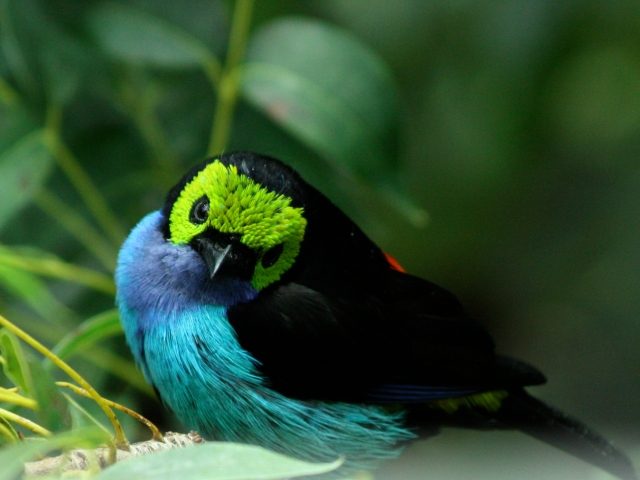
GENERAL CHARACTERISTICS: In Spanish, called “sieite colores” for its seven-colored appearance: green, yellow, scarlet, black, and three colors of blue feathers adorn this handsome bird. Monomorphic (males and females look similar). Length 13.5 to 15 cm 5.3 to 6 inches.

DISTRIBUTION/HABITAT: South America: common in Venezuela, Peru, Columbia, Ecuador, Brazil. Found in the canopy and edges of subtropical to tropical lowland humid forests, including parts of the Amazon basin and upwards to 1400 m (4500 feet). Often moves in mixed flocks.

DIET IN THE WILD: Mainly fruit, buds, leaves. Forage from middle heights to treetops. Also, like other  tanagers, picks insects from leaves or sometimes takes them in flight. Often moves and feeds in mixed flocks.
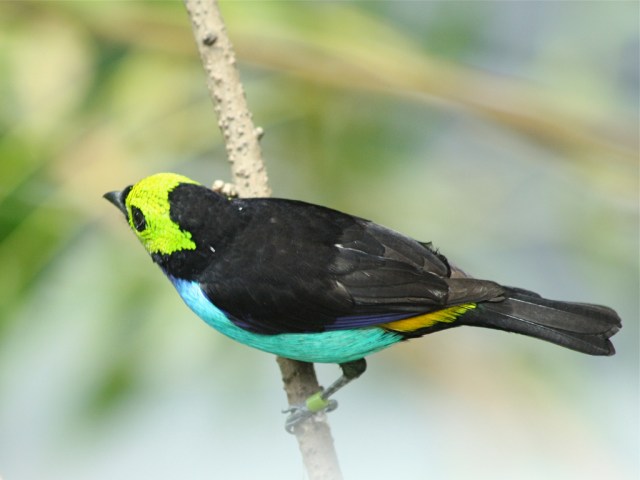
Paradise Tanager   3259028446_790c536452_b

REPRODUCTION: Female builds a cup nest where she lays two or three brown or lilac-speckled white eggs. Eggs hatch in 13–14 days; chicks fledge in additional 15–16 days. Nestlings are feed insects and fruit by both male and female..

CONSERVATION: IUCN, least concern.

Rainforest.

1-8-09, 11-11-11

flickr  http://www.flickr.com/photos/cas_docents/3259028446/in/set-72157608454346681

WordPress Shortlink  http://wp.me/p1DZ4b-15F
TAXONOMY
Kingdom: Animalia
Phylum: Chordata
Class: Aves
Order: Passeriformes
Family: Thraupidae

Genus/species: Tachyphonus phoenicius

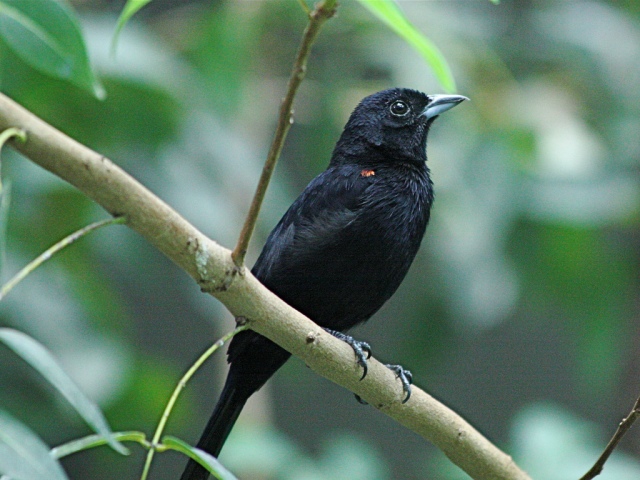
Red-shouldered Tanager (male) 3334159981_db9f81a402_b

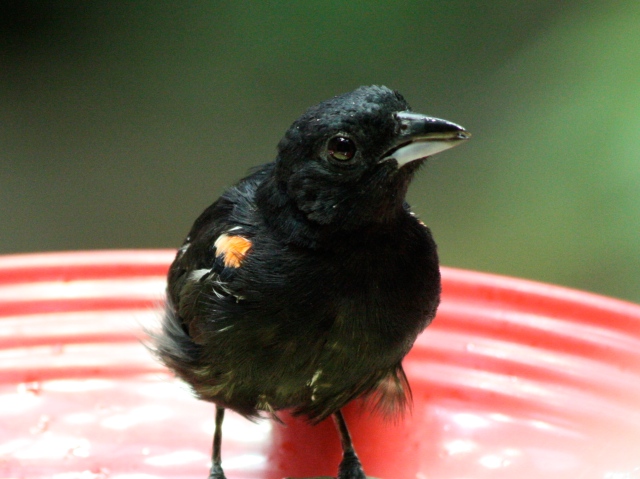
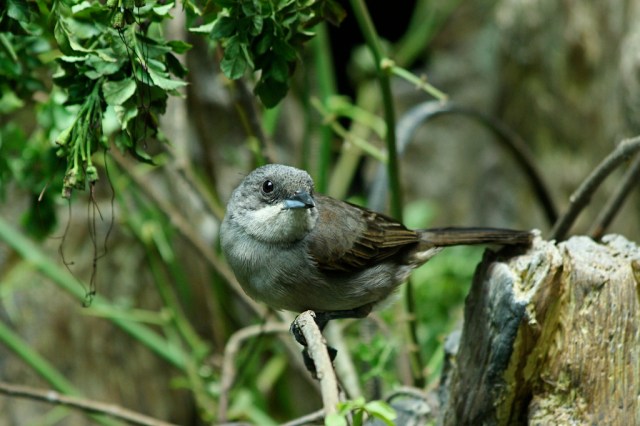
GENERAL CHARACTERISTICS: Males are basically all black, with a tiny red and white patch on the shoulder region and white underwing linings. Females, are brownish gray above, while the throat and middle abdomen are white. Pairs of Red-shouldered Tanagers usually forage in close proximity, low down, but often keeping within cover. Length 16-17 cm (6.3-6.7 inches).

Male above and below

Red-shouldered Tanager (male) 3186809464_2c975c664e_o

DISTRIBUTION/HABITAT: Bolivia, Brazil, Colombia, Ecuador, French Guiana, Guyana, Peru, Suriname, and Venezuela. Found in dry shrubland or seasonally wet or flooded lowland grassland. Also open rainforest, to 2000 m (6500 feet).

DIET IN THE WILD: Insects and fruit.

female below

Red-shouldered Tanager (female) 3105184668_a8dfdddccd_b

CONSERVATION: IUCN, least concern (population trend stable).

flickr http://www.flickr.com/photos/cas_docents/sets/72157608454346681/with/3334159981/

WordPress Shortlink  http://wp.me/p1DZ4b-15y


TAXONOMY:
Kingdom: Animalia
Phylum: Arthropoda
Class: Insecta
Order: Lepidoptera (moths and butterflies)
Family: Pieridae (Whites and Sulfurs)

Genus/species: Phoebis philea 

3201526951_715a363cc4_o

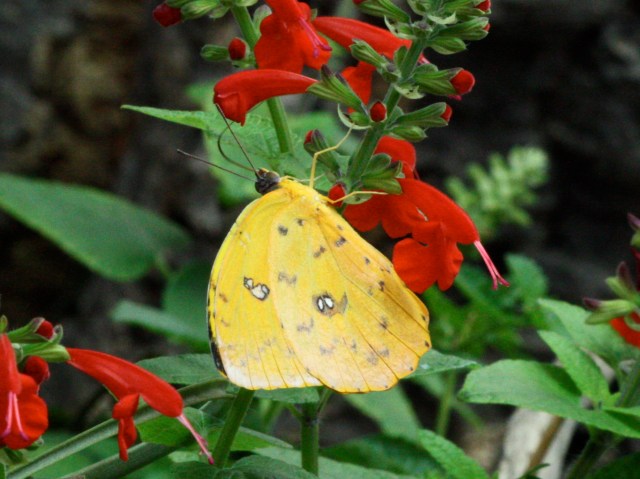
GENERAL CHARACTERISTICS: Upperside of male bright yellow-orange; forewing has red-orange bar, hindwing with red-orange outer margin. Female much larger than male with prominent dark spots along the upper forewing. Wing Span: 2 3/4 – 4 inches.

DISTRIBUTION/HABITAT: Resident from Brazil, north through Central America to peninsular Florida. Migrants appear sometimes along the Gulf States, in eastern Arizona and in New Mexico along the border. During dry years, some migrate to the Northeast. P. philea has been considered a transient resident of Southern California. Found in open lowland sites along forest edges. Also frequents gardens, parks, and road edges.

Orange Barr Sulphur 3128915093_cd28b8bf32_o

DIET IN THE WILD: Caterpillar: Cassia species in the pea family; adult: nectar from various flowers.

REPRODUCTION: Females lay single eggs on leaves and flowers of host plants during the wet season. Caterpillars feed preferentially on the flowers.

REMARKS: These swift, high flyers have been reported as rare migrants as far north as Canada.

flickr http://www.flickr.com/photos/cas_docents/sets/72157608449327886/with/3201526951/

WordPress Shortlink  http://wp.me/p1DZ4b-14i