Tag Archive: venomous


TAXONOMY
Kingdom: Animalia
Phylum: Mollusca
Class: Gastropoda
Family: Conidae

Genus/species: Conus marmoreus
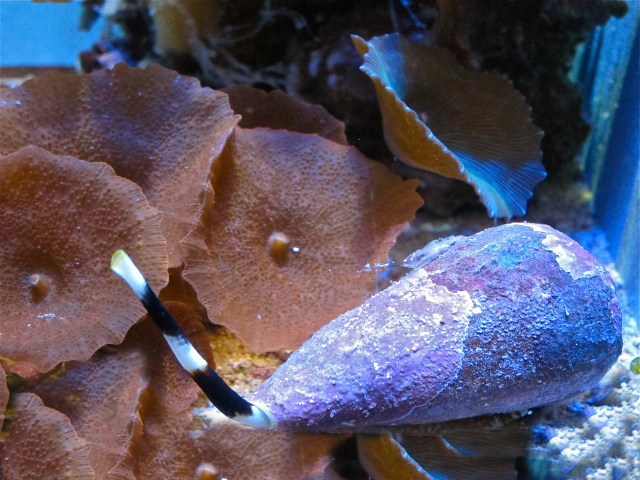
Marble Cone Snail IMG_8764

GENERAL CHARACTERISTICS: Shell length to 10 cm or 4 inches. Flat, noduled spire. Reticulated pattern of black or dark brown with white patches overall.

DISTRIBUTION/HABITAT: Red Sea, Indo-Pacific in shallow water to 90 m or 300 ft in depth on coral reef platforms or lagoon pinnacles, as well as in sand, under rocks or sea grass.

DIET IN THE WILD: Molluscivore  A predator of predators; harpoons fishes, worms and other mollusks. Its “harpoon” is a single, specialized modified radula tooth equipped with a spearlike barbed tip. The barbed tooth has a groove through which the snail injects a neurotoxic peptide poison into its victim. The prey is paralyzed then the snail devours it.
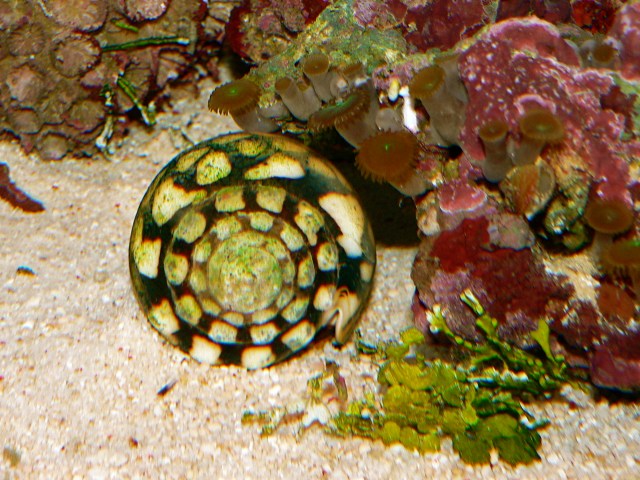
Marble Cone Snail  Conus marmoreus (Conidae)

REMARKS: Small cone snails pose little danger to humans beyond a beelike sting; however, large cone snails inject enough toxin to be deadly. About 30 human deaths have been attributed to cone snail envenomation
Research on cone snail peptide conotoxin toxins is an active field and has resulted in a new highly effective painkiller recently approved by the FDA that, unlike opium-derived medications, has a low risk of addiction.

Venoms Cluster PR26

flickr http://www.flickr.com/photos/cas_docents/sets/72157608597736188/

WordPress Shortlink http://wp.me/p1DZ4b-Oi
TAXONOMY
Kingdom: Animalia
Phylum:Chordata
Class: Actinopterygii (ray-finned fishes)
Order: Scorpaeniformes (Scorpionfishes and flatheads)
Family: Scorpaenidae (Scorpionfishes or rockfishes)

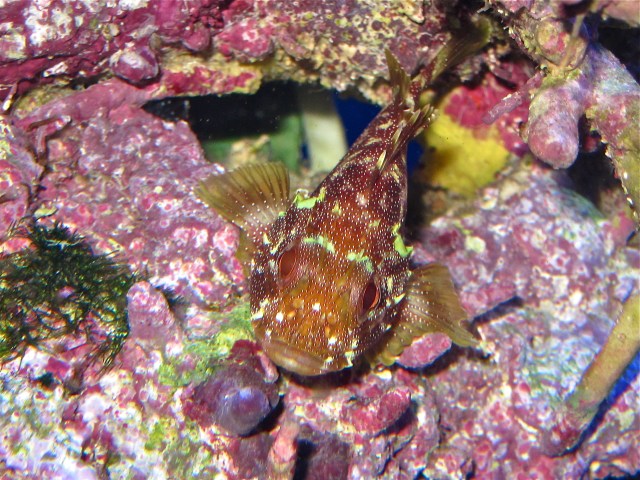
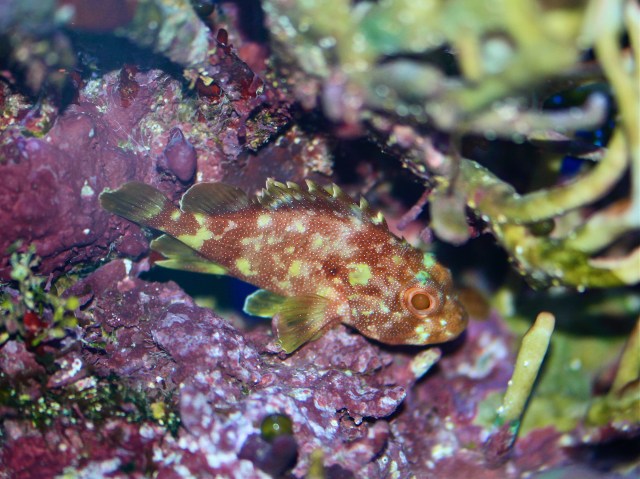
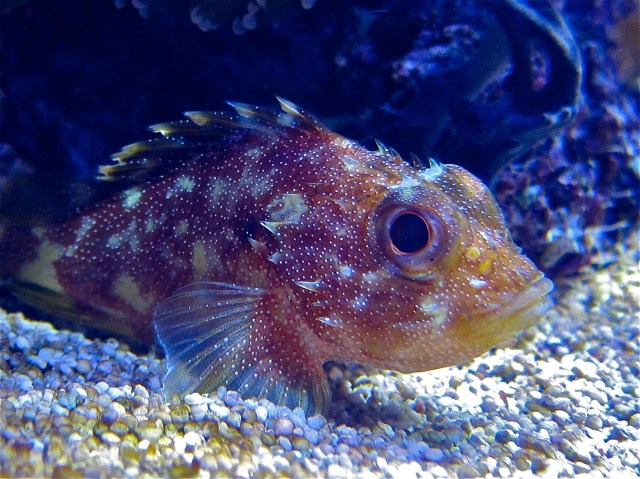
Genus/species: Sebastapistes cyanostigma

IMG_4381

GENERAL CHARACTERISTICS: large head, relatively smooth skin,spotted, usually yellow and white on a pinkish red background. No dark bars on underside of head. Common length : 6.4 cm or 2.5 inches.

DISTRIBUTION/HABITAT:Tropical, Indo-Pacific. Typically found among the branches of Pocillopora corals in surge areas of seaward reefs. Also observed between the branches of the fire coral.

DIET IN THE WILD: Crustaceans and small fishes.

IMG_0029

REMARKS: A master of camouflage, this small fish hide among corals, changing colors to match its background. A viewer of the Fire Coral Tank where this little fish resides may look directly at the fish and still not see it. A true scorpionfish, it uses the sharp venomous spines on its back for protection.

IMG_7182

Venoms Cluster

Fire Coral exhibit, PR24

flickr http://www.flickr.com/photos/cas_docents/sets/72157608341866427/

WordPress Shortlink  http://wp.me/p1DZ4b-NJ

TAXONOMY
Class: Actinopterygii (ray-finned fishes)
Order: Perciformes (Perch-likes)
Family: Blenniidae (Combtooth blennies

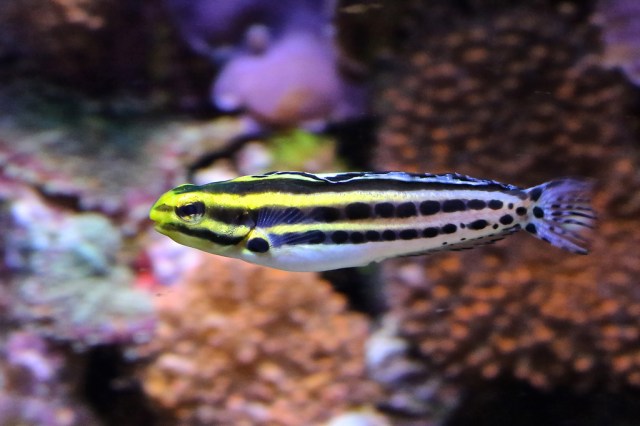
Genus/species: Meiacanthus grammistes

8393608989_a6c74ab647_b

GENERAL CHARACTERISTICS: Deep-bodied with a pointed snout and long continues dorsal fin. It is brown with tan wavy bands stretches the length of its body. On the dorsal fin near the head is a small blue spot. It grows to a size of 10 cm (4 inches) in length. Lined pattern on the body that ends in spots on the tail-fin base.

DISTRIBUTION/HABITAT: Western Pacific and Eastern Atlantic Ocean in sheltered lagoons and seaward reefs.

DIET IN THE WILD: DIET IN THE WILD: Omnivorous; small invertebrates and plant material. Remarks: About 50 blenny spp., including the 22 Meiacanthus spp., have evolved glands that produce venom and fangs to deliver it. The fangs are very large canines in the lower jaw that are grooved to inject venom when the fish bites, usually only in self-defense. Reports indicate that the fang blenny will bite the inside of a predator’s mouth and is quickly spit out.

IMG_9302

REPRODUCTION: Oviparous. Eggs are demersal and adhesive

Animal Attractions

flickr http://www.flickr.com/photos/cas_docents/8393608989/in/set-72157623764848303

WordPress Shortlink:  http://wp.me/p1DZ4b-NB

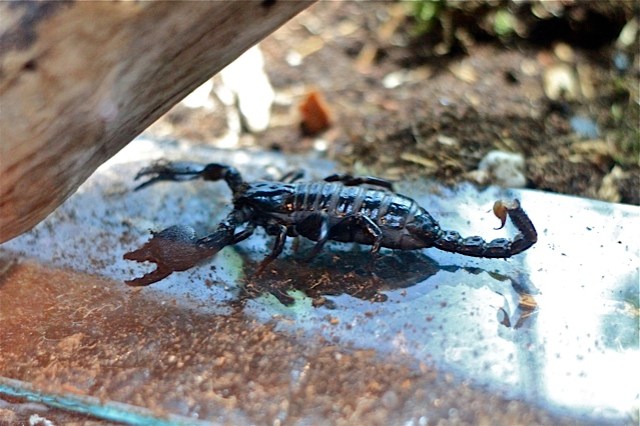
Phylum Arthropoda, Class Arachnida, Order Scorpiones, Family Scorpanidae, Scorpions

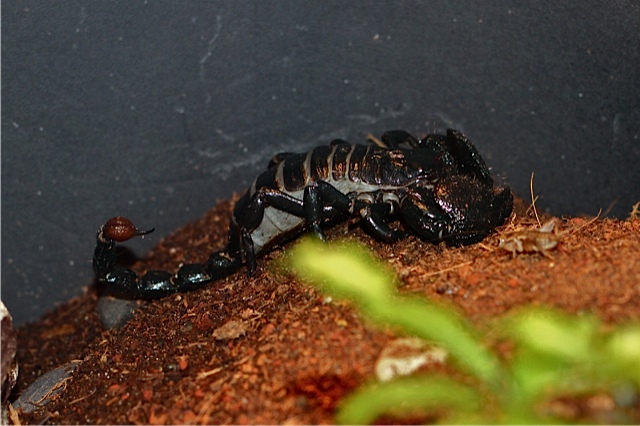
Pandinus imperator

DISTRIBUTION: West Africa

HABITAT: Tropical forest and open savanna where it hides under rocks, burrows beneath the soil, or cohabits termite mounds.

APPEARANCE: The largest scorpion known, (length to 20 cm (8 in); weight to 30 g (1 oz). Its black body bears large, blackish-red pincers with a granular appearance. The long tail, which arches back over the body, is tipped with a sharp curved stinger that delivers venom produced from a gland in the attached bulb.

DIET:  It preys upon ground-dwelling insects, spiders, and other invertebrates as well as an occasional baby lizard, snake, or mouse. These large scorpions rarely sting small prey; instead they grasp the prey in powerful pincers and tear it apart. The venom is reserved for larger prey or defense.

REPRODUCTION/DEVELOPMENT:  During mating, the male finds a suitable spot where he deposits his sperm packet, called a spermatophore. He then engages the female in an elaborate mating dance above the spermatophore with the male holding up the pincers of the female with his own, and carefully maneuvering her over the spermatophore, which she draws up into her genital pore. The eggs are fertilized, and the female carries them internally. After a 7 to 9 month gestation period, she gives birth to between 9 to 32 live young. The newborn climb onto the mother’s back, protected from predators by her size and aggressive behavior. Until the young are capable of hunting on their own, the mother feeds them by killing insects which are left on the floor of the burrow or other enclosure where the young can climb down and feed in safety.

MORTALITY/LONGEVITY:  Predators include birds, bats, small mammals, large spiders, centipedes, large lizards, and other scorpions. Life span: 5 to 8 years.

REMARKS: Sensory hairs on the pincers and tail enable the scorpion to detect prey and danger through vibrations from the air and ground. Like all scorpions, it has poor eyesight (despite having 6 to 12 eyes), good hearing, and a good sense of touch.

flickr http://www.flickr.com/photos/cas_docents/6976512905/in/set-72157629304397467/

WORDPRESS SHORTLINK http://wp.me/p1DZ4b-qK


TAXONOMY
Kingdom: Animalia
Phylum: Chordata
Subphylum: Vertebrata
Class: Reptilia
Order: Squamata
Suborder: Serpentes
Family: Viperidae

Genus/species: Crotalus horridus

GENERAL CHARACTERISTICS:  Average length of 91–152 cm (35.8-59.8 in). Dorsally they have a pattern of dark brown or black cross-bands on a yellowish brown or grayish background and an irregular zig-zag edges, and may be V-shaped or M-shaped. Often a rust-colored vertebral stripe is present.

DISTRIBUTION/HABITAT: Eastern United States from southern Minnesota and southern New Hampshire, south to east Texas and north Florida in deciduous forests in rugged terrain. 

DIET IN THE WILD: Prey is mainly small mammals, but may include small birds, frogs, or other snakes usually garter snakes.

REMARKS: Potentially, this is one of North America’s most dangerous snakes, due to its long fangs, impressive size and high venom yield. This is to some degree offset by its relatively mild disposition. Before striking, they often do a good deal of preliminary rattling and feinting.

Swamp

References

Ron’s flickr https://www.flickr.com/photos/cas_docents/8328119005/in/album-72157625194985646/

Ron’s WordPress shortlink http://wp.me/s1DZ4b-17