Tag Archive: reptiles


TAXONOMY
Kingdom: Animalia
Phylum: Chordata
Class; Reptilia
Order; Squamata (scaled reptiles, all lizards and snakes)
Suborder; Iguania
Family: Chamaeleonidae (Chameleons)

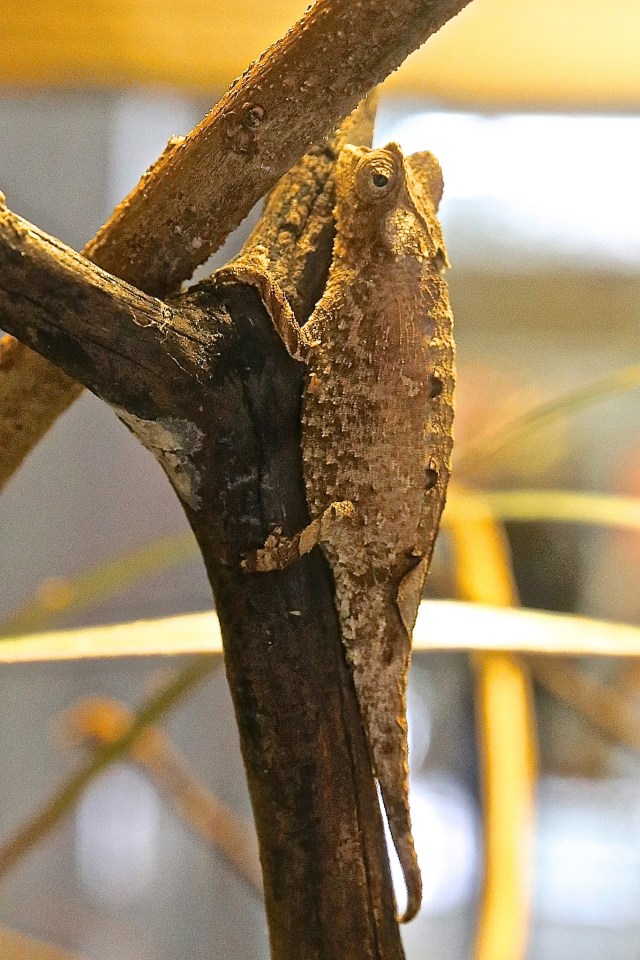
Genus/species: Brookesia stumpffi

GENERAL CHARACTERISTICS: This small chameleon grows up to 9 cm (3.5 in).
16273325375_8e6da34af4_k

DISTRIBUTION/HABITAT: Northern Madagascar and on several offshore islands. Commonly found in primary rainforest, dry forests, and secondary vegetation.

DIET IN THE WILD: It hunts in the leaf litter of the forest floor during the day, where it feeds on insects such a crickets, cockroaches, grasshoppers, and moths. At night it sleeps on branches of small shrubs about 30–80 cm (1–3 ft) above the ground.

PREDATORS: Probably snakes, birds, small mammals.

REPRODUCTION: Females lay between 3 to 5 eggs in depressions under dead leaves on the forest floor. 

LIFE SPAN: About 3 years.

CONSERVATION: IUCN Red List) Least Concern (LC).   This chameleon occurs in a fairly large area and seems relatively adaptable to disturbed habitats; however, its popularity in the pet trade as well as pressure from slash and burn farming pose possible threats

REMARKS: Can rapidly change colors to blend with the forest leaf litter to avoid predators. 

When disturbed these chameleons will play dead, resembling a fallen leaf. The Brookesia species are often called “leaf chameleons” because their small body and morphology resembling a leaf makes them highly cryptic when on the ground. 

Madagascar MA14 

References

California Academy of Sciences Docent Rainforest Training Manual 2014

IUCN Red List  www.iucnredlist.org/details/176297/0

Encyclopedia of Life  eol.org/pages/1057220/details

Ron’s flickr  https://www.flickr.com/photos/cas_docents/16273325375/in/album-72157620708610230/

Ron’s WordPress shortlink   http://wp.me/p1DZ4b-1sE


TAXONOMY
Kingdom: Animalia
Phylum: Chordata
Subphylum: Vertebrata
Class: Reptilia
Order: Squamata
Suborder: Sauria
Infraorder: Gekkota
Family: Gekkonidae

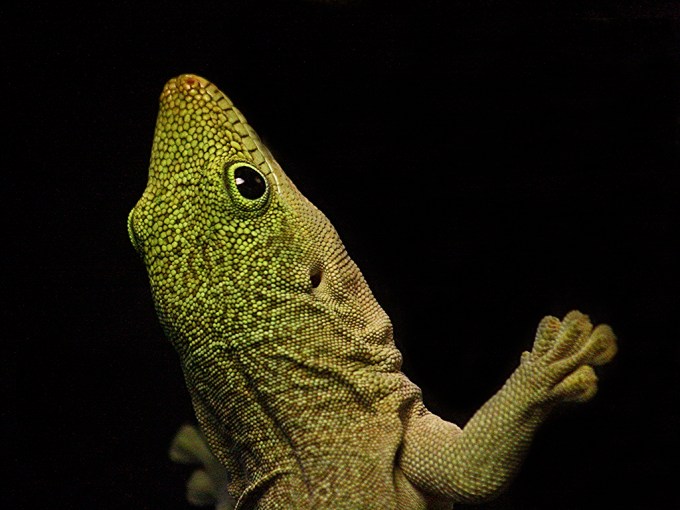
Genus/species: Blaseodactylus salalava

14933388794_fa4df3c0d4_o

DISTRIBUTION: Southwest Madagascar.

DIET IN THE WILD: Insects.

Madagascar MA10

TAXONOMY
Kingdom: Animalia
Phylum: Chordata
Class: Reptilia (snakes, worm lizards, lizards, alligators, caimans, crocodiles, tortoises, turtles, and tuataras)
Order: Squamata (Lizards and Snakes)
Suborder Sauria (Lizards)
Family: Gekkonidae (Geckos)

Genus/species: Uroplatus henkeli

Henkel's Leaf-tailed Gecko 4226839485_62145bf20d_b

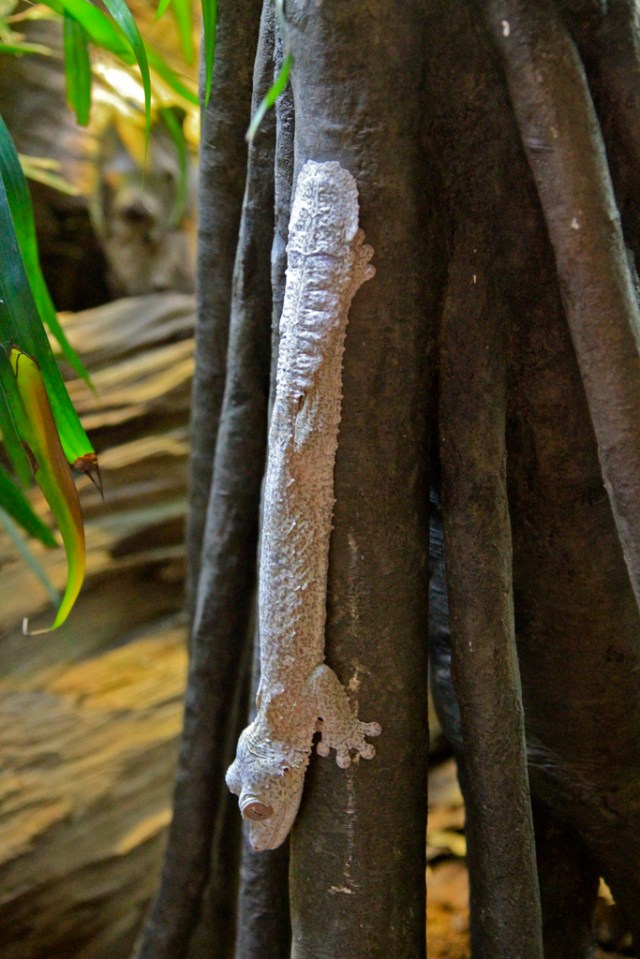
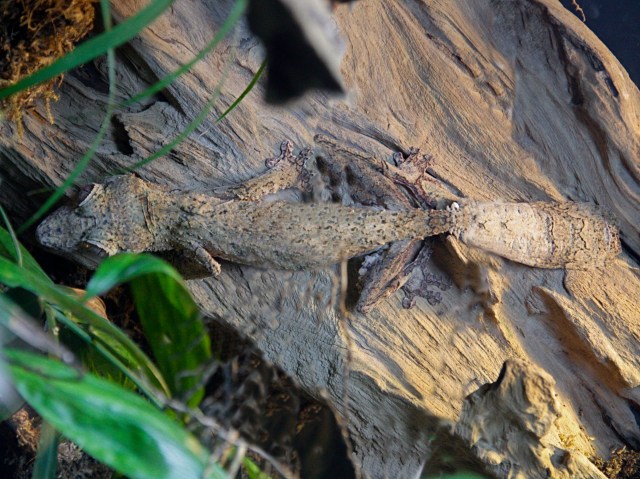
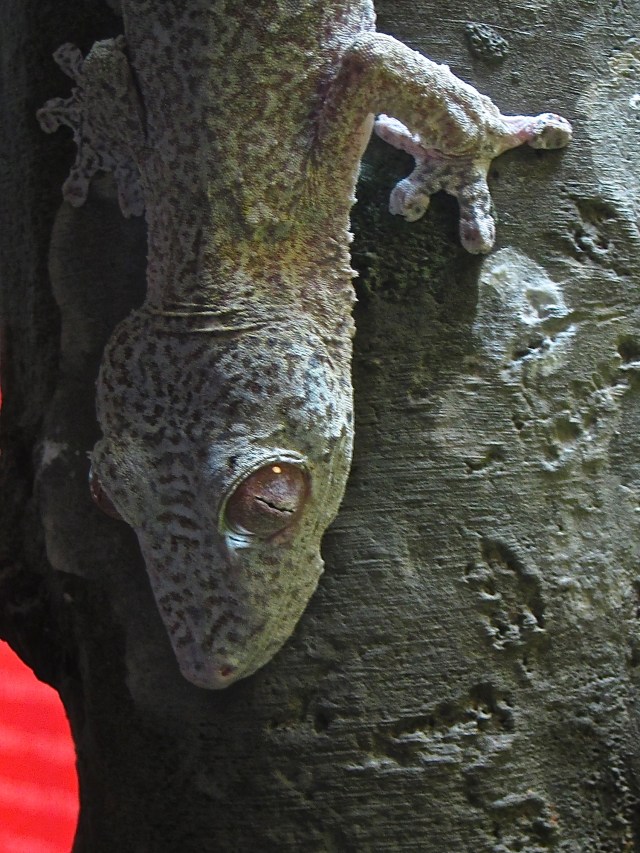
GENERAL CHARACTERISTICS A master of camouflage: its grey-brown skin blends in with the colors of tree bark. The fringes of skin along its head and body mask shadows by breaking up the. outlines of its body. The charcoal/light grey patterns on some individuals’ bodies look like lichen. The short flat tail, for which the genus was named (uro – “flat,” platus – “tail”), looks like a dead leaf. The bulging eyes on its flat triangular head have pupils with vertical slits, an indication of a nocturnal life style. Size to 255 mm (10 inches).

DISTRIBUTION/HABITAT Madagascar rainforest vegetation just a few metres off the ground

DIET IN THE WILD Nocturnal predator, eats mainly insects.

Henkel's leaf-tailed  Gecko  Uroplatus henkeli IMG_0394

REPRODUCTION: Eggs are deposited on the forest floor hidden under fallen leaves, beneath pieces of wood, or among dead leaves still attached to a plant. Juveniles hatch following a three-month incubation period.

MORTALITY Life span in the wild believed to be 3–5 years. Species has lived up to 15 years in captivity.

CONSERVATION IUCN Vulnerable from continued destruction of Madagascar forests. 

Listed in Appendix II of CITES.


REMARKS: To help escape predators. Like most lizard species, geckos can shed their tails. A new, shorter tail composed of cartilage will grow back. It can also frighten enemies by opening its mouth wide revealing a bright red interior. Also some geckos, including this one, have vocal cords, the only lizards that do. Its defensive behavior is often accompanied by loud distress calls.

Henkel's Leaf-tailed Gecko IMG_0742

Madagascar MAO7

References

California Academy of Sciences  Docent Rainforest Training Manual 2014

Encyclopedia of Life  eol.org/pages/961880/details

IUCN Red List:  www.iucnredlist.org/details/178653/0

Ron’s WordPress shortlink  http://wp.me/p1DZ4b-Uo

Ron’s flickr  http://www.flickr.com/photos/cas_docents/sets/72157608449603666/with/4226839485/

TAXONOMY
Kingdom:Animalia
Phylum: Chordata
Class: Reptilia
Order: Squamata (scaled reptiles, all lizards and snakes)
Family: Gekkonidae (Geckos)

Genus/species: Phelsuma standingi

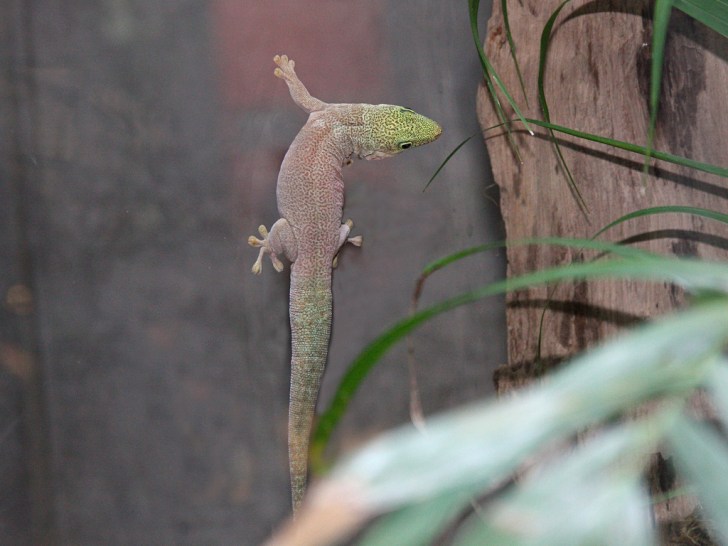
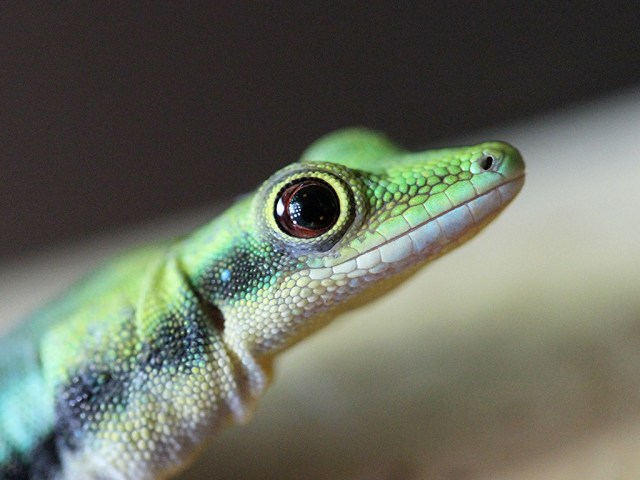
GENERAL CHARACTERISTICS: Base color is usually light gray or brown with darker fine reticulations. If inactive, the coloration of this day gecko is often duller, giving it an overall grey appearance. When cool it takes on darker colors to help absorb light and heat and when hot it turns pale. Hatchlings have a yellowish-green head and typical light bands and bars on their backs. Large for a gecko, to 30 cm (11.75 inches) in length.

 3268112303_e60d08c407_b

DISTRIBUTION/HABITAT: They have a limited range within southwest Madagascar, preferring dry thorn forests and arid to semi-arid regions where vegetation consists of thorny succulent plants and baobab trees.    

DIET IN THE WILD: Diurnal; feeds on insects, fruit, nectar and possibly other lizards. 


3496930709_f260501cc1_b


REPRODUCTION: Established adult pairs will tolerate juveniles until they reach sexual maturity. Eggs are most often laid in pairs that are “glued” to each other. As in many reptile species, sex of newborns is temperature dependent.

LONGEVITY: Captivity to 12 years, wild 5 years.

PREDATORS: Snakes and birds of prey.

CONSERVATION: IUCN Red list: Vulnerable (VU) 

Populations numbers are thought to have declined in the 1990s due to heavy collecting for the pet trade.

Color of Life: Madagascar geckos are often either green or brownish, providing concealment in the rainforest.

References

California Academy of Sciences Docent Rainforest Training Manual 2014

ARKive  www.arkive.org/banded-day-gecko/phelsuma-standingi/

Encyclopedia of Life  eol.org/pages/791137/details

IUCN Red List  www.iucnredlist.org/details/16947/0

Ron’s flickr  www.flickr.com/photos/cas_docents/3268112303/in/set-72157…

https://www.flickr.com/photos/cas_docents/3779080187/in/album-72157652559028013/

Ron’s WordPress shortlink  wp.me/p1DZ4b-1s3


TAXONOMY
Kingdom: Animalia
Phylum: Chordata
Class: Reptilia
Order: Squamata
Family: Gekkonidae (Geckos)

Genus/species: Phelsuma klemmeri

IMG_0913

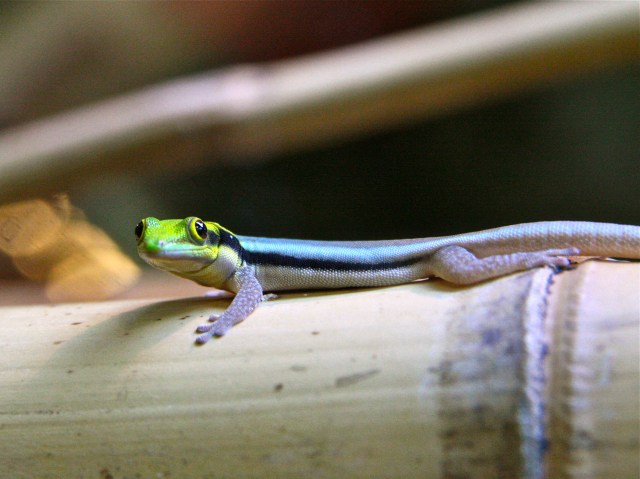
GENERAL CHARACTERISTICS: Dorsal color is brown to turquoise with turquoise bands. A black lateral line runs from the eyes to the hind legs. The head and neck are yellow. The ventral surface is whitish; scales are small and smooth. Adults are about 9 cm (3.5 in) long.

DISTRIBUTION/HABITAT: Found only in northwest Madagascar among medium-sized bamboo in fragmented “bamboo islands.” When disturbed they hide in the cracks in older dead bamboo.

Phelsuma klemmeri 4813861605_40e1c52a37_b

DIET IN THE WILD: Insects, other invertebrates and soft sweet fruit, pollen and nectar. In the wild, they avoid the hotter part of the day and usually hunt and forage in the early morning, late afternoon, or right after a shower.

DIET IN CAPTIVITY: A variety of insects, including crickets and fruit flies, but will also eat fruit baby foods. They also eat fruits such as guava, papaya, and peaches.

REPRODUCTION: Females lay eggs every 3 to 5 weeks. Like most geckos, she usually lay two eggs at a time, often inside a hollow piece of bamboo. The babies are iridescent and look like tiny copies of the adults. Newborns weigh a mere 0.1 g at birth.

CONSERVATION: IUCN Endangered (EN)
it is known from only two locations and occurs as a severely fragmented population, and there is a continuing decline in the extent and quality of forest habitat within its range.

REMARKS: First described in 1990.

Geckos have very special feet that contain millions of hairs capable of producing electrical forces, probably van der Waals forces. These forces, which are molecular and not caused by a sticky substance, allow the gecko to attract any surface, even polished glass.

Rainforest Madagascar with Madagascar Tree Boa MA06

References

California Academy of Sciences Docent Rainforest Training Manual 2014

IUCN Red List  www.iucnredlist.org/details/172981/0

phelsumania www.phelsumania.com/public/systematics/species/phelsuma_k…

Ron’s WordPress shortlink http://wp.me/p1DZ4b-TM

Ron’s flickr https://www.flickr.com/photos/cas_docents/3707689563/in/set-72157620708610230

TAXONOMY

Kingdom: Animalia
Phylum: Chordata
Class: Reptilia
Order: Squamata
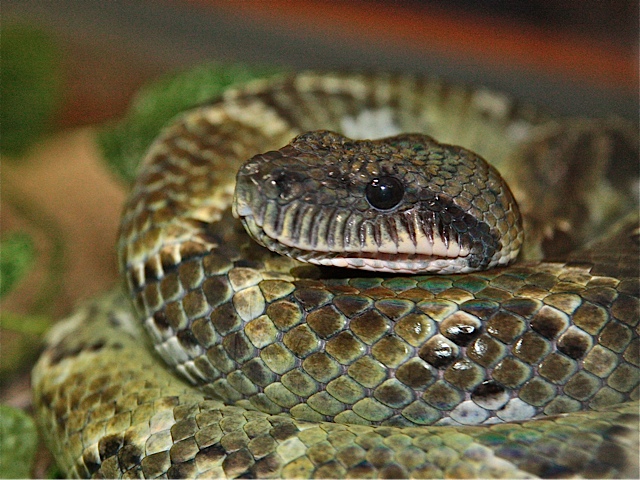
Family: Boidae (Boas; non-venomous, constricting snakes)

Genus/species: Sanzinia madagascariensis


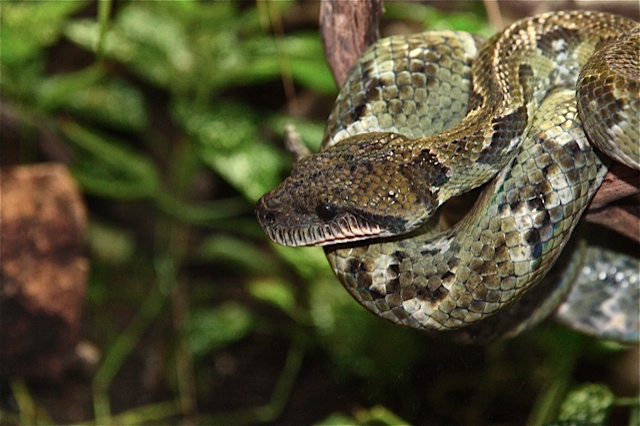
GENERAL CHARACTERISTICS: Endemic throughout the island of Madagascar, excluding the very southwest corner. Occurs in 2 color variations; those in the eastern part of the range are green to grayish-green, while in some parts of the western range they are yellow, orange, and brown. The green variety is somewhat smaller than the western form. Max length: about 2 m or 6 ft. Females are larger than males.

DISTRIBUTION/HABITAT: Endemic throughout the island of Madagascar, excluding the very southwest corner. Live in a variety of forest habitats, ranging from lowland tropical forests, to humid upland forests, to dry forests.

DIET IN THE WILD: It is a nocturnal snake, feeding on small mammals (including bats!) and birds, seeking them out using the heat-sensitive pits around its mouth that enable it to hunt for warm-blooded prey in complete darkness. Prey are constricted by the powerful coils of the boa which tighten as the prey struggles, restricting the blood flow to the heart and ultimately causing circulatory failure. Not venomous.

REPRODUCTION: Like all boas, females give birth to live young.Reach maturity at 3 years old, giving usually gives birth to fewer than 12  living young, which are red-colored to deter predators.

 
CONSERVATION:  IUCN Red List; Least Concern (LC)   Appendix I of CITES. Habitat loss through deforestation for agriculture and human settlement has restricted these boas mostly to protected areas of Madagascar. 

LOCATION: Rainforest  Madagascar MA06

References

Encyclopedia of Life  eol.org/pages/795591/details

ARKive http://www.arkive.org/madagascar-tree-boa/sanzinia-madagascariensis/

California Academy of Sciences Docent Training Manual on Rainforests 2014

Ron’s flickr http://www.flickr.com/photos/cas_docents/sets/72157625194985646/

Ron’s WordPress shortlink   http://wp.me/p1DZ4b-zd


TAXONOMY
Kingdom: Animalia
Phylum: Chordata
Class: Reptilia
Order: Squamata
Family: Gerrhosauridae

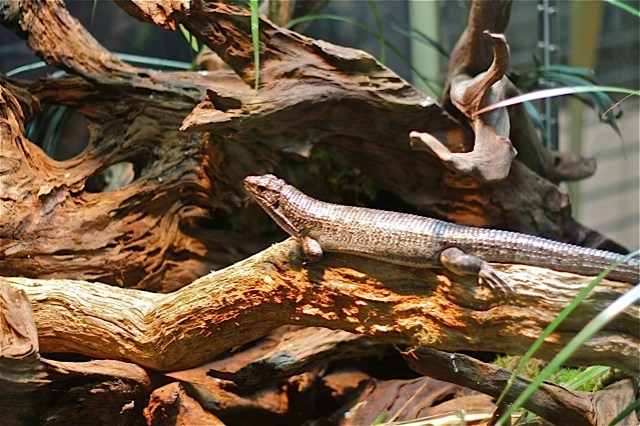
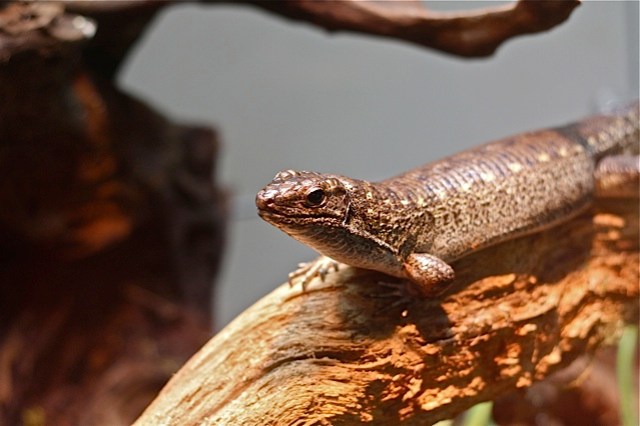
Genus: Zonosaurus maximus

 GENERAL CHARACTERISTICS: Relatively flattened body with a long, pointed snout. The body is covered with heavy armor of large, bony, keeled scales, especially on the dorsal surface. The scaleless area along the sides functions as expansion joints for gravid females that allow distention after feeding. Length is up to 70 cm (28 inches).


DISTRIBUTION/HABITAT: Endemic to Madagascar, this species is found in lowland humid forest associated with rivers and streams as well as non-forested riparian areas where it builds dens close to water. When disturbed, it seeks shelter in water and can stay submerged for several minutes.

DIET IN THE WILD: Plant matter, invertebrates, small rodents, other reptiles.

PREDATORS: Predators are primarily snakes.

REPRODUCTION: Oviparous. Life span: about 20 years.


CONSERVATION: IUCN Red List Vulnerable (VU)
Populations are severely fragmented and declining because of the reduced size and quality of habitat due to agricultural activities. Mature animals may also be over-collected for the pet trade. Some sites where this plated lizard occurs are fortunately under conservation management, including newly protected areas.

LOCATION:  Madagascar Rainforest  MA13

References

California Academy of Sciences, Docent Rainforest Training Manuel 2014

Encyclopedia of Life eol.org/pages/462210/details

IUCN Red List www.iucnredlist.org/details/172865/0

Ron’s flickr  https://www.flickr.com/photos/cas_docents/7423084566/in/set-72157620708610230/

Ron’s WordPress Shortlink  http://wp.me/p1DZ4b-xI


TAXONOMY
Kingdom: Animalia
Phylum: Chordata
Class: Reptilia ( turtles, crocodilians, snakes, lizards and tuatara)
Order: Squamata (scaled reptiles, all lizards and snakes)
Suborder: Serpentes (snakes are elongated, legless, carnivorous reptiles)
Family: Colubridae Colubrids

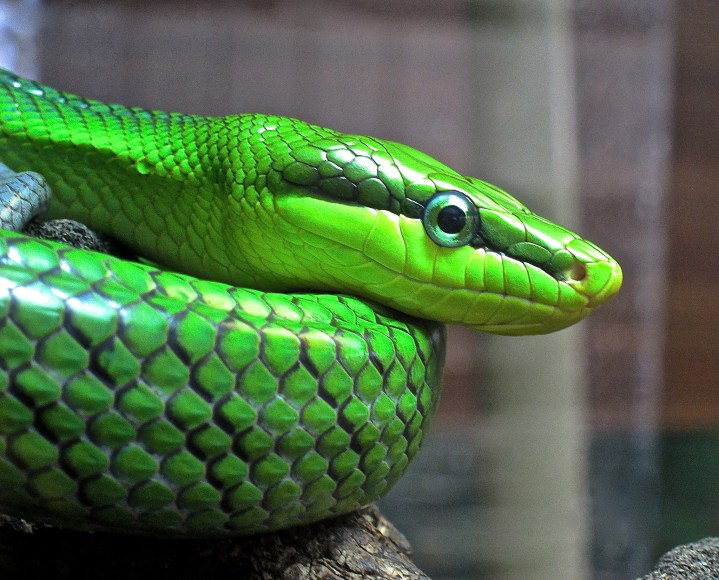
Genus/species: Gonyosoma oxycephala

GENERAL CHARACTERISTICS: Typically bright green but may also be grey with a dark line horizontally across its eye. The top of the head maybe dark green, yellow-green or yellow in color. Length of up to 2.4 m (almost 8 feet).

Gonyosoma oxycephala4185275536_412f9a05fa_o

DISTRIBUTION/HABITAT: Southeast Asia. Found in primary rainforests. Predominantly arboreal (tree-dwelling).

DIET IN THE WILD: Primarily birds, eggs and bats. Will also eat frogs, lizards, bats, and other small mammals. They are fast hunters, and can capture bats in flight. Prey is killed by constriction, rather than venom.

In captivity they are usually eat mice. 

REPRODUCTION: Oviparous, laying clutches of between 5 and 12 eggs

LONGEVITY: 15.1 years (captivity)

 Gonyosoma oxycephala8599840952_eb8bad64f1_k

CONSERVATION: IUCN Red List; Least Concern LC

Common in Borneo

References

Encyclopedia of Life eol.org/pages/456476/details

Ron’s flickr https://www.flickr.com/photos/cas_docents/4185275536/in/set-72157620567930293

Ron’s WordPress shortlink http://wp.me/p1DZ4b-1pJ

TAXONOMY
Kingdom: Animalia
Phylum: Chordata
Subphylum: Vertebrata
Class: Reptilia  (turtles, snakes, lizards, and relatives)
Order: Squamata
Suborder: Serpentes
Family: Viperidae (Vipers)

Genus/species: Tropidolaemus wagleri

GENERAL CHARACTERISTICS: Males are green in color. Females have 4 color phases. In the Malaysian phase seen here, the snake has a black background with yellow bars across it’s back, a yellow belly and green spots, one on each scale. Length to 4 ft. 

Wagler's Pit Viper 8324403992_9febc37327_b

DISTRIBUTION/HABITAT: They are arboreal living in the lowland tropical rainforests of Southeast Asia, including southern Thailand, Malaysia, Singapore, Borneo, Sumatra, Sulawesi and southern Philippines.

DIET IN THE WILD: Ambush nocturnal predator. Like all pit vipers, T. wagleri has heat-sensing organs (called loreal pits) on its head below and in front of their eyes which are used to sense prey, even when they can’t see it. Juveniles and adult males prefer lizards, especially geckos. Females eat a more varied diet, including rats, birds, frogs and lizards, Needs only 3 meals a month.

REPRODUCTION: Viviparous (bears young alive). Litters contain 6-50 young.

PREDATORS: King Cobra.

Wagler's Pit Viper  3506502014_96d97cbdb9_b

CONSERVATION: IUCN Red list; Least Concern (LC)

REMARKS: They have hemotoxic, venom, preventing blood from clotting. Bites can cause local pain, swelling, bruising, and bleeding but bites are rarely fatal to humans.

The Temple of the Azure Cloud in Penang Island, Malaysia is known as Snake Temple. It was once filled with hundreds of Wagler’s pit vipers. Tourists would be photographed with the snakes. Locals collected the snakes, and, fortunately, the ones used for photography had their fangs removed.

Borneo Cave Cluster B005

References

Encyclopedia of Life  eol.org/pages/790394/details

Ron’s flickr https://www.flickr.com/photos/cas_docents/8324403992/in/set-72157620567930293

California Academy of Sciences Docent Rainforest Training class 2014

Ron’s WordPress shortlink http://wp.me/p1DZ4b-Vu

 Borneo Cave Cluster B005


TAXONOMY
Kingdom: Animalia
Phylum: Chordata
Class: Reptilia
Order: Squamata
Family: Colubridae

Genus/species: Elaphe taeniura ridleyi aka Orthriophis taeniurus ridleyi

GENERAL CHARACTERISTICS: Color: yellow to beige background color that darkens to a grey-black towards the tail. A white to cream mid-dorsal stripe starts about half of the way down the body and continues to the tip of tail. Both sides of the head are marked just behind the eye with a black stripe surrounded by blue.

Cave Rat Snake aka Bat Eating Snake4496227660_4d83a12687_o

DISTRIBUTION/HABITAT: Southeast Asia including Borneo. Found hanging from the walls and ceilings within caves.

DIET IN THE WILD: Mainly of bats, also rodents and birds.

Cave Rat Snake aka Bat Eating Snake7687438440_3272f123dc_k

REMARKS: Its color is paler than forest racers due to its life in limestone caves.

Borneo Cave Cluster BO03 

References

Encyclopedia of Life  eol.org/pages/794893/details

Ron’s flickr https://www.flickr.com/photos/cas_docents/5252793782/in/set-72157620567930293/

Ron’s WordPress  http://wp.me/p1DZ4b-1pB