Tag Archive: rainforests


TAXONOMY
Kingdom: Animalia
Phylum: Chordata
Class: Amphibia
Order: Anura (frogs and toads)
Family: Rhacophoridae (shrub frogs including Asian flying frogs)

Genus/species: Polypedates otilophus

IMG_0389

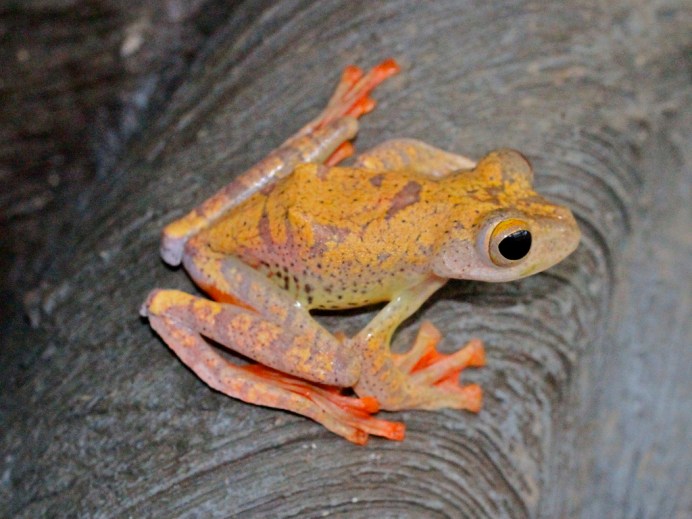
GENERAL CHARACTERISTICS: Dorsal color light brown to gray to yellowish brown or bright yellow. Head triangular and longer than broad; serrated bony ridge behind the eye. Pupils are horizontal, with yellowish gray irises. Thin black stripes run from the head down the back; thighs marked by black bars. Finger and toe tips expanded into large discs; toes webbed. Length from snout to vent: 6–8 cm (2.4- 3 inches) female 10 cm (4 inches).

Reinwardt's flying frog (Rhacophorus reinwardtii) MG_0098_2

DISTRIBUTION/HABITAT: Islands of Borneo and Sumatra in lowland rainforest up to elevations of around 400 m (1300 feet). Found in trees, bushes and freshwater ponds.

DIET IN THE WILD: Insects, crickets and spiders .

REPRODUCTION: When ready to mate the male calls loudly then the pair builds a foam nest overhanging water which the tadpoles eventually drop into.

CONSERVATION: IUCN least concern. Though populations are declining somewhat, this frog’s wide distribution and ability to thrive under conditions modified by humans suggest a strong survivability quotient.

IMG_0231

REMARKS: Has a has an unpleasant musty smell, which people find irritating.

Borneo, B011

References

Encyclopedia of life  eol.org/pages/1048298/details

AmphibiaWeb  http://amphibiaweb.org/cgi/amphib_query?where-genus=Polypedates&where-species=otilophus

flickr  http://www.flickr.com/photos/cas_docents/sets/72157608456457315/with/3766068513/

WordPress Shortlink http://wp.me/p1DZ4b-11k

TAXONOMY
Kingdom:Animalia
Phylum: Chordata
Class: Amphibia
Order: Anura
Family: Rhacophoridae

Genus/species: Rhacophorus pardalis

GENERAL CHARACTERISTICS: Fingers webbed and bear expanded discs, outer edge of hand and forearm have wide flap of skin – all adaptations for gliding. Bright red hand and foot webbing make this frog easy to identify. Dorsal side tan to reddish-brown, often with spots. Flanks yellowish with black spots. Size: Snout to vent males to 5.0 cm (2 inches) females, to 7.0cm (2.75 inches).


5170277207_42b048bdfe_b

DISTRIBUTION/HABITAT: Known from peninsular Malaysia, Sumatra, Borneo, and the Philippines. Found in subtropical primary forest, secondary forest and freshwater marshes from sea level to 1,000 m (3,281 feet). 

5170277417_17153bc773_b

REPRODUCTION: R. pardalis breeds at swampy forest pools.

CONSERVATION: IUCN Red List; Least Concern (LC) 

The most important threat to this species is logging.

Borneo Gliding Herps BO11

References

Encyclopedia of Life  eol.org/pages/1025363/details

IUCN Red List  www.iucnredlist.org/details/full/59012/0

Ron’s WordPress shortlink  http://wp.me/p1DZ4b-1q1

Ron’s flickr  https://www.flickr.com/photos/cas_docents/5170877230/in/set-72157620567930293

TAXONOMY
KINGDOM: Animalia
Phylum: Chordata
Class: Amphibia
Order: Anura
Family: Rhacophoridae

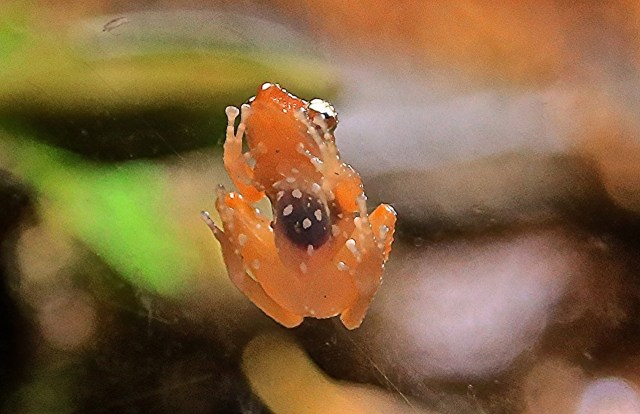
Genus/species: Nyctixalus pictus

DISTRIBUTION/HABITAT: Southern Southeast Asia. Found in shrub and lower tree strata in primary and secondary forests.

 Nyctixalus pictus15762349568_83118c678d_k

REPRODUCTION: Breeds by larval development in arboreal water-filled cavities and in rotting logs.

15923978406_3abc22c9b1_o

CONSERVATION: ICUN Redlist Near Threatened (NT)    The extent and quality of its habitat is declining very rapidly due to widespread forest loss within its range.

www.iucnredlist.org/details/58806/0

Borneo Nursery BO08

References  

Ron’s flickr https://www.flickr.com/photos/cas_docents/15762349568/in/set-72157608456457315/

Ron’s WordPress shortlink  http://wp.me/p1DZ4b-1pS


TAXONOMY
Kingdom: Animalia
Phylum: Chordata
Class: Reptilia ( turtles, crocodilians, snakes, lizards and tuatara)
Order: Squamata (scaled reptiles, all lizards and snakes)
Suborder: Serpentes (snakes are elongated, legless, carnivorous reptiles)
Family: Colubridae Colubrids

Genus/species: Gonyosoma oxycephala

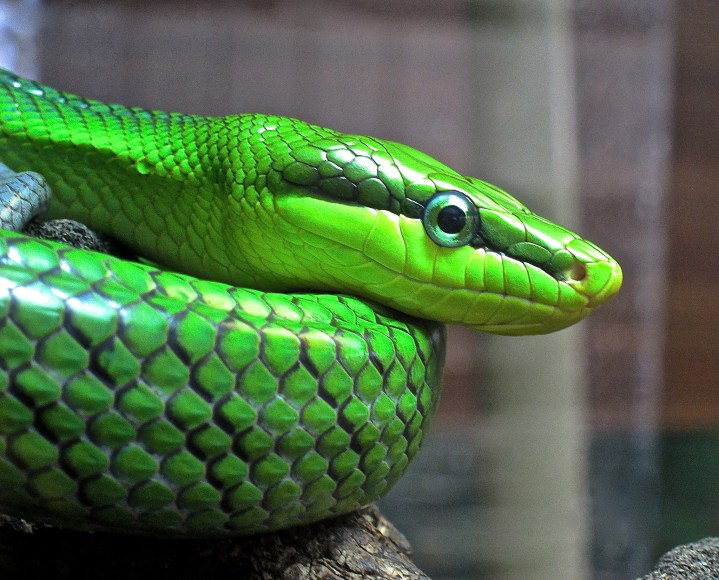
GENERAL CHARACTERISTICS: Typically bright green but may also be grey with a dark line horizontally across its eye. The top of the head maybe dark green, yellow-green or yellow in color. Length of up to 2.4 m (almost 8 feet).

Gonyosoma oxycephala4185275536_412f9a05fa_o

DISTRIBUTION/HABITAT: Southeast Asia. Found in primary rainforests. Predominantly arboreal (tree-dwelling).

DIET IN THE WILD: Primarily birds, eggs and bats. Will also eat frogs, lizards, bats, and other small mammals. They are fast hunters, and can capture bats in flight. Prey is killed by constriction, rather than venom.

In captivity they are usually eat mice. 

REPRODUCTION: Oviparous, laying clutches of between 5 and 12 eggs

LONGEVITY: 15.1 years (captivity)

 Gonyosoma oxycephala8599840952_eb8bad64f1_k

CONSERVATION: IUCN Red List; Least Concern LC

Common in Borneo

References

Encyclopedia of Life eol.org/pages/456476/details

Ron’s flickr https://www.flickr.com/photos/cas_docents/4185275536/in/set-72157620567930293

Ron’s WordPress shortlink http://wp.me/p1DZ4b-1pJ

TAXONOMY
Kingdom: Animalia
Phylum: Chordata
Class: Reptilia
Order: Squamata
Family: Colubridae

Genus/species: Elaphe taeniura ridleyi aka Orthriophis taeniurus ridleyi

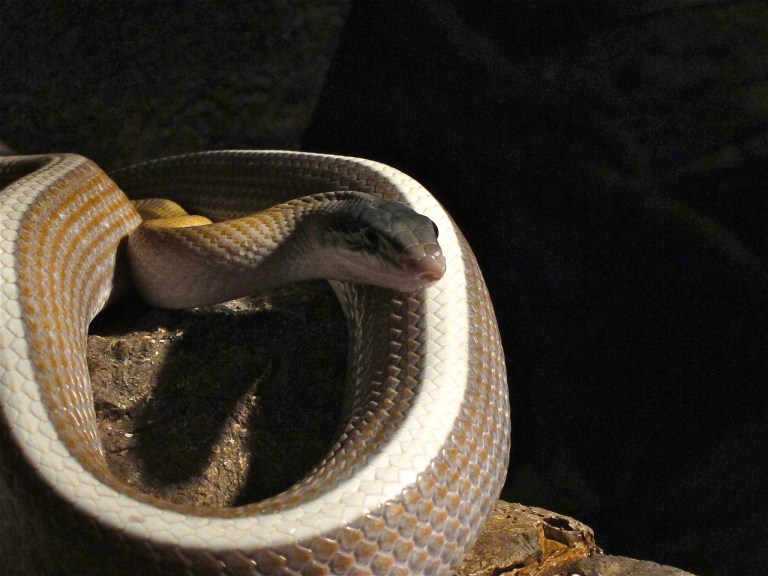
GENERAL CHARACTERISTICS: Color: yellow to beige background color that darkens to a grey-black towards the tail. A white to cream mid-dorsal stripe starts about half of the way down the body and continues to the tip of tail. Both sides of the head are marked just behind the eye with a black stripe surrounded by blue.

Cave Rat Snake aka Bat Eating Snake4496227660_4d83a12687_o

DISTRIBUTION/HABITAT: Southeast Asia including Borneo. Found hanging from the walls and ceilings within caves.

DIET IN THE WILD: Mainly of bats, also rodents and birds.

Cave Rat Snake aka Bat Eating Snake7687438440_3272f123dc_k

REMARKS: Its color is paler than forest racers due to its life in limestone caves.

Borneo Cave Cluster BO03 

References

Encyclopedia of Life  eol.org/pages/794893/details

Ron’s flickr https://www.flickr.com/photos/cas_docents/5252793782/in/set-72157620567930293/

Ron’s WordPress  http://wp.me/p1DZ4b-1pB


TAXONOMY
Animalia (animals)
Phylum (Arthopoda)
Subphylum: Hexapoda
Class: Insecta
• Three body parts – head, thorax, abdomen
• Three pairs of legs attached to thorax
• Usually one or two pairs of wings
Order: Hymenoptera (ants)
Family: Formicidae

Genus/species: Atta cephalotes
4471989519_93ab359108_o

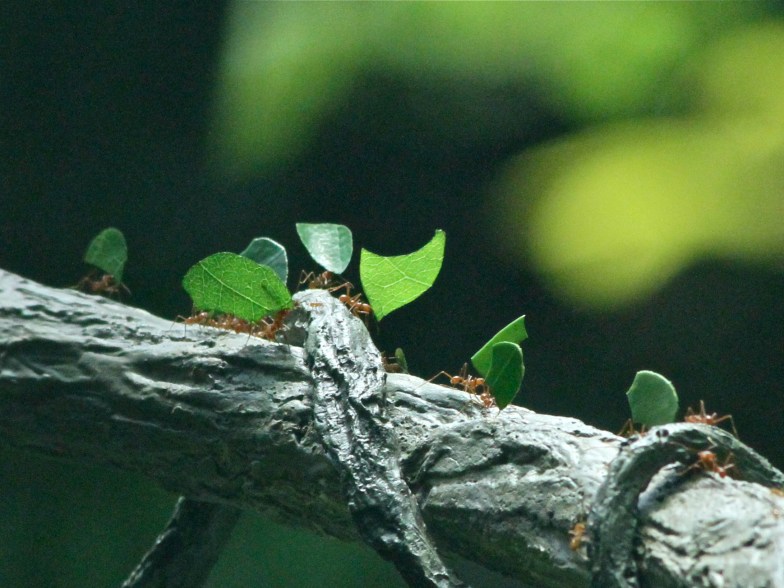
GENERAL CHARACTERISTICS: Rust colored with lighter colored legs, members of the genus Atta are among the largest, most socially complex leafcutters. The huge queen is up to 1.5 cm (0.5 inches) in length, an egg laying machine capable of building a colony of several million individuals. A. cephalotes is noted for its especially large head (hence the name). Workers take many forms and sizes, from large soldiers and major workers with their impressive mandibles. A soldier may be 10 times longer and weigh several hundred times more than the smallest worker.

DISTRIBUTION/HABITAT: Fungus growing ants, or gardening ants, number about 200 species, all in the tribe Attini, and are found only in the New World, in every mainland country except Canada and Chile. Most leaf cutter ant species are native to tropical Central and South America, though a few species occur in the southwestern United States. Atta cephalotes ranges from southern Mexico to Bolivia and Brazil.

Found throughout the tropical rain forest, tropical deciduous forest, and tropical scrub forest. Nests are underground to a depth of 6 m (20 ft). Some have up to 3000 chambers.
3003360666_7be42e475a_b

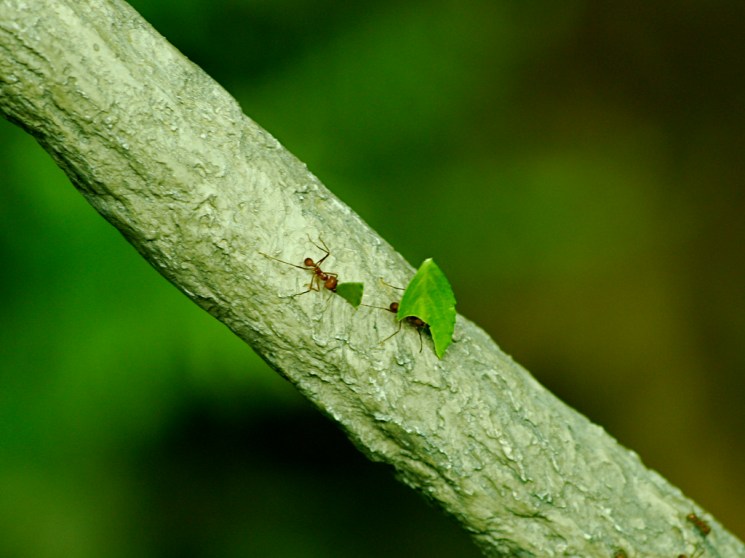
DIET IN THE WILD: They grow their own food by cutting leaves, mostly during the evening and nighttime, and carrying them back to the nest, where smaller workers then process them further and take them to underground “garden” chambers. All along the way, the leaves are fertilized by their handlers with anal secretions. Fungi then grow on the decaying vegetation, and the ants feed exclusively on the fungus, not the leaves. Each ant species grows a specific fungus.

REPRODUCTION: A. cephalotes swarm in mating flights at the onset of the rainy season. The queen mates with multiple males. The founding female has a pocket in her mouth cavity for storage of fungus spores to start her new nest. After she digs the first chamber for the garden, she deposits the spores, gathers appropriate leaves, and begins laying about 1,000 eggs each day. The first group of workers to develop takes over for the queen in caring for eggs, larvae, and pupae. The queen has only one job then—to lay the eggs that will build the colony.
The queen lives up to 10 years on average, but some have lived up to 14 years.

REMARKS: Fungus and ants are mutually dependent for survival. Obviously, the fungus provides the ants with food, but equally important, the fungus receives a warm, moist home and is supplied with fresh, fertilized nutrients. A large colony harvests the same amount of plant material that a cow consumes in a single day. Like most insects, are a good source of protein; they are eaten by people in parts of Mexico and in many places in South America. They also circulate nutrients and aerate huge quantities of soil.

Negative impacts of A. cephalotes include undermining building foundations, causing structural damage and destroying crops.

FOREST FLOOR BO14

References

Ron’s flickr  https://www.flickr.com/photos/cas_docents/4471989519/in/set-72157620567930293/

For Video ARKive  www.arkive.org/leaf-cutter-ant/atta-cephalotes/video-08.html

 Encyclopedia of Life  eol.org/pages/53197/overview

 Rainforest of the World docent training manual of the California Academy of Sciences 2014

Ron’s WordPress shortlink  wp.me/p1DZ4b-1pv

TAXONOMY
Kingdom: Animalia
Phylum: Chordata
Class: Reptilia
Order: Squamata
Suborder: Sauria
Family: Gekkonidae (Geckos)

Genus/species: Ptychozoon kuhlii

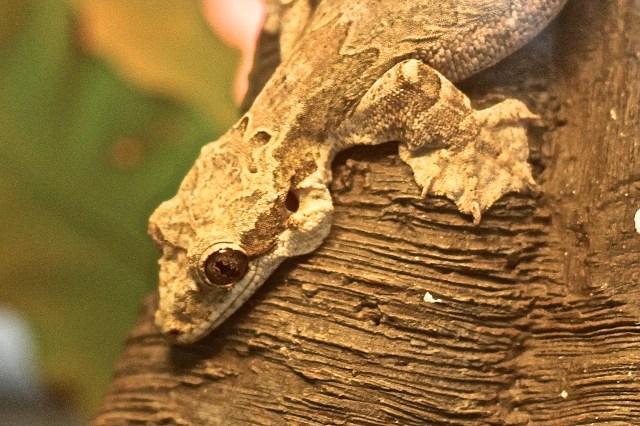
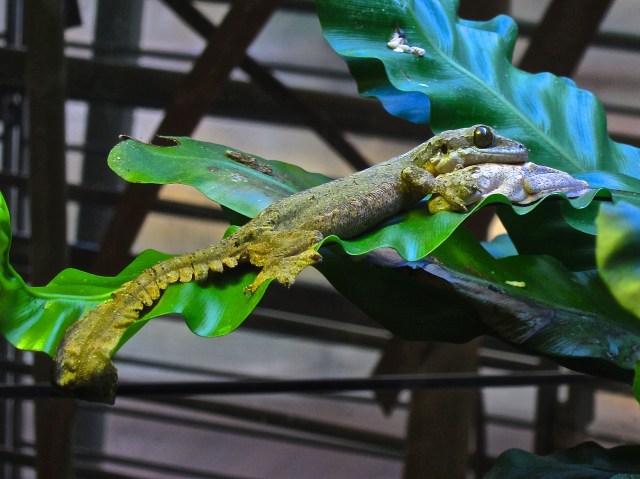
Kuhl's Flying Gecko IMG_9599

GENERAL CHARACTERISTICS Weird looking with big heads, bulging lidless eyes, and elaborate webbed feet. Gliding apparatus is composed of a large flap of skin along the flank. These flaps remain rolled across the belly until the lizard jumps off a tree. Then the flaps open passively in the air, acting as a parachute during descent. Additional flaps lie along the sides of the head, neck, and tail. These geckos are nocturnal and cryptic, and often go unnoticed in their natural habitat.

DISTRIBUTION/HABITAT Southeast Asia, including southern Thailand, Malaysia, Borneo, Indonesia, and Singapore. Nocturnal arboreal animals, found in lowland and mid-level rainforests.

Kuhl's Flying Gecko IMG_9650

DIET IN THE WILD Insects and arthropods.

MORTALITY Can live up to 7–9 years.

REPRODUCTION In captivity, breeding occurs when the animals are exposed to about 12 hours of daylight. The female will lay two eggs about once a month. She can lay five or six clutches per season. Eggs will hatch in 2–3 months.

Kuhl's Flying Gecko

Rainforest Borneo BO11

WordPress Shortlink  http://wp.me/p1DZ4b-UA

flickr  http://www.flickr.com/photos/cas_docents/sets/72157620567930293/