Tag Archive: marine


TAXONOMY
Kingdom: Animalia
Phylum: Cnidaria
Class: Anthozoa
Order: Actiniaria
Family: Actiniidae

Genus/species: Urticina lofotensis

 GENERAL CHARACTERISTICS: Column diameter to 10 cm (4 inches), height to 15 cm (6 inches). Column bright scarlet or crimson with white warty spots in longitudinal rows; tentacles slender, elongate, scarlet to crimson.
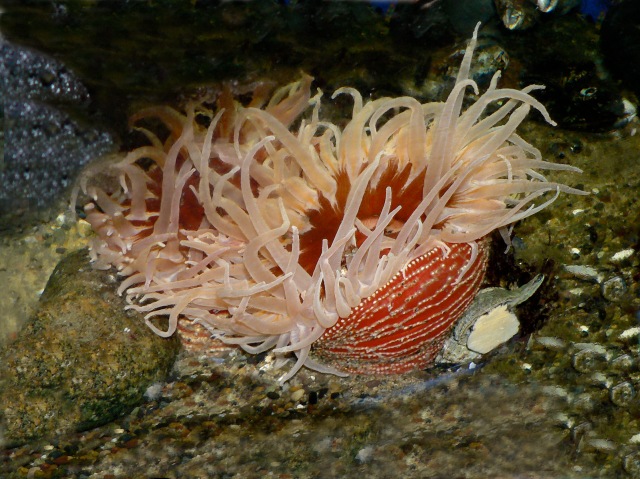
 White-spotted Rose Anemone3005754146_b9c9c195c5_o

DISTRIBUTION/HABITAT: SE Alaska to San Diego, CA. Found on rocks and walls of surge channels, low intertidal to 15 m (49 feet) on exposed outer coast.

 DIET IN THE WILD: Carnivorous.

REMARKS: Shells or debris rarely found adhered to the tubercles. Juvenile painted greenlings and adults may sleep near its base.

References

 eol eol.org/pages/2549638/details

 Walla Walla Universitywww.wallawalla.edu/academics/departments/biology/rosario/…

 Washing state Universitywww.beachwatchers.wsu.edu/ezidweb/animals/Urticinalofoten…

 Ron’s flickr  https://www.flickr.com/photos/cas_docents/3005754146/in/set-72157625127345346/

Ron’s WordPress shortlink   http://wp.me/p1DZ4b-1ly


Location; California Rocky Coast, Giants, Octopus exhibit
TAXONOMY
Kingdom: Animalia
Phylum: Cnidaria
Class: Anthozoa
Order: Actiniaria
Family: Metridiidae

Genus/species: Metridium senile

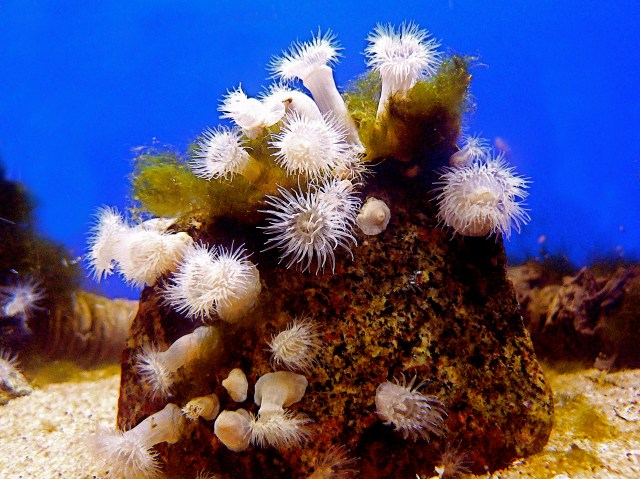
GENERAL CHARACTERISTICS: M. senile is colored white, cream, tan, orange or brown. Height to 5 cm (2 inches). Tentacular crown diameter to 25 cm (9.75 inches), Up to one hundred small, slender tentacles give a feathery (plumose) appearance.

 Metridium senile 3074666433_ab584596e9_o

DISTRIBUTION/HABITAT: Southern Alaska to Southern California and both Atlantic coasts. Found live in groups of up to 500 specimens per square meter at depths to 166 m (540 feet). M. senile lives on rocks, shells, wood pilings and stony breakwaters in bays and harbors in the low intertidal and subtidal zones. Plumose anemones crawl slowly along the substrate by muscular waves of the pedal disk.

DIET IN THE WILD: Mostly small zooplankton, though they may also eat small benthic polychaetes, fish, and squid.

REPRODUCTION: Protandric hermaphrodite starting life as one sex and changes to the other when it is older. Eggs or sperm develop in the gonads embedded in the mesentery that lines the coelom. They are ejected through the mouth, and when fertilised develop into planula larvae which settle and become juveniles.

They also reproduce asexually by binary fission, budding and fragmentation.

PREDATORS: Nudibranch Aeolidia papillosa (on small individuals), and the seastars Hippasteria spinosa and Dermasterias imbricata, which can eat even quite large individuals.  Attacked individuals may detach and drift to a new location.

Location: California Rocky Coast and tide pool

References

Walla Walla University: www.wallawalla.edu/academics/departments/biology/rosario/…

eol  eol.org/pages/421495/details 

Ron’s flickr   https://www.flickr.com/photos/cas_docents/3074666433/in/set-72157625127345346/

Ron’s WordPress shortlink  http://wp.me/p1DZ4b-1ls 

TAXONOMY
Kingdom: Animalia (animals)
Phylum: Cnidaria
Class: Anthozoa
Subclass: Ceriantipatharia,
Order: Ceriantharia
Family: Cerianthidae

Genus/species: Pachycerianthus fimbriatus

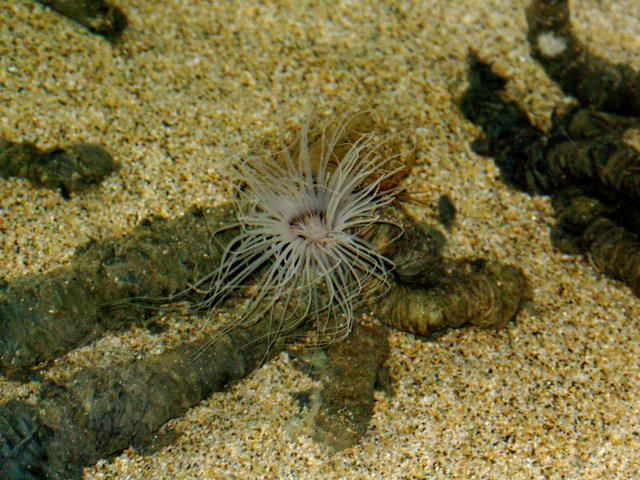
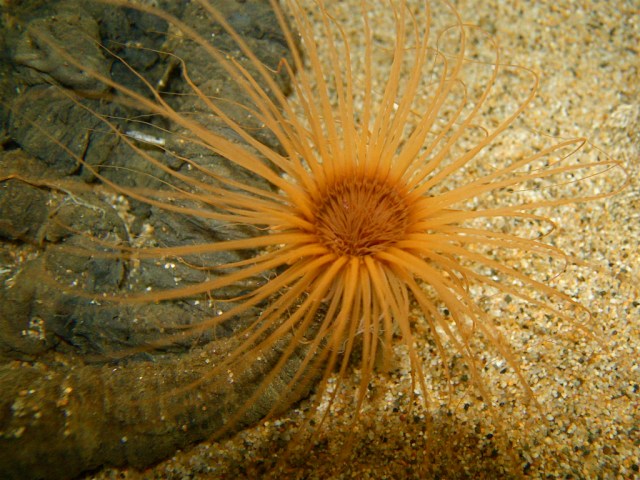
GENERAL CHARACTERISTICS: Solitary tube to 35 cm (14 inches) long when expanded. The tough, slippery, black, secreted tube projects above the mud substrate. Tentacular crown with two circles of translucent whitish to brown-gold tentacles. The inner
circle usually held over the mouth, the outer circle projecting up or out. Like most anemones, the tube-dwelling anemone contains stinging cells or nematocytes along its tentacles.

Tube Anemone  3236526239_4f6bd4f600_o

DISTRIBUTION/HABITAT: California (total distribution poorly known). Fairly common in soft mud bottoms of bays and harbors and protected sandy substrates of the outer coast. Low intertidal and subtidal in S. California; subtidal only in N. California to at least 54 m (177 feet).

Tube Anemone 3288842115_73a426d48d_b

DIET IN THE WILD: Small invertebrates, hydromedusae, small crustaceans and plankton

PREDATORS: Barber slugs clip off its tentacles, resulting in P. fimbriatus retreating quickly down the tube—sometimes pulling the slug in with it. The tentacles grow back after an attack.

REMARKS: Unlike sea anemones the anal pore is at the end of the body.

References

eol eol.org/pages/199417/details

 Walla Walla Universitywww.wallawalla.edu/academics/departments/biology/rosario/…

 Monterey Bay Aquarium www.montereybayaquarium.org/animal-guide/invertebrates/tu…

Ron’s WordPress Shortlink  http://wp.me/p1DZ4b-1kM

Ron’s flickr  https://www.flickr.com/photos/cas_docents/3236526239/in/set-72157625127345346


TAXONOMY
Kingdom: Animalia
Phylum: Chordata
Class: Actinopterygii (ray-finned fishes)
Order: Perciformes (Perch-likes)
Family: (Labridae) Wrasses

Genus/speces: Halichoeres semicinctus

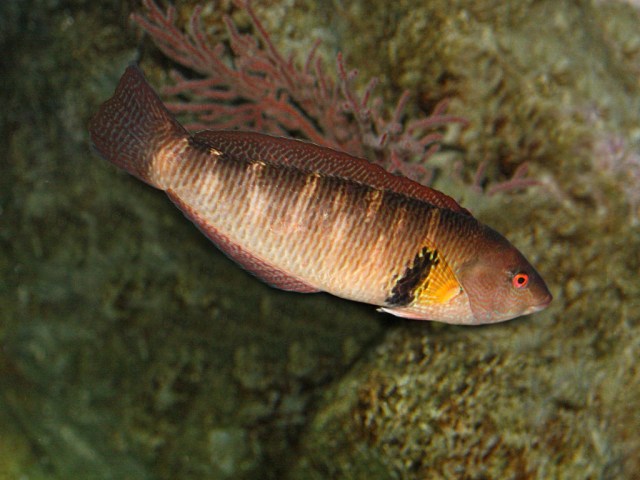
Rock Wrasse (male) below:

Rock Wrasse Male 3995256931_9e14b0f8ab_b

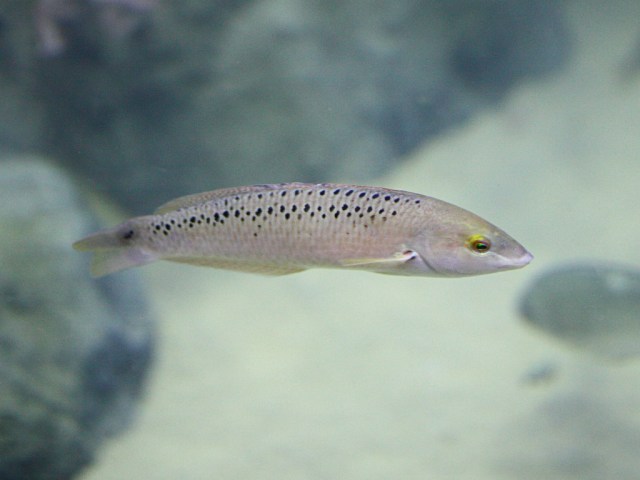
GENERAL CHARACTERISTICS: Length to 38 cm (15 inches). Terminal phase males are characterized by a partial dark stripe behind yellow pectoral fins and pink eyes, while females and immature male rock wrasses are similar in appearance having ranging from brown to yellow to orange. 

Rock Wrasse (female or immature male) below:

Rock Wrasse (female or immature male)  3995255809_8f686dbab8_b

DISTRIBUTION/HABITAT: Pt. Conception, California to Guadalupe Island off central Baja California, Mexico. Habitat: Close to rocks near patches of sand; tidepools and down to 24 m (79 feet).

DIET IN THE WILD: Small invertebrates, taken during the day.

REPRODUCTION: Each individual starts as female then changes to a male at length of about 30 cm. Pelagic spawners

CONSERVATION: IUCN: Least concern.

REMARKS : Sleeps at night buried in sand, with head protruding, and will dart to a sandy refuge during the day if startled.

Rock Wrasse (female or immature male) below:

Rock Wrasse (female or immature male)  2972940984_0ce80884d9_b

Southern California Kelp Tank CC14

WordPress Shortlink http://wp.me/p1DZ4b-Yk

flickr http://www.flickr.com/photos/cas_docents/sets/72157633391356187/with/3995255809/