Tag Archive: Invertebrates


TAXONOMY
Kingdom: Animalia
Phylum: Arthropoda
Subphylum: Crustacea
Class: Malacostraca
Order: Decapoda
Family: Atyidae

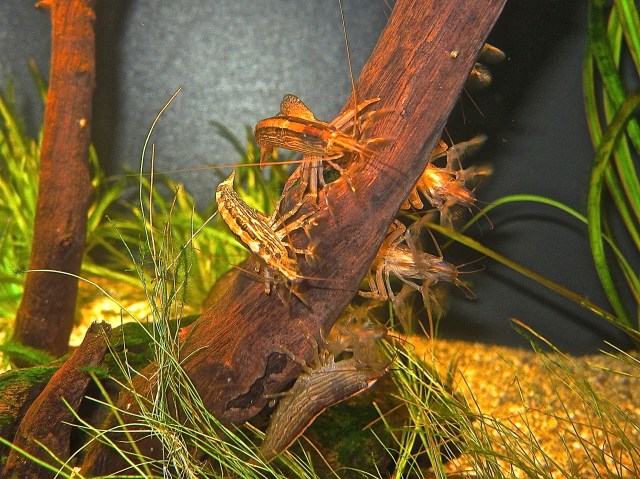
Genus/species: Atyopsis moluccensis

Bamboo Shrimp IMG_0285

GENERAL CHARACTERISTICS: Most species are a brown base color with a tan strip running from head to tail. They vary greatly in color however. Some a greenish-yellow or even red as the base color. Clawless and 4-5 inches in length. Male bamboo shrimp displays two larger forelegs, while the female’s legs are all the same size.

DISTRIBUTION/HABITAT: Found on high islands from Sri Lanka to the Samoan Islands, and as far north as Okinawa, as well as on the Asian mainland from the Malay Peninsula in freshwater areas where their is high current..

DIET IN THE WILD: Filter feeder. using four fan-like appendages on the head to sweep food particles from the water.

Bamboo Shrimp  8724380835_382a2b1ec6_o

Water Planet

WordPress Shortlink http://wp.me/p1DZ4b-XZ

flickr  http://www.flickr.com/photos/cas_docents/8717355179/in/set-72157608602469734

TAXONOMY
Phylum: Arthropoda
Class: Arachnida
Order: Araneae
Family: Theraphosidae

Genus/species: Lasiodora parahybana

8274421702_51193cf844_b

GENERAL CHARACTERISTICS: Said to be the third largest spider in the world, this is a large-bodied tarantula with abdomen and legs covered with sensitive, long, and partially pink or salmon-colored hairs. Maximum size: body, 9-10 cm (3.5–4 in); leg span, 20-25 cm (8–10 in).

DISTRIBUTION/ HABITAT: Throughout northeastern Brazil on the tropical forest floor

DIET IN THE WILD: Lie and wait carnivore, eating large crawling insects and other invertebrates, small rodents, lizards, and frogs rarely seen eating birds like newly hatched chicks of ground-dwelling birds. Venom injected by chelicerae that liquefy the kill, which is then sucked in by the mouthparts.
Regardless of its name, the spider is rarely seen eating birds.

6962229601_2e288eea4a_b

REPRODUCTION: The male spins a small area of silk onto which he deposits his sperm. The sperm is then absorbed into the pedipalps, which during mating are inserted into the genital opening of the female, transferring the sperm, which remains viable. After insemination, the male makes a swift retreat as the much smaller males occasionally become a sacrifice to the female’s need to maintain the nutritional viability of a mother-to-be. The female lays up to 2000 fertilized eggs in a thick, silken sac which she guards fiercely. Young spiderlings are born about 3 weeks later. Voracious feeders, they grow quickly.

PREDATORS: Tarantulas have few enemies except the tarantula hawk wasps. Members of this wasp family use their sting to paralyze species specific tarantulas.

REMARKS: Like most tarantulas and some other spiders, if this spider loses one of its legs, it can regrow the lost appendage.
While not highly aggressive and bites are not fatal to humans (most tarantula bites are similar to a bee sting in toxicity), this big bruiser, because of its long fangs, can inflict a serious wound which one researcher defined as “capable of medically significant mechanical damage”! If pursued by a potential foe, the spider rubs its legs against its abdomen, throwing tiny, barbed hairs that become imbedded in the attacker. The barbs can cause significant irritation, especially if lodged in the eyes or nasal passages.
Venomous

Animal Attractions

flickr http://www.flickr.com/photos/cas_docents/sets/72157608653175263/with/6962229601/

WordPress Shortlink  http://wp.me/p1DZ4b-Qk

TAXONOMY
Phylum Arthropoda
Class Arachnida
Order Scorpiones,
Family Scorpanidae (Scorpions)

Genus/species: Pandinus imperator

6976512905_11a36f5ae1_b

GENERAL CHARACTERISTICS: The largest scorpion known, (length to 20 cm (8 in); weight to 30 g (1 oz). Its black body bears large, blackish-red pincers with a granular appearance. The long tail, which arches back over the body, is tipped with a sharp curved stinger that delivers venom produced from a gland in the attached bulb.

DISTRIBUTION/HABITAT: West Africa Tropical forest and open savanna where it hides under rocks, burrows beneath the soil, or cohabits termite mounds.

GENERAL CHARACTERISTICS: The largest scorpion known, (length to 20 cm (8 in); weight to 30 g (1 oz). Its black body bears large, blackish-red pincers with a granular appearance. The long tail, which arches back over the body, is tipped with a sharp curved stinger that delivers venom produced from a gland in the attached bulb.

DIET IN THE WILD: It preys upon ground-dwelling insects, spiders, and other invertebrates as well as an occasional baby lizard, snake, or mouse. These large scorpions rarely sting small prey; instead they grasp the prey in powerful pincers and tear it apart. The venom is reserved for larger prey or defense.

REPRODUCTION/DEVELOPMENT: During mating, the male finds a suitable spot where he deposits his sperm packet, called a spermatophore. He then engages the female in an elaborate mating dance above the spermatophore with the male holding up the pincers of the female with his own, and carefully maneuvering her over the spermatophore, which she draws up into her genital pore. The eggs are fertilized, and the female carries them internally. After a 7 to 9 month gestation period, she gives birth to between 9 to 32 live young. The newborn climb onto the mother’s back, protected from predators by her size and aggressive behavior. Until the young are capable of hunting on their own, the mother feeds them by killing insects which are left on the floor of the burrow or other enclosure where the young can climb down and feed in safety.

PREDATORS: Predators include birds, bats, small mammals, large spiders, centipedes, large lizards, and other scorpions. Life span: 5 to 8 years.
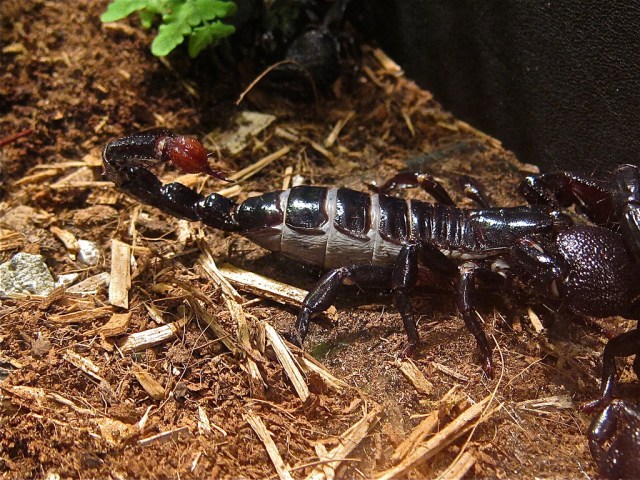
7595589286_6713f5c418_b

REMARKS: Sensory hairs on the pincers and tail enable the scorpion to detect prey and danger through vibrations from the air and ground. Like all scorpions, it has poor eyesight (despite having 6 to 12 eyes), good hearing, a good sense of touch and is venomous.

ANIMAL ATTRACTIONS

flickr http://www.flickr.com/photos/cas_docents/sets/72157608653175263/with/7595589286/

WordPress Shortlink http://wp.me/p1DZ4b-Q4

TAXONOMY
Kingdom: Animalia
Phylum: Cnidaria
Class: Scyphozoa
Order: Semaeostomeae
Family: Pelagiidae

Genus/species: Chrysaora fuscescens

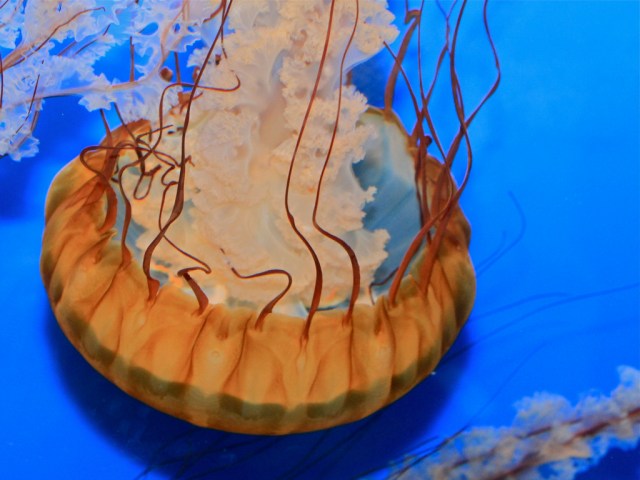
4330825373_e4d12ba6ca_b

GENERAL CHARACTERISTICS: The sea nettle is a giant, semitransparent jellyfish, with an amber-colored, swimming bell commonly as large as 30 cm (12 inches) in diameter, with some measuring more than a meter. In addition to four oral arms attached to the underside of the mouth, the sea nettle has 24 long tentacles around the perimeter of the bell that extend up to 4 m (13 ft).

DISTRIBUTION/HABITAT: Marine, found along the westcoast of North America from Mexico to British Columbia.

DIET IN THE WILD: Carnivorous; feeds on zooplankton, small crustaceans, comb jellies, fish eggs and larvae. Sea nettles sting their prey with their tentacles, which have millions of microscopic stinging cells that inject toxins to stun or kill tiny animals. The main oral arms then transport food to the heart-shaped gastric pouches in the bell, where digestion occurs.

PREDATORS: In the medusa stage, sea nettles live from 2–6 mos, usually perishing in rough waters or being eaten by predators— ocean sunfish and leatherback turtles are two of the most prevalent jellyfish predators.

4798725394_c1fc6938ab_b

REMARKS: Question: What has no heart, bones, eyes or brain, is made up of 95% water, and yet
is still a remarkably efficient ocean predator? (The jellyfish) Some jellies commute 1,000 m up and down in the water column daily! Sea nettle stings can result in extreme localized pain. Fortunately this jelly is not aggressive. The bell of this and other jellies is called a “medusa” because, with its long, fringing tentacles, it resembles the snake-haired Gorgon Medusa of Greek mythology.

Venomous

Plankton/Sea Drifters CC24

flickr http://www.flickr.com/photos/cas_docents/sets/72157610031545571/with/4330825373/

WordPress Shortlist  http://wp.me/p1DZ4b-PM

TAXONOMY

Kingdom Animalia

Phylum: Cnidaria (anemones, corals and jellyfish)

Classis: Scyphozoa
Order: Semaeostomeae
Familia: Pelagiidae

Genus/species: Chrysaora Pacifica

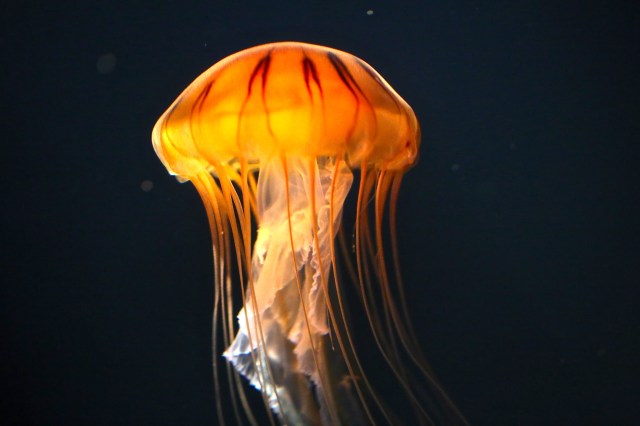
IMG_5334

GENERAL CHARACTERISTICS: APPEARANCE: Bells can grow up to 12 inches across and tentacles can stretch 10 feet or more. Their bells are white with brown-to-orange stripes, containing up to 32 very long orange-red tentacles and four long lips. One of C. Pacifica’s most distinguishing characteristics can be found on their undersides, where they have 16 brown stripes and eight stomach pouches.

DISTRIBUTION/ HABITAT: Deep open waters of the northern Pacific Ocean, Arctic Ocean and the Bering Sea. Found at the ocean surface to 200 meters (650 feet) below the surface.

DIET IN THE WILD: Other jellies, small crustaceans called copepods, and small fishes.

REPRODUCTION and DEVELOPMENT: The life cycle made up of five stages. They go through a metamorphosis or change in shape as they grow.
1.lifecycle begins when males broadcast or release sperm into the water and the females catch the sperm to fertilize the eggs she has produced and is holding in her mouth.
2. The fertilized eggs remain attached to the mother’s oral arms and grow into a flat jelly bean-shaped planula.
3. The planula then grows into flower-shaped polyps and the mother releases them into the ocean.
4. The polyps attach to a solid surface and undergo asexual reproduction through which they make an exact copy of themselves without eggs and sperm. The polyp makes these identical animals by budding where the new polyp grows out of its side.
5.After the new polyp is fully formed, it is released into the ocean and starts to change shape, looking more like the adult nettle. The nettle develops a bell, arms and tentacles until it is a fully formed medusa or adult. (Shedd AQ).

IMG_5338

REMARKS: Like many jellies, Japanese sea nettles use stinging cells to defend themselves and stun their prey. While not especially poisonous, their stings can cause intense skin irritation and burning sensations in humans. Some people can have allergic reactions to their venom. If you see one in the water, stay away because there’s a good chance more of them are nearby. Japanese sea nettles travel in swarms, which increases your chance of being stung if you encounter one.

 Animal Attractions

flickr http://www.flickr.com/photos/cas_docents/sets/72157610031545571/

WordPress Shortlink http://wp.me/p1DZ4b-Ps