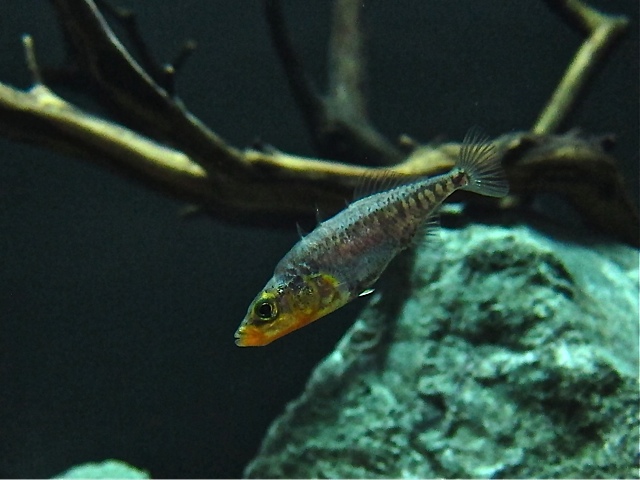
Tag Archive: fishes


TAXONOMY
Kingdom: Animalia
Phylum: Chordata
Class: Actinopterygii
Order: Cypriniformes
Family: Cyprinidae (carps, true minnows, and their relatives (as the barbs and barbels).

Genus/species: Pethia padamya

9830844836_c473e373de_b

GENERAL CHARACTERISTICS: This species exhibits sexual dimorphism. The male has a beige to light brown background with a bright red stripe running the length of the body. The dorsal, anal, and pelvic fins of the male are yellowish-green in color with contrasting black spots.
The female is light beige with a silvery sheen on the scales. The fins are a light yellowish-green; however, only the dorsal fin contains the contrasting black spots, which are fainter than those of the male. Both sexes have a black and prominent spot in the dorsal area, as well as a smaller spot in the caudal area.
Average length is 4.5cm (about 2 inches).
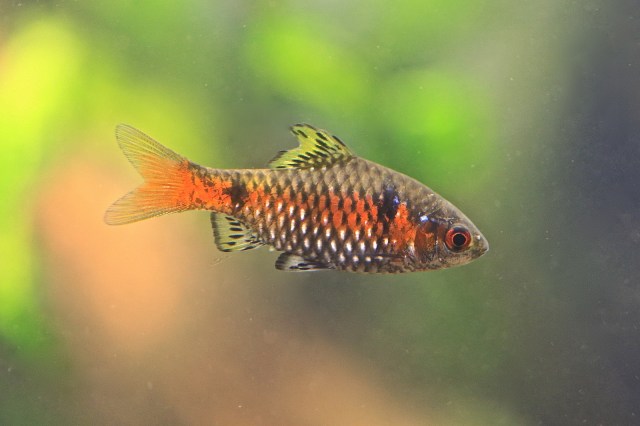
Odessa Barb 9830830994_eb9d56b36b_h

DISTRIBUTION/HABITAT: Central Myanmar in one pond and one river.

DIET IN THE WILD: Not well-studied, omnivores. Cyprinids are stomachless fish with toothless jaws. Even so, food can be effectively chewed by the pharyngeal teeth the gill rakers of the specialized last gill bow.

REMARKS: Named “Odessa barb” because it was said to have first appeared in pet enthusiast’s circles in Odessa, Ukraine in the early 1970s.

flickr  http://www.flickr.com/photos/cas_docents/9830830994/in/set-72157608614099673

WordPress shortlink http://wp.me/p1DZ4b-16w
TAXONOMY
Class: Actinopterygii (ray-finned fishes)
Order: Acipenseriformes (Sturgeons and paddlefishes)
Family:Polyodontidae Paddlefishes (Paddlefishes)

Genus/species: Polyodon spathula

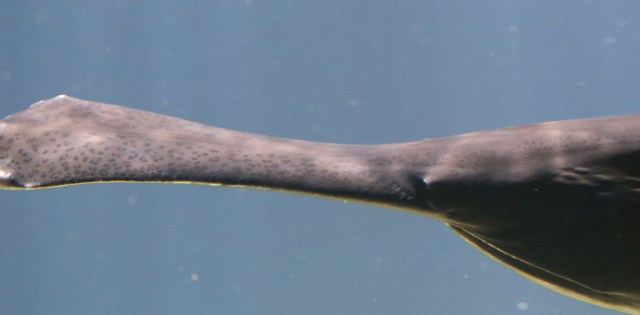
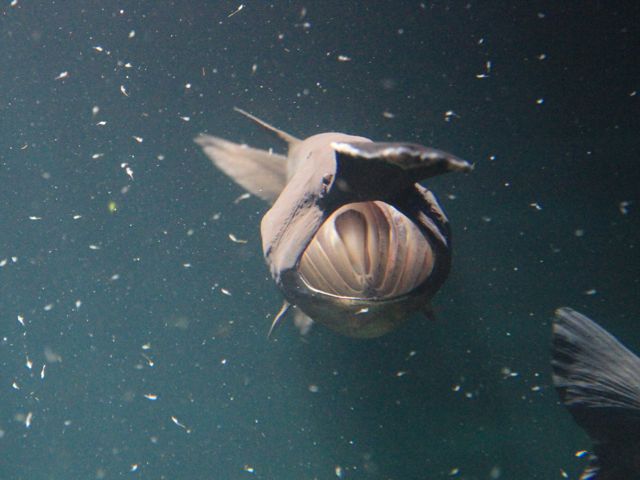
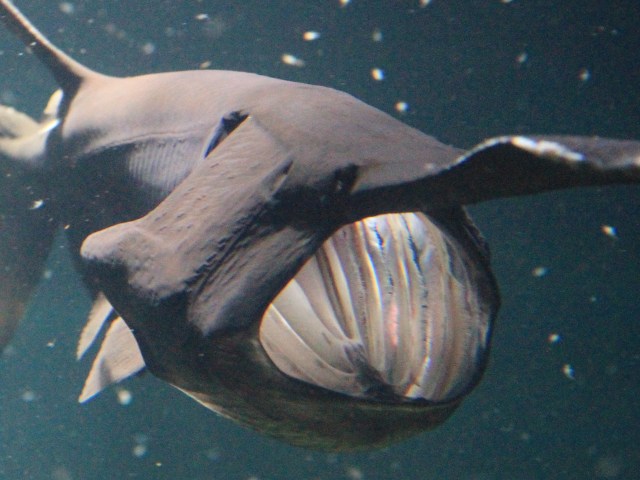
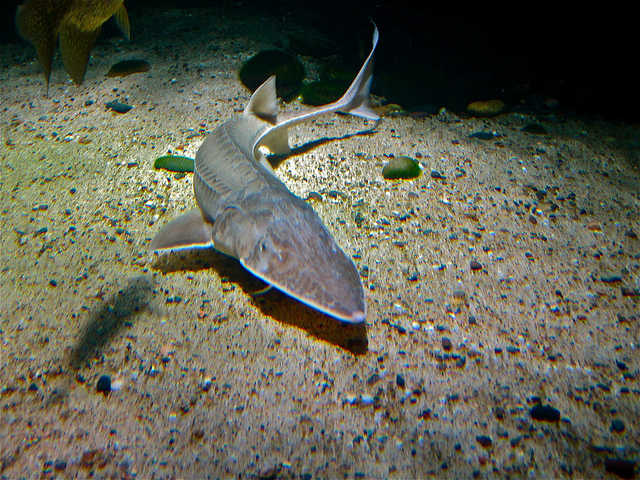
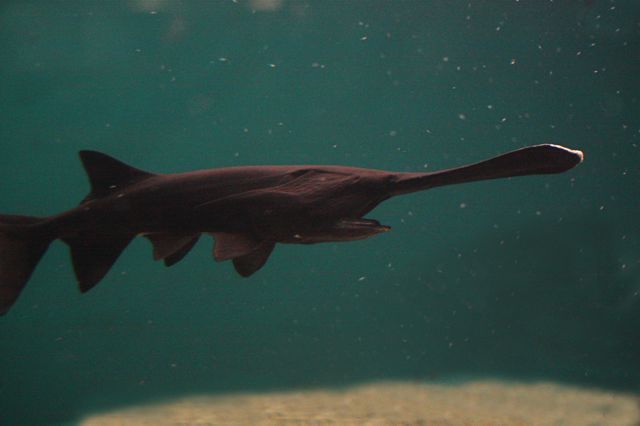
GENERAL CHARACTERISTICS: Gray, shark-like body with a deeply forked tail and huge toothless mouth when feeding. Extended upper jaw (rostrum) flattened into paddleshape, accounts for 1/3 of total body length. Fins stiffer than those of teleost fishes. Heterocercal tail. Skeleton cartilaginous, skin tough, scales lacking. Max length 221 cm (87 inches); max weight 90.7 kg (200 pounds), average weight considerably less.

DISTRIBUTION/HABITAT: Rivers of central United States, especially Mississippi River and its tributaries. Prefers deep pools in large rivers where the current is slow; is highly mobile and has been known to travel more than 2,000 miles.

8440810977_b3ddc58544_b

DIET IN THE WILD: Zooplankton, the majority being water fleas, also tiny crustaceans and larvae. To feed, the fish swims with its huge mouth wide open. As the water passes over its gills food is filtered out by special filaments called gill rakers. Also, the paddle is covered with pores that extend over the head and along the gill covers. These pores are electroreceptors capable of detecting as little as 1/100 of 1-millionth volt per cm, enough to sense the presence of plankton, a valuable tool, especially since vision, hearing and smell are poor.


REPRODUCTION and DEVELOPMENT: Female spawn only once every 4 to 7 years starting when they are 6-12 years old swimming up river to lay 2 eggs at a time. Egg cases rounded. Eggs hatch in 7 days; young are swept downstream to permanent home.

MORTALITY: Live up to 30 years.

PREDATORS: Only man.

CONSERVATION STATUS: IUCN: vulnerable. Threatened by overfishing throughout much of its range, particularly for its eggs since the ban on imported caviar. Dams prevent fish from reaching spawning grounds, sedimentation and river modifications destroy habitat.

Mississippi paddlefish   (Polyodon spathula)  IMG_2499 - Version 2

REMARKS: The paddle is covered with pores that extend over the head and along the gill covers. These pores are electroreceptors capable of detecting as little as 1/100 of 1-millionth volt per cm, enough to sense the presence of plankton, a valuable tool, especially since vision, hearing and smell are poor.

Both paddlefish and sharks have skeletons made of cartilage, not bone. Paddlefish have no scales.

Paddlefish are the oldest surviving animal species in North America. Fossil records indicate that they date back 300 million years.

Water Planet Feeding Cluster WP31

Ron’s flickr  http://www.flickr.com/photos/cas_docents/sets/72157625017923579/with/3186623140/

Ron’s WordPress shortlink  http://wp.me/p1DZ4b-lb

TAXONOMY
Kingdom: Animalia
Phylum: Chordata
Class Actinopterygii (ray-finned fishes) 
Order Acipenseriformes (Sturgeons and paddlefishes)
Family  Acipenseridae (Sturgeons)

Genus/species: Scaphirhynchus albus 

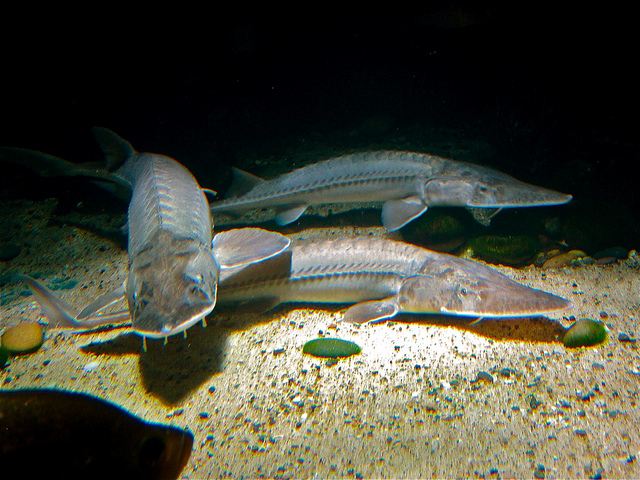
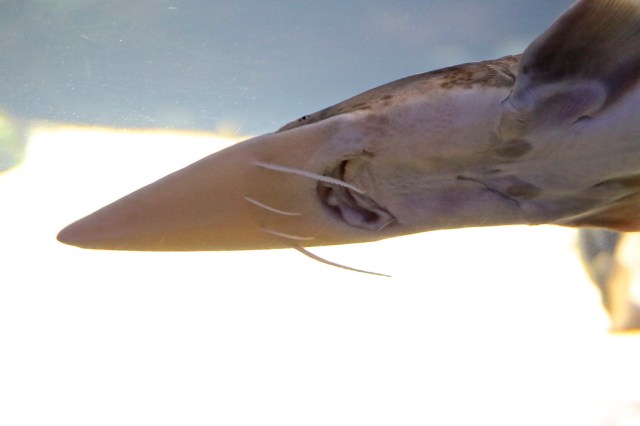
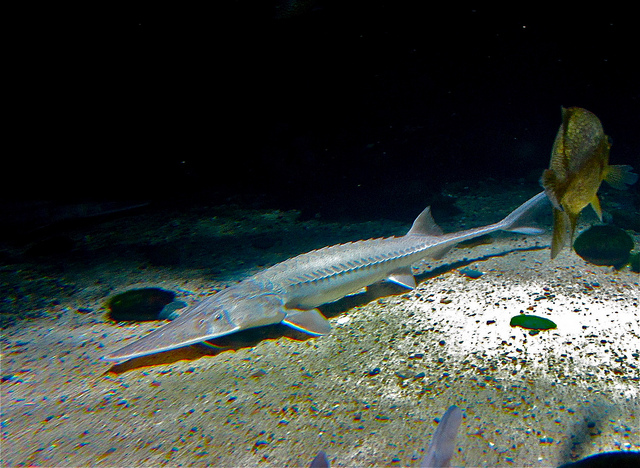
GENERAL CHARACTERISTICS: Shark-like with heterocercal tale and scutes instead of scales; gray above, white below. Flat, upturned head. Four long barbels. One of the rarest and largest freshwater fishes in North America; length to over 2 m (6.5 feet), weight over 75 lbs.

Pallid Sturgeon  8395624080_f62868641d_b

DISTRIBUTION/HABITAT: Missouri and Mississippi Rivers and their large tributaries, especially the Kansas River, from Montana to the Gulf
of Mexico. Found on the bottom in turbid, deep, fast
 flowing rivers over sand and gravel bars. 

DIET: Mollusks, insects, and small fishes. S. albus  is a bottom feeder. In addition to taste buds on the tips of the barbels it has sensory organs on the ventral surface of the
snout that pick up electrical fields emanating from prey. The sturgeon stirs up the muck with its snout, then the mouth, which is folded in.

REPRODUCTION and DEVELOPMENT: In the wild, external fertilization, eggs scattered and not guarded. However, natural reproduction is almost non-existent. Since 1990 over 150,000 pallid sturgeon have been raised in hatcheries and released.

MORTALITY/LONGEVITY: Life span: up to 50 years or more.

CONSERVATION STATUS:: ESA: federally listed 1990: Endangered.Our juvenile pallids came from Gavin’s Point National Fish Hatchery in Montana. The Steinhart is permitted to display these 88 A Docent & Guide View of the Steinhart Aquarium Species
endangered species as long as an educational message is presented about their distribution, endangered status, and threats facing them.

REMARKS: Pallid and shovelnose sturgeon are
 known to hybridize, another potential threat to the species survival in the southern portion of the pallid’s range where shovel nose sturgeon dominate. Often referred to as the Dinosaur of the Missouri, the pallid sturgeon is known from 70 million years ago and at one time was the top freshwater carnivore. Like all sturgeon, have a cartilaginous skeleton.

Water Planet, Feeding Cluster WP31 

flickr http://www.flickr.com/photos/cas_docents/sets/72157608608528651/with/8395624080/

WordPress Shortlink http://wp.me/p1DZ4b-kX

TAXONOMY

KINGDOM      Animalia

PHYLUM        Chordata

CLASS           Actinopterygii  (ray-finned fishes)

ORDER          Percifomes  (Perch-likes)

FAMILY         Cichlidae  (Cichlids)

GENUS/SPECIES  Katria katria


GENERAL CHARACTERISTICS

Katria katria  has a unique pattern of two prominent black vertical bars on an iridescent golden background. Max length: 5.5 cm (2 in).


DISTRIBUTION/HABITAT

One of 17 cichlid species indigenous to Madagascar.

Lives in freshwater pools, slow flowing runs and rapids with predominantly sand and gravel substrate, with a few very large rocks.


DIET IN THE WILD

Omnivorous.

 REPRODUCTION

Substrate spawner. Pairs of Katria have been observed guarding either eggs or small juveniles close to the top of the rocks in the Nosivolo Rver in November, 2005.


CONSERVATION STATUS

IUCN List: Vulnerable.

This species has a restricted distribution within the Nosivolo and Mangoro rivers, but its habitat is in very good condition and it does not have to deal with either exotic predators or competitors. Given the lack of evidence for decline in quality of habitat or population size (it is a very common species within its range), this species is assessed as vulnerable on account of its restriction to a single location.


LOCATION

Rainforest Madagascar MA04

Flickr  http://www.flickr.com/photos/cas_docents/sets/72157627949403670/

WordPress Shortlink http://wp.me/p1DZ4b-yS

TAXONOMY

CLASS   Actinopterygii (ray-finned fishes)

ORDER    Atheriniformes (Silversides)

FAMILY    Atherinopsidae (Neotropical silversides

GENUS/SPECIES    Atherinops affinis

GENERAL CHACTERISTICS

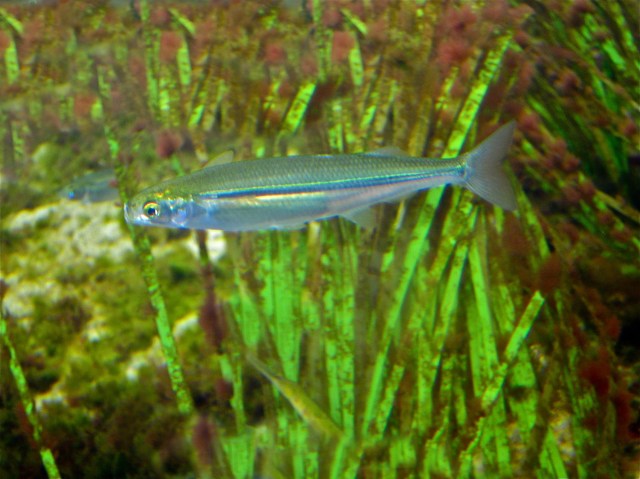
Blue gray to green above, silvery below; a striking silver band bordered above with blue extends the full length of the body.

DISTRIBUTION/HABITAT

Marine; brackish; pelagic-neritic..  Eastern Pacific: Vancouver Island in British Columbia, Canada to Baja California, Mexico and the Gulf of California. Subtropical; 55°N – 23°N.Common in bays, muddy and rocky areas and kelp beds, also in estuaries forming schools.

 DIET:

 A.  affinis adults feed on zooplankton while juveniles feed on algae and kelp fly larvae.

REPRODUCTION: 

Demersal spawner in nearshore habitats. Oviparous, with planktonic, primarily neustonic larvae  Eggs are attached to spawning substrate and to one another by adhesive filaments

PREDATORS

Other fishes, birds and people.

REMARKS

Called “topsmelt” for their habit of swimming up near the surface and schooling near shore.

LOCATION

Salt Marsh Pop-up CC03

flickr;  http://www.flickr.com/photos/cas_docents/sets/72157625063185432/

WORDPRESS SHORTLINK  http://wp.me/p1DZ4b-x5

Class: Actinopterygii, Order: Scorpaeniformes,  Family: Cottidae ( Sculpins)

Oligocottus snyderi 

DISTRIBUTION: Endemic to the Pacific Coast from Alaska to Baja California.

HABITAT: Temperate rocky intertidal pools, especially those with algae or eelgrass and asandy substrate. They don’t migrate but do move between pools. In Central California, dominant in sub- to mid-intertidal pools.

APPEARANCE: Coloration varies greatly from green to reddish brown to pink, depending on the color of the surrounding algae; sides spotted and mottled. Like many sculpins, they have no scales. Cirri line the base of the dorsal fin and the lateral line. The common name refers to a “fluffy” fleshy area behind the dorsal fin. Max. length: 9 cm (3.50 in); average weight: 8 g (0.28 oz). 

DIET: Worms, crustaceans, and other marine invertebrates.

REPRODUCTION: Males use claspers during intercourse for internal fertilization. Eggs are deposited on rocks, and are guarded by the males. O. Synderi develops through larval, post larval, juvenile and adult stages.

REMARKS: Can breathe air for hours at a time, often in response to reduction in the tide pool’s oxygen at night .

LOCATION: Tidepool  CC15

Flickr http://www.flickr.com/photos/cas_docents/sets/72157608359804936/

WORDPRESS SHORTLINK:  http://wp.me/p1DZ4b-vX


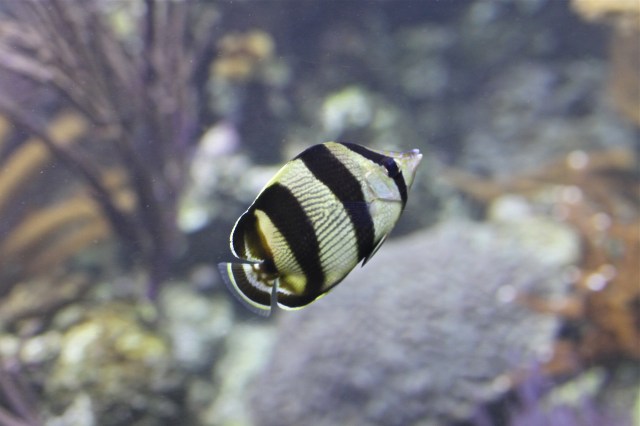
Class Actinopterygii (ray-finned fishes), Order Perciformes (Perch-likes), Family Chaetodontidae  (Butterflyfishes)

Chaetodon striatus

DISTRIBUTION:  Western Atlantic: Massachusetts, USA to Santa Catarina, Brazil including the Gulf of Mexico and Caribbean Sea.

HABITAT: shallow waters around coral reefs.

APPEARANCE:  Length: 6 inches (15cm). Two broad black bars on side of body and a third bar basally in soft portion of dorsal fin which extends onto caudal peduncle; broad black submarginal bands in the median fins; pelvic fins black except for the spine.

DIET: Feed on polychaete worms, coral polyps, crustaceans and mollusk eggs.

REPRODUCTION: Oviparous and monogamous forming pairs during breeding.

MORTALITY: Diurnal species, active during the day and sleeping at night.  At the end of the day it seeks shelter since it is highly vulnerable to such night predators as moray eels, sharks, and other large reef fishes.

REMARKS: The small, protractile mouth has comb-like teeth arranged in narrow rows in the jaws. “Chaetodontidae” is actually derived from ancient Greek (“Chaeto” = bristle and “donte” = teeth). The bristle nature of its teeth allows the butterfly to scrape at the invertebrates that make up its diet.

LOCATION:  Caribbean reef   PR36

flickr   http://www.flickr.com/photos/cas_docents/sets/72157625119200613/

WORDPRESS SHORTLINK   http://wp.me/p1DZ4b-uz

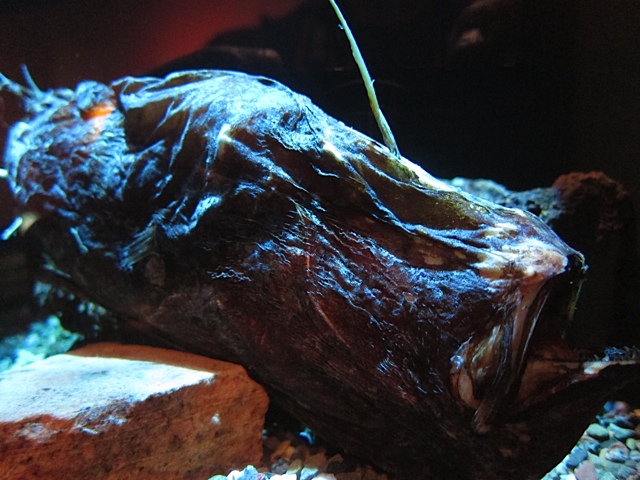
Class Actinopterygii (ray-finned fishes,  Order Lophiiformes (Anglerfishes) > Ceratiidae (Seadevils)

Cryptopsaras couesii  Warty Sea Devils

DISTRIBUTION: Deep tropical and subtropical oceans.

HABITAT: Deep ocean below 300 m (984 ft).

APPEARANCE:  The female triplewart sea devil is among the largest of the deepsea anglerfishes, reaching up to 1.5 m (5 ft) and weighing 10 kg (22 lb). Anglerfishes are characterized by a long filament, a modified first spine of the anterior dorsal fin, that extends over the eyes and is used to lure prey. In the ceratoid families, only the female  possesses  this lure. The male has no lure, is born small, and  remains so, weighing only about 150 g (5 oz). Most ceratoid anglerfishes have a bioluminescent lure; C. couesii is unusual in being luminescent over most of its body.

 DIET: Primarily on small cephalopods as well as fish and crustaceans. With their huge mouths and pliable bodies, anglerfishes are able to swallow prey up to twice their size.

 REPRODUCTION/DEVELOPMENT: As scientists began to explore the deep sea, they caught anglerfish and were surprised that all were females with what appeared to be parasites attached. More observation and experimentation revealed  that these “parasites” were actually male anglerfish of the same species.

 The male is equipped with a highly developed sense of smell, especially sensitive to pheromones emitted by the female. Triplewart sea devil males have large, forward-facing eyes, and are thought to rely both on vision and smell for their search and identification of a conspecific female. The male locates a female, attaches to her with a set of pincher-like teeth at the tip of his jaw. In the case of C. couesii and some other species, the epidermal tissues of male and female soon fuse and their circulatory systems unite. Shortly after attachment, the male organs atrophy; digestive organs, brain, heart, eyes are lost and little more than gonads remain.

 An extreme example of sexual dimorphism, the male may be as much as 30 times smaller than the female. Able to sense when the female is ready to spawn by detection of hormones in her bloodstream, he releases sperm as she releases eggs. A C. couesii female may have as many as eight males attached to various parts of her body.

WORDPRESS SHORTLINK    http://wp.me/p1DZ4b-qW

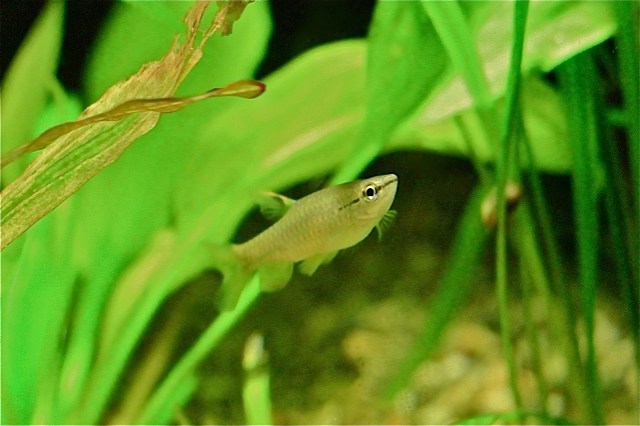
Actinopterygii (Ray-finned fishes) > Characiformes (Characins) > Lebiasinidae (Pencilfishes)

Copella arnoldi

 DISTRIBUTION: Amazon Basin.

 HABITAT: Slow-moving fresh water.

 APPEARANCE: Males tend to be larger and more colorful than females and have more elaborate fins. Max. length: 3.4 cm. 

 DIET: Worms, insects, and crustaceans.

 REPRODUCTION/DEVELOPMENT: The unusual behavior of the splashing tetra provides a unique strategy that keeps aquatic predators away from progeny: The male and female will leap out of the water as a pair, both remaining together while the female attaches her eggs to the leaves of plants at the water’s edge and the male then immediately fertilizes them. This procedure is repeated several times until 50 to 200 eggs have been laid. After attachment, the male, now in the water, faithfully flicks his tail every few minutes, shedding droplets of water onto the eggs to keep them moist. After 2 to 3 days the eggs hatch and the fry fall into the water below. The male’s attention then abates and the young tetras are on their own.

MORTALITY/LONGEVITY: Life span: about 3 years.

 REMARKS: In spite of their common name, they are not closely related to true tetras of the family Characidae found in a variety of other Steinhart exhibits.

Flickr http://www.flickr.com/photos/cas_docents/6939753715/in/set-72157629304397467

WORDPRESS SHORTLINK   http://wp.me/p1DZ4b-pP

TAXONOMY

KINGDOM Animalia
PHYLUM Chordata
CLASS  Actinopterygii (ray-finned fishes)
ORDER Gasterosteiformes (Sticklebacks and seamoths)
FAMILY Gasterosteidae (Sticklebacks and tubesnouts)
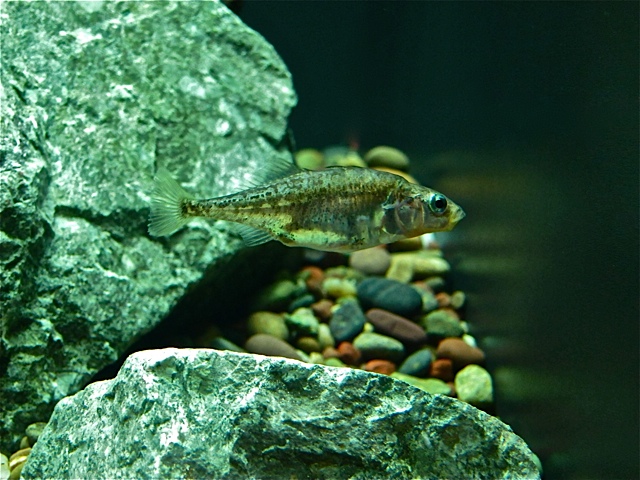
GENUS/SPECIES  Gasterosteus aculeatus


GENERAL CHARACTERISTICS

Common length : 5.1 cm or 2 in.  Identified by the 3 to 4 sharp, free spines before the dorsal fin, the pelvic fin reduced to a sharp spine and a small ray, the series of plates along the sides of the body and are usually mottled brown or greenish.


DISTRIBUTION/HABITAT 

 Coastal oceans in northern Europe, Asia and North America

 Freshwater streams, estuaries


DIET: worms, aquatic insects, fish eggs and fry


REPRODUCTION:  Red means ready.  At mating time, the chin and belly of male sticklebacks turn red. The brighter the red, the more enticing they are to the females they’re courting. Male sticklebacks weave rounded nests of algae, leaves and pebbles.   The neater the nest, the more likely a male is to woo a mate to lay her eggs inside. Once she does, he drives her out, guards and aerates the eggs until the hatch.

LOCATION

Salt Marsh Pop_up CC03
Animal Attractions


flickr http://www.flickr.com/photos/cas_docents/6870766417/in/set-72157629304397467

WORDPRESS SHORTLINK  http://wp.me/p1DZ4b-oa