Latest Entries »

Phylim Molluska, Class Gastropoda, Family ‪Aeolidioidea,

Aeolidia papillosa


DISTRIBUTION: Common on the Atlantic coast of Europe and North America and the Pacific coast of North America. Also from from both west and east coasts of South America

HABITAT: On rocks, or may be on floats or docks. Often near its perferred prey. Intertidal to 380m deep.

APPEARANCE: Its color appears to be quite variable, depending upon locale and food resources. This large aeolid grows to about 10 cm (4 in)  in length and its body is covered with close obliquely arranged rows of flattened cerata.

DIET: Feeds almost exclusively on sea anemones.

MORTALITY/LONGEVITY:  This species is famous for obtaining undischarged cnidae (cells which bear nematocysts) from its Cnidarian prey and moving to the tips of the cerata , where they are likely used for defense. If disturbed they sometimes wave their cerata. If one of the cerata is broken off, muscles within it contract, expelling the nematocysts, which then discharge . The chemical composition of A. papillosa mucus changes and does not trigger a discharge of nematocysts in the sea anemone.

REPRODUCTION/DEVELOPMENT: Nudibranchs are hermaphroditic, and thus have a set of reproductive organs for both sexes, but they cannot fertilize themselves.

REMARKS: Their eyes are simple and able to discern little more than light and dark. The eyes are set into the body, are about a quarter of a millimeter in diameter, and consist of a lens and five photoreceptors.

 WORDPRESS SHORTLINK: http://wp.me/p1DZ4b-sk


Phylum Molluska, Order: Veneroida, Class: Bivalvia, Family: Veneridae

Venerupis philippinarum

DISTRIBUTION: Native to Japan, Korea and China.  Introduced to British Columbia, Washington, Oregon, Baja California and French Atlantic Coast, and Mediterranean coast..

APPEARANCE: Shell is usually cream or gray, sometimes with green or brown tones, and sometimes stained rusty or black (the latter typical of anoxic mud). It often has patterns of dark brown or black, overlapping, triangular markings  Smaller specimens (up to about 3 cm)  found in muddy sand on the east shore of  San Francisco Bay come in a remarkable variety of hues, including white, tan, yellow, blue and green, The interior of the shell is mostly white, often with dark purple or yellow staining near the hind end and the lower margins of the shell.

DIET: Filter feeder

REMARKS: Global aquaculture production of V. philippinarum is estimated at over 1 million tons/year with a value of around $1.5 billion.

MORTALITY: A variety of organisms have been observed feeding on Venerupis philippinarum on the Pacific coast, including the moon snail Euspira lewisii, the Atlantic oyster drill Urosalpinx cinerea, crabs, bat rays, flounder, sturgeon, willet, gulls, ducks and raccoons, and undoubtedly many others. The small pea crabs Pinnixa faba and Pinnixa littoralis are sometimes found living inside the shells of live Venerupis philippinarum.

At the Steinheart Aquarium V. philippinarum is found in the tidepool where starfishes feed on them in place of mussels which are harder to obtain.   SEE PHOTO BELOW . 

Ochre Sea Star Pisaster ochraceus consuming a Manila Clam.

WORDPRESS SHORTLINK http://wp.me/p1DZ4b-rY

TAXONOMY

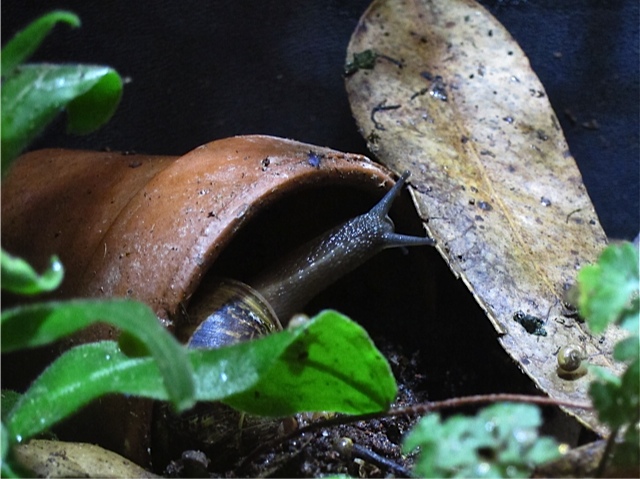
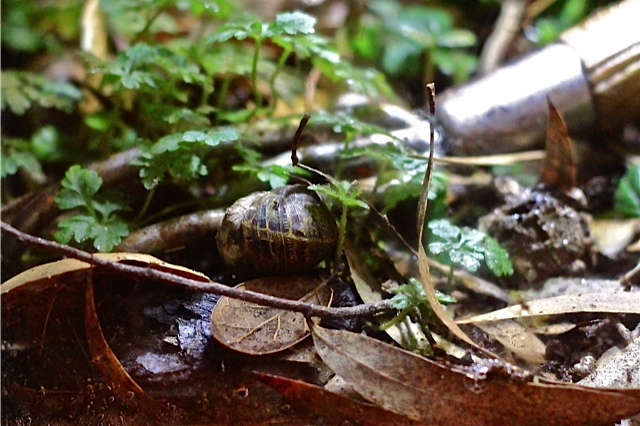
Kingdom Animalia, Phylum Molluska, Class Gastropoda, Family Helicidae,

Genus/species:   Cornu aspersum aka Helix aspersa

DISTRIBUTON:  Native to the Mediterranean region and western Europe, from northwest Africa and Iberia east to Asia Minor, and north to the British Isles. Has become very abundant in all human-disturbed habitats in regions with a temperate climate.

APPEARANCE:  hard, thin calcareous shell 25–40 mm in diameter and 25–35 mm high, with four or five whorls. The shell is somewhat variable in color and shade but is generally dark brown or chestnut with yellow stripes, flecks, or streaks. The body is soft and slimy, brownish-grey, and is retracted entirely into the shell when the animal is inactive or threatened.  The head bears four tentacles, the upper two of which have eye-like light sensors, and the lower two of which are smaller, tactile and olfactory sensory structures.

DIET: Herbivore and has a wide range of host plants (It feeds on plants only). It feeds on numerous types of fruit trees, vegetable crops, garden flowers, and cereals.

REPRODUCTION/DEVELOPMENT:  Like other Pulmonata, C.aspera is a hermaphrodite, producing both male and female gametes. Mating garden snails shoot at one another with long, sharp “love” darts. If a dart hits its mark, it improves that snail’s odds of reproduction.  For garden snails, there’s more to sex than shooting darts. But “he” can’t fertilize “her” own eggs, so it must mate with another. Courtship takes hours as two snails rub bodies, exchange “love” bites and wave the tentacles on their heads.

ANIMAL ATTRACTIONS

WordPress shortlink  http://wp.me/p1DZ4b-rP


Class Actinopterygii (ray-finned fishes),  Order Perciformes (Perch-likes),  Family Pomacanthidae (Angelfishes)

Chaetodontoplus melanosoma


DISTRIBUTION: Indonesia and Philippines to S.W. Japan.  Also S.E. Papua New Guinea.

HABITAT: Marine. Inshore and outer rock and coral reefs (5-30m).

APPEARANCE: Up to 8 inches in size.  Light grey head and back, dark grey below, dorsal, anal and tailfins black with yellow margin; maze of yellow markings on snout and nape.  Several similar species, easily confused. Juveniles are almost identical as in other species complexes in the genus. Most confusion is caused as color changes occur with growth that may match between different species at certain stages, especially the caudal fin pattern that maybe yellow in sub-adults on one and yellow in adults of others

DIET: Omnivore, primarily feeding on sessile Invertebrates, Algae, Sponges, and Tunicates.

REMARKS; Solitary or in pairs.

LOCATION: Philippine coral Reef

WORDPRESS SHORTLINK  http://wp.me/p1DZ4b-rB


TAXONOMY
Class: Actinopterygii (Ray-finned fishes)
Order: Perciformes (Perch-likes)
Family: Serranidae (Sea basses: groupers and fairy basslets)
Subfamily: Anthiinae (Anthias)

On exhibit:

Pseudanthias dispar – Redfin anthias
P. lori – Lori’s anthias
P. randalli – Randall’s anthias* (not currently on exhibit 1-31-14)
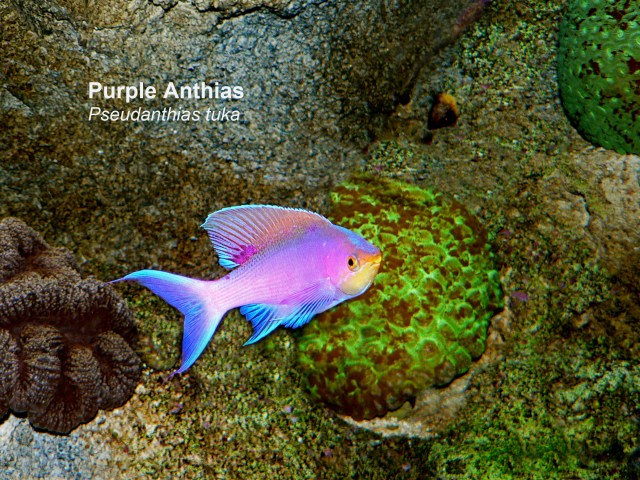
P. tuka – Yellowstrip anthias
P. ventralis ­– Longfin anthias
Serranocirrhitus latus  – Sunburst anthias ( a closely related genus)
 

 DISTRIBUTION: Pseudanthias species are found throughout the Indo-Pacific region. Many of the some 64 species have fairly wide distribution.

 HABITAT: During the day, they are found along the upper reef face in areas of strong current. At night, when predators threaten, they seek shelter in the reef’s caves and crevices.

GENERAL CHARACTERISTICS: Pseudanthias are small, fast-moving, colorful fishes. The male and female pseudanthias, like many members of the family Serranidae display gender-specific body shape and/or color. The male of P. dispar, for example, has a bright red dorsal fin and more pink and blue on the head and sides than the generally yellow female. The male yellowstripe anthias is a deeper purple overall than the female that sports a bright yellow stripe on the back not seen in the male.

DIET IN THE WILD: Plankton and fish eggs.

REPRODUCTION: All are sequential protogynous hermaphrodites. Protogynous literally means “first female,” a reference to the fact that all individuals are born as females, but a few, usually the largest females, will in time will change sex and develop male sex organs. The sex change, which can be completed in only a few days, is triggered by the loss of the dominant male, usually to predation.

 This reproductive strategy may confer at least two benefits: first, many young, healthy females serviced by a few large males means that in a given aggregation of fish more eggs, which are larger and therefore more energetically expensive, are produced.  Sperm, especially that produced by a large male, is plentiful enough to fertilize the eggs of even a large group of females. Also, the large males are extremely territorial and protective of their harems.

PREDATORS: These small fish are snack food for many larger predators. Life span of most species is about 3­–5 years.


REMARKS: The Steinhart displays several other fish families besides serranids with members that practice protogynous hermaphoditism, including wrasses, angelfishes, gobies, found in a number of tanks. Bocalo, the giant sea bass, is the Steinhart’s most notable practitioner

flickr  http://www.flickr.com/photos/cas_docents/sets/72157608545590153/

WORDPRESS SHORTLINK  http://wp.me/p1DZ4b-rh

Order Coleoptera

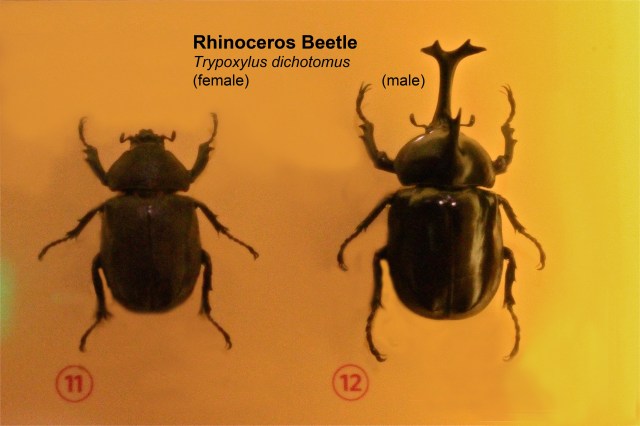
The largest of insect orders, currently about 350,000 beetle species are known.  One of every five animals on earth is a beetle!  The name coleoptera or “sheath wings” derives from sheath-like wing cases, called elytra, that provide protection to a second, underlying pair of more delicate flight wings. The elytra are not used to power flight, but help stabilize the beetle as it flies.  Some beetles, such as various ground beetles, have lost the ability to fly.

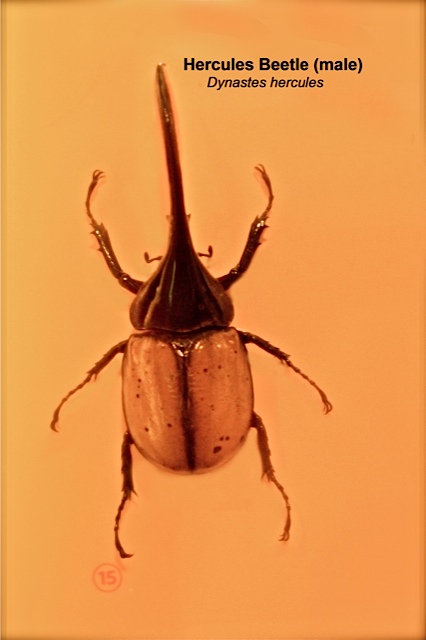
Stag, Hercules, and Rhinoceros Beetles

Family Lucanidae and Family Scarabaeidae (Subfamily Dynastinae)

DISTRIBUTION: Worldwide distribution.

HABITAT: Mostly woodlands. Adults live and breed in damp, rotting wood.

APPEARANCE:  Medium to large beetles, males of some species have spectacularly large jaws. Females are considerably smaller in size, and lack the impressive “horns.”

DIET: Larvae feed on decaying wood, probably getting nutrition not just from the cellulose, but from the fungi and microbes decomposing it. Adults of most species feed on sugary liquid food, such as sap from wounded trees, aphid ” honeydew” secretions, and ripe fruit. Adults are unable to chew.

REPRODUCTION/DEVELOPMENT: Males use their huge jaws to fight for access to females. Individual males play “king of the hill,” only in their case they are fighting to win access to control a dead stump or tree that a discriminating female will find highly suitable as a residence to feed and protect her offspring. The male-male contest involves each trying to maneuver his huge mandible underneath and overturning his competitor, ideally knocking him to the ground. Injuries are rare, but the victor, who is typically the largest and strongest, gains the female, or often multiple females, as he controls the best breeding property.

Stag beetles evolutionary development of sexual dimorphism, with males being significantly larger than females, repeats a miniature version of a sexual strategy familiar in the animal kingdom: to the victor (the largest male) belongs the spoils (reproductive rights to pass along his genes). Even better, this strategy is most often found in haremic groups, where the male wins not only one female, but many.

MORTALITY/LONGEVITY: Larvae live 3-5 years, adults a few months.

WORDPRESS SHORTLINK  http://wp.me/p1DZ4b-r7

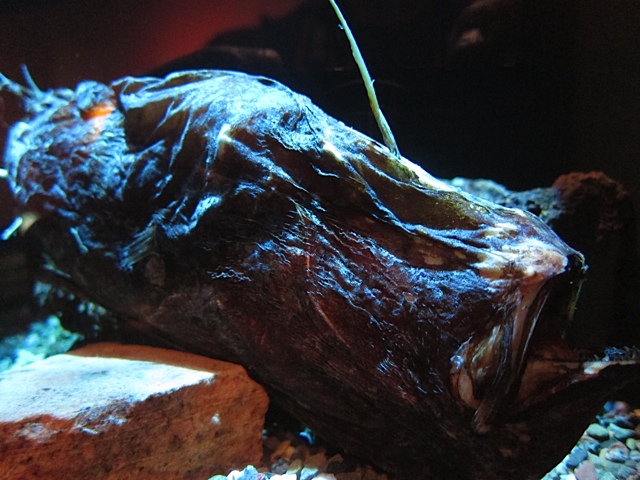
Class Actinopterygii (ray-finned fishes,  Order Lophiiformes (Anglerfishes) > Ceratiidae (Seadevils)

Cryptopsaras couesii  Warty Sea Devils

DISTRIBUTION: Deep tropical and subtropical oceans.

HABITAT: Deep ocean below 300 m (984 ft).

APPEARANCE:  The female triplewart sea devil is among the largest of the deepsea anglerfishes, reaching up to 1.5 m (5 ft) and weighing 10 kg (22 lb). Anglerfishes are characterized by a long filament, a modified first spine of the anterior dorsal fin, that extends over the eyes and is used to lure prey. In the ceratoid families, only the female  possesses  this lure. The male has no lure, is born small, and  remains so, weighing only about 150 g (5 oz). Most ceratoid anglerfishes have a bioluminescent lure; C. couesii is unusual in being luminescent over most of its body.

 DIET: Primarily on small cephalopods as well as fish and crustaceans. With their huge mouths and pliable bodies, anglerfishes are able to swallow prey up to twice their size.

 REPRODUCTION/DEVELOPMENT: As scientists began to explore the deep sea, they caught anglerfish and were surprised that all were females with what appeared to be parasites attached. More observation and experimentation revealed  that these “parasites” were actually male anglerfish of the same species.

 The male is equipped with a highly developed sense of smell, especially sensitive to pheromones emitted by the female. Triplewart sea devil males have large, forward-facing eyes, and are thought to rely both on vision and smell for their search and identification of a conspecific female. The male locates a female, attaches to her with a set of pincher-like teeth at the tip of his jaw. In the case of C. couesii and some other species, the epidermal tissues of male and female soon fuse and their circulatory systems unite. Shortly after attachment, the male organs atrophy; digestive organs, brain, heart, eyes are lost and little more than gonads remain.

 An extreme example of sexual dimorphism, the male may be as much as 30 times smaller than the female. Able to sense when the female is ready to spawn by detection of hormones in her bloodstream, he releases sperm as she releases eggs. A C. couesii female may have as many as eight males attached to various parts of her body.

WORDPRESS SHORTLINK    http://wp.me/p1DZ4b-qW

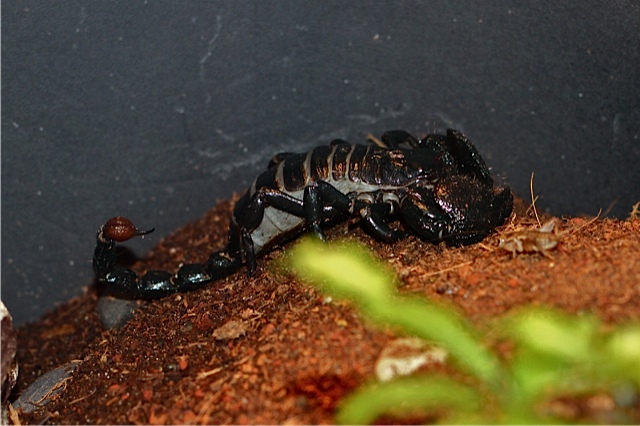
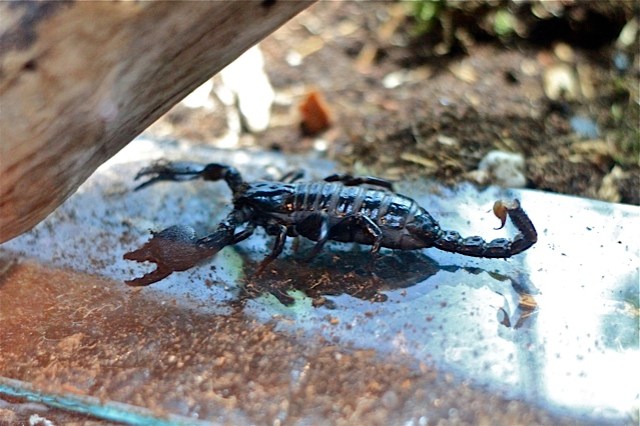
Phylum Arthropoda, Class Arachnida, Order Scorpiones, Family Scorpanidae, Scorpions

Pandinus imperator

DISTRIBUTION: West Africa

HABITAT: Tropical forest and open savanna where it hides under rocks, burrows beneath the soil, or cohabits termite mounds.

APPEARANCE: The largest scorpion known, (length to 20 cm (8 in); weight to 30 g (1 oz). Its black body bears large, blackish-red pincers with a granular appearance. The long tail, which arches back over the body, is tipped with a sharp curved stinger that delivers venom produced from a gland in the attached bulb.

DIET:  It preys upon ground-dwelling insects, spiders, and other invertebrates as well as an occasional baby lizard, snake, or mouse. These large scorpions rarely sting small prey; instead they grasp the prey in powerful pincers and tear it apart. The venom is reserved for larger prey or defense.

REPRODUCTION/DEVELOPMENT:  During mating, the male finds a suitable spot where he deposits his sperm packet, called a spermatophore. He then engages the female in an elaborate mating dance above the spermatophore with the male holding up the pincers of the female with his own, and carefully maneuvering her over the spermatophore, which she draws up into her genital pore. The eggs are fertilized, and the female carries them internally. After a 7 to 9 month gestation period, she gives birth to between 9 to 32 live young. The newborn climb onto the mother’s back, protected from predators by her size and aggressive behavior. Until the young are capable of hunting on their own, the mother feeds them by killing insects which are left on the floor of the burrow or other enclosure where the young can climb down and feed in safety.

MORTALITY/LONGEVITY:  Predators include birds, bats, small mammals, large spiders, centipedes, large lizards, and other scorpions. Life span: 5 to 8 years.

REMARKS: Sensory hairs on the pincers and tail enable the scorpion to detect prey and danger through vibrations from the air and ground. Like all scorpions, it has poor eyesight (despite having 6 to 12 eyes), good hearing, and a good sense of touch.

flickr http://www.flickr.com/photos/cas_docents/6976512905/in/set-72157629304397467/

WORDPRESS SHORTLINK http://wp.me/p1DZ4b-qK

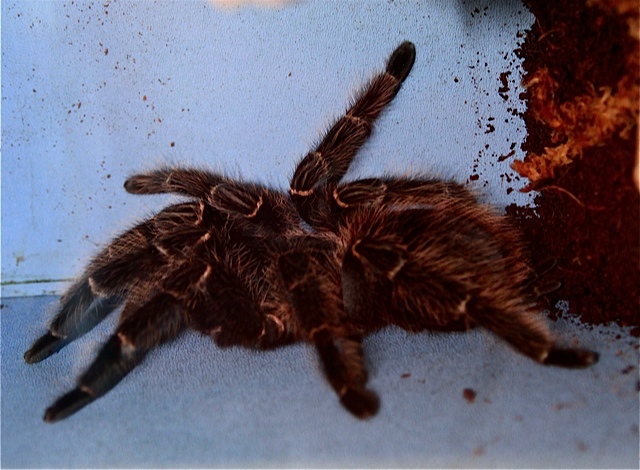
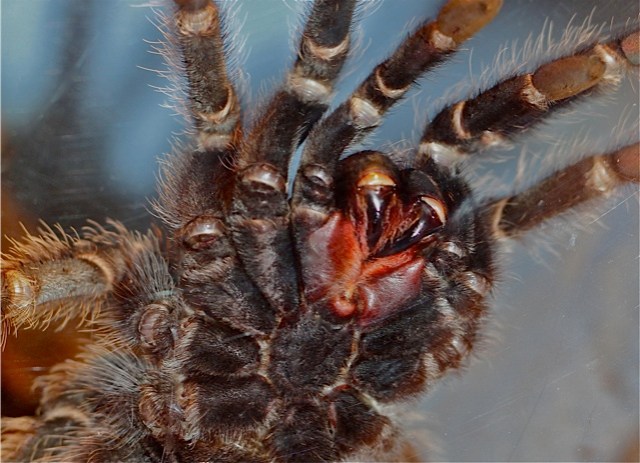
Phylum Arthropoda, Class Arachnida, Order Araneae, Family Theraphosidae

Lasiodora parahybana

DISTRIBUTION: Throughout northeastern Brazil.

HABITAT:  Tropical forest floor

APPEARANCE: Said to be the third largest spider in the world, this is a large-bodied tarantula with abdomen and legs covered with sensitive, long, and partially pink or salmon-colored hairs.   Maximum size: body, 9-10 cm (3.5–4 in); leg span, 20-25 cm (8–10 in).

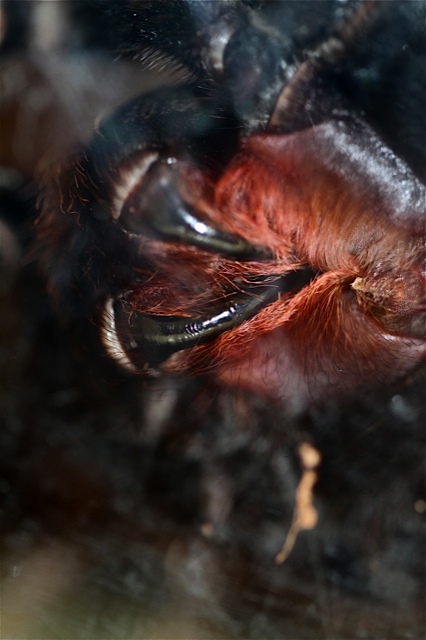
DIET: Lie and wait carnivore, eating large crawling insects and other invertebrates, small rodents, lizards, and frogs rarely seen eating birds like newly hatched chicks of ground-dwelling birds. Venom injected by chelicerae that liquefy the kill, which is then sucked in by the mouthparts.

REPRODUCTION and DEVELOPMENT: The male spins a small area of silk onto which he deposits his sperm. The sperm is then absorbed into the pedipalps, which during mating are inserted into the genital opening of the female, transferring the sperm, which remains viable. After insemination, the male makes a swift retreat as the much smaller males occasionally become a sacrifice to the female’s need to maintain the nutritional viability of a mother-to-be. The female lays up to 2000 fertilized eggs in a thick, silken sac which she guards fiercely. Young spiderlings are born about 3 weeks later. Voracious feeders, they grow quickly.

MORTALITY/LONGEVITY: Tarantulas have few enemies except tarantula hawk wasps. Members of this wasp family use their sting to paralyze species specific tarantulas. The wasp lays an egg on the tarantula’s abdomen and then seals the spider in its burrow. The wasp larva hatches and feeds on the immobile and doomed tarantula. Males usually die shortly after maturity and mating. Females can live over 20 years in the wild, perhaps significantly longer.

REMARKS: Like most tarantulas and some other spiders, if this spider loses one of its legs and is still in a growth stage, it can regrow the lost appendage,

While not highly aggressive and bites are not fatal to humans (most tarantula bites are similar to a bee sting in toxicity), this big bruiser, because of its long fangs, can inflict a serious wound which one researcher defined as “capable of medically significant mechanical damage”!

If pursued by a potential foe, the spider rubs its legs against its abdomen, throwing tiny, barbed hairs that become imbedded in the attacker. The barbs can cause significant irritation, especially if lodged in the eyes or nasal passages.

flickr http://www.flickr.com/photos/cas_docents/6962229021/in/set-72157608653175263/

WORDPRESS SHORTLINK  http://wp.me/p1DZ4b-qx

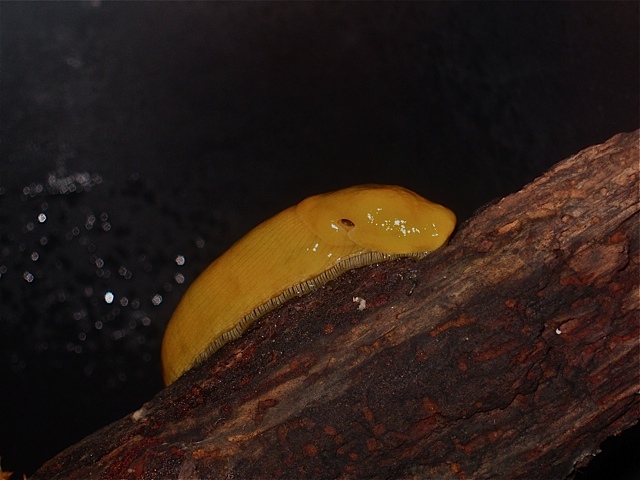
3-6-12 Banana Slug from Ron’s Animal Attraction Series (Exhibit)

Phylum Molluska, Class Gastropoda, Family Arionidae

Ariolimax californicus

DISTRIBUTION; Central California

HABITAT:  Require moist surroundings. Damp forest floors and crevices in rotting trees.

APPEARANCE: Snails that have lost their external shell. Banana slugs derive their common name from their bright yellow color, although they can also be green, black, brown, or white.  Have two sets of retractable tentacles on the head. The first and larger pair is used for sensing light; the smaller pair detects odors. The mouth is on the underside of the head with the anal and genital pores close by.

DIET: Detritivores and herbivores, they eat dead and decomposing plant and animal matter, including feces. They also eat living plants, particularly mushrooms.

REPRODUCTION/DEVELOPMENT: As hermaphrodites, each individual has both male and female organs. While they are known to self-fertilize, for the most part they cross-fertilize.  Courtship behavior of the banana slug is elaborate, with both partners engaged in ritualized bouts of lunging, nipping, and sideswiping with their tails until the two eventually line up side by side, genital pore to genital pore. The pair may intertwine for several hours before copulation begins. Each pair alternately releases and receives sperm, which is stored until the eggs are laid and fertilized in the rainy season.

Separation is even more dramatic than copulation since the slugs penises often as long their bodies may become entangled. The pair may resort to apophallation, a fancy term for the deliberate amputation of the penis with one or the other copulating individual gnawing off his or his partner’s penis. The dismembered slug, unable to deliver sperm, functions solely as a female.

MORTALITY/LONGEVITY:  Predators include birds, raccoons, snakes, and salamanders. Life span is thought to be 3–6  years. 

WORDPRESS SHORTLINK http://wp.me/p1DZ4b-qn