Latest Entries »

TAXONOMY
Kingdom: Animalia
Phylum: Chordata
Class: Actinopterygii (ray-finned fishes)
Order: Perciformes (Perch-likes)
Family: (Labridae) Wrasses

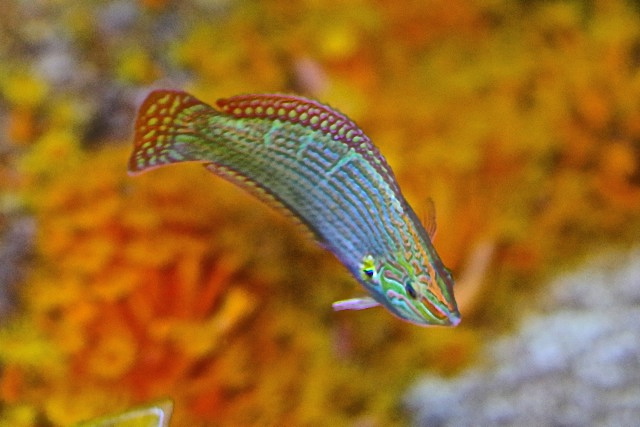
Genus/species: Pseudojuloides cerasinus

Pencil Wrasse  8362948295_4f3b9c4930_h

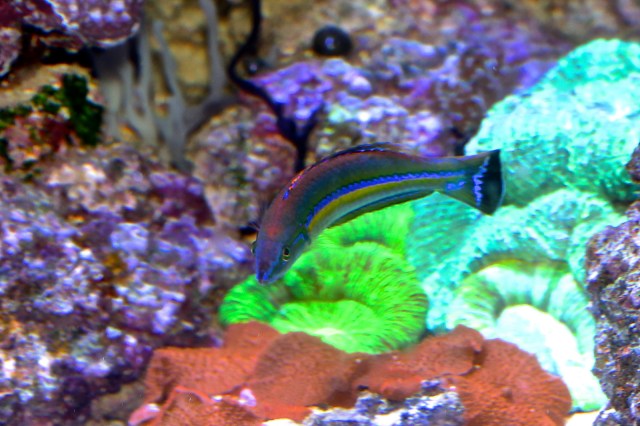
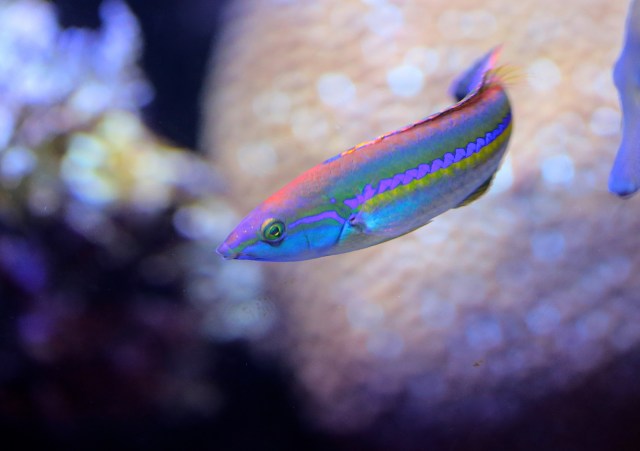
GENERAL CHARACTERISTICS: Long slender bodies and pointed snouts. Body color of males and females differ; geographic variation exists Initial phase (IP) fish are white with a copper-colored dorsum. Terminal phase (TP) green upper body, bicolor blue and yellow mid-body stripe; blue below. Length to 12 cm (5 in).

DISTRIBUTION AND HABITAT: East Africa to Samoa and Hawaii. S. Japan to Australia. Found among rubble, weed and coral areas of lagoon and seaward reefs to 61m (201 ft).

DIET IN THE WILD: Small benthic invertebrates (including fan worms, small crustaceans).

8644493886_4619144611_h

Reef Partners Cluster,  Shrimpfish Exhibit PR31

WordPress Shortlink  http://wp.me/p1DZ4b-VM

flickr  http://www.flickr.com/photos/cas_docents/sets/72157608208133134/with/8358672657/

TAXONOMY
Phylum: Mollusca
Class: Cephalopoda
Order: Octopoda
Family: Octopodidae.

Genus/species: Amphioctopus marginatus


GENERAL CHARACTERISTICS
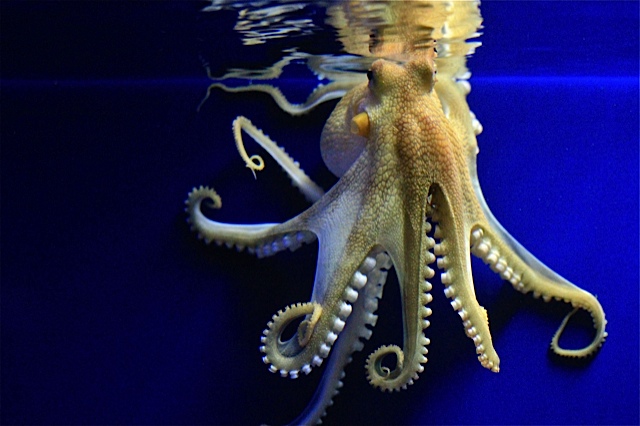
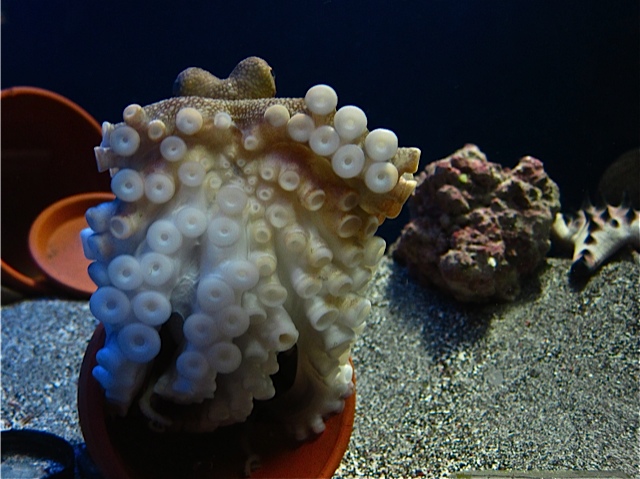
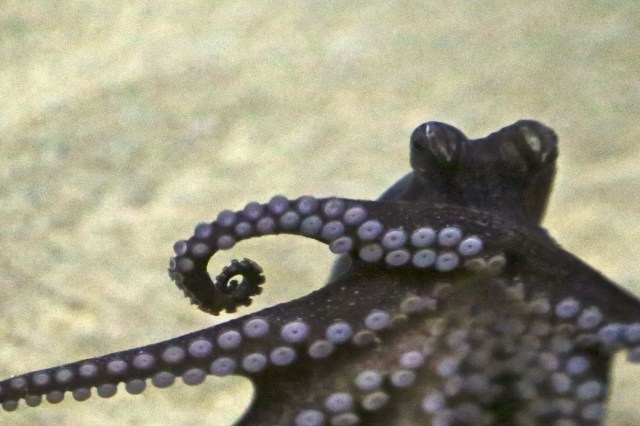
The main body (mantle) is small to medium-sized, 5–8 cm (15 cm [6 in] including arms) in length. The arms are usually dark with contrasting white suckers. They have only soft bodies with no internal skeleton with a hard parrot-like beak allowing them to hide in very small spaces.

DISTRIBUTION/HABITAT
The tropical western Pacific and coastal waters of the Indian Ocean on sandy bottoms.

DIET: Shrimp, crabs, and clams. A.marginatus uses its sharp parrot-like beak to crush the shells of its prey. Shells of prey that are difficult to pull or bite open can be “drilled” in order to gain access to the soft tissue: salivary secretions soften the shell, and a tiny hole is created with the radula (a rasp-like structure of tiny teeth used for scraping food particles off a surface). The octopus then secretes a toxin that paralyzes the prey and begins to dissolve it. The shell is pulled apart and the soft tissues are consumed.

REPRODUCTION: Octopus reproduction strategy provides a counterpoint to the male sacrifice of the flower mantis and the bird-eater tarantula,  The coconut octopus female mates with the male, and retreats into a den where she lays her eggs. At this point, she no longer feeds, instead spending the rest of her now short life protecting her eggs from predators and continually cleaning and aerating them.  She dies shortly after the hatching of her eggs and their subsequent entry into the plankton.

Egg mass below

MORTALITY/LONGEVITY:  10–12 months

REMARKS: The species’ common name derives from this octopus’ habit of carrying around coconut shell halves, by fitting its body into the bowl and extending rigid arms from the coconut’s edge to the substrate and tiptoeing away in gait called “stilt-walking”  or bipedal walking.    

Below A. marginatus using a shell. 

IMG_0198

The Steinhart is the first public aquarium in the U.S. to display the coconut octopus.  Our octopus was collected by Bart Shepherd, Curator of the Steinhart Aquarium, during a 2011 research expedition to the Philippines.

flickr  http://www.flickr.com/photos/cas_docents/6776485376/in/set-72157608597736188

WORDPRESS SHORTLINK http://wp.me/p1DZ4b-pu


TAXONOMY
Kingdom: Animalia
Phylum: Chordata
Subphylum: Vertebrata
Class: Reptilia
Order: Squamata
Suborder: Serpentes
Family: Boidae

Genus/species: Python reticulatus


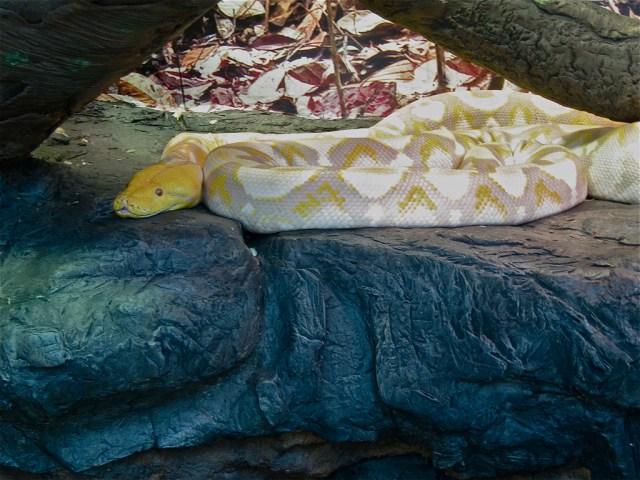
Albino Reticulated Python  6196134316_755d730e34_b

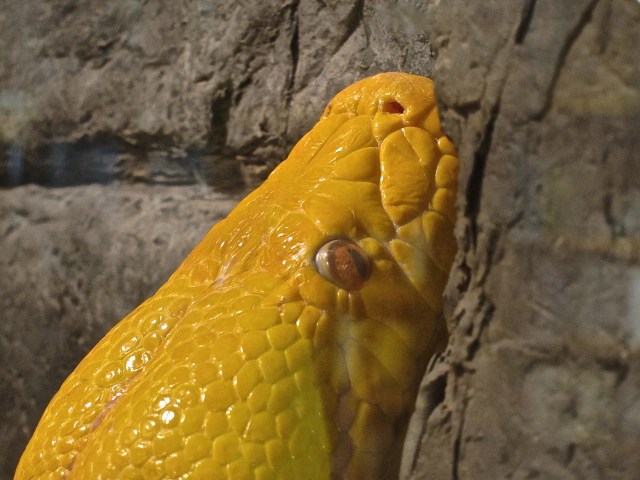
GENERAL CHARACTERISTICS: Largest species of python.  The giant South American Anaconda may grow  heavier ( 29 feet long & 550 pounds), but the longest snake in the world is the reticulated pythons (33 feet). Normally colored reticulated pythons have several pigments: melanin (blacks), and xanthins (yellows) amongst other more subtle colors. Lemondrop is a “lavender albino” which is the same thing as a “tyrosinase positive albino” (t-positive) which have the inability to complete the synthesis of melanin but can produce other melanin related pigments such as various shades of brown grey and red resulting the “lavender” color. A “normal albino” (t-negative) reticulated python is yellow and white with pink/red eyes. Melanin and other melanin pigments areas are pure white but non-melanin pigments are present giving alternate colors (xanthines produce yellows). To make matters more complicated different albino snakes may have mutations giving them additional color morphs.
Our albino American Alligator, (Claude) Alligator mississippiensis is a “normal albino” (t-negative) with no melanin or non-melanin pigments making him pure white. If you google “t-positive albino” or “tyrosinase positive albino” you can find more information on this condition. (Albino Appearance Ref. Nicole Chaney Biologist II, California Academy of Sciences for basic albino information).

DISTRIBUTION/HABITAT: Reticulated pythons can be found throughout Southeast Asia. Their range includes the Nicobar Islands, Burma through Indochina, and Borneo, Sulawesi, Ceram and Timor in the Malay archipelago. Found in steamy tropical rainforests near small rivers or ponds in tropical environments.

Albino Reticulated Python,  Python reticulatus  IMG_0184

DIET IN THE WILD   P. reticulatus is strictly carnivorous typically feeding on birds and mammals. This diet extends however to dogs, large deer, pigs and very rarely humans. Usually ambush predators, waiting in trees for unsuspecting prey.  They use their 100 curved teeth to capture their prey by biting then holding prey and they kill  by wrapping around them and squeezing them until the prey is unable to breath and its heart is unable to pump blood swallowing them whole.  The entire animal is digested in the snake’s stomach except for fur or feathers, which are passed with the snakes waste.

REPRODUCTION   Lays 25-80 eggs and guards nest but not hatched young.

REMARKS  Reticulated Pythons are heavily sold for their skin and meat. Also tourists visiting these areas often buy materials made from these snakes.
The largest P. reticulatus ever caught was 33 feet long in 1912 in Indonesia. The largest in captivity was from Thailand reaching a length of 28½ feet long with a girth of 37.5 inches and  weighed apron. 320 pounds.

This specimen below is a male, 14.5 ft long 60 lbs, 6 yrs old (6-22-12).

Albino Reticulated Python IMG_0182

WordPress Shortlink   http://wp.me/p1DZ4b-Vi

flickr  http://www.flickr.com/photos/cas_docents/sets/72157608449603666/

TAXONOMY
Kingdom: Animalia
Phylum: Chordata
Class: Reptilia
Order: Squamata
Suborder: Sauria
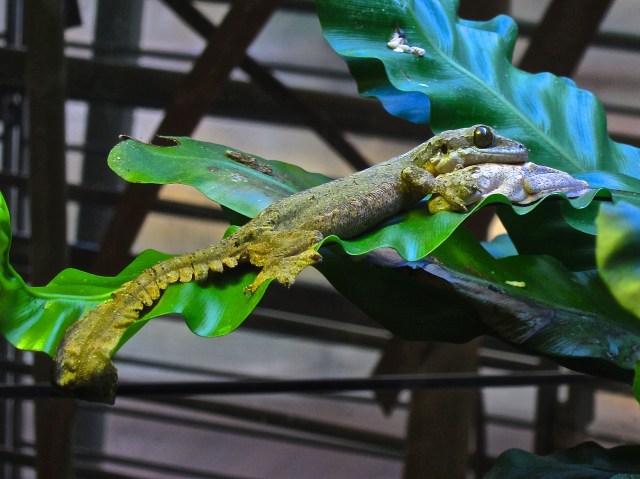
Family: Gekkonidae (Geckos)

Genus/species: Ptychozoon kuhlii

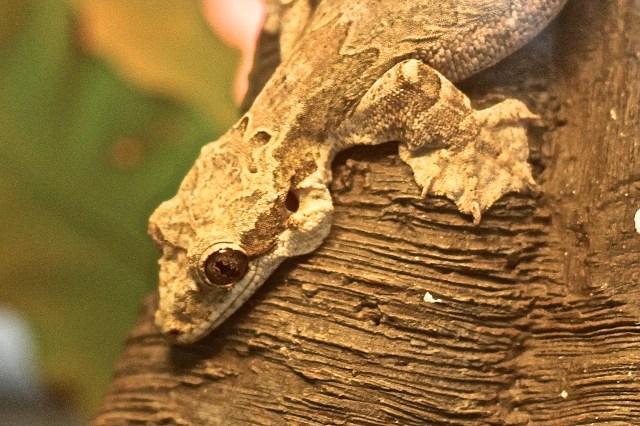
Kuhl's Flying Gecko IMG_9599

GENERAL CHARACTERISTICS Weird looking with big heads, bulging lidless eyes, and elaborate webbed feet. Gliding apparatus is composed of a large flap of skin along the flank. These flaps remain rolled across the belly until the lizard jumps off a tree. Then the flaps open passively in the air, acting as a parachute during descent. Additional flaps lie along the sides of the head, neck, and tail. These geckos are nocturnal and cryptic, and often go unnoticed in their natural habitat.

DISTRIBUTION/HABITAT Southeast Asia, including southern Thailand, Malaysia, Borneo, Indonesia, and Singapore. Nocturnal arboreal animals, found in lowland and mid-level rainforests.

Kuhl's Flying Gecko IMG_9650

DIET IN THE WILD Insects and arthropods.

MORTALITY Can live up to 7–9 years.

REPRODUCTION In captivity, breeding occurs when the animals are exposed to about 12 hours of daylight. The female will lay two eggs about once a month. She can lay five or six clutches per season. Eggs will hatch in 2–3 months.

Kuhl's Flying Gecko

Rainforest Borneo BO11

WordPress Shortlink  http://wp.me/p1DZ4b-UA

flickr  http://www.flickr.com/photos/cas_docents/sets/72157620567930293/

TAXONOMY
Kingdom: Animalia
Phylum: Arthropoda
Class: Arachnida (Arachnids)
Order: Araneae (Spiders)
Infraorder: Araneomorphae (True Spiders)
Family: Theridiidae (Cobweb Spiders)

Genus/species: Latrodectus mactans

Black Widow Spider

GENERAL CHARACTERISTICS: Female is glossy, coal-black color with long, slender legs and round abdomen; her underside usually carries a characteristic red hourglass mark. Adult Female: Approximately 8-13 mm (~1/2 inch) in body length. With legs extended, the female measures about 25-35 mm (1 inch – 1 1/2 inches). Adult Male: Approximately half the size of the female

DISTRIBUTION/HABITAT: In the U.S. ranges north to New England, south to Florida, Texas, Oklahoma; west to California, and throughout the southwest deserts. Also found in Canada, Mexico, the West Indies, and South America. Found close to the ground, especially dark, sheltered spots, such as under stones, in woodpiles, crevices, barns, outbuildings. Usually not found indoors.

DIET IN THE WILD: Carnivorous, mostly on insects, but also on other small invertebrates. When prey becomes ensnared in the web, black widow wraps it in silken threads and injects venom.

PREDATORS: Probably lives, like most spiders, about one year. Preyed upon by wasps including the muddauber wasps.

Black Widow Spider

REMARKS: Adult males are harmless. Females have a highly venomous bite that rarely kills humans, though young children or the elderly are likely to have severe reactions that can be fatal. Improvements in plumbing have greatly reduced the incidence of bites and fatalities in areas where outdoor privies have been replaced by indoor flush toilets.

Swamp SW06

WordPress Shortlink http://wp.me/p1DZ4b-Tt

flickr http://www.flickr.com/photos/cas_docents/sets/72157608653175263/

TAXONOMY
Kingdom: Animalia
Phylum: Mollusca
Class: Cephalopoda
Order: Octopoda
Family: Octopodidae

Genus/species: Octopus (No species name at the current time).

Note: octopus chierchiae is the lesser Pacific striped octopus and has been studied more extensively .

9830791415_f30b68b649_k-1

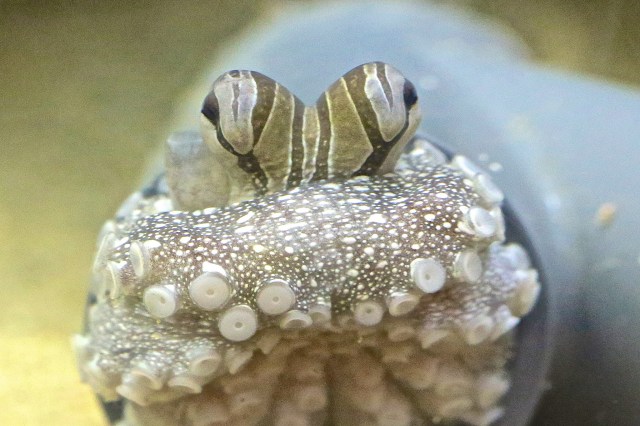
GENERAL CHARACTERISTICS: This pigmy octopus has arms spans of some eight to 10 inches, Color varies. It can switch from a dark reddish hue to black with white stripes and spots in fluid waves and also assume different shapes, both flat and expanded. Thought to live in groups of up to 40 or more individuals in the wild.

Larger Pacific Striped Octopus  8584026008_f1f86341db_o

DISTRIBUTION/HABITAT: Eastern Pacific off the coast of Central America. Found on sandy bottoms in intertidal areas.

DIET IN THE WILD: Shrimp, crabs and snails.Larger Pacific Striped Octopus IMG_6898

REPRODUCTION: Pairs of Larger Pacific Striped Octopuses live peacefully together in an aquarium, at times sharing a den. Mating is civil with a beak-to-beak, or sucker-to-sucker, position and their arms entwined for up to five minutes while the male inserts a sperm packet into the female. In contrast to other species which die after their first clutch of eggs this octopus lays many egg clutches in her lifetime.

REMARKS: Very rare, (Discovered 1991). Displayed only at the California Academy of Sciences.

Academy biologist Richard Ross, has spent the last 13 months raising and studying the behavior of this recently rediscovered species, along with Dr. Roy Caldwell of the University of California, Berkeley. They are currently studying the behavior of this species and working on a formal description and species name as well as are planning an expedition to observe them in their natural habitat in Nicaragua,

Reference:

California Academy of Sciences  http://www.calacademy.org/newsroom/releases/2013/rare_octopus.php

Ron’s WordPress Shortlink: http://wp.me/p1DZ4b-T5

Ron’s flickr http://www.flickr.com/photos/cas_docents/sets/72157608597736188/with/8562294939/

California Academy of Sciences  http://bit.ly/1pgpXLI

California Academy of Sciences    http://calacademy.org/explore-science/raising-rare-octopus

TAXONOMY
Kingdom: Animalia
Phylum: Chordata
Subphylum: Vertebrata
Class: Reptilia
Order: Testudines
Suborder: Cryptodira
Family: Carettochelyidae

Genus/species: Carettochelys insculpta
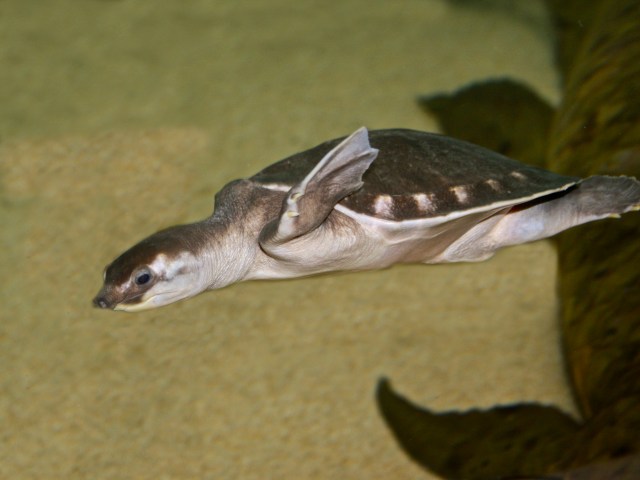
Pignose Turtle aka Fly River Turtle Carettochelys insculpta (Carettochelyidae) Pig-nose Turtles IMG_1388

GENERAL CHARACTERISTICS: Length ave. 46 cm (18 inches). Weight ave. 22 kg (49 lbs). Pitted, leathery,gray-green carapace and a white plastron. Limbs are clawed and paddlelike. Short head terminating in a broad, tubular, “piglike” snout. Carapaces of juveniles have serrated perimeters and a central keel. They have flat, broad limbs that have two claws each, with their enlarged pectoral flippers having a similar appearance to those of sea turtles.

DISTRIBUTION/HABITAT: Southern New Guinea and Kimberly Plateau of Australia in shallow, slow-moving rivers, lagoons, lakes and swamps with sandy or silty bottoms. Also in estuaries. Active nocturnally. Emerges from water only in order to nest.

DIET IN THE WILD: Opportunistic omnivores. Principal food is the fruits of shoreline trees. Eat other plant material: leaves, flowers that fall into river from banks, and aquatic algae. Also take insect larvae, mollusks and crustaceans. Scavenge fishes and mammals as carrion.

PREDATORS: Water monitors and humans. Eggs and adults taken for food by Papua New Guineans. Australian aborigines eat adults of this species. Have been reported to live 38.4 years in captivity.

REPRODUCTION: Oviparous laying two clutches of eggs, every two years. Males never come out of the water and females only come out when they are about to lay eggs. They don’t return to land until the next nesting season.

CONSERVATION: Vulnerable by the IUCN due to overharvest as a food source.

REMARKS: The only freshwater turtle to have limbs modified into flippers and swim via synchronous forelimb motions that resemble dorsoventral flapping, that evolved independently from their presence in sea turtles.

Secretive animals. Use forelimbs to burrow by scooping sand substrate over their carapace. Adults may thermoregulate underwater by lying over small thermal springs. Only extant species in its family.

 pignose-turtle-aka-fly-river-turtle- IMG_0316

Water Planet WP25

WordPress Shortlink  http://wp.me/p1DZ4b-SE

flickr http://www.flickr.com/photos/cas_docents/sets/72157608449490716/with/8547862948/

TAXONOMY
Kingdom: Animalia
Phylum: Chordata
Class: Actinopterygii (ray-fin fishes)
Order: Cyprinodontiformes (Rivulines, killifishes and live bearers)
Family: Nothobranchiidae (African rivulines)

Genus/species: Fundulopanchax avichang

Avichang killifish Fundulopanchax avichang IMG_5151

DISTRIBUTION/HABITAT: Africa: Cameroon, freshwater

CONSERVATION: IUCN Red List Endangered (EN)

Waterplanet

References

WordPress Shortlink http://wp.me/p1DZ4b-RA

flickr  http://www.flickr.com/photos/cas_docents/sets/72157608614099673/

TAXONOMY
Phylum: Chordata (Chordates)
Subphylum: Vertebrata (Vertebrates)
Infraphylum: Gnathostomata (Jawed Vertebrates)
Class: Osteichthyes
Subclass: Actinopterygii (ray-finned fishes)
Order: Perciformes (Perch-likes)
Family: Labridae (Wrasses)

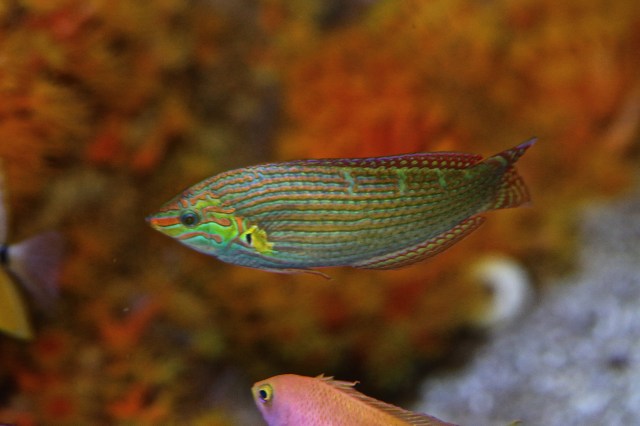
Genus/species: Halichoeres vroliki

IMG_5270

GENERAL CHARACTERISTICS: Light green with darker green stripes of linked spots. 3-4 narrow greenish white bars on back, greenish and pink bands on head, yellow pectoral fin base. Length to 13 cm (5 inches).

DISTRIBUTION/HABITAT: Maldives and Andaman Sea to Moluccan Is in E. Indonesia. Found in shallow weedy areas among coral reefs 2-20 m (6.5-65 ft).

REPRODUCTION: Pelagic spawners.

IMG_5268

Animal Attractions

flickr  http://www.flickr.com/photos/cas_docents/sets/72157608208133134/

WordPress Shortlink  http://wp.me/p1DZ4b-Rk

TAXONOMY
Kingdom: Animalia
Phylum: Chordata
Class: Actinopterygii (ray-finned fishes)
Order: Perciformes (Perch-likes)
Family: Ptereleotridae (Dartfishes)

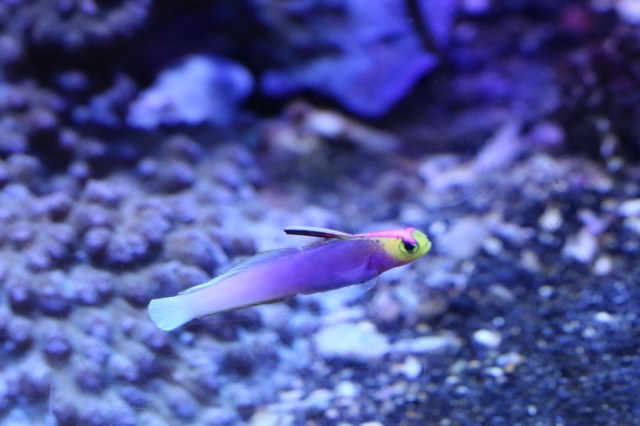
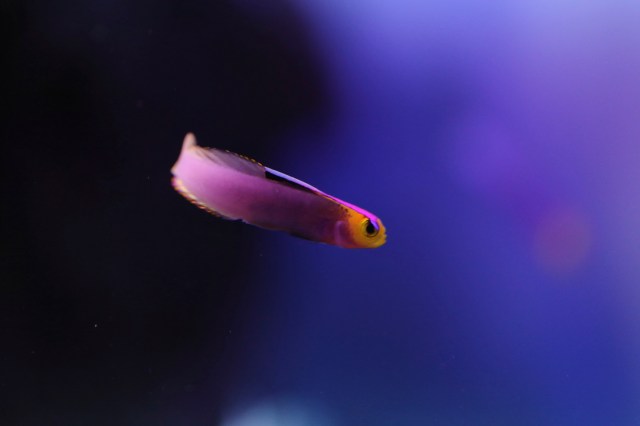
Genus/species: Nemateleotris helfrichi

8510843234_cd068d461a_b

GENERAL CHARACTERISTICS: Goby-like fishes but like the other fire fishes has an elongated two part dorsal fin.They have long anal fins and an upturned mouth. The head is yellow with a purple forehead, and the body is varying shades of purple and white. Length to 2.5 inches.

DISTRIBUTION/HABITAT: Pacific Ocean: eastwards to the Tuamoto Islands, north to the Ryukyu Islands in relatively deep water. Found over small patches of sand, rubble, or hard open bottoms of steep seaward reefs. Rarely found in less than 40 m (130 ft).

DIET IN THE WILD: Carnivore.

REPRODUCTION: Monogamous.

REMARKS: When approached by predators they dart into burrows or under rocks.IMG_6506

Water Planet Defenses WP33

flickr http://www.flickr.com/photos/cas_docents/sets/72157623764848303/with/8412647783/

WordPress Shortlink http://wp.me/p1DZ4b-Ra