Latest Entries »

TAXONOMY
Animalia (animals)
Phylum (Arthopoda)
Subphylum: Hexapoda
Class: Insecta
• Three body parts – head, thorax, abdomen
• Three pairs of legs attached to thorax
• Usually one or two pairs of wings
Order: Hymenoptera (ants)
Family: Formicidae

Genus/species: Atta cephalotes
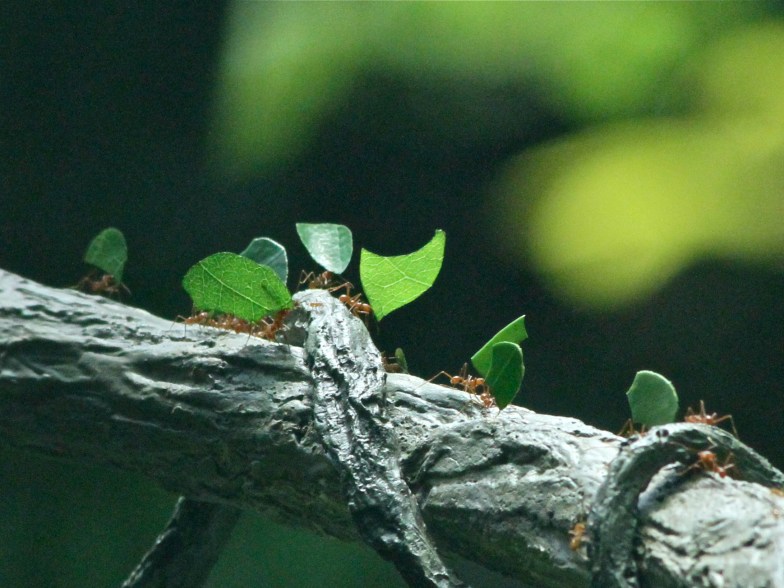
4471989519_93ab359108_o

GENERAL CHARACTERISTICS: Rust colored with lighter colored legs, members of the genus Atta are among the largest, most socially complex leafcutters. The huge queen is up to 1.5 cm (0.5 inches) in length, an egg laying machine capable of building a colony of several million individuals. A. cephalotes is noted for its especially large head (hence the name). Workers take many forms and sizes, from large soldiers and major workers with their impressive mandibles. A soldier may be 10 times longer and weigh several hundred times more than the smallest worker.

DISTRIBUTION/HABITAT: Fungus growing ants, or gardening ants, number about 200 species, all in the tribe Attini, and are found only in the New World, in every mainland country except Canada and Chile. Most leaf cutter ant species are native to tropical Central and South America, though a few species occur in the southwestern United States. Atta cephalotes ranges from southern Mexico to Bolivia and Brazil.

Found throughout the tropical rain forest, tropical deciduous forest, and tropical scrub forest. Nests are underground to a depth of 6 m (20 ft). Some have up to 3000 chambers.
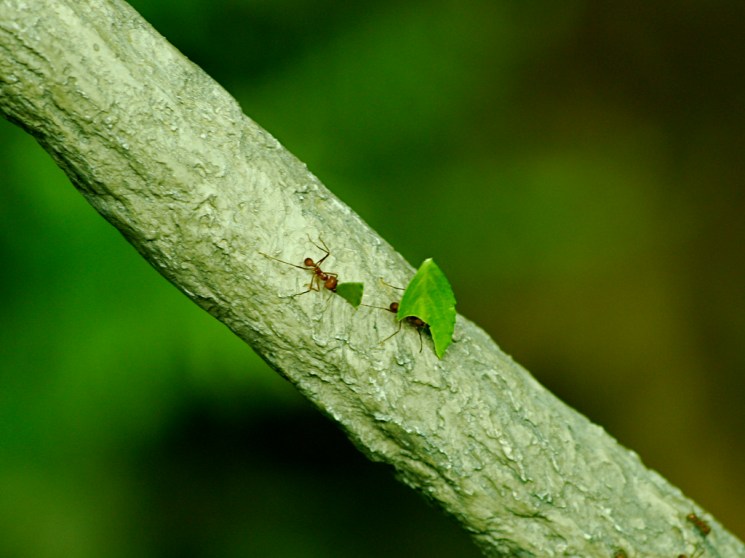
3003360666_7be42e475a_b

DIET IN THE WILD: They grow their own food by cutting leaves, mostly during the evening and nighttime, and carrying them back to the nest, where smaller workers then process them further and take them to underground “garden” chambers. All along the way, the leaves are fertilized by their handlers with anal secretions. Fungi then grow on the decaying vegetation, and the ants feed exclusively on the fungus, not the leaves. Each ant species grows a specific fungus.

REPRODUCTION: A. cephalotes swarm in mating flights at the onset of the rainy season. The queen mates with multiple males. The founding female has a pocket in her mouth cavity for storage of fungus spores to start her new nest. After she digs the first chamber for the garden, she deposits the spores, gathers appropriate leaves, and begins laying about 1,000 eggs each day. The first group of workers to develop takes over for the queen in caring for eggs, larvae, and pupae. The queen has only one job then—to lay the eggs that will build the colony.
The queen lives up to 10 years on average, but some have lived up to 14 years.

REMARKS: Fungus and ants are mutually dependent for survival. Obviously, the fungus provides the ants with food, but equally important, the fungus receives a warm, moist home and is supplied with fresh, fertilized nutrients. A large colony harvests the same amount of plant material that a cow consumes in a single day. Like most insects, are a good source of protein; they are eaten by people in parts of Mexico and in many places in South America. They also circulate nutrients and aerate huge quantities of soil.

Negative impacts of A. cephalotes include undermining building foundations, causing structural damage and destroying crops.

FOREST FLOOR BO14

References

Ron’s flickr  https://www.flickr.com/photos/cas_docents/4471989519/in/set-72157620567930293/

For Video ARKive  www.arkive.org/leaf-cutter-ant/atta-cephalotes/video-08.html

 Encyclopedia of Life  eol.org/pages/53197/overview

 Rainforest of the World docent training manual of the California Academy of Sciences 2014

Ron’s WordPress shortlink  wp.me/p1DZ4b-1pv
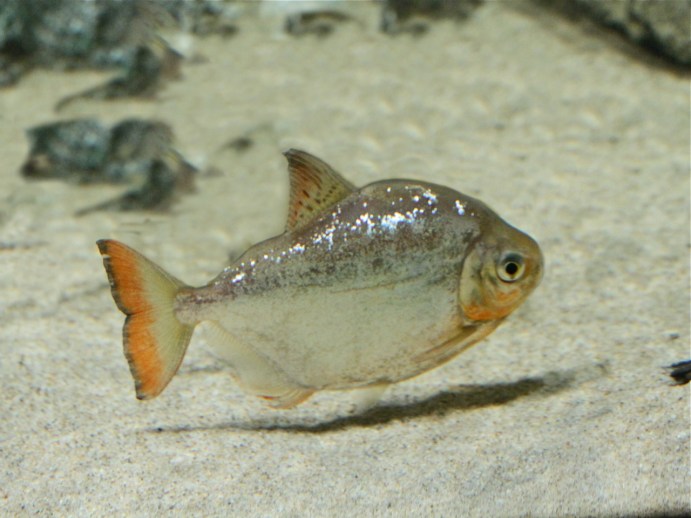
TAXONOMY
Kingdom: Animalia
Phylum: Chordata
Class: Actinopterygii (ray-finned fishes)
Order: Characiformes (Characins)
Family: Serrasalmidae

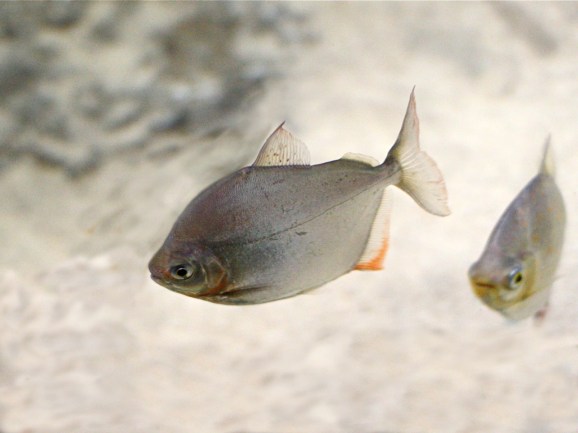
Genus/species: Metynnis hypsauchen

GENERAL CHARACTERISTICS: Almost circular in profile; juveniles may be spotted or striped; adults solidly silver with anal and caudal fins edged in red or orange. Length : 15.0 cm (6 inches).

DISTRIBUTION/HABITAT: Tropical South America primarily Amazon and Orinoco basins. Found in calm river reaches overhung by foliage.

DIET IN THE WILD: Generally herbivorous, eating leaves of river plants; occasionally eats worms and small insects.

REPRODUCTION: Group spawners. Eggs hatch in 3 days.

CONSERVATION: IUCN Red List, CITIES, Not Evaluated

REMARKS: A schooling species related to piranhas.
Possesses powerful dentition that can cause serious bites.

Amazon Flooded Tunnel AM11

References

Ron’s flickr  https://www.flickr.com/photos/cas_docents/6343628168/in/set-72157620568438047/

fishbase  fishbase.org/summary/Metynnis-hypsauchen.html

Encyclopedia of Life  eol.org/pages/217649/details

Ron’sWordpress shortlink  http://wp.me/p1DZ4b-cl


TAXONOMY
Kingdom: Animalia
Phylum: Arthropoda (Invertebrate animal having an exoskeleton (external skeleton), a segmented body, and jointed appendages). Includes the insects, arachnids, myriapods, and crustaceans.
Subphylum: Crustacea ( crabs, lobsters, crayfish, shrimp, krill and barnacles.)
Class: Malacostraca (Body plan comprises 20 body segments (rarely 21), and divided into a head, thorax, and abdomen). Crabs, lobsters, crayfish, shrimp, krill, woodlice, scuds (Amphipoda)mantis shrimp.
Order: Decapoda (“ten-footed”) crayfish, crabs, lobsters, prawns and shrimp
Family: Palinuridae (langouste or rock lobsters)

Genus/species: Panulirus interruptus

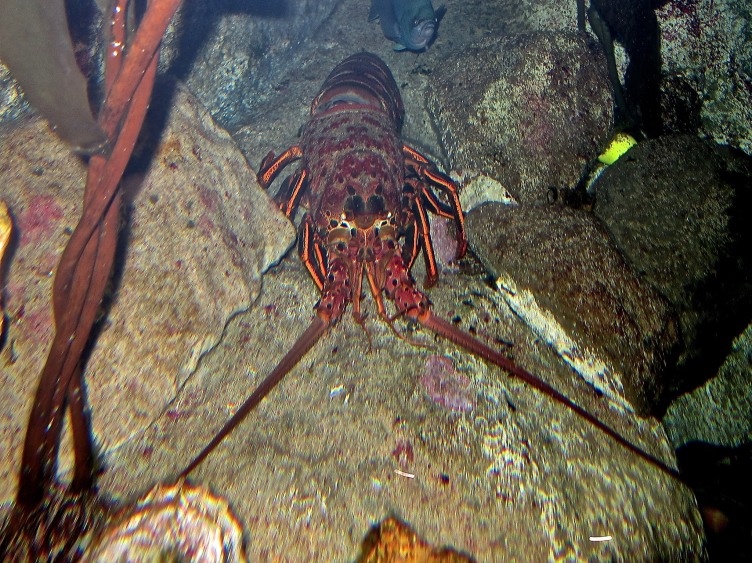
GENERAL CHARACTERISTICS: One of the largest spiny lobster species. The exoskeleton is generally red to orange in color with black markings. Spiny projections are located on the carapace (upper shell) and sides of the abdomen. Their two primary antennae may equal the length of their body. Panulirus interruptus lacks the large pinching claws of their Maine lobster relatives. Average mass is 908 g (32.00 oz) ranging from 454 to 2270 g (16.00 to 80.00 oz). On average, they are 30 cm (11.81 in) long, though they can measure as large as 90 cm (35.43 in) in length.

15790212682_b1f9460bd4_k

DISTRIBUTION/HABITAT: Monterey Bay, California to Baja California, Mexico. Found in rocky reefs in caves and rocky crevices. Maximum depth 240 feet.

DIET IN THE WILD: Nocturnal scavenging on sea urchins, small clams, mussels, algae and worms.

REPRODUCTION: Breed once a year during warmer months. Males attach sperm packets to females where she can produce up to 800,000 eggs which hatch into tiny young after 10 weeks. They reach legal size for harvest at 7-11 years of age.

LIFESPAN: In captivity 8 to 25 years.

PREDATORS: Giant Sea Bass, California Sheephead, cabezon, horn sharks, Leopard Sharks, octopus, sea otters and humans.

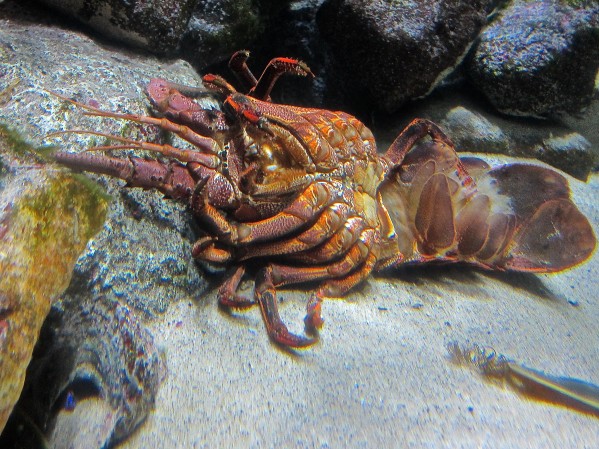
The photo below is a recent Moult ( shedding of the exoskeleton  typically to let the organism grow).

CA Spiny Lobster Molt15837588685_55717b70aa_k

CONSERVATION: IUCN Red List and CITES No special status. California fish and game regulates taking of lobster which requires a sport fishing license. In 2003 over 270 metric tons were harvested.

REMARKS: For defense P. interruptus has sharp spines on the body, tail and antennae. It also can use its powerful flexing tail to flee predators.

Southern California Coastal Marine

References

Animal Diversity Web ADW, animaldiversity.ummz.umich.edu/accounts/Panulirus_interru…

California department of fish and game nrm.dfg.ca.gov/FileHandler.ashx?DocumentID=36321&inli…

Ron’s flickr https://www.flickr.com/photos/cas_docents/15790212682/in/set-72157608602469734/

WordPress shortlink http://wp.me/p1DZ4b-1pi

TAXONOMY
Kingdom: Animalia
Phylum: Chordata
Class: Reptilia
Order: Testudines
Suborder: Pleurodira (side-necked turtles)
Family: Chelidae (“snake-necked turtles”)

Genus/species: Chelus fimbriata

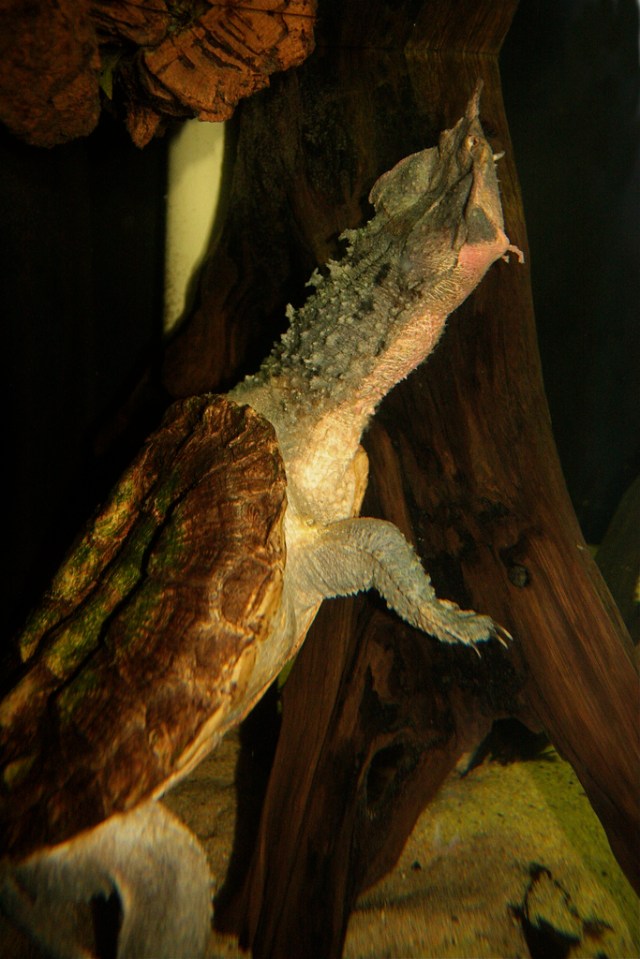
GENERAL CHARACTERISTICS: Color is faded yellow, washed out browns, oranges, and greys. The carapace has three lengthwise knobby keels with algae covering much of the carapace resembling a piece of bark, camouflaging it from possible predators. The head is widely triangular with large lateral flaps of skin and three barbels on the chin and four additional filamentous barbels at the upper jaw, The snout is a long protuberance used as a snorkel.  Carapace length to up to 45 cm (18 inches). Weight to 15 kg (33 lb).

DISTRIBUTION/HABITAT: Tropical. Amazon Basin, South America. Found near the bottom of turbid waterways in lakes, ponds and sluggish creeks. Rarely leaves the water.

DIET IN THE WILD: Carnivore. A “lay-in-wait” predator. Fishes and aquatic invertebrates are captured with the “gape and suck” technique. The opening of its mouth creates a vacuum to draw in prey with the mouth snaping shut, expelling the water and the fish swallowed whole.


REPRODUCTION: Fertilization is internal. They excavate their nests in decaying vegetation at the forest edge laying 12 to 28 eggs with an incubation periods of around 200 days.

LIFESPAN: To 15 years in captivity.

CONSERVATION: IUCN and CITES No special status.


3449612144_afdc85b508_b

REMARKS: The common name “matamata” is said to have the meaning “I kill” in one of the South American native languages.
C.fimbriatus has extremely poor eyesight. It can sense sound through a well developed tympanum on both sides of the head.

References

Ron’s WordPress shortlink  http://wp.me/p1DZ4b-bJ 

 U. of Michigan ADW animaldiversity.ummz.umich.edu/accounts/Chelus_fimbriatus/

Encyclopedia of Life  eol.org/pages/795410/details

Ron’s flickr  http://www.flickr.com/photos/cas_docents/sets/72157608449490716/


TAXONOMY
Kingdom: Animalia
Phylum: Chordata
Class: Amphibia
Order: Anura (frogs)
Family: Hylidae (“tree frogs and their allies”)

Genus/species: Trachycephalus resinifictrix

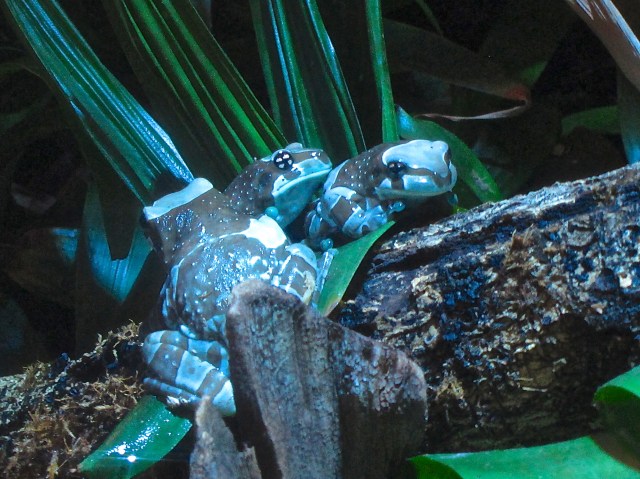
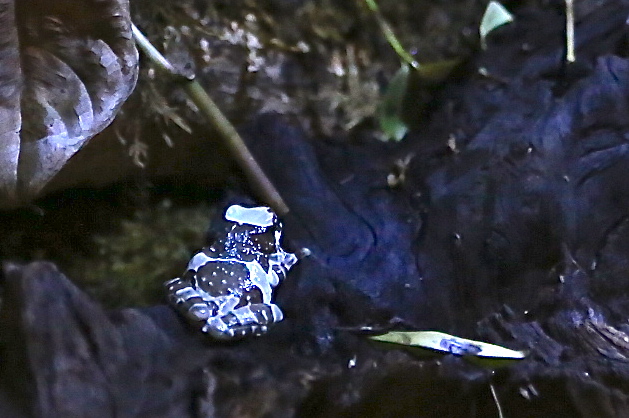
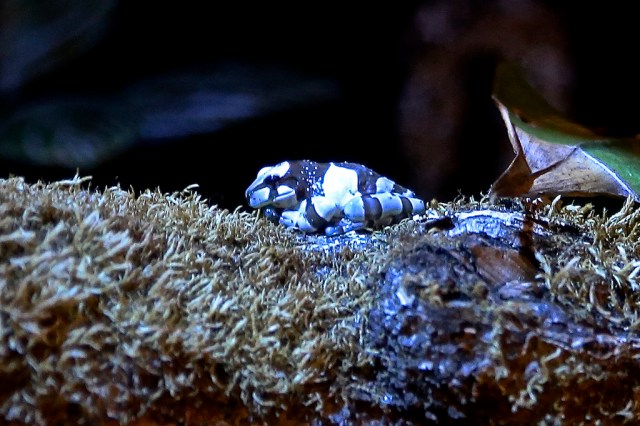
GENERAL CHARACTERISTICS: Light grey in color with brown or black banding,  Older frogs develop a slightly bumpy texture. The iris is golden with a black Maltese cross centered on the pupil. There is a vocal sac on each side of the head.  Reach 2.5 to 4 inches in length.

9830839556_f67b20a3fe_o

GENERAL CHARACTERISTICS: Light grey in color with brown or black banding, Older frogs develop a slightly bumpy texture. Reach 2.5 to 4 inches in length.

DISTRIBUTION/HABITAT:  Bolivia, Brazil, Colombia, Ecuador, French Guiana, Suriname, Venezuela.  Found in the canopy of tropical primary humid rainforests. They often inhabit vegetation which extends over permanent, slow-moving water.

IMG_0243

DIET IN THE WILD: Insectivorous

REPRODUCTION: Mainly in the rainy season between November and May. Clutches of about 2500 eggs form a gelatinous mass that floats near the surface of water or adheres to the inner wall of the tree holes. Tadpoles feed on conspecific eggs and vegetable detritus until metamorphosis in the tree holes.

IMG_4424

LIFESPAN Up to 25 years.

CONSERVATION: IUCN Red List; Least concern.

8353978767_29b24b4235_b

 REMARKS: The “milk” in the name comes from the poisonous milky-coloured fluid these frogs excrete when stressed.

References

Ron’s flickr  http://www.flickr.com/photos/cas_docents/8353978767/sizes/l/in/set-72157608456457315/

Ron’s WordPress Shortlink  http://wp.me/p1DZ4b-Mo

eol  eol.org/pages/1025259/details

Connecticut Beardsely Zoo  beardsleyzoo.org/amazonmilkfrog-fk1

TAXONOMY
Kingdom: Animalia
Phylum:Chordata
Class: Actinopterygii (ray-finned fishes)
Order: Characiformes (Characins)
Family: Gasteropelecidae (Freshwater hatchetfishes)

Genus/species: Carnegiella strigata

More Marbeled Hatchetfish  IMG_7957

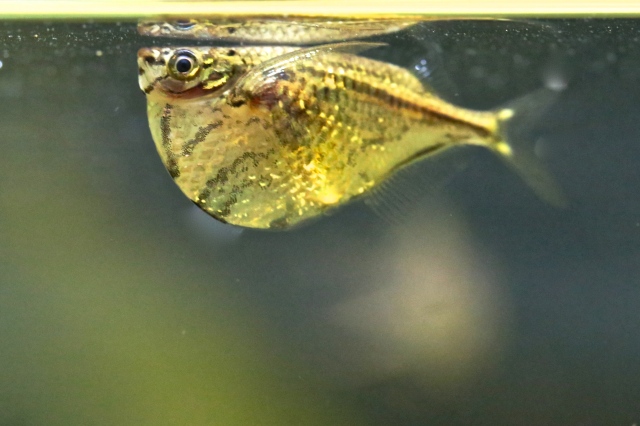
GENERAL CHARACTERISTICS: Hatchet shaped. A gold line extends from its eye to its caudal fin while the area below has a brown and cream-colored marble-like pattern. Length, 3.5 cm (1.4 in).

DISTRIBUTION/HABITAT: South America rivers in blackwater environments generally in areas with a lot of surface vegetation.

DIET IN THE WILD:  Their mouth situated up on top of their body to eat surface crustaceans and insects. 

REPRODUCTION: The female deposits eggs on plants and roots.  Fry will hatch after 30 hours and become free swimming in 5 days.  

LIFESPAN: 2-5 years.

CONSERVATION: IUCN Red List; Not evaluated.

REMARKS: Amazonian rivers as they resemble a dead leaf floating sideways on the surface of a body of water.

Capable of propelled jumps above the water surface by beating their pectoral fins to escape predatory threats.

References

Ron’s WordPress shortlink  http://wp.me/p1DZ4b-17P

Ron’s flickr  http://www.flickr.com/photos/cas_docents/sets/72157608614099673/

fishbase  www.fishbase.org/summary/speciessummary.php?id=10736


TAXONOMY
Kingdom: Animalia
Phylum: Chordata
Subphylum: Vertebrata
Class: Reptilia
Order: Squamata
Suborder: Serpentes
Family: Boidae
Subfamily: Boinae

Genus/species: Epicrates cenchria

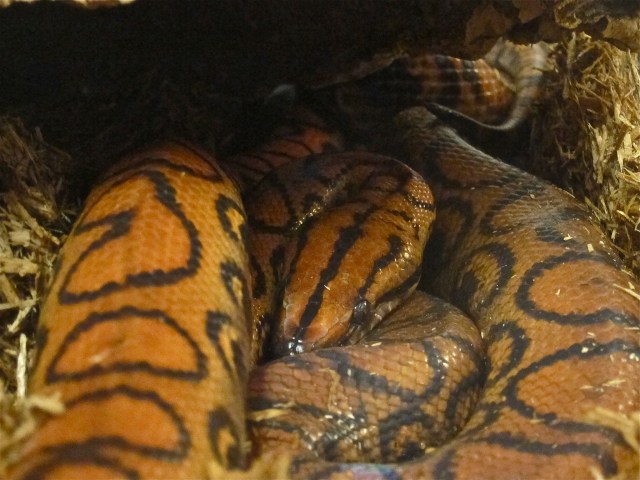
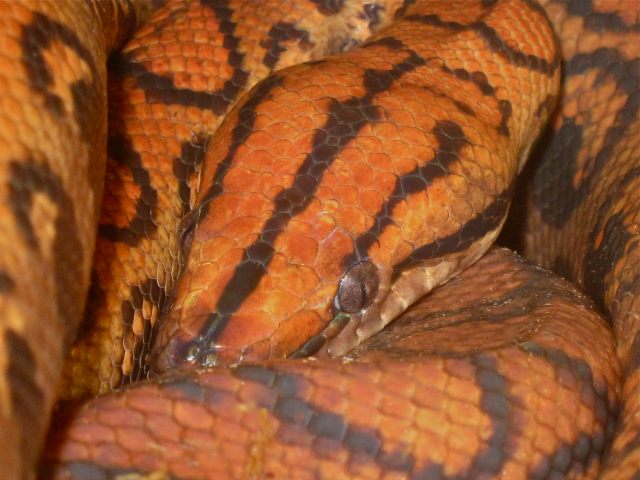
GENERAL CHARACTERISTICS: The Brazilian rainbow boa is one of about 12 named subspecies of rainbow boa. Color is brown or reddish brown with three parallel black stripes on the top of the head and large black rings down the back that give the appearance of dorsal blotches. There is a great deal of variation in color and marking among individuals of this species. Length is four to six feet (1.2 to 1.8 m).

Brazilian Rainbow Boa15580871426_15f0f85863_k


DISTRIBUTION/HABITAT: Found in the Amazon Basin, and in coastal Guiana, French Guyana, and Suriname and southern Venezuela most often in humid forests.

DIET IN THE WILD: Rodents, birds, and possibly some forms of aquatic life and lizards.

REPRODUCTION: Babies are born live in litters of two to 35 (viviparous). They are usually 15 to 20 inches (38 to 51 cm) long.

LIFESPAN: To 20 years in capativity.

REMARKS: E. cenchria is named because of the iridescent sheen imparted by microscopic ridges on their scales, which act like prisms to refract light into rainbows.

Brazilian Rainbow Boa15580871146_3fc18628e1_k


References

 National Zoo http://nationalzoo.si.edu/Animals/ReptilesAmphibians/Facts/FactSheets/Brazilianrainbowboa.cfm

The Reptile Database  http://reptile-database.reptarium.cz/species?genus=Epicrates&species=cenchria

Ron’s WordPress shortlink  http://wp.me/p1DZ4b-1nJ

Ron’s flickr  https://www.flickr.com/photos/cas_docents/15580871426/

TAXONOMY
Kingdom: Animalia
Phylum: Echinodermata
Class: Holothuroideaia
Order: Aspidochirotida
Family: Stichopodidae

Genus/species: Parastichopus parvimensis

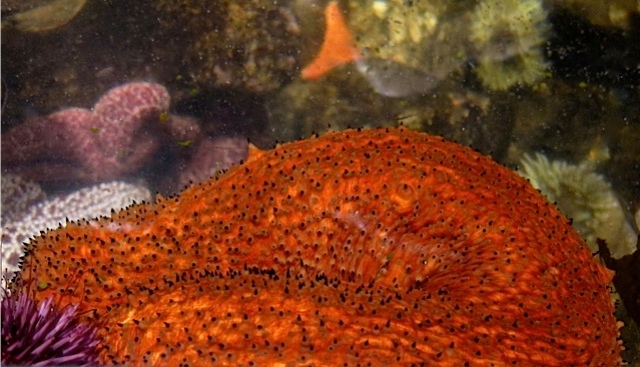
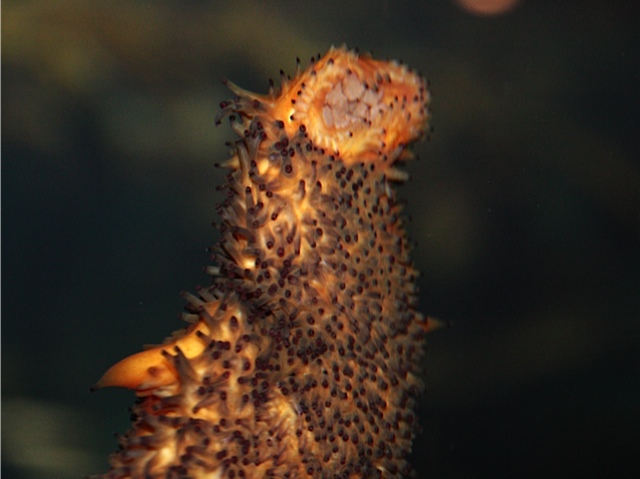
GENERAL CHARACTERISTICS: Colored brown above, lighter below. Conical black-tipped papillae on the dorsal side provide the common name. The mouth and anus are on opposite ends of their cylindrical bodies. Tube feet aide in gathering food as well as ambulating.Length to 25 cm (10 inches). 

DISTRIBUTION/HABITAT: Monterey Bay, California to Baja California. Found on sandy or muddy-sandy soft bottoms between rocks or in eelgrass beds. Sub tidal to 27 m (89 feet) in depth.

DIET: Digests organic detritus and small organisms in soft sediments.

REPRODUCTION?DEVELOPMENT: Have separate sexes (look-alike), and eggs are fertilized externally. Broadcast spawning usually takes place in November, and each female can produce thousands of eggs. After fertilization, a larva is formed which metamorphoses into a Sea Cucumber after a few weeks.

MORTALITY/LONGEVITY: Eaten by sea stars including the sunflower star. Sea otters and humans are also predators. Lifespan estimated to be 5-10 years in the wild.

CONSERVATION: IUCN Red list; Not Evaluated

REMARKS: Holothuroids differ from echinoderms, because they have a water vascular system full of body fluid rather than sea water.  Like other echinoderms, cucumbers have a calcareous skeleton; but in their case it is only vestigial, composed of plates and spicules of lime buried in the skin and serving merely to stiffen the body wall. Respiratory trees are the lungs of a sea cucumber. These hollow branched organs lie inside the body cavity on either side of the posterior intestine. The base of the tree connects to a muscular cavity, or cloaca. Oxygen is transferred across the thin membrane into the fluids of the body cavity. When the oxygen is depleted, the main body wall contracts to squeeze water out of the trees. 
When threatened, it can expel all its internal organs through its anus (evisceration) and grow new ones in 2-4 weeks. It can also expel sticky filaments to ensnare or confuse predators. Warty sea cucumbers and their related species are sometimes called the “earthworms of the sea,” as they cultivate the seafloor in much the same manner as earthworms cultivate the soil. Oral tube feet around the mouth are covered with a sticky mucus that traps food particles from the seafloor’s sediment and mud. In areas where overfishing has reduced the population of sea cucumbers, the seafloor hardens, thus destroying a habitat for other bottom-dwelling creatures. Can walk on tube feet if stressed up to one yard every 15 min..Humans eat a variety of sea cucumber species, including Warty sea cucumbers. The demand is greatest in Asian countries, for consumption and folk medicine applications. It is considered to be widely overfished.


Parastichopus parvimensisIMG_8852 - Version 2


References

ADW Animal Diversity Web, U. of Michigan  http://animaldiversity.ummz.umich.edu/accounts/Parastichopus_parvimensis/

Encyclopedia of Life  eol.org/pages/597920/details

Monterey Bay Aquarium  www.montereybayaquarium.org/animal-guide/invertebrates/wa…

Ron’s flickr  https://www.flickr.com/photos/cas_docents/3702926813/in/set-72157608501343477

 Ron’s WordPress Shortlink  wp.me/p1DZ4b-s6


TAXONOMY
Kingdom: Animalia
Phylum: Echinodermata
Class: Echinoidea (Sea urchins)
Subclass: Cidaroidea
Order: Cidaroida
Family: Cidaridae

Genus/species: Eucidaris tribuloides

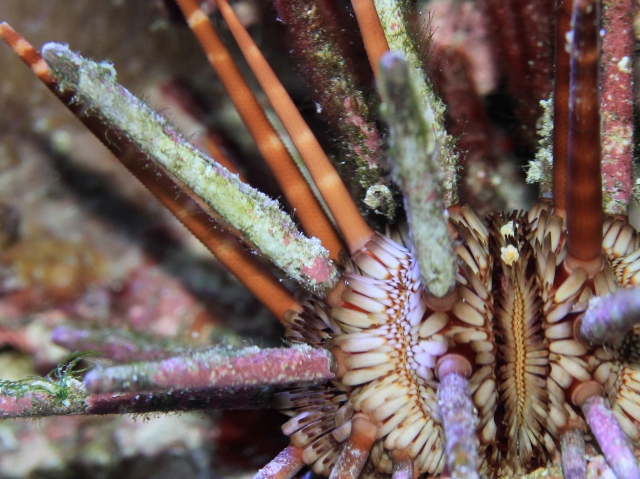
GENERAL CHARACTERISTICS: Brown body with thick spines in all directions. 

Slate Pencil UrchinIMG_1479

DISTRIBUTION/HABITAT: North Carolina through Brazil, Caribbean, Bahamas, Florida. Found in coral reef crevices, in turtle grass beds, or under rocks and rubble in back reef lagoon areas. Depth to 800 m (usually 50 m). 


Slate Pencil UrchinIMG_1478

DIET IN THE WILD: Nocturnal omnivore: algae and small invertebrates such as sea squirts and sponges.

Slate Pencil UrchinIMG_0664

REMARKS: The spines of pencil urchins, unlike other urchin groups, are not covered with epidermis. They are, however, often covered with algae and epizoans that provide excellent camouflage. Spines are also covered with barbs that can inflict serious pain to a predator. Seek shelter in rocky crevices by day, using the thick spines to maintain a protected position.

References

Encyclopedia of life eol.org/pages/600976/details

Smithsonian Tropical Research Institute 

biogeodb.stri.si.edu/bocas_database/search/species/1130

Animal Diversity Web animaldiversity.ummz.umich.edu/accounts/Eucidaris_tribulo…

Ron’s flickr https://www.flickr.com/photos/cas_docents/4330820247/in/set-72157608501343477

Ron’s WordPress shortlink  http://wp.me/p1DZ4b-1nk

Caribbean  PR36

TAXONOMY
Kingdom: Animalia
Phylum: Echinodermata
Class: Echinoidea
Order: Diadematoida
Family: Diadematidae

Genus/species: Diadema setosum

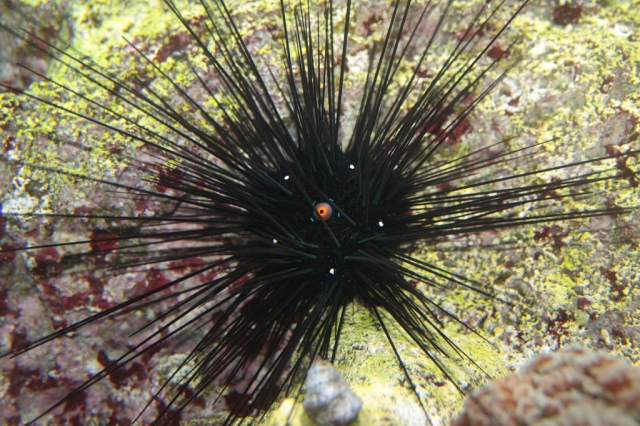
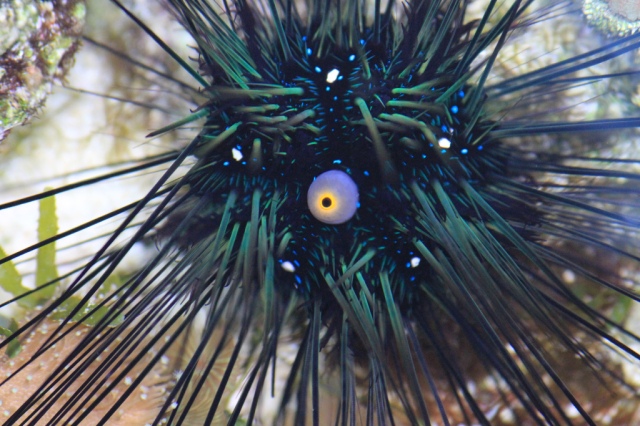
GENERAL CHARACTERISTICS:  Usually black but some or all of them can be grey or white. Very long, black spines are up to 30 cm (1.1 inches). Orange-red ring around anal cone at the center of its dorsal surface is distinctive. Weight 35 gm (1.25 oz) to 80 gm (2.8 oz).  Adult test to 9 cm (3.5 inches) diameter with a distinct pattern of iridophores, usually with 5 white dots.  Height to around 40 mm (1.5 inches) high. 

3708478244_83afedaa94_b

DISTRIBUTION/HABITAT: Red Sea, east Africa to western Pacific (Philippines) in low tide areas to 20 m (66 ft) on rubble and seagrasses. Often abundant in shallow water areas that have been recently disturbed. Also in lagoons and on coral and rocky reefs.

4333507132_3945bbf3a3_b

DIET IN THE WILD: Herbivore. Hides during the day, and emerges at night to feed on algae, plankton, and waste material. Its feeding habits help keep the reef free from coral-smothering algae; however, too many of these algal-eating machines can actually threaten a reef, scraping away living coral as they devour algae and leaving little food for other herbivores.

CONSERVATION: IUCN Red List ; not evaluated.

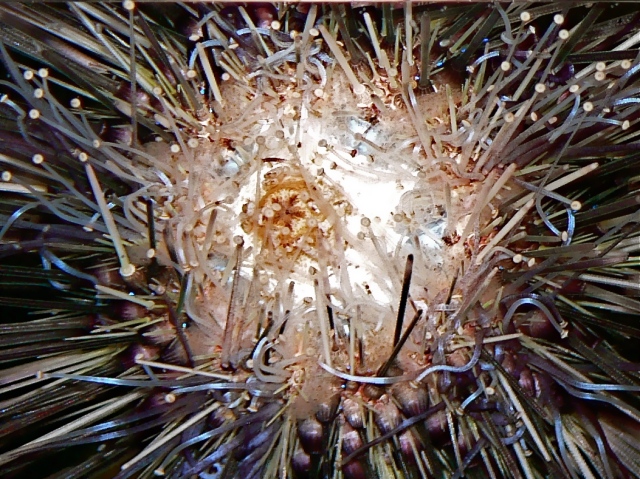
REMARKS: Uses hundreds of flexible, tube feet to move around, eat and breathe.

The venom is mild and causes swelling and pain, and gradually diffuses over several hours. Tiny hooked barbs often require surgical removal.

Commensal with a number of species, including various shrimps and fishes.

2985491545_3eef5bdec7_o

Sea-grass shallows PR03a

References

Encyclopedia of Life  eol.org/pages/2942801/details

Archive www.arkive.org/long-spined-sea-urchin/diadema-setosum/

WordPress Shortlink  http://wp.me/p1DZ4b-Qv

flickr http://www.flickr.com/photos/cas_docents/sets/72157608501343477/with/4333507132/