Latest Entries »

TAXONOMY
Kingdom: Animalia
Phylum: Mollusca
Class: Cephalopoda
Order: Sepiida
Family: Sepiidae (Cuttlefishes, shell internalized)

Genus/species: Sepia bandensis

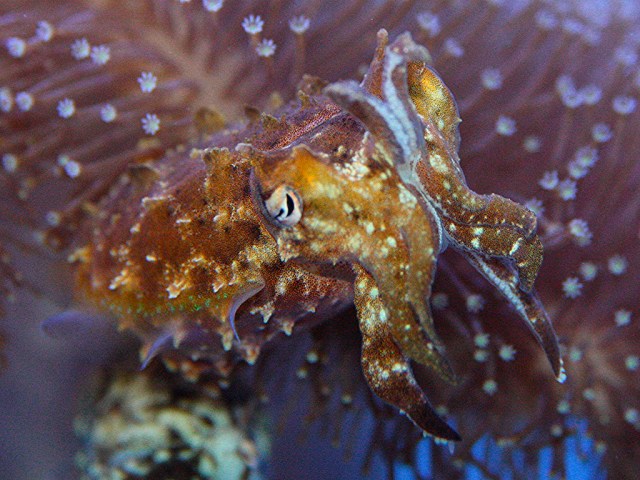
GENERAL CHARACTERISTICS:. Sepia bandensis has 8 arms with rows of suckers along each and 2 feeding tentacles. It moves by the undulation of lateral fins that surround the body. Cuttles have an internal shell within their bodies that they can fill with more or less gas to create neutral buoyancy. The cuttlebone is often collected and used as a calcium supplement, beak sharpener, and all-purpose toy for caged birds.
Like most cephalopods, cuttlefish have 3 hearts. Two hearts pump blood to the gills, and a central heart pumps oxygenated blood to the body.
Length: 5 cm – 10 cm (2 in – 4 in)
3953684509_d8a7ff53db_b

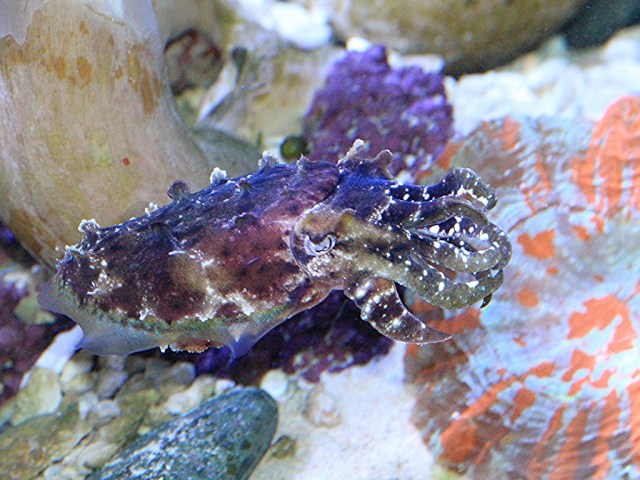
DISTRIBUTION/HABITAT: The Indo-Pacific region, including the Philippines, Indonesia, and Papua New Guinea.
Found in shallow coastal waters near or on coral reefs or sandy substrates.
4155077422_fbdca1e012_b

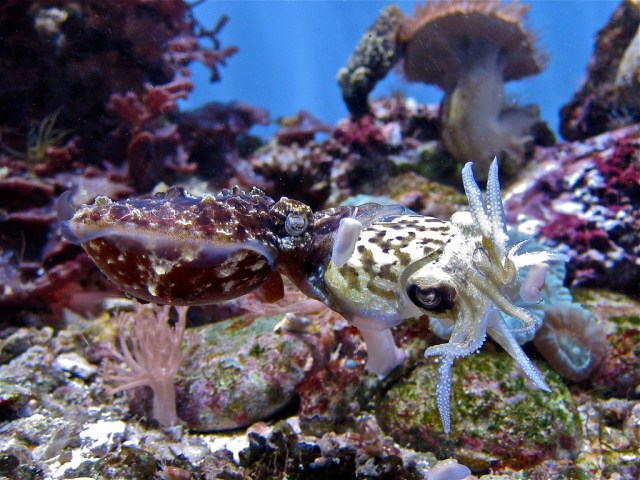
DIET IN THE WILD: Crustaceans and fish. The Cuttlefish changes colors and patterns as it approaches prey then ejects its feeding tentacles to capture its prey with its suckers and eating it with a parrot-like beak and a radula. Active diurnally.

ACADEMY DIET: Shrimp and crab (M Avila, staff biologist)
6502617393_a6e58de35b_b

LONGEVITY: Life span: 6 mos. to 3 yrs.

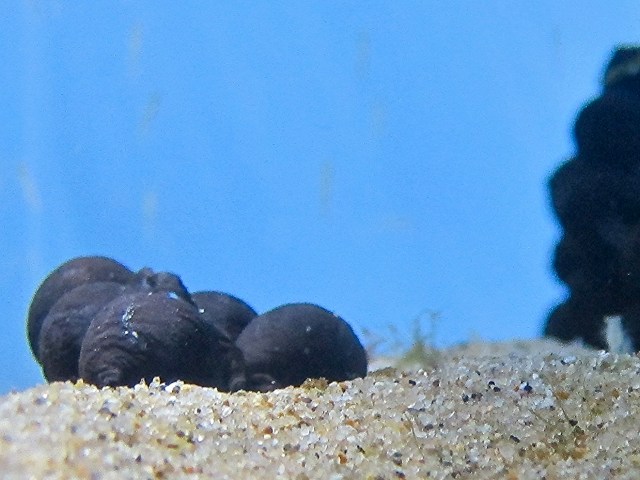
eggs below
5519039392_2b09a5da70_o

REMARKS: Masters of camouflage, cuttlefish and most cephalopods can change their colors, shapes and textures in seconds to avoid predators and blend into their surroundings. They have keen vision, but are color blind.

They also produce large amounts of ink, both as a decoy and foul-tasting deterrent. Known as sepia ink, after the genus name of cuttlefish, it was a dye once prized by artists.

The Steinhart Aquarium is the first institution in the U.S. to breed dwarf cuttlefish. To date, (2010) more than 350 have hatched at the Academy, most of which have been sent to other aquaria and research institutions. Quote from Rich Ross, Academy biologist and cuttlefish breeder extraordinaire: Over time, [cuttlefish] learn to recognize and respond to you, and will often greet you when you walk into the room (or maybe they just know you bring the food). 

Color of Life note: Cuttlefish are excellent examples of cryptic coloration. Chromatophores in the cuttlefish skin are controlledneurologically, allowing almost immediate color change disappearing into its background right before your eyes.
Ref: California Academy Color of Life exhibit

References 

California Academy Color of Life exhibit

The Marine Biology Coloring Book 2nd Ed. Thomas Niesen 2000

EOL Encyclopedia of Life  eol.org/pages/591499/details

Ron’s flickr  https://www.flickr.com/photos/cas_docents/3953684359/in/album-72157652559028013/

Ron’s WordPress shortlink    http://wp.me/p1DZ4b-1yp
TAXONOMY
Kingdom: Animalia
Phylum: Arthropoda
Class: Insecta
Order: Mantodea
Family: Hymenopodidae
Subfamily: Epaphroditinae

Genus/species: Phyllocrania paradoxa

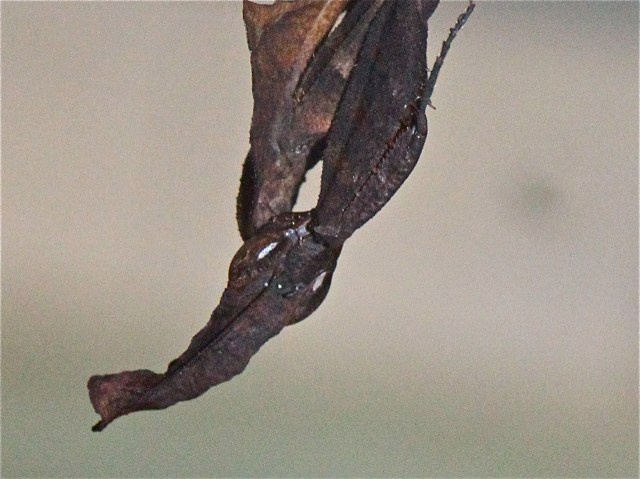
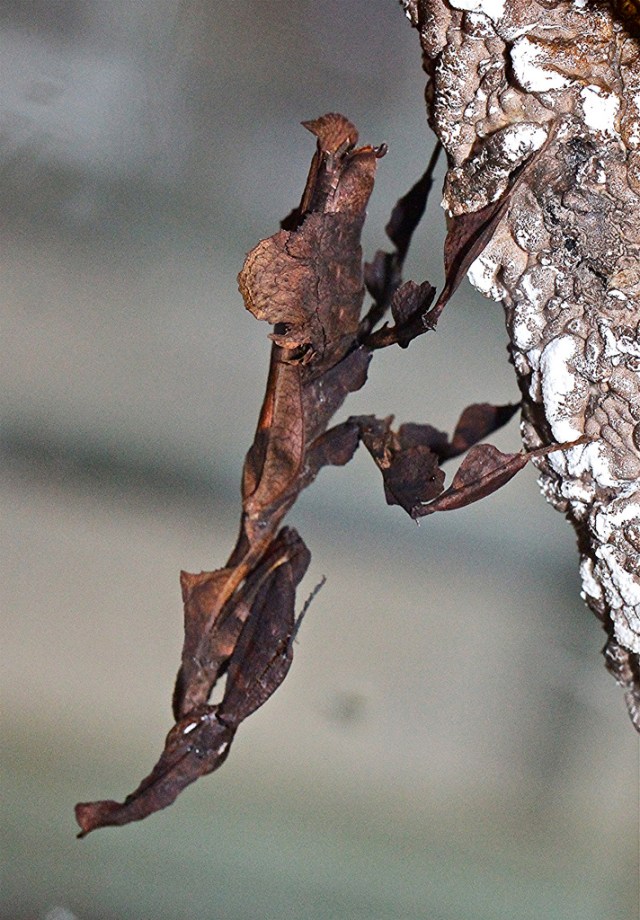
GENERAL CHARACTERISTICS: This is a miniature species of leaf mantis, growing to under 5 cm (2 in). Theses mantids exhibit sexual dimorphism with females being longer and having a wider abdomen than males. Colors can vary from grey/green to dark brown or almost black. Colors are dependent on humidity and light levels. Ghost mantids have leaf-like head and shoulder shields, and leaf-like protrusions hanging from their limbs. This “dead-leaf” appearance makes it very difficult to see. The scientific name is probably derived from Greek for “leaf “(phyllo) and Latin for “head” (crania).

Phyllocrania paradoxa6319511720_e34688f6b4_b

DISTRIBUTION/HABITAT: P. paradoxa are found in the warm, highly humid tropical forests of Tropical Africa including Madagascar, Mozambique, Namibia, and Somalia.

DIET IN THE WILD: This species will eat almost anything that moves, and it is very, very fast. When another insect comes within striking distance, the mantid flicks out the long front legs, and grabs it in a fraction of a second. They are remarkably patient, and will sit in the same position for weeks, just waiting for something to land near them.

DIET IN CAPTIVITY: Drosophila (fruit flies), houseflies, crickets, and flour worms.

MORTALITY and LONGEVITY: Generally a long-lived species.  Molt every 3–5 weeks, until the 4th and final molting.  Life span: up to 14 months in captivity.

REPRODUCTION: In general mantids reproductive organs are found at the tip of their abdomen. Females attract males with pheromones, there is a brief courtship dance, and the male alights on the female’s back. After delivering sperm, the male usually hurries away as females are known to consume their mates! After fertilization the female deposits batches of eggs, using an ovipositor at the tip of her abdomen. The eggs stick to stems and leaves, and each batch is housed in an egg case made from an abdominal secretion that hardens to protect the eggs from birds and other predators. After about a month the nymphs hatch and then molt several times, each time becoming more like the adult form. 

Juvenile below

Color of Life Note: Ghost mantids exhibit cryptic coloration (conceals or disguises an animal’s shape). They look like a vine draped on tree and bush branches.


LOCATION: Madagascar Rainforest

References

References. California Academy of Sciences Docent Rainforest Training Manual.

Ron’s flickr https://www.flickr.com/photos/cas_docents/4333501334/in/set-72157620708610230/

Ron’s WordPress shortlink  http://wp.me/p1DZ4b-eK

Encyclopedia of Life  http://eol.org/pages/3489690/details

ADW Animal Diversity Web animaldiversity.org/accounts/Phyllocrania_paradoxa/classi…


TAXAONMY
Kingdom: Animalia
Phylum: Chordata
Class: Actinopterygii (ray-finned fishes)
Order: Pleuronectiformes (flat-fishes)
Family: Paralichthyidae (large-tooth flounders)

Genus/species; Paralichthys californicus

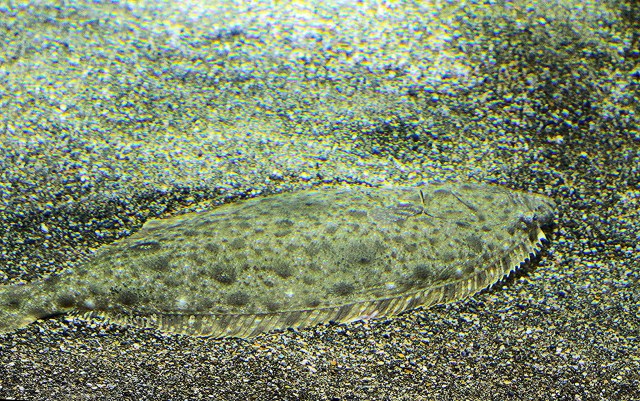
GENERAL CHARACTERISTICS: They are large, oval-shaped flatfish. with small heads, large mouths, small eyes set wide apart. Their lateral line appears as a high arch above the pectoral fin. Many of these fish are right eyed even though they are members of the left-eyed family. They may grow to 1.5 m (5 feet) in length and weigh 32 kg (72 pounds).

15947629781_cd65ceee5b_k

DISTRIBUTION/HABITAT: Northern Washington to southern Baja California, though less common north of San Francisco Bay. P. californicus are found on sandy bottoms to a depth of 183 m along the shore, near rocks and in bays and estuaries.

DIET IN THE WILD: Like flatfish in general, is an ambush predator, using its large, powerful caudal fin to accelerate off of the substrate when prey such as other fishes or squid venture near. Juveniles (less than 55 mm) feed mainly on small crustaceans, such as harpacticoid copepods, small gammarid amphipods, and mysid shrimps.

4330626298_aac443953f_b

MORTALITY/LONGEVITY: They may live as long as 30 years but are subject to predation by sea lions, sharks, rays and dolphins.

REPRODUCTION: Females can reproduce at 4-5 years and males at 2-3 years. California halibut are broadcast spawners in shallow waters of coastal areas. Their eggs are fertilized externally. In the larval form flatfish are bilaterally symmetrical and swim upright, as do other fishes, but at about 13 days one eye begins to migrate to the other side of the head. By the time the juvenile is about 8 mm, it has turned on its side.

LONGEVITY: Up to 30 years in the wild.

CONSERVATION: IUCN Red List: Least Concern (LC)

Color of Life note:  P. californicus demonstrates a well-camouflaged fish using cryptic coloration on the sandy substrate. The chromatophores in the skin change its color and patterning to match its environment.

REMARKS: They have very sharp canine like teeth, and are known to bite.

They are able to use their lateral line to detect vibrations in the water, aiding in prey location and predator avoidance.

Support important commercial and recreational fisheries

Giants, Flatfishes

References

Ron’s flickr https://www.flickr.com/photos/cas_docents/15947629781/in/album-72157652559028013/

Ron’s WordPress shortlink wp.me/p1DZ4b-1yd

Animal Diversity Web animaldiversity.org/accounts/Paralichthys_californicus/

IUCN Red List www.iucnredlist.org/details/183801/0

Monterey Bay Aquariun  www.montereybayaquarium.org/animal-guide/fishes/californi…

TAXONOMY
Kingdom: Animalia (animals) 
Phylum: Chordata (chordates) 
Subphylum: Vertebrata (vertebrates) 
Class: Amphibia (Amphibians) 
Order: Anura  (Frogs, Toads) 
Family: Bufonidae ( Bufonids, bufonidés, crapauds, Toads)

Genus/species:  Phrynoidis juxtaspera

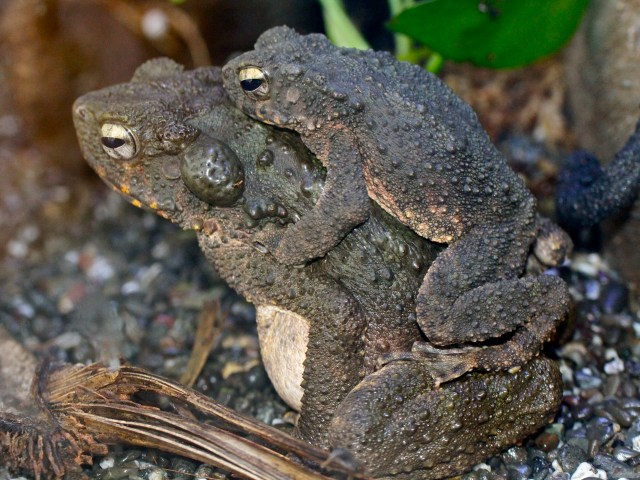
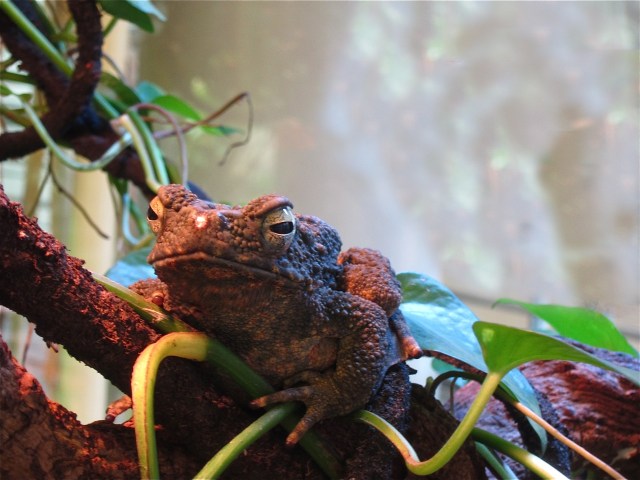
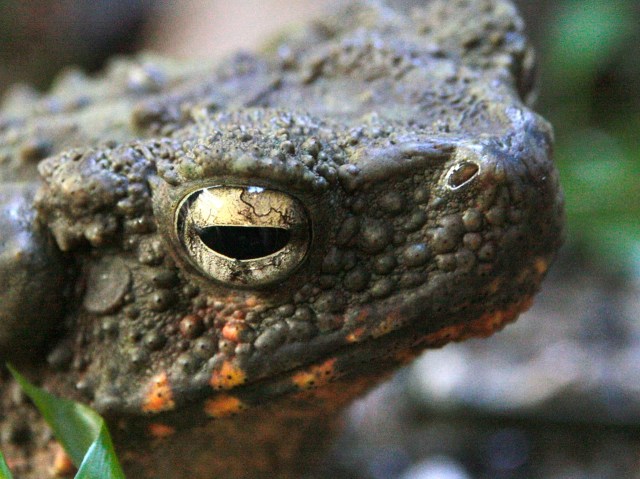
GENERAL CHARACTERISTICS: P. juxtaspera is one of the two river toads. It can get as big as a small rabbit. The toad has extensive webbing between toes and is a good swimmer; strong legs make it a good jumper as well.The warts have thoroughly keratinized apices. The warts behind the eyes (parotic glands) are thick and long (as opposed to Phrynoidis aspera). Males up to 120 mm (4.75 inches), females 215 mm (8.5 inches) snout-vent length).

DISTRIBUTION/ HABITAT: This species is widely distributed in Borneo and Sumatra. It probably occurs more widely than current records suggest, especially in areas between known sites. It occurs up to elevations of 1,600 meters. Found along rocky creeks and riverbanks. Breed in rocky-bottomed, strong flowing streams where the larvae also develop.

DIET IN THE WILD: Ants, other insects, spiders


REPRODUCTION: It breeds in rocky-bottomed, strong flowing streams where the larvae also develop.

CONSERVATION: IUCN Red list; least concern (LC) www.iucnredlist.org/details/biblio/54676/0

There are no threats to this relatively adaptable species.

REMARKS: P. juxtaspera secretes large amounts of highly toxic, milky poison from their warts when molested. Not only skin secretions of adults but also eggs and tadpoles are poisonous. However, large specimens are hunted for food in some areas: the toad is skinned, washed, and cooked. The heat denatures the toxins.

Color of Life Note: An example of cryptic coloration (coloring that conceals or disguises an animal’s shape) are the Borneo river toads. Their brownish-gray lumpy warty skin is similar to their rocky streams and riverbed habitats. Ref. California Academy of Sciences, Color of Life.

Rainforest, Borneo

References

Encyclopedia of life eol.org/pages/313980/details

Ron’s flickr http://www.flickr.com/photos/cas_docents/sets/72157608456457315/with/5355461537/

WordPress shortlink  http://wp.me/p1DZ4b-eh

Frogs of Borneo  http://www.frogsofborneo.org/index.php/bufonidae/143-bufonidae/phrynoidis/juxtaspera


TAXONOMY
Kingdom: Animalia
Phylum: Chordata
Class: Amphibia
Order: Anura
Family: Mantellidae

Genus/species: Mantella aurantiaca

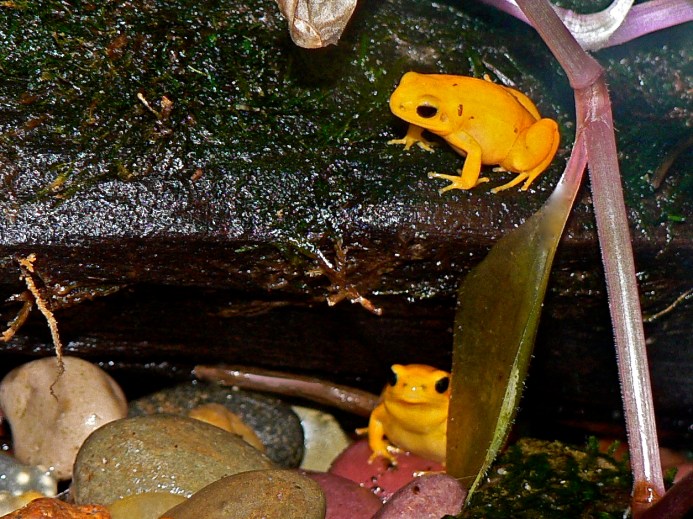
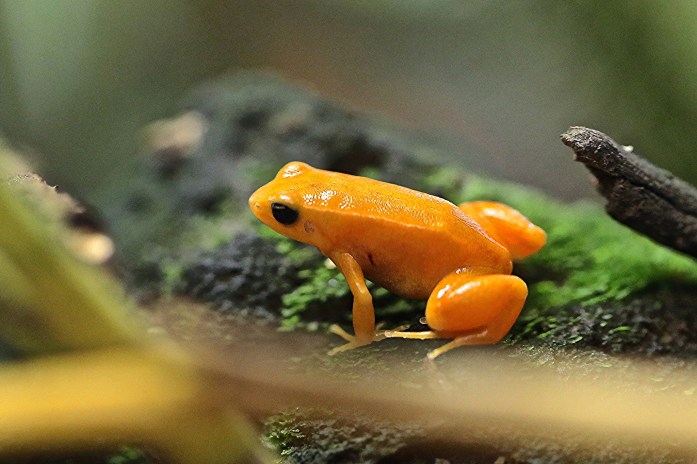
GENERAL CHARACTERISTICS: Color may be yellow, orange or gold. Eyes are black. Juveniles are black and green. Length to 3 cm (1.25 in).

GOLDEN MANTELLA TREE FROG P1060198

DISTRIBUTION/HABITAT: Endemic and very limited in west-central Madagascar. Found on sunny patches in the high montane rainforest (900 meters or 2950 feet)). Entirely terrestrial. Diurnally active.

DIET IN THE WILD: M. aurantiaca are entirely insectivorous. A diet commonly consists of termites (Isoptera), ants (Formicidae), fruitflies (Drosphila), and just about any other arthropod that can be fit into the mouth. Golden mantellas are known for attempting to eat anything, even if the taste is repulsive

PREDATORS: M. aurantiacas aposematic coloration, advertises the toxicity of skin secretions that protect it from most predators.

REPRODUCTION: Lays eggs on leaf litter during the rainy season. Egg mass requires high humidity, warmth and no direct sunlight, but not immersion. At about 10 days larvae have absorbed much of their yolk sac, the jelly surrounding the eggs liquefies and forms a communal pool for the clutch. A few days later tadpoles are washed into small pools by rain.

LIFE SPAN: About 8 years

Golden Mantella Frog9130971576_83b4631fe8_k


CONSERVATION: IUCN Red List: Critically Endangered   CITES Appendix II.
Though abundant in small areas, their distribution is extremely fragmented and limited to just a few hectares surrounded by land degraded by agriculture, timber extraction, fire, and expanding development. The pet trade until recently posed a threat to the wild population, but export has been successfully limited. The species is also being maintained and bred in captivity by some 35 zoos, aquaria, and other institutions.

REMARKS: Members of the genus Mantella have evolved to be very similar in appearance and behavior to the very distantly related poison arrow frogs of South America (family Dendrobatidae). Several species of each group are on display in the Rainforest.

Color of Life Note,  Color communicates anti-predator adaptations.: Animals with bright distinctive colors can be a warning to predators as a warning of toxicity. In the case of the Golden Mantella toxic skin secretions are an example of aposematism.
Ref: California Academy of Sciences, Color of Life Exhibit 2015

Madagascar Rainforest MA14

References

 Animal Diversity Web animaldiversity.org/accounts/Mantella_aurantiaca/

 ARKive  www.arkive.org/golden-frog/mantella-aurantiaca/

 California Academy of Sciences Docent Rainforest Training Manual 2014.

Ron’s flickr  http://www.flickr.com/photos/cas_docents/sets/72157608456457315/

Ron’s WordPress shortlink  http://wp.me/p1DZ4b-N5

TAXONOMY
Phylum: Mollusca
Class: Gastropoda (slugs, snails, nudibranchs, abalone)
Order: Archaeogastropoda (sea snails)
Family: Haliotidae (abalones)

Genus/species: Haliotis rufescens

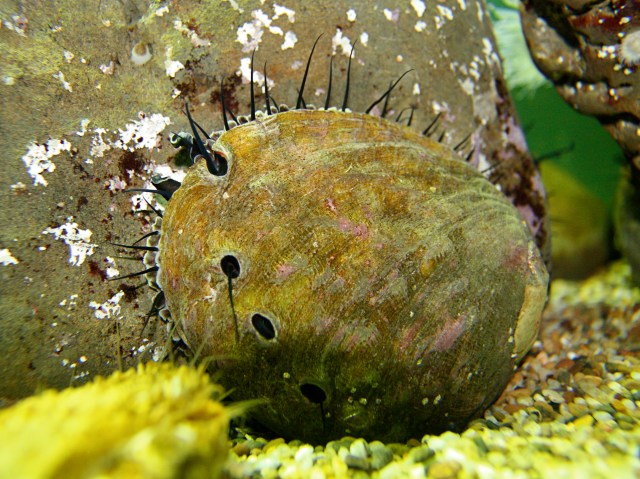
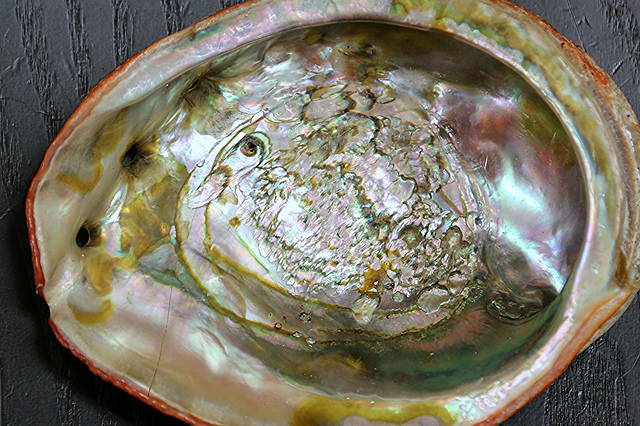
GENERAL CHARACTERISTICS: The red abalone is a large limpet-like snail with a flattened and rounded shell. The shell can reach up to 30 cm (11.8 in) in length and is usually brick-red and overgrown with fouling organisms. Color varies with diet and varies between aquamarine, green, or white. Water enters anteriorly through row of holes parallel to the rim of the shell and exits posteriorly carrying waste products and gametes. When in danger, the abalone clamps its shell tightly to the substrate, protecting soft parts of its body. The shell’s color is influenced by the animal’s diet. The red color is from the pigment phycoerythrin consumed in its red alga diet. Color varies with a diet of brown algae (varies between aquamarine, green, or white).

DISTRIBUTION/HABITAT: Red abalone are found from Oregon to Baja California. They are uncommon in the lower intertidal zone in rocky areas with heavy surf. Most are now found at six to 17 m (20 to 56 ft) depth in central California.


DIET IN THE WILD: Small abalones feed on diatoms and algae; larger animals browse the seaweeds. Red abalone eat algae, especially red and brown species. Usually foraging at night, they trap drifting pieces of algae (kelp) with the tentacles that extend from the foot. The algae is then carried by the foot to the mouth, and is torn and consumed with by the radula.

flickr Feeding Video http://www.flickr.com/photos/cas_docents/6393536637/in/set-72157626486149324


PREDATORS: Sea stars, crabs, octopuses, sea otters and human divers are among the abalone’s primary predators.

REPRODUCTION: After spawning takes place, fertilized eggs sink. Larvae develop in the plankton until they settle to the bottom, metamorphose, and begin to graze. Growth slows with increasing size and age. Mortality is very high in the planktonic stages. Mature individuals can live more than 20 years.

REMARKS: Red abalone are highly endangered due to overexploitation by the abalone fishery. The population plummeted in the late twentieth century, but poaching continues to be a problem. California passed many strict regulations to protect the red abalone: abalone smaller than 20 cm (8 in) in diameter are protected, the canning of abalone is prohibited, and the shipment of fresh or frozen meat out of California is prohibited. Red abalone is the only species that can still be fished. Aquacultured abalone is now increasingly available.

Abalone blood is blue-green and cannot clot making injury possibly fatal.

Red Abalone Shell19600303421_7eae835178_z

Color of Life note: Iridescence is caused by two or more semi-transparent, inorganic and/or organic surfaces that cause multiple light reflections. An example found in our tidepool is the Red Abalone inner shell surface which produces an impressive vibrant luster when exposed to light.  The aragonite and conchiolin secreted by the abalone in forms a crystalline structure that reflects light, causing the shell’s iridescence. The inner surface of the shell is known as mother-of-pearl, or nacre. Ref: California Academy of Sciences, Color of Life Exhibit 2015   Jewelry is still made from abalone shells and is quite popular.                        Ref: www.best-deal.com/search/landing/query/red+abalone+shells...


Other references

Marine Biology Coloring book, T.M. Nielsen, 2nd Ed. Harper Resource 1982, 2000.

Encyclopedia of Life  eol.org/pages/620396/details

Monterey Bay Aquarium  www.montereybayaquarium.org/animal-guide/invertebrates/ab…

California Fish and Game www.dfg.ca.gov/marine/pdfs/response/abalone.pdf

Ron’s flickr https://www.flickr.com/photos/cas_docents/6393536637/in/album-72157608597736188/


TAXONOMY
Kingdom: Animalia
Phylum: Chordata
Subphylum: Vertebrata (chordates with backbones)
Class: Reptilia (turtles, crocodilians, snakes, lizards and tuatara
Order: Squamata (scaled reptiles)
Suborder: Serpentes (snakes)
Family: Pythonidae (pythons)

Genus/species: Morelia viridis

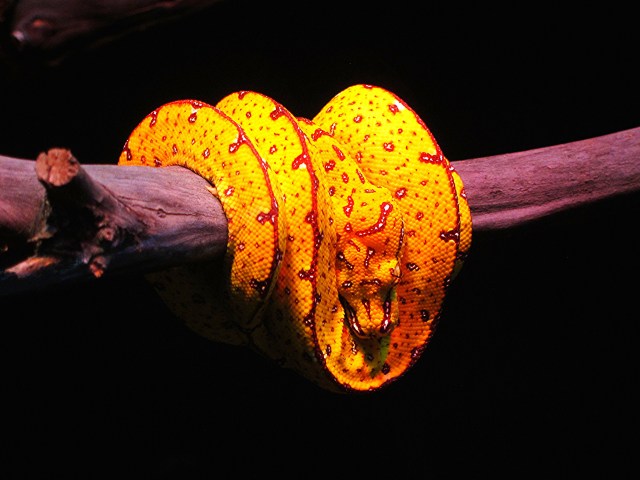
GENERAL CHARACTERISTICS: Adults are green with a distinct ridge of scales that is usually white to yellow in coloration and forms a broken or continuous line down the length of the body.
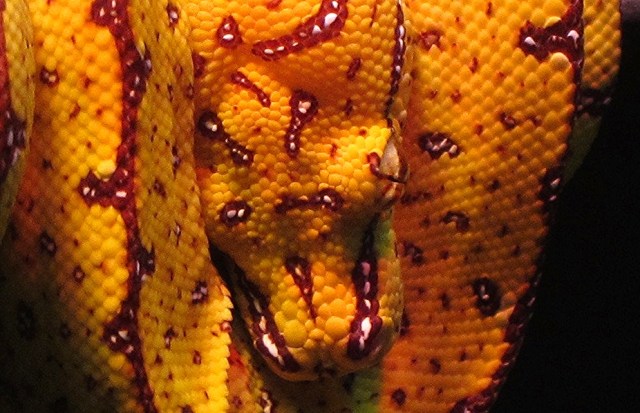
Ventrally, the scales are generally yellow. Juveniles may be either bright yellow or brick-red. They have series of white blotches edged in black or brown. A white streak edged in black runs from the nostril through the eye and to the back of the head.
Average length of 1.5 m (5 ft); with the largest up to 2.2 m (7.2 ft).


Morelia viridis18399138824_510cf00ea1_k

DISTRIBUTION/HABITAT: Found in the Mainland New Guinea, its offshore islands, and in eastern Indonesia and in the northeast Cape York Peninsula of Australia. Found mainly in moist forests from lowland to mid-montane altitudes.

DIET IN THE WILD: They are nocturnal hunter when larger nocturnal prey are active as well. M. viridis changes color when it changes its diet from small reptiles and invertebrates to rodents and birds in the rainforest canopy.

Morelia viridis19021843505_b2a60523a7_o

REPRODUCTION: M. viridis exhibit some maternal care by brooding their eggs before they hatch. Females have been observed coiling around their clutches. They will often shiver and contract their coils, apparently to produce metabolic heat and thus maintaining a temperature, which ranges from 84 to 88 degrees Fahrenheit.
Yellow and red individuals averaging 30.5 cm (12.8 inches) in length hatch out of 6 to 32 eggs in captivity but colors are separate on different islands.

PREDATORS: Main predators of green tree pythons are rufous owls, black butcherbirds, and an assortment of diurnal raptors.

CONSERVATION: IUCN Red List Least Concern (LC)
Threats: It is becoming increasingly popular in the pet trade.

REMARKS: Each color stage appears to provide camouflage suitable to its immediate habitat. As a young snake, the red or yellow color blends in better in forest gaps or edges, where smaller animals reside. Adult green coloration blends in best in the closed canopy of the rainforest, where larger prey live.

References

California Academy of Sciences, Color of Life exhibit June 2015

IUCN Red List www.iucnredlist.org/details/177524/0

Animal Diversity Web  animaldiversity.org/accounts/Morelia_viridis/

Ron’s flickr https://www.flickr.com/photos/cas_docents/18399138824/in/album-72157652559028013/

Ron’s WordPress shortlink http://wp.me/p1DZ4b-1xT

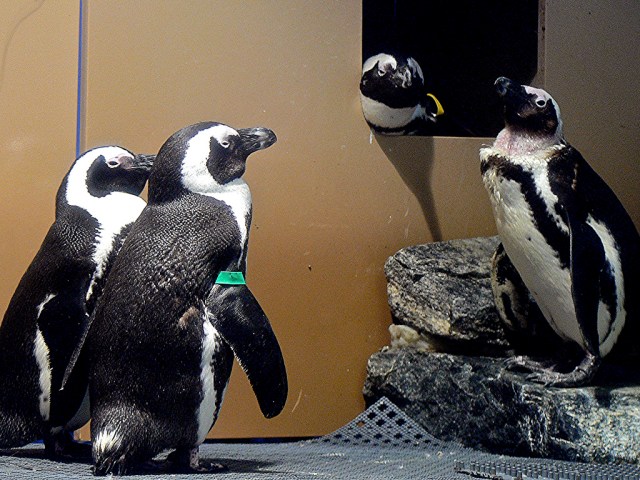
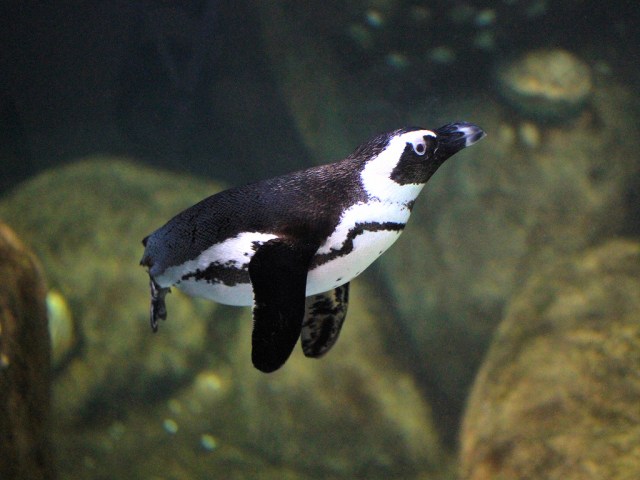
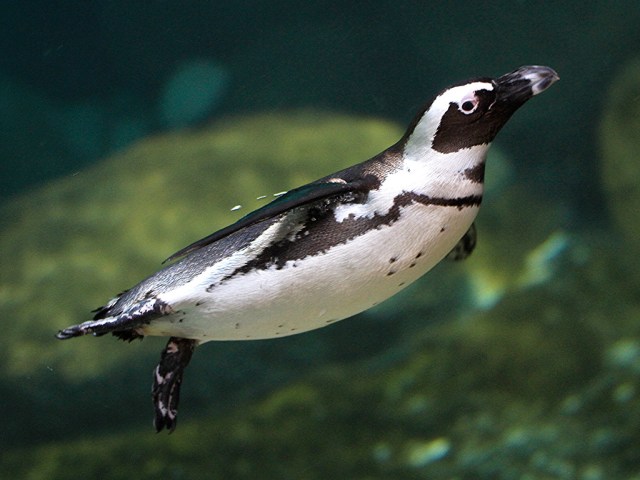
Color of Life note: The blackish-grey top surface of the African Penguin camouflages it from predators above it and the mostly white underside does the same for predators below it.

TAXONOMY
Kingdom:Animalia
Phylum: Chordata
Subphylum: Vertebrata
Class: Aves (birds)
Order: Sphenisciformes (Penguins )
Family: Spheniscidae

Genus/species: Spheniscus demersus

GENERAL CHARACTERISTICS: Like most birds with shared parental duties, sexes are similar in appearance. Adults: upper parts blackish-grey, underparts mostly white with inverted black horseshoe extending down flank to thigh. Feet and legs black. Chicks arrive with secondary down feathers. Juveniles are grey blue and immatures gradually come to resemble adults in approx. 3 years..
Length up to To 70 cm (28 inches) tall.
Weight up to 3.5 kg (7.7 lb)

4546692496_18964c0e05_b

DISTRIBUTION/HABITAT: Found off the Coasts of South Africa and
Namibia. Nests in colonies mainly on offshore islands. Rarely encountered more than 8 km from islands or mainland.4545404530_496c8cf6b1_b

DIET IN THE WILD: Piscivorous. They feed primarily on shoaling fishes such as anchovies, mackerel and herring. They can reach a top speed of close to 20 km/h (12 mph). On the west coast a typical foraging trip could range from 30 to 70 km (18-44 miles) for a single trip. On the south coast, foraging birds cover an average of 110 km (68 miles) per trip.

Academy diet: Vitamin fortified herring, and capelin.

5230397759_d463c01f85_b

REPRODUCTION: S. demersus are monogamous colonial nesters. They dig nesting burrows.and lays 2 eggs which are then incubated by both parents for about 40 days. The pair feeds their young for about one month by regurgitating food into the hatchling’s mouth.The average time to independence is 80 days.

LONGEVITY: May live to at least 25 years.

PREDATORS: Seals in the water and mongooses, large-spotted genets and leopards on land. Eggs and chicks are eaten by feral cats, Kelp gulls and Sacred Ibises.

CONSERVATION: IUCN Red List: Vulnerable (VU) 2010

Threats: Depleted fish stocks, human collection of penguin guano fertilizer, oil pollution and collection of eggs in the past have resulted in a 90 percent drop in the population since 1900.

REMARKS: The alternate common name “jackass” is a reference to its donkey-like vocalization.

California Academy of Sciences penguins
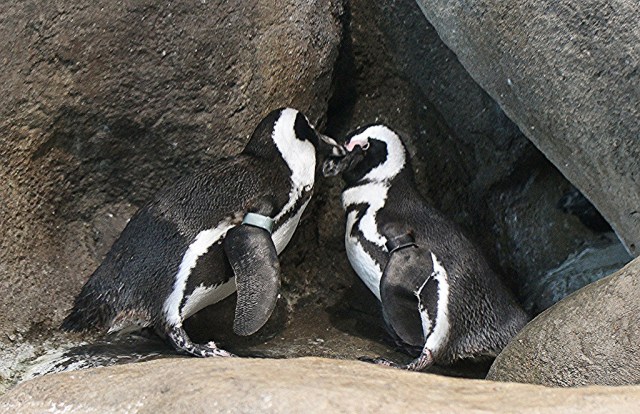
Wing bands identify males females and couples. Males right, females left and couples are the same color.

African penguins are finding a strong ally in the Species Survival Plan (SSP), a program sponsored by the California Academy of Sciences and 53 other zoos and scientific institutions in the U.S. and Canada. The captive population acts as a reservoir for genetic diversity, and could eventually be used to bolster wild penguin populations.
See the Academy web site below for more information and a 24 hour web cam.

4544769957_4534b0d012_b

Penguins constantly work to keep their feathers clean, well-oiled, and waterproofed. They preen their feathers by nipping at an oil glad at the base of their tail to express oil which transferred to their beaks and then to their body feathers.

References

Ron’s flickr  https://www.flickr.com/photos/cas_docents/4569783089/in/album-72157623916364716/

California Academy of Sciences  www.calacademy.org/explore-science/common-penguin-behaviors

California Academy of Sciences www.calacademy.org/explore-science/live-penguin-cams

BirdLife International www.birdlife.org/datazone/speciesfactsheet.php?id=3861

ARKive  www.arkive.org/african-penguin/spheniscus-demersus/

Animal Diversity Web  animaldiversity.org/accounts/Spheniscus_demersus/

IUCN Red List  www.iucnredlist.org/details/22697810/0

Ron’s WordPress shortlink  http://wp.me/p1DZ4b-1xH


TAXONOMY
Kingdom: Animalia
Phylum: Chordata
Class: Amphibia
Order: Anura (frogs)
Family: Hyperoliidae (sedge and bush frogs)

Genus/species: Hyperolius riggenbachi

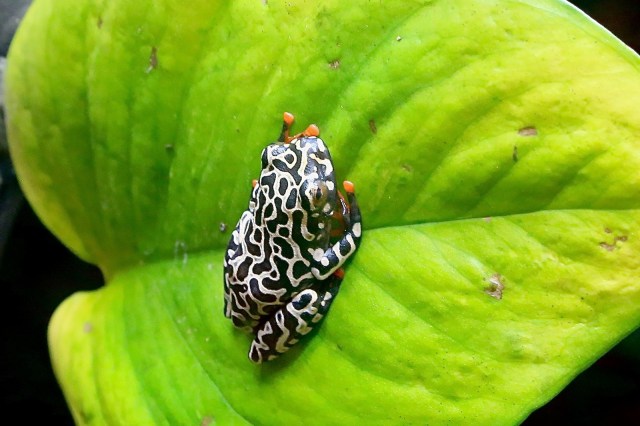
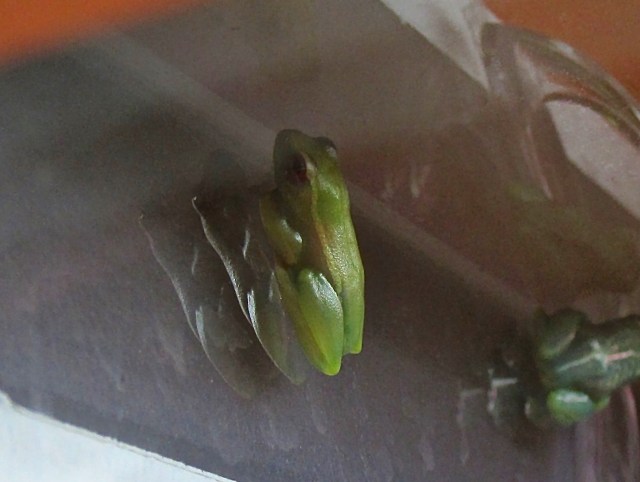
GENERAL CHARACTERISTICS: Phase J (juveniles and many mature males) are green with light canthal and dorsolateral stripes. Phase F (mature females and some mature males) have a vermiculated pattern in yellow, red and black. Toes and fingers red. Pupils are horizontal and toes and fingers are red.
Males length up to 27–30 mm (1-1.2 inches), females larger up to 40 mm (1.6 inches).

female and some malesRiggenbach's reed frog18517011003_c5ff421b61_h

DISTRIBUTION/HABITAT: Highlands of Eastern Nigeria and Central Cameroon. Found in wetlands and small wooded watercourses in montane grassland.

maleRiggenbach's reed frog19111242432_cdd15294a9_o

DIET IN THE WILD: Small invertebrates.

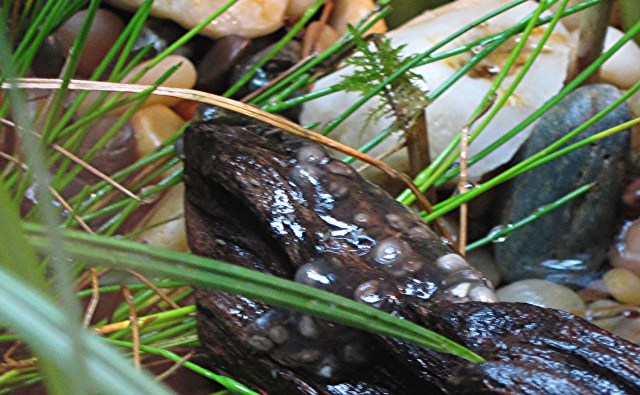
REPRODUCTION: H. riggenbachi breeds in still water near streams.

 egg mass belowRiggenbach's reed frog18691210596_603d27a367_o


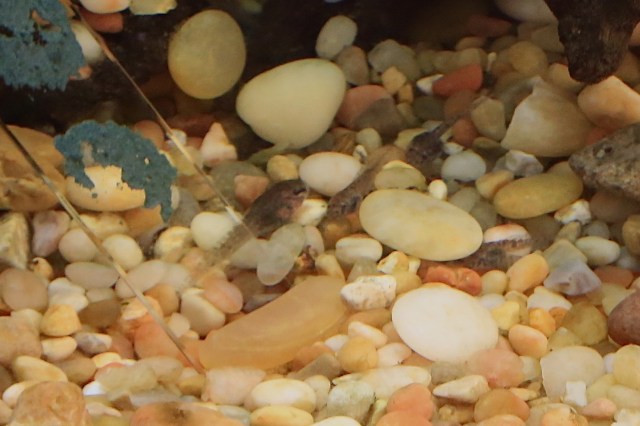
tadpoles below

Riggenbach's reed frog19111466876_92958680e5_o

CONSERVATION: IUCN: Vulnerable (VU) 2014
Threatened by habitat loss caused by agricultural activities, wood collection, and human settlement.

References

David C. Blackburn PhD Associate Curator Herpetology California Academy of Sciences. personal communication 2015

IUCN Red List www.iucnredlist.org/details/56198/0

ARKive  www.arkive.org/riggenbachs-reed-frog/hyperolius-riggenbachi/

Amphibiaweb.org  www.amphibiaweb.org/cgi-bin/amphib_query?where-genus=Hype…

Ron’s flickr www.flickr.com/photos/cas_docents/19141066501/in/album-72157652559028013/

Ron’s WordPress shortlink  http://wp.me/p1DZ4b-1xy


TAXONOMY

Kingdom: Animalia
Phylum: Arthropoda
Class: Insecta
Order: Phasmatodea (stick insects, phasmids, ghost insects and leaf insects)
Superfamily: Phyllioidea
Family: Phylliidae (true leaf insects or walking leaves)

Genus/species: Phyllium giaganteum

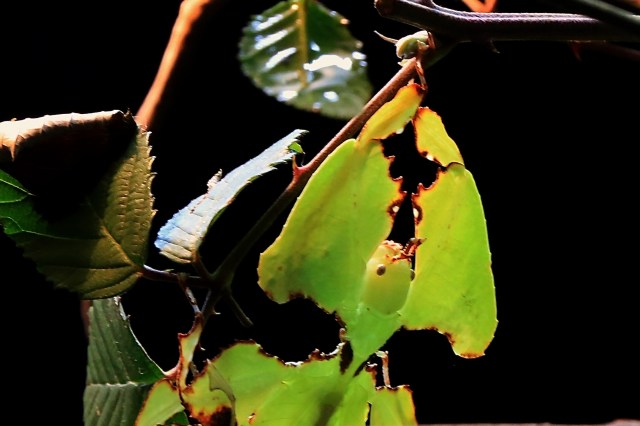
GENERAL CHARACTERISTICS: Use camouflage to mimic leaves and even waver when they walk like leaves blowing in the wind.

Giant Malaysian leaf insect19131910632_d71d7691e0_o

DISTRIBUTION/HABITAT: Southeast Asia to Australia

Giant Malaysian leaf insect18951496529_05edfe0096_o

DIET IN THE WILD: Plant leaves including Oak and bramble

Giant Malaysian leaf insect19141065381_b24c18b8d4_o

REPRODUCTION: Males are hard to find so females are able to reproduce by laying unfertilized eggs that grow into more females.

References

California Academy of Sciences Color of life exhibit, June 2015

Encyclopedia of Life  eol.org/pages/1077423/overview

Ron’s WordPress shortlink  http://wp.me/p1DZ4b-1xg

Ron’s flickr  https://www.flickr.com/photos/cas_docents/19131910632/in/album-72157652559028013/