Latest Entries »

TAXONOMY
Kingdom: Animalia
Phylum: Chordata
Class: Reptilia
Order: Squamata
Suborder: Serpentes
Family: Colubridae (Colubrids)

Genus/species: Ahaetulla fronticincta


IMG_5338

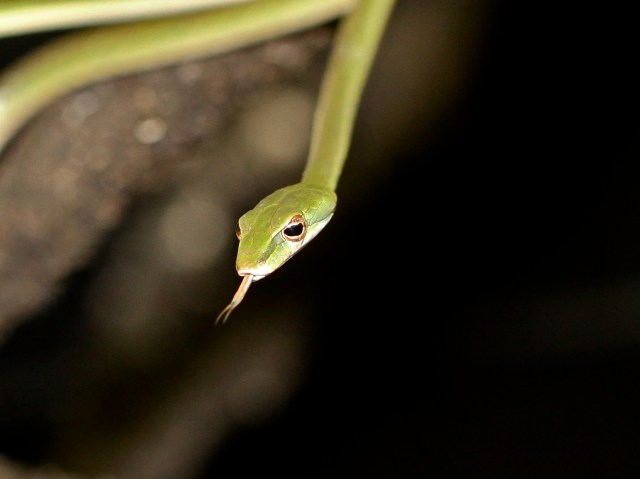
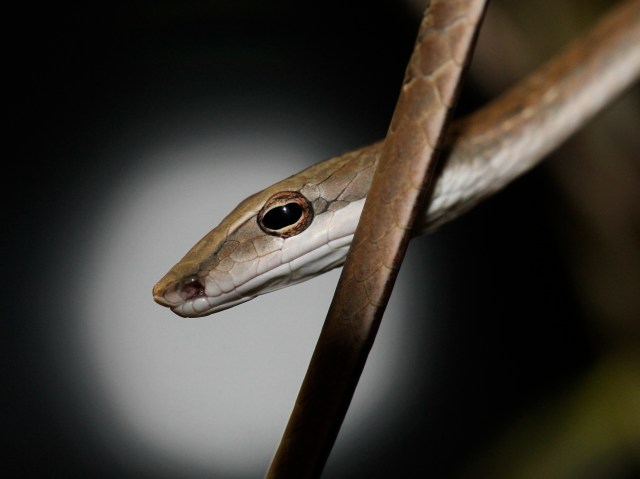
GENERAL CHARACTERISTICS: Pencil thin, delicate; green and brown scales. Bulbous wide-set raised eyes.   Length to 60 cm (23.5 inches). 

DISTRIBUTION/HABITAT: Myanmar (formerly Burma) Mostly arboreal in brackish mangrove swamps. Diurnal hunter of small fish: gobies, and rice fish. 

IMG_8805

DIET IN THE WILD: Diurnal hunter of small fish: gobies, and rice fish. Prey immobilized with mild venom  from enlarged rear fangs. Visually oriented hunter.

REPRODUCTION: Fertilization internal. Viviparous. Newborn snakes are a subtle shade of brown. Polymorphic: some adults turn green, brown, or more rarely two-toned.
The Steinhart Aquarium was the first to display this species. Academy field research on this little-known species continues. An arboreally-adapted species that consumes fishes is an oddity. In the Steinhart, feed on guppies and goldfish. Steinhart’s vine shakes have bred and reproduced in captivity, a first for this species.

IMG_1259

Color is Life: Pencil thin, delicate; green and brown scales conceal these snakes in the bushes along the banks of tidal rivers in brackish mangrove swamps.

CONSERVATION: IUCN  Least Concern (LC)

Water Planet, Feeding Cluster 

References

California Academy of Sciences Water is Life Exhibit

https://search.yahoo.com/search?ei=utf-8&fr=aaplw&p=steinhart+Burmese+Vine+Snake+video

IUCN Red List  www.iucnredlist.org/details/192058/0

Encyclopedia of Life  eol.org/pages/1057253/details

Ron’s flickr  http://www.flickr.com/photos/cas_docents/sets/72157608449603666/

Ron’s WordPress Shortlink  http://wp.me/p1DZ4b-OM

TAXONOMY
Kingdom: Animalia
Phylum: Chordata
Class: Reptilia (snakes, worm lizards, lizards, alligators, caimans, crocodiles, tortoises, turtles, and tuataras)
Order: Squamata (scaled reptiles, all lizards and snakes)
Family: Chamaeleonidae Chameleons

Genus/species: Furcifer pardalis


GENERAL CHARACTERISTICS: This arboreal species has a laterally compressed body, prehensile tail, zygodactylous feet, protruding eyes covered with muffler-like lids, independent eye rotation and an extensile tongue. length to 23 cm (9.06 in).

A popular misconception is that chameleons change color to match their surroundings. While chameleons can in fact, change color, they are limited by a natural range of color unique to each species and, in the case of the panther chameleon, unique to the locales within the species. Color change occurs based on temperature, lighting, time of day, and the individual’s mood. It is also a way for the chameleons to communicate with one another.  Ref. Academy Rainforest blog 2-10-14      

DISTRIBUTION/HABITAT: Endemic to Madagascar, the panther chameleon is found in lowland areas of the northeast and east, where it is locally abundant. They prefer humid disturbed scrub and forest. 

DIET IN THE WILD: F. pardalis forages diurnally for insects, small vertebrates and vegetation.

REPRODUCTION: Lays 10–46 eggs after about 45 days following copulation. Can produce four clutches per year. Young hatch 4–9 months later, depending on climatic conditions. Growth is rapid. Sexual maturity at 6–9 months.


PREDATORS: The most common threat to chameleons are birds — as these are diurnal canopy searching predators with excellent vision.  At night, roosting chameleons are also vulnerable to rats, mouse lemurs, arboreal tenrecs, carnivores, and snakes. But they usually choose sleeping points at the ends of thin branches or leaves, and will drop off if they feel vibrations towards them.

CONSERVATION: IUCN Red List No Special Status. CITES Appendix II. In 1998, 34,000 wild-taken of this species were exported from Madagascar for the pet trade. CITES established an export quota of 2,000 in 1999. The facts that this chameleon has populated disturbed areas and is one of the few chameleons that is bred outside of Madagascar on a commercial basis have supported its survival rate.

REMARKS: Chameleons also are known for their unusual grasping feet ideally adapted to climbing and for their long tongues that, missile-like, can project to remarkable distance to capture prey.

The independent rotation of their eyes allows chameleons to see where they’re going and where they’ve been at the same time or even to recognize a prey item in the foreground and a predator behind.

Color of life note: The Panther Chameleon uses cryptic coloration (conceals or disguises an animal’s shape) by changing the colors of its skin to make them look similar to its surroundings.

This change occurs through active tuning of a lattice of guanine nanocrystals within a superficial thick layer of dermal iridophores. These nanocrystal act like the structural lattice of the Blue Morpho butterfly but in the chameleon the nanocrystal are moved to create different color reflections of structural light. 

Nature  http://www.nature.com/ncomms/2015/150302/ncomms7368/full/ncomms7368.html

Other References

California Academy of Sciences Rainforest Docent Training Manual 2014

Animal Diversity Web (ADW) animaldiversity.org/accounts/Furcifer_pardalis/

Ron’s flickr http://www.flickr.com/photos/cas_docents/sets/72157608449603666/ 

Ron’s WordPress shortlink  http://wp.me/p1DZ4b-zQ

TAXONOMY
Kingdom: Animalia
Phylum: Chordata
Class: Actinopterygii (ray-finned fishes)
Order: Cyprinodontiformes (Rivulines, killifishes and live bearers)
Family: Nothobranchiidae (African rivulines)

Genus/species: Fundulopanchax gardneri mamfensis

GENERAL CHARACTERISTICS: Max length : 6.0 cm (2.35 in).

Killifish20776631555_95cc874e24_kDISTRIBUTION/HABITAT: Africa; Equatorial Western Guinea. Found in temporary freshwater marshes and pools.
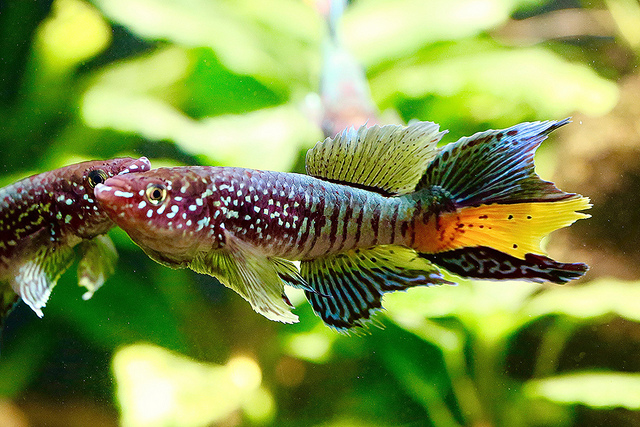
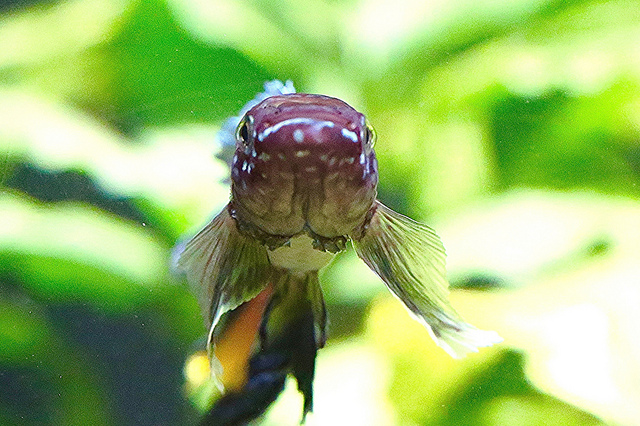
DIET IN THE WILD: This killifish feeds on aquatic insect larvae, and other small invertebrates.

REPRODUCTION: Mate and lay eggs in the water. The eggs remain dormant until seasonal rains return. The dormant eggs can be mailed to different locations and will hatch upon the addition of water.

CONSERVATION: IUCN Red List: Endangered (EN) 8-26-15
Threats: deforestation of Habitat.

References

California Academy of Sciences, Water is life 2015

fishbase  www.fishbase.org/summary/56567

IUCN Red List  www.iucnredlist.org/details/183140/0

Ron’s flickr https://www.flickr.com/photos/cas_docents/20776631555/in/photostream/

WordPress shortlink  http://wp.me/p1DZ4b-1Ac

TAXONOMY
Kingdom: Animalia
Phylum: Chordata
Class: Actinopterygii (ray-finned fishes)
Order: Anguilliformes (Eels and morays)
Family: Congridae (Conger and garden eels)
Subfamily: Heterocongrinae

Genus/species: Gorgasia preclara

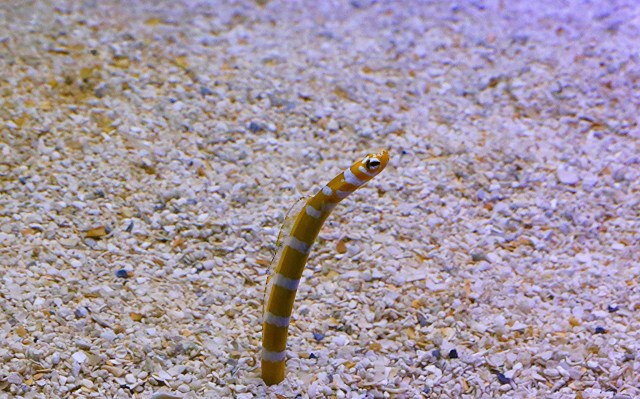
GENERAL CHARACTERISTICS: Its yellow to orange with characteristic white bands body has a circular shape with a diameter of about 10 mm (0.4 in). Length up to 40 cm (15.75 in) maximum.
Typically, only its head and upper body protrudes from the sand where the garden eel lives in a buried tube in the sand either alone or in small groups.

Garden Eel20776620435_68e152af6d_k

DISTRIBUTION/HABITAT: Found in the Indo-West Pacific in sandy areas exposed to currents at depths between 18 and 75 m (60-245 ft), but is usually observed at an average depth of 30 m (100 ft).

DIET IN THE WILD: Plankton

CONSERVATION: Not Evaluated

References

fishbase  fishbase.org/summary/Gorgasia-preclara.html

California Academy of Sciences Water is life Exhibit 8-20-15

Ron’s flickr  https://www.flickr.com/photos/cas_docents/20776620435/in/dateposted/

WordPress shortlink http://wp.me/p1DZ4b-1zP


TAXONOMY

Kingdom: Animalia
Phylum: Chordata
Class: Actinopterygii (ray-finned fishes)
Order: Cyprinodontiformes (Rivulines, killifishes and live bearers)
Family: Nothobranchiidae (African rivulines)

Genus/species: Fundulopanchax sjostedti

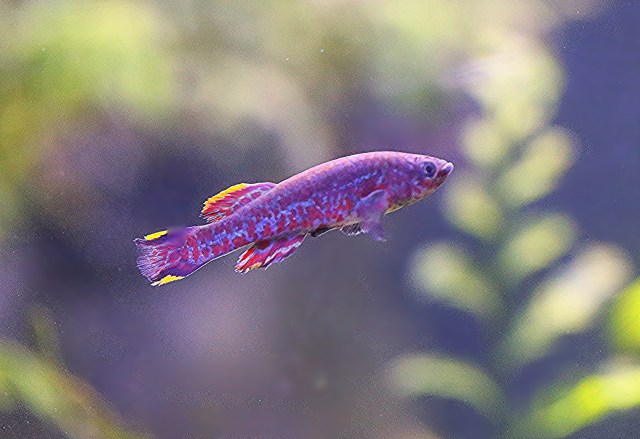
GENERAL CHARACTERISTICS: Brightly colored killifish.

Blue Gularis Killifish20750345676_f4b54fecfe_z

DISTRIBUTION/HABITAT: Africa: Niger delta in southern and southeastern Nigeria and southwestern Cameroon. Found in temporary swamps, raphia-swamps and swampy parts of slow flowing brooks in the swampy coastal rainforest.

DIET IN THE WILD: Insect Larvae

20767185002_4d90ae95ba_z

REPRODUCTION: Bottom spawner. It lays eggs in the mud which drys out during the dry season. The adults die but the eggs lie dormant and hatch when the rains return.

IUCN Red List: Least Concern (LC)

References

California Academy of Sciences, Water is life exhibit 2015)

fishbase fishbase.org/summary/9792

IUCN Red List www.iucnredlist.org/details/full/181696/0

Ron’s flickr  https://www.flickr.com/photos/cas_docents/20589851839/in/dateposted/

WordPress shortlink  http://wp.me/p1DZ4b-1zH

TAXONOMY
Kingdom: Animalia
Phylum: Arthropoda
Subphylum: Crustacea
Class: Malacostraca
Order: Stomatopoda
Family: Odontodactylidae

Genus/species: Odontodactylus scyllarus

6179234815_63ae89f1c0_b

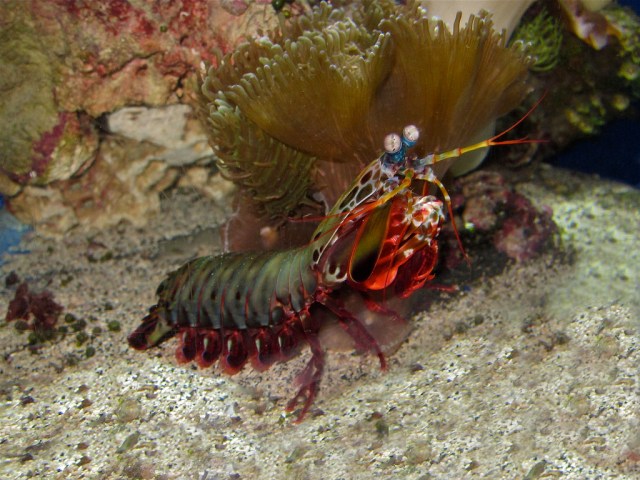
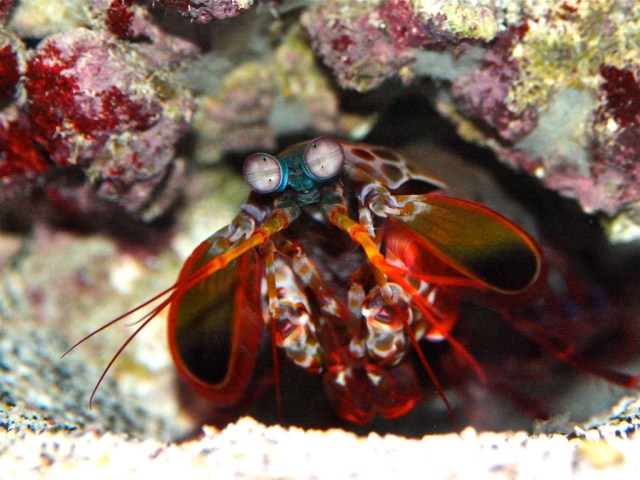
GENERAL CHARACTERISTICS: Beautifully colored in peacock colors of greens, blues, and reds. Has a green body, blue head, green antennal scales, red limbs. The body is elongated with a long, flattened , blue tail and ranges in size from 3–18 cm (1.2-7.0 in). Highly noticeable is the pair of clubbed-shaped, praying mantis-like claws..

DISTRIBUTION/HABITATS: Indo-Pacific Habitat: warm salt water and builds U-shaped burrows in gravel substrates. Depth ranges from 3-40 m (10-131 ft).

DIET IN THE WILD: Feeds on other shrimp, worms, snails, crabs, mollusks. Lies in wait for prey in front of burrow, then swims out and quickly crushes prey with a strong, powerful smash. The claw moves so quickly it generates cavitation bubbles, which explode with a second powerful burst. The speed with which the claw moves through the water generates a force 100 times the shrimp’s body weight.

REMARKS: Large peacock mantis shrimp generate forces powerful enough to crush the shell of a large conch, and have been known in captivity to break the glass of their tanks!

The amazingly complex eyes of mantis shrimp detect 12 base colors (compared to our 3). They also can discern ultraviolet, infrared frequencies, and the polarization of light.

3751466248_44af0964d4_b

Color of Life note
Biofluorescence results from the absorption of electromagnetic radiation at one wavelength by an organism, followed by its reemission at a longer and lower energy wavelength, visually resulting in green, orange, and red emission coloration. Many species of mantis shrimp, for example, make use of fluorescent body parts when in threat display in order to intimidate or confuse either a predator or a competing male.
Ref: Color sources, California Academy of Sciences Docent program May 2015

References

Animal Diversity Web animaldiversity.org/accounts/Odontodactylus_scyllarus/

Plos one   http://journals.plos.org/plosone/article?id=10.1371/journal.pone.0083259

Ron’s WordPress shortlink  http://wp.me/p1DZ4b-We

Ron’s flickr  http://www.flickr.com/photos/cas_docents/sets/72157608602469734/

TAXONOMY
Kingdom: Animalia
Phylum: Chordata
Class: Mammalia
Order: Rodentia
Family: Muridae
Genus/species: Mus musculus

GENERAL CHARACTERISTICS: it has a dull greyish-brown fur and the tail, which is the same length as the body, It has a
distinctive strong ‘stale’ odor. Length: 6 – 10 cm (2.36 – 4 inches)

IMG_8925 (1)

DISTRIBUTION/HABITAT: Global, origin probably Mediterranean

DIET: House mice are typically active at night eating invertebrates, most human food and more.

IUCN Red List Least Concern (LC)

REMARKS: The House Mouse is partially color blind communicating with squeaks, ultrasonic calls and pheromones.

Predators such as pit vipers, boas and pythons have heat sensing organs which detect infrared wavelengths on their face. This feature that detects heat is used in the dark to detect warm-blooded prey such as mice.

M. musculus is one of the most widely distributed and successful mammals in the world.

References

Ron’s flickr https://www.flickr.com/photos/cas_docents/19826905554/in/album-72157652559028013/

Ron’s wordpress shortlink  http://wp.me/p1DZ4b-1z2

ARKive www.arkive.org/house-mouse/mus-musculus/

California Academy of Sciences Color of Life Exhibit 2015

TAXONOMY
Kingdom: Animalia
Phylum: Chordata
Subphylum: Vertebrata
Class: Reptilia
Order: Squamata
Suborder: Serpentes
Family: Viperidae

Genus/species: Crotalus adamanteus

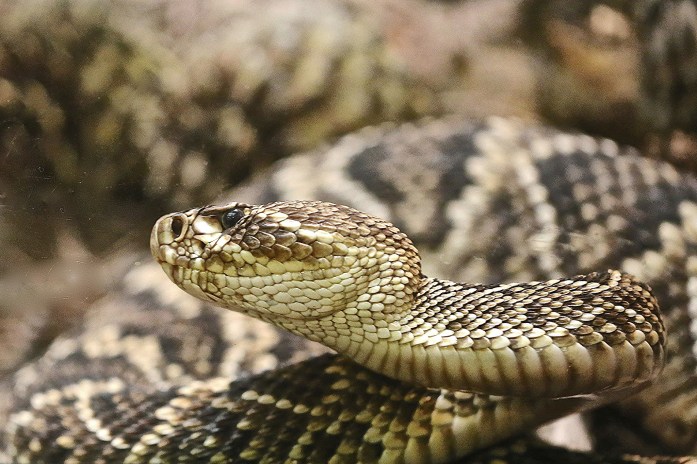
GENERAL CHARACTERISTICS: They have a large head with a light bordered dark stripe running diagonally through the eye and a large pit between the nostril and eye.. The body is bulky with a row of large dark diamonds with brown centers and cream borders down its back. The ground color of the body ranges from olive, to brown, to almost black. The tail has a well-developed rattle. Maximum length to 7 feet (average length 33 to 72 inches).

2996206695_40cbd1ebb7_b

DISTRIBUTION/HABITAT: Endemic to the southeast of the United States. Found in in the coastal lowlands, barrier islands. Occasionally it may venture into salt water, swimming to the outlying Keys off the Florida coast.

DIET IN THE WILD; C. adamanteus is crepuscular and are most active in the evening or early morning. They feed primarily on small mammals, from mice to rabbits. Location of the prey is by odor, as well as by sensing the infrared waves (heat) given off by their warm-blooded prey.

8727976198_ac774801e6_k

REPRODUCTION: Brood size ranges from 6 to 21. The gestation period is six to seven months. Young are born live, in retreats such as gopher tortoise burrows or hollow logs and can live over 20 years.

PREDATORS: Young are taken by hogs, carnivorous mammals (the gray fox), raptors (the red-tailed hawk), and other snakes (especially king snakes). Adults have no natural predators.

CONSERVATION: Red List (LC) Least concern but the population is decreasing due to fragmentation by agriculture, forestry practices and urbanization.

REMARKS: It preys on rats, mice, rabbits, and other small mammals, many of which are pests to humans.
It can strike up to 2/3 its body length; a 6-foot specimen may strike 4 feet. It has potent venom with a mortality rate for humans is nearly 40 percent. The only acceptable treatment for venomous snakebite, involves the use of antivenom.

Color of Life note: Pit vipers, boas and pythons have heat sensing organs which detect infrared (IR) wavelengths on their face.  The snake can tell the direction from which a signal originates, depending on where the nerve signal strikes a membrane. This partnership between heat detection and visual sensory inputs allows the snake to detect its warm-blooded prey, even when it is too dark to pick out prey from the background.

Ref: California Academy of Sciences Color of Life Exhibit 2015.

References 

Ron’s flickr https://www.flickr.com/photos/cas_docents/8359753686/in/album-72157652559028013/

Ron’s WordPress shortlink http://wp.me/p1DZ4b-1yT

Florida Museum of Natural History www.flmnh.ufl.edu/herpetology/fl-snakes/list/crotalus-ada…

IUCN Red List  www.iucnredlist.org/details/64308/0

Animal Diversity Web  animaldiversity.org/accounts/Crotalus_adamanteus/

TAXONOMY
Kingdom: Animalia
Phylum: Chordata
Class: Actinopterygii (ray-finned fishes)
Order: Perciformes (Perch-likes)
Family: Serranidae (Sea basses: groupers and fairy basslets)

Genus/species: Hypoplectrus gummigutta

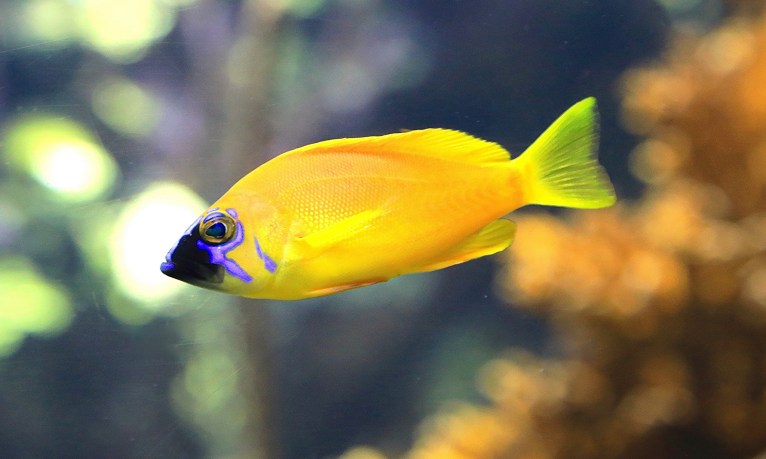
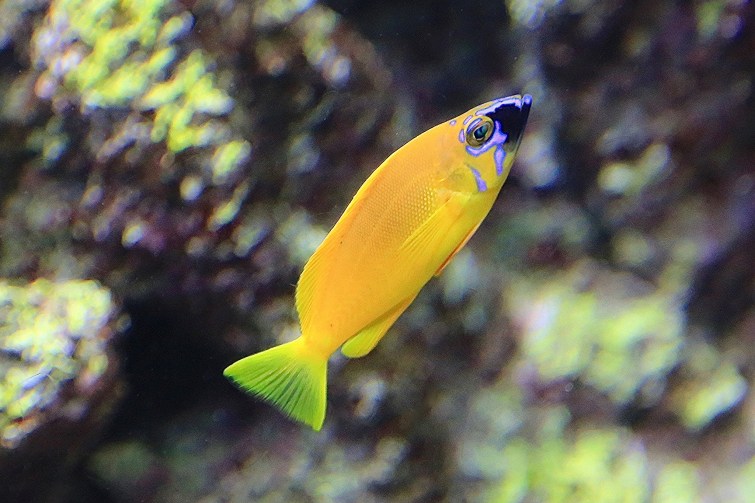
GENERAL CHARACTERISTICS: Body rich chrome-yellow in color. The snout is black bordered by an iridescent blue. Pectoral fins pigmented. Hamlet “species” are defined primarily on differences in color patterns. They are known to interbreed and hybridize freely with very little consistent genetic differentiation amongst them.

Golden Hamlet19442208331_9807a11d99_k

DISTRIBUTION/HABITAT: H. gummigutta is rare and found in the Western Central Atlantic. It is coral reef associated.

CONSERVATION: IUCN: Least Concern (LC)

No known major threat but juveniles are potentially a prey item of the invasive Lionfish.


Golden hamlet18815471474_4ab1413005_k

REPRODUCTION: The Golden Hamlet is a simultaneous hermaphrodite (possesses both male and female sex organs).  Successful spawning requires two individual fish.

Color of Life note: Brightly colored fish seem to jump into your sight. But underwater, these bright colors mingle with those of other fish, reef creatures, and the coral itself, to offer a mixtures of color and patterns in which no one individual stands out. Movement of the anemones and corals in the current also serve to obscure and protect the fish.
Ref: California Academy Academy of Sciences, Color of Life Exhibit 2015

References

Ron’s flickr  https://www.flickr.com/photos/cas_docents/19442208331/in/album-72157652559028013/

Ron’s WordPress shortlink  http://wp.me/p1DZ4b-1yL

Reef builders.com (an excellent description of the Caribbean reef exhibit at the California Academy of Sciences). http://reefbuilders.com/2015/03/24/steinhart-aquariums-caribbean-display-realistic-biotope-representation/#

fishbase  www.fishbase.org/summary/Hypoplectrus-gummigutta.html

IUCN Red List  www.iucnredlist.org/details/16751128/0

TAXONOMY
Kingdom:Animalia
Phylum: Chordata
Class: Actinopterygii (ray-finned fishes)
Order: Salmoniformes (Salmons)
Family: Salmonidae (Salmonids)
Subfamily: Salmoninae

 Genus/Species: Oncorhynchus tshawytscha

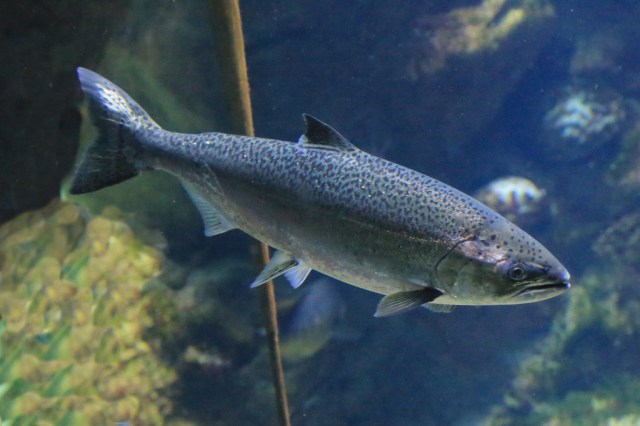
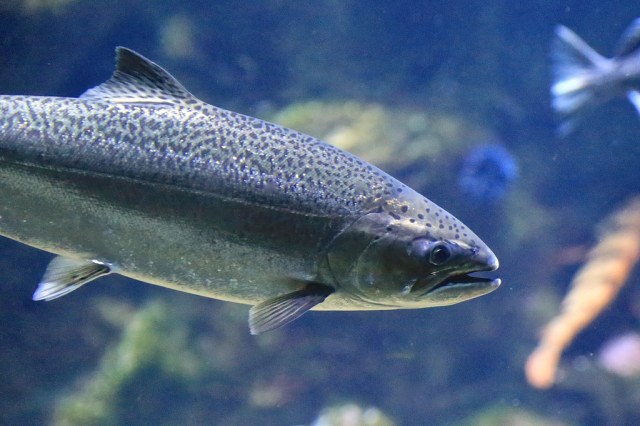
Chinook Salmon aka King Salmon14630212572_bab25a96d9_b

 GENERAL CHARACTERISTICS: Largest species in the Pacific salmon (Oncorhynchus) genus. Max length :150 cm.(59 inches). Max wt. 64 kg (140 pounds). They average 10 to 50 pounds (4.5 to 22.7 kg.
Small black spots on the back and on the upper and lower lobes of the caudal fin, and the black gums of the lower jaw. In the sea are dark greenish to blue-black on top of head and back, silvery to white on the lower sides and belly; numerous small, dark spots along back and upper sides and on both lobes of caudal; gum line of lower jaw black.
In fresh water, with the approach of the breeding condition, the fish change to olive-brown, red or purplish,

Chinook Salmon 14444106928_8b07130949_b

DISTRIBUTION/HABITAT:, Native areas include Alaska, Canada, northwestern USA, Russia, and Japan. Introduced in New Zealand, Chile, Argentina, and the Great Lakes along the USA-Canada border. Found in marine, freshwater; brackish; benthopelagic. (swim just above the seabed at depths below about 200 m, 650 feet (the edge of the continental shelf). Benthopelagic river fish are found near the bottom of the water column, feeding on benthos and zooplankton

DIET IN THE WILD: Young may feed on insects and crustaceans. Adults feed primarily on other fishes.

 REPRODUCTION: Onset of fertility 4.0 years. At breeding time, the head of the male is transformed into a ‘kype’, with a deformed, upturned jaw and a hooked nose. Anadromous (migrate from the sea into fresh water to spawn; or, ones that stay entirely in fresh water and migrate upstream to spawn). May also spawn in lakes.
Max age 9yrs.

 PREDATORS: Young are preyed upon by fishes and birds (such as mergansers and kingfishers); adults are prey of large mammals and large birds.

 CONSERVATION: IUCN not evaluated

 REMARKS: The Alaska Salmon fishery of this species has been certified by the Marine Stewardship Council as well-managed and sustainable.

Color of Life note: The salmon’s  rich marine diet gives them their iconic pink hue. Farmed salmon raised on manufactured, aquaculture feed (pellets) tend to have a gray tone. The color pattern of salmon demonstrates countershading, where the dark back and light belly allows the fish to blend into the darker water when seen from above and into the lighter sky when seen from below.

Reference: Shepherd, B. 2015. Color of Life Public Engagement and Education presentation. California Academy of Sciences. March 26, 2015.

 California Coastal Marine

 References

Margarita Upton, Biologist II
Steinhart Aquarium, California Academy of Sciences

Ron’s flickr pro  https://www.flickr.com/photos/cas_docents/14630212572/in/album-72157652559028013/

 ADW  animaldiversity.ummz.umich.edu/accounts/Oncorhynchus_tsha…

 eol  eol.org/pages/205252/hierarchy_entries/44694307/details

 fishbase  www.fishbase.org/summary/244

WordPress Shortlink   http://wp.me/p1DZ4b-1in