Latest Entries »

TAXONOMY
Kingdom: Animalia
Phylum: Chordata
Class: Actinopterygii (ray-finned fishes)
Order: Perciformes (Perch-likes)
Family:Embiotocidae (Surfperches)

Genus/species:  Cymatogaster aggregata
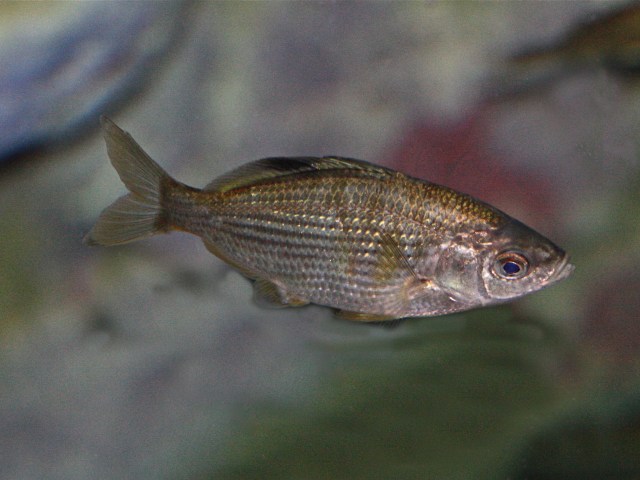
GENERAL CHARACTERISTICS: Shiner surfperch are small, deep-bodied fish, silvery colored with rows of dark spots on the scales that form vague black stripes on sides crossed by three vertical yellow bars. Males cover their shiny silver and yellow stripes with a darker courtship colors during the summer. Their maximum length is to 20 cm (8 in).

DISTRIBUTION AND HABITATShiners are found from Wrangell, Alaska to Baja California. Within their range, they are a common fish in shallow water around eelgrass beds, piers, pilings and oil platforms, and are also found in calm, shallow waters along the coast. They live in loose schools to depths of 146 m (480 ft). They are also known to enter brackish and fresh waters, and are common in San Francisco Bay.

DIET IN THE WILDTheir diet includes small crustaceans, crab larvae, and polychaete worms, as well as planktonic copepods, amphipods, fish eggs, algae and diatoms.

PREDATORS: These small fish are preyed upon by other fishes, including kelp bass, sand bass, and halibut as well as by harbor seals. They are caught along almost all shoreline fishing areas, probably the most common fish taken by recreational anglers along the California coast and in estuaries.
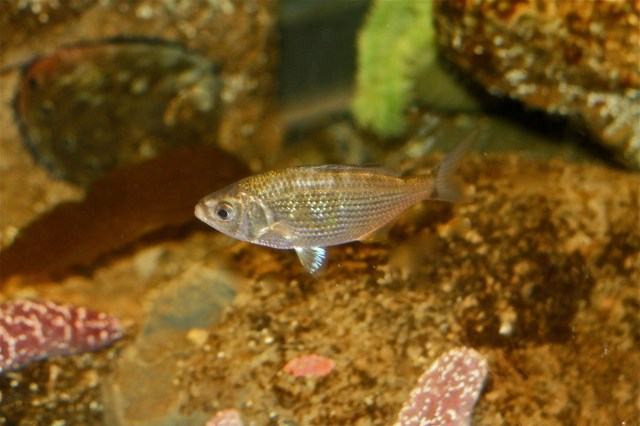
REPRODUCTION:Shiner surfperch mate during the summer; young are born the following spring or summer. Fertilization is internal, embryos are nourished internally, and females give birth to about 20 live young. Litter size varies from 4 to 25. Some males are sexually active immediately after their birth. Females grow faster than males. Their live span is at least six to eight years.

CONSERVATION: IUCN Red List  Least Concern (LC)

LOCATION: Tidepool

References

Ron’s Flickr http://www.flickr.com/photos/cas_docents/sets/72157626486149324/

Ron’s WordPress :  http://wp.me/p1DZ4b-wj  

fishbase  www.fishbase.org/summary/Cymatogaster-aggregata.html

ADW  animaldiversity.org/accounts/Mytilus_californianus/

EOL eol.org/pages/1012531/overview


TAXONOMY
Phylum Cnidaria
Class Anthozoa
Subclass Zoantharia
Order Actiniaria (anemones)
Family Actiniidae

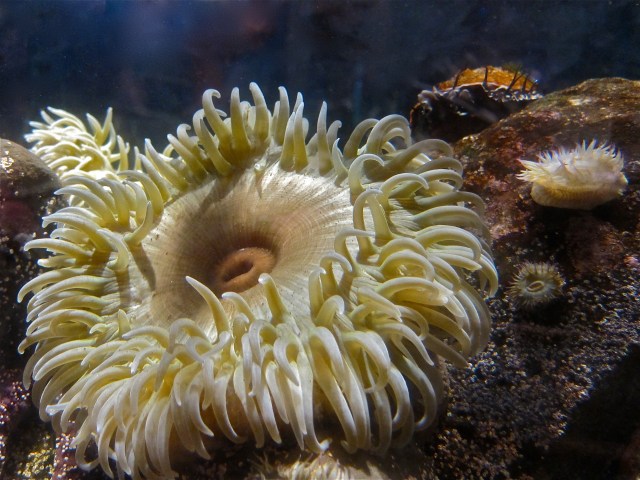
Genus/species: Anthopleura xanthogrammica

GENERAL CHARACTERISTICS: A  solitary species and one of the largest species of anemone in the world. Column to 30 cm (12 in) tall and 30 cm (12 in) tentacular crown with 25 cm (10 in ) diameter mid base. The base bottom is only slightly larger than column diameter and adheres to rocks.  Tentacles are green, blue, or white without pink on the tips.  No marks or bands.  The oral disk is flat and usually green, but can be grayish-blue to greenish-blue.  Contracted animals form a green to dark greenish-brown, occasionally white hemispherical mound.

DISTRIBUTION/HABITAT: Alaska to Panama in prefers rocky areas and deeper tide pools of the low to middle intertidal zones to 9 m (30 ft), and wharf pilings. Usually solitary; in favorable locations can occur in numbers to 14 per square m.

DIET IN THE WILD: Detached mussels and sea urchins, also take crabs and small fishes. Zoochlorellae endosymbionts supplement host’s diet.

PREDATORS: Nudibranchs, snails, sea spiders and some sea stars, especially leather stars.

REPRODUCTION: A. xanthogrammica have separate sexes releasing sperm and eggs in late spring to summer. The larvae swim or float freely. They do not use asexual reproduction.


REMARKS: Some fishes and the hermit crab Pagurus samuelis develop protection from the anemone’s toxins by covering themselves with mucus that prevents them from being stung.

The bright green can be attributed to green pigment in the anemone epidermis and to symbiotic algae that live in the tissues that line the gut. Inside there may be zoochorellae (green algae) or zooxanthellae, which are dinoflagellates. The symbiotic algae are reduced in numbers or even absent (aposymbiotic) when in shady areas.

LOCATION: Tidepool and California coast.

REFERENCES

Walla Walla University

www.wallawalla.edu/academics/departments/biology/rosario/…

 eol eol.org/pages/704306/details#cite_note-Skiles-4

flickr  http://www.flickr.com/photos/cas_docents/sets/72157625127345346/

WordPress shortlink: http://wp.me/p1DZ4b-w4

TAXONOMY

Phylum: Mollusca
Class: Bivalvia
Order: Filibranchia
Family: Mytilidae

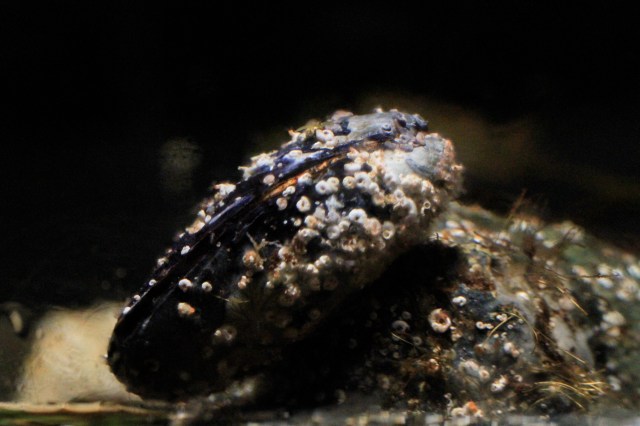
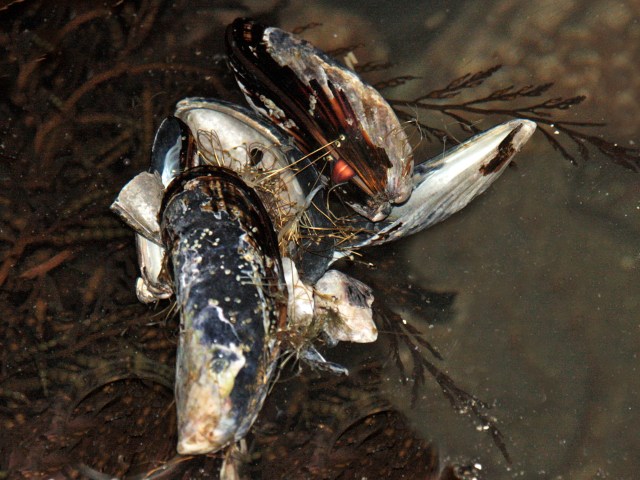
Genus/species: Mytilus californianus

GENERAL CHARACTERISTICS: California mussels are relatively large mussels, with a blue-black shell with strong radial ribs and irregular growth lines. Maximum size is about 13 cm (5 in). The shell surface is often worn and eroded.


DISTRIBUTION/HABITAT:  California mussels form extensive beds, commonly mixed with gooseneck barnacles (Pollicipes polymerus). Attached firmly to the substrate by tough proteinaceous byssal threads, mussels are able to thrive in the most surf-swept areas. Mussel beds break the force of waves and collect organic debris, and so provide shelter and food for other organisms. Worms, chitons, snails, clams, isopods, crabs, and sea cucumbers are among the invertebrates found in mussel beds.

The upper limit of the mussel beds is set primarily by physical factors, particularly time out of water. The lower limit is set in part by the predation of the ochre star (Pisaster ochraceus), which practices vertical foraging, moving up and down with the tides. Mussels range from low intertidal to 40 m (131 ft) deep and are common in surf-swept, rocky areas, and are found from Alaska to southern Baja California.


DIET IN THE WILD: Mussels filter fine organic detritus and living plankton from sea water. A mussel filters 1.8 l to 2.8 l (2 to 3 qts) of water an hour.


PREDATORS: California mussels are favored food items of seas stars (especially ochre stars), crabs, predatory snails, shorebirds, sea otters, and humans. Sea otters have devastated formerly extensive mussel beds in Monterey Bay.


REPRODUCTION: Mussels are either male or female. During breeding they broadcast sperm or eggs into the sea where fertilization occurs. They spawn November to May. Mussel larvae are free-swimming for about four weeks. After settling and attachment they grow to full size in about three years.


Remarks

  • The California mussel attaches to rocks by fibers called byssal threads. These threads are produced as a liquid by the byssal gland. The liquid runs down a groove formed by the foot. When the foot pulls back, exposing the liquid to sea water, the liquid solidifies into a thread.
  • A large mussel moves by breaking old threads, then attaching new ones to another spot; a small mussel creeps around on its foot.
  • By filtering algae spores from the water, mussels may limit algae growing around mussel beds.
  • Coastal areas are at risk from development and pollution. Mussels are also at risk because many of their homes are in danger of being ‘loved too much’ by too many tide pool visitors.

References

California Academy of Sciences Docent Guide 2015

flickr http://www.flickr.com/photos/cas_docents/5118861762/in/set-72157608597736188/

WordPress shortlink:  http://wp.me/p1DZ4b-wF

Encyclopedia of Life eol.org/pages/449960/details

Monterey Bay Aquarium www.montereybayaquarium.org/animal-guide/invertebrates/ca…


TAXONOMY
Phylum: Echinodermata
Class: Echinoidea
Order: Echinoida
Family: Strongylocentrotidae

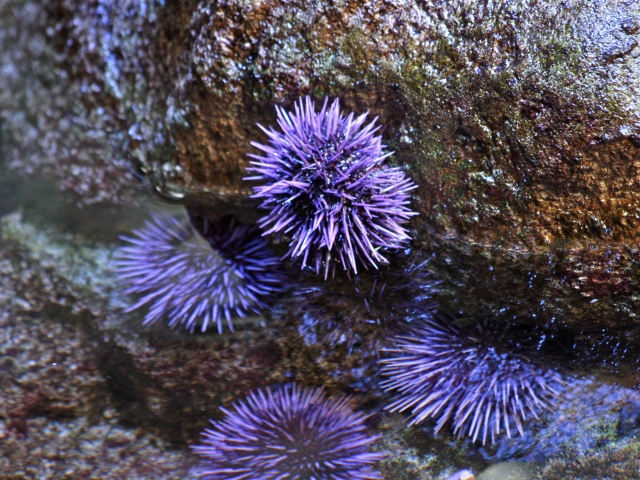
Genus/species: Strongylocentrotus purpuratus

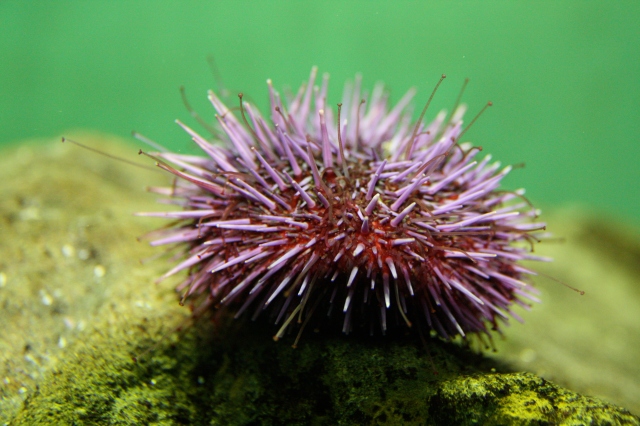
GENERAL CHARACTERISTIC: Round body with radially symmetrical test, (shell), covered with large spines 0.5 cm (2 in) in diameter, rarely to 10 cm (4 in). Test and spines are pale green (young) to purple (adults). Also covering the test or shell, are tube feet and pedicellariae (pincers). The long
suckered tube feet visible above the spines are used for locomotion and capture of food, which is then passed along to the mouth. The oral side of the urchin, on which the mouth is located, faces the substrate (down). Sexes are not physically distinguishable from one another (monomorphic).

DISTRIBUTION/HABITAT: British Columbia to Baja California in the lower intertidal to 160 m (525 ft) depth. Rounded burrows in rock that have been scoured out by the present or previous urchin using its teeth (Aristotle’s lantern) and spines, a strategy that protects from predators and surge.  Subtidal purple urchins live, often in large numbers, on the substrate among kelp holdfasts.


DIET IN THE WILD: Herbivore/Detritivore. Uses calcite (CaCO3) teeth (Aristotle’s lantern) to feed on kelp, other algae, diatoms and scavenge on dead animals. These urchins prefer the giant brown kelp Macrocystis and can destroy entire forests of kelp which are commercially important for fisheries. Algin a product from kelp is also used in the manufacturing of plastics, paints and as a thickening agent in foods such as gravy and pudding.


REPRODUCTION: Sexually mature during their second year. Sexes are separate, although hermaphrodites occur. Broadcast spawning deposits sperm or eggs into the sea where random fertilization occurs. Pluteus larvae hatch, drift and settle. Growth after metamorphosis is slow.

PREDATORS: Preyed upon by seastars such as the sunflower star and cancer crab species as well as fish such as the California sheepshead, shorebirds and sea otters. Sheephead blow over sea urchins and nibble at the oral side where the spines are shortest. When approached by most sea stars, the urchin allows the potential predator to get close, then uses its pincers to attack the sea star’s tube feet. Most sea star species will beat a hasty retreat; however, the sunflower star is too big and fast; the urchin cannot escape and is swallowed whole! Average lifespan 20 years but can live to more than 30 years.

CONSERVATION: CITES; no special status

REMARKS: Purple pigments from this urchin lodge in the bones and teeth of sea otters, turning the otter’s skeleton and teeth purple.

In the wild, they protect themselves from predation, drying out, and damage from the sun’s UV light by covering themselves with seaweed or shells.

Sea urchin is commonly used in sushi and is considered a delicacy Japan. The primary urchin harvesting company in California sends 75% of the harvest to Japan.

LOCATION

RockyReefcluster, Abalone and urchins, Rocky Coast Main Exhibit, Tidepool

References

California Academy of Sciences Docent Water is Life Guide 2015

eol  http://eol.org/pages/598175/details

Ron’s flickr http://www.flickr.com/photos/cas_docents/sets/72157608501343477/

Ron’s WordPress shortlink: http://wp.me/p1DZ4b-vq

TAXONOMY

Kingdom: Animalia
Phylum: Echinodermata
Class: Asteroidea (Starfish or sea stars)
Order: Forcipulatida
Family: Asteriidae

Genus/species: Asterina miniata

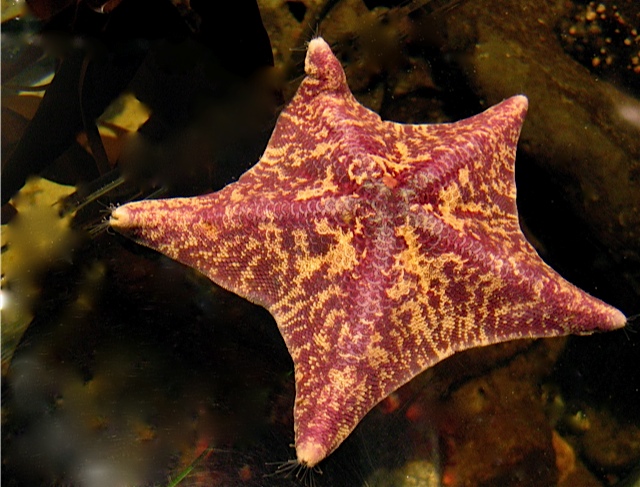
GENERAL CHARACTERISTICS: Colors may be colored red, orange, brown, purple or mottled. They have webbing between their short, triangular arms, which gives them a batlike look. Size is up to 20 cm (eight inches) across. Radially symmetrical they normally have five arms, but they occasionally have as many as nine arms. They have tube-feet that allow locomotion.

DISTRIBUTION/HABITAT: Sitka, Alaska to Baja California, Mexico. Found in low intertidal areas on rocks overgrown with surfgrass, large algae and sponges. Depth intertidal to 290 m (950 ft) on rocky or sandy substrates.

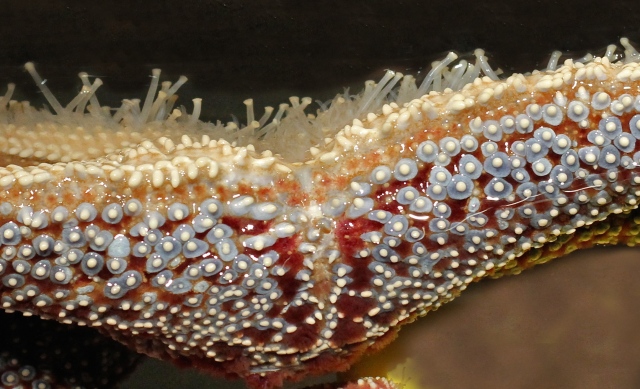
DIET IN THE WILD: Sensors at the end of each arm that sense light and detect prey. Typically an omnivore or scavenger: surfgrass, algae, colonial tunicates, organic films on hard surfaces, as well as other seastars.  Like most seastars, feeds by everting its stomach over prey.

See everted Bat Star stomach below.

REPRODUCTION: Usually spawns May to June. The male broadcasts sperm and the female broadcasts eggs from pores near the bases of their arms. Embryos and larvae are transparent.

PREDATORS Other sea stars, molluscs, and crustaceans. Like some other sea stars, bat stars can sometimes avoid predation by secreting chemicals that evoke flight responses in other animals.

CONSERVATION: IUCN No special status. Collecting by tidepool visitors has diminished some populations, for example around the Monterey Peninsula.

REMARKS: When two bat stars bump into each other, a gentle brawl begins. They seem to be “arm wrestling” in a slow motion skirmish where no winner is usually obvious.

Bat stars lack the pedicillariae, or pincers, common to most other sea stars and used to clear the animal of unwanted parasites and other debris. Even so, bat stars are free of debris, perhaps because small, constantly moving hairs (cilia) discourage settling

Sea stars have endoskeletons made up of plates (calcified ossicles) joined by connective tissue to protect the bat star’s vital organs.  The bat star’s ossicles are so large and defined that they look like rough shingles. 


REMARKS:  SEA STAR WASTING SYNDROME has become a major issue in both the Pacific and Atlantic Oceans. For an excellent summary check this link to the University of Santa Cruz 9-9-14.  http://www.eeb.ucsc.edu/pacificrockyintertidal/data-products/sea-star-wasting/updates.htm

Fitzgerald Marine Reserve.  http://www.fitzgeraldreserve.org/newffmrsite/wp-content/uploads/2014/09/BetweenTides_9-14_web.pdf


References

Monterey Bay Aquarium  http://www.montereybayaquarium.org/animal-guide/invertebrates/bat-star

U. of Michigan Animal Diversity Web http://animaldiversity.ummz.umich.edu/accounts/Patiria_miniata/

Ron’s flickr    http://www.flickr.com/photos/cas_docents/sets/72157608501343477/

Ron’s WordPress shortlink   http://wp.me/p1DZ4b-to

TAXONOMY
Kingdom: Animalia
Phylum: Echinodermata
Class Asteroidea
Order: Forcipulatida
Family: Asteriidae

Genus/species: Pisaster giganteus

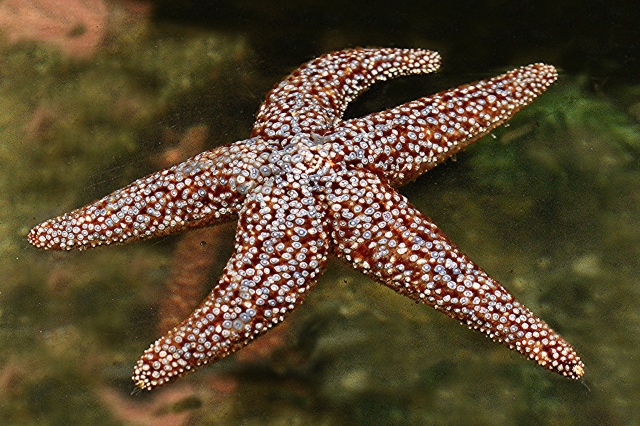
 GENERAL CHARACTERISTICS: Giant sea stars have five arms covered with white, pink, or purple spines surrounded by blue tissue at the base, and range in color from red, orange, brown, or even green. The surface has brown fuzz and pedicellariae. They have a maximum arm span of about 60 cm (23.6 in). P. giganteus would seem improperly named, as the average intertidal specimen is smaller than the average P. ochraceous; however subtidal specimens grow considerably larger.

7137830837_192c64b940_k 

DISTRIBUTION/HABITAT: They are distributed along the eastern Pacific coast from British Columbia to Baja California. They are common on rocky substrates, but also found on sand from the middle to lower intertidal zone down to 90 m (300 ft).

Giant Sea StarIMG_1040.JPG - Version 2

DIET IN THE WILD: Their typical prey are hard-shelled organisms such as mussels, snails, and barnacles by extending its stomach to fit into tiny gaps in bivalves such as mussels. However, they may occasionally eat anything slow-moving enough to be caught, such as a dying fish or shellfish, anemones, or other sea stars.

Giant Seastar IMG_8851

PREDATORS: Sea gulls and sea otters are sea star predators.

REPRODUCTION: Individual sea stars are male or female. Both sexes release gametes into the water for external fertilization. Larvae are planktonic and have bilateral symmetry. Giant sea stars live about 20 years.

REMARKS:  SEA STAR WASTING SYNDROME has become a major issue in both the Pacific and Atlantic Oceans. For an excellent summary check this link to the University of Santa Cruz 9-9-14.  http://www.eeb.ucsc.edu/pacificrockyintertidal/data-products/sea-star-wasting/updates.htm

Fitzgerald Marine Reserve.  http://www.fitzgeraldreserve.org/newffmrsite/wp-content/uploads/2014/09/BetweenTides_9-14_web.pdf

Tidepool 

References

California Academy of Sciences Tidepool Exhibit 2015

Woods Hole www.whoi.edu/science/B/people/kamaral/SeaStar.html

Bishop Museum hbs.bishopmuseum.org/pubs-online/pdf/op11-8.pdf

Encyclopedia of Life  eol.org/pages/598468/details

Animal Diversity Web, ADW  http://animaldiversity.ummz.umich.edu/accounts/Pisaster_giganteus/classification/

Ron’s flickr  https://www.flickr.com/photos/cas_docents/7137830837/in/set-72157608501343477

Ron’s WordPress shortlink  http://wp.me/p1DZ4b-1mV

TAXONOMY
Kingdom: Animalia
Phylum: Echinodermata
Class Asteroidea
Order: Forcipulatida
Family: Asteriidae

Genus/species: Pisaster brevispinus


GENERAL CHARACTERISTICS The pink sea star reaches a maximum diameter of nearly 65 cm (2 ft); however, individuals are usually smaller. Its central disc has a raised, humplike appearance. They are robust, pink in color and have aboral spines much shorter than those of other Pisaster species, thus its scientific name, which translates as “short-spined sea star.”

7137858011_f41cdc4304_k

DISTRIBUTION/HABITAT They range from Sitka, Alaska to San Diego County, California. They can occasional be seen in the low intertidal zone, but are more commonly found in deeper water to 90 m (300 ft ) on sand and mud substrates, but sometimes on rocks and pier pilings in calm waters. They cannot tolerate prolonged exposure to air.

DIET IN THE WILD: Pink sea stars prey on live clams, snails, sand dollars, barnacles, mussels, – annelid worms, and scavenge on dead fish and squid. On soft surfaces, P. brevispinus digs into sand or mud with its arms. It also can extend its tube feet (the ones around its disk) to a length of 20 cm (8 in). When the tube feet reach a clam buried in the mud, they attach and the sea star hauls it up. On shale, it can lower its stomach into the burrow of a clam and digest the animal in place. Their large size may well be due to their access to a plentiful food supply of large organisms unavailable to potential competitors.

PREDATORS Large adults have few predators, but they may be taken by the sunflower sea star Pycnopodia helianthoides. Sea otters have been known to detach rays to consume gonads, and sea gulls occasionally feed on individuals exposed during very low tides.

REPRODUCTION They spawn in the spring. Sexes are separate and fertilization takes place externally. Larvae disperse in the water column.

Pink stars can live up to 20 years.


REMARKS: Can chemosense clams through sand. May dig down to the clam for 2 –3 days or extend tube feet to the clam a distance equal to the arm radius to 20 cm (7.8 in). Once contacted,
the clam is lifted from the substrate or the stomach may be everted to 8 cm (3.15 in) to digest the prey in place. Some sand-bottom invertebrates including the sand dollar Dendraster excentricus and the snail Olivella biplicata chemosense the presence of a pink star and attempt to avoid contact by burrowing.

References

California Academy of Sciences Tidepool exhibit 2015

Walla Walla Univ. www.wallawalla.edu/academics/departments/biology/rosario/…

EOL eol.org/pages/598470/details

Ron’s WORDPRESS SHORTLINK  http://wp.me/p1DZ4b-tA

Ron’s flickr http://www.flickr.com/photos/cas_docents/sets/72157608501343477/

TAXONOMY
Kingdom: Animalia
Phylum: Chordata
Class: Actinopterygii (ray-finned fishes)
Order: Syngnathiformes (Pipefishes and seahorses)
Family: Syngnathidae (Seahorses, Pipefishes, and Seadragons)

Genus/species: Phycodurus eques

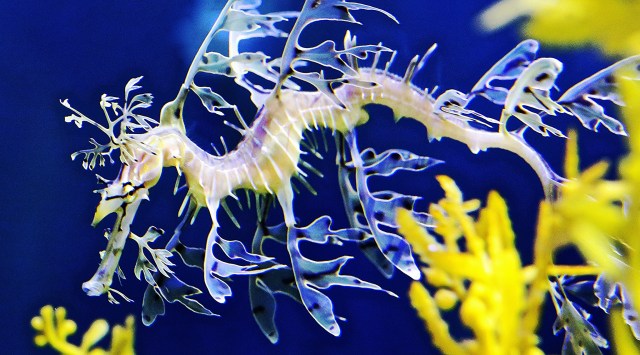
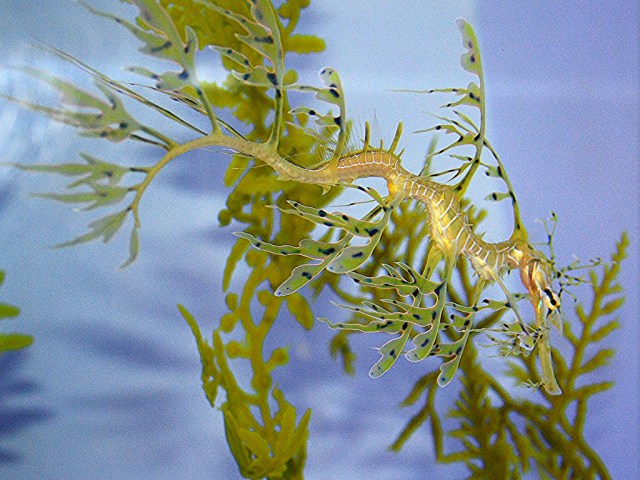
GENERAL CHARACTERISTICS: Color varies from brown tones,to greenish or reddish depending on depth. Their body is scaleless and covered is in hard bony plates with long sharp spines on each bony plate that may be defensive. Leaf-like appendages protrude from the head, body, and tail and transparent dorsal and pectoral fins. Their long, thin pipe-like snout has no jaw.
Maximum length of the leafy seadragon is about 35 cm (14 in).

leafy seadragon11042381084_94c0a006a8_k

DISTRIBUTION/HABITAT: Endemic to southern Australia.
Found amongst brown algae (kelp) in shallow, temperate water, associated with seagrass beds and rocky reefs.

DIET IN THE WILD: Do not have a jaw, teeth or a stomach. They swallow their prey whole by creating a suction to suck mysid shrimp, zooplankton and fish larvae into their mouths.

REPRODUCTION: Like the seahorse, the male seadragon carries the eggs. He develops about 120 shallow depressions in a spongy section of the ventral surface of his tail. The female deposits her eggs in the depressions.

LONGEVITY: 7-10 yrs.

PREDATORS: Depend on camouflage and sway like plants in the water to hide from predators.

CONSERVATION:IUCN Red List (2006.) Near Threatened. Habitat destruction, pollution, excessive fertilizer runoff, and poaching by humans has lead to a decrease in numbers. They are fully protected with special licenses required to collect or export them.

REMARKS: Unlike its seahorse relative that swims vertically, the seadragon swims horizontally. It is a very slow swimmer, as might be expected from its tiny fins, but is protected not only by its camouflage but by sharp spines that deter predators.
The leafy seadragon has the honor of being the official emblem of Australia.

leafy seadragon2980686562_a871c0e383_b

Color of Life
P. eques moves very slowly through the water and mimics seaweed, which makes it a master at camouflage.

References

California Academy of Sciences Water planet: Centerpiece Water Dependence 2015

Ron’s flickr https://www.flickr.com/photos/cas_docents/11042381084/in/album-72157608441047857/

Ron’s WordPress shortlink  http://wp.me/p1DZ4b-1C2

fishbase fishbase.org/summary/Phycodurus-eques.html

Animal Diversity Web animaldiversity.org/accounts/Phycodurus_eques/

IUCN Red List www.iucnredlist.org/details/17096/0

Aquarium of the Pacific www.aquariumofpacific.org/onlinelearningcenter/species/le…


TAXONOMY

Kingdom: Animalia
Phylum: Chordata
Class: Actinopterygii (ray-finned fishes)
Order: Syngnathiformes (Pipefishes and seahorses)
Family: Syngnathidae (Seahorses, Pipefishes, and Seadragons)

Genus/species: Phyllopteryx taeniolatus

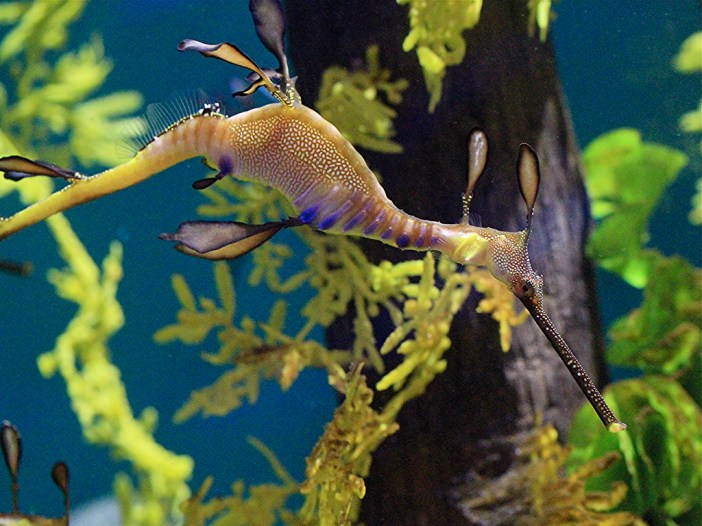
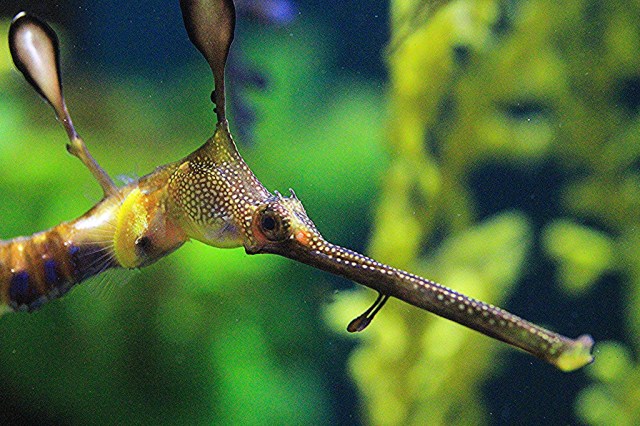
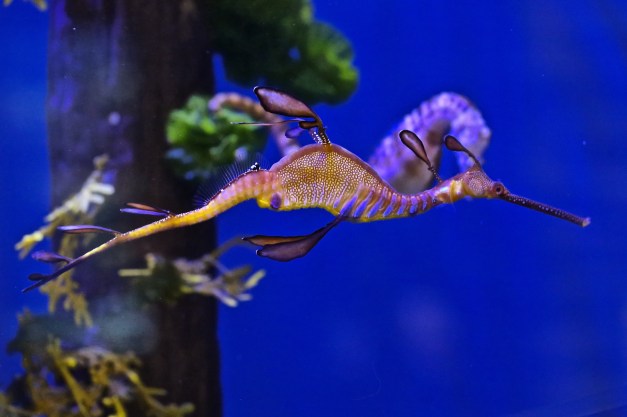
GENERAL CHARACTERISTICS: Orange-yellow to brownish-yellow, small pale dots on body with stripes, often brilliant blue, on neck. Leafy projections, purple with black edges, in varying numbers, along the body. Long, tubular snout. Dorsal fin near the tail, two tiny pectoral fins on neck.
Max length : 46.0 cm (18 inches).

5119453686_669d49f3b7_b

DISTRIBUTION/HABITAT: Endemic to waters off southern Australia in kelp-covered rocky reefs.

DIET IN THE WILD: Since all seadragons and seahorses lack teeth and moveable jaws they suck in their prey, similar to drinking through a straw.

seadragon5119453148_827f229703_b

REPRODUCTION: Prior to mating the area of the male’s tail where he will keep the eggs becomes slightly swollen, soft and spongy. The female actually pushes the eggs onto this area of the male’s tail where they are fertilized. He carries the eggs for about 2 months. The young are born with a yolk sac still attached that sustains them for about two days, until their snout grows enough to feed.

seadragon8395822449_9cd5ac59ff_k

CONSERVATION: IUCN RED LIST Near Threatened (NT)
Major threat. Weedy Seadragons are weak swimmers; in conjunction with a lack of a dispersive egg phase, this potentially makes them vulnerable to habitat loss and degradation, which is the main threat to this species.
Asian herbalists can sell dried and powdered bodies for up to $200/gram.

REMARKS: The appendages of weedy seadragons are not as elaborate as those of leafy seadragons; however, their camouflage is also effective as they look like pieces of sea weed floating in the water. Weedy and leafy seadragons share the same range and habitat and have the same conservation status.

Color of Life; Cryptic coloration
Leaf-shaped appendages and cryptic colouration of this species provides protection from predators.

References

California Academy of Sciences Seadragon Exhibit 2015

Ron’s flickr https://www.flickr.com/photos/cas_docents/5119453686/in/album-72157608441047857/

Ron’s WordPress shortlink  http://wp.me/p1DZ4b-1BP

fishbase www.fishbase.se/summary/Phyllopteryx-taeniolatus.html

IUCN www.iucnredlist.org/details/17177/0

Australian Museum  australianmuseum.net.au/weedy-seadragon-phyllopteryx-taen…

ADW animaldiversity.org/accounts/Phyllopteryx_taeniolatus/

TAXONOMY
Kingdom: Animalia
Phylum: Chordata
Class: Actinopterygii (ray-finned fishes)
Order: Gasterosteiformes (Pipefishes and seahorses)
Family: Syngnathidae (Pipefishes, Seahorses and Sea Dragons)

Genus/species: Hippocampus reidi

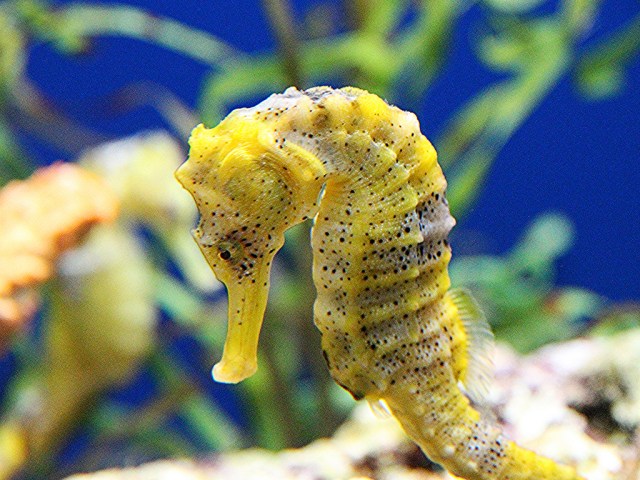
GENERAL CHARACTERISTICS: Comments apply to all species of the genus. They are characterised by their elongated snouts, fused jaws, the absence of pelvic fins, and by thick plates of bony armour covering their bodies. The armour gives them a rigid body, so they swim slowly in an upright posture by rapidly fanning their fins. The horse-like head set at right angles to the body and the caudal peduncle has evolved into a prehensile “tail” for grasping plants.

Like most other syngnathids, seahorses may undergo color changes to blend with their surroundings, to indicate breeding readiness, or to indicate mood or stress.  Ref www.theseahorsetrust.org/seahorse-facts.aspx

H. reidi males often bright orange and females yellow; both may be covered in brown or white spots. Length 6.8 inches long (17.5 centimeters)

seahorses4039107114_c4de28e230_b

DISTRIBUTION/HABITAT: Subtropical; 29°N – 25°S.
Western Atlantic Ocean, North Carolina to Brazil. Usually found near coral reefs, in association with gorgonian corals,

DIET IN THE WILD: Seahorses have a unique feeding mechanism, known as elastic recoil feeding resulting in extremely fast head rotation to accelerate their mouths towards unsuspecting prey. (small crustaceans and zooplankton).

REPRODUCTION: Monogamous and Ovoviviparous
Like other species in their family, pairs generally mate for life. Highly ritualistic courtship may include dramatic color changes to pink or white and intricate dances leading up to the female’s depositing up to 1,000 eggs in the male’s brood pouch.

CONSERVATION: IUCN Red List Data Deficient (DD)
The entire genus Hippocampus is listed in Appendix II of CITES in 2002.
Threats: Collected as aquarium fishes, folk medicine, and curiosities. Also taken as bycatch in shrimp trawl fisheries. Degradation of seagrass habitats, especially along the U.S. may be reducing their numbers locally. 

Color of Life, Color on the Reef, Color Conceals      Seahorses use color to blend with their backgrounds and attach to plants to obscure themselves. Certain species also change color when mating using their chromatophores.

References

California Academy of Sciences Color on the Reef Exhibits 2015

fishbase www.fishbase.org/summary/3285

IUCN Red List 2015  www.iucnredlist.org/details/10082/0

ARKive  www.arkive.org/longsnout-seahorse/hippocampus-reidi/

Ron’s flickr https://www.flickr.com/photos/cas_docents/4039107114/in/album-72157608441047857/

Ron’s WordPress shortlink  http://wp.me/p1DZ4b-1BE

EOL www.eol.org/pages/5064/details