Latest Entries »

TAXONOMY
Kingdom: Animalia
Phylum: Cnidaria
Class: Anthozoa
Subclass: Zoantharia
Order: Actiniara (anemones)
Family: Actiniidae

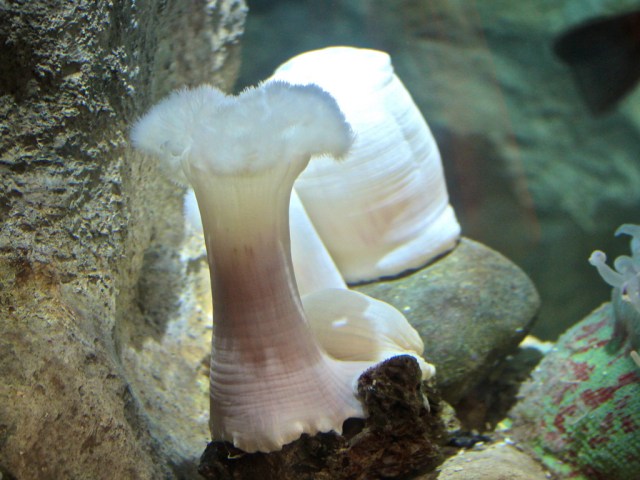
Genus/species: Urticina piscivora

GENERAL CHARACTERISTICS: Large to 20 cm (8 inches) high and 26 cm (10 inches) across. The column is red (without spots) with white. Tentacles are white, and the oral disc is creamy yellow. Normally they do not accumulate debris such as shells and sand.
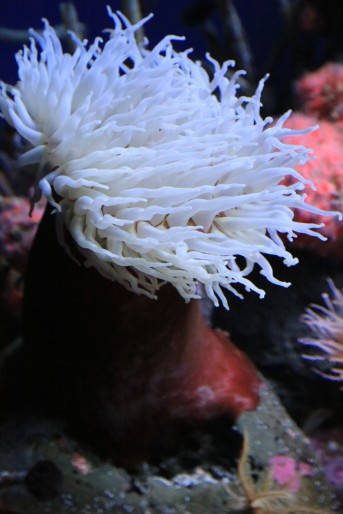
IMG_9525 

DISTRIBUTION/HABITAT: Alaska to southern California. Found in low intertidal areas with rocky attachment sites and at least moderate current. Depth to about 50 m (160 feet)
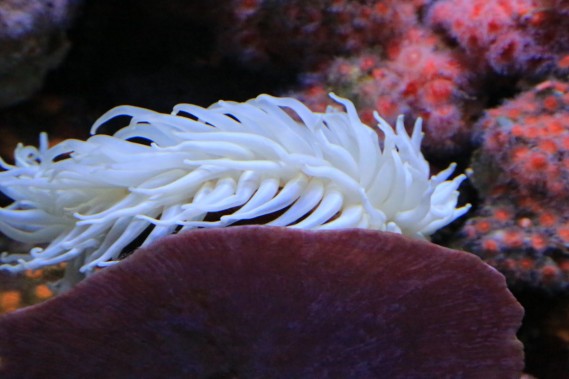
IMG_9523

DIET IN THE WILD: Invertebrates, shrimp and small fishes. U. piscivora have no zooxanthellae and depend wholly on capturing their food, a strategy aided by their exceptionally virulent nematocysts (stinging cells), which can cause long-lasting lesions on humans. Food items are usually swept into the central mouth by the tentacles where enzymes digest the food. Non digested items are expelled out through the mouth.
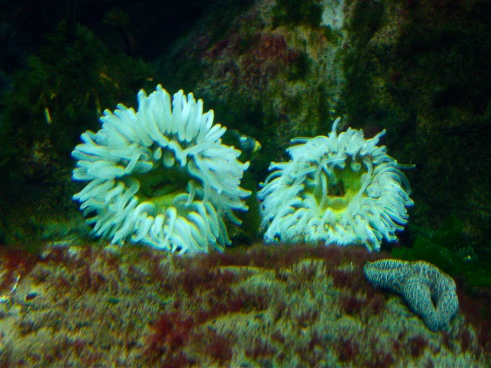
 

Genus/species: Urticina piscivora3702912695_1708579b2e_b 

CONSERVATION: IUCN Not evaluated

REMARKS: One fish species, the painted greenling (Oxylebius pictus), has been observed lying unharmed in this anemone much as clownfish do in tropical anemones. 

References

California Academy of Sciences Steinhart Aquarium California Coastal Marine Reef Exhibit

eol eol.org/pages/2549643/details

Walla Walla Universitywww.wallawalla.edu/academics/departments/biology/rosario/…

Georgia Aquariumanimalguide.georgiaaquarium.org/home/galleries/cold-water…

Ron’s flickr www.flickr.com/photos/cas_docents/3702912695/in/set-72157…

Ron’s WordPress shortlink http://wp.me/p1DZ4b-1l6


Kingdom: Animalia
Phylum: Arthropoda
Class: Arachnida
Order: Araneae
Family: Theraphosidae

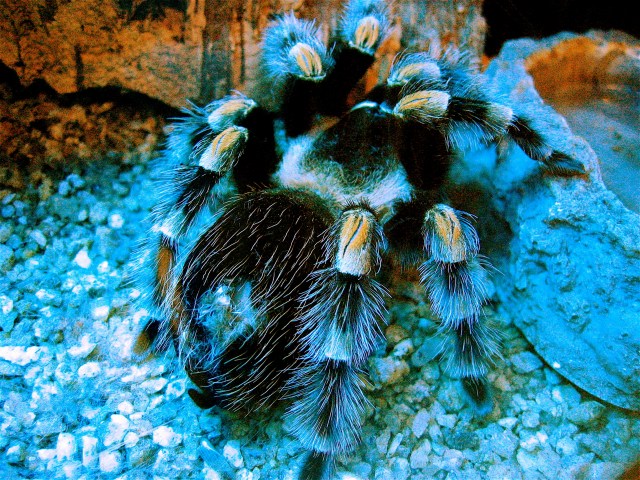
Genus/species: Brachypelma smithi

GENERAL CHARACTERISTICS: The body and legs are dark brown with orange-red leg joints. The ends of the legs can detect vibrations, smells and tastes, to help the tarantula locate prey and the opposite sex, although it also has a group of eight eyes on the top of the carapace.

Length up to 14 cm (5.5 in)

Mexican Red Knee Tarantula30463911086_990fd616a7_k

DISTRIBUTION/HABITAT: Found in in dry areas with little vegetation, usually in scrubland, deserts, dry thorn forests, or tropical deciduous forests along the central Pacific coast of Mexico.
DIET IN THE WILD: Hunting at night by lying in ambush, the Mexican redknee tarantula attacks insects, small frogs, small lizards, and mice. An area on the end of each leg is sensitive to smells, tastes and vibrations, and this is used to detect prey. The tarantula holds its prey with its pedipalps (front limbs) and injects it with venom delivered via two hollow fangs. This venom has a double purpose, paralysing the prey as well as beginning digestion. Once the venom has acted, the tarantula is able to suck up the proteins and fats of its prey, leaving just a small ball of undigested body parts

REPRODUCTION: Mating occurs in or near to the female’s burrow, where the male uses his pedipalps (front limbs) to transfer his sperm into openings in the underside of the female’s abdomen. After mating, some females will try to kill and eat the male. In the spring, the female deposits hundreds of eggs and the sperm onto a silk mat which she has made and then fashions this mat into a ball or egg sac. Fertilisation takes place within minutes and the spiderlings hatch in just less than three months. Once out of the egg-sac they spend two weeks in the burrow before dispersing. Males mature at about four years of age and females two to three years later at about six or seven years old. They are a long-lived species with females living up to 25 to 30 years old, however males only live about one year after maturity.


Mexican Red Knee Tarantula4515783385_eb611c7fd6_o

REMARKS: This usually docile tarantula will kick hairs off the abdomen with its hind legs when threatened, which cause blindness if they hit the eyes of a predator and can also cause a rash on the skin.
References

California Academy of Sciences Animal Attractions 2016

Ron’s Flickr   https://www.flickr.com/photos/cas_docents/30463911086/in/album-72157608653175263/

EOL  eol.org/pages/1181785/details

Ron’s WordPress Shortlink  http://wp.me/p1DZ4b-1IR


TAXONOMY
Kingdom: Animalia
Phylum: Cnidaria
Class: Anthozoa
Order: Actiniaria
Family: Metridiidae

Genus/species: Metridium farcimen  aka Metridium giganteum
Metridium farcimen4545409258_06cac3dd83_b

GENERAL CHARACTERISTICS: Erect smooth column. Usually 50 cm (20 in) or less in height The column is slender, smooth and studded with acontia. These are openings through which thread-like nematocysts from inside the body wall can protrude. The oral disc is lobed and deeply convoluted at the edge and bears well over 100 fine, short, tapering tentacles. Color variable from white through cream to tan, brown and orange. Carries short, feathery tentacles in white, brown or gray.

 Metridium farcimenIMG_9548

DISTRIBUTION/HABITAT: Eastern North Pacific: Alaska to Baja California. Found in sub tidal areas attached to rocky substrate. Individuals usually aggregate in groups on deeper rocky reefs.

 Metridium farcimen4673318353_928bfcd2f0_o

DIET IN THE WILD: Plankton—whatever drifts by or is carried in by the tide; predators include Pisaster spp. sea star and some species of nudibranchs.

REPRODUCTION: Eggs and sperm from the gonads embedded in the body wall which are ejected through the mouth. Fertilised eggs develop into planula larvae which settle and metamorphose into polyps.                   

PREDATORS: Pisaster spp. sea star and some species of nudibranchs.

REMARKS: When attacked, they contract suddenly, extruding specialized nematocysts through the mouth and body wall that, much larger than those found in the tentacles, can deter or even kill predators.

 Location: California Rocky Coast and Giant Pacific Octopus exhibits

 References

 The University of Kansas kuscholarworks.ku.edu/dspace/handle/1808/6043

 eol eol.org/pages/704280/details#type_information

 racerocks:www.racerocks.com/racerock/eco/taxalab/ensy02/bend.htm

 Ron’s flickr  https://www.flickr.com/photos/cas_docents/3400331201/in/set-72157625127345346/

Ron’s WordPress shortlink  http://wp.me/p1DZ4b-1lg


TAXONOMY
Kingdom: Animalia
Phylum: Cnidaria
Class: Anthozoa
Subclass: Hexacorallia
Order: Corallimorpharia
Family: Corallimorphidae

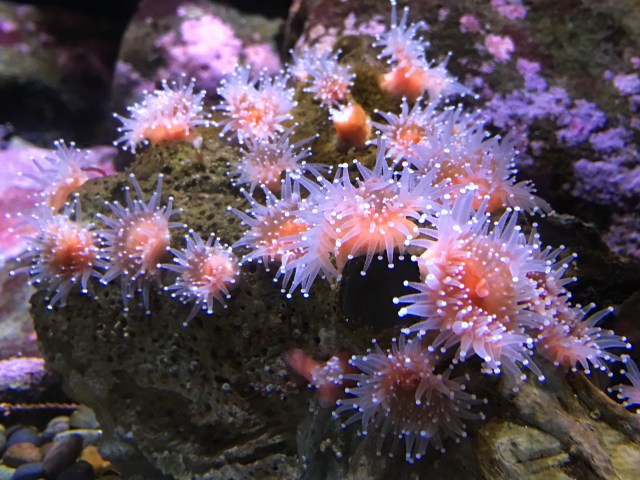
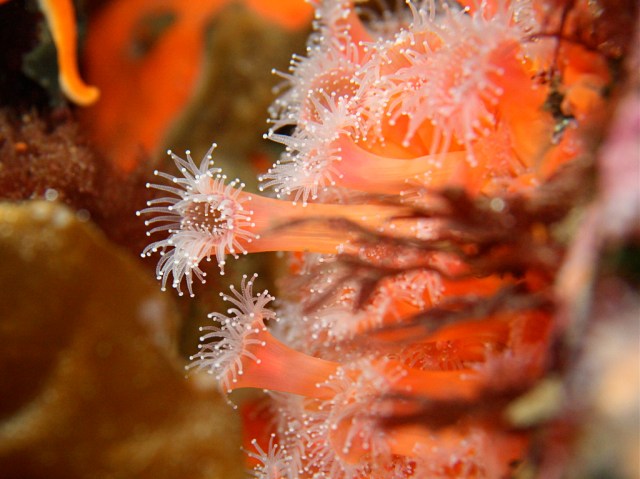
Genus/species: Corynactis californica

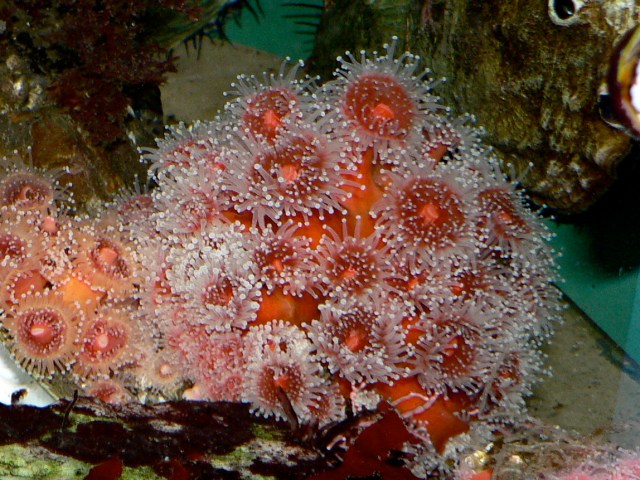
GENERAL CHARACTERISTICS: Typically red or orange-pink, occasionally purple, yellow, buff, brown or nearly white.
Corallimorphs are not true anemones. Tentacles end in knobs (club-tipped tentacles) and are not fully retractile, usually being white. Corallimorphs are also very similar to corals in some other characters, but lack the hard coral skeleton. Found in groups, with individuals up to 2 cm (0.8 inches) long (average height and diameter is 1 cm  (0.4 inches).

Northern Feather Duster Wormimg_5344

3395717381_112ffd5d87_b-2

DISTRIBUTION/HABITAT: British Columbia, Canada to Baja California, Mexico. Habitat: Colonies abundant from the low rocky intertidal to 30 m (98 feet).

3124837767_b890803df1_o

DIET IN THE WILD: C. californica captures prey by extruding mesenterial filaments onto its prey which are used for digestion and absorption of food in the coelenteron. If the prey is too large to take into the coelenteron, the mesenterial filaments are used to digest it externally. They are carnivores consuming  copepods, crustacean larvae and other zooplankton.

REPRODUCTION: Asexual by fission and budding resulting in a dense cluster of clones

REMARKS: The presence of aggregations of C. californica increase the density of rock oysters and mussels by protecting them from predatory sea stars.

References

California Academy of Sciences Steinhart Aquarium 2016

Ron’s flickr https://www.flickr.com/photos/cas_docents/2996776409/in/set-72157608597451452/

Ron’s WordPress  http://wp.me/p1DZ4b-1l0

eol eol.org/pages/1006944/details

 U. of Michigan ADWanimaldiversity.ummz.umich.edu/accounts/Corynactis_califo…

 Walla Walla Universitywww.wallawalla.edu/academics/departments/biology/rosario/…


TAXONOMY
Kingdom: Animalia
Phylum: Chordata
Class: Amphibia
Order: Caudata
Family: Ambystomatidae

Genus/species: Ambystoma andersoni

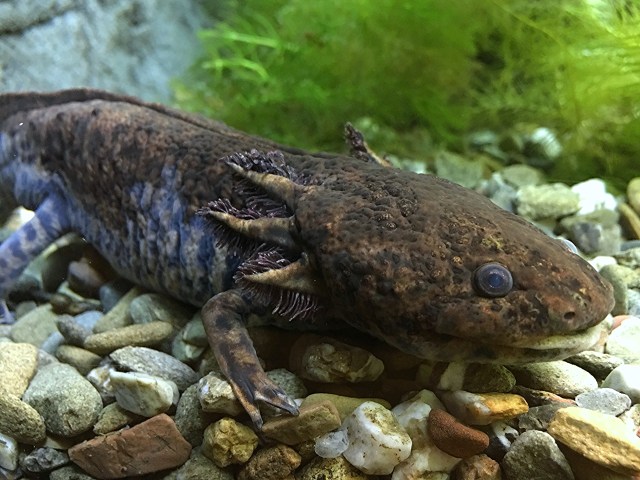
GENERAL CHARACTERISTICS: A. andersoni is dark, mottled brownish-green in color. the body is long and cylindrical with short legs. Note the well-developed “costal” grooves Although it does develop lungs,  A. andersoni retains its branch-like gills. These are three external projections from the neck covered with feathery filaments  increase the surface area for gas exchange.

Length up to 30 cm (14 inches)

Anderson's Salamander29682163253_8ab1906ee7_o

DISTRIBUTION/HABITAT: Lake Zacapu, Central Mexico. Prefers deep vegetated portions of streams.

DIET IN THE WILD: Aquatic invertebrates

REPRODUCTION: A. andersoni is polygynandrous (promiscuous). Eggs hatch at 10 to 14 days and the young are immediately independent. It is an example of neoteny in that animals become sexually mature without undergoing the final metamorphosis to the land-borne adult.

Longevity up to 17 years.

CONSERVATION: IUCN RED LIST Critically Endangered 2014
The major threat to this species is the pollution of the lake due to surrounding agricultural and tourist activities, next to the lagoon and in conjunction with it is a new bathing area. The animals are also heavily harvested for food, and predatory fish have been introduced into the lake, which might well pose a major problem for the species.

References

California Academy of Sciences Steinhart Aquarium 2016

Ron’s flickr  https://www.flickr.com/photos/cas_docents/29682163253/in/album-72157608456457315/

Amphibiaweb   amphibiaweb.org/cgi/amphib_query?where-genus=Ambystoma&am…

Arkive www.arkive.org/achoque/ambystoma-andersoni/

EDGE  www.edgeofexistence.org/amphibians/species_info.php?id=554

IUCN RED LIST  www.iucnredlist.org/details/59051/0

Ron’s WordPress Short Link   http://wp.me/p1DZ4b-1Is

TAXONOMY
Kingdom:Animalia
Phylum: Chordata
Class: Actinopterygii (ray-finned fishes)
Order: Perciformes (Perch-likes)
Family: Labridae (Wrasses)

Genus/species: Stethojulis bandanensis

Stethojulis bandanensisIMG_8597

GENERAL CHARACTERISTICS: The body is elongate and fusiform with a pointed head and small mouth. Primary phase individuals are brown with hundreds of tiny white specks, a white belly, yellowish cheeks, and an orange shoulder patch. Terminal males typically have a series of partial to complete longitudinal thin blue lines on their sides. Females mainly bluish grey with fine white spotting over upper sides and a small red spot at axil of pectoral fin. They have a blue-green on upper half and bluish below.

Length up to 15 cm (6 inches)

DISTRIBUTION/HABITAT: Tropical Indo-Pacific: eastern Indian Ocean to western Australia, Found in shallow clear water of reef flats and lagoon and seaward reefs, in areas of mixed sand, rubble and coral. Depth 3-30m (10-100 feet).

DIET IN THE WILD: Zoobenthos ( small benthic invertebrates living on, in, or near the seabed, also known as the benthic zone)

REPRODUCTION: Oviparous with distinct pairing during breeding

CONSERVATION: IUCN Least concern LC

References

California Academy of Sciences Philippine coral reef 2016
Vetted J. Charles Delbeek, M.Sc.
Assistant Curator, Steinhart Aquarium

fishbase www.fishbase.se/summary/5640

EOL eol.org/pages/994413/details

Ron’s flickr www.flickr.com/photos/cas_docents/13226075944/

IUCN  www.iucnredlist.org/details/full/187424/0

Ron’s WordPress Shortlink  http://wp.me/p1DZ4b-1e5


www.guammarinelab.com/fish/species_html/stethojulis.banda…

TAXONOMY
Kingdom:Animalia
Phylum: Chordata
Subphylum: Vertebrata
Class: Actinopterygii (ray-finned fishes)
Order: Perciformes (Perch-likes)
Family: Labridae (Wrasses)

Genus/species: Cirrhilabrus rubrimarginatus


GENERAL CHARACTERISTICS: Body shape is fusiform. The male is more brilliantly colored compared to the female and the juvenile, Has a red margin on both the tail and dorsal fin.

length up to 5 inchesRed-Margin Wrasse

DISTRIBUTION/HABITAT: Western Pacific: north to the Ryukyu Islands, through the Philippines, Palau, and Indonesia. Adults found in deep coastal to outer reef drop-offs and steep slopes to 40 m (130 feet) or more, usually in loose aggregations.

CONSERVATION: IUCN; Least concern.

REMARKS: Fairy wrasses, along with 4 other closely related genera, have an unusual eye structure. The cornea is divided into two segments, basically forming a double pupil. It is theorized that the center pupil acts like a close-up lens to give the fish a clear view of its small prey. Fairy wrasses are active during the day, and sleep at night wedged into crevasses protected by a mucous cocoon they secrete around themselves.

References

California Academy of Sciences Philippine coral reef 2016      Charles Delbeek, M.Sc  Assistant Curator, Steinhart Aquarium  California Academy of Sciences

Ron’s WordPress shortlink http://wp.me/p1DZ4b-1en

Ron’s flickr www.flickr.com/photos/cas_docents/13277420973/in/set-7215…

fishbase www.fishbase.org/summary/Cirrhilabrus-rubrimarginatus.html

EOL eol.org/pages/213476/hierarchy_entries/44698464/details

Reef Keeping  http://www.reefkeeping.com/issues/2003-01/hcs3/

TAXONOMY
Kingdom: Animalia
Phylum: Chordata
Class: Actinopterygii (ray-finned fishes)
Order: Perciformes (Perch-likes)
Family: Labridae (Wrasses)

Genus/species: Halichoeres prosopeion

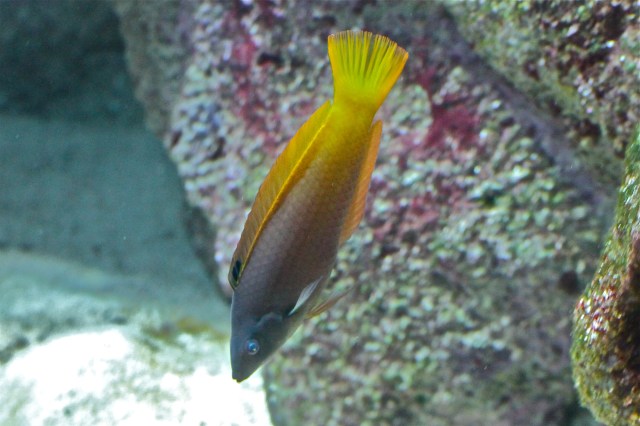
GENERAL CHARACTERISTICS: Adults green-blue in front fading to light yellow behind. A dark spot behind the eye; dorsal fin with large black spot near the front. Unlike most wrasses, no obvious differences between sexes.

Length up to 13 cm (5 inches).

Two-tonewrasseIMG_6778

DISTRIBUTION/HABITAT: Western Pacific; east to Indonesia and Sumatra, north to southern Japan, south to Great Barrier Reef. Habitat: Lagoons and seaward reefs. Depth range 2 – 40 m (6.5 -130 feet).

DIET IN THE WILD: Small crabs, shrimps, worms, and other benthic invertebrate.

Two-tonewrasse13572020553_2c6e678b2e_b

REMARKS: Like many wrasses, it quickly buries itself in sand when threatened or alarmed.

CONSERVATION: IUCN Least concern

References

California Academy of Sciences Philippine coral reef 2016
Vetted J. Charles Delbeek, M.Sc.
Assistant Curator, Steinhart Aquarium

Ron’s Wordpress shortlink  http://wp.me/p1DZ4b-1fe

Ron’s flickr https://www.flickr.com/photos/cas_docents/13572020553/in/album-72157625992053826/

 fishbase www.fishbase.org/summary/Halichoeres-prosopeion.html

 EOL eol.org/pages/211449/details


TAXONOMY
Kingdom: Animalia
Phylum: Chordata
Class: Actinopterygii (ray-finned fishes)
Order: Perciformes (Perch-likes)
Family: Labridae (Wrasses)

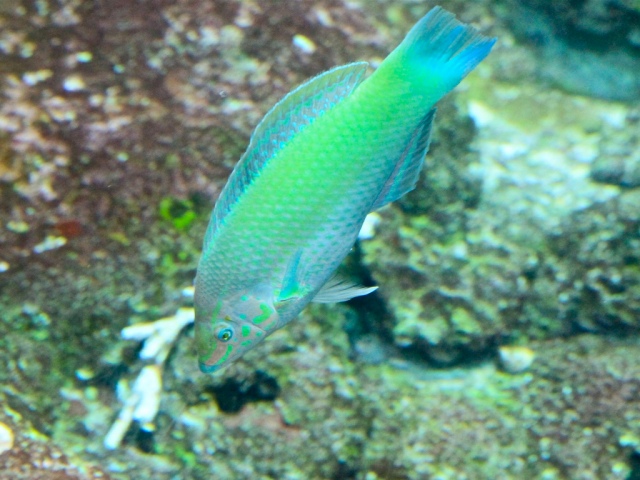
Genus/species: Halichoeres chloropterus

13392429345_0df197f614_b

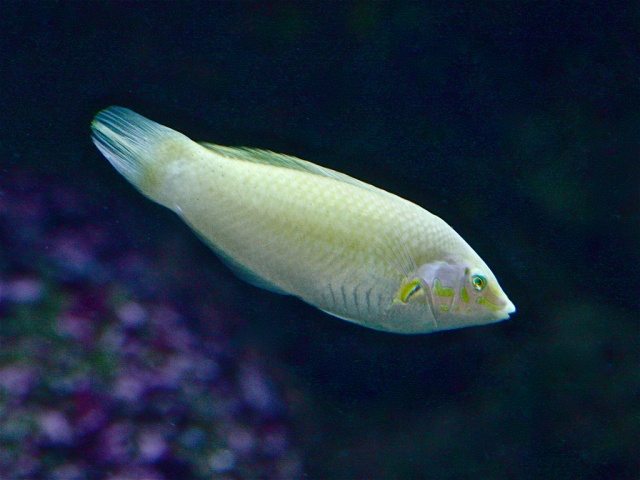
GENERAL CHARACTERISTICS: Juveniles lime green; females pale green above and white below, with a thin dark line on the base of the pectoral fin. Terminal males head of male with intricate reticulate pattern of bands that varies from one individual to another; small blackish spot on anus.

Length up to 19 cm (7.5 inches).

DISTRIBUTION/HABITAT: West Central Pacific: Philippines to the Great Barrier Reef. Found in shallow protected coral reef on silt, sand and rubble bottom. Depth to 10 meters (33 feet)

Pastel-green wrasse4391731072_b36a014eca_b

DIET IN THE WILD: Hard-shelled prey, including mollusks, crustaceans, and sea urchins.

CONSERVATION: IUCN Least concern.

References

California Academy of Sciences Philippine coral reef 201

Ron’s flickr  https://www.flickr.com/photos/cas_docents/3332103036/in/set-72157608208133134/

Ron’s WordPress shortlink  http://wp.me/p1DZ4b-1eI

fishbase: www.fishbase.org/summary/Halichoeres-chloropterus.html

EOL eol.org/pages/223761/details


TAXONOMY

Kingdom: Animalia

Phylum: Chordata

Subphylum: Vertebrata

Class: Actinopterygii

Order: Perciformes

Family: Labridae: (Wrasses)


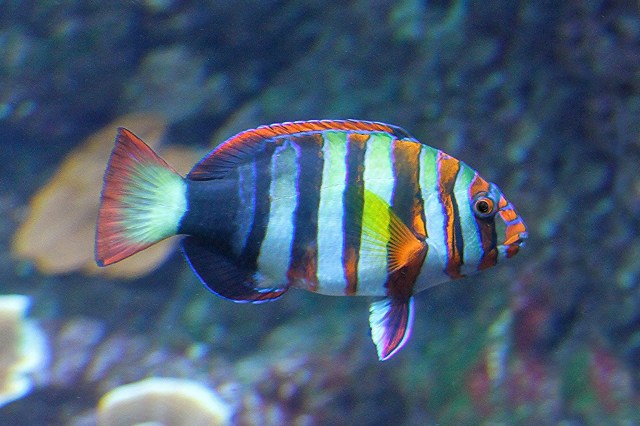
Genus/species;   Choerodon fasciatus

GENERAL CHARACTERISTICS: 
C. fasciatus 
has vertical, broad, bright orange bands interspersed with blue bands. The caudal peduncle is black,  tail is white and dorsal as well as pelvic fins are orange. As it ages the back half of the body darkens to a dark blue/purple color. The mouth has large blue teeth is a very distinctive feature. 

Length up to 30 cm (12 in).

13468909953_41792a2c76_k

DISTRIBUTION/HABITAT: Found in the Western Pacific among seaward reefs, 5–35 m (15-100 ft). Usually solitary.

DIET IN THE WILD:
 Tuskfish have protruding canines used for moving rubble to expose invertebrate prey and prying mollusks from the substrate. Hard shelled prey crushed by pharyngeal teeth. Eats mollusks, echinoderms, crustaceans, worms.

REPRODUCTION
 Pelagic spawners, initial males spawn in large groups; terminal males are usually territorial and pair
 spawn with females of their choice. Females change sex into males for their terminal phase.

CONSERVATION: IUCN Least Concern

REMARKS: Wrasses are most easily identified by their pointed snouts and prominent canine teeth that protrude in front of the jaw. Other common characteristics include their form of propulsion, which depends mostly on the wing like motion of the pectoral fins with only an occasional burst of speed provided by the caudal fin. Color, markings and body shapes change during maturation.

References

California Academy of Sciences Philippine coral reef 2016

Ron’s flickr  https://www.flickr.com/photos/cas_docents/13468909953/in/album-72157608208133134/

Ron’s Wordpress Shortlink  http://wp.me/p1DZ4b-BV

EOL  http://eol.org/pages/206009/details

fishbase   http://www.fishbase.org/summary/Choerodon-fasciatus.html