Category: TROPICAL MARINE


TAXONOMY
Kingdom: Animalia
Phylum: Chordata
Class: Actinopterygii (ray-finned fishes)
Order: Perciformes (Perch-likes)
Family: Serranidae (Sea basses: groupers and fairy basslets)

Subfamily: Anthiinae (Anthias)

Genus/species: Pseudanthias tuka

Male below
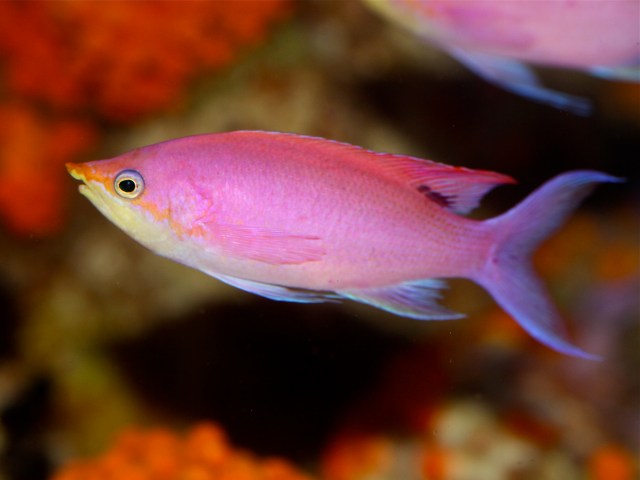
Purple AnthiasI MG_2808

GENERAL CHARACTERISTICS: Sexes bichromatic. Both sexes are a deep pink to purple; however, females have a bright yellow stripe on the back extending onto the caudal fin. Males have a purple blotch on the base of the dorsal fin, elongated fin rays, and a pointed snout Max. size: 12 cm.

DISTRIBUTION/HABITAT: Indo-Pacific: Philippines, Bali, Solomon Islands, Great Barrier Reef, Japan. Habitat: Favor strong currents along the edge of drop-offs and steep outer reef slopes at depths of 30 m or more.

Female below
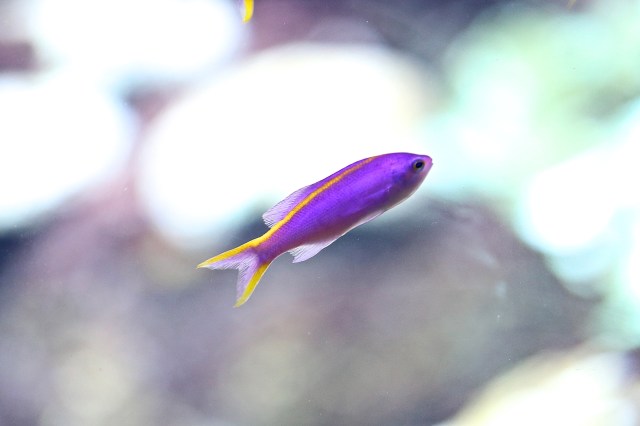
Purple Anthias (female) IMG_7268
DIET IN THE WILDt: Planktonic crustaceans and fish eggs.

REPRODUCTION: As in all Anthias species, if a dominant male dies, the largest female will usually change into a male and take his place.

REMARKS: Usually found in large aggregations with many more females than males.

Animal Attractions SP14, Philippine Coral Reef PR04

flickr http://www.flickr.com/photos/cas_docents/sets/72157608545590153/

WordPress Shortlink http://wp.me/p1DZ4b-YR
TAXONOMY
Kingdom: Animalia
Phylum: Chordata
Class: Actinopterygii (ray-finned fishes)
Order: Perciformes (Perch-likes)
Family: (Labridae) Wrasses

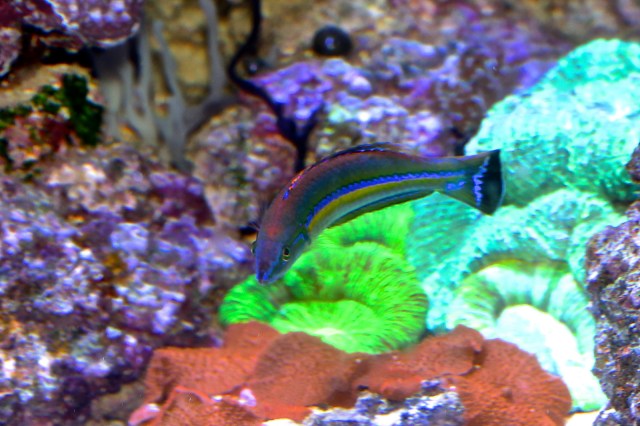
Genus/species: Pseudojuloides cerasinus

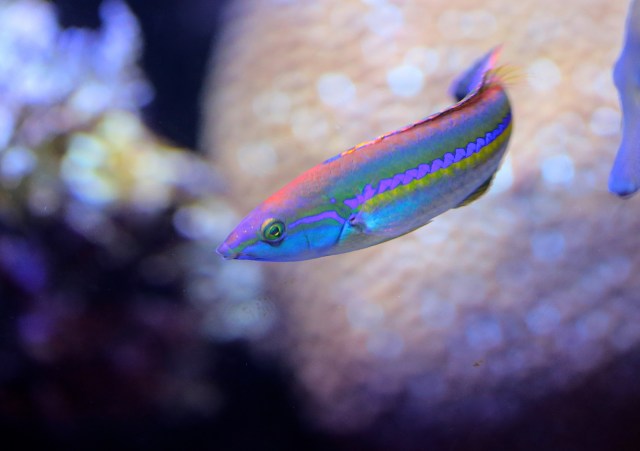
Pencil Wrasse  8362948295_4f3b9c4930_h

GENERAL CHARACTERISTICS: Long slender bodies and pointed snouts. Body color of males and females differ; geographic variation exists Initial phase (IP) fish are white with a copper-colored dorsum. Terminal phase (TP) green upper body, bicolor blue and yellow mid-body stripe; blue below. Length to 12 cm (5 in).

DISTRIBUTION AND HABITAT: East Africa to Samoa and Hawaii. S. Japan to Australia. Found among rubble, weed and coral areas of lagoon and seaward reefs to 61m (201 ft).

DIET IN THE WILD: Small benthic invertebrates (including fan worms, small crustaceans).

8644493886_4619144611_h

Reef Partners Cluster,  Shrimpfish Exhibit PR31

WordPress Shortlink  http://wp.me/p1DZ4b-VM

flickr  http://www.flickr.com/photos/cas_docents/sets/72157608208133134/with/8358672657/

TAXONOMY
Phylum: Mollusca
Class: Cephalopoda
Order: Octopoda
Family: Octopodidae.

Genus/species: Amphioctopus marginatus


GENERAL CHARACTERISTICS
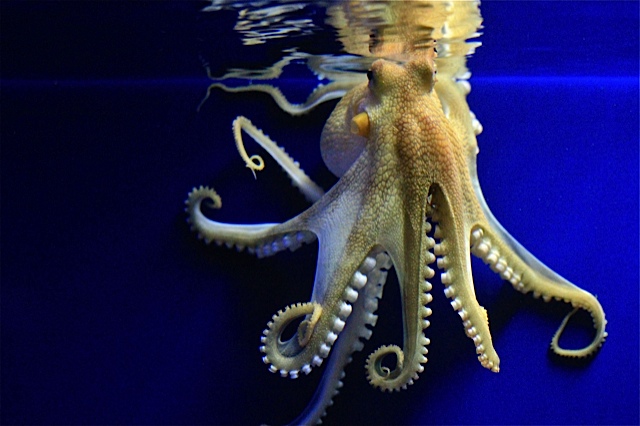
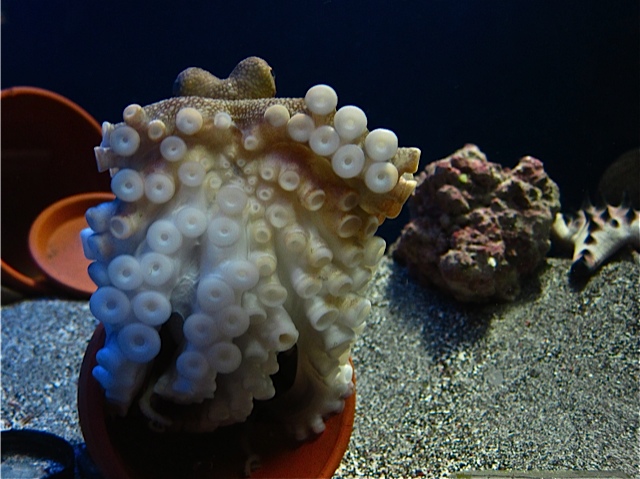
The main body (mantle) is small to medium-sized, 5–8 cm (15 cm [6 in] including arms) in length. The arms are usually dark with contrasting white suckers. They have only soft bodies with no internal skeleton with a hard parrot-like beak allowing them to hide in very small spaces.

DISTRIBUTION/HABITAT
The tropical western Pacific and coastal waters of the Indian Ocean on sandy bottoms.

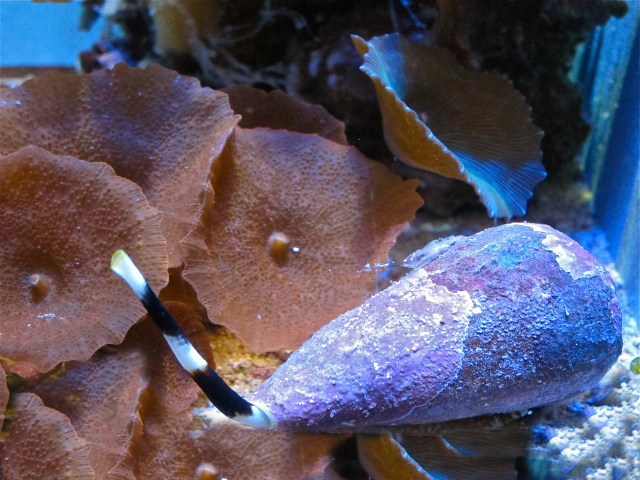
DIET: Shrimp, crabs, and clams. A.marginatus uses its sharp parrot-like beak to crush the shells of its prey. Shells of prey that are difficult to pull or bite open can be “drilled” in order to gain access to the soft tissue: salivary secretions soften the shell, and a tiny hole is created with the radula (a rasp-like structure of tiny teeth used for scraping food particles off a surface). The octopus then secretes a toxin that paralyzes the prey and begins to dissolve it. The shell is pulled apart and the soft tissues are consumed.

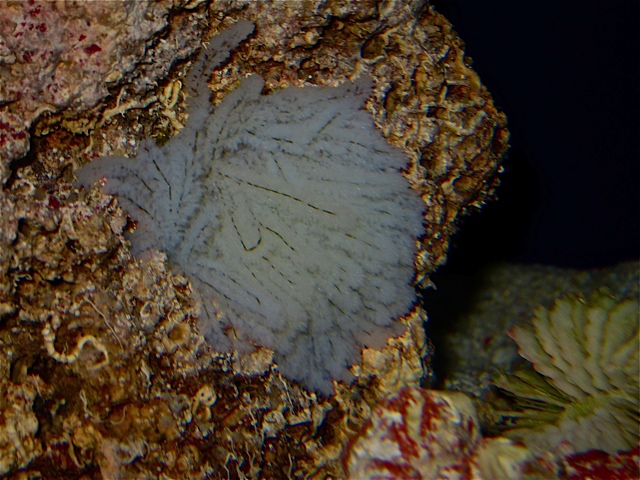
REPRODUCTION: Octopus reproduction strategy provides a counterpoint to the male sacrifice of the flower mantis and the bird-eater tarantula,  The coconut octopus female mates with the male, and retreats into a den where she lays her eggs. At this point, she no longer feeds, instead spending the rest of her now short life protecting her eggs from predators and continually cleaning and aerating them.  She dies shortly after the hatching of her eggs and their subsequent entry into the plankton.

Egg mass below

MORTALITY/LONGEVITY:  10–12 months

REMARKS: The species’ common name derives from this octopus’ habit of carrying around coconut shell halves, by fitting its body into the bowl and extending rigid arms from the coconut’s edge to the substrate and tiptoeing away in gait called “stilt-walking”  or bipedal walking.    

Below A. marginatus using a shell. 

IMG_0198

The Steinhart is the first public aquarium in the U.S. to display the coconut octopus.  Our octopus was collected by Bart Shepherd, Curator of the Steinhart Aquarium, during a 2011 research expedition to the Philippines.

flickr  http://www.flickr.com/photos/cas_docents/6776485376/in/set-72157608597736188

WORDPRESS SHORTLINK http://wp.me/p1DZ4b-pu


TAXONOMY
Phylum: Chordata (Chordates)
Subphylum: Vertebrata (Vertebrates)
Infraphylum: Gnathostomata (Jawed Vertebrates)
Class: Osteichthyes
Subclass: Actinopterygii (ray-finned fishes)
Order: Perciformes (Perch-likes)
Family: Labridae (Wrasses)

Genus/species: Halichoeres vroliki

IMG_5270

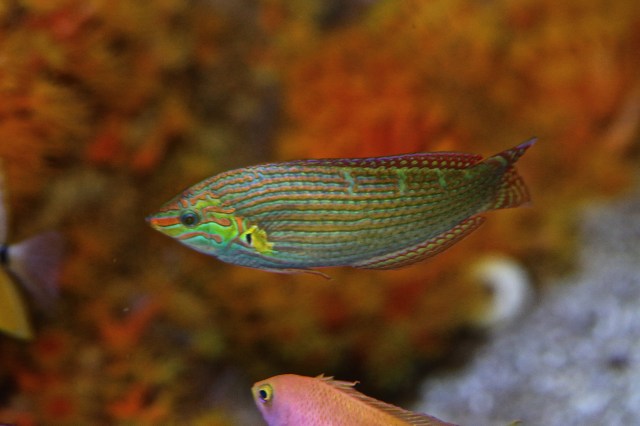
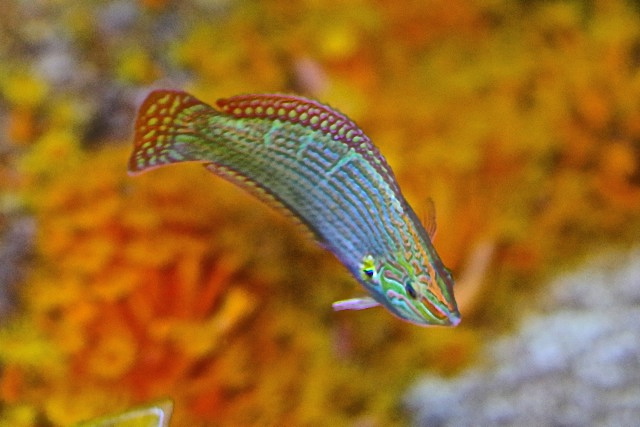
GENERAL CHARACTERISTICS: Light green with darker green stripes of linked spots. 3-4 narrow greenish white bars on back, greenish and pink bands on head, yellow pectoral fin base. Length to 13 cm (5 inches).

DISTRIBUTION/HABITAT: Maldives and Andaman Sea to Moluccan Is in E. Indonesia. Found in shallow weedy areas among coral reefs 2-20 m (6.5-65 ft).

REPRODUCTION: Pelagic spawners.

IMG_5268

Animal Attractions

flickr  http://www.flickr.com/photos/cas_docents/sets/72157608208133134/

WordPress Shortlink  http://wp.me/p1DZ4b-Rk

TAXONOMY
Kingdom: Animalia
Phylum: Chordata
Class: Actinopterygii (ray-finned fishes)
Order: Perciformes (Perch-likes)
Family: Ptereleotridae (Dartfishes)

Genus/species: Nemateleotris helfrichi

8510843234_cd068d461a_b

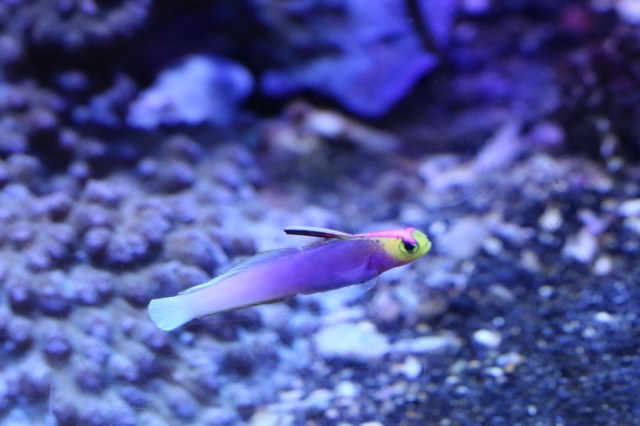
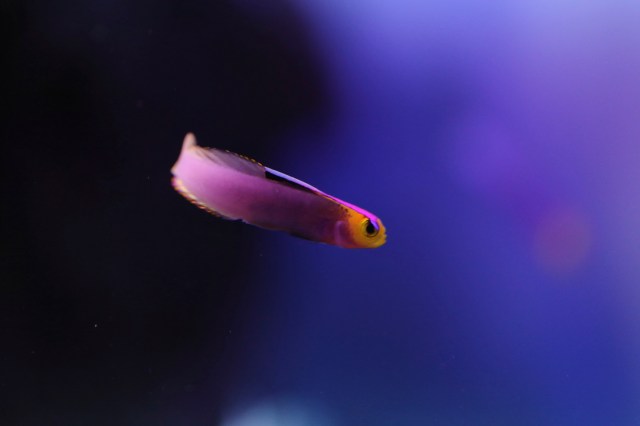
GENERAL CHARACTERISTICS: Goby-like fishes but like the other fire fishes has an elongated two part dorsal fin.They have long anal fins and an upturned mouth. The head is yellow with a purple forehead, and the body is varying shades of purple and white. Length to 2.5 inches.

DISTRIBUTION/HABITAT: Pacific Ocean: eastwards to the Tuamoto Islands, north to the Ryukyu Islands in relatively deep water. Found over small patches of sand, rubble, or hard open bottoms of steep seaward reefs. Rarely found in less than 40 m (130 ft).

DIET IN THE WILD: Carnivore.

REPRODUCTION: Monogamous.

REMARKS: When approached by predators they dart into burrows or under rocks.IMG_6506

Water Planet Defenses WP33

flickr http://www.flickr.com/photos/cas_docents/sets/72157623764848303/with/8412647783/

WordPress Shortlink http://wp.me/p1DZ4b-Ra

TAXONOMY
Phylum:Cnidaria
Class: Scyphozoa
Order: Rhizostomae
Family: Cassiopeidae

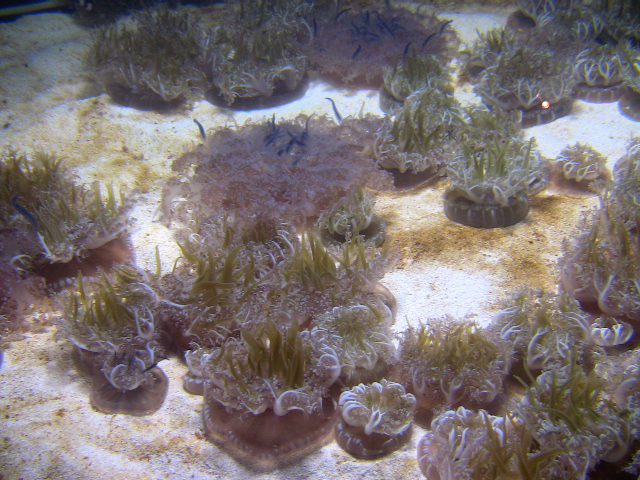
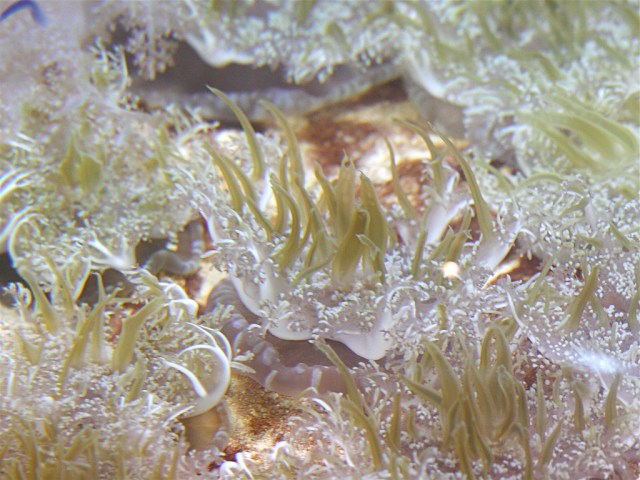
Genus/species: Cassiopea andromeda

3052389114_c2ebdbe533_o

GENERAL CHARACTERISTICS: To 30 cm (12 in) diameter, disc-shaped bell has elaborately fringed oral arms. Coloration is gray, brown or green with triangular white blotches surrounding the bell. Zooxanthellae are the responsible for the color

DISTRIBUTION/HABITAT: Native to Indo-Pacific, but introduced in Caribbean, southern Florida, Hawaii. Upon shallow substrates, typically in calm sandy areas, often around mangroves. Intertidal to 10 m (33 ft).

DIET IN THE WILD: Consumes small marine animals after it paralyzes its prey with its mucous and nematocysts. Symbiotic algae in its tissues provide nutrition by photosynthesis, thus the upside down posture that allows algae, which live on the ventral surface, to receive maximum sunlight. The rhythmic pulsations create water flow that carries zooplankton over the tentacles to supplement the diet.

REPRODUCTION: Asexually (by budding) and sexually in the medusa form.

3279199519_42777fe55f_b

REMARKS: The sting is relatively mild, but may create an irritating, itchy rash; especially sensitive individuals can experience vomiting and skeletal pain.

Mildly venonomus.

Reef Partners Cluster PR35

WordPress Shortlink http://wp.me/p1DZ4b-PV

flickr   http://www.flickr.com/photos/cas_docents/sets/72157610031545571/with/3052389114/

TAXONOMY
Kingdom: Animalia
Phylum: Chordata
Class: Actinopterygii (ray-finned fishes)
Order: Scorpaeniformes (Scorpionfishes and flatheads)
Family: Scorpaenidae (Scorpionfishes or rockfishes)

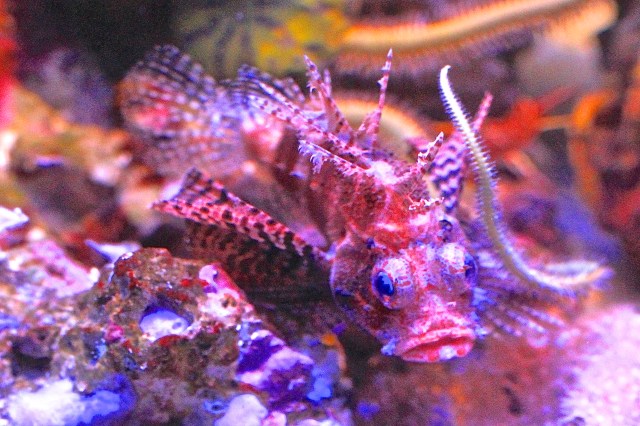
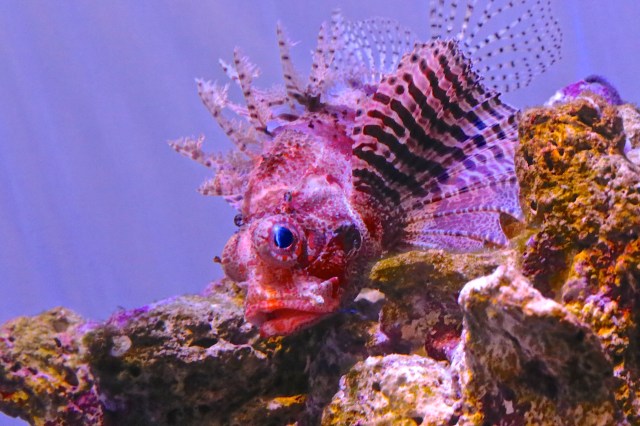
Genus/species: Dendrochirus brachypterus

IMG_9989

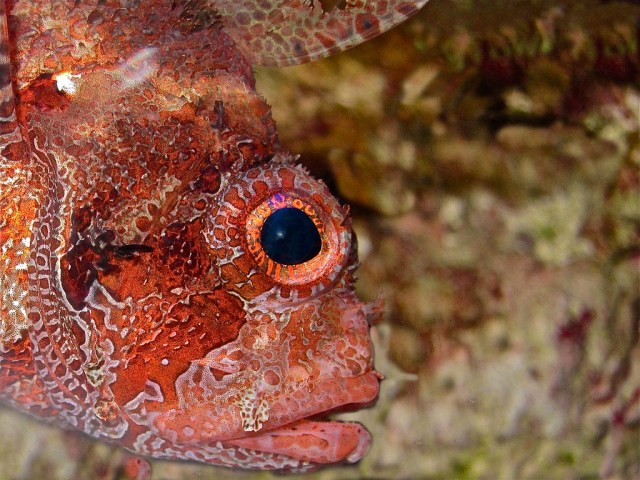
GENERAL CHARACTERISTICS: Body reddish with vague broad bars, paired fins with bars and median fins with small dark spots. Mid-dorsal spines shorter than body depth. Males have larger heads than females and their pectoral fins are longer, extending back to the middle of their caudal peduncle, while the female’s pectoral fins may only reach as far as the base of the caudal peduncle. Max. length to 7 inches.

IMG_6759

DISTRIBUTION/HABITAT: Indo-West Pacific in mature reefs consisting of large aggregations of Acropora and other stony reef-building corals.

DIET IN THE WILD: Most active during dawn and dusk while feeding on small crustaceans.

REMARKS: Dorsal spines are venomous and the stings are similar to a bad wasp or bee sting. Treatment is to soak the affected area in hot water to denature the poison and call a physician.
Most active during dawn and dusk searching for food.

6287825773_71207d7831_b

Locomotion Cluster, Water Planet

WP27

flickr http://www.flickr.com/photos/cas_docents/sets/72157608341866427/

WordPress Shortlink  http://wp.me/p1DZ4b-OF

TAXONOMY
Kingdom: Animalia
Phylum: Mollusca
Class: Gastropoda
Family: Conidae

Genus/species: Conus marmoreus

Marble Cone Snail IMG_8764

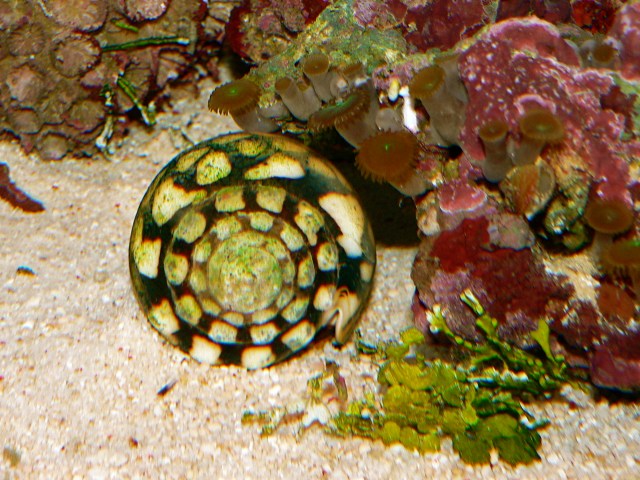
GENERAL CHARACTERISTICS: Shell length to 10 cm or 4 inches. Flat, noduled spire. Reticulated pattern of black or dark brown with white patches overall.

DISTRIBUTION/HABITAT: Red Sea, Indo-Pacific in shallow water to 90 m or 300 ft in depth on coral reef platforms or lagoon pinnacles, as well as in sand, under rocks or sea grass.

DIET IN THE WILD: Molluscivore  A predator of predators; harpoons fishes, worms and other mollusks. Its “harpoon” is a single, specialized modified radula tooth equipped with a spearlike barbed tip. The barbed tooth has a groove through which the snail injects a neurotoxic peptide poison into its victim. The prey is paralyzed then the snail devours it.

Marble Cone Snail  Conus marmoreus (Conidae)

REMARKS: Small cone snails pose little danger to humans beyond a beelike sting; however, large cone snails inject enough toxin to be deadly. About 30 human deaths have been attributed to cone snail envenomation
Research on cone snail peptide conotoxin toxins is an active field and has resulted in a new highly effective painkiller recently approved by the FDA that, unlike opium-derived medications, has a low risk of addiction.

Venoms Cluster PR26

flickr http://www.flickr.com/photos/cas_docents/sets/72157608597736188/

WordPress Shortlink http://wp.me/p1DZ4b-Oi

TAXONOMY
Kingdom: Animalia
Phylum: Cnidaria
Class: Hydrozoa
Order: Anthomedusae
Family: Milleporidae

Genus/species: Millepora sp. 

3271264676_0c4fd03cd3_b

GENERAL CHARACTERISTICS: Colored brownish, greenish or
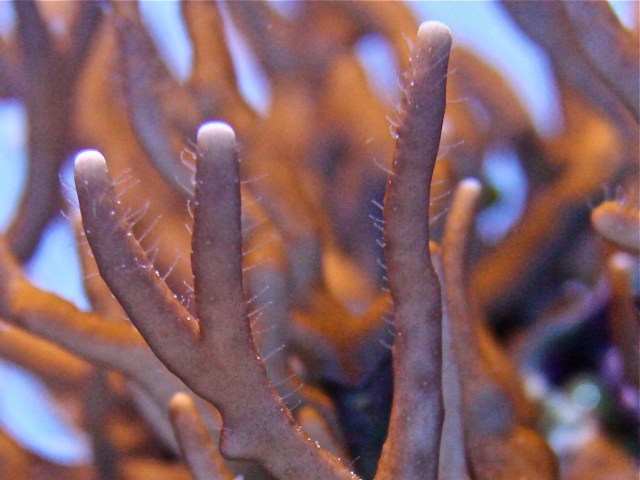
grayish, often with a yellow hue and light tips. Skeleton calcareous with diverse growth-forms from fine branching, to domes, encrusting, or sheet-like. May form extensive colonies to 2 m diameter.

DISTRIBUTION/HABITAT: Pantropical, shallow reefs.

DIET IN THE WILD: Microplankton; zooxanthellae also provide nutrition.

REPRODUCTION: Sexual reproduction, with both medusa and polyp
stages; asexual reproduction via budding. Note Anthozoan corals have only a polyp stage.

IMG_1517

CONSERVATION STATUS: All coral reef species are threatened due to global warming. 

REMARKS: Fire corals are important reef-building organisms, though they are not closely related to the most common group of reef-building hard corals (Scleractinians), which belong to an entirely different class (Anthozoa). Unlike octocorals or hexacorals, fire corals possess polyps so small they are almost microscopic. One type is armed with nematocysts for food-capture and defense; the other type are capable of sexual reproduction. Potent nematocysts are also used to clear the coral of organisms that might shade zooxanthellae and can inflict a painful, burning sting to humans, hence the common name. Fire corals can outcompete many other corals by growing large quickly. and dominating the available space.

Venoms Cluster

Fire Coral PR24

flickr  http://www.flickr.com/photos/cas_docents/sets/72157623828845591/with/3271264676/

WordPress Shortlink: http://wp.me/p1DZ4b-NT

TAXONOMY
Kingdom: Animalia
Phylum:Chordata
Class: Actinopterygii (ray-finned fishes)
Order: Scorpaeniformes (Scorpionfishes and flatheads)
Family: Scorpaenidae (Scorpionfishes or rockfishes)

Genus/species: Sebastapistes cyanostigma

IMG_4381

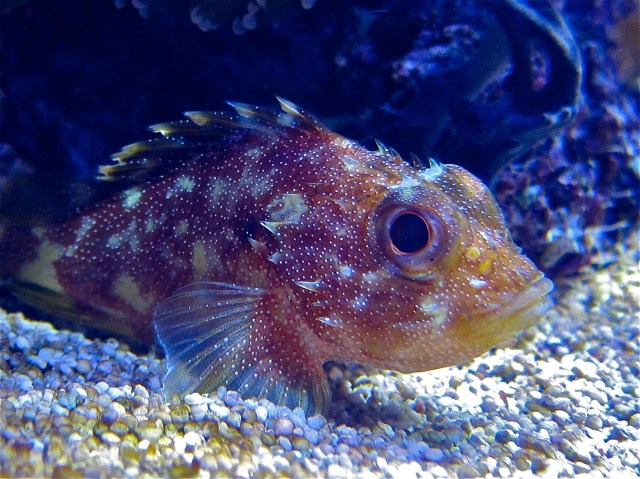
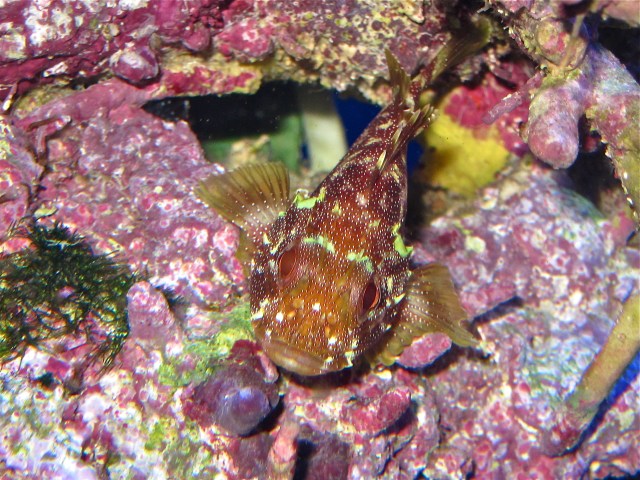
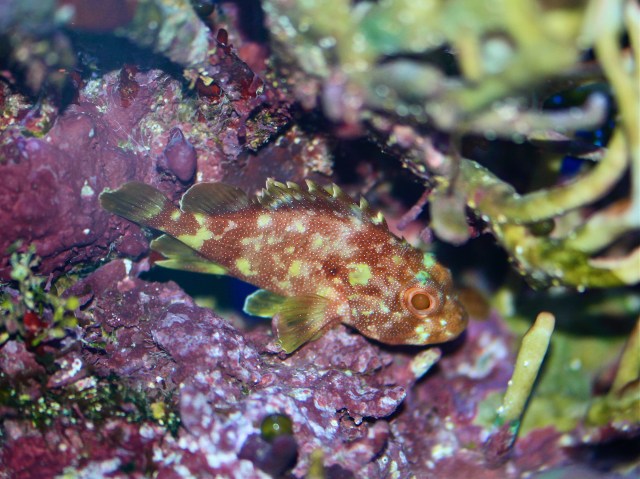
GENERAL CHARACTERISTICS: large head, relatively smooth skin,spotted, usually yellow and white on a pinkish red background. No dark bars on underside of head. Common length : 6.4 cm or 2.5 inches.

DISTRIBUTION/HABITAT:Tropical, Indo-Pacific. Typically found among the branches of Pocillopora corals in surge areas of seaward reefs. Also observed between the branches of the fire coral.

DIET IN THE WILD: Crustaceans and small fishes.

IMG_0029

REMARKS: A master of camouflage, this small fish hide among corals, changing colors to match its background. A viewer of the Fire Coral Tank where this little fish resides may look directly at the fish and still not see it. A true scorpionfish, it uses the sharp venomous spines on its back for protection.

IMG_7182

Venoms Cluster

Fire Coral exhibit, PR24

flickr http://www.flickr.com/photos/cas_docents/sets/72157608341866427/

WordPress Shortlink  http://wp.me/p1DZ4b-NJ