Category: TEMPERATE MARINE


TAXONOMY

Phylum: Mollusca
Class: Bivalvia
Order: Filibranchia
Family: Mytilidae

Genus/species: Mytilus californianus

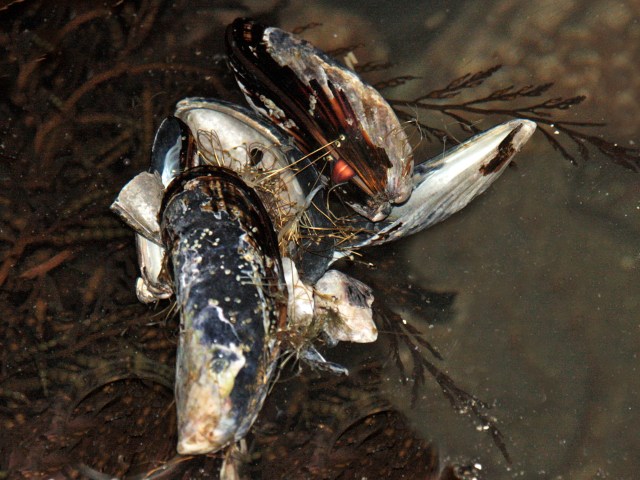
GENERAL CHARACTERISTICS: California mussels are relatively large mussels, with a blue-black shell with strong radial ribs and irregular growth lines. Maximum size is about 13 cm (5 in). The shell surface is often worn and eroded.
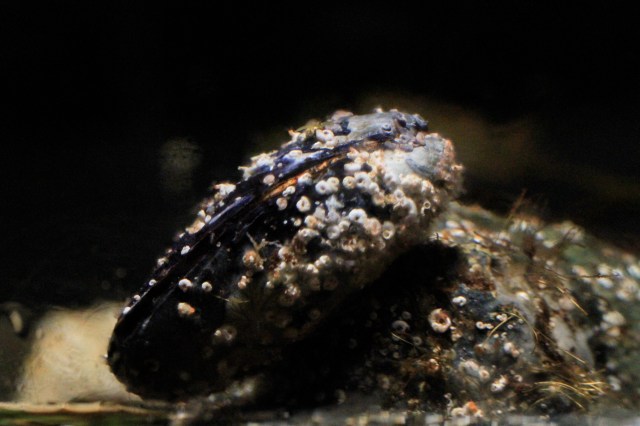
 

DISTRIBUTION/HABITAT:  California mussels form extensive beds, commonly mixed with gooseneck barnacles (Pollicipes polymerus). Attached firmly to the substrate by tough proteinaceous byssal threads, mussels are able to thrive in the most surf-swept areas. Mussel beds break the force of waves and collect organic debris, and so provide shelter and food for other organisms. Worms, chitons, snails, clams, isopods, crabs, and sea cucumbers are among the invertebrates found in mussel beds.

The upper limit of the mussel beds is set primarily by physical factors, particularly time out of water. The lower limit is set in part by the predation of the ochre star (Pisaster ochraceus), which practices vertical foraging, moving up and down with the tides. Mussels range from low intertidal to 40 m (131 ft) deep and are common in surf-swept, rocky areas, and are found from Alaska to southern Baja California.


DIET IN THE WILD: Mussels filter fine organic detritus and living plankton from sea water. A mussel filters 1.8 l to 2.8 l (2 to 3 qts) of water an hour.


PREDATORS: California mussels are favored food items of seas stars (especially ochre stars), crabs, predatory snails, shorebirds, sea otters, and humans. Sea otters have devastated formerly extensive mussel beds in Monterey Bay.


REPRODUCTION: Mussels are either male or female. During breeding they broadcast sperm or eggs into the sea where fertilization occurs. They spawn November to May. Mussel larvae are free-swimming for about four weeks. After settling and attachment they grow to full size in about three years.
 

Remarks

  • The California mussel attaches to rocks by fibers called byssal threads. These threads are produced as a liquid by the byssal gland. The liquid runs down a groove formed by the foot. When the foot pulls back, exposing the liquid to sea water, the liquid solidifies into a thread.
  • A large mussel moves by breaking old threads, then attaching new ones to another spot; a small mussel creeps around on its foot.
  • By filtering algae spores from the water, mussels may limit algae growing around mussel beds.
  • Coastal areas are at risk from development and pollution. Mussels are also at risk because many of their homes are in danger of being ‘loved too much’ by too many tide pool visitors.

References

California Academy of Sciences Docent Guide 2015

flickr http://www.flickr.com/photos/cas_docents/5118861762/in/set-72157608597736188/

WordPress shortlink:  http://wp.me/p1DZ4b-wF

Encyclopedia of Life eol.org/pages/449960/details

Monterey Bay Aquarium www.montereybayaquarium.org/animal-guide/invertebrates/ca…

TAXONOMY
Phylum: Echinodermata
Class: Echinoidea
Order: Echinoida
Family: Strongylocentrotidae

Genus/species: Strongylocentrotus purpuratus

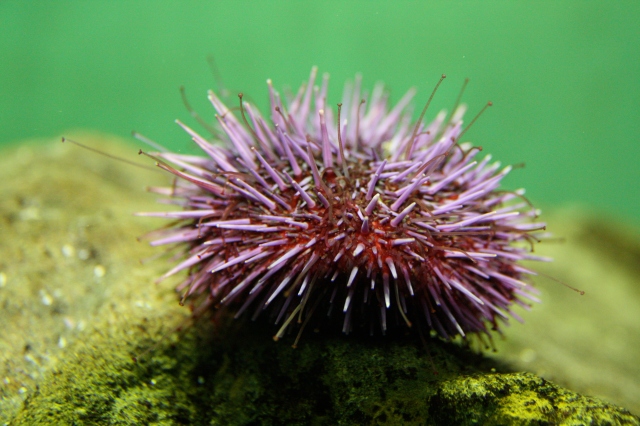
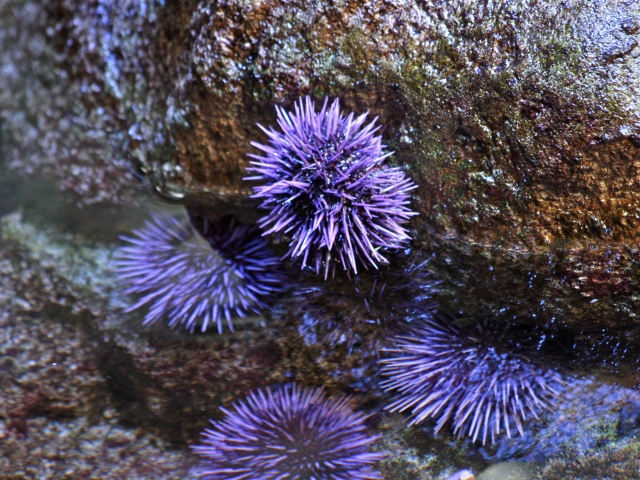
GENERAL CHARACTERISTIC: Round body with radially symmetrical test, (shell), covered with large spines 0.5 cm (2 in) in diameter, rarely to 10 cm (4 in). Test and spines are pale green (young) to purple (adults). Also covering the test or shell, are tube feet and pedicellariae (pincers). The long
suckered tube feet visible above the spines are used for locomotion and capture of food, which is then passed along to the mouth. The oral side of the urchin, on which the mouth is located, faces the substrate (down). Sexes are not physically distinguishable from one another (monomorphic).

DISTRIBUTION/HABITAT: British Columbia to Baja California in the lower intertidal to 160 m (525 ft) depth. Rounded burrows in rock that have been scoured out by the present or previous urchin using its teeth (Aristotle’s lantern) and spines, a strategy that protects from predators and surge.  Subtidal purple urchins live, often in large numbers, on the substrate among kelp holdfasts.


DIET IN THE WILD: Herbivore/Detritivore. Uses calcite (CaCO3) teeth (Aristotle’s lantern) to feed on kelp, other algae, diatoms and scavenge on dead animals. These urchins prefer the giant brown kelp Macrocystis and can destroy entire forests of kelp which are commercially important for fisheries. Algin a product from kelp is also used in the manufacturing of plastics, paints and as a thickening agent in foods such as gravy and pudding.


REPRODUCTION: Sexually mature during their second year. Sexes are separate, although hermaphrodites occur. Broadcast spawning deposits sperm or eggs into the sea where random fertilization occurs. Pluteus larvae hatch, drift and settle. Growth after metamorphosis is slow.

PREDATORS: Preyed upon by seastars such as the sunflower star and cancer crab species as well as fish such as the California sheepshead, shorebirds and sea otters. Sheephead blow over sea urchins and nibble at the oral side where the spines are shortest. When approached by most sea stars, the urchin allows the potential predator to get close, then uses its pincers to attack the sea star’s tube feet. Most sea star species will beat a hasty retreat; however, the sunflower star is too big and fast; the urchin cannot escape and is swallowed whole! Average lifespan 20 years but can live to more than 30 years.

CONSERVATION: CITES; no special status

REMARKS: Purple pigments from this urchin lodge in the bones and teeth of sea otters, turning the otter’s skeleton and teeth purple.

In the wild, they protect themselves from predation, drying out, and damage from the sun’s UV light by covering themselves with seaweed or shells.

Sea urchin is commonly used in sushi and is considered a delicacy Japan. The primary urchin harvesting company in California sends 75% of the harvest to Japan.

LOCATION

RockyReefcluster, Abalone and urchins, Rocky Coast Main Exhibit, Tidepool

References

California Academy of Sciences Docent Water is Life Guide 2015

eol  http://eol.org/pages/598175/details

Ron’s flickr http://www.flickr.com/photos/cas_docents/sets/72157608501343477/

Ron’s WordPress shortlink: http://wp.me/p1DZ4b-vq

TAXONOMY

Kingdom: Animalia
Phylum: Echinodermata
Class: Asteroidea (Starfish or sea stars)
Order: Forcipulatida
Family: Asteriidae

Genus/species: Asterina miniata

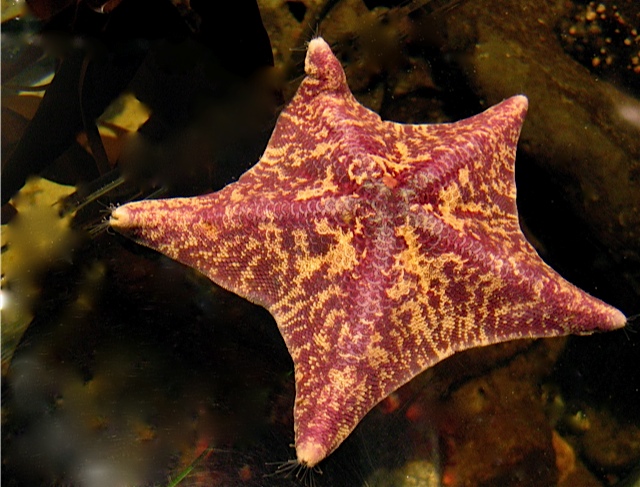
GENERAL CHARACTERISTICS: Colors may be colored red, orange, brown, purple or mottled. They have webbing between their short, triangular arms, which gives them a batlike look. Size is up to 20 cm (eight inches) across. Radially symmetrical they normally have five arms, but they occasionally have as many as nine arms. They have tube-feet that allow locomotion.

DISTRIBUTION/HABITAT: Sitka, Alaska to Baja California, Mexico. Found in low intertidal areas on rocks overgrown with surfgrass, large algae and sponges. Depth intertidal to 290 m (950 ft) on rocky or sandy substrates.

DIET IN THE WILD: Sensors at the end of each arm that sense light and detect prey. Typically an omnivore or scavenger: surfgrass, algae, colonial tunicates, organic films on hard surfaces, as well as other seastars.  Like most seastars, feeds by everting its stomach over prey.

See everted Bat Star stomach below.

REPRODUCTION: Usually spawns May to June. The male broadcasts sperm and the female broadcasts eggs from pores near the bases of their arms. Embryos and larvae are transparent.

PREDATORS Other sea stars, molluscs, and crustaceans. Like some other sea stars, bat stars can sometimes avoid predation by secreting chemicals that evoke flight responses in other animals.

CONSERVATION: IUCN No special status. Collecting by tidepool visitors has diminished some populations, for example around the Monterey Peninsula.

REMARKS: When two bat stars bump into each other, a gentle brawl begins. They seem to be “arm wrestling” in a slow motion skirmish where no winner is usually obvious.

Bat stars lack the pedicillariae, or pincers, common to most other sea stars and used to clear the animal of unwanted parasites and other debris. Even so, bat stars are free of debris, perhaps because small, constantly moving hairs (cilia) discourage settling

Sea stars have endoskeletons made up of plates (calcified ossicles) joined by connective tissue to protect the bat star’s vital organs.  The bat star’s ossicles are so large and defined that they look like rough shingles. 


REMARKS:  SEA STAR WASTING SYNDROME has become a major issue in both the Pacific and Atlantic Oceans. For an excellent summary check this link to the University of Santa Cruz 9-9-14.  http://www.eeb.ucsc.edu/pacificrockyintertidal/data-products/sea-star-wasting/updates.htm

Fitzgerald Marine Reserve.  http://www.fitzgeraldreserve.org/newffmrsite/wp-content/uploads/2014/09/BetweenTides_9-14_web.pdf


References

Monterey Bay Aquarium  http://www.montereybayaquarium.org/animal-guide/invertebrates/bat-star

U. of Michigan Animal Diversity Web http://animaldiversity.ummz.umich.edu/accounts/Patiria_miniata/

Ron’s flickr    http://www.flickr.com/photos/cas_docents/sets/72157608501343477/

Ron’s WordPress shortlink   http://wp.me/p1DZ4b-to

TAXONOMY
Kingdom: Animalia
Phylum: Echinodermata
Class Asteroidea
Order: Forcipulatida
Family: Asteriidae

Genus/species: Pisaster giganteus

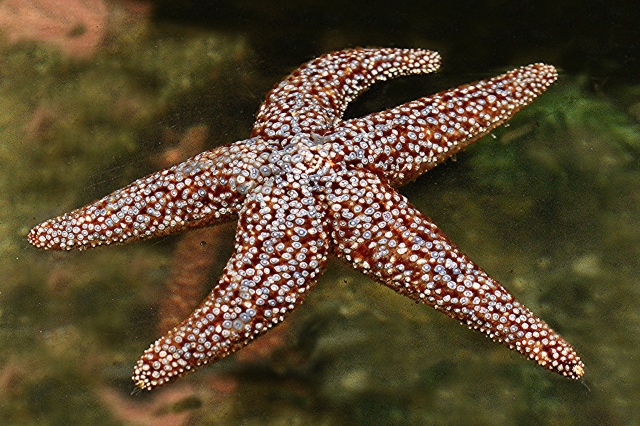
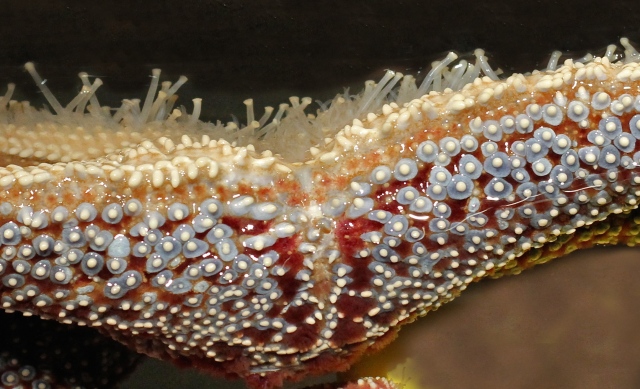
 GENERAL CHARACTERISTICS: Giant sea stars have five arms covered with white, pink, or purple spines surrounded by blue tissue at the base, and range in color from red, orange, brown, or even green. The surface has brown fuzz and pedicellariae. They have a maximum arm span of about 60 cm (23.6 in). P. giganteus would seem improperly named, as the average intertidal specimen is smaller than the average P. ochraceous; however subtidal specimens grow considerably larger.

7137830837_192c64b940_k 

DISTRIBUTION/HABITAT: They are distributed along the eastern Pacific coast from British Columbia to Baja California. They are common on rocky substrates, but also found on sand from the middle to lower intertidal zone down to 90 m (300 ft).

Giant Sea StarIMG_1040.JPG - Version 2

DIET IN THE WILD: Their typical prey are hard-shelled organisms such as mussels, snails, and barnacles by extending its stomach to fit into tiny gaps in bivalves such as mussels. However, they may occasionally eat anything slow-moving enough to be caught, such as a dying fish or shellfish, anemones, or other sea stars.

Giant Seastar IMG_8851

PREDATORS: Sea gulls and sea otters are sea star predators.

REPRODUCTION: Individual sea stars are male or female. Both sexes release gametes into the water for external fertilization. Larvae are planktonic and have bilateral symmetry. Giant sea stars live about 20 years.

REMARKS:  SEA STAR WASTING SYNDROME has become a major issue in both the Pacific and Atlantic Oceans. For an excellent summary check this link to the University of Santa Cruz 9-9-14.  http://www.eeb.ucsc.edu/pacificrockyintertidal/data-products/sea-star-wasting/updates.htm

Fitzgerald Marine Reserve.  http://www.fitzgeraldreserve.org/newffmrsite/wp-content/uploads/2014/09/BetweenTides_9-14_web.pdf

Tidepool 

References

California Academy of Sciences Tidepool Exhibit 2015

Woods Hole www.whoi.edu/science/B/people/kamaral/SeaStar.html

Bishop Museum hbs.bishopmuseum.org/pubs-online/pdf/op11-8.pdf

Encyclopedia of Life  eol.org/pages/598468/details

Animal Diversity Web, ADW  http://animaldiversity.ummz.umich.edu/accounts/Pisaster_giganteus/classification/

Ron’s flickr  https://www.flickr.com/photos/cas_docents/7137830837/in/set-72157608501343477

Ron’s WordPress shortlink  http://wp.me/p1DZ4b-1mV

TAXONOMY
Kingdom: Animalia
Phylum: Echinodermata
Class Asteroidea
Order: Forcipulatida
Family: Asteriidae

Genus/species: Pisaster brevispinus


GENERAL CHARACTERISTICS The pink sea star reaches a maximum diameter of nearly 65 cm (2 ft); however, individuals are usually smaller. Its central disc has a raised, humplike appearance. They are robust, pink in color and have aboral spines much shorter than those of other Pisaster species, thus its scientific name, which translates as “short-spined sea star.”

7137858011_f41cdc4304_k

DISTRIBUTION/HABITAT They range from Sitka, Alaska to San Diego County, California. They can occasional be seen in the low intertidal zone, but are more commonly found in deeper water to 90 m (300 ft ) on sand and mud substrates, but sometimes on rocks and pier pilings in calm waters. They cannot tolerate prolonged exposure to air.

DIET IN THE WILD: Pink sea stars prey on live clams, snails, sand dollars, barnacles, mussels, – annelid worms, and scavenge on dead fish and squid. On soft surfaces, P. brevispinus digs into sand or mud with its arms. It also can extend its tube feet (the ones around its disk) to a length of 20 cm (8 in). When the tube feet reach a clam buried in the mud, they attach and the sea star hauls it up. On shale, it can lower its stomach into the burrow of a clam and digest the animal in place. Their large size may well be due to their access to a plentiful food supply of large organisms unavailable to potential competitors.

PREDATORS Large adults have few predators, but they may be taken by the sunflower sea star Pycnopodia helianthoides. Sea otters have been known to detach rays to consume gonads, and sea gulls occasionally feed on individuals exposed during very low tides.

REPRODUCTION They spawn in the spring. Sexes are separate and fertilization takes place externally. Larvae disperse in the water column.

Pink stars can live up to 20 years.


REMARKS: Can chemosense clams through sand. May dig down to the clam for 2 –3 days or extend tube feet to the clam a distance equal to the arm radius to 20 cm (7.8 in). Once contacted,
the clam is lifted from the substrate or the stomach may be everted to 8 cm (3.15 in) to digest the prey in place. Some sand-bottom invertebrates including the sand dollar Dendraster excentricus and the snail Olivella biplicata chemosense the presence of a pink star and attempt to avoid contact by burrowing.

References

California Academy of Sciences Tidepool exhibit 2015

Walla Walla Univ. www.wallawalla.edu/academics/departments/biology/rosario/…

EOL eol.org/pages/598470/details

Ron’s WORDPRESS SHORTLINK  http://wp.me/p1DZ4b-tA

Ron’s flickr http://www.flickr.com/photos/cas_docents/sets/72157608501343477/

TAXONOMY
Kingdom: Animalia
Phylum: Mollusca
Class: Gastropoda
Family: Dorididae

Genus/species: Peltodoris nobilis

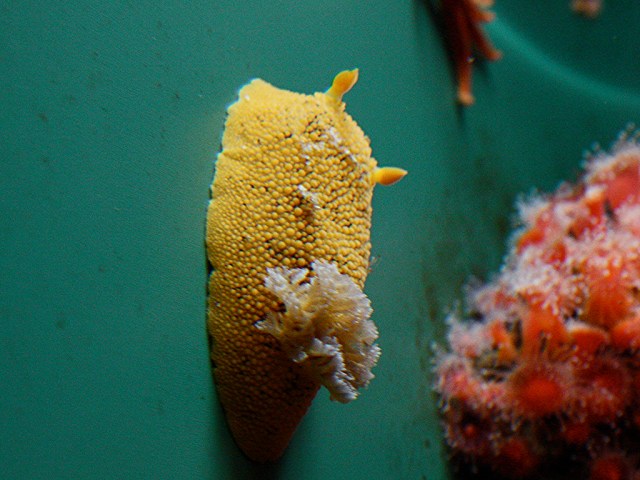
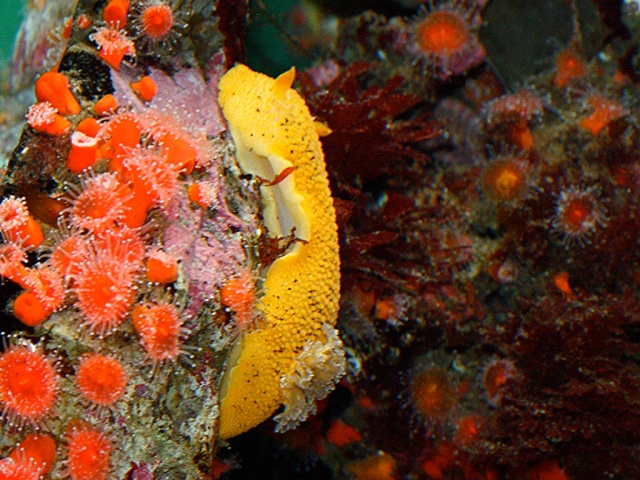
GENERAL CHARACTERISTICS: Color variable: may be pale yellow to a deep rich yellow or orange. Back is covered with tubercules and dark spots. Fleshy antennae (sensory organs) and a rosette of gills protrude from the back of a sea lemon’s slim, flat body. One of the largest of all nudibranchs; 4 to 4.5 inches (10 to 11.5 cm).

Sea Lemon Nudibranch3124713462_3c7ecb3ff5_b

DISTRIBUTION/HABITAT: found from Alaska to Baja California in
rocky areas, mostly at low intertidal and subtidal depths to 300 feet (91 m). Often seen on harbor pilings. California is well-known for the diversity of nudibranchs found in its coastal waters.

DIET: uses a file-like radula to eat sponges.

Sea Lemon Nudibranch3123887143_7648580fb9_b

REPRODUCTION: like all nudibranchs, is hermaphroditic and can produce both sperm and eggs.

LIFE SPAN: approx. one year

CONSERVATION: abundant.

REMARKS: P. nobilis is one several dorid nudibranchs with a fruity, distinct lemon scent usually given off when the animal is handled, thus its common name. When concentrated, the odor repels many predators.

COLOR OF LIFE Note: Concealment by camouflage. Has a bumpy surface typical of those corals and sponges.

Sea Lemon Nudibranch2997671850_b9f4546718_b

References

California Academy of Sciences Color of Life docent training 2015

Ron’s flickr  https://www.flickr.com/photos/cas_docents/2997671850/in/album-72157608597736188/

Metropolitan Oceanic Institute and Aquarium  www.svsu.edu/~tkschult/moia/sea-lemon.html

Monterey Bay Aquarium  www.montereybayaquarium.org/animal-guide/invertebrates/se…

EOL eol.org/pages/451875/details

Ron’s WordPress shortlink  http://wp.me/p1DZ4b-1AF

TAXAONMY
Kingdom: Animalia
Phylum: Chordata
Class: Actinopterygii (ray-finned fishes)
Order: Pleuronectiformes (flat-fishes)
Family: Paralichthyidae (large-tooth flounders)

Genus/species; Paralichthys californicus

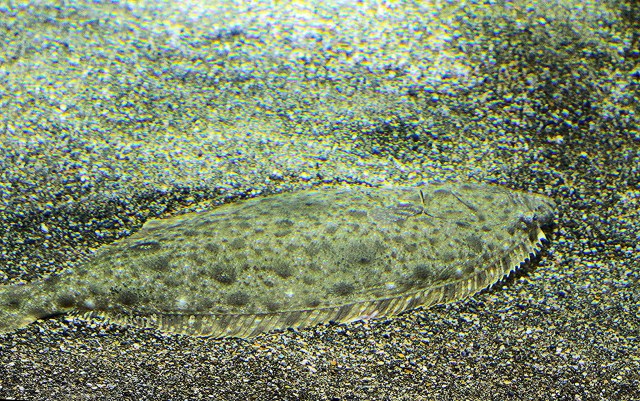
GENERAL CHARACTERISTICS: They are large, oval-shaped flatfish. with small heads, large mouths, small eyes set wide apart. Their lateral line appears as a high arch above the pectoral fin. Many of these fish are right eyed even though they are members of the left-eyed family. They may grow to 1.5 m (5 feet) in length and weigh 32 kg (72 pounds).

15947629781_cd65ceee5b_k

DISTRIBUTION/HABITAT: Northern Washington to southern Baja California, though less common north of San Francisco Bay. P. californicus are found on sandy bottoms to a depth of 183 m along the shore, near rocks and in bays and estuaries.

DIET IN THE WILD: Like flatfish in general, is an ambush predator, using its large, powerful caudal fin to accelerate off of the substrate when prey such as other fishes or squid venture near. Juveniles (less than 55 mm) feed mainly on small crustaceans, such as harpacticoid copepods, small gammarid amphipods, and mysid shrimps.

4330626298_aac443953f_b

MORTALITY/LONGEVITY: They may live as long as 30 years but are subject to predation by sea lions, sharks, rays and dolphins.

REPRODUCTION: Females can reproduce at 4-5 years and males at 2-3 years. California halibut are broadcast spawners in shallow waters of coastal areas. Their eggs are fertilized externally. In the larval form flatfish are bilaterally symmetrical and swim upright, as do other fishes, but at about 13 days one eye begins to migrate to the other side of the head. By the time the juvenile is about 8 mm, it has turned on its side.

LONGEVITY: Up to 30 years in the wild.

CONSERVATION: IUCN Red List: Least Concern (LC)

Color of Life note:  P. californicus demonstrates a well-camouflaged fish using cryptic coloration on the sandy substrate. The chromatophores in the skin change its color and patterning to match its environment.

REMARKS: They have very sharp canine like teeth, and are known to bite.

They are able to use their lateral line to detect vibrations in the water, aiding in prey location and predator avoidance.

Support important commercial and recreational fisheries

Giants, Flatfishes

References

Ron’s flickr https://www.flickr.com/photos/cas_docents/15947629781/in/album-72157652559028013/

Ron’s WordPress shortlink wp.me/p1DZ4b-1yd

Animal Diversity Web animaldiversity.org/accounts/Paralichthys_californicus/

IUCN Red List www.iucnredlist.org/details/183801/0

Monterey Bay Aquariun  www.montereybayaquarium.org/animal-guide/fishes/californi…

TAXONOMY
Phylum: Mollusca
Class: Gastropoda (slugs, snails, nudibranchs, abalone)
Order: Archaeogastropoda (sea snails)
Family: Haliotidae (abalones)

Genus/species: Haliotis rufescens

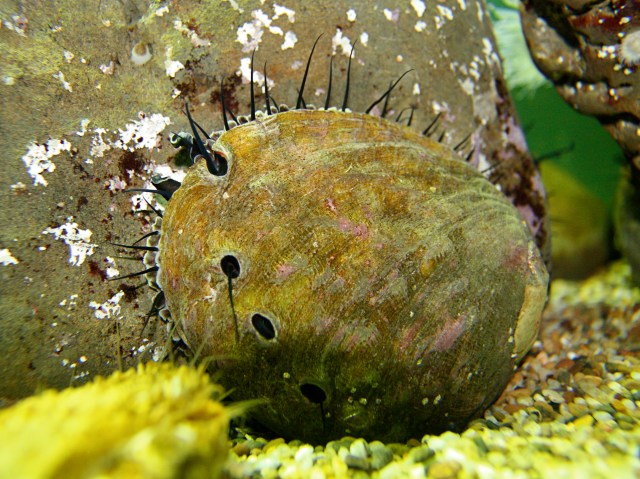
GENERAL CHARACTERISTICS: The red abalone is a large limpet-like snail with a flattened and rounded shell. The shell can reach up to 30 cm (11.8 in) in length and is usually brick-red and overgrown with fouling organisms. Color varies with diet and varies between aquamarine, green, or white. Water enters anteriorly through row of holes parallel to the rim of the shell and exits posteriorly carrying waste products and gametes. When in danger, the abalone clamps its shell tightly to the substrate, protecting soft parts of its body. The shell’s color is influenced by the animal’s diet. The red color is from the pigment phycoerythrin consumed in its red alga diet. Color varies with a diet of brown algae (varies between aquamarine, green, or white).

DISTRIBUTION/HABITAT: Red abalone are found from Oregon to Baja California. They are uncommon in the lower intertidal zone in rocky areas with heavy surf. Most are now found at six to 17 m (20 to 56 ft) depth in central California.


DIET IN THE WILD: Small abalones feed on diatoms and algae; larger animals browse the seaweeds. Red abalone eat algae, especially red and brown species. Usually foraging at night, they trap drifting pieces of algae (kelp) with the tentacles that extend from the foot. The algae is then carried by the foot to the mouth, and is torn and consumed with by the radula.

flickr Feeding Video http://www.flickr.com/photos/cas_docents/6393536637/in/set-72157626486149324


PREDATORS: Sea stars, crabs, octopuses, sea otters and human divers are among the abalone’s primary predators.

REPRODUCTION: After spawning takes place, fertilized eggs sink. Larvae develop in the plankton until they settle to the bottom, metamorphose, and begin to graze. Growth slows with increasing size and age. Mortality is very high in the planktonic stages. Mature individuals can live more than 20 years.

REMARKS: Red abalone are highly endangered due to overexploitation by the abalone fishery. The population plummeted in the late twentieth century, but poaching continues to be a problem. California passed many strict regulations to protect the red abalone: abalone smaller than 20 cm (8 in) in diameter are protected, the canning of abalone is prohibited, and the shipment of fresh or frozen meat out of California is prohibited. Red abalone is the only species that can still be fished. Aquacultured abalone is now increasingly available.

Abalone blood is blue-green and cannot clot making injury possibly fatal.

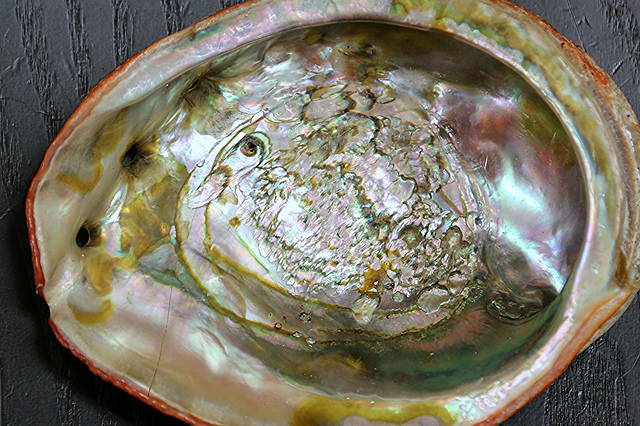
Red Abalone Shell19600303421_7eae835178_z

Color of Life note: Iridescence is caused by two or more semi-transparent, inorganic and/or organic surfaces that cause multiple light reflections. An example found in our tidepool is the Red Abalone inner shell surface which produces an impressive vibrant luster when exposed to light.  The aragonite and conchiolin secreted by the abalone in forms a crystalline structure that reflects light, causing the shell’s iridescence. The inner surface of the shell is known as mother-of-pearl, or nacre. Ref: California Academy of Sciences, Color of Life Exhibit 2015   Jewelry is still made from abalone shells and is quite popular.                        Ref: www.best-deal.com/search/landing/query/red+abalone+shells...


Other references

Marine Biology Coloring book, T.M. Nielsen, 2nd Ed. Harper Resource 1982, 2000.

Encyclopedia of Life  eol.org/pages/620396/details

Monterey Bay Aquarium  www.montereybayaquarium.org/animal-guide/invertebrates/ab…

California Fish and Game www.dfg.ca.gov/marine/pdfs/response/abalone.pdf

Ron’s flickr https://www.flickr.com/photos/cas_docents/6393536637/in/album-72157608597736188/


TAXONOMY
Kingdom: Animalia
Phylum: Chordata
Class: Mammalia
Order: Cetartiodactyla
Suborder: Odontoceti (toothed whales)
Family: Physeteridae
Genus/species: Physeter macrocephalus

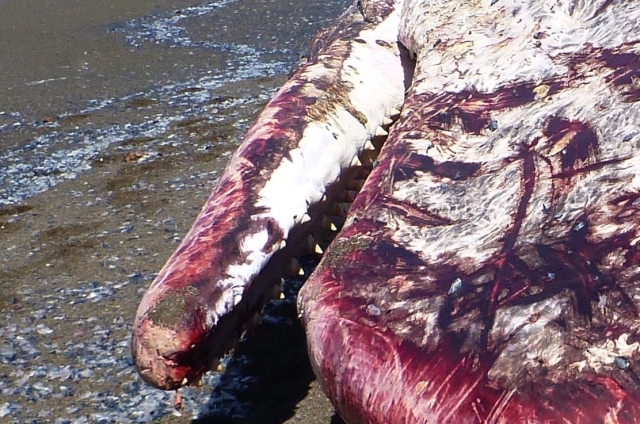
GENERAL CHARACTERISTICS: Have large square heads, comprising almost a third of the total body length with the largest and heaviest brain of any living animal. The head of a Sperm whales contains the spermaceti organ used in echo location. It is filled with a waxy liquid called spermaceti oil. Their single blowhole is located on the left of the head rather than on the top and they have a low, bushy spout, which is projected forward and slightly to the left. Their skin is wrinkled to increase surface area for heat loss, giving them a shriveled look. Color is dark brown to bluish-black and there usually is a large hump (no fin) on the back. There are 18-28 functional teeth on each side of the lower jaws, but the upper teeth are few, weak and nonfunctional. The lower teeth fit into sockets in the upper jaw. 

Male length to 17 m (60 ft) in length, making it the largest toothed whale. Weight up to 54,431 kg (60 tons).
Female length to 12 m (37 ft), Weight to 24,494 kg (27 tons).

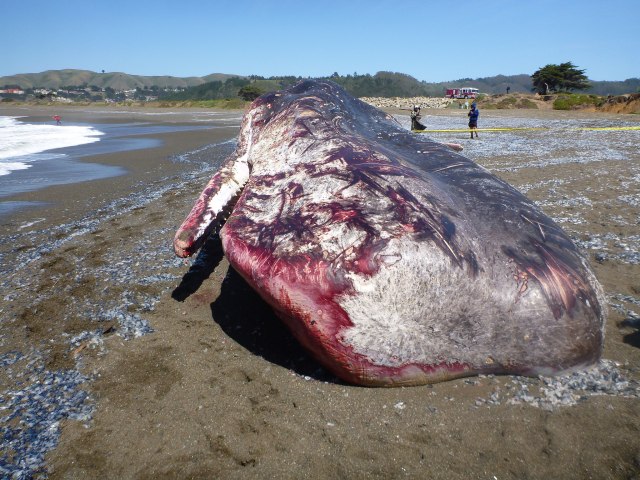
Photos below: Sperm whale, Initial Assessment, 2015, Pacifica       See Pacifica Sperm Whale 2015  californiadiver.com/second-dead-whale-washes-ashore-in-pa…

18639770676_ff60f26a21_k   Photo Credit Denise Greig18378411898_f5397c0b87_o   Photo Credit: Duncan Sinfield, Youtube screenshot

DISTRIBUTION/HABITAT: Found in all of the oceans of the world except the high Arctic. Primarily an inhabitant of the open ocean in offshore areas, the Sperm whale may also occasionally be seen closer to land, providing that the water is deeper than 200 m (650 ft). In California, sperm whales can be seen in waters off the continental slope from November to April.

18377274008_3490082081_k

Photo Credit Denise Greig

DIET: Powerful sound waves are emitted from the head which can stun and perhaps kill squid, octopuses and fish including sharks and rays. They eat about 907 kg (2,200 lbs/1 ton) per day.

Note:  Surprisingly teeth aren’t used mainly for eating. Male Sperm whales appear to use their teeth mostly for fighting other males. The whale sucks prey into its mouth and gullet which is large enough to swallow a man whole. Ref. Te Papa, New Zealand museum and The Encyclopedia of Life.

Version 2

Photo Credit Denise Greig

REPRODUCTION: Mating occurs in spring and summer.After a gestation period of about 16 months, a single calf weighing up to 500 kg (1100 lbs.) is born between July and November. The calf is suckled for up to two years.
Females protect their young by adopting a defensive ‘marguerite formation’ in which the calves are surrounded by a circle of females, facing tail outwards.
Adult males lead a solitary life except for the breeding season. Female and young male sperm whales are social and sometimes are seen in pods, or groups, of up to 50 whales.

PREDATORS: Killer whales

CONSERVATION: IUCN Red List Vulnerable VU   Large-scale hunting began in 1712 in the North Atlantic, based at Nantucket in America. These whales were not widely hunted for its meat, but for ambergris and spermaceti oil. Ambergris collects around the indigestible beaks of squid in the stomach of the whale, and was highly prized for use as a fixative in the perfume industry; spermaceti was used in the production of cosmetics and candles. Recent estimates suggest a global population of 300,000 animals, down from about 1,100,000 before whaling.

Although the International Whaling Commission brought an international moratorium on whaling into force in the 1980s Japan continues to kill whales and dolphins.

Threats: Japan continues to hunt Sperm whales every year at Lamalera, Indonesia using hand harpoons. Other threats include entanglement in fishing gear and collisions with boats.

REMARKS:
P. macrocephalus dives can last two hours and can be as deep as 3000m (9800 ft) making it the deepest diving mammal.

A white Sperm whale was featured in Herman Melville’s classic novel, Moby Dick.

SPECIAL NOTE:  On April 15, 2015 biologists and researchers from the Marine Mammal Center and the California Academy of Sciences performed a necropsy on a beached sperm whale found below Mori Point in Pacifica. Because of its size the mandible is now on the Academy roof buried underneath some soil, which will allow the tissue remaining on the bone to decompose Exposure to the sun after removal from the dirt will naturally whiten the specimen which will become part of the Academy’s research collection.

Reference: Laura Wilkinson, California Academy of Sciences.

18478019998_9e6b459f22_o

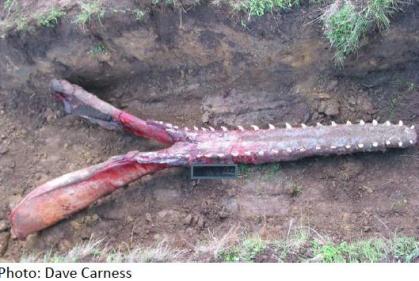
The photo below is a mandible from beached Sperm whale jaw several years ago. It was buried then excavated for further processing and study by the California Academy of Sciences.

Sperm Whale Mandible18661069302_a1e3689d06_o

References

Te Papa, the New Zealand museum Whale to the exhibit at the California Academy of Sciences 2015

Laura Wilkinson, California Academy of Sciences.

ARKive www.arkive.org/sperm-whale/physeter-macrocephalus/

National Geographic www.flickr.com/photos/cas_docents/18639770676/in/album-72…

Marine Mammal Center  www.marinemammalcenter.org/education/marine-mammal-inform..

Monterey Bay Aquarium  www.montereybayaquarium.org/animal-guide/marine-mammals/s…

Encyclopedia of Life eol.org/pages/328547/details

Ron’s flickr https://www.flickr.com/photos/cas_docents/18639770676/in/album-72157652727235908/

Ron’s WordPress Shortlink wp.me/p1DZ4b-1wI


TAXONOMY
Kingdom: Animalia
Phylum: Chordata
Class: Mammalia
Order: Cetartiodactyla
Family: Eschrichtiidae

Genus/species: Eschrichtius robustus

GENERAL CHARACTERISTICS: This species is mottled dark to light grey and is encrusted with patches of barnacles and orange whale lice. Unlike Humpback whales, Grey whales lack a dorsal fin and instead has a series of bumps along a dorsal ridge on the final third of the back. Gray whales have small, paddle-shaped flippers, compared to the large white flippers of Humpback whales.
Length to 14 m (46 ft).
Weigh to 36,000 kg (79,300 pounds).

(see links below for live animal photos under references).

Grey Whale18204939731_f69eecb43a_k

DISTRIBUTION/HABITAT: Now found only in the North Pacific and adjacent waters. E. robustus are primarily bottom feeders and are thus restricted to shallow continental shelf waters for feeding.

DIET: The only cetacean to feed by straining the sediment on the sea floor. mainly for bottom-dwelling crustaceans but also worms and mollusks. Water, sand and mud are expelled through the baleen and food is then swallowed.
Sufficient fat reserves are stored in the feeding grounds to allow individuals to go without food during the breeding season; on return to the feeding grounds about a third of the body weight may have been lost.

REPRODUCTION: The breeding cycle last two years. Gestation takes about 13 months and the single calf is then suckled for a further seven months. The mother may have to hold the calf near the surface to help it to breathe during the first few hours after birth.

E. robustus makes the longest migration of any mammal known, each autumn and spring they pass between their Arctic summer feeding grounds and the mating and calving lagoons in Baja California.
Round-trip up to 20,400 kilometres (12,676 miles).

LONGEVITY: 25 to 80 years.

PREDATION: The only non-human predator of Gray whales is the Killer whale with up to 18% of all Gray whales showing evidence of an Orca attack.

CONSERVATION: IUCN RED LIST Least Concern (LC)
The Eastern North Pacific population has made a significant recovery since 1947 when whaling stopped for this species and now they number between 19,000 – 23,000, which may be close to their original population size.
Three gray whale breeding lagoons in Mexico enjoy some protection in the form of limitations on boating, fishing and coastal development.

Threats: Collisions with ships, entanglement in fishing nets and pollution. Habitat degradation resulting from drilling and dredging is also a problem.

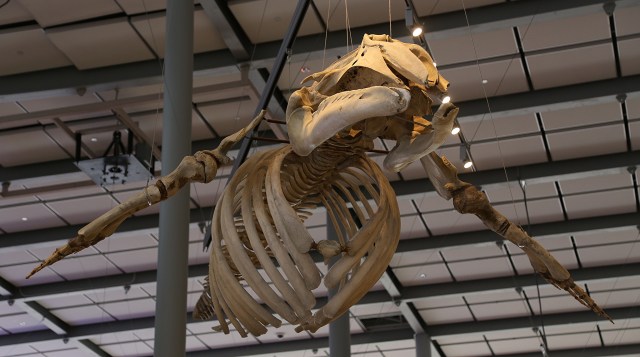
REMARKS: The California Academy’s Gray whale was a juvenile that beached in Baja California in 1966. It would have been about 35 feet long while alive. The two small, hanging, isolated bones towards the tail are remnants of pelvic bones, evidence that whales descended from four-legged land mammals that returned to the ocean about 53 million years ago.

References

California Academy of Sciences Docent program Whale  information March 2015

IUCN Red List www.iucnredlist.org/details/8097/0

ARKive  www.arkive.org/gray-whale/eschrichtius-robustus/

Ron’s flickr link www.flickr.com/photos/cas_docents/18204939731/in/album-72…

Shirihai, H & Jarrett (2006) Whales Dolphins and Other Marine Mammals of the World Princeton University Press.

Evans, P & Weinrich, M (2002) Whales Dolphins and Porpoises D K London New York Munich Melbourne and Delhi.

Reeves, R, R, et al (2002) Guide to Marine Mammals of the World  Chanticleer Press, Inc.

Ron’s WordPress Shortlink https://fishoncomputer.wordpress.com/wp-admin/post.php?post=5851&action=edit