Category: TEMPERATE MARINE


TAXONOMY
Kingdom: Animalia
Phylum: Mollusca
Class: Cephalopoda
Order: Octopoda
Family: Octopodidae

Genus/species: Octopus bimaculoides

GENERAL CHARACTERISTICS: Usually a mottled-brown color with a dark deep-blue ovoid spot under each eye. It can use the chromatophores in its skin to change its color and texture when hunting for prey or hiding from predators (including its eye spots).

Size to 3 feet (including its body and outstretched arms)

2spot Octopus25853155380_e17555cef7_k

DISTRIBUTION/HABITAT: Found from central California to northern Baja California among reefs and pilings on the sea floor.

DIET IN THE WILD: Limpets, black abalone, snails, clams, hermit crabs and small fishes. Prey are subdued with a parrotlike beak and toxic secretions through a salivary gland. Their food is then scraped out with a radula.

REPRODUCTION: Females lay up to 150,000 eggs under rocks from late winter to early summer, then brood on them continuously for 2-4 months. During brooding, the female doesn’t feed and usually dies when eggs hatch.
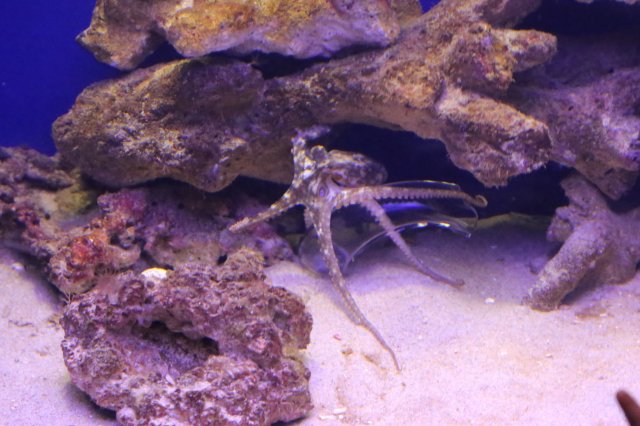
Two-spot Octopus26033508582_96a0c27793_k

Life Span: One-and-a-half to two years.

PREDATORS: Moray eels, scorpionfish and humans. Arms are often lost during a fight with a moray eel and can regenerate.

CONSERVATION: O bimaculoides is very sensitive to impaired water quality, thus water pollution is an issue for its survival.

References

California Academy of Sciences Steinhart aquarium Animal Attractions 2016

Ron’s flickr  https://www.flickr.com/photos/cas_docents/26033508582/in/album-72157629304397467/

Animal Diversity Web animaldiversity.org/accounts/Octopus_bimaculatus/

Jaffe Laboratory jaffeweb.ucsd.edu/node/twospottedoctopus

Monterey bay Aquarium  www.montereybayaquarium.org/animal-guide/octopuses-and-ki…

Cabrillo Marine Aquarium www.cabrillomarineaquarium.org/exhibits/socal-species-det…

Ron’s WordPress Shortlink  http://wp.me/p1DZ4b-1G9


TAXONOMY
Kingdom: Animalia
Phylum: Chordata
Class: Chondrichthyes
Subclass: Elasmobranchii (sharks and rays)
Order: Rajiformes (Skates and rays)
Family: Myliobatidae (Cownose and Manta Rays)

Genus/species: Rhinoptera javanica


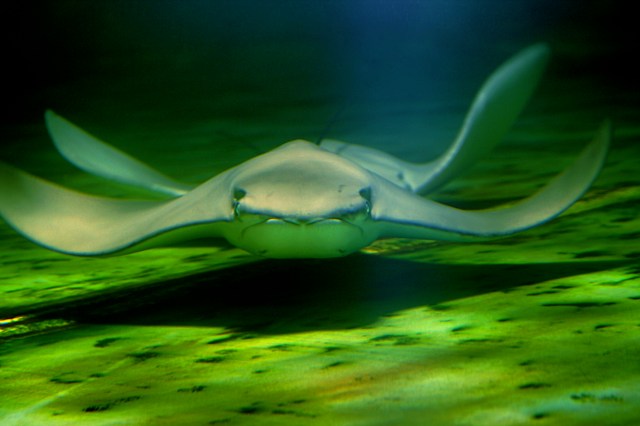
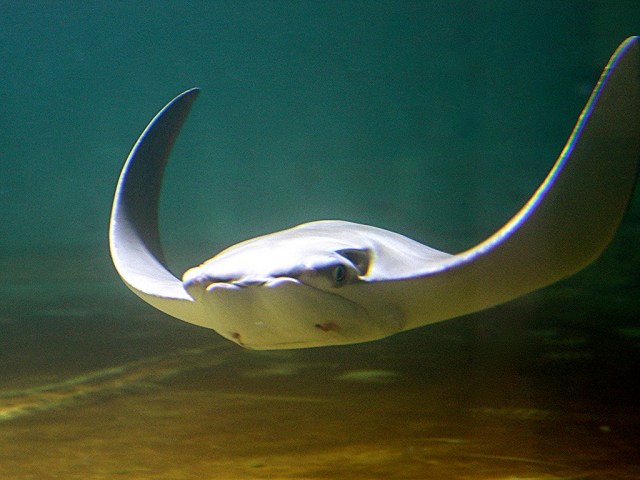
GENERAL CHARACTERISTICS: R. javanica is a cartilaginous fish with bat-like, swept back pectoral fins. Double-lobed snout and indented forehead. Long, slender tail. Brown above, white below. The stinger is located at base of the tail rather than half way or more down the tail as in the whiptail rays
Width up to 1.5 m (5 ft), weight up to 45 kg (100 lbs).

Rhinoptera javanica2981790284_a7f88eab35_b

DISTRIBUTION/HABITAT: Tropical, Indo-West Pacific from South Africa north to India and possibly Thailand, Indonesia and southern China. Also in Okinawa, Ryukyu Islands.  The Javanese Cownose Ray inhabits tropical bays, estuaries, among mangroves, and near coral reefs over sand and mud bottoms. It can also tolerate brackish water.

JAVANESE COWNOSE RAY (Rhinoptera javanica) IMG_1769

DIET IN THE WILD: Feeds on clams, oysters and crustaceans. The ray sucks in sand and expels it out of its gills, blowing off sand covering its prey. (Looking for prey below)

Javanese Cownose Ray Rhinoptera javanica (Myliobatidae) eating IMG_0015

REPRODUCTION: Mating pair orient in a venter to venter position, and the male inserts one or both claspers. Ovoviviparous, 1–2 pups per litter. Females have been known to leap out of the water and slam into the surface; this action seems to be an aid in birthing.

CONSERVATION STATUS: IUCN Red List  Vulnerable

A declining population is inferred from the unregulated nature of inshore fisheries as well as small litter size.


REMARKS:  Like its pelagic relatives the manta and devil rays, it swims by flapping its pectoral fins like wings, enabling it to swim at greater speeds than most bottom dwelling stingrays. Sometimes these “wings” protrude above the water, bearing a frightening resemblance to a shark.

References

California Academy of Sciences Reef Lagoon 2016

ARKive www.arkive.org/javanese-cownose-ray/rhinoptera-javanica/

fishbase www.fishbase.org/summary/SpeciesSummary.php?id=7971

IUCN Red List www.iucnredlist.org/details/60129/0

Ron’s WordPress Shortlink  http://wp.me/p1DZ4b-RK

Ron’s flickr http://www.flickr.com/photos/cas_docents/sets/72157608440813109/with/2981790284/

TAXONOMY
Kingdom: Animalia
Phylum: Cnidaria
Class: Anthozoa
Subclass: Hexacorallia (includes stony corals, all sea anemones, tube anemones, and zoanthids)
Order: Actiniaria (sea anemones)
Family: Actiniidae (largest family of sea anemones)

Genus/species: Anthopleura elegantissima

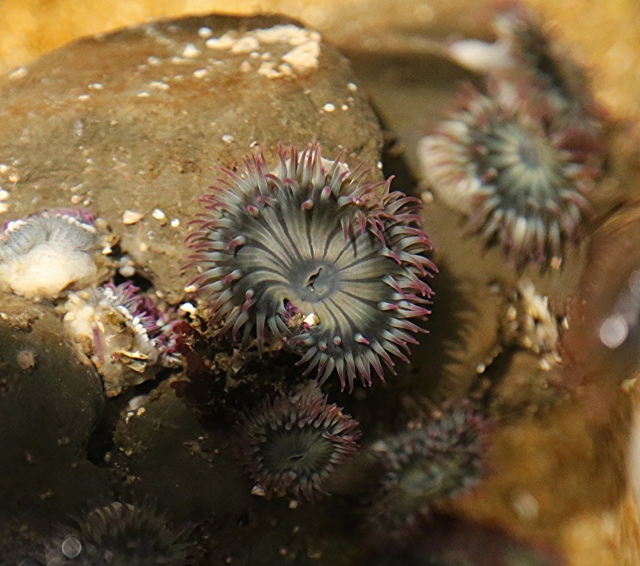
GENERAL CHARACTERISTICS: Most are olive to bright green (depending on the species of algal symbionts present) with tentacles tipped in pink. The oral disk has approximately 100 tentacles in three or four rows around its margins. Those that are deficient in photosynthetically active radiation, such as under docks or in caves, lack symbionts and are pale yellow to white in color.
Disc 2-3 cm (0.78-1.2 in) across, under water.

Aggregating Anemones23710001752_0cf3a8e808_k

DISTRIBUTION/HABITAT: Common in tide pools. The body of the anemone is firmly attached to rock substrate and detritus and sand adheres to the column almost covering them.

DIET IN THE WILD: Capture tiny crustaceans and other animals past their tentacles using their stinging nematocysts (also called cnidocytes) on the surface of their tentacles.

REPRODUCTION: To clone themselves, anemones split in half tearing themselves apart (asexual reproduction). Aggregating anemones also reproduce sexually by broadcasting eggs and sperm.

PREDATORS: Their are few known predators but include the nudibranch Aeolidia papillosa, leather star Dermasterias imbricata and mosshead sculpin Clinocottus globiceps.

REMARKS: When one colony of genetically identical polyps encounters a different genetic colony, the two will wage territorial battles. A. elegantissima has specialized tentacles called acrorhagi to deter non identical colonies from encroaching on their space. It extends the acrorhagi to attack the competing anemone with nematocytes leaving behind a ‘peel’ of the ectoderm and nematocysts that causes tissue necrosis in the receiving animal.

References

California Academy of Sciences Tidepool

Ron’s flickr  https://www.flickr.com/photos/cas_docents/23710001752/in/album-72157625127345346/

Encyclopedia of Life  eol.org/data_objects/27560182

Ron’s WordPress shortlink  http://wp.me/p1DZ4b-1D1

Monterey Bay Aquarium www.montereybayaquarium.org/animal-guide/invertebrates/ag…

Slatter Museum of the U. of Puget Sound www.pugetsound.edu/academics/academic-resources/slater-mu…

TAXOMOMY
Kingdom: Animalia
Phylum: Arthropoda
Subphylum: Crustacea
Class: Cirripedi (barnacles)

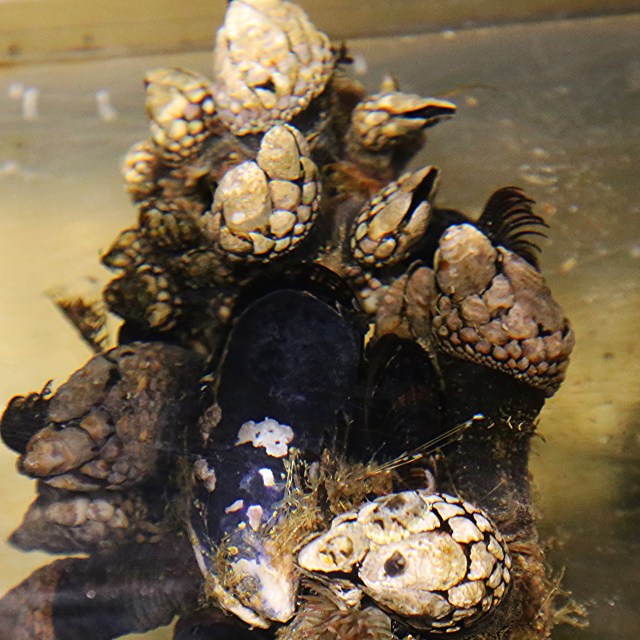
GENERAL CHARACTERISTICS: Free-living barnacles are attached to the substratum by cement glands that form the base of the first pair of antennae; in effect, the animal is fixed upside down by means of its forehead. Inside the carapace, the animal lies on its back, with its limbs projecting upwards. There are six pairs of thoracic limbs, referred to as “cirri”, which are feathery and very long, being used to filter food from the water and move it towards the mouth. They have no gills, absorbing oxygen from the water through their limbs and the inner membrane of the carapace. The excretory organs of barnacles are maxillary glands.

barnacles23190303024_13b7f3ff63_k

DISTRIBUTION/HABITAT: They are also found in all the world’s oceans as hitchhikers on ships, driftwood, and other living animals such as whales, crabs, mollusks, and turtles.

DIET IN THE WILD: Rhythmic movement of the appendages captures small animals, organic fragments, and other suspended nutrients.

PREDATORS: the most common predators on barnacles are whelks. They are able to grind through the calcareous exoskeletons of barnacles and feed on the softer inside parts. Mussels also prey on barnacle larvae. Another predator on barnacles is the starfish species Pisaster ochraceus.

REPRODUCTION: Barnacles begin life as a free-swimming larva. Upon settling, the animal attaches to a hard substrate by its head end. Overlapping plates of calcium carbonate are then secreted externally and protect the animal from predators and water loss.

REMARKS: Various barnacle species create serious and expensive fouling problems on ship hulls and pilings. In two years, 10 tons of barnacles may attach to a large tanker, causing huge losses in fuel efficiency.

Since the intertidal zone periodically desiccates, barnacles are well adapted against water loss. Their calcite shells are impermeable, and they possess two plates which they can slide across their aperture when not feeding. These plates also protect against predation.

Tidepool

References

California Academy of Sciences Tidepool 2015

Encyclopedia of Life eol.org/pages/2630893/details

Ron’s flickr  https://www.flickr.com/photos/cas_docents/23190303024/in/album-72157660640336765/

Ron’s WordPress shortlink  http://wp.me/p1DZ4b-1CW


TAXONOMY
Kingdom:Animalia
Phylum: Molluska,
Class: Gastropoda
Family: ‪Aeolidioidea‬ (superfamily of sea slugs, the aeolid nudibranchs)

Genus /species: Aeolidia papillose

GENERAL CHARACTERISTICS: Its color appears to be quite variable, depending upon locale and food resources. This large aeolid grows to about 10 cm(4 in) in length and its body is covered with close obliquely arranged rows of flattened cerata.

Aeolidia papillose 6873953510_5aecc605bd_k

DISTRIBUTION/HABITAT: Common on the Atlantic coast of Europe and North America and the Pacific coast of North America. Also from  both west and east coasts of South America  Found on rocks, or may be on floats or docks often near its preferred prey. Intertidal to 380 m (116 ft) deep.

DIET IN THE WILD: Feeds almost exclusively on sea anemones.

MORTALITY/LONGEVITY: This species is famous for obtaining undischarged cnidae (cells which bear nematocysts) from its Cnidarian prey and moving to the tips of the cerata , where they are likely used for defense. If disturbed they sometimes wave their cerata. If one of the cerata is broken off, muscles within it contract, expelling the nematocysts, which then discharge . The chemical composition of A. papillosa mucus changes and does not trigger a discharge of nematocysts in the sea anemone.

REPRODUCTION/: Nudibranchs are hermaphroditic, and thus have a set of reproductive organs for both sexes, but they cannot fertilize themselves.

REMARKS: Their eyes are simple and able to discern little more than light and dark. The eyes are set into the body, are about a quarter of a millimeter in diameter, and consist of a lens and five photoreceptors.

Tidepool.

References

Ron’s flickr https://www.flickr.com/photos/cas_docents/6873953510/in/album-72157660640336765/

Encyclopedia of Life eol.org/pages/402852/details

Ron’s WordPress shortlink http://wp.me/p1DZ4b-1CP


TAXONOMY
Phylum: Heterokontophyta
Class: Phaeophyceae
Order: Laminariales
Family: Laminariaceae

Genus/species: Macrocystis pyrifera

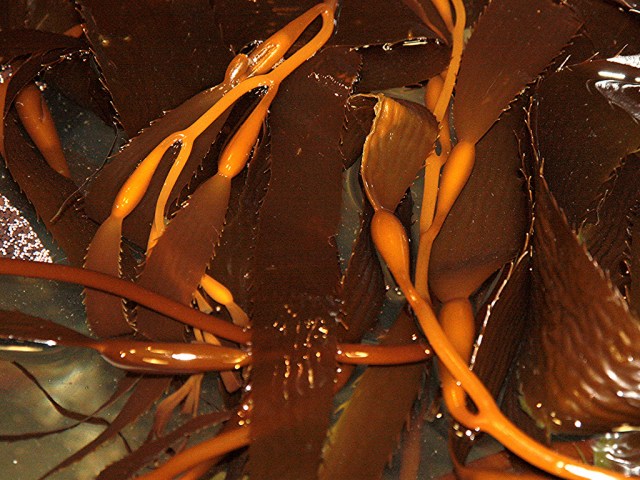
GENERAL CHARACTERISTICS: Stout holdfast attaches to solid substrate to anchor its long, limber stipes (central stalks) and deeply incised blades. Held upright by gas-filled bladders at the base of blades, kelp fronds grow straight up to the surface,

Giant Kelp5055944979_13b2c8c620_b

DISTRIBUTION/ HABITAT: North Atlantic and northern Pacific;
also the Mediterranean Sea and off Brazil. Kelp Forest in general to 100 ft to 175 ft. The water depth zone is often known as the Laminaria zone.

They can grow at a rate of 0.6 metres (2 ft) a day to reach over 45 metres (148 ft) long in one growing season.

REPRODUCTION; Drifting M. pyrifera sporophytes (kelp rafts) are created following sporophyte detachment from benthic substrates. Kept afloat by numerous pneumatocysts (gas-filled bladders), M. pyrifera sporophytes may remain alive and adrift for more than 100 days. the reproductive longevity of drifting M. pyrifera sporophytes is long enough to support effective long-distance dispersal of over 1000 km (620 miles).

LIFESPAN: Five years.

REMARKS: Giant kelp forests are home to many marine species who depend upon the kelp directly for food and shelter, or indirectly as a hunting ground for prey. Invertebrates graze on the blades, fish seek shelter in the fronds and thousands of invertebrates such as brittle stars, sea stars, anemones, sponges and tunicates live in the holdfast. In addition sea otters wrap up in a kelp frond to keep from drifting away when sleeping.

Tidepool

References

 
Ron’s WordPress shortlink  http://wp.me/p1DZ4b-1CJ

Encyclopedia of Life  eol.org/pages/906815/details

TAXONOMY
Phylum: Chordata
Class: Actinopterygii
Order: Perciformes
Family: Gobiesocidae

Genus/species: Gobiesox maeandricus

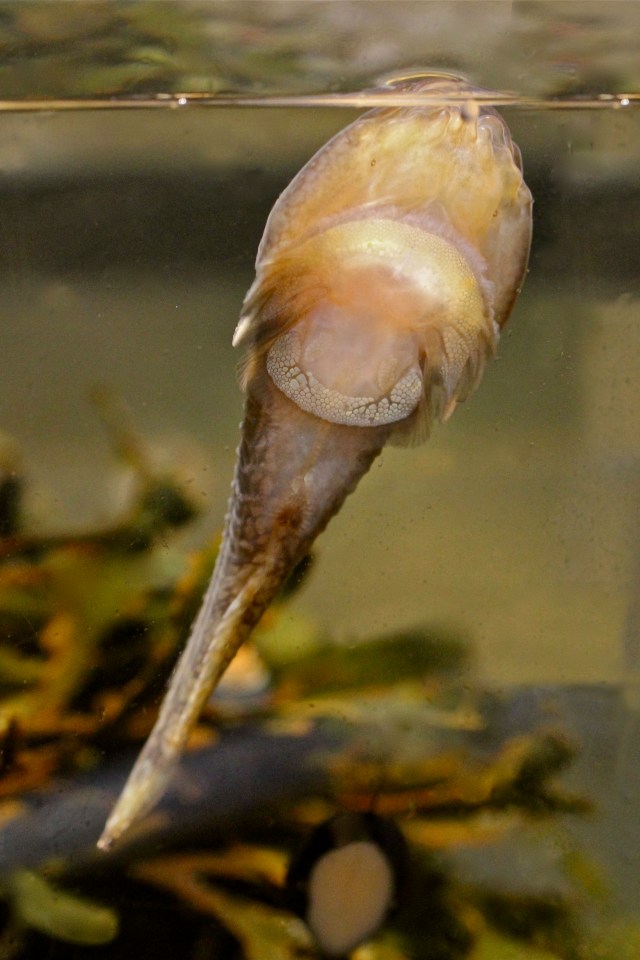
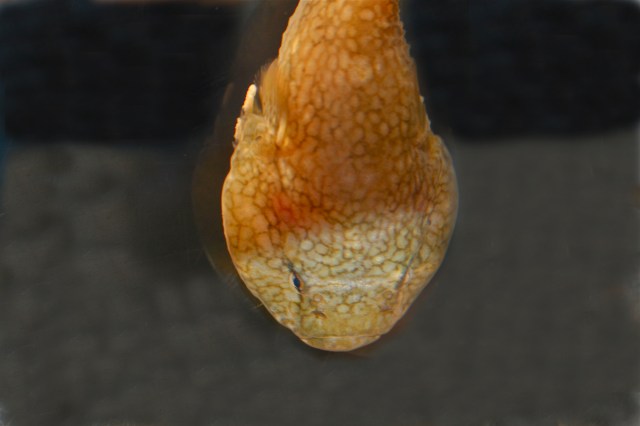
GENERAL CHARACTERISTICS: Like all clingfish, the northern clingfish possesses an adhesive disc, partially developed from the pelvic fins, that allows it to cling tightly to rocks or blades of kelp even in strong currents or crashing waves. The tapering, tadpole-shaped body, about 17 cm (6.5 in) long, has a single, posteriorly located dorsal fin, a fanlike caudal fin, no spines, and a flattened head. The skin is smooth and scaleless, with a thick layer of protective mucus. Its cryptic coloration makes the animal difficult to see among rocks or kelp.

DISTRIBUTION/ HABITAT: The family totals about 150 species worldwide; only 2 – the northern kelpfish (Gobiesox maeandricus) and the kelp clingfish (Rimicola muscarum) are found in northern California. They are bottom-dwelling fishes, typically found on or under rocks or high up in the kelp.

DIET IN THE WILD: Worms, molluscs, small crabs and other crustaceans.

PREDATORS: The clingfish is preyed upon by various aquatic animals that hunt among the rocks at high tide, and terrestrial predators such as snakes and raccoons that hunt at low tide.

REPRODUCTION: The male nudges the female’s belly. If she accepts him, the male moves parallel to her and quivers, stimulating egg laying. Fertilized eggs are deposited on stones, algae, or other bottom material, and are usually guarded by the male. Larvae are planktonic. Life span is about two years.

CONSERVATION: IUCN Red List Status Not Evaluated 

REMARKS: Like a number of other bottom-dwelling fishes, clingfish lack swim bladders, an internal sac used by the majority of fish species to control their position in the water. Clingfish can adhere so tightly to a surface that a rock might be moved some distance by strong currents with the fish still attached! Its suction cup also holds water from which the fish can extract oxygen even when exposed by a low tide.

References

California Academy of Sciences Tidepool Docent Guide 2015

fishbase  www.fishbase.org/summary/3075

Eschmeyer, W.N., E.S. Herald and H. Hammann, 1983. A field guide to Pacific coast fishes of North America. Houghton Mifflin Company, Boston, U.S.A. 336 p.

Encyclopedia of Life eol.org/pages/203811/details

Ron’s flickr  http://www.flickr.com/photos/cas_docents/sets/72157626486149324/

Ron’s WordPress shortlink  http://wp.me/p1DZ4b-vx

TAXONOMY
Kingdom: Animalia
Phylum: Chordata
Class: Actinopterygii (ray-finned fishes)
Order: Perciformes (Perch-likes)
Family:Embiotocidae (Surfperches)

Genus/species:  Cymatogaster aggregata

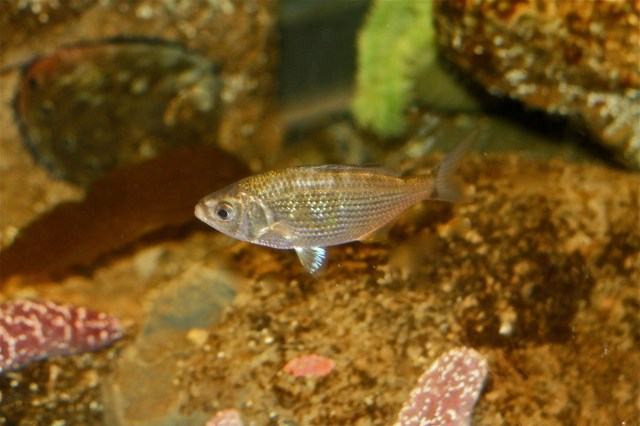
GENERAL CHARACTERISTICS: Shiner surfperch are small, deep-bodied fish, silvery colored with rows of dark spots on the scales that form vague black stripes on sides crossed by three vertical yellow bars. Males cover their shiny silver and yellow stripes with a darker courtship colors during the summer. Their maximum length is to 20 cm (8 in).

DISTRIBUTION AND HABITATShiners are found from Wrangell, Alaska to Baja California. Within their range, they are a common fish in shallow water around eelgrass beds, piers, pilings and oil platforms, and are also found in calm, shallow waters along the coast. They live in loose schools to depths of 146 m (480 ft). They are also known to enter brackish and fresh waters, and are common in San Francisco Bay.

DIET IN THE WILDTheir diet includes small crustaceans, crab larvae, and polychaete worms, as well as planktonic copepods, amphipods, fish eggs, algae and diatoms.

PREDATORS: These small fish are preyed upon by other fishes, including kelp bass, sand bass, and halibut as well as by harbor seals. They are caught along almost all shoreline fishing areas, probably the most common fish taken by recreational anglers along the California coast and in estuaries.

REPRODUCTION:Shiner surfperch mate during the summer; young are born the following spring or summer. Fertilization is internal, embryos are nourished internally, and females give birth to about 20 live young. Litter size varies from 4 to 25. Some males are sexually active immediately after their birth. Females grow faster than males. Their live span is at least six to eight years.

CONSERVATION: IUCN Red List  Least Concern (LC)

LOCATION: Tidepool

References

Ron’s Flickr http://www.flickr.com/photos/cas_docents/sets/72157626486149324/

Ron’s WordPress :  http://wp.me/p1DZ4b-wj  

fishbase  www.fishbase.org/summary/Cymatogaster-aggregata.html

ADW  animaldiversity.org/accounts/Mytilus_californianus/

EOL eol.org/pages/1012531/overview


TAXONOMY
Phylum Cnidaria
Class Anthozoa
Subclass Zoantharia
Order Actiniaria (anemones)
Family Actiniidae

Genus/species: Anthopleura xanthogrammica

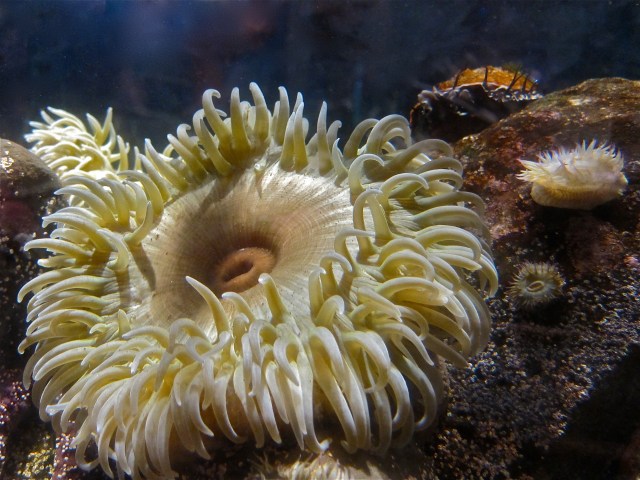
GENERAL CHARACTERISTICS: A  solitary species and one of the largest species of anemone in the world. Column to 30 cm (12 in) tall and 30 cm (12 in) tentacular crown with 25 cm (10 in ) diameter mid base. The base bottom is only slightly larger than column diameter and adheres to rocks.  Tentacles are green, blue, or white without pink on the tips.  No marks or bands.  The oral disk is flat and usually green, but can be grayish-blue to greenish-blue.  Contracted animals form a green to dark greenish-brown, occasionally white hemispherical mound.

DISTRIBUTION/HABITAT: Alaska to Panama in prefers rocky areas and deeper tide pools of the low to middle intertidal zones to 9 m (30 ft), and wharf pilings. Usually solitary; in favorable locations can occur in numbers to 14 per square m.

DIET IN THE WILD: Detached mussels and sea urchins, also take crabs and small fishes. Zoochlorellae endosymbionts supplement host’s diet.

PREDATORS: Nudibranchs, snails, sea spiders and some sea stars, especially leather stars.

REPRODUCTION: A. xanthogrammica have separate sexes releasing sperm and eggs in late spring to summer. The larvae swim or float freely. They do not use asexual reproduction.


REMARKS: Some fishes and the hermit crab Pagurus samuelis develop protection from the anemone’s toxins by covering themselves with mucus that prevents them from being stung.

The bright green can be attributed to green pigment in the anemone epidermis and to symbiotic algae that live in the tissues that line the gut. Inside there may be zoochorellae (green algae) or zooxanthellae, which are dinoflagellates. The symbiotic algae are reduced in numbers or even absent (aposymbiotic) when in shady areas.

LOCATION: Tidepool and California coast.

REFERENCES

Walla Walla University

www.wallawalla.edu/academics/departments/biology/rosario/…

 eol eol.org/pages/704306/details#cite_note-Skiles-4

flickr  http://www.flickr.com/photos/cas_docents/sets/72157625127345346/

WordPress shortlink: http://wp.me/p1DZ4b-w4