Category: REPTILES


TAXONOMY

Kingdom: Animalia
Phylum: Chordata
Class: Reptilia
Order: Squamata
Family: Boidae (Boas; non-venomous, constricting snakes)

Genus/species: Sanzinia madagascariensis
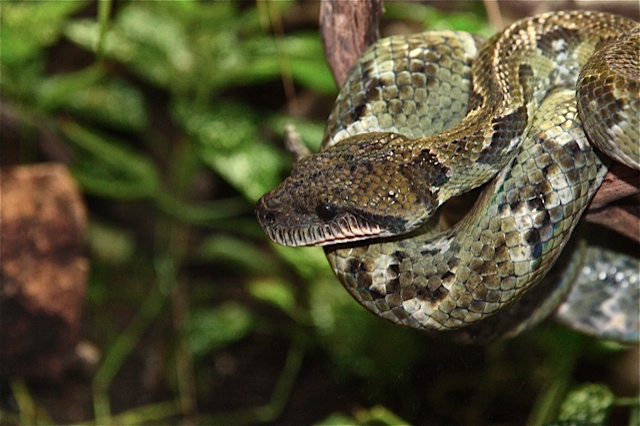
 

GENERAL CHARACTERISTICS: Endemic throughout the island of Madagascar, excluding the very southwest corner. Occurs in 2 color variations; those in the eastern part of the range are green to grayish-green, while in some parts of the western range they are yellow, orange, and brown. The green variety is somewhat smaller than the western form. Max length: about 2 m or 6 ft. Females are larger than males.

DISTRIBUTION/HABITAT: Endemic throughout the island of Madagascar, excluding the very southwest corner. Live in a variety of forest habitats, ranging from lowland tropical forests, to humid upland forests, to dry forests.

DIET IN THE WILD: It is a nocturnal snake, feeding on small mammals (including bats!) and birds, seeking them out using the heat-sensitive pits around its mouth that enable it to hunt for warm-blooded prey in complete darkness. Prey are constricted by the powerful coils of the boa which tighten as the prey struggles, restricting the blood flow to the heart and ultimately causing circulatory failure. Not venomous.

REPRODUCTION: Like all boas, females give birth to live young.Reach maturity at 3 years old, giving usually gives birth to fewer than 12  living young, which are red-colored to deter predators.
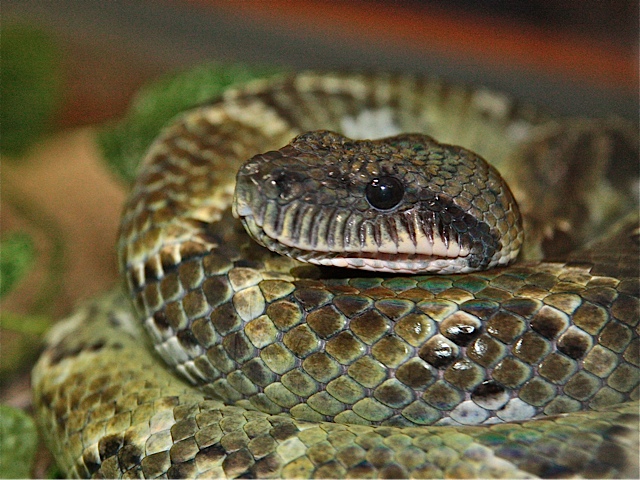
 
CONSERVATION:  IUCN Red List; Least Concern (LC)   Appendix I of CITES. Habitat loss through deforestation for agriculture and human settlement has restricted these boas mostly to protected areas of Madagascar. 

LOCATION: Rainforest  Madagascar MA06

References

Encyclopedia of Life  eol.org/pages/795591/details

ARKive http://www.arkive.org/madagascar-tree-boa/sanzinia-madagascariensis/

California Academy of Sciences Docent Training Manual on Rainforests 2014

Ron’s flickr http://www.flickr.com/photos/cas_docents/sets/72157625194985646/

Ron’s WordPress shortlink   http://wp.me/p1DZ4b-zd


TAXONOMY
Kingdom: Animalia
Phylum: Chordata
Class: Reptilia
Order: Squamata
Family: Colubridae (Colubrids)

Genus/species: Langaha madagascariensis

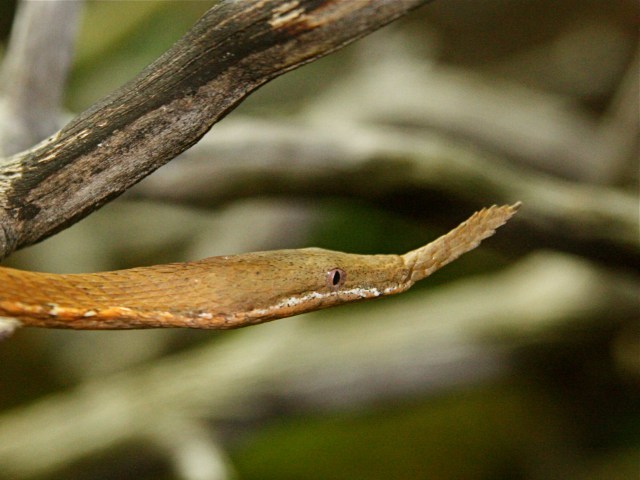
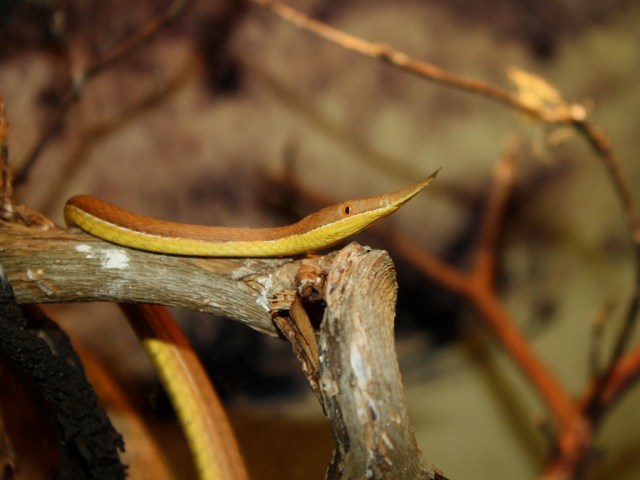
GENERAL CHARACTERISTICS: Displays striking sexual dimorphism: male has a pointed snout and body with contrasting coloration; female has leaf-shaped snout and is uniformly dark brown. 

                    female belowLangaha madagascariensis8599840662_312f136ba9_k

DISTRIBUTION/HABITAT: Endemic to Madagascar. Found at low elevations in much of the island. It is arboreal, living on and in vines. 

                    female belowLangaha madagascariensis3268009379_b359b1da8b_o

DIET IN THE WILD: Lizards Primarily ambush predators, rather than active foragers although it has been observed chasing skinks on the ground. Usually vertical ‘hanging’ behavior as adults, mimicking the seed pods of Malagasy plants (and perhaps deter predation, though by what predator is unclear).

                     male belowLangaha madagascariensis2981271735_2d1bf7df0f_b-2

REPRODUCTION: Egg laying.

CONSERVATION: ICUN Red list Least Concern (LC) 

Wide distribution and presumed large overall population, make it unlikely to decline fast enough to qualify for a more threatened category.

REMARKS: Venomous; bites can produce severe local pain and swelling that may last for several days. Colubrids tend to chew when they bite, further envenomating and infecting the site. 

Madagascar Rainforest MA03

References 

California Academy of Sciences Rainforest Docent Training Manual 2014

Encyclopedia of Life  eol.org/pages/794161/details

Ron’s flickr https://www.flickr.com/photos/cas_docents/8599840662/in/set-72157620708610230/

Ron’s WordPress shortlink  http://wp.me/p1DZ4b-1rx


TAXONOMY
Kingdom: Animalia
Phylum: Chordata
Class: Reptilia
Order: Squamata
Family: Gerrhosauridae

Genus: Zonosaurus maximus

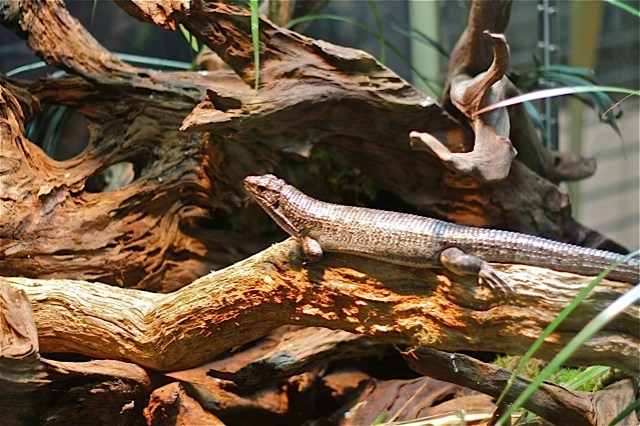
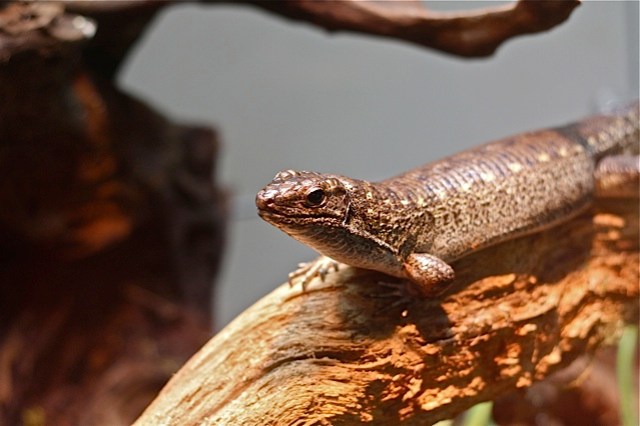
 GENERAL CHARACTERISTICS: Relatively flattened body with a long, pointed snout. The body is covered with heavy armor of large, bony, keeled scales, especially on the dorsal surface. The scaleless area along the sides functions as expansion joints for gravid females that allow distention after feeding. Length is up to 70 cm (28 inches).


DISTRIBUTION/HABITAT: Endemic to Madagascar, this species is found in lowland humid forest associated with rivers and streams as well as non-forested riparian areas where it builds dens close to water. When disturbed, it seeks shelter in water and can stay submerged for several minutes.

DIET IN THE WILD: Plant matter, invertebrates, small rodents, other reptiles.

PREDATORS: Predators are primarily snakes.

REPRODUCTION: Oviparous. Life span: about 20 years.


CONSERVATION: IUCN Red List Vulnerable (VU)
Populations are severely fragmented and declining because of the reduced size and quality of habitat due to agricultural activities. Mature animals may also be over-collected for the pet trade. Some sites where this plated lizard occurs are fortunately under conservation management, including newly protected areas.

LOCATION:  Madagascar Rainforest  MA13

References

California Academy of Sciences, Docent Rainforest Training Manuel 2014

Encyclopedia of Life eol.org/pages/462210/details

IUCN Red List www.iucnredlist.org/details/172865/0

Ron’s flickr  https://www.flickr.com/photos/cas_docents/7423084566/in/set-72157620708610230/

Ron’s WordPress Shortlink  http://wp.me/p1DZ4b-xI


TAXONOMY
Kingdom: Animalia
Phylum: Chordata
Class: Reptilia
Order: Squamata (scaled reptiles)
Family: Colubridae (Colubrids)

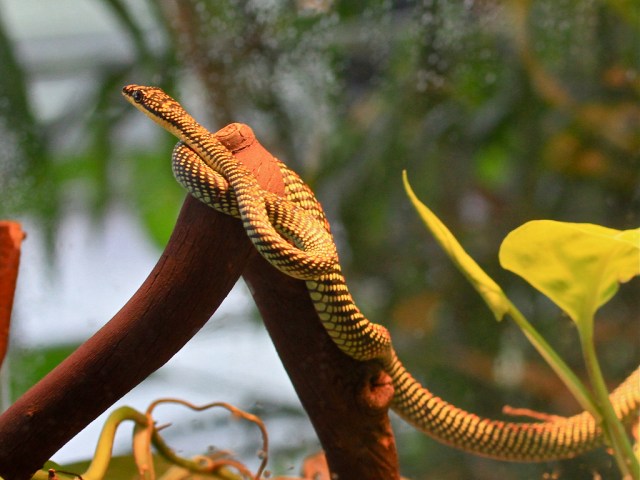
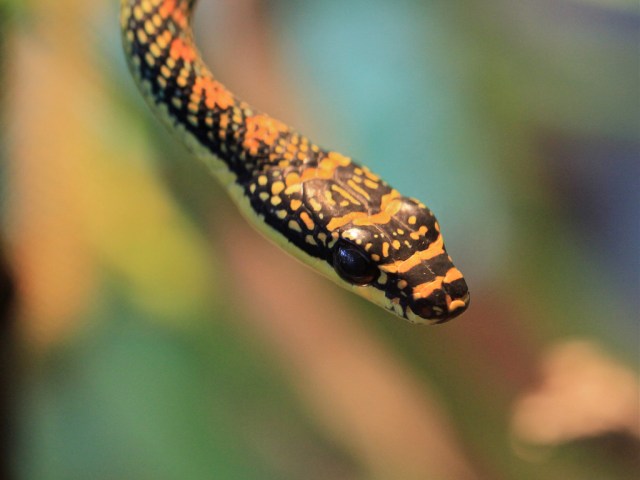
Genus/species: Chrysopelea paradisi 

4495384997_561475b31b_b

GENERAL CHARACTERISTICS  Long slender black body is covered from head to tail with a yellow spotting pattern that may form a somewhat stripped pattern with red or orange splotches starting at the base of the head and extends down to the tail. The head of the snake is distinguished by the 5 yellow, or sometimes orange, bars that span its width. Length: to 3 feet. 

DISTRIBUTION/HABITAT  Southern Thailand, Malaysia, Singapore, Indonesia and the Philippines. Habitat: Arboreal. Lives in a fairly diverse habitat, ranging from tropical evergreen rainforests with relatively sparse undergrowth to deciduous forests with undergrowth of shrubs and grasses.

DIET IN THE WILD  Carnivorous and, like all snakes, swallows its food whole. Prefers lizard species but will eat frogs, bats, small birds and small rodents. They are mildly venomous with rear fangs and also can constrict its prey, which consists of mostly lizards and bats.

PREDATORS: Preyed upon by predatory birds and large mammals.

REPRODUCTION: Oviparous, with internal fertilization, the female lays clutches of 5 to 11 eggs. Offspring are brightly colored like adults.

CONSERVATION: IUCN Red List; Least Concern

The species is fairly common throughout its range.

4495385953_49b8be668f_b-1

REMARKS  The genus Chrysopelea usually posses the ability to “fly.” They slither out to the end of a branch, and dangle in a “J” shape. Using the lower half of their body they form into an S. They then stretch out their ribs, flattening their bodies to double the original width. The belly region of the snake becomes concave, a shape that acts as a parachute as the snake glides on air drafts from a higher branch to a lower one. They can undulate their bodies to change directions and can glide up to 300 feet.

Borneo Rainforest BO13

References

Encyclopedia of Life: http://eol.org/pages/795382/details

California Academy docent rainforest training class 2014

WordPress Shortlink  http://wp.me/p1DZ4b-UM

flickr  http://www.flickr.com/photos/cas_docents/sets/72157608449603666/

TAXONOMY
Kingdom: Animalia
Phylum: Chordata
Class: Reptilia ( turtles, crocodilians, snakes, lizards and tuatara)
Order: Squamata (scaled reptiles, all lizards and snakes)
Suborder: Serpentes (snakes are elongated, legless, carnivorous reptiles)
Family: Colubridae Colubrids

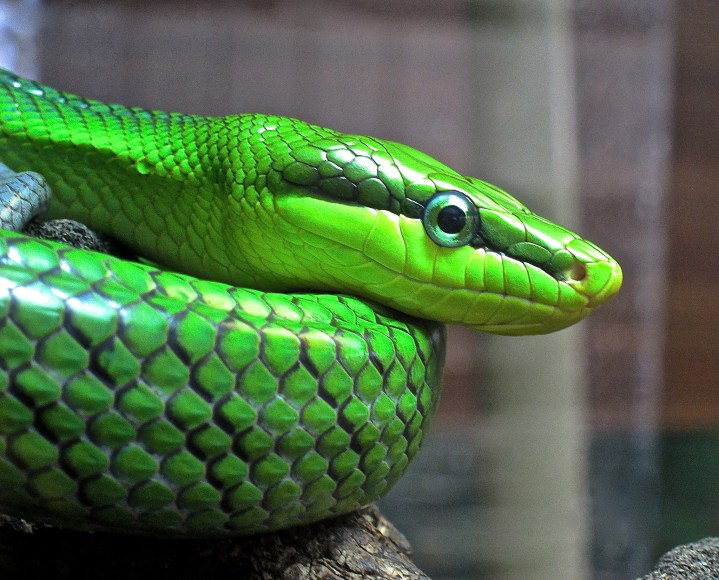
Genus/species: Gonyosoma oxycephala

GENERAL CHARACTERISTICS: Typically bright green but may also be grey with a dark line horizontally across its eye. The top of the head maybe dark green, yellow-green or yellow in color. Length of up to 2.4 m (almost 8 feet).

Gonyosoma oxycephala4185275536_412f9a05fa_o

DISTRIBUTION/HABITAT: Southeast Asia. Found in primary rainforests. Predominantly arboreal (tree-dwelling).

DIET IN THE WILD: Primarily birds, eggs and bats. Will also eat frogs, lizards, bats, and other small mammals. They are fast hunters, and can capture bats in flight. Prey is killed by constriction, rather than venom.

In captivity they are usually eat mice. 

REPRODUCTION: Oviparous, laying clutches of between 5 and 12 eggs

LONGEVITY: 15.1 years (captivity)

 Gonyosoma oxycephala8599840952_eb8bad64f1_k

CONSERVATION: IUCN Red List; Least Concern LC

Common in Borneo

References

Encyclopedia of Life eol.org/pages/456476/details

Ron’s flickr https://www.flickr.com/photos/cas_docents/4185275536/in/set-72157620567930293

Ron’s WordPress shortlink http://wp.me/p1DZ4b-1pJ

TAXONOMY
Kingdom: Animalia
Phylum: Chordata
Subphylum: Vertebrata
Class: Reptilia  (turtles, snakes, lizards, and relatives)
Order: Squamata
Suborder: Serpentes
Family: Viperidae (Vipers)

Genus/species: Tropidolaemus wagleri

GENERAL CHARACTERISTICS: Males are green in color. Females have 4 color phases. In the Malaysian phase seen here, the snake has a black background with yellow bars across it’s back, a yellow belly and green spots, one on each scale. Length to 4 ft. 

Wagler's Pit Viper 8324403992_9febc37327_b

DISTRIBUTION/HABITAT: They are arboreal living in the lowland tropical rainforests of Southeast Asia, including southern Thailand, Malaysia, Singapore, Borneo, Sumatra, Sulawesi and southern Philippines.

DIET IN THE WILD: Ambush nocturnal predator. Like all pit vipers, T. wagleri has heat-sensing organs (called loreal pits) on its head below and in front of their eyes which are used to sense prey, even when they can’t see it. Juveniles and adult males prefer lizards, especially geckos. Females eat a more varied diet, including rats, birds, frogs and lizards, Needs only 3 meals a month.

REPRODUCTION: Viviparous (bears young alive). Litters contain 6-50 young.

PREDATORS: King Cobra.

Wagler's Pit Viper  3506502014_96d97cbdb9_b

CONSERVATION: IUCN Red list; Least Concern (LC)

REMARKS: They have hemotoxic, venom, preventing blood from clotting. Bites can cause local pain, swelling, bruising, and bleeding but bites are rarely fatal to humans.

The Temple of the Azure Cloud in Penang Island, Malaysia is known as Snake Temple. It was once filled with hundreds of Wagler’s pit vipers. Tourists would be photographed with the snakes. Locals collected the snakes, and, fortunately, the ones used for photography had their fangs removed.

Borneo Cave Cluster B005

References

Encyclopedia of Life  eol.org/pages/790394/details

Ron’s flickr https://www.flickr.com/photos/cas_docents/8324403992/in/set-72157620567930293

California Academy of Sciences Docent Rainforest Training class 2014

Ron’s WordPress shortlink http://wp.me/p1DZ4b-Vu

 Borneo Cave Cluster B005


TAXONOMY
Kingdom: Animalia
Phylum: Chordata
Class: Reptilia
Order: Squamata
Family: Colubridae

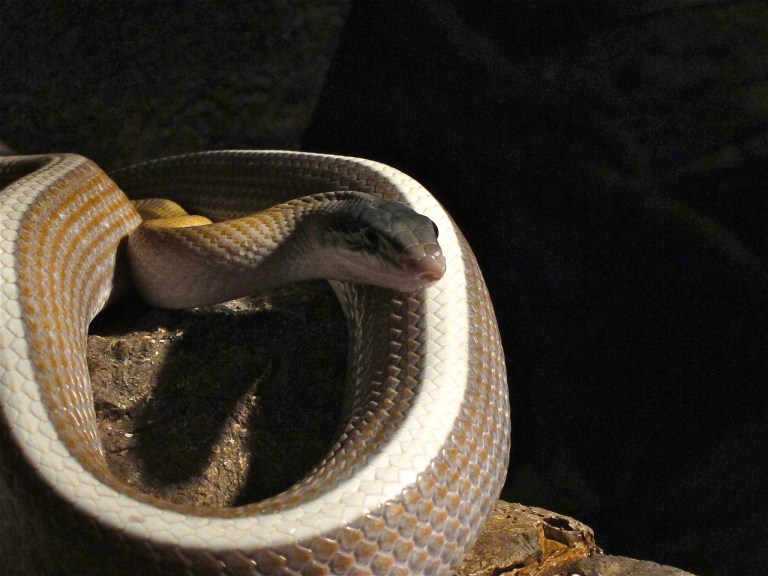
Genus/species: Elaphe taeniura ridleyi aka Orthriophis taeniurus ridleyi

GENERAL CHARACTERISTICS: Color: yellow to beige background color that darkens to a grey-black towards the tail. A white to cream mid-dorsal stripe starts about half of the way down the body and continues to the tip of tail. Both sides of the head are marked just behind the eye with a black stripe surrounded by blue.

Cave Rat Snake aka Bat Eating Snake4496227660_4d83a12687_o

DISTRIBUTION/HABITAT: Southeast Asia including Borneo. Found hanging from the walls and ceilings within caves.

DIET IN THE WILD: Mainly of bats, also rodents and birds.

Cave Rat Snake aka Bat Eating Snake7687438440_3272f123dc_k

REMARKS: Its color is paler than forest racers due to its life in limestone caves.

Borneo Cave Cluster BO03 

References

Encyclopedia of Life  eol.org/pages/794893/details

Ron’s flickr https://www.flickr.com/photos/cas_docents/5252793782/in/set-72157620567930293/

Ron’s WordPress  http://wp.me/p1DZ4b-1pB


TAXONOMY
Kingdom: Animalia
Phylum: Chordata
Class: Reptilia
Order: Squamata
Family: Varanidae

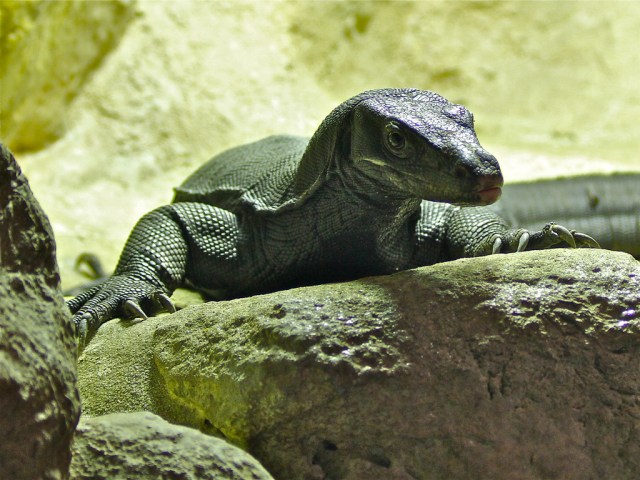
Genus/species: Varanus salvator (melanistic color form)

GENERAL CHARACTERISTICS: Color is usually dark brown or blackish.  The neck is  long with an elongated snout and the nostrils close to the end of the nose. The tail is laterally compressed and has a dorsal keel. Scales on the top of the head are relatively large, while those on the back are smaller in size and are keeled. Length to 2 meters (6.6 ft), but most adults are 1.5 meters (4.9 ft) long. Average weight is 19.5 kg (43 lb). As of 2014 the Academy Water Monitor is aprox. 7 years old and 4 feet long (California Academy of Sciences, Eric Hupperts, Biologist)

Water Monitor


DISTRIBUTION/HABITAT: Found throughout much of southern Asia, from India in the west to the Philippines and the Indo-Australian islands in the east. They are semi-aquatic and has a wide range of habitats. Also found on flat land, a typical burrow is in a river bank. The entrance starts on a downward slope but then increases forming a shallow pool of water.

DIET IN THE WILD: The lizard is very fast and is an ‘open pursuit’ hunter, rather than stalking and ambushing. V. salvator is an extreme carnivore: birds, eggs, mammals, fishes, other reptiles and carrion.
Academy diet: Rodents.

REPRODUCTION: Males are normally larger than the females, usually twice as large in mass.. Eggs are usually deposited along rotting logs or stumps.

LIFESPAN: 10.6 years in captivity.

Water Monitor

CONSERVATION: IUCN Redlist: Least Concern. CITES: appendix II. It is abundant in parts of its range, despite large levels of harvesting.

REMARKS:They are excellent swimmers known to cross large stretches of water, explaining its wide distribution. Known to dig up corpses of human and devour them.

Skins of  V. salvator are used for dietary protein, ceremonies, medicine, and leather goods. Annual trade in these skins may reach more than 1 million whole skins a year, mostly in Indonesia for the leather trade. Medium-sized individual are preferred because the skin of large animals is too tough and thick to shape.

References:

Encyclopedia of Life  http://eol.org/pages/1055072/details

Animal Diversity Web animaldiversity.ummz.umich.edu/accounts/Varanus_salvator/

Ron’s WordPress Shortlink  http://wp.me/p1DZ4b-TY

Ron’s flickr http://www.flickr.com/photos/cas_docents/sets/72157625194985646/with/5492305677/

TAXONOMY
Kingdom: Animalia
Phylum: Chordata
Class: Reptilia
Order: Testudines
Suborder: Pleurodira (side-necked turtles)
Family: Chelidae (“snake-necked turtles”)

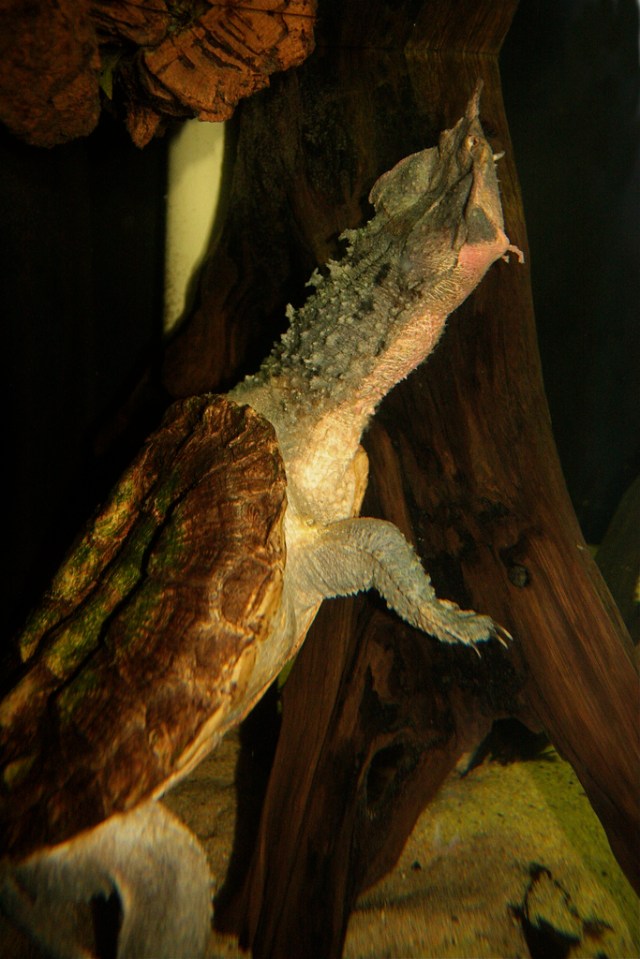
Genus/species: Chelus fimbriata

GENERAL CHARACTERISTICS: Color is faded yellow, washed out browns, oranges, and greys. The carapace has three lengthwise knobby keels with algae covering much of the carapace resembling a piece of bark, camouflaging it from possible predators. The head is widely triangular with large lateral flaps of skin and three barbels on the chin and four additional filamentous barbels at the upper jaw, The snout is a long protuberance used as a snorkel.  Carapace length to up to 45 cm (18 inches). Weight to 15 kg (33 lb).

DISTRIBUTION/HABITAT: Tropical. Amazon Basin, South America. Found near the bottom of turbid waterways in lakes, ponds and sluggish creeks. Rarely leaves the water.

DIET IN THE WILD: Carnivore. A “lay-in-wait” predator. Fishes and aquatic invertebrates are captured with the “gape and suck” technique. The opening of its mouth creates a vacuum to draw in prey with the mouth snaping shut, expelling the water and the fish swallowed whole.


REPRODUCTION: Fertilization is internal. They excavate their nests in decaying vegetation at the forest edge laying 12 to 28 eggs with an incubation periods of around 200 days.

LIFESPAN: To 15 years in captivity.

CONSERVATION: IUCN and CITES No special status.


3449612144_afdc85b508_b

REMARKS: The common name “matamata” is said to have the meaning “I kill” in one of the South American native languages.
C.fimbriatus has extremely poor eyesight. It can sense sound through a well developed tympanum on both sides of the head.

References

Ron’s WordPress shortlink  http://wp.me/p1DZ4b-bJ 

 U. of Michigan ADW animaldiversity.ummz.umich.edu/accounts/Chelus_fimbriatus/

Encyclopedia of Life  eol.org/pages/795410/details

Ron’s flickr  http://www.flickr.com/photos/cas_docents/sets/72157608449490716/


TAXONOMY
Kingdom: Animalia
Phylum: Chordata
Subphylum: Vertebrata
Class: Reptilia
Order: Squamata
Suborder: Serpentes
Family: Boidae
Subfamily: Boinae

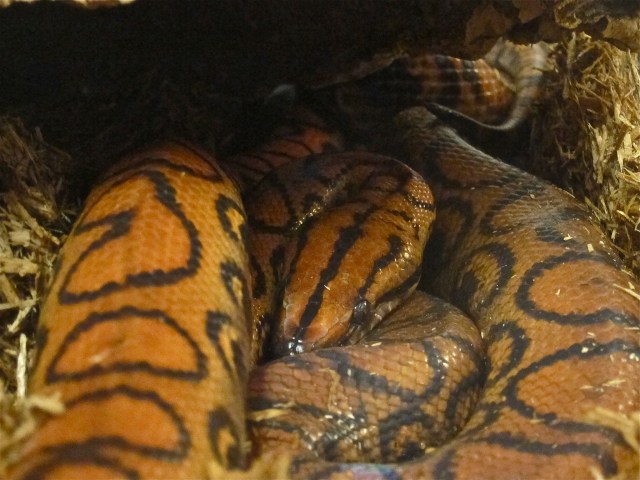
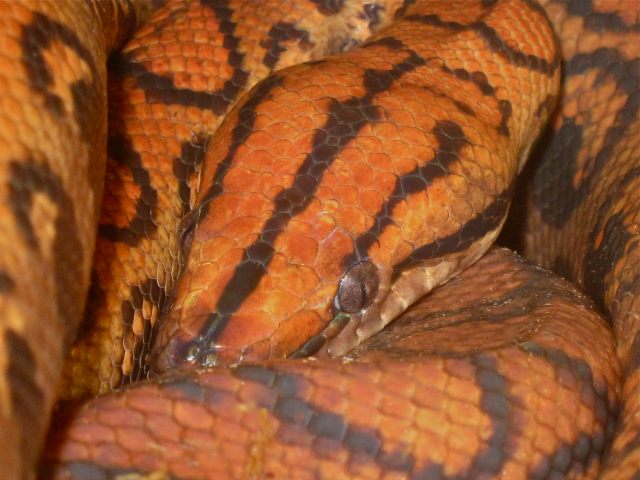
Genus/species: Epicrates cenchria

GENERAL CHARACTERISTICS: The Brazilian rainbow boa is one of about 12 named subspecies of rainbow boa. Color is brown or reddish brown with three parallel black stripes on the top of the head and large black rings down the back that give the appearance of dorsal blotches. There is a great deal of variation in color and marking among individuals of this species. Length is four to six feet (1.2 to 1.8 m).

Brazilian Rainbow Boa15580871426_15f0f85863_k


DISTRIBUTION/HABITAT: Found in the Amazon Basin, and in coastal Guiana, French Guyana, and Suriname and southern Venezuela most often in humid forests.

DIET IN THE WILD: Rodents, birds, and possibly some forms of aquatic life and lizards.

REPRODUCTION: Babies are born live in litters of two to 35 (viviparous). They are usually 15 to 20 inches (38 to 51 cm) long.

LIFESPAN: To 20 years in capativity.

REMARKS: E. cenchria is named because of the iridescent sheen imparted by microscopic ridges on their scales, which act like prisms to refract light into rainbows.

Brazilian Rainbow Boa15580871146_3fc18628e1_k


References

 National Zoo http://nationalzoo.si.edu/Animals/ReptilesAmphibians/Facts/FactSheets/Brazilianrainbowboa.cfm

The Reptile Database  http://reptile-database.reptarium.cz/species?genus=Epicrates&species=cenchria

Ron’s WordPress shortlink  http://wp.me/p1DZ4b-1nJ

Ron’s flickr  https://www.flickr.com/photos/cas_docents/15580871426/