Category: INVERTEBRATES


TAXONOMY

Kingdom: Animalia
Phylum: Echinodermata
Class: Asteroidea (Starfish or sea stars)
Order: Forcipulatida
Family: Asteriidae

Genus/species: Asterina miniata

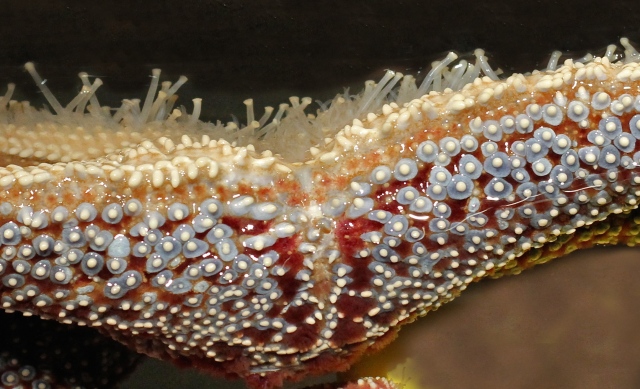
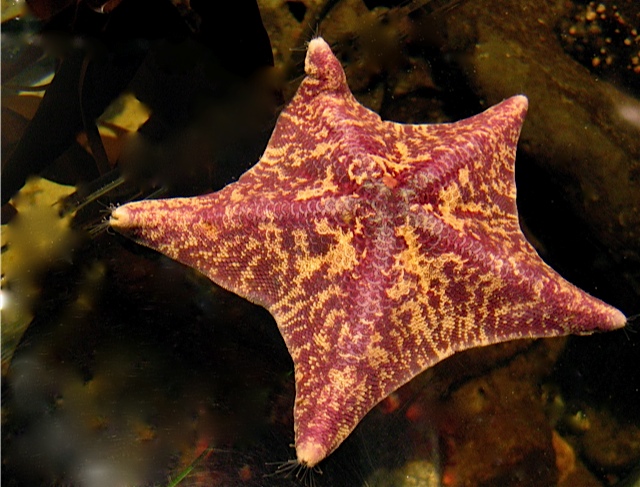
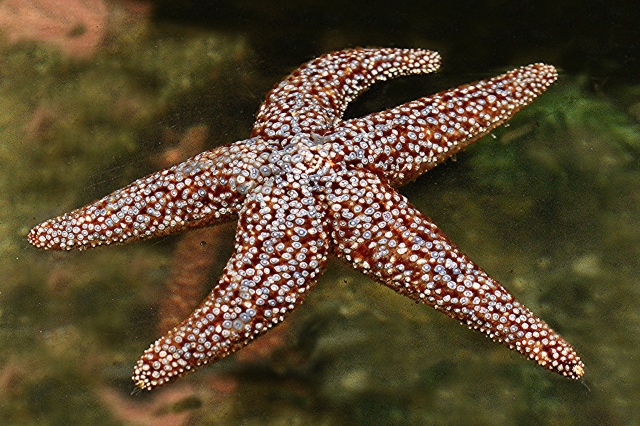
GENERAL CHARACTERISTICS: Colors may be colored red, orange, brown, purple or mottled. They have webbing between their short, triangular arms, which gives them a batlike look. Size is up to 20 cm (eight inches) across. Radially symmetrical they normally have five arms, but they occasionally have as many as nine arms. They have tube-feet that allow locomotion.

DISTRIBUTION/HABITAT: Sitka, Alaska to Baja California, Mexico. Found in low intertidal areas on rocks overgrown with surfgrass, large algae and sponges. Depth intertidal to 290 m (950 ft) on rocky or sandy substrates.

DIET IN THE WILD: Sensors at the end of each arm that sense light and detect prey. Typically an omnivore or scavenger: surfgrass, algae, colonial tunicates, organic films on hard surfaces, as well as other seastars.  Like most seastars, feeds by everting its stomach over prey.

See everted Bat Star stomach below.

REPRODUCTION: Usually spawns May to June. The male broadcasts sperm and the female broadcasts eggs from pores near the bases of their arms. Embryos and larvae are transparent.

PREDATORS Other sea stars, molluscs, and crustaceans. Like some other sea stars, bat stars can sometimes avoid predation by secreting chemicals that evoke flight responses in other animals.

CONSERVATION: IUCN No special status. Collecting by tidepool visitors has diminished some populations, for example around the Monterey Peninsula.

REMARKS: When two bat stars bump into each other, a gentle brawl begins. They seem to be “arm wrestling” in a slow motion skirmish where no winner is usually obvious.

Bat stars lack the pedicillariae, or pincers, common to most other sea stars and used to clear the animal of unwanted parasites and other debris. Even so, bat stars are free of debris, perhaps because small, constantly moving hairs (cilia) discourage settling

Sea stars have endoskeletons made up of plates (calcified ossicles) joined by connective tissue to protect the bat star’s vital organs.  The bat star’s ossicles are so large and defined that they look like rough shingles. 
 

REMARKS:  SEA STAR WASTING SYNDROME has become a major issue in both the Pacific and Atlantic Oceans. For an excellent summary check this link to the University of Santa Cruz 9-9-14.  http://www.eeb.ucsc.edu/pacificrockyintertidal/data-products/sea-star-wasting/updates.htm

Fitzgerald Marine Reserve.  http://www.fitzgeraldreserve.org/newffmrsite/wp-content/uploads/2014/09/BetweenTides_9-14_web.pdf


References

Monterey Bay Aquarium  http://www.montereybayaquarium.org/animal-guide/invertebrates/bat-star

U. of Michigan Animal Diversity Web http://animaldiversity.ummz.umich.edu/accounts/Patiria_miniata/

Ron’s flickr    http://www.flickr.com/photos/cas_docents/sets/72157608501343477/

Ron’s WordPress shortlink   http://wp.me/p1DZ4b-to
TAXONOMY
Kingdom: Animalia
Phylum: Echinodermata
Class Asteroidea
Order: Forcipulatida
Family: Asteriidae

Genus/species: Pisaster giganteus

 GENERAL CHARACTERISTICS: Giant sea stars have five arms covered with white, pink, or purple spines surrounded by blue tissue at the base, and range in color from red, orange, brown, or even green. The surface has brown fuzz and pedicellariae. They have a maximum arm span of about 60 cm (23.6 in). P. giganteus would seem improperly named, as the average intertidal specimen is smaller than the average P. ochraceous; however subtidal specimens grow considerably larger.

7137830837_192c64b940_k 

DISTRIBUTION/HABITAT: They are distributed along the eastern Pacific coast from British Columbia to Baja California. They are common on rocky substrates, but also found on sand from the middle to lower intertidal zone down to 90 m (300 ft).

Giant Sea StarIMG_1040.JPG - Version 2

DIET IN THE WILD: Their typical prey are hard-shelled organisms such as mussels, snails, and barnacles by extending its stomach to fit into tiny gaps in bivalves such as mussels. However, they may occasionally eat anything slow-moving enough to be caught, such as a dying fish or shellfish, anemones, or other sea stars.

Giant Seastar IMG_8851

PREDATORS: Sea gulls and sea otters are sea star predators.

REPRODUCTION: Individual sea stars are male or female. Both sexes release gametes into the water for external fertilization. Larvae are planktonic and have bilateral symmetry. Giant sea stars live about 20 years.

REMARKS:  SEA STAR WASTING SYNDROME has become a major issue in both the Pacific and Atlantic Oceans. For an excellent summary check this link to the University of Santa Cruz 9-9-14.  http://www.eeb.ucsc.edu/pacificrockyintertidal/data-products/sea-star-wasting/updates.htm

Fitzgerald Marine Reserve.  http://www.fitzgeraldreserve.org/newffmrsite/wp-content/uploads/2014/09/BetweenTides_9-14_web.pdf

Tidepool 

References

California Academy of Sciences Tidepool Exhibit 2015

Woods Hole www.whoi.edu/science/B/people/kamaral/SeaStar.html

Bishop Museum hbs.bishopmuseum.org/pubs-online/pdf/op11-8.pdf

Encyclopedia of Life  eol.org/pages/598468/details

Animal Diversity Web, ADW  http://animaldiversity.ummz.umich.edu/accounts/Pisaster_giganteus/classification/

Ron’s flickr  https://www.flickr.com/photos/cas_docents/7137830837/in/set-72157608501343477

Ron’s WordPress shortlink  http://wp.me/p1DZ4b-1mV

TAXONOMY
Kingdom: Animalia
Phylum: Echinodermata
Class Asteroidea
Order: Forcipulatida
Family: Asteriidae

Genus/species: Pisaster brevispinus


GENERAL CHARACTERISTICS The pink sea star reaches a maximum diameter of nearly 65 cm (2 ft); however, individuals are usually smaller. Its central disc has a raised, humplike appearance. They are robust, pink in color and have aboral spines much shorter than those of other Pisaster species, thus its scientific name, which translates as “short-spined sea star.”

7137858011_f41cdc4304_k

DISTRIBUTION/HABITAT They range from Sitka, Alaska to San Diego County, California. They can occasional be seen in the low intertidal zone, but are more commonly found in deeper water to 90 m (300 ft ) on sand and mud substrates, but sometimes on rocks and pier pilings in calm waters. They cannot tolerate prolonged exposure to air.

DIET IN THE WILD: Pink sea stars prey on live clams, snails, sand dollars, barnacles, mussels, – annelid worms, and scavenge on dead fish and squid. On soft surfaces, P. brevispinus digs into sand or mud with its arms. It also can extend its tube feet (the ones around its disk) to a length of 20 cm (8 in). When the tube feet reach a clam buried in the mud, they attach and the sea star hauls it up. On shale, it can lower its stomach into the burrow of a clam and digest the animal in place. Their large size may well be due to their access to a plentiful food supply of large organisms unavailable to potential competitors.

PREDATORS Large adults have few predators, but they may be taken by the sunflower sea star Pycnopodia helianthoides. Sea otters have been known to detach rays to consume gonads, and sea gulls occasionally feed on individuals exposed during very low tides.

REPRODUCTION They spawn in the spring. Sexes are separate and fertilization takes place externally. Larvae disperse in the water column.

Pink stars can live up to 20 years.


REMARKS: Can chemosense clams through sand. May dig down to the clam for 2 –3 days or extend tube feet to the clam a distance equal to the arm radius to 20 cm (7.8 in). Once contacted,
the clam is lifted from the substrate or the stomach may be everted to 8 cm (3.15 in) to digest the prey in place. Some sand-bottom invertebrates including the sand dollar Dendraster excentricus and the snail Olivella biplicata chemosense the presence of a pink star and attempt to avoid contact by burrowing.

References

California Academy of Sciences Tidepool exhibit 2015

Walla Walla Univ. www.wallawalla.edu/academics/departments/biology/rosario/…

EOL eol.org/pages/598470/details

Ron’s WORDPRESS SHORTLINK  http://wp.me/p1DZ4b-tA

Ron’s flickr http://www.flickr.com/photos/cas_docents/sets/72157608501343477/

TAXONOMY
Kingdom: Animalia
Phylum: Arthropoda
Subphylum: Crustacea
Class: Malacostraca
Order: Stomatopoda
Family: Odontodactylidae

Genus/species: Odontodactylus scyllarus

6179234815_63ae89f1c0_b

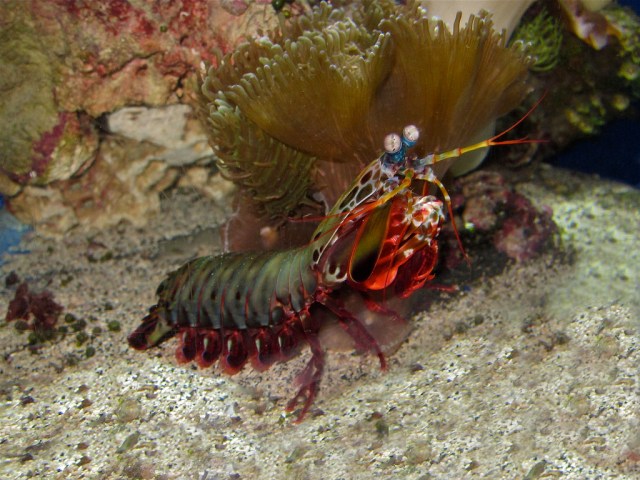
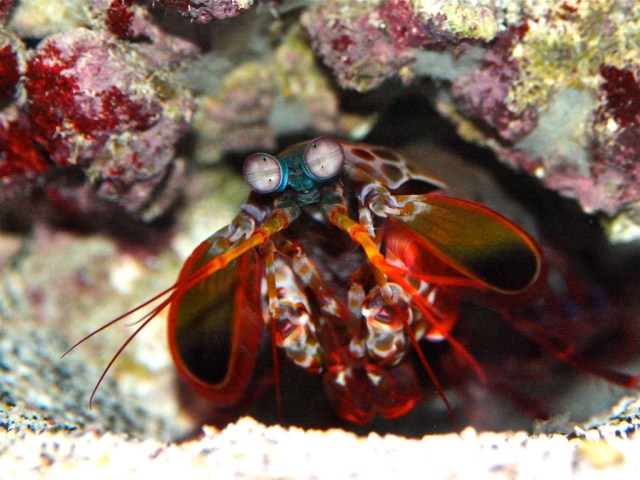
GENERAL CHARACTERISTICS: Beautifully colored in peacock colors of greens, blues, and reds. Has a green body, blue head, green antennal scales, red limbs. The body is elongated with a long, flattened , blue tail and ranges in size from 3–18 cm (1.2-7.0 in). Highly noticeable is the pair of clubbed-shaped, praying mantis-like claws..

DISTRIBUTION/HABITATS: Indo-Pacific Habitat: warm salt water and builds U-shaped burrows in gravel substrates. Depth ranges from 3-40 m (10-131 ft).

DIET IN THE WILD: Feeds on other shrimp, worms, snails, crabs, mollusks. Lies in wait for prey in front of burrow, then swims out and quickly crushes prey with a strong, powerful smash. The claw moves so quickly it generates cavitation bubbles, which explode with a second powerful burst. The speed with which the claw moves through the water generates a force 100 times the shrimp’s body weight.

REMARKS: Large peacock mantis shrimp generate forces powerful enough to crush the shell of a large conch, and have been known in captivity to break the glass of their tanks!

The amazingly complex eyes of mantis shrimp detect 12 base colors (compared to our 3). They also can discern ultraviolet, infrared frequencies, and the polarization of light.

3751466248_44af0964d4_b

Color of Life note
Biofluorescence results from the absorption of electromagnetic radiation at one wavelength by an organism, followed by its reemission at a longer and lower energy wavelength, visually resulting in green, orange, and red emission coloration. Many species of mantis shrimp, for example, make use of fluorescent body parts when in threat display in order to intimidate or confuse either a predator or a competing male.
Ref: Color sources, California Academy of Sciences Docent program May 2015

References

Animal Diversity Web animaldiversity.org/accounts/Odontodactylus_scyllarus/

Plos one   http://journals.plos.org/plosone/article?id=10.1371/journal.pone.0083259

Ron’s WordPress shortlink  http://wp.me/p1DZ4b-We

Ron’s flickr  http://www.flickr.com/photos/cas_docents/sets/72157608602469734/

TAXONOMY
Kingdom: Animalia
Phylum: Mollusca
Class: Cephalopoda
Order: Sepiida
Family: Sepiidae (Cuttlefishes, shell internalized)

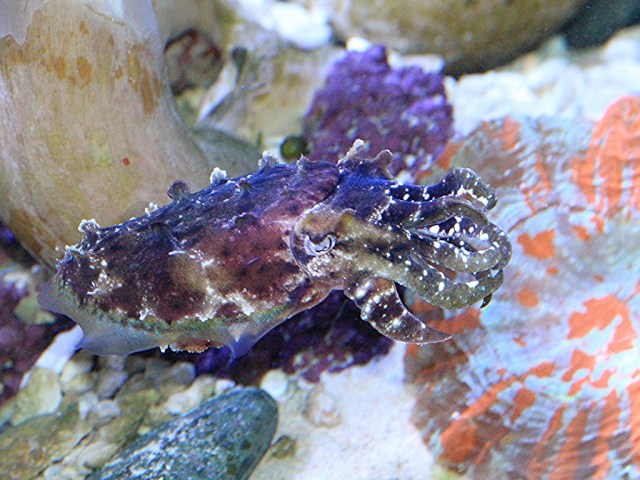
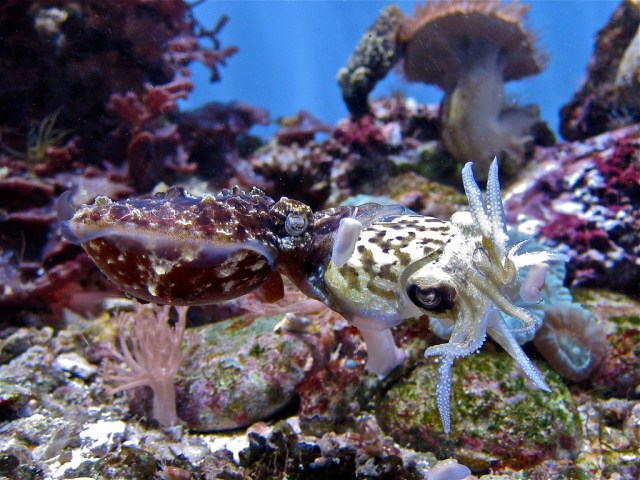
Genus/species: Sepia bandensis

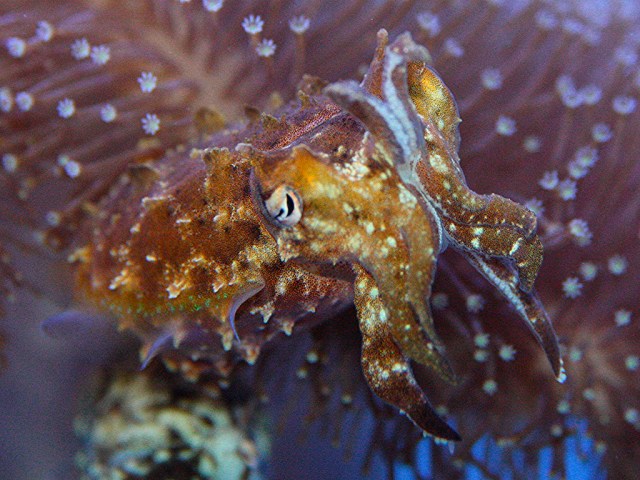
GENERAL CHARACTERISTICS:. Sepia bandensis has 8 arms with rows of suckers along each and 2 feeding tentacles. It moves by the undulation of lateral fins that surround the body. Cuttles have an internal shell within their bodies that they can fill with more or less gas to create neutral buoyancy. The cuttlebone is often collected and used as a calcium supplement, beak sharpener, and all-purpose toy for caged birds.
Like most cephalopods, cuttlefish have 3 hearts. Two hearts pump blood to the gills, and a central heart pumps oxygenated blood to the body.
Length: 5 cm – 10 cm (2 in – 4 in)

3953684509_d8a7ff53db_b

DISTRIBUTION/HABITAT: The Indo-Pacific region, including the Philippines, Indonesia, and Papua New Guinea.
Found in shallow coastal waters near or on coral reefs or sandy substrates.

4155077422_fbdca1e012_b

DIET IN THE WILD: Crustaceans and fish. The Cuttlefish changes colors and patterns as it approaches prey then ejects its feeding tentacles to capture its prey with its suckers and eating it with a parrot-like beak and a radula. Active diurnally.

ACADEMY DIET: Shrimp and crab (M Avila, staff biologist)

6502617393_a6e58de35b_b

LONGEVITY: Life span: 6 mos. to 3 yrs.

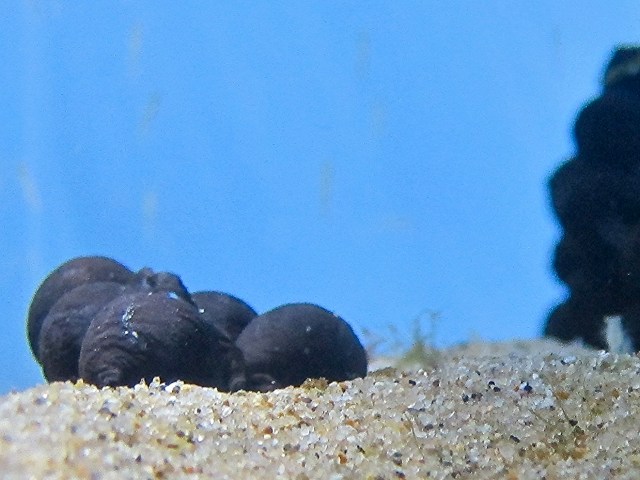
eggs below

5519039392_2b09a5da70_o

REMARKS: Masters of camouflage, cuttlefish and most cephalopods can change their colors, shapes and textures in seconds to avoid predators and blend into their surroundings. They have keen vision, but are color blind.

They also produce large amounts of ink, both as a decoy and foul-tasting deterrent. Known as sepia ink, after the genus name of cuttlefish, it was a dye once prized by artists.

The Steinhart Aquarium is the first institution in the U.S. to breed dwarf cuttlefish. To date, (2010) more than 350 have hatched at the Academy, most of which have been sent to other aquaria and research institutions. Quote from Rich Ross, Academy biologist and cuttlefish breeder extraordinaire: Over time, [cuttlefish] learn to recognize and respond to you, and will often greet you when you walk into the room (or maybe they just know you bring the food). 

Color of Life note: Cuttlefish are excellent examples of cryptic coloration. Chromatophores in the cuttlefish skin are controlledneurologically, allowing almost immediate color change disappearing into its background right before your eyes.
Ref: California Academy Color of Life exhibit

References 

California Academy Color of Life exhibit

The Marine Biology Coloring Book 2nd Ed. Thomas Niesen 2000

EOL Encyclopedia of Life  eol.org/pages/591499/details

Ron’s flickr  https://www.flickr.com/photos/cas_docents/3953684359/in/album-72157652559028013/

Ron’s WordPress shortlink    http://wp.me/p1DZ4b-1yp

TAXONOMY
Kingdom: Animalia
Phylum: Arthropoda
Class: Insecta
Order: Mantodea
Family: Hymenopodidae
Subfamily: Epaphroditinae

Genus/species: Phyllocrania paradoxa

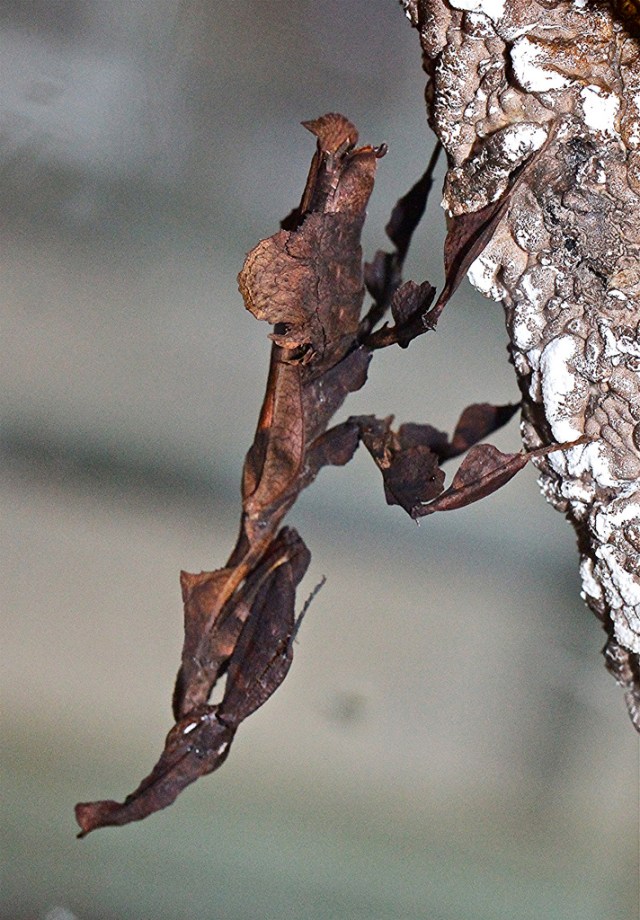
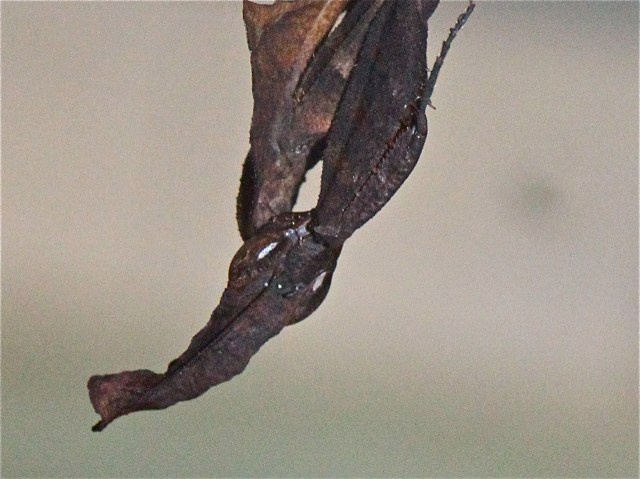
GENERAL CHARACTERISTICS: This is a miniature species of leaf mantis, growing to under 5 cm (2 in). Theses mantids exhibit sexual dimorphism with females being longer and having a wider abdomen than males. Colors can vary from grey/green to dark brown or almost black. Colors are dependent on humidity and light levels. Ghost mantids have leaf-like head and shoulder shields, and leaf-like protrusions hanging from their limbs. This “dead-leaf” appearance makes it very difficult to see. The scientific name is probably derived from Greek for “leaf “(phyllo) and Latin for “head” (crania).

Phyllocrania paradoxa6319511720_e34688f6b4_b

DISTRIBUTION/HABITAT: P. paradoxa are found in the warm, highly humid tropical forests of Tropical Africa including Madagascar, Mozambique, Namibia, and Somalia.

DIET IN THE WILD: This species will eat almost anything that moves, and it is very, very fast. When another insect comes within striking distance, the mantid flicks out the long front legs, and grabs it in a fraction of a second. They are remarkably patient, and will sit in the same position for weeks, just waiting for something to land near them.

DIET IN CAPTIVITY: Drosophila (fruit flies), houseflies, crickets, and flour worms.

MORTALITY and LONGEVITY: Generally a long-lived species.  Molt every 3–5 weeks, until the 4th and final molting.  Life span: up to 14 months in captivity.

REPRODUCTION: In general mantids reproductive organs are found at the tip of their abdomen. Females attract males with pheromones, there is a brief courtship dance, and the male alights on the female’s back. After delivering sperm, the male usually hurries away as females are known to consume their mates! After fertilization the female deposits batches of eggs, using an ovipositor at the tip of her abdomen. The eggs stick to stems and leaves, and each batch is housed in an egg case made from an abdominal secretion that hardens to protect the eggs from birds and other predators. After about a month the nymphs hatch and then molt several times, each time becoming more like the adult form. 

Juvenile below

Color of Life Note: Ghost mantids exhibit cryptic coloration (conceals or disguises an animal’s shape). They look like a vine draped on tree and bush branches.


LOCATION: Madagascar Rainforest

References

References. California Academy of Sciences Docent Rainforest Training Manual.

Ron’s flickr https://www.flickr.com/photos/cas_docents/4333501334/in/set-72157620708610230/

Ron’s WordPress shortlink  http://wp.me/p1DZ4b-eK

Encyclopedia of Life  http://eol.org/pages/3489690/details

ADW Animal Diversity Web animaldiversity.org/accounts/Phyllocrania_paradoxa/classi…


TAXONOMY
Phylum: Mollusca
Class: Gastropoda (slugs, snails, nudibranchs, abalone)
Order: Archaeogastropoda (sea snails)
Family: Haliotidae (abalones)

Genus/species: Haliotis rufescens

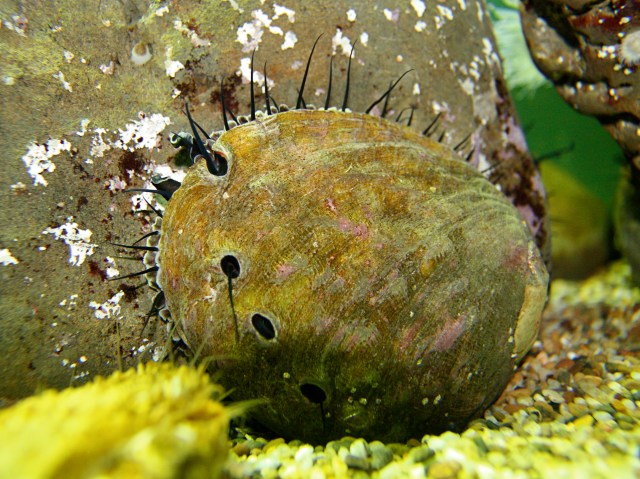
GENERAL CHARACTERISTICS: The red abalone is a large limpet-like snail with a flattened and rounded shell. The shell can reach up to 30 cm (11.8 in) in length and is usually brick-red and overgrown with fouling organisms. Color varies with diet and varies between aquamarine, green, or white. Water enters anteriorly through row of holes parallel to the rim of the shell and exits posteriorly carrying waste products and gametes. When in danger, the abalone clamps its shell tightly to the substrate, protecting soft parts of its body. The shell’s color is influenced by the animal’s diet. The red color is from the pigment phycoerythrin consumed in its red alga diet. Color varies with a diet of brown algae (varies between aquamarine, green, or white).

DISTRIBUTION/HABITAT: Red abalone are found from Oregon to Baja California. They are uncommon in the lower intertidal zone in rocky areas with heavy surf. Most are now found at six to 17 m (20 to 56 ft) depth in central California.


DIET IN THE WILD: Small abalones feed on diatoms and algae; larger animals browse the seaweeds. Red abalone eat algae, especially red and brown species. Usually foraging at night, they trap drifting pieces of algae (kelp) with the tentacles that extend from the foot. The algae is then carried by the foot to the mouth, and is torn and consumed with by the radula.

flickr Feeding Video http://www.flickr.com/photos/cas_docents/6393536637/in/set-72157626486149324


PREDATORS: Sea stars, crabs, octopuses, sea otters and human divers are among the abalone’s primary predators.

REPRODUCTION: After spawning takes place, fertilized eggs sink. Larvae develop in the plankton until they settle to the bottom, metamorphose, and begin to graze. Growth slows with increasing size and age. Mortality is very high in the planktonic stages. Mature individuals can live more than 20 years.

REMARKS: Red abalone are highly endangered due to overexploitation by the abalone fishery. The population plummeted in the late twentieth century, but poaching continues to be a problem. California passed many strict regulations to protect the red abalone: abalone smaller than 20 cm (8 in) in diameter are protected, the canning of abalone is prohibited, and the shipment of fresh or frozen meat out of California is prohibited. Red abalone is the only species that can still be fished. Aquacultured abalone is now increasingly available.

Abalone blood is blue-green and cannot clot making injury possibly fatal.

Red Abalone Shell19600303421_7eae835178_z

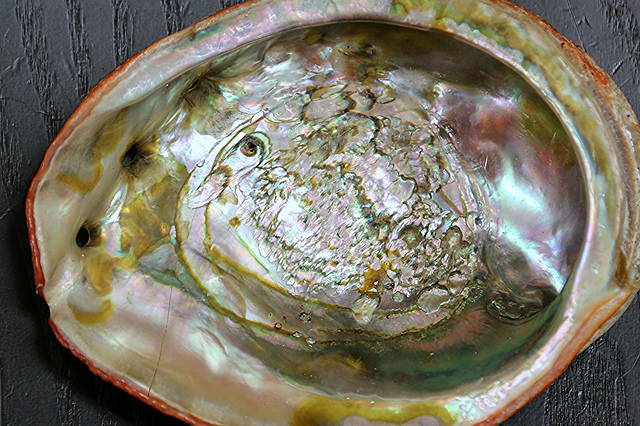
Color of Life note: Iridescence is caused by two or more semi-transparent, inorganic and/or organic surfaces that cause multiple light reflections. An example found in our tidepool is the Red Abalone inner shell surface which produces an impressive vibrant luster when exposed to light.  The aragonite and conchiolin secreted by the abalone in forms a crystalline structure that reflects light, causing the shell’s iridescence. The inner surface of the shell is known as mother-of-pearl, or nacre. Ref: California Academy of Sciences, Color of Life Exhibit 2015   Jewelry is still made from abalone shells and is quite popular.                        Ref: www.best-deal.com/search/landing/query/red+abalone+shells...


Other references

Marine Biology Coloring book, T.M. Nielsen, 2nd Ed. Harper Resource 1982, 2000.

Encyclopedia of Life  eol.org/pages/620396/details

Monterey Bay Aquarium  www.montereybayaquarium.org/animal-guide/invertebrates/ab…

California Fish and Game www.dfg.ca.gov/marine/pdfs/response/abalone.pdf

Ron’s flickr https://www.flickr.com/photos/cas_docents/6393536637/in/album-72157608597736188/


TAXONOMY

Kingdom: Animalia
Phylum: Arthropoda
Class: Insecta
Order: Phasmatodea (stick insects, phasmids, ghost insects and leaf insects)
Superfamily: Phyllioidea
Family: Phylliidae (true leaf insects or walking leaves)

Genus/species: Phyllium giaganteum

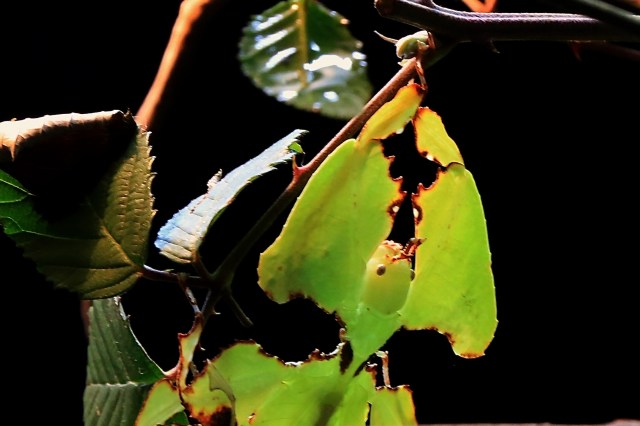
GENERAL CHARACTERISTICS: Use camouflage to mimic leaves and even waver when they walk like leaves blowing in the wind.

Giant Malaysian leaf insect19131910632_d71d7691e0_o

DISTRIBUTION/HABITAT: Southeast Asia to Australia

Giant Malaysian leaf insect18951496529_05edfe0096_o

DIET IN THE WILD: Plant leaves including Oak and bramble

Giant Malaysian leaf insect19141065381_b24c18b8d4_o

REPRODUCTION: Males are hard to find so females are able to reproduce by laying unfertilized eggs that grow into more females.

References

California Academy of Sciences Color of life exhibit, June 2015

Encyclopedia of Life  eol.org/pages/1077423/overview

Ron’s WordPress shortlink  http://wp.me/p1DZ4b-1xg

Ron’s flickr  https://www.flickr.com/photos/cas_docents/19131910632/in/album-72157652559028013/


TAXONOMY
Kingdom: Animalia
Phylum: Arthropoda (insects, arachnids, and crustaceans)
Class: Insecta
Order: Blattodea (cockroaches and the termites)
Family: Blaberidae (giant cockroaches)

Genus/species: Blaberus giganteus 

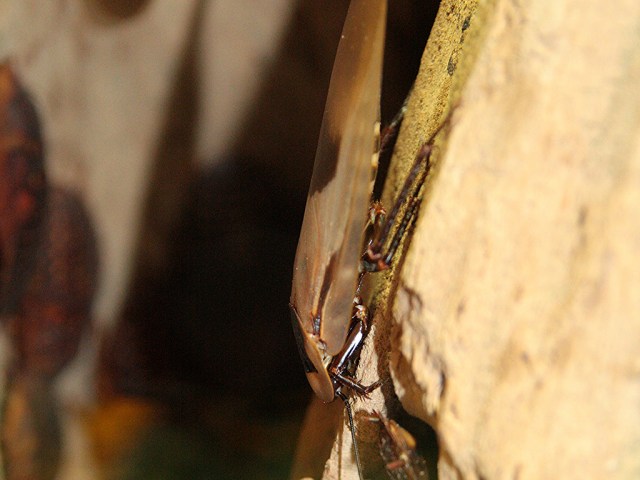
GENERAL CHARACTERISTICS: They have three pairs of legs, and two pairs of wings, the forewings being light brown in colour. Largest neotropical cockroach by weight. A giant cockroach has a flattened, oval body, about 9 cm (3.5 inches) long and 4 cm (1.5 inches) wide. Females are slightly larger than males. They commonly run along the ground, although the adults have wings that are rarely if ever used for flight. They have long, very slender antennae and two sensory organs, called cerci, at the tip of the abdomen.

Blaberus giganteus 3445478500_7a02fcb067_b

DISTRIBUTION/HABITAT: Central and South America. They prefer dark, damp locations such as caves, rock crevices, tree hollows, and spaces under loose tree bark.

Blaberus giganteus 3775296951_fd8e873273_b

DIET IN THE WILD: Cockroaches are omnivores and detritivores. Common diet includes bat guano, rotting wood, fruit, seeds, decomposing vegetation, dead insects, and other animals. They help recycle decaying matter on the ground into useful nutrients for plants. 

REPRODUCTION: Females emit a pheromone that induces males to mate. Male courtship rituals include raising wings at right angles to abdomen and making trembling movements with abdomen. After mating, the female B. giganteus will be pregnant for life producing eggs which turn into nymphs which later become adults.

Blaberus giganteus 3779077163_a2d1b493c7_b-2

MORTALITY/LONGEVITY: They can live about 20 months as adults.

PREDATORS:  Army ants kill and eat nymphs.

CONSERVATION:  IUCN: Not Listed; CITES: Not Listed  

Cockroaches dates back over 200-300 million years, and are very adaptable and resilient animals.

REMARKS:  The leg bristles and antennae are used for seeing and feeling, in their dark habitat, while their flat bodies enable them to hide in crevices and underneath rocks. Cockroaches do not have lungs to breathe, but instead they take air in through spiracles, which are tiny holes on the sides of their bodies, and are used to send oxygen to other parts of the body. This allows the cockroach to survive for a period of time without its head, until it dies of infection, starvation or dehydration. When threatened, the giant cockroach is able to produce a foul smell to ward off predators. 

Location: Rainforest Costa Rica CR04 

References: 

Toronto Zoo http://www.torontozoo.com/ExploretheZoo/AnimalDetails.asp?pg=445

Encyclopedia of Life  eol.org/pages/1075061/details

Sreng, L. 1993. Cockroach Mating Behaviours, Sex-Pheromones, and Abdominal Glands (Dictyoptera, Blaberidae). Journal of Insect Behaviour. 6: 715-735.

Ron’s WordPress shortlink  http://wp.me/p1DZ4b-1tE

Ron’s flickr https://www.flickr.com/photos/cas_docents/3776101942/in/set-72157620708938680

TAXONOMY
Kingdom: Animalia
Phylum: Arthropoda
Class: Arachnida
Order: Araneae
Suborder: Araneomorphae (fangs slope towards each other in a pinching action)
Family: Nephilidae

Genus/species; Nephila Clavipes

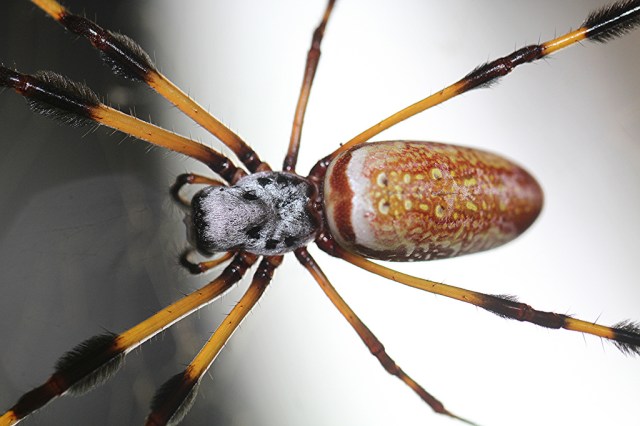
GENERAL CHARACTERISTICS; Orb-weavers are highly sexually dimorphic. Females grow up to 8 cm (3 in), and are 5 to 6 times larger than males. Adults are mostly yellow with elongated abdomen and long, hairy legs. This spider lives in hot places. The long cylindrical abdomen of the spider may be angled towards the sun to reduce the amount of exposed body surface and thus prevent overheating. The reflective silvery surface of much of the body serves the same purpose.

Nephila Clavipes   5389185249_24cf049f4f_b 

DISTRIBUTION/HABITAT: These spiders are found from the southeastern United States south through Argentina and Peru. They prefer areas of high humidity and forest areas along trails and clearing edges. N. clavipes is the only member of its genus known in the Western Hemisphere.

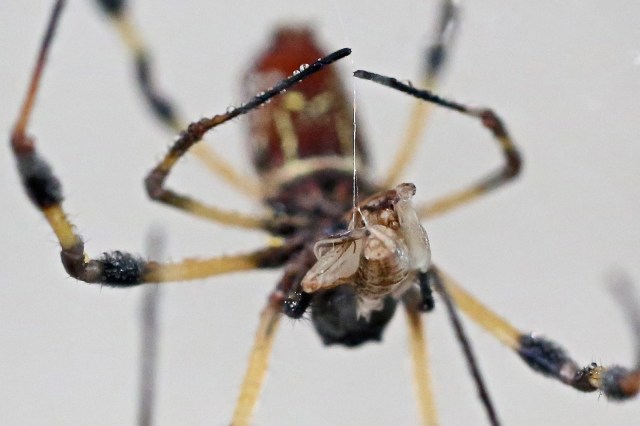
DIET IN THE WILD: They feed on small flying insects: beetles, flies, moths, etc., that are captured in their web. After prey is entangled in the web, the spider incapacitates it by biting and then encases it in silk.

9129006757_d402137e70_h

REPRODUCTION: Mating is a tricky proposition for orb weaving males. For successful reproduction, males must successfully stimulate females in order to prevent being a meal for their would-be mate, though this unfortunate ending is relatively rare with this species.

MORTALITY/LONGEVITY: Life span: a single season (1 year).

REMARKS: 

•Orb weavers construct webs for defense and capture of prey.

•The silk of the web usually has a golden color that is visible to the naked eye and is the source of the common name.

•The impressive web of most orb weavers is a semi-permanent structure, repaired and rebuilt daily as necessary.

•Spiders from the Nephilia species on display from Madagascar are sometimes released into the Rainforest exhibit. They have settled in a territory behind the exhibit and observable from the spiral ramp. Only females are released as 1) they are much larger than the males and so more visible and 2) the Rainforest biologists have no interest in the uncontrolled breeding of these spiders in the exhibit!

Rainforest Costa Rica CR03

References

California Academy of Sciences docent Rainforest Training Manual 2014

Animal Diversity Web animaldiversity.org/accounts/Nephila_clavipes/

Ron’s flickr  https://www.flickr.com/photos/cas_docents/5389185249/in/album-72157620708938680/

Ron’s WordPress shortlink  http://wp.me/p1DZ4b-1tf