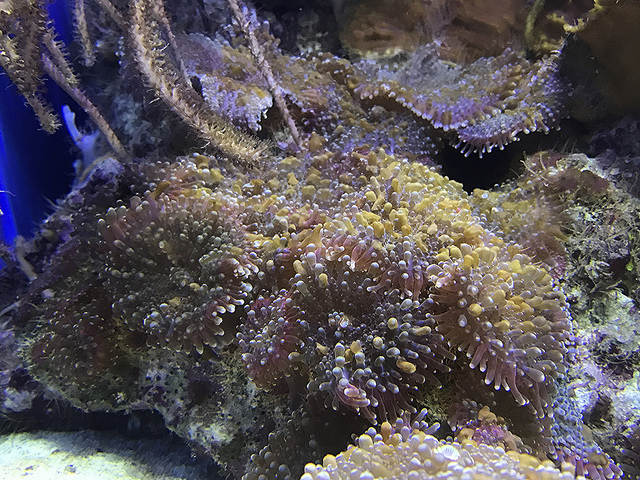
Category: INVERTEBRATES


TAXONOMY
Kingdom: Animalia
Phylum: Arthropoda
Class: Insecta
Order: Lepidoptera (moths and butterflies)
Family: Papilionidae (Swallowtail butterflies)

Genus/ species: Ornithoptera priamus

GENERAL CHARACTERISTICS: Variable between numerous subspecies.
The top of the forewing is velvety black with a green subcostal and marginal stripe. The bottom of the forewing is black with a chain of bluish or green postdiscal spots.
The hindwings are green. At the wing’s leading edge there are yellow-gold spots with a postdiscal chain of black spots. The edge of the hindwing is black. The underside is dark green or bluish. The yellow-golden spots are transparent. The veins are partly black and the marginal edge of the wing is black. At the outer edge there is a postdiscal chain of black spots.

The body (abdomen) is yellow. Head and thorax are black. The underside of thorax has a red hair coat.
Wingspan: 5 in. (12.7 cm.)  Male below Topwing (dorsal)
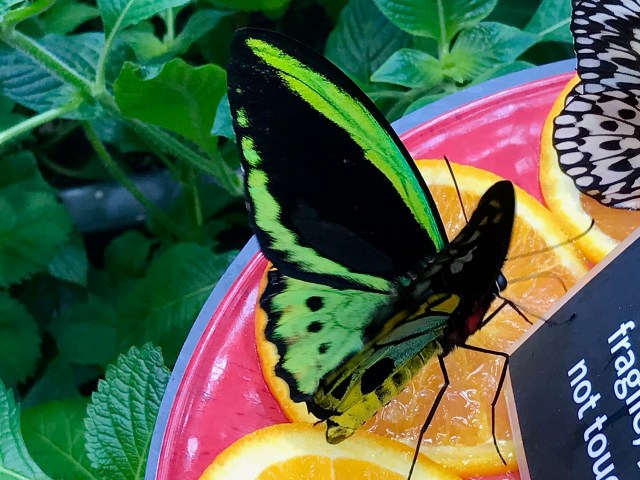
Male bottom side (ventral)
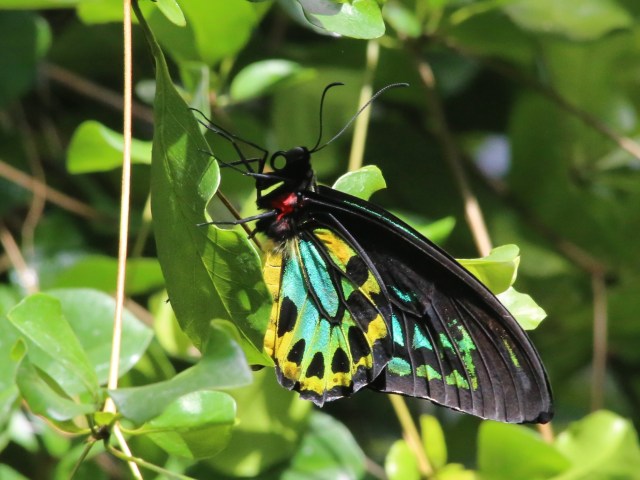
 O. priamus is sexually dimorphic. The basic color of the female is dark-brown with a chain of white postdiscal spots on the forewings and a chain of larger white postdiscal spots with dark centres on the hindwing. The underside is very similar to the upper.

The female is larger than the male and in the upper range of the wing-span.

Female below top wing (dorsal)

Female bottom wing (ventral)
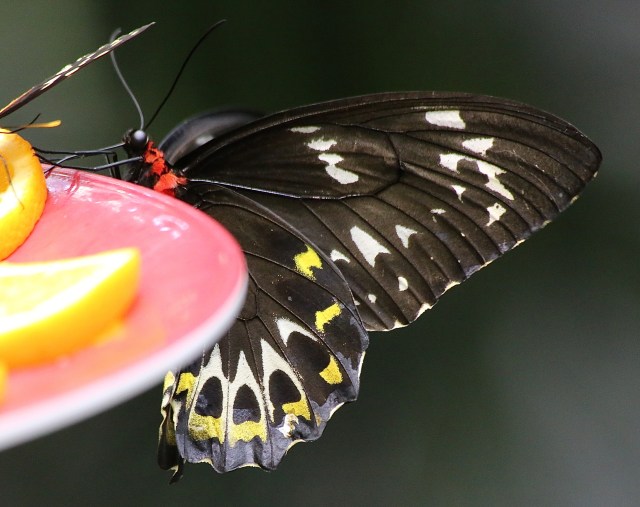


DISTRIBUTION/HABITAT: Found in the Australasia / Indomalaya (Australia) ecozone.

References

California Academy of Sciences Rainforest 2017 Vetting Tim Wong

Ron’s WordPress Shortlink  http://wp.me/p1DZ4b-1Mz

Ron’s flickr  https://www.flickr.com/photos/cas_docents/33116609042/in/album-72157608449327886/

EOL eol.org/pages/130749/overview

www.nagypal.net/images/zzpriamu.htm

 Lewis Ginter Botanical Garden www.lewisginter.org/sexually-dimorphic-butterflies/

butterflycorner.net en.butterflycorner.net/Ornithoptera-priamus.952.0.html

insecta.pro  insecta.pro/taxonomy/15076
 

TAXONOMY
Kingdom: Animalia
Phylum: Arthropoda
Class: Insecta
Order: Lepidoptera (moths and butterflies)
Family: Nymphalidae (Brush-footed Butterflies)

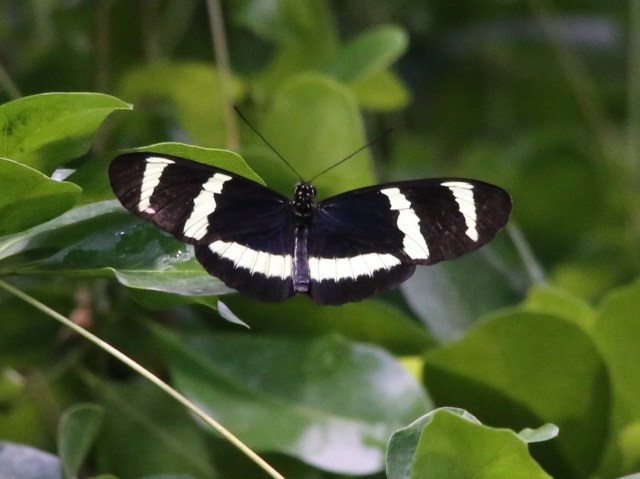
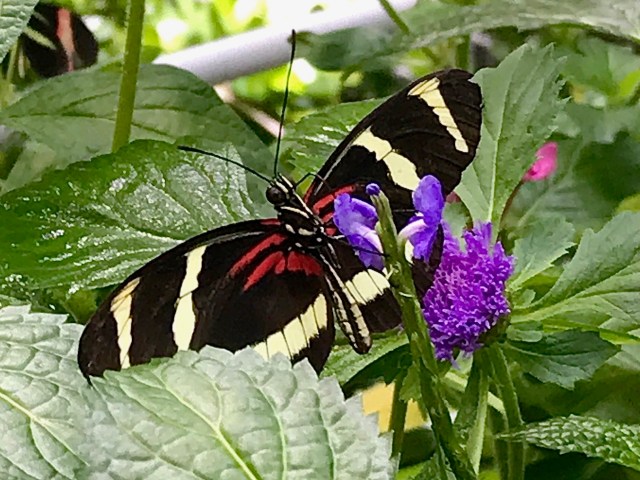
Genus/species: Heliconius hewitsoni

GENERAL CHARACTERISTICS: A distinctive black butterfly with yellow transverse bands on fore- and hindwings. H. hewitsoni is very similar in general appearance to its Müllerian mimic H.pachinus. (Species with strong defences evolve to resemble one another and deter predation).


DISTRIBUTION/HABITAT: Found in the province of Chiriqui (Panama) and the Pacific slopes of Costa Rica. Usually individuals fly rapidly and in the canopy.

REMARKS: Heliconius are recognized by their large eyes, long antennae, characteristic elongate wing-shape, teardrop-shaped hindwing discal (disc-like) cell, and distinctive color patterns.

Adult butterflies systematically collect pollen from flowers, which they masticate on the proboscis to dissolve out amino acids. This allows caterpillars to develop relatively rapidly (since they do not need to store nutrients for egg and sperm production), and allows adults to have a greatly extended lifespan – up to 8 months – in the wild.

A second unusual trait found in some Heliconius species is a unique mating behaviour known as pupal-mating. Males of certain species search larval food plants for female pupae. The males then sit on the pupae a day before emergence, and mating occurs the next morning, before the female has completely closed (insect emerging from the pupa stage.)

References

California Academy of Sciences Rainforest 2017 Photo vetted Tim Wong

EOL eol.org/pages/18499/details

tolweb.org/Heliconius_hewitsoni/72941

www.insectlifeforms.com/6050205531__236/Bow_Wings__Helico...

Ron’s flickr  https://www.flickr.com/photos/cas_docents/32471538194/in/album-72157608449327886/

Ron’s WordPress Shortlink http://wp.me/p1DZ4b-1N3

TAXONOMY
Kingdom:Animalia
Phylum: Arthropoda
Class: Insecta
Order: Coleoptera (Beetles)
Family: Scarabaeidae  (Scarab Beetles)
Subfamily: Dynastinae (Rhinocerous Beetles)

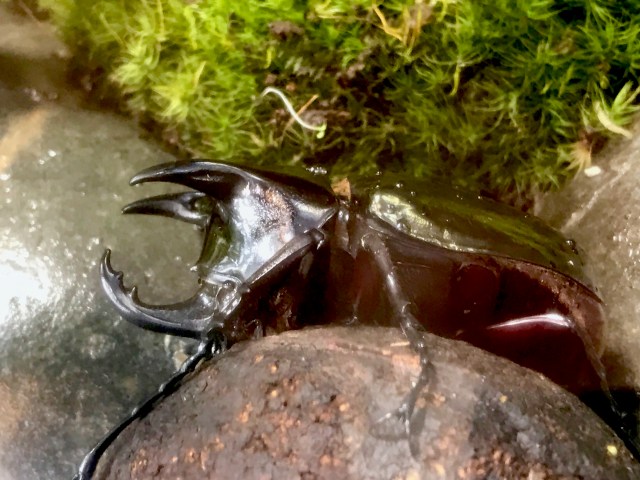
Genus/species: Chalosoma caucasus

GENERAL CHARACTERISTICS: Males have large curved horns which are used when fighting other males for a female. The smaller females do not have horns but are covered with fine tiny hairs called setae. The male female differences are an example of sexual dimorphism.

It is the largest of the genus Chalcosoma and one of Asia’s largest beetles. Length up to 90–120 millimetres (3.5–4.7 in)

DISTRIBUTION: Found from Malaysia south into Indonesia

DIET IN THE WILD: Feed on compost from decaying logs and wood.

REPRODUCTION: Larvae emerge from eggs and grow through 3 instar stages, then a pupal stage in a papery covering (7.5 inches in length) followed by emergence of the beetle after several months

References

California Academy of Sciences Rainforest 2017 Vetting Tim Wong

EOL eol.org/pages/10753705/overview

Natural Worlds.org www.naturalworlds.org/scarabaeidae/species/Chalcosoma_cau…

Ron’s flickr https://www.flickr.com/photos/cas_docents/32488979164/in/album-72157620708938680/

Ron’s WordPress Shortlink http://wp.me/p1DZ4b-1MX


TAXONOMY
Kingdom: Animalia
Phylum: Arthropoda
Class: Insecta
Order: Phasmatodea (walking sticks, plasmids and ghost insects)
Family: Heteropterygidae

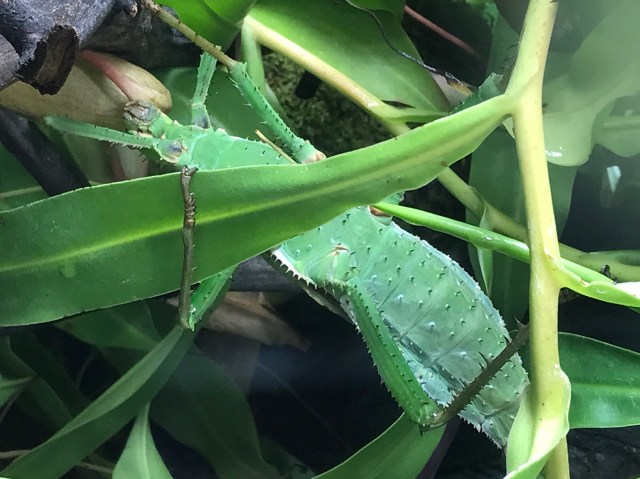
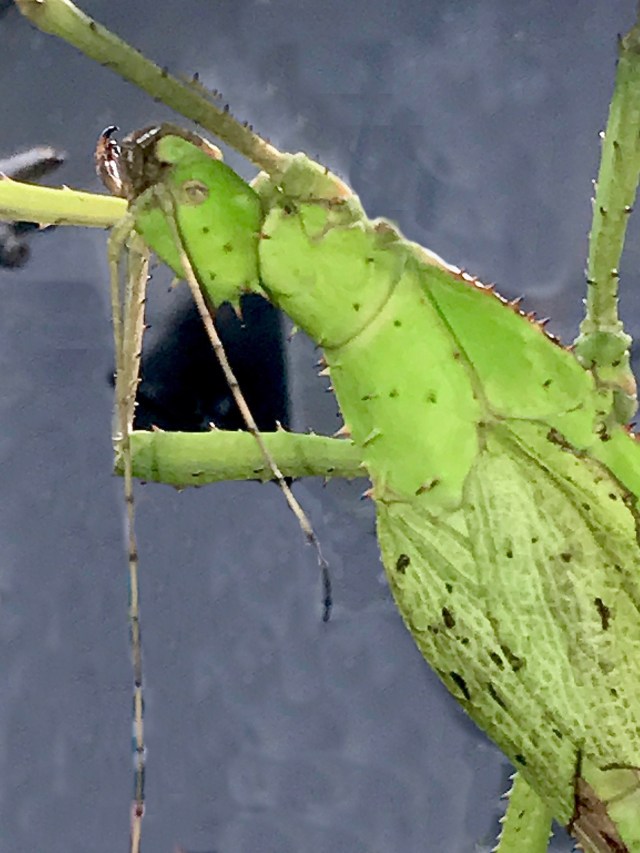
Genus/species: Heteropteryx dilatata

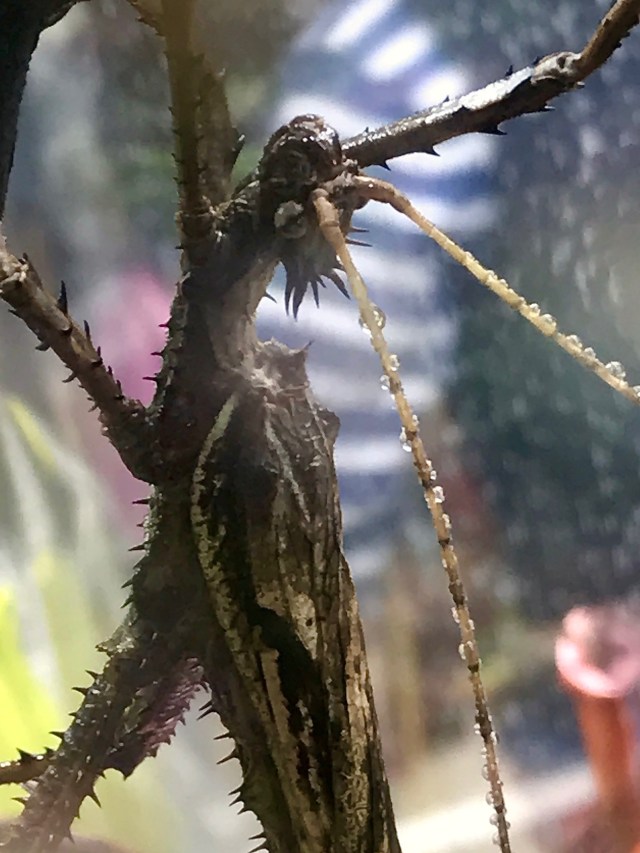
GENERAL CHARACTERISTICS: Heteropteryx dilatata are well camouflaged. The males are long and slender and are brown with beige in color (length up to 10 cm in, light and able to fly.). The adult females are lime green, very large and have a very wide body (length up to 15 cm or 6 in). Wings are short and lay like a cap on the back of the insect and can’t fly. Males are much smaller and a mottled brown color. Both sexes have small spikes on their head and body, but the female has more of them.

DISTRIBUTION: Malaysia

DIET IN THE WILD: Blackberry, raspberry, rose and ivy leaves.

REPRODUCTION: Sexual.  Females deposit the dark, circular eggs in moist soil. They hatch in 12 to 14 months.

Male Jungle Nymph below


REMARKS: Both sexes have small spikes on their upper bodies, more numerous in the female, who also has very large spines on her hind legs that can snap together as a scissor-like weapon.

References

California Academy of Sciences Rainforest Level 4

EOL  http://eol.org/pages/1077486/details

ADW http://animaldiversity.org/accounts/Heteropteryx_dilatata/classification/

Keeping Insects  https://www.keepinginsects.com/stick-insect/species/jungle-nymph/

Ron’s WordPress Shortlink  http://wp.me/p1DZ4b-1MO

Ron’s flickr https://www.flickr.com/photos/cas_docents/33312595406/in/album-72157620708938680/

TAXONOMY
Kingdom: Animalia
Phylum: Cnidaria
Class: Scyphozoa
Order: Rhizostomeae
Family: Mastigiidae

Genus/species: Mastigias papua 

IMG_5610

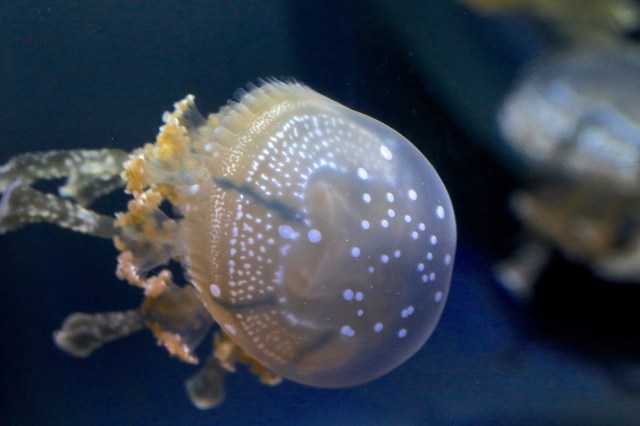
GENERAL CHARACTERISTICS: The translucent bell of M. papua is usually hemispherical, with a diameter ranging from 30 to 80 mm (1 in to 3 inches). This species has 8 frilled oral arms, rather than tentacles. These arms end in a club-like filament that has a triangular cross-section, though this is absent in some species. Each oral arm has mouths on the club, as well as along the length towards the bell.
Color variation exists within Mastigias papua, though the bell is usually greenish blue to olive-green with yellow, white, and/or brown oval, granular spots across the rim (over the exumbrella). Coloring can be attributed to the zooxanthellae that reside symbiotically within the lagoon jellyfish (mostly in the mesoglea)

DISTRIBUTION/HABITAT: Tropical Pacific ocean usually bays, harbors and lagoons.

DIET IN THE WILD: Instead of a single mouth, they have many small mouth openings on their oral-arms, which capture small animal plankton. In addition, each jelly grows a crop of algae, which gives them a greenish-brown color. They harvest some of their food directly from the algae.

MORTALITY: Lifespan of approximately 4 months

PREDATION The only creature that has been confirmed to prey on Mastigias papua is a sea anemone, Entacmaea medusivora.

IMG_5608

REMARKS: Some species of small, juvenile fishes are known to shelter within this jelly’s bell for protection from larger predators.
The famous jellyfish of Jellyfish Lake, a well-known dive site in the Pacific islands of Palau, are descended from M. papua However unlike its jellyfish lake cousin M. papua possess venomous stinging cells for feeding and protection.

Human contacts may  experience many adverse effects such as rashes, severe itching, nausea, and vomiting when contacting tentacles.

References

California Academy of Sciences Steinhart Aquarium Color on the Reef 2017 AQA17

Monterey Bay Aquarium  www.montereybayaquarium.org/animal-guide/invertebrates/sp…

ADW animaldiversity.org/accounts/Mastigias_papua/

EOL  eol.org/pages/203445/overview

Ron’sW0rdpress Shortlink  http://wp.me/p1DZ4b-PC

Ron’s flickr http://www.flickr.com/photos/cas_docents/sets/72157610031545571/with/5985963712/


California Academy of Sciences Steinhart Aquarium Color on the Reef 2017 AQA17

Monterey Bay Aquarium

www.montereybayaquarium.org/animal-guide/invertebrates/sp…

ADW animaldiversity.org/accounts/Mastigias_papua/

Eol eol.org/pages/203445/overview


TAXONOMY
Kingdom: Animalia
Phylum: Arthropoda
Class: Insecta
Order: Lepidoptera
Family: Saturniidae

Genus/species: Rothschildia lebeau

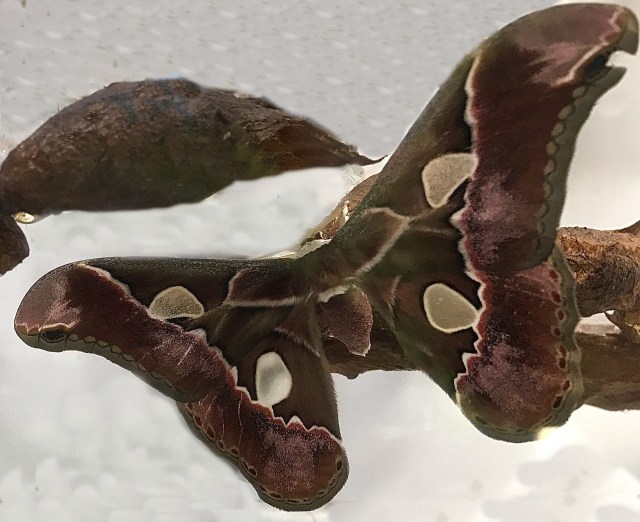
GENERAL CHARACTERISTICS: Wings are reddish-brown with an olive tinge. The four clear spots or four windows give it its Spanish name cuatro ventanars. It may live as a pupa for two or three years before becoming an adult which does not eat in their short lifetime.

Wing Span: 9 – 12.5 cm (3 1/2 – 4 15/16 in)

DISTRIBUTION: Southern Texas To South America. Found in thorn scrub,

References

California Academy of Sciences Rainforest Level 3 2017 Vetting Tim Wong

Ron’s flickr https://www.flickr.com/photos/cas_docents/33312191516/in/album-72157608449327886/

Butterflies and Moths of North America  www.butterfliesandmoths.org/species/Rothschildia-lebeau

Ohio State Univ. bugguide.net/node/view/151823

Chicago Botanical Garden  www.chicagobotanic.org/butterflies/rothschild_silkmoth

Ron’s WordPress Shortlink http://wp.me/p1DZ4b-1MF

TAXONOMY
Kingdom: Animalia
Phylum: Arthropoda
Class: Insecta
Order: Lepidoptera  (moths and butterflies)
Family: Nymphalidae (brush-footed butterflies or four-footed butterflies: they are known to stand on only four legs while the other two are curled up)
Subfamily Danainae

Genus/species: Idea leuconoe

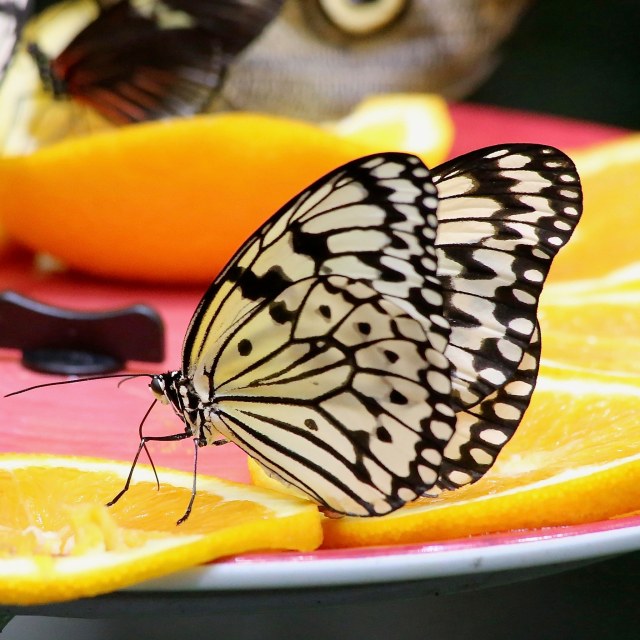
GENERAL CHARACTERISTICS: Wings are translucent white patterned with black veins, and numerous oval black spots.

paper kite33211409166_fbd4a42379_k

DISTRIBUTION/HABITAT: Found in Malaysia, Taiwan, Philippines in coastal mangrove forest and lowland rainforest.

PREDATORS: The bright wing patterns “advertise” these unpalatable qualities, All Danaines are thought to be distasteful to birds. Their bodies contain toxins which are derived from the lactiferous larval food plants, and are often supplemented by further toxins sequestered from adult food sources. Any bird that suffers the highly unpleasant experience of tasting a Danaine is unlikely to attack other similarly coloured butterflies. Effectively, a few individuals are sacrificed for the good of the species as a whole. Aposematism see Color of Life

REMARKS: They are noted for their slow and very graceful flight, which gives them the appearance of white handkerchiefs floating gently on the breeze.

References

California Academy of Sciences Rainforest 2017

Ron’s WordPress Shortlink http://wp.me/p1DZ4b-1Ms

Ron’s flickr https://www.flickr.com/photos/cas_docents/33211409166/in/album-72157608449327886/

EOL www.eol.org/pages/137237/overview

Guide to the world of butterflies and moths: www.learnaboutbutterflies.com/Malaysia%20-%20Idea%20leuco…

TAXONOMY
Kingdom: Animalia
Phylum: Arthropoda
Class: Insecta
Order: Lepidoptera
Family: Saturniidae

Genus/species: Argema mimosae

GENERAL CHARACTERISTICS: Color is emerald-green with yellow and red eyespots on wings. Larvae are green with thin white bands and rows of long projections on back. The cocoons are silvery and pitted with small holes. This Moth has no moving mouth parts. Its one week adult life consists of living off stored fat, mating and laying eggs.
Females release pheromones which are detected by the males large feathery antennae.

Wing Span 10-12 cm (4-5 inches)

African Moon Mothimg_0654

DISTRIBUTION: Eastern and Southern Africa

References

California Academy of Sciences Rainforest 2017

Ron’s flickr https://www.flickr.com/photos/cas_docents/33175672016/in/dateposted-public/

Ron’s WordPress Shortlink http://wp.me/p1DZ4b-1Mi

reimangardens.com/  www.reimangardens.com/wp-content/uploads/2013/02/african_…

TAXONOMY
Kingdom: Animalia
Phylum: Cnidaria
Class: Anthozoa
Subclass: Hexacorallia
Order: Corallimorpharia
Family: Ricordeidae

Genus/sp. Rhodactis spp.

GENERAL CHARACTERISTICS: Rhodactis mushroom grow much larger than other mushroom genera, some attaining sizes of more than 10 inches across. The surface of their mushroom cap is covered with small tentacles (verrucae) or large warty knobs that are radially arranged. They are found attached to rock.

Rhodactus32905288196_ab8d24778a_z

DIET IN THE WILD: Ricordeidae feed both on the products of zooxanthellae, and on zooplankton or fish they catch with their tentacles and nematocysts as well as dissolved organic matter.

Rhodactus32774273105_54135cc7e6_z

REPRODUCTION: Asexual reproduction occurs by two mechanisms. Split or fission reproduction occurs when the coral splits along its mouth creating a clone. Alternatively, particulates released from the foot can develop into a new specimen, which is called laceration.

Sexual reproduction produces a larva called a Planula which once on the seabed develops into a new individual.

References

California Academy of Sciences Steinhart Aquarium Color on the Reef AQA12 2017

Aquarium Corals Eric Borneman TFH publications 2001 pages 206-209

EOL eol.org/pages/4680444/overview

Ron’s WordPress Shortlink http://wp.me/p1DZ4b-1M9

Ron’s flickr https://www.flickr.com/photos/cas_docents/32905288196/in/album-72157659465376212/


TAXONOMY
Kingdom: Animalia
Phylum: Cnidaria
Class: Anthozoa
Order: Alcyonacea
Family: Alcyoniidae

Genus/species: Lobophytum sp.

GENERAL CHARACTERISTICS: Typically colored yellowish brown, some ridged leather corals colored green by their algal endosymbionts. Lobed leather corals often encrusting or low and spreading. Upper surface with rounded or finger-like lobes. Usually no real stalk; colony often grows out from a low platform. Large polyps distinctly spaced from one another. Tentacles are retractile.

Tentacles retracted below

Lobophytum sp.32131393013_65a065d26a_k

DISTRIBUTION/HABITAT: Found in Indo-Pacific, Red Sea tropical coral reefs. Zonation varies by species, intertidal to 30 m. Notes apply to entire genus composed of at least 47 species.

Tentacles extended below

lobophytum sp.15794440950_f989b64b19_k

DIET IN THE WILD: They capture microscopic food particles from the water column, can absorb dissolved organic matter, and also use algal photosynthesis.

REPRODUCTION Typically reproduces asexually by budding or fragmentation.

REMARKS: Like Sarcophyton sp., to which it’s closely related, Lobophytum has two distinct types of polyps, one quite small, the other larger. Sinularia has only one.

References

California Academy of Sciences Steinhart Aquarium Color on the Reef AQA17 2017 Vetting Charles Delbeek

Aquarium Corals Eric Borneman TFH publications 2001 pages 127-129

Ron’s flickr https://www.flickr.com/photos/cas_docents/32131393013/in/album-72157659465376212/

Ron’s WordPress Shortlink  http://wp.me/p1DZ4b-1M0