Category: INVERTEBRATES


TAXONOMY
Phylum Arthropoda
Class Arachnida
Order Scorpiones,
Family Scorpanidae (Scorpions)

Genus/species: Pandinus imperator

6976512905_11a36f5ae1_b

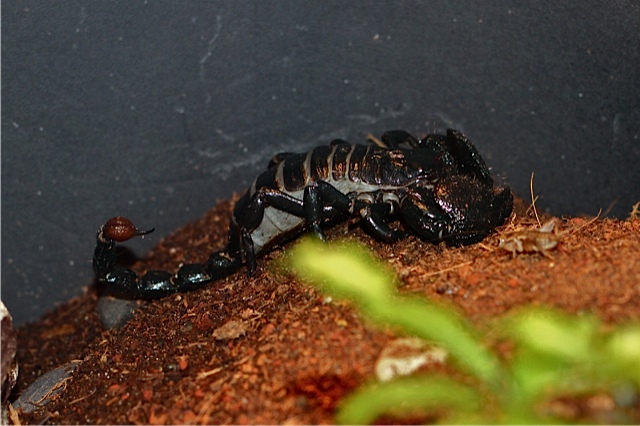
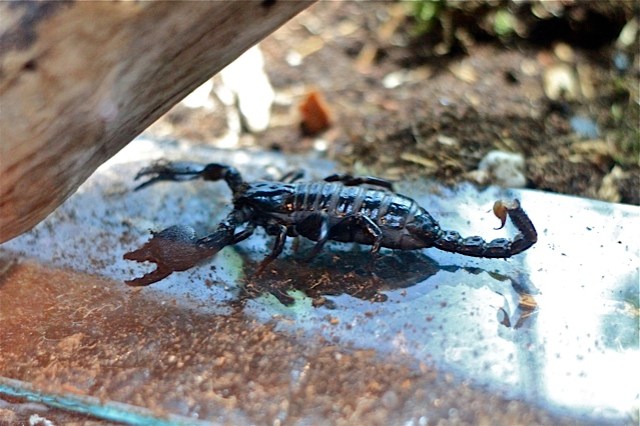
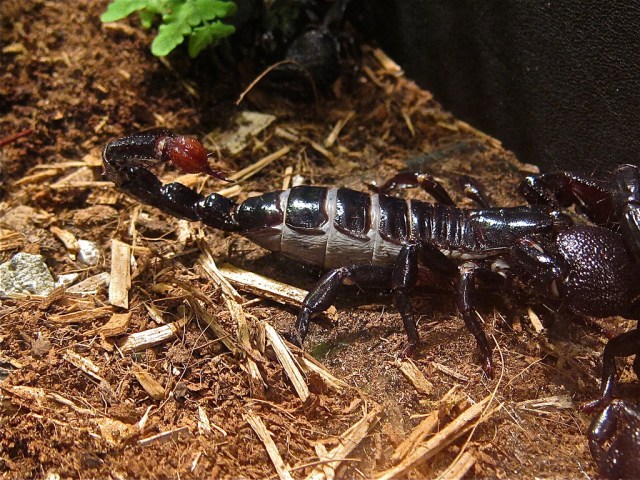
GENERAL CHARACTERISTICS: The largest scorpion known, (length to 20 cm (8 in); weight to 30 g (1 oz). Its black body bears large, blackish-red pincers with a granular appearance. The long tail, which arches back over the body, is tipped with a sharp curved stinger that delivers venom produced from a gland in the attached bulb.

DISTRIBUTION/HABITAT: West Africa Tropical forest and open savanna where it hides under rocks, burrows beneath the soil, or cohabits termite mounds.

GENERAL CHARACTERISTICS: The largest scorpion known, (length to 20 cm (8 in); weight to 30 g (1 oz). Its black body bears large, blackish-red pincers with a granular appearance. The long tail, which arches back over the body, is tipped with a sharp curved stinger that delivers venom produced from a gland in the attached bulb.

DIET IN THE WILD: It preys upon ground-dwelling insects, spiders, and other invertebrates as well as an occasional baby lizard, snake, or mouse. These large scorpions rarely sting small prey; instead they grasp the prey in powerful pincers and tear it apart. The venom is reserved for larger prey or defense.

REPRODUCTION/DEVELOPMENT: During mating, the male finds a suitable spot where he deposits his sperm packet, called a spermatophore. He then engages the female in an elaborate mating dance above the spermatophore with the male holding up the pincers of the female with his own, and carefully maneuvering her over the spermatophore, which she draws up into her genital pore. The eggs are fertilized, and the female carries them internally. After a 7 to 9 month gestation period, she gives birth to between 9 to 32 live young. The newborn climb onto the mother’s back, protected from predators by her size and aggressive behavior. Until the young are capable of hunting on their own, the mother feeds them by killing insects which are left on the floor of the burrow or other enclosure where the young can climb down and feed in safety.

PREDATORS: Predators include birds, bats, small mammals, large spiders, centipedes, large lizards, and other scorpions. Life span: 5 to 8 years.
7595589286_6713f5c418_b

REMARKS: Sensory hairs on the pincers and tail enable the scorpion to detect prey and danger through vibrations from the air and ground. Like all scorpions, it has poor eyesight (despite having 6 to 12 eyes), good hearing, a good sense of touch and is venomous.

ANIMAL ATTRACTIONS

flickr http://www.flickr.com/photos/cas_docents/sets/72157608653175263/with/7595589286/

WordPress Shortlink http://wp.me/p1DZ4b-Q4
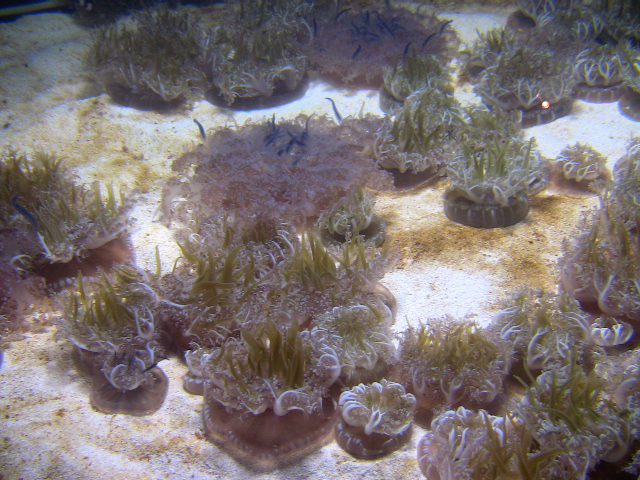
TAXONOMY
Phylum:Cnidaria
Class: Scyphozoa
Order: Rhizostomae
Family: Cassiopeidae

Genus/species: Cassiopea andromeda

3052389114_c2ebdbe533_o

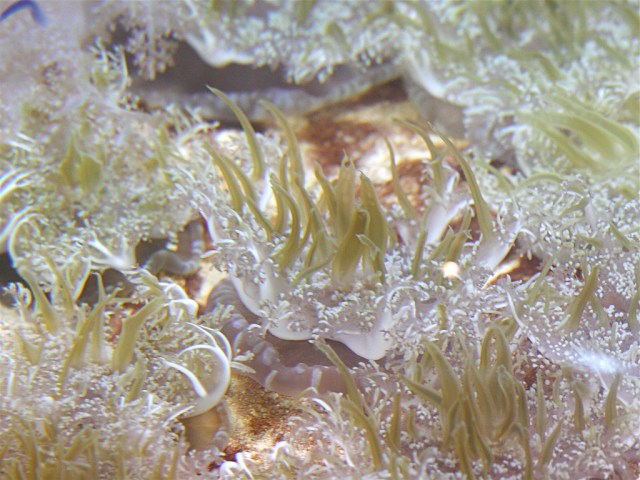
GENERAL CHARACTERISTICS: To 30 cm (12 in) diameter, disc-shaped bell has elaborately fringed oral arms. Coloration is gray, brown or green with triangular white blotches surrounding the bell. Zooxanthellae are the responsible for the color

DISTRIBUTION/HABITAT: Native to Indo-Pacific, but introduced in Caribbean, southern Florida, Hawaii. Upon shallow substrates, typically in calm sandy areas, often around mangroves. Intertidal to 10 m (33 ft).

DIET IN THE WILD: Consumes small marine animals after it paralyzes its prey with its mucous and nematocysts. Symbiotic algae in its tissues provide nutrition by photosynthesis, thus the upside down posture that allows algae, which live on the ventral surface, to receive maximum sunlight. The rhythmic pulsations create water flow that carries zooplankton over the tentacles to supplement the diet.

REPRODUCTION: Asexually (by budding) and sexually in the medusa form.

3279199519_42777fe55f_b

REMARKS: The sting is relatively mild, but may create an irritating, itchy rash; especially sensitive individuals can experience vomiting and skeletal pain.

Mildly venonomus.

Reef Partners Cluster PR35

WordPress Shortlink http://wp.me/p1DZ4b-PV

flickr   http://www.flickr.com/photos/cas_docents/sets/72157610031545571/with/3052389114/

TAXONOMY
Kingdom: Animalia
Phylum: Cnidaria
Class: Scyphozoa
Order: Semaeostomeae
Family: Pelagiidae

Genus/species: Chrysaora fuscescens

4330825373_e4d12ba6ca_b

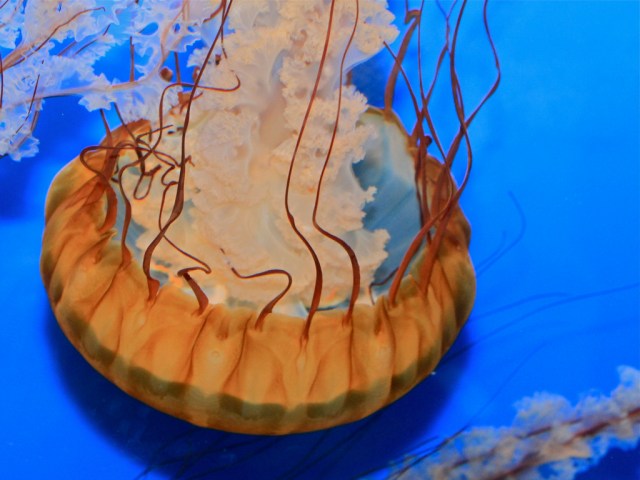
GENERAL CHARACTERISTICS: The sea nettle is a giant, semitransparent jellyfish, with an amber-colored, swimming bell commonly as large as 30 cm (12 inches) in diameter, with some measuring more than a meter. In addition to four oral arms attached to the underside of the mouth, the sea nettle has 24 long tentacles around the perimeter of the bell that extend up to 4 m (13 ft).

DISTRIBUTION/HABITAT: Marine, found along the westcoast of North America from Mexico to British Columbia.

DIET IN THE WILD: Carnivorous; feeds on zooplankton, small crustaceans, comb jellies, fish eggs and larvae. Sea nettles sting their prey with their tentacles, which have millions of microscopic stinging cells that inject toxins to stun or kill tiny animals. The main oral arms then transport food to the heart-shaped gastric pouches in the bell, where digestion occurs.

PREDATORS: In the medusa stage, sea nettles live from 2–6 mos, usually perishing in rough waters or being eaten by predators— ocean sunfish and leatherback turtles are two of the most prevalent jellyfish predators.

4798725394_c1fc6938ab_b

REMARKS: Question: What has no heart, bones, eyes or brain, is made up of 95% water, and yet
is still a remarkably efficient ocean predator? (The jellyfish) Some jellies commute 1,000 m up and down in the water column daily! Sea nettle stings can result in extreme localized pain. Fortunately this jelly is not aggressive. The bell of this and other jellies is called a “medusa” because, with its long, fringing tentacles, it resembles the snake-haired Gorgon Medusa of Greek mythology.

Venomous

Plankton/Sea Drifters CC24

flickr http://www.flickr.com/photos/cas_docents/sets/72157610031545571/with/4330825373/

WordPress Shortlist  http://wp.me/p1DZ4b-PM

TAXONOMY

KINGDOM Animalia

PHYLUM Cnidaria (possess cnidocytes)

CLASS Anthozoa (Sea Anemones and Corals)

SUBCLASS Hexacorallia (water-based organisms formed of colonial polyps generally with 6-fold symmetry)

ORDER Scleractinia (Stony Corals)

FAMILY Merulinidae

GENUS Hydnophora sp.

GENERAL CHARACTERISTICS
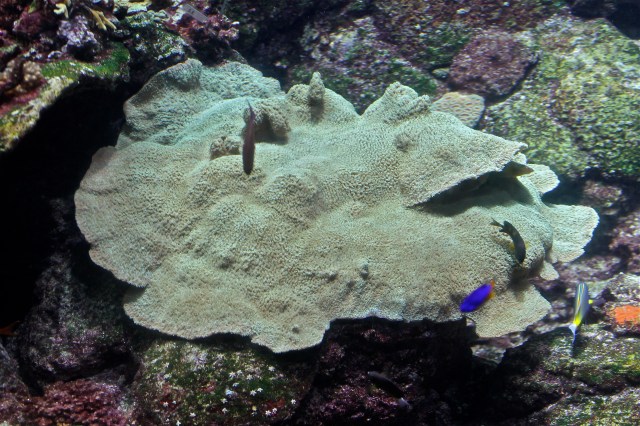
Hexacoral or stonycorals with colonies that may be massive, encrusting, or branched; usually brown, greenish, or yellowish. Conical protuberances over the entire colony’s surface. Tentacles often partially extended during the day.

DISTRIBUTION/HABITAT
Widely distributed in the Indo- Pacific. Common in variety of reef habitats.

DIET IN THE WILD
Nutrition mostly provided by symbiotic zooxanthellae, but also take other food sources, such as plankton.

REPRODUCTION: The small polyp stony (SPS) corals are male and female and can reproduce both sexually and asexually. They reproduce sexually by releasing eggs and sperm at the same time (spawning), resulting in a fertilized egg which then forms into a free-swimming planula larva. Eventually the planula larvae settles onto the substrate, becoming plankters. This then forms a tiny polyp which begins to excrete calcium carbonate and develops into a coral. Planula larvae are extremely vulnerable to predation, and very few survive. Hydnophoras reproduce asexually from breakage due to storms resulting in fragmentation.

REMARKS: Hydnophora are very aggressive and can extend sweeper polyps and sting or basically eat other corals it touches.

LOCATION; Main Philippine Coral Reef Tank PR04

flickr http://www.flickr.com/photos/cas_docents/4673421321/in/set-72157623778757037/

WORDPRESS SHORTLINK  http://wp.me/p1DZ4b-nP

Family Poraniidae 

Dermasterias imbricate

DISTRIBUTION: Eastern North Pacific: Alaska to Northern California. 

HABITAT: On rocks and rocky reefs in subtidal areas.  APPEARANCE: Medium size sea star up to 5 Iin or 12 cm in diameter with disproportionately short broad arms with a smooth, slippery surface. Mottled coloring—bluish-grey with brown to orange blotches all over.  Oral side pale and smooth. Smells garlic-like.  

DIET: Mainly sea anemones, but also takes sea cucumbers, sea urchins, and other invertebrates. Leather stars, unlike many other sea stars, such as the ochre, bat, and pink sea stars, swallow their prey whole and digest internally. 

REPRODUCTION/DEVELOPMENT: Releases eggs and sperm; fertilized eggs float in plankton and develop into juveniles, which eventually settle out.

REMARKS: Known to eat the Plumose Anemone (Metridium senile and Metridium farcimen), and the Strawberry Anemone Corynactis californica.

Larger anemones have been observed to fight back by distending the mouth to envelope the attacking star. In the end the leather star often retreats and both the star and the anemone are none the worse for wear. 


LOCATION: Tidepool  CC15    **DisplayIntermittent 

WORDPRESS SHORTLINK   http://wp.me/p1DZ4b-u0

flickr    http://www.flickr.com/photos/cas_docents/sets/72157608501343477/

Phylum Echinodermata, Class Asteroidea, Order Forcipulatida, Family Asteriidae, 

Pisaster gianteus


DISTRIBUTION: Eastern Pacific coast from British Columbia to Baja California.

HABITAT: Rocky but also sandy substrates from middle to lower intertidal zone down to 300 ft or 90 m.

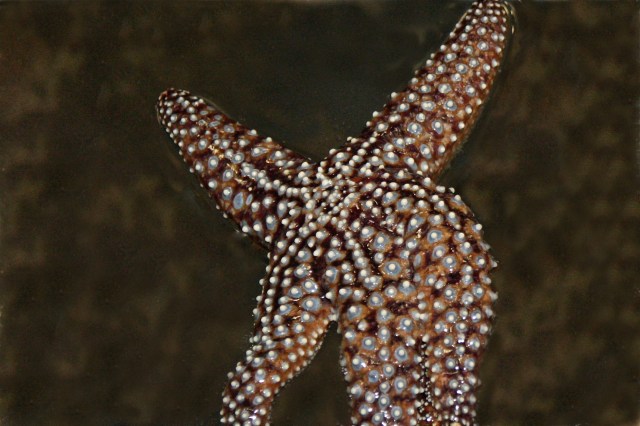
APPEARANCE: Five arms. Can be colored red, orange, brown, or green. Evenly spaced blunt white stubby spines surrounded by blue plaques.  Maximum arm span about 24 in or 60 cm.

DIET: Typical prey are hard-shelled organisms such as mussels, snails, and barnacles. May occasionally eat anything slow-moving enough to be caught, such as dying fish or shellfish, anenomes, or other sea stars.

REPRODUCTION and DEVELOPMENT: Individual sea stars are male or female. Broadcast spawners, both sexes release gametes into the water for external fertilization. Larvae are planktonic and have bilateral symmetry.

MORTALITY/LONGEVITY: Sea gulls and sea otters are sea star predators. Giant sea stars live about 20 years.

TIDEPOOL CC15  

WORDPRESS SHORTLINK  http://wp.me/p1DZ4b-tO

flickr  http://www.flickr.com/photos/cas_docents/sets/72157608501343477/

Phylim Molluska, Class Gastropoda, Family ‪Aeolidioidea,

Aeolidia papillosa


DISTRIBUTION: Common on the Atlantic coast of Europe and North America and the Pacific coast of North America. Also from from both west and east coasts of South America

HABITAT: On rocks, or may be on floats or docks. Often near its perferred prey. Intertidal to 380m deep.

APPEARANCE: Its color appears to be quite variable, depending upon locale and food resources. This large aeolid grows to about 10 cm (4 in)  in length and its body is covered with close obliquely arranged rows of flattened cerata.

DIET: Feeds almost exclusively on sea anemones.

MORTALITY/LONGEVITY:  This species is famous for obtaining undischarged cnidae (cells which bear nematocysts) from its Cnidarian prey and moving to the tips of the cerata , where they are likely used for defense. If disturbed they sometimes wave their cerata. If one of the cerata is broken off, muscles within it contract, expelling the nematocysts, which then discharge . The chemical composition of A. papillosa mucus changes and does not trigger a discharge of nematocysts in the sea anemone.

REPRODUCTION/DEVELOPMENT: Nudibranchs are hermaphroditic, and thus have a set of reproductive organs for both sexes, but they cannot fertilize themselves.

REMARKS: Their eyes are simple and able to discern little more than light and dark. The eyes are set into the body, are about a quarter of a millimeter in diameter, and consist of a lens and five photoreceptors.

 WORDPRESS SHORTLINK: http://wp.me/p1DZ4b-sk


Order Coleoptera

The largest of insect orders, currently about 350,000 beetle species are known.  One of every five animals on earth is a beetle!  The name coleoptera or “sheath wings” derives from sheath-like wing cases, called elytra, that provide protection to a second, underlying pair of more delicate flight wings. The elytra are not used to power flight, but help stabilize the beetle as it flies.  Some beetles, such as various ground beetles, have lost the ability to fly.

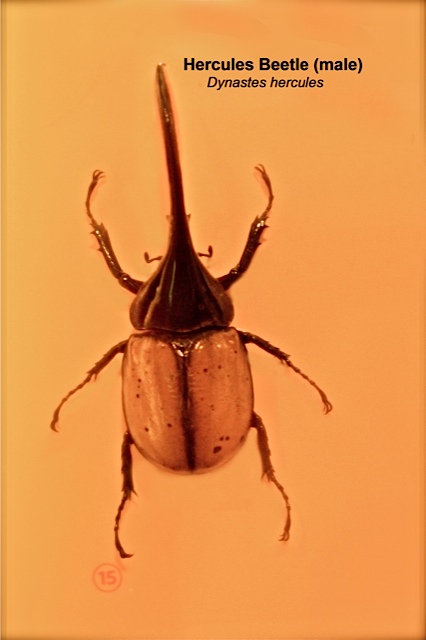
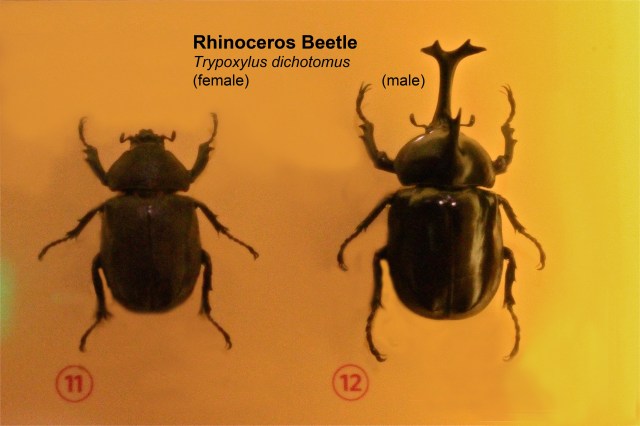
Stag, Hercules, and Rhinoceros Beetles

Family Lucanidae and Family Scarabaeidae (Subfamily Dynastinae)

DISTRIBUTION: Worldwide distribution.

HABITAT: Mostly woodlands. Adults live and breed in damp, rotting wood.

APPEARANCE:  Medium to large beetles, males of some species have spectacularly large jaws. Females are considerably smaller in size, and lack the impressive “horns.”

DIET: Larvae feed on decaying wood, probably getting nutrition not just from the cellulose, but from the fungi and microbes decomposing it. Adults of most species feed on sugary liquid food, such as sap from wounded trees, aphid ” honeydew” secretions, and ripe fruit. Adults are unable to chew.

REPRODUCTION/DEVELOPMENT: Males use their huge jaws to fight for access to females. Individual males play “king of the hill,” only in their case they are fighting to win access to control a dead stump or tree that a discriminating female will find highly suitable as a residence to feed and protect her offspring. The male-male contest involves each trying to maneuver his huge mandible underneath and overturning his competitor, ideally knocking him to the ground. Injuries are rare, but the victor, who is typically the largest and strongest, gains the female, or often multiple females, as he controls the best breeding property.

Stag beetles evolutionary development of sexual dimorphism, with males being significantly larger than females, repeats a miniature version of a sexual strategy familiar in the animal kingdom: to the victor (the largest male) belongs the spoils (reproductive rights to pass along his genes). Even better, this strategy is most often found in haremic groups, where the male wins not only one female, but many.

MORTALITY/LONGEVITY: Larvae live 3-5 years, adults a few months.

WORDPRESS SHORTLINK  http://wp.me/p1DZ4b-r7

Phylum Arthropoda, Class Arachnida, Order Scorpiones, Family Scorpanidae, Scorpions

Pandinus imperator

DISTRIBUTION: West Africa

HABITAT: Tropical forest and open savanna where it hides under rocks, burrows beneath the soil, or cohabits termite mounds.

APPEARANCE: The largest scorpion known, (length to 20 cm (8 in); weight to 30 g (1 oz). Its black body bears large, blackish-red pincers with a granular appearance. The long tail, which arches back over the body, is tipped with a sharp curved stinger that delivers venom produced from a gland in the attached bulb.

DIET:  It preys upon ground-dwelling insects, spiders, and other invertebrates as well as an occasional baby lizard, snake, or mouse. These large scorpions rarely sting small prey; instead they grasp the prey in powerful pincers and tear it apart. The venom is reserved for larger prey or defense.

REPRODUCTION/DEVELOPMENT:  During mating, the male finds a suitable spot where he deposits his sperm packet, called a spermatophore. He then engages the female in an elaborate mating dance above the spermatophore with the male holding up the pincers of the female with his own, and carefully maneuvering her over the spermatophore, which she draws up into her genital pore. The eggs are fertilized, and the female carries them internally. After a 7 to 9 month gestation period, she gives birth to between 9 to 32 live young. The newborn climb onto the mother’s back, protected from predators by her size and aggressive behavior. Until the young are capable of hunting on their own, the mother feeds them by killing insects which are left on the floor of the burrow or other enclosure where the young can climb down and feed in safety.

MORTALITY/LONGEVITY:  Predators include birds, bats, small mammals, large spiders, centipedes, large lizards, and other scorpions. Life span: 5 to 8 years.

REMARKS: Sensory hairs on the pincers and tail enable the scorpion to detect prey and danger through vibrations from the air and ground. Like all scorpions, it has poor eyesight (despite having 6 to 12 eyes), good hearing, and a good sense of touch.

flickr http://www.flickr.com/photos/cas_docents/6976512905/in/set-72157629304397467/

WORDPRESS SHORTLINK http://wp.me/p1DZ4b-qK

Phylum Arthropoda, Class Arachnida, Order Araneae, Family Theraphosidae

Lasiodora parahybana

DISTRIBUTION: Throughout northeastern Brazil.

HABITAT:  Tropical forest floor

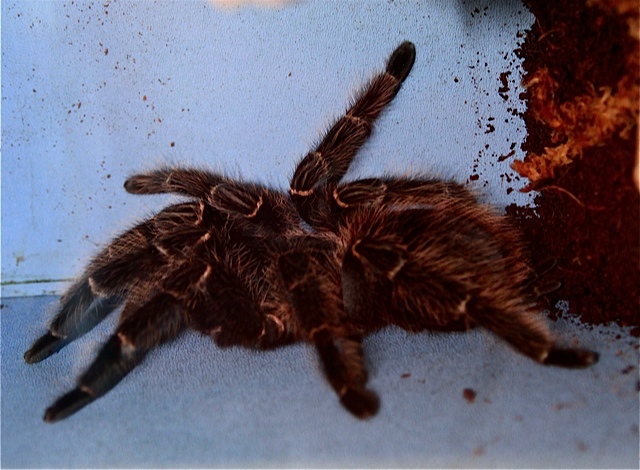
APPEARANCE: Said to be the third largest spider in the world, this is a large-bodied tarantula with abdomen and legs covered with sensitive, long, and partially pink or salmon-colored hairs.   Maximum size: body, 9-10 cm (3.5–4 in); leg span, 20-25 cm (8–10 in).

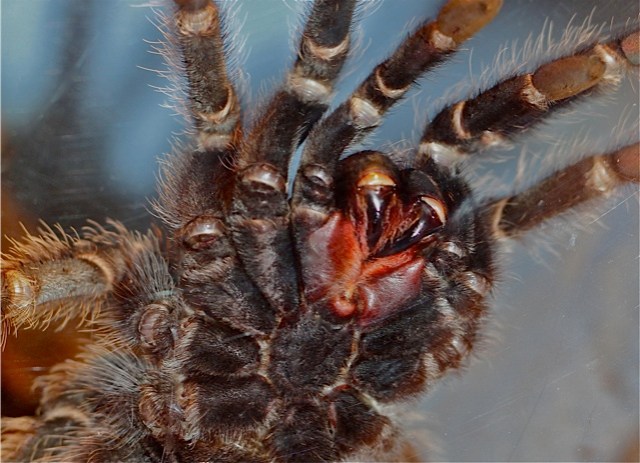
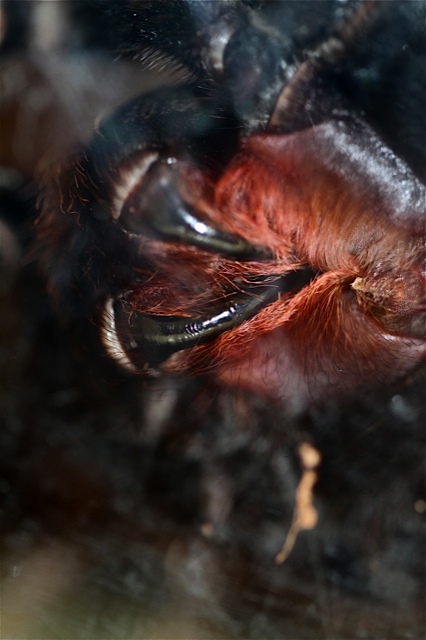
DIET: Lie and wait carnivore, eating large crawling insects and other invertebrates, small rodents, lizards, and frogs rarely seen eating birds like newly hatched chicks of ground-dwelling birds. Venom injected by chelicerae that liquefy the kill, which is then sucked in by the mouthparts.

REPRODUCTION and DEVELOPMENT: The male spins a small area of silk onto which he deposits his sperm. The sperm is then absorbed into the pedipalps, which during mating are inserted into the genital opening of the female, transferring the sperm, which remains viable. After insemination, the male makes a swift retreat as the much smaller males occasionally become a sacrifice to the female’s need to maintain the nutritional viability of a mother-to-be. The female lays up to 2000 fertilized eggs in a thick, silken sac which she guards fiercely. Young spiderlings are born about 3 weeks later. Voracious feeders, they grow quickly.

MORTALITY/LONGEVITY: Tarantulas have few enemies except tarantula hawk wasps. Members of this wasp family use their sting to paralyze species specific tarantulas. The wasp lays an egg on the tarantula’s abdomen and then seals the spider in its burrow. The wasp larva hatches and feeds on the immobile and doomed tarantula. Males usually die shortly after maturity and mating. Females can live over 20 years in the wild, perhaps significantly longer.

REMARKS: Like most tarantulas and some other spiders, if this spider loses one of its legs and is still in a growth stage, it can regrow the lost appendage,

While not highly aggressive and bites are not fatal to humans (most tarantula bites are similar to a bee sting in toxicity), this big bruiser, because of its long fangs, can inflict a serious wound which one researcher defined as “capable of medically significant mechanical damage”!

If pursued by a potential foe, the spider rubs its legs against its abdomen, throwing tiny, barbed hairs that become imbedded in the attacker. The barbs can cause significant irritation, especially if lodged in the eyes or nasal passages.

flickr http://www.flickr.com/photos/cas_docents/6962229021/in/set-72157608653175263/

WORDPRESS SHORTLINK  http://wp.me/p1DZ4b-qx