Category: INVERTEBRATES


TAXONOMY
Kingdom: Animalia
Phylum: Cnidaria
Class: Anthozoa
Order: Actiniaria
Family: Metridiidae

Genus/species: Metridium senile

GENERAL CHARACTERISTICS: M. senile is colored white, cream, tan, orange or brown. Height to 5 cm (2 inches). Tentacular crown diameter to 25 cm (9.75 inches), Up to one hundred small, slender tentacles give a feathery (plumose) appearance.
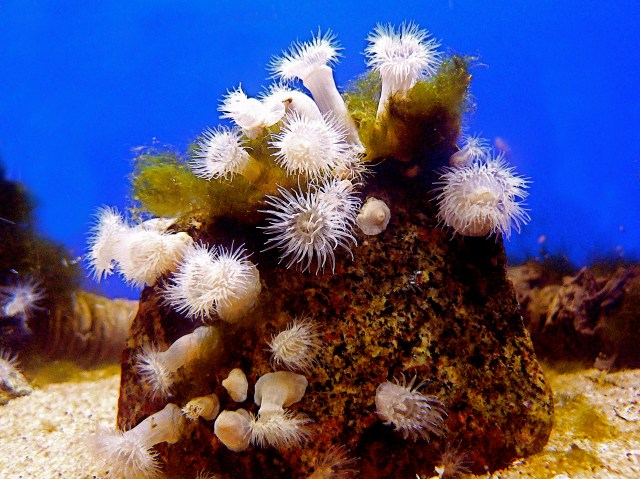
 Metridium senile 3074666433_ab584596e9_o

DISTRIBUTION/HABITAT: Southern Alaska to Southern California and both Atlantic coasts. Found live in groups of up to 500 specimens per square meter at depths to 166 m (540 feet). M. senile lives on rocks, shells, wood pilings and stony breakwaters in bays and harbors in the low intertidal and subtidal zones. Plumose anemones crawl slowly along the substrate by muscular waves of the pedal disk.

DIET IN THE WILD: Mostly small zooplankton, though they may also eat small benthic polychaetes, fish, and squid.

REPRODUCTION: Protandric hermaphrodite starting life as one sex and changes to the other when it is older. Eggs or sperm develop in the gonads embedded in the mesentery that lines the coelom. They are ejected through the mouth, and when fertilised develop into planula larvae which settle and become juveniles.

They also reproduce asexually by binary fission, budding and fragmentation.

PREDATORS: Nudibranch Aeolidia papillosa (on small individuals), and the seastars Hippasteria spinosa and Dermasterias imbricata, which can eat even quite large individuals.  Attacked individuals may detach and drift to a new location.

Location: California Rocky Coast and tide pool

References

Walla Walla University: www.wallawalla.edu/academics/departments/biology/rosario/…

eol  eol.org/pages/421495/details 

Ron’s flickr   https://www.flickr.com/photos/cas_docents/3074666433/in/set-72157625127345346/

Ron’s WordPress shortlink  http://wp.me/p1DZ4b-1ls 
TAXONOMY
Kingdom: Animalia (animals)
Phylum: Cnidaria
Class: Anthozoa
Subclass: Ceriantipatharia,
Order: Ceriantharia
Family: Cerianthidae

Genus/species: Pachycerianthus fimbriatus

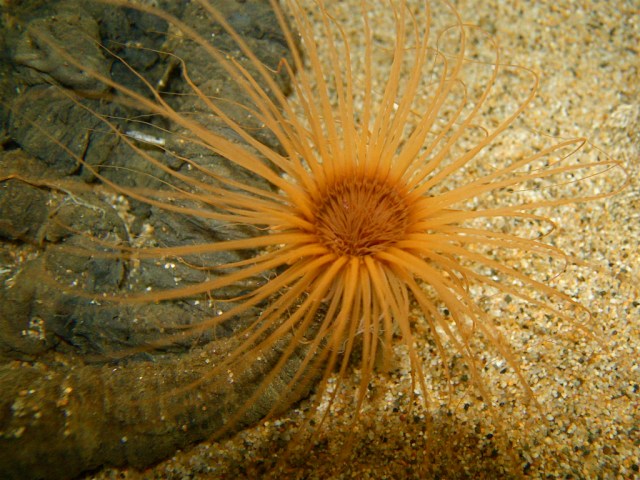
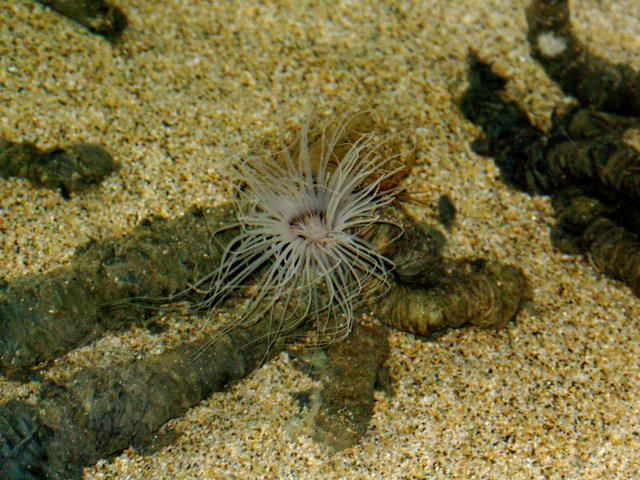
GENERAL CHARACTERISTICS: Solitary tube to 35 cm (14 inches) long when expanded. The tough, slippery, black, secreted tube projects above the mud substrate. Tentacular crown with two circles of translucent whitish to brown-gold tentacles. The inner
circle usually held over the mouth, the outer circle projecting up or out. Like most anemones, the tube-dwelling anemone contains stinging cells or nematocytes along its tentacles.

Tube Anemone  3236526239_4f6bd4f600_o

DISTRIBUTION/HABITAT: California (total distribution poorly known). Fairly common in soft mud bottoms of bays and harbors and protected sandy substrates of the outer coast. Low intertidal and subtidal in S. California; subtidal only in N. California to at least 54 m (177 feet).

Tube Anemone 3288842115_73a426d48d_b

DIET IN THE WILD: Small invertebrates, hydromedusae, small crustaceans and plankton

PREDATORS: Barber slugs clip off its tentacles, resulting in P. fimbriatus retreating quickly down the tube—sometimes pulling the slug in with it. The tentacles grow back after an attack.

REMARKS: Unlike sea anemones the anal pore is at the end of the body.

References

eol eol.org/pages/199417/details

 Walla Walla Universitywww.wallawalla.edu/academics/departments/biology/rosario/…

 Monterey Bay Aquarium www.montereybayaquarium.org/animal-guide/invertebrates/tu…

Ron’s WordPress Shortlink  http://wp.me/p1DZ4b-1kM

Ron’s flickr  https://www.flickr.com/photos/cas_docents/3236526239/in/set-72157625127345346


TAXONOMY
Kingdom: Animalia
Phylum: Arthropoda (invertebrate animal having an exoskeleton (external skeleton), a segmented body, and jointed appendages
Subphylum: Crustacea (crabslobsterscrayfishshrimpkrill and barnacles). Distinguished from other groups of arthropods, such as insectsmyriapods and chelicerates, by the possession of biramous (two-parted) limbs
Class: Malacostraca  (crabslobsterscrayfishshrimpkrillwoodlice, scuds (Amphipoda), mantis shrimp and less familiar animals)
Subclass: Eumalacostraca
Superorder: Eucarida  (decapodskrill and Amphionides)
Order: Decapoda (literally “ten-footed”)  Includes crayfishcrabslobstersprawns and shrimp.
Suborder: Pleocyemata;  members of the Reptantia (including crabs, lobsters, crayfish, and others)
Infraorder: Anomura
Superfamily: Paguroidea (hermit crabs)
Family: Lithodidae (stone crabs)

Genus/species: Cryptolithodes typicus

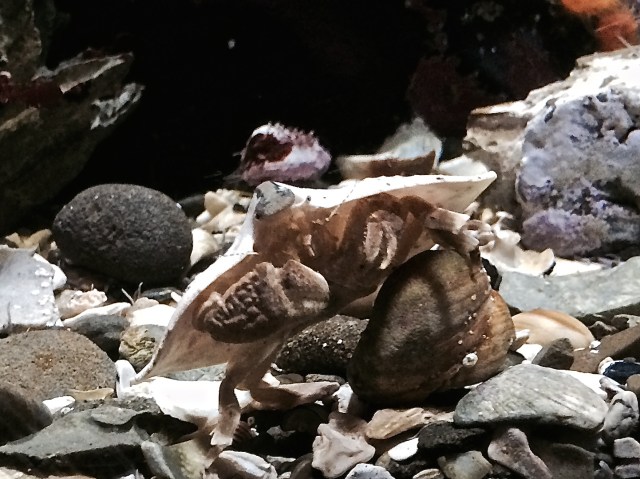
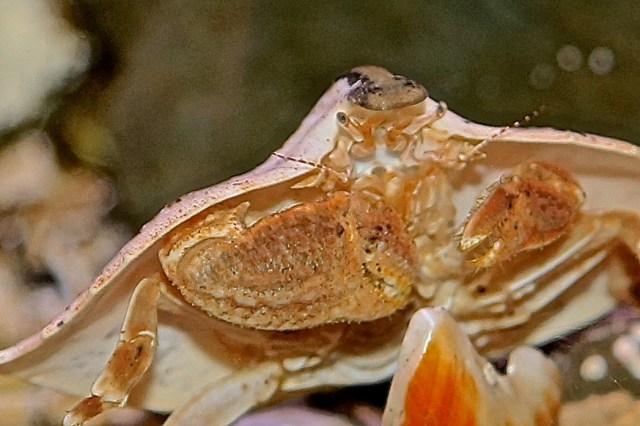
 GENERAL CHARACTERISTICS: The carapace covers the thoracic segments extending so far out covering the tips of the legs. The rostrum is widest at the base and narrower at the tip. Chelipeds are covered with rough tubercles. Carapace color is variable, from dark gray-blue to bright orange, white (especially in small individuals), or red (especially in males). The central part of the carapace is often a different color than the “wings”. Carapace width to 8 cm (3 inches).

Cryptolothodes sitchensis has a similar carapace but its rostrum is widest at the tip and its chelae are smooth.

 Butterfly Crab14453583299_3d6be76343_oDISTRIBUTION/HABITAT: Marine from Amchitka Island, Alaska to Santa Rosa Island, CA. Found in Rocky banks, shell rubble near rocky cliffs in open coast or inland waters, Depth Range: Low intertidal to 45 m (150 feet).

Butterfly Crab14453618558_e56e0e248d_o

DIET IN THE WILD: Feeds on bryozoans, coralline algae.

REFERENCES:

wallawalla.edu/academics/;  www.wallawalla.edu/academics/departments/biology/rosario/…

 eol eol.org/pages/342506/details

Ron’s WordPress shortlink  http://wp.me/p1DZ4b-1k8

Ron’s flickr  https://www.flickr.com/photos/cas_docents/14453618558/in/set-72157608602469734/

 Photo vetted, Margarita Upton Biologist II Steinhart Aquarium California Academy of Sciences

TAXONOMY:
Kingdom: Animalia
Phylum: Mollusca:
Class: Gastropoda  (snails and slugs)
Order: Vetigastropoda:  (primitive group of sea snails)
Family: Trochidae (“top snails”, because in many species the shell is shaped like a toy top)

Genus/species: Norrisia norrisi

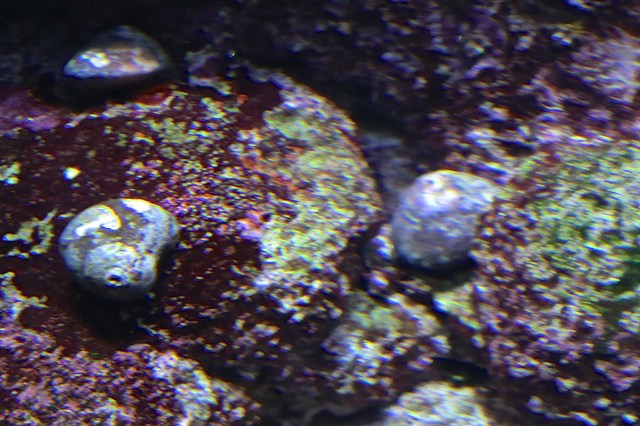
Red Foot Moon Snail Norrisia norrisi IMG_7601

GENERAL CHARACTERISTICS: Smooth brown shell that ranges in size from a few mm to 55mm or 2 inches.

DISTRIBUTION/HABITAT: Eastern Pacific found on kelp from Point Conception to Baja California, May live in water 15-24°C or 59 to 75°F.

DIET IN THE WILD: The Norris’ top snail feeds mainly on brown algae but in aquariums they use their file-like tongue or radula to eat most types of algae helping to keep the aquarium clean.

PREADATORS: Commonly eaten by seastars.

REMARKS: Used to help control algae in the Philippine coral reef. PR04

IMG_7602

flickr http://www.flickr.com/photos/cas_docents/sets/72157608597736188/ 

WordPress shortlink  http://wp.me/p1DZ4b-16o

TAXONOMY:
Kingdom: Animalia
Phylum: Arthropoda
Class: Insecta
Order: Lepidoptera (moths and butterflies)
Family: Pieridae (Whites and Sulfurs)

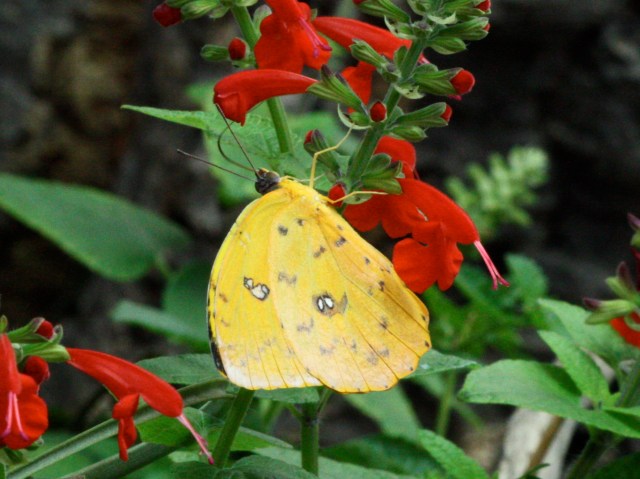
Genus/species: Phoebis philea 

3201526951_715a363cc4_o

GENERAL CHARACTERISTICS: Upperside of male bright yellow-orange; forewing has red-orange bar, hindwing with red-orange outer margin. Female much larger than male with prominent dark spots along the upper forewing. Wing Span: 2 3/4 – 4 inches.

DISTRIBUTION/HABITAT: Resident from Brazil, north through Central America to peninsular Florida. Migrants appear sometimes along the Gulf States, in eastern Arizona and in New Mexico along the border. During dry years, some migrate to the Northeast. P. philea has been considered a transient resident of Southern California. Found in open lowland sites along forest edges. Also frequents gardens, parks, and road edges.

Orange Barr Sulphur 3128915093_cd28b8bf32_o

DIET IN THE WILD: Caterpillar: Cassia species in the pea family; adult: nectar from various flowers.

REPRODUCTION: Females lay single eggs on leaves and flowers of host plants during the wet season. Caterpillars feed preferentially on the flowers.

REMARKS: These swift, high flyers have been reported as rare migrants as far north as Canada.

flickr http://www.flickr.com/photos/cas_docents/sets/72157608449327886/with/3201526951/

WordPress Shortlink  http://wp.me/p1DZ4b-14i

TAXONOMY
Kingdom: Animalia
Phylum: Arthropoda
Class: Insecta
Order: Lepidoptera (moths and butterflies)
Family: Nymphalidae (Brush-footed Butterflies)

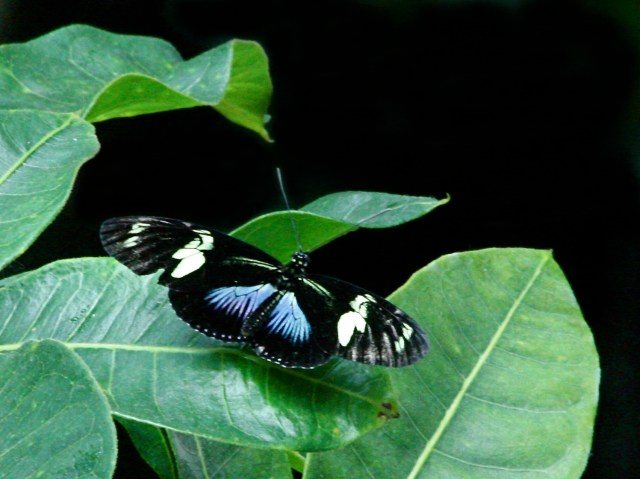
Genus/species: Heliconius doris

Blue morph

Doris Longwing (blue morph)  3267097210_300ac83016_o

GENERAL CHARACTERISTICS: Appears in several color morphs; hindwing markings may be red-orange, blue, or green. Two white markings on forewing.

Doris Longwing red morph Heliconius doris light sm text

DISTRIBUTION/HABITAT: Central America to northwestern Amazonia. Found from sea level to 1,800 m (5,900 feet) in forest clearings. Fly and feed mostly in the mid-story.

DIET IN THE WILD: Nectar and pollen.

Wing underside

Doris Longwing 4747129049_3c7123e657_b

PREDATORS: Eaten by birds.

REMARKS: Heliconians are unique. Unlike other butterflies, they not only sip nectar, but also use their proboscises to collect and absorb the protein from pollen. This amino acid-rich diet allows them to function and live longer than most other butterflies. Adults can live for up to 9 months.

flickr http://www.flickr.com/photos/cas_docents/sets/72157608449327886/

WordPress Shortlink   http://wp.me/p1DZ4b-13s

TAXONOMY
Kingdom: Animalia
Phylum: Arthropoda
Subphylum: Crustacea
Class: Malacostraca
Order: Decapoda
Family: Atyidae

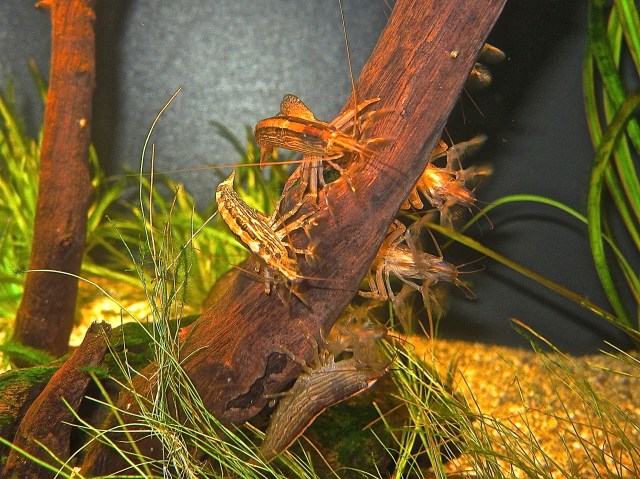
Genus/species: Atyopsis moluccensis

Bamboo Shrimp IMG_0285

GENERAL CHARACTERISTICS: Most species are a brown base color with a tan strip running from head to tail. They vary greatly in color however. Some a greenish-yellow or even red as the base color. Clawless and 4-5 inches in length. Male bamboo shrimp displays two larger forelegs, while the female’s legs are all the same size.

DISTRIBUTION/HABITAT: Found on high islands from Sri Lanka to the Samoan Islands, and as far north as Okinawa, as well as on the Asian mainland from the Malay Peninsula in freshwater areas where their is high current..

DIET IN THE WILD: Filter feeder. using four fan-like appendages on the head to sweep food particles from the water.

Bamboo Shrimp  8724380835_382a2b1ec6_o

Water Planet

WordPress Shortlink http://wp.me/p1DZ4b-XZ

flickr  http://www.flickr.com/photos/cas_docents/8717355179/in/set-72157608602469734

TAXONOMY
Phylum: Mollusca
Class: Cephalopoda
Order: Octopoda
Family: Octopodidae.

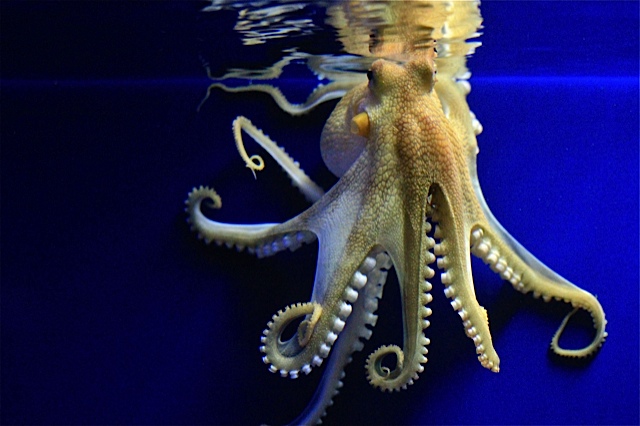
Genus/species: Amphioctopus marginatus


GENERAL CHARACTERISTICS
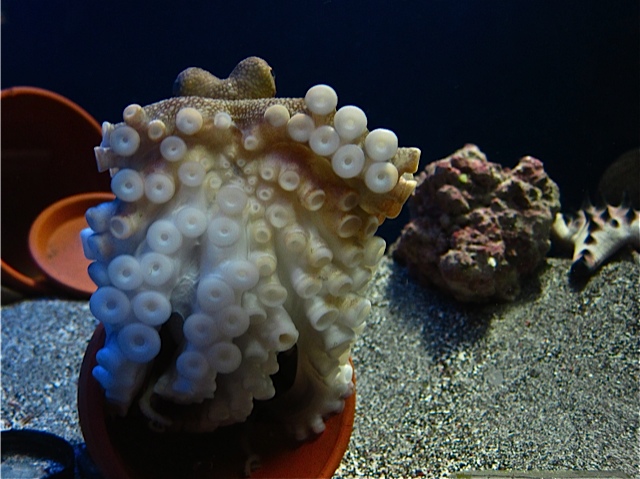
The main body (mantle) is small to medium-sized, 5–8 cm (15 cm [6 in] including arms) in length. The arms are usually dark with contrasting white suckers. They have only soft bodies with no internal skeleton with a hard parrot-like beak allowing them to hide in very small spaces.

DISTRIBUTION/HABITAT
The tropical western Pacific and coastal waters of the Indian Ocean on sandy bottoms.

DIET: Shrimp, crabs, and clams. A.marginatus uses its sharp parrot-like beak to crush the shells of its prey. Shells of prey that are difficult to pull or bite open can be “drilled” in order to gain access to the soft tissue: salivary secretions soften the shell, and a tiny hole is created with the radula (a rasp-like structure of tiny teeth used for scraping food particles off a surface). The octopus then secretes a toxin that paralyzes the prey and begins to dissolve it. The shell is pulled apart and the soft tissues are consumed.

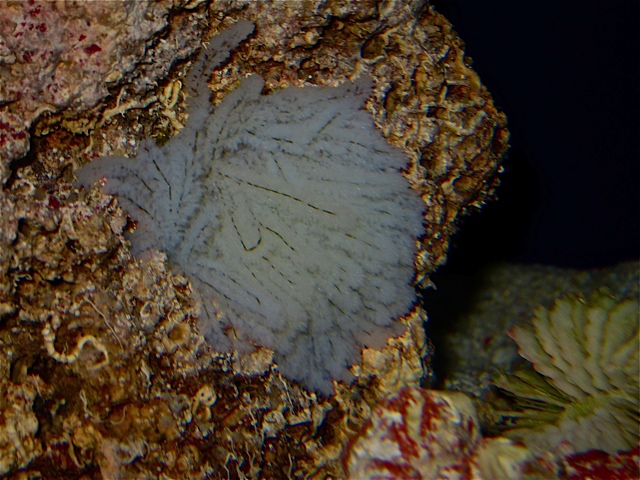
REPRODUCTION: Octopus reproduction strategy provides a counterpoint to the male sacrifice of the flower mantis and the bird-eater tarantula,  The coconut octopus female mates with the male, and retreats into a den where she lays her eggs. At this point, she no longer feeds, instead spending the rest of her now short life protecting her eggs from predators and continually cleaning and aerating them.  She dies shortly after the hatching of her eggs and their subsequent entry into the plankton.

Egg mass below

MORTALITY/LONGEVITY:  10–12 months

REMARKS: The species’ common name derives from this octopus’ habit of carrying around coconut shell halves, by fitting its body into the bowl and extending rigid arms from the coconut’s edge to the substrate and tiptoeing away in gait called “stilt-walking”  or bipedal walking.    

Below A. marginatus using a shell. 

IMG_0198

The Steinhart is the first public aquarium in the U.S. to display the coconut octopus.  Our octopus was collected by Bart Shepherd, Curator of the Steinhart Aquarium, during a 2011 research expedition to the Philippines.

flickr  http://www.flickr.com/photos/cas_docents/6776485376/in/set-72157608597736188

WORDPRESS SHORTLINK http://wp.me/p1DZ4b-pu


TAXONOMY
Kingdom: Animalia
Phylum: Mollusca
Class: Cephalopoda
Order: Octopoda
Family: Octopodidae

Genus/species: Octopus (No species name at the current time).

Note: octopus chierchiae is the lesser Pacific striped octopus and has been studied more extensively .

9830791415_f30b68b649_k-1

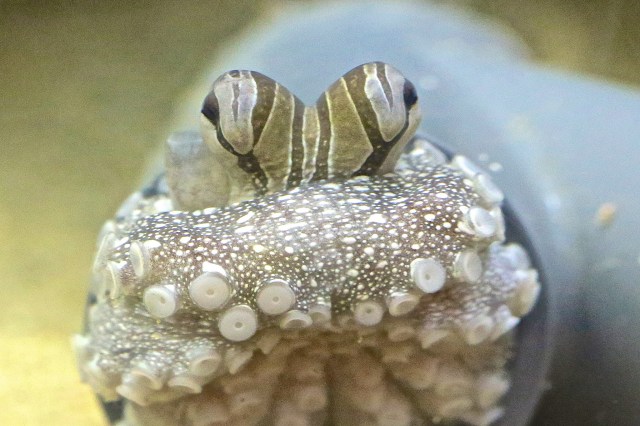
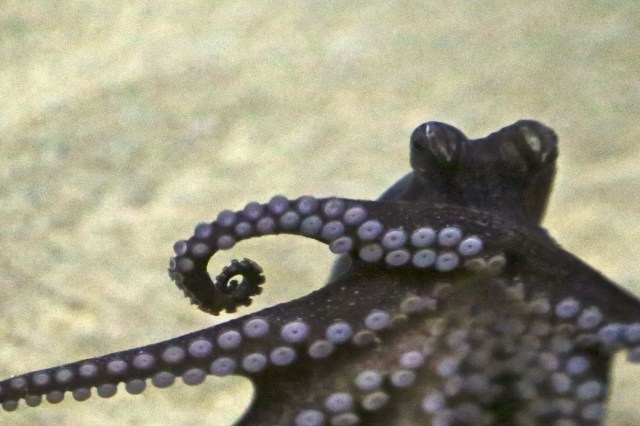
GENERAL CHARACTERISTICS: This pigmy octopus has arms spans of some eight to 10 inches, Color varies. It can switch from a dark reddish hue to black with white stripes and spots in fluid waves and also assume different shapes, both flat and expanded. Thought to live in groups of up to 40 or more individuals in the wild.

Larger Pacific Striped Octopus  8584026008_f1f86341db_o

DISTRIBUTION/HABITAT: Eastern Pacific off the coast of Central America. Found on sandy bottoms in intertidal areas.

DIET IN THE WILD: Shrimp, crabs and snails.Larger Pacific Striped Octopus IMG_6898

REPRODUCTION: Pairs of Larger Pacific Striped Octopuses live peacefully together in an aquarium, at times sharing a den. Mating is civil with a beak-to-beak, or sucker-to-sucker, position and their arms entwined for up to five minutes while the male inserts a sperm packet into the female. In contrast to other species which die after their first clutch of eggs this octopus lays many egg clutches in her lifetime.

REMARKS: Very rare, (Discovered 1991). Displayed only at the California Academy of Sciences.

Academy biologist Richard Ross, has spent the last 13 months raising and studying the behavior of this recently rediscovered species, along with Dr. Roy Caldwell of the University of California, Berkeley. They are currently studying the behavior of this species and working on a formal description and species name as well as are planning an expedition to observe them in their natural habitat in Nicaragua,

Reference:

California Academy of Sciences  http://www.calacademy.org/newsroom/releases/2013/rare_octopus.php

Ron’s WordPress Shortlink: http://wp.me/p1DZ4b-T5

Ron’s flickr http://www.flickr.com/photos/cas_docents/sets/72157608597736188/with/8562294939/

California Academy of Sciences  http://bit.ly/1pgpXLI

California Academy of Sciences    http://calacademy.org/explore-science/raising-rare-octopus

TAXONOMY
Phylum: Arthropoda
Class: Arachnida
Order: Araneae
Family: Theraphosidae

Genus/species: Lasiodora parahybana

8274421702_51193cf844_b

GENERAL CHARACTERISTICS: Said to be the third largest spider in the world, this is a large-bodied tarantula with abdomen and legs covered with sensitive, long, and partially pink or salmon-colored hairs. Maximum size: body, 9-10 cm (3.5–4 in); leg span, 20-25 cm (8–10 in).

DISTRIBUTION/ HABITAT: Throughout northeastern Brazil on the tropical forest floor

DIET IN THE WILD: Lie and wait carnivore, eating large crawling insects and other invertebrates, small rodents, lizards, and frogs rarely seen eating birds like newly hatched chicks of ground-dwelling birds. Venom injected by chelicerae that liquefy the kill, which is then sucked in by the mouthparts.
Regardless of its name, the spider is rarely seen eating birds.

6962229601_2e288eea4a_b

REPRODUCTION: The male spins a small area of silk onto which he deposits his sperm. The sperm is then absorbed into the pedipalps, which during mating are inserted into the genital opening of the female, transferring the sperm, which remains viable. After insemination, the male makes a swift retreat as the much smaller males occasionally become a sacrifice to the female’s need to maintain the nutritional viability of a mother-to-be. The female lays up to 2000 fertilized eggs in a thick, silken sac which she guards fiercely. Young spiderlings are born about 3 weeks later. Voracious feeders, they grow quickly.

PREDATORS: Tarantulas have few enemies except the tarantula hawk wasps. Members of this wasp family use their sting to paralyze species specific tarantulas.

REMARKS: Like most tarantulas and some other spiders, if this spider loses one of its legs, it can regrow the lost appendage.
While not highly aggressive and bites are not fatal to humans (most tarantula bites are similar to a bee sting in toxicity), this big bruiser, because of its long fangs, can inflict a serious wound which one researcher defined as “capable of medically significant mechanical damage”! If pursued by a potential foe, the spider rubs its legs against its abdomen, throwing tiny, barbed hairs that become imbedded in the attacker. The barbs can cause significant irritation, especially if lodged in the eyes or nasal passages.
Venomous

Animal Attractions

flickr http://www.flickr.com/photos/cas_docents/sets/72157608653175263/with/6962229601/

WordPress Shortlink  http://wp.me/p1DZ4b-Qk