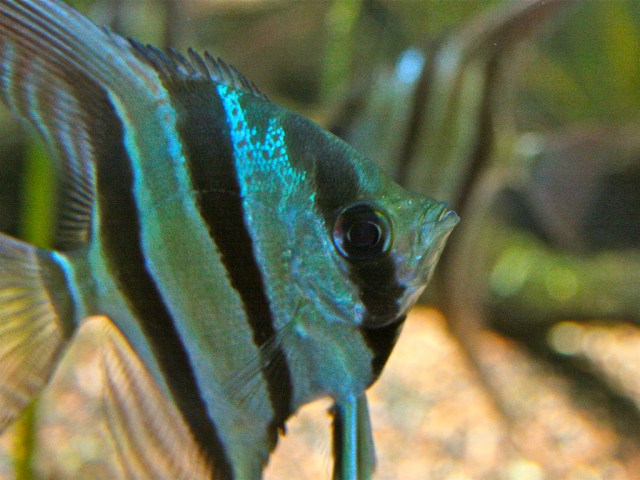
Category: FRESH WATER FISHES


TAXONOMY
Kingdom: Animalia
Phylum: Chordata
Class: Actinopterygii (ray-finned fishes)
Order: Cypriniformes (Carps)
Family: Cyprinidae (Minnows or carps) 

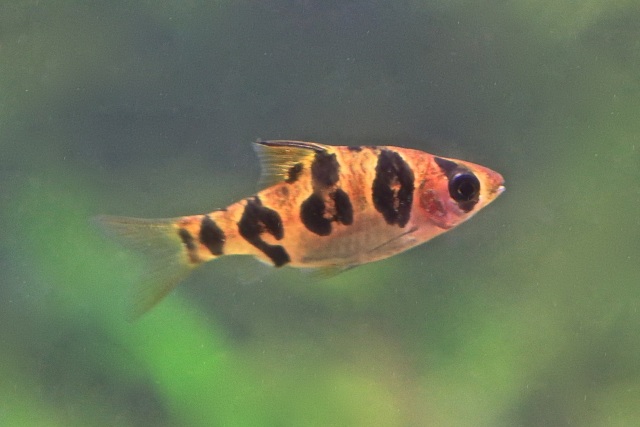
Genus/species: Systomus rhomboocellatus

Snakeskin Barb IMG_7888

GENERAL CHARACTERISTICS: Diamond-shaped markings on their body, giving them a snake-skin appearance. Length 5-8 cm (2-3 inches).

DISTRIBUTION/HABITAT: West and Central Kalimantan in Borneo, Indonesia in black water streams in forested areas.

DIET IN THE WILD: Omnivorous; eats insects and worms.

REPRODUCTION: Egg scatter within areas of dense plant growth.

CONSERVATION: IUCN and CITES Not Evaluated

References

fishbase www.fishbase.org/summary/Puntius-rhomboocellatus.html

 Encyclopedia of Life eol.org/pages/224467/details

Ron’s flickr http://www.flickr.com/photos/cas_docents/sets/72157608614099673/

Ron’s WordPress Shortlink http://wp.me/p1DZ4b-16F

TAXONOMY
Kingdom: Animalia
Phylum: Chordata
Class: Actinopterygii (ray-finned fishes)
Order: Perciformes (Perch-likes)
Suborder: Anabantoidei, (accessory breathing organ known as the labyrinth organ).
Family: Osphronemidae (Gouramies)

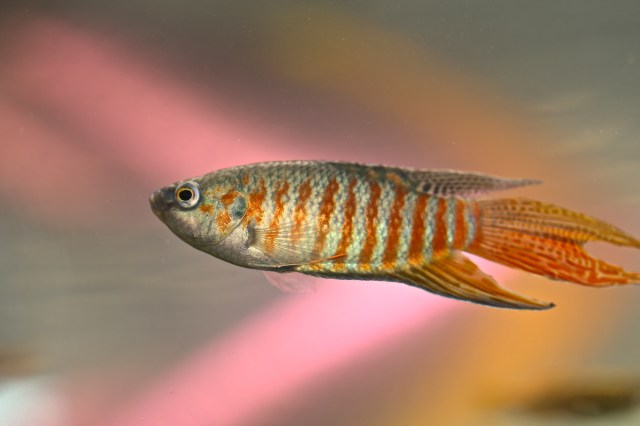
Genus/Species: Macropodus opercularis

Paradisefish IMG_7999

GENERAL CHARACTERISTICS: Common length : 5.5 cm (2 inches). Can reach 10 cm (4 inches). Conspicuous dark brown opercular spot with whitish posterior margin (margin red in life); body with 7-11 bold, dark bars on a light background. Caudal fin forked, both lobes elongate with filamentous extension in each lobe

DISTRIBUTION/HABITAT: Native to East Asia from Korea to Northern Viet Nam. Introduced elsewhere. Air breather preferring, slow-moving or still habitats, ranging from irrigation ditches, rice paddies, streams and stagnant ponds to marshes and the backwaters of major rivers.

DIET IN THE WILD: Omnivore consuming planktonic invertebrates and smaller fish. 

REPRODUCTION: The males build bubble nests . After courtship, the male wraps himself around the female in a nuptial embrace during which he fertilizes eggs released by the female. He then gathers up the eggs in his mouth and blows them into the nest. . The male then tends the eggs until they hatch about 36 hours later.

CONSERVATION: IUCN Red List; Least concern.  M. opercularis has a large distribution area and there are no known widespread threats to this species.

REMARKS: Used as predators of mosquito larvae and to control Dengue Fever.

These fish are thought to be one of the first fish introduced to Europe as an ornamental fish, in the mid 1800s.

Males must be kept separate from each other in tanks to prevent fighting,

Rainforest Borneo BO09

References

fishbase  http://www.fishbase.org/summary/Macropodus-opercularis.html

Encyclopedia of Life   http://eol.org/pages/203995/details

Ron’s flickr http://www.flickr.com/photos/cas_docents/sets/72157627795872023/

Ron’s WordPress shortlink http://wp.me/p1DZ4b-17z

TAXONOMY

Kingdom: Animalia
Phylum: Chordata
Class: Actinopterygii (ray-finned fishes)
Order: Perciformes (Perch-likes)
Family: Osphronemidae (Gouramies)

Genus/species: Trichogaster trichopterus
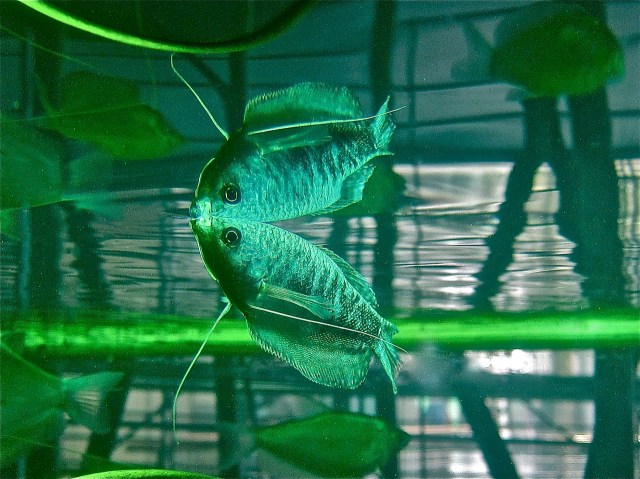

GENERAL CHARACTERISTICS: Usually silvery blue in color but their colors can change significantly with their moods, as well as during spawning, when they obtain a much deeper blue hue.The three-spot gourami displays only two spots, one in the center of the body and a second on the caudal peduncle. The eye is actually the third “spot”. T. trichopterus has many different colour forms and varieties, all of which have been selectively bred for the aquarium trade. These are seen much more often than the natural form, which is the blue-grey three spotted fish. They include gold, opaline, cosby, marbled and silver forms. Length to 15 cm (6 inches).

DISTRIBUTION/HABITAT: Southeast Asia: Mekong River basin in Laos, Yunnan, Thailand, Cambodia, and Viet Nam. Preference is thickly vegetated fresh water in ditches, canals, ponds, swamps, rivers or lakes.

DIET IN THE WILD: Omnivore. Eats insects, crustaceans, and zooplankton.

REPRODUCTION and DEVELOPMENT: Typical of gouramis, male builds bubble nest, usually under a large leaf, after which he displays to female. Their courtship ends with her releasing eggs, which the male fertilizes and then collects in his mouth and “spits” into the bubble nest, where he guards them until they hatch in 2–3 days.

CONSERVATION: IUCN Red List; Least Concern (LC) Abundant to common in suitable habitats throughout its range.

REMARKS: Like all labyrinth fish, the moonlight gourami has a special lung-like organ that allows it to breathe air directly from above the water line. This allows gouramis to survive in pools with a low oxygen.

Processed into salted, dried fish in Java.
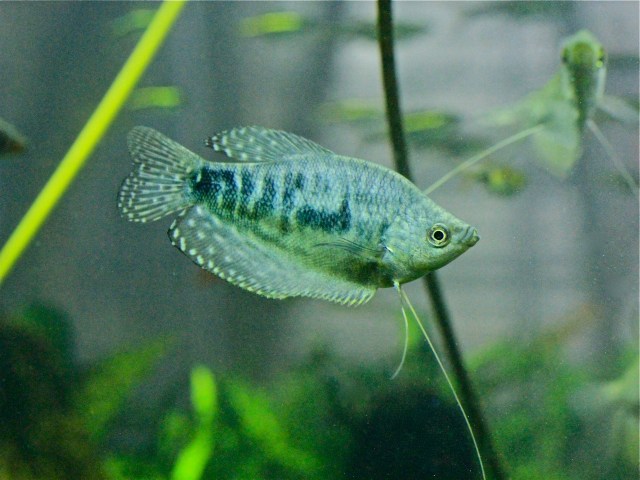
LOCATION: BO09 Rainforest Borneo, Southeast Asia Community 

References

fishbase  www.fishbase.org/summary/Trichopodus-trichopterus.html

Encyclopedia of Life  eol.org/pages/222297/details

Ron’s flickr  http://www.flickr.com/photos/cas_docents/6287701586/in/set-72157627795872023

Ron’s WordPress shortlink  http://wp.me/p1DZ4b-dJ
TAXONOMY
Kingdom: Animalia
Phylum: Chordata
Class: Actinoptergii
Order: Pecifomes
Family: Osphronemidae (Gouramis)

Genus/species: Trichogaster microlepis

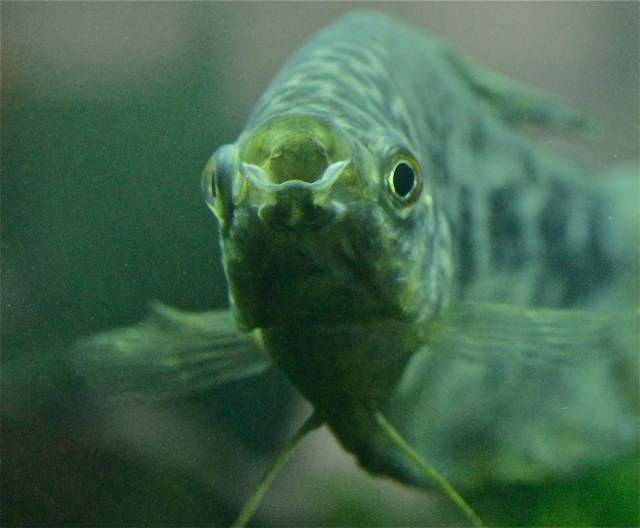
GENERAL CHARACTERISTICS: It has a greenish hue similar to moonlight glow, hence its name, and a distinctive concave head. Males can be identified by the orange to red color of the pelvic fins and the long, pointed dorsal fins. The female’s pelvic fins are colorless to yellow, while the dorsal fins are shorter and rounder. Length: 12–15 cm  (4.66 – 6 inches)

DISTRIBUTION/HABITAT: Thailand and Cambodia. Found in ponds, lakes and swamps with shallow, sluggish or standing water and abundant vegetation.

DIET IN THE WILD: Omnivorous. Eats insects, crustaceans, and zooplankton.

REPRODUCTION: Oviparous; a bubble nest builder. The bubble nest does not contain much plant matter so the bubbles float around freely. The male performs a courtship dance beneath the nest, culminating with the male wrapping itself around the female and turning her on her back as she releases her eggs. Up to 2000 eggs may be laid during the spawning. The male fertilizes the eggs as they float up to the prepared bubble nest. Eggs incubate in the nest for 2–3 days before hatching.

CONSERVATION: IUCN: Least Concern (LC)  No major threats to this species have been reported, however, pollution in wetlands, infrastructure and draining water may impact the species.

REMARKS: Like all labyrinth fish, T. microlepis has a special lung-like organ that allows it to breathe air directly from above the water line. This allows gouramis to survive in pools with a low oxygen.

LOCATION: BO09 Rainforest Borneo, Southeast Asia Community 

References 

fishbase www.fishbase.org/summary/4729

 Encyclopedia of Life  eol.org/pages/203969/details

flickr http://www.flickr.com/photos/cas_docents/sets/72157627795872023/

WordPress shortlink   http://wp.me/p1DZ4b-dB


TAXONOMY:
Kingdom: Animalia
Phylum: Chordata
Class: Actinopterygii
Order: Cypriniformes
Family: Cyprinidae (Minnows or Carps)

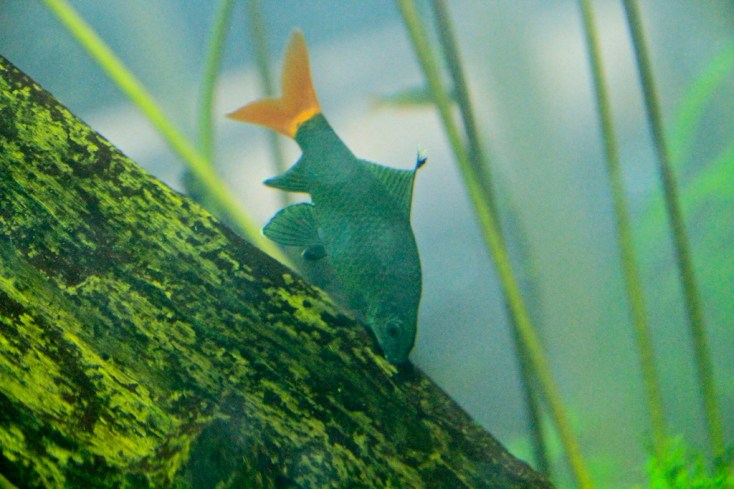
Genus/species: Epalzeorhynchos bicolor

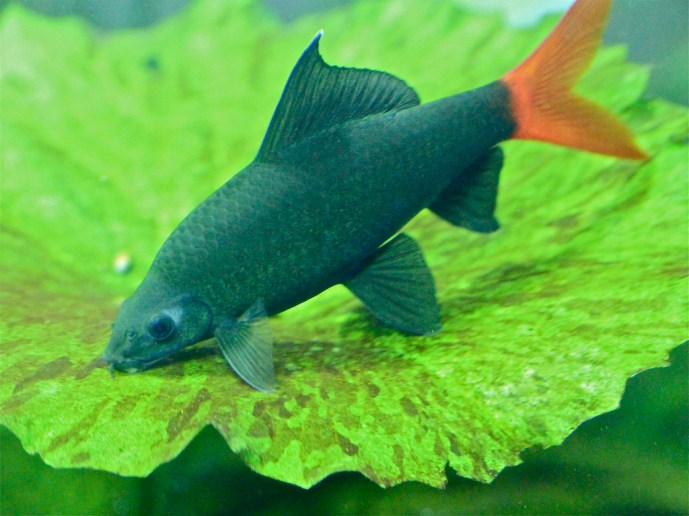
Redtail Black Shark Minnow 4472041343_d9431913da_b

GENERAL CHARACTERISTICS: Deep velvet-black body and bright red caudal fin. Two fleshy projections (barbels) extend from the edges of the mouth Max. length: 15 cm (6 inches).

DISTRIBUTION/HABITAT: Originally from the Mae Klong River in Thailand. Found in the middle and bottom levels of freshwater streams and rivers, especially areas with rocks and/or plants for resting and hiding.

Redtail Black Shark Minnow  5170275837_91ba6445e9_b

DIET IN THE WILD: Omnivorous, primarily a bottom-feeding scavenger.

REPRODUCTION: E. bicolor spawns in rocky caves, and the young hatch after 30 to 60 hours. Four days after hatching, the young are free-swimming, but do not develop the characteristic red tail until seven to ten weeks old.

CONSERVATION: IUCN: Critically Endangered (CR)
Habitat alteration; during the 1970s contributed to its decline. Captive bred in Thailand for aquarium export trade.

LONGEVITY: 5-8 years.

REMARKS: In spite of its common name, most likely a reference to its streamlined, torpedo shape, it is not a shark. Related to carp.

Location: Borneo

References

fishbase www.fishbase.org/summary/Epalzeorhynchos-bicolor.html

Encyclopedia of life  eol.org/pages/1015624/details

 ARKIVE  http://www.arkive.org/redtailed-black-shark/epalzeorhynchos-bicolor/

Ron’s flickr  http://www.flickr.com/photos/cas_docents/sets/72157608614099673/

Ron’s WordPress shortlink  http://wp.me/p1DZ4b-16X

TAXONOMY
Kingdom: Animalia
Phylum: Chordata
Class: Actinopterygii (ray-finned fishes)
Order: Characiformes (Characins)
Family: Serrasalmidae

Genus/species: Metynnis hypsauchen

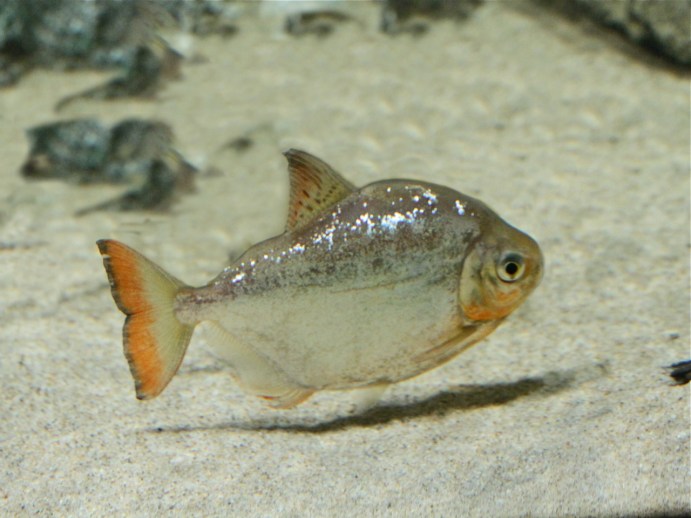
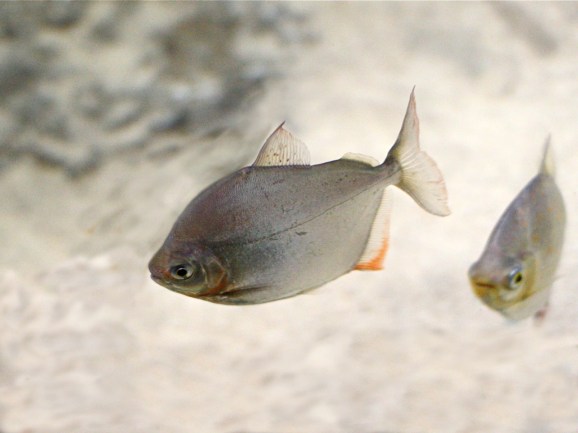
GENERAL CHARACTERISTICS: Almost circular in profile; juveniles may be spotted or striped; adults solidly silver with anal and caudal fins edged in red or orange. Length : 15.0 cm (6 inches).

DISTRIBUTION/HABITAT: Tropical South America primarily Amazon and Orinoco basins. Found in calm river reaches overhung by foliage.

DIET IN THE WILD: Generally herbivorous, eating leaves of river plants; occasionally eats worms and small insects.

REPRODUCTION: Group spawners. Eggs hatch in 3 days.

CONSERVATION: IUCN Red List, CITIES, Not Evaluated

REMARKS: A schooling species related to piranhas.
Possesses powerful dentition that can cause serious bites.

Amazon Flooded Tunnel AM11

References

Ron’s flickr  https://www.flickr.com/photos/cas_docents/6343628168/in/set-72157620568438047/

fishbase  fishbase.org/summary/Metynnis-hypsauchen.html

Encyclopedia of Life  eol.org/pages/217649/details

Ron’sWordpress shortlink  http://wp.me/p1DZ4b-cl


TAXONOMY
Kingdom: Animalia
Phylum:Chordata
Class: Actinopterygii (ray-finned fishes)
Order: Characiformes (Characins)
Family: Gasteropelecidae (Freshwater hatchetfishes)

Genus/species: Carnegiella strigata

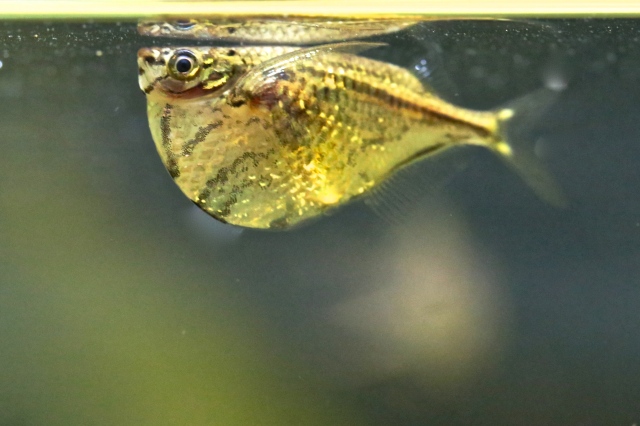
More Marbeled Hatchetfish  IMG_7957

GENERAL CHARACTERISTICS: Hatchet shaped. A gold line extends from its eye to its caudal fin while the area below has a brown and cream-colored marble-like pattern. Length, 3.5 cm (1.4 in).

DISTRIBUTION/HABITAT: South America rivers in blackwater environments generally in areas with a lot of surface vegetation.

DIET IN THE WILD:  Their mouth situated up on top of their body to eat surface crustaceans and insects. 

REPRODUCTION: The female deposits eggs on plants and roots.  Fry will hatch after 30 hours and become free swimming in 5 days.  

LIFESPAN: 2-5 years.

CONSERVATION: IUCN Red List; Not evaluated.

REMARKS: Amazonian rivers as they resemble a dead leaf floating sideways on the surface of a body of water.

Capable of propelled jumps above the water surface by beating their pectoral fins to escape predatory threats.

References

Ron’s WordPress shortlink  http://wp.me/p1DZ4b-17P

Ron’s flickr  http://www.flickr.com/photos/cas_docents/sets/72157608614099673/

fishbase  www.fishbase.org/summary/speciessummary.php?id=10736


TAXONOMY
Kingdom:Animalia
Phylum: Chordata
Class: Actinopterygii (ray-finned fishes)
Order: Cypriniformes ( carps, minnows, loaches and relatives)
Family: Balitoridae (hillstream river loaches)

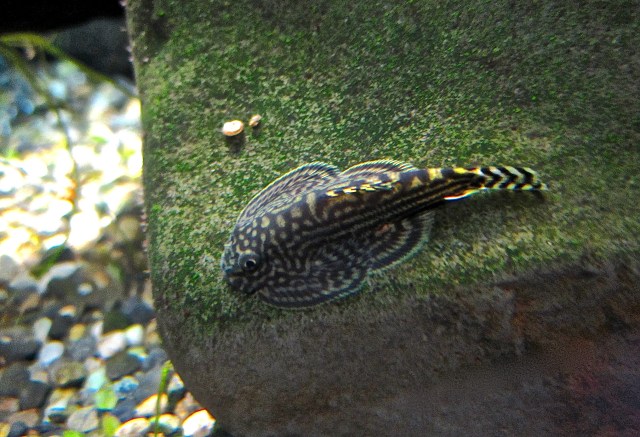
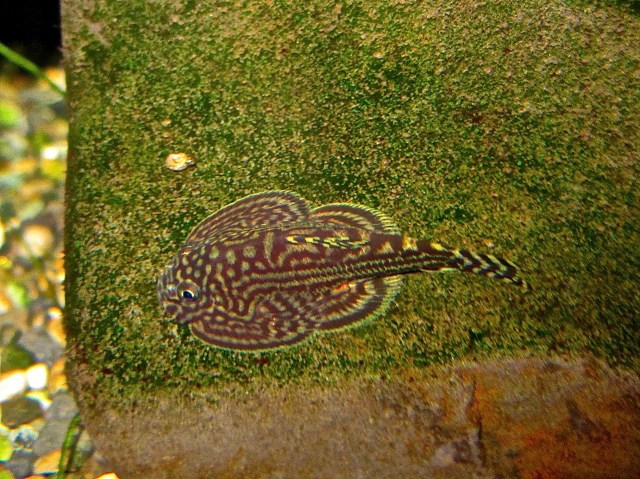
Genus/species: Sewellia lineolata

Hillstream Loach  IMG_0740

GENERAL CHARACTERISTICS: Sewellia spp. are perhaps the most dominant of the ‘sucker belly’ group of loaches. Sides of body with 3-5 bold longitudinal stripes. Pectoral fin with bold submarginal stripe, otherwise with reticulated marks. Pelvic fin with 3 bold stripes. Females plumper than males. Males have raised areas like small “fences” on first few rays of pectoral fins, and when viewed from above are noticeably “squarer” in the area of the front leading edge of the pectoral fins. Maximum size: 2.5 inches

DISTRIBUTION/HABITAT: China, Viet Nam, Cambodia. Known from the Mekong basin. Found in shallow, fast-flowing rivers, highly oxygenated headwaters and tributaries with substrates of composed of bedrock, sand and gravel.

Hillstream Loach  IMG_0739

DIET: Algae plus associated micro-organisms although insect larvae are probably taken on an opportunistic basis.

CONSERVATION: IUCN; V.ulnerable (VU)

REMARKS: Paired fins are orientated horizontally, head and body flattened and the last two pelvic-fin rays combine with a fleshy flap on the base of the fin to form a ‘pelvic valve’ forming a powerful sucking cup which allowing the fish to cling tightly to solid surfaces in rapid moving streams.

Waterplanet, senses cluster
11-25-13

flickr http://www.flickr.com/photos/cas_docents/sets/72157625017923579/

WordPress Shortlink http://wp.me/p1DZ4b-1aa

Ref: fish base, EOL, Seriously Fish.

TAXONOMY
Kingdom: Animalia
Phylum: Chordata
Class: Actinopterygii (ray-finned fishes)
Order: Characiformes (Characins)
Family: Lebiasinidae (Pencilfishes)

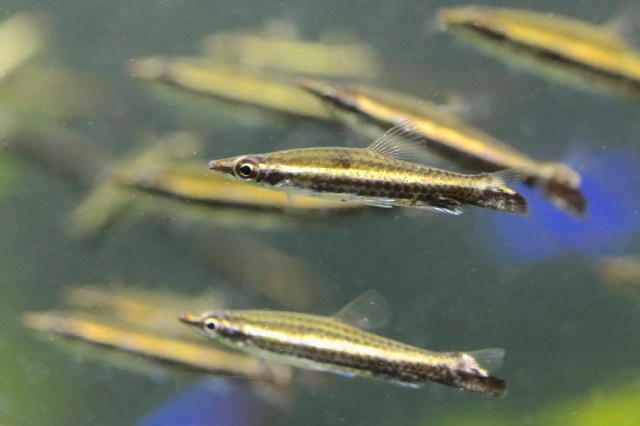
Genus/species: Nannostomus eques

Diptail Pencilfish aka Brown Pencilfish 10286393965_fe0600ac47_b

GENERAL CHARACTERISTICS: Small elongate fish with a brown lateral stripe extending from snout to caudal-fin base. Above the dark brown stripe a silver-grey stripe. A dark brown spot on each body scale except those forming part of the silver stripe. . Latin, nannus = small + Greek, stoma = mouth. Adult males have an enlarged anal fin. Max Length 5 cm

DISTRIBUTION/HABITAT: South America: central and upper Amazon. Found in sluggish tributaries, small rivers, and swampy zones, ofter where vegetation grows densely with submerged woody structures and leaf litter.

DIET IN THE WILD: Micropredator feeding on worms, crustaceans, insects and zooplankton.

REPRODUCTION: Oviparous.

REMARKS: Has an interesting oblique swimming-style.

Flooded Amazon, Cardinal tetra exhibit

flickr  http://www.flickr.com/photos/cas_docents/10286393965/in/set-72157625825649576/

WordPress shortlink  http://wp.me/p1DZ4b-18A

Ref. Fishbase, Seriouslyfish.com

TAXONOMY 
Kingdom: Animalia
Phylum: Chordata
Class: Actinopterygii (ray-finned fishes)
Order: Perciformes (Perch-likes)
Family: Cichlidae (Cichlids)
Subfamily: Cichlasomatinae

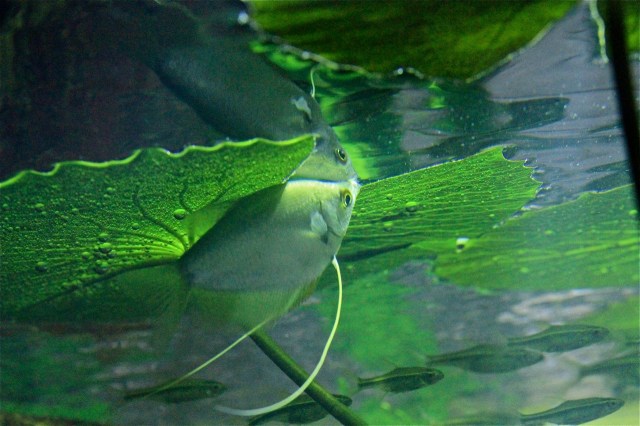
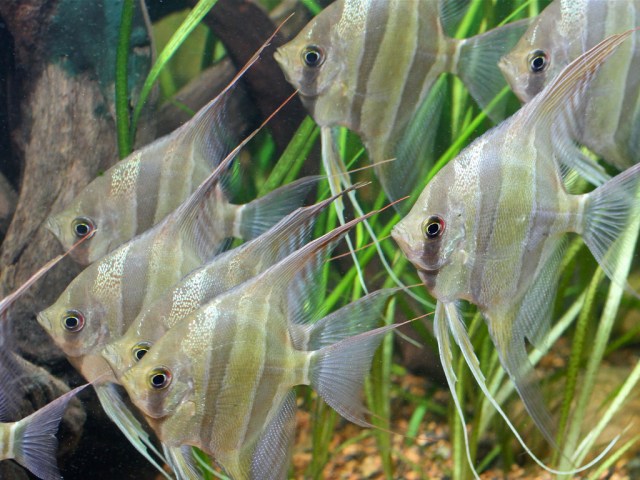
Genus/species: Pterophyllum altum

Altum Angelfish 4689972848_189e460e8f_b

GENERAL CHARACTERISTICS: Extremely compressed silvery body with two broad dark vertical bands. Remarkably long trailing pelvic fins. Altum refers to the dramatic height of their dorsal and anal fins. Length to 18 cm (7 inches). Max height 20 cm (7.87 inches). Orbital indentation differentiates from Pterophyllum scalare.

DISTRIBUTION/HABITAT: South America: Amazon basin, in the upper Rio Negro drainage; Orinoco River basin.

DIET IN THE WILD: Carnivore

REPRODUCTION and DEVELOPMENT: External fertilization. Monogamous; pairs persist until partner dies or is separated. Clutch-tending guarders.

Altum Angelfish 3787890518_a572b4929f_b

MORTALITY/LONGEVITY: Preyed upon by other fishes. Subject to bacterial diseases and protozoan, fungal and worm infestations.

CONSERVATION: IUCN: Not evaluated.

Flooded Amazon AM05

Ref. fishbase, EOL

flickr http://www.flickr.com/photos/cas_docents/4689972848/in/set-72157608376694453/

WordPress shortlink http://wp.me/p1DZ4b-18q