Category: FLOODED AMAZON


TAXONOMY
Kingdom: Animalia
Phylum: Chordata
Class: Actinopterygii (Ray-finned fishes)
Order: Siluriformes (Catfishes)
Family: Doradidae (Thorny catfishes)

Genus/species: Oxydoras niger

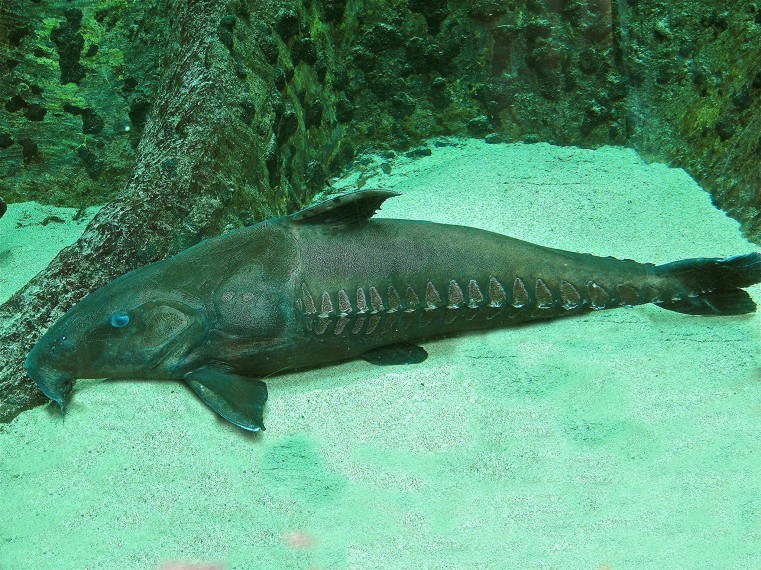
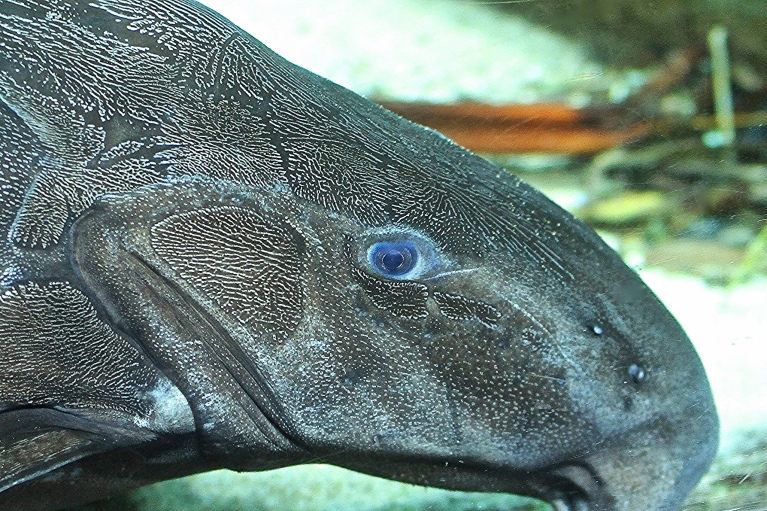
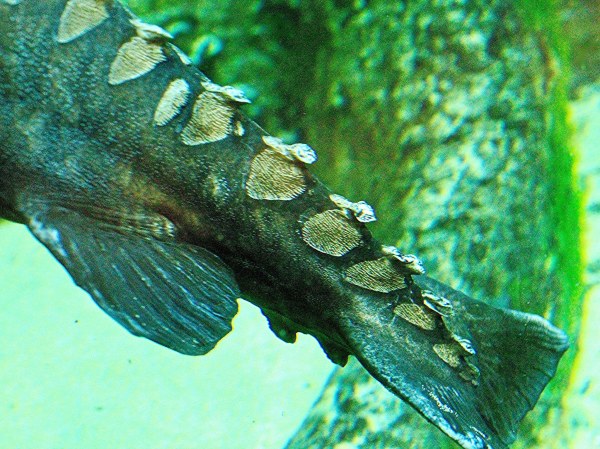
GENERAL CHARACTERISTICS:  A stocky brown catfish with three pairs of barbels.  Like all members of their family, have bony plates that protect the head and hook-like scutes that run along the lateral line. The Scutes on the O. niger are sharp and can cause significant lacerations.

Length up to 1 m (3.3 ft) in length and weigh up to 14 kg (30 lbs)

DISTRIBUTION/ HABITAT: South America: Amazon and possibly Orinoco River basins. Occur over mud in streams and lakes.
DIET IN THE WILD: The Ripsaw Catfishes large mouth creates a suction to vacuum up detritus, insect larvae, crustaceans, and plant material. When the forest is flooded, they feed exclusively on seeds and fruit.
REPRODUCTION: Sexes separate. Fertilization is external. Adults are non-guarders.

CONSERVATION: IUCN AND CITES: No special status.

REMARKS: Members of the family Doradidae are known as “talking catfishes” as they make a strange, creaking noise when removed from the water., a sound produced by movement of the pectoral spine within its socket and amplified by the swim bladder.
References

California Academy of Sciences Steinhart Aquarium Amazon Flooded Tunnel 2018

Animal Diversity Web ADW animaldiversity.ummz.umich.edu/accounts/Oxydoras_niger/

 fishbase www.fishbase.org/summary/Oxydoras-niger.html

 Ron’s flickr https://www.flickr.com/photos/cas_docents/6181844571/in/set-72157620568438047/

Ron’s WordPress Shortlink  http://wp.me/p1DZ4b-96


TAXONOMY
Kingdom: Animalia
Phylum: Chordata
Class: Actinopterygii (ray-finned fishes)
Order: Osteoglossiformes (Bony tongues)
Family: Arapaimidae (Bonytongues)

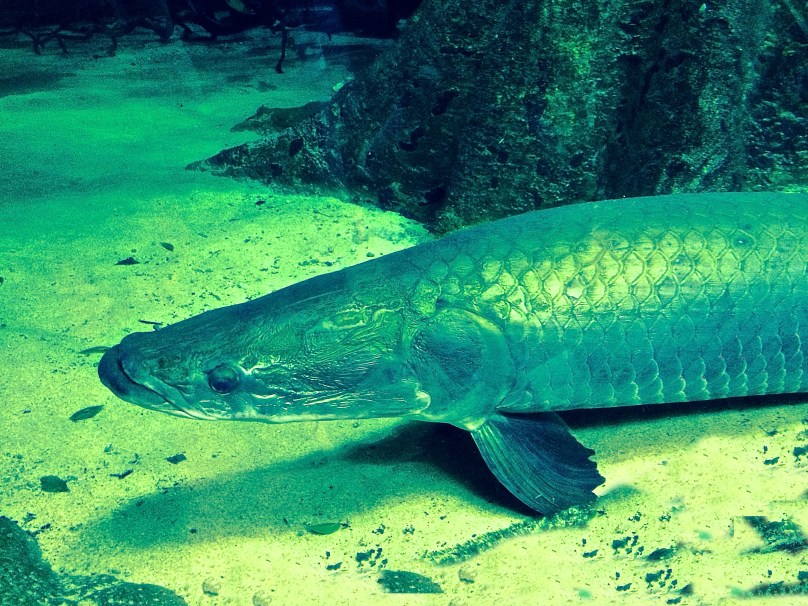
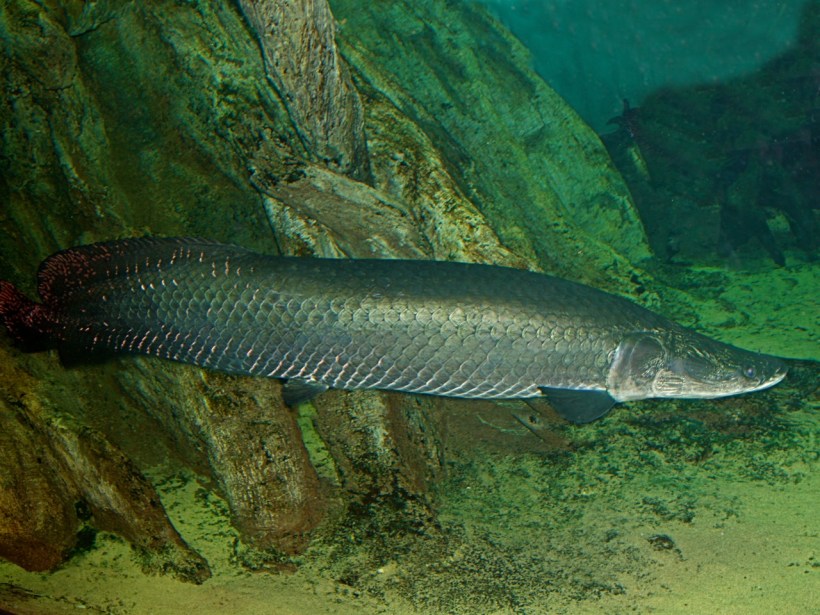
Genus/species: Arapaima gigas

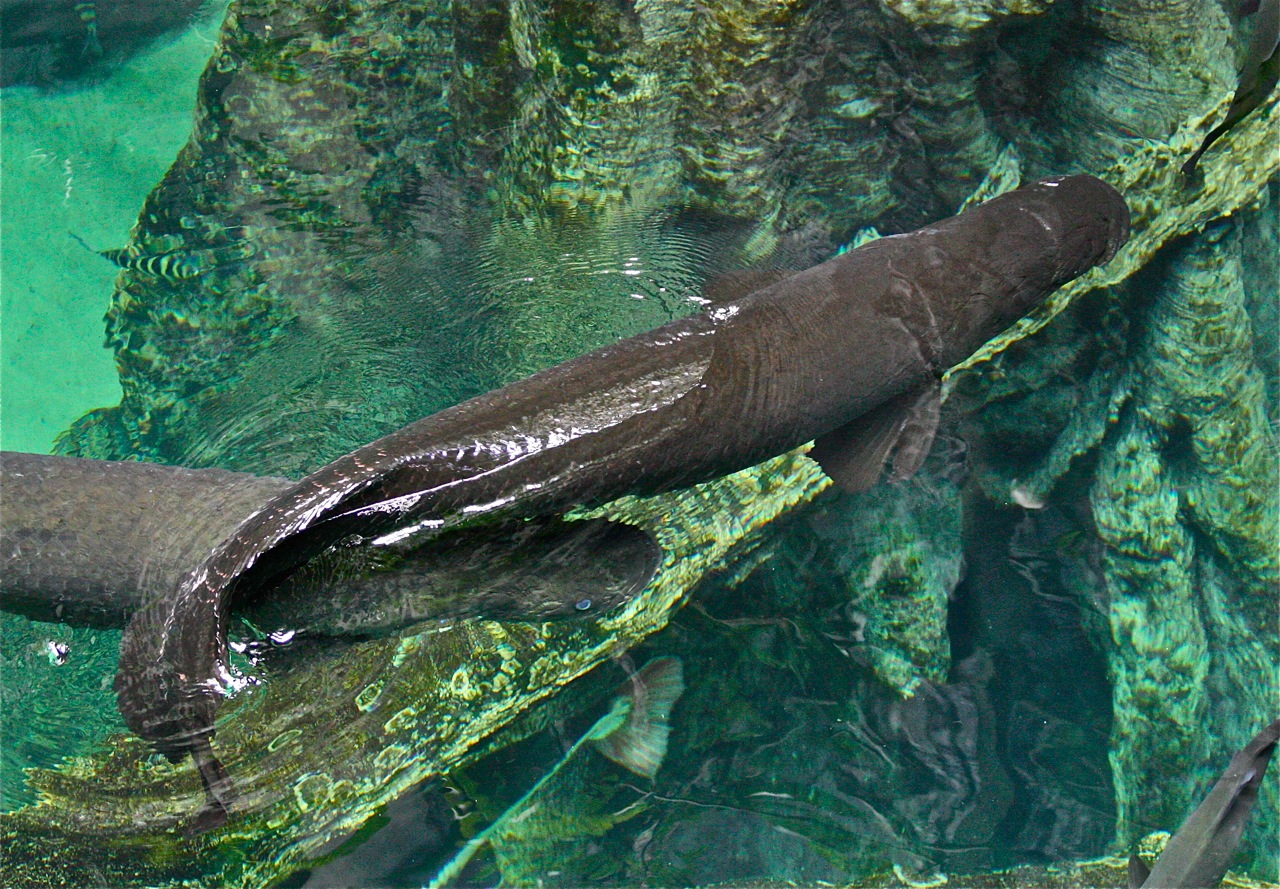
GENERAL CHARACTERISTICS: Usually grey to green in color with red flecks on the scales towards the tail and reddish-orange color of the filleted flesh. They are heavy with an elongated body with very large scales. There are also two symmetrical fins on either side of the body at the posterior end. The arapaima has a tongue with sharp, bony teeth that together with teeth on the roof of its palate are involved in disabling and shredding prey

It is one of the largest freshwater fishes in the world (length up to 450cm (14 feet in the 1800’s) Common length 200 cm (6.75 feet). Weight up to 133 kg. (292 lbs) In the 1800s specimens to 200 kg (440 lbs) were reported. 

DISTRIBUTION/HABITAT: Tropical. Amazon River and its tributaries in freshwater flooded areas dense with aquatic vegetation and shore plants. Much of the water that comprises the pirarucu’s habitat is also oxygen deficient, as it is located in swampy areas of the rainforest.

DIET IN THE WILD: Specialized for surface feeding with their up turned mouths. Adults prey on fish at the surface; suck smaller fish into the mouth, then crush pre against the roof of its mouth using its tooth-covered bony tongue. Like its close relative the arawana, it can leap from the water to snatch a bird or even a monkey from an overhanging branch.

ArapaimaGigasIMG_2727

REPRODUCTION: Sexually mature at the age of five years old. Builds a nest of about 15 cm (6 inches) depth and 50 cm (20 inches) width in sandy bottoms. Guards the eggs and the young. Adults have the ability to exude a pheromone from their head to attract offspring and keep them in close proximity.

MORTALITY and LONGEVITY: Preyed upon by humans. Life spans of 15 to 20 years in captivity .

CONSERVATION: IUCV Red List Data deficient. CITES Appendix II. Heavily exploited as a commercial fish throughout the Amazon. Populations have been greatly reduced during the past 200 years Commercial fishing of arapaima was banned in Brazil outside of a limited number of sustainable reserves, but illegal fishing still continues.

REMARKS: Indigenous people utilize the scales and bones. The bony or toothed tongue was once used as a seed grater to make drink powders. Its scales were used as scrappers.

In addition to gills, it has a modified and enlarged swim bladder, composed of lung-like tissue, which enables it to extract oxygen from the air. It is an obligate air breather, well adapted to oxygen-deficient waters gulping air every 10–15 minutes when oxygen levels are low.

Often referred to as the largest freshwater fish; some freshwater catfishes and sturgeon may challenge this “record.”

References

California Academy of Sciences Steinhart Aquarium Amazon Flooded Tunnel, 2018

Ron’s WordPress shortlink  wp.me/p1DZ4b-a7

Ron’s flickr   https://www.flickr.com/photos/cas_docents/3258200203/in/album-72157620568438047/

 fishbase  www.fishbase.org/summary/Arapaima-gigas.html

Arkive www.arkive.org/arapaima/arapaima-gigas/

 U. of Michigan Animal Diversity Web  animaldiversity.ummz.umich.edu/accounts/Arapaima_gigas/

National Geographic. www.nationalgeographic.com/environment/freshwater/arapaima/

 Encyclopedia of Life  eol.org/pages/204868/details


TAXONOMY
Kingdom: Animalia
Phylum: Chordata
Class: Actinopterygii
Order: Perciformes
Family: Cichlidae

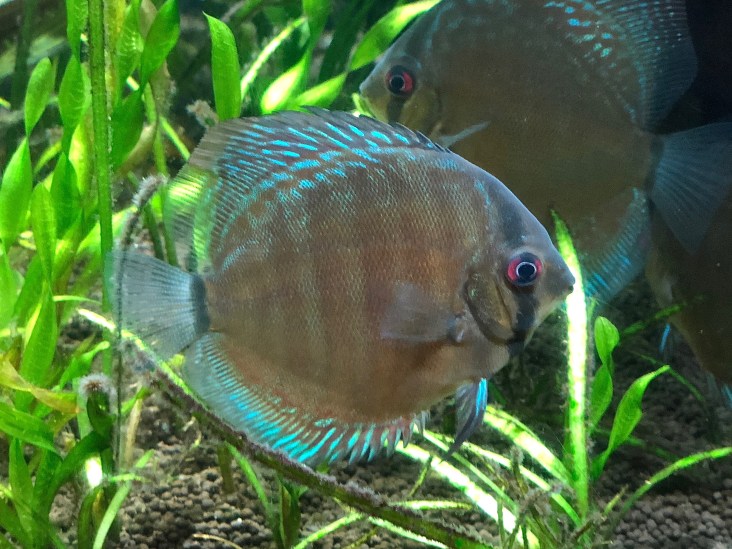
Genus: Symphysodon aequifasciatus

GENERAL CHARACTERISTICS: Color varies as they age. They present a dark brownish to green body. They have nine vertical bars along the body, but lack a bold centrally located bar. They have irregular metallic streaks along the belly, dorsal fin, anal fins, and on the dorsal area of the body of green, blue, or turquoise.

Length up to 5 inches (13.7 cm)

DISTRIBUTION/ HABITAT: Blue Discus are found in freshwater in the South America eastern Amazon River basin in Brazil In deep, rocky areas in crevices and among roots. Normally in schools.

DIET IN THE WILD: They feed on insect larvae, insects, and planktonic invertebrates.

REPRODUCTION: S. aequifasciatus eggs are deposited on stones or plants; both parents defend eggs and larvae; larvae feed on a skin mucus during their first few days.

CONSERVATION: IUCN Not Evaluated

References

California Academy of Sciences Steinhart Aquarium, Flooded Amazon 2018 (Vetted C Delbeek)

Ron’s Flickr  https://www.flickr.com/photos/cas_docents/27863424969/in/dateposted-public/

fishbase www.fishbase.org/summary/Symphysodon-aequifasciatus.html

Animal Diversity Web. animaldiversity.org/accounts/Symphysodon_aequifasciatus/c…

Ron’s WordPress Shortlink wp.me/p1DZ4b-1TF


TAXONOMY
Kingdom: Animalia
Phylum: Chordata
Class: Actinopterygii (ray-finned fishes)
Order: Characiformes (Characins)
Family: Serrasalmidae

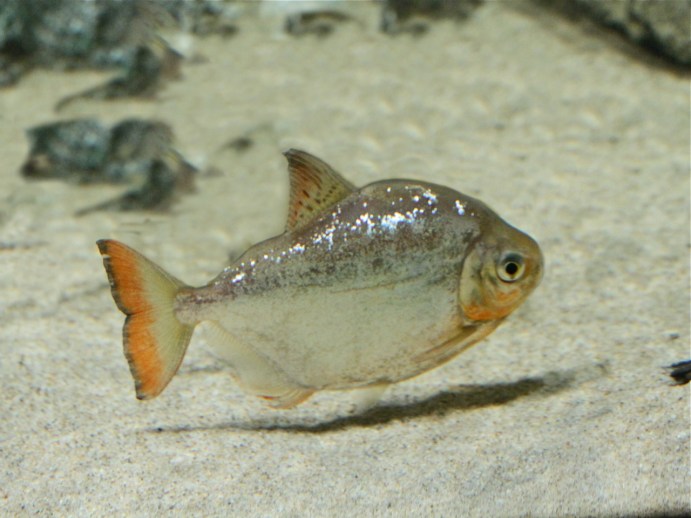
Genus/species: Metynnis hypsauchen

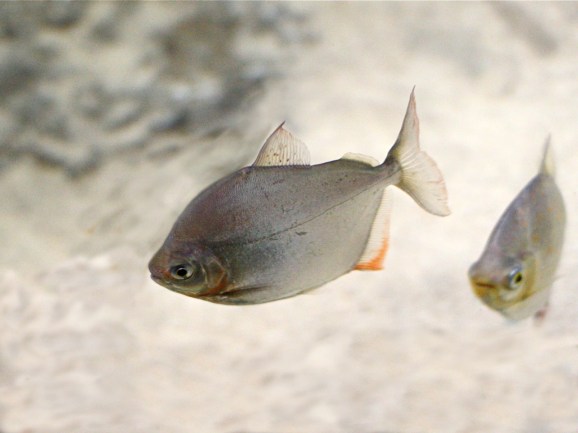
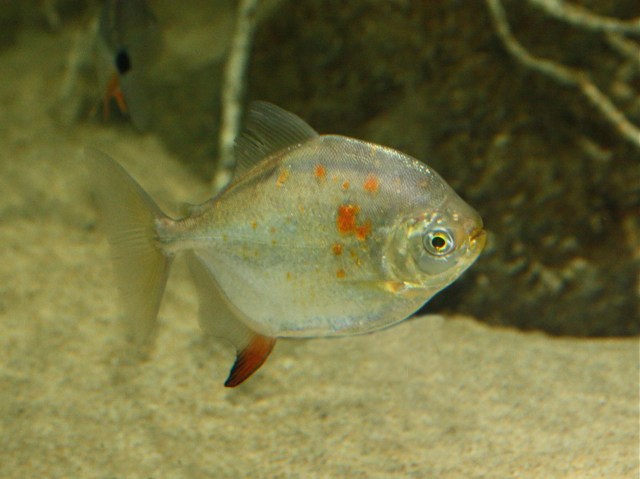
GENERAL CHARACTERISTICS: Almost circular in profile; juveniles may be spotted or striped; adults solidly silver with anal and caudal fins edged in red or orange. Length : 15.0 cm (6 inches).

DISTRIBUTION/HABITAT: Tropical South America primarily Amazon and Orinoco basins. Found in calm river reaches overhung by foliage.

DIET IN THE WILD: Generally herbivorous, eating leaves of river plants; occasionally eats worms and small insects.

REPRODUCTION: Group spawners. Eggs hatch in 3 days.

CONSERVATION: IUCN Red List, CITIES, Not Evaluated

REMARKS: A schooling species related to piranhas.
Possesses powerful dentition that can cause serious bites.

Amazon Flooded Tunnel AM11

References

Ron’s flickr  https://www.flickr.com/photos/cas_docents/6343628168/in/set-72157620568438047/

fishbase  fishbase.org/summary/Metynnis-hypsauchen.html

Encyclopedia of Life  eol.org/pages/217649/details

Ron’sWordpress shortlink  http://wp.me/p1DZ4b-cl


TAXONOMY
Kingdom: Animalia
Phylum: Chordata
Class: Reptilia
Order: Testudines
Suborder: Pleurodira (side-necked turtles)
Family: Chelidae (“snake-necked turtles”)

Genus/species: Chelus fimbriata

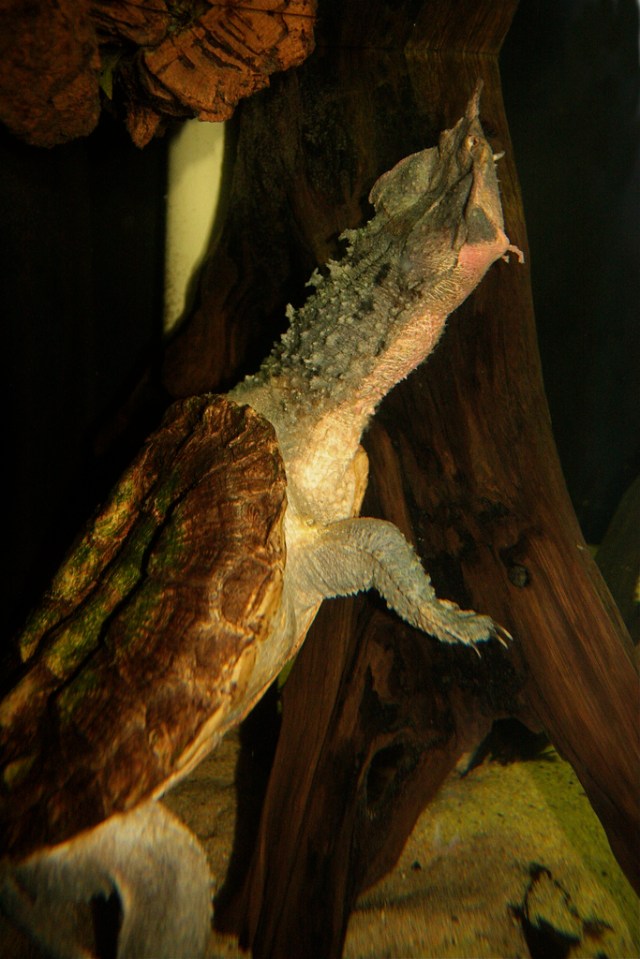
GENERAL CHARACTERISTICS: Color is faded yellow, washed out browns, oranges, and greys. The carapace has three lengthwise knobby keels with algae covering much of the carapace resembling a piece of bark, camouflaging it from possible predators. The head is widely triangular with large lateral flaps of skin and three barbels on the chin and four additional filamentous barbels at the upper jaw, The snout is a long protuberance used as a snorkel.  Carapace length to up to 45 cm (18 inches). Weight to 15 kg (33 lb).

DISTRIBUTION/HABITAT: Tropical. Amazon Basin, South America. Found near the bottom of turbid waterways in lakes, ponds and sluggish creeks. Rarely leaves the water.

DIET IN THE WILD: Carnivore. A “lay-in-wait” predator. Fishes and aquatic invertebrates are captured with the “gape and suck” technique. The opening of its mouth creates a vacuum to draw in prey with the mouth snaping shut, expelling the water and the fish swallowed whole.


REPRODUCTION: Fertilization is internal. They excavate their nests in decaying vegetation at the forest edge laying 12 to 28 eggs with an incubation periods of around 200 days.

LIFESPAN: To 15 years in captivity.

CONSERVATION: IUCN and CITES No special status.


3449612144_afdc85b508_b

REMARKS: The common name “matamata” is said to have the meaning “I kill” in one of the South American native languages.
C.fimbriatus has extremely poor eyesight. It can sense sound through a well developed tympanum on both sides of the head.

References

Ron’s WordPress shortlink  http://wp.me/p1DZ4b-bJ 

 U. of Michigan ADW animaldiversity.ummz.umich.edu/accounts/Chelus_fimbriatus/

Encyclopedia of Life  eol.org/pages/795410/details

Ron’s flickr  http://www.flickr.com/photos/cas_docents/sets/72157608449490716/


TAXONOMY
Kingdom: Animalia
Phylum: Chordata
Class: Amphibia
Order: Anura (frogs)
Family: Hylidae (“tree frogs and their allies”)

Genus/species: Trachycephalus resinifictrix

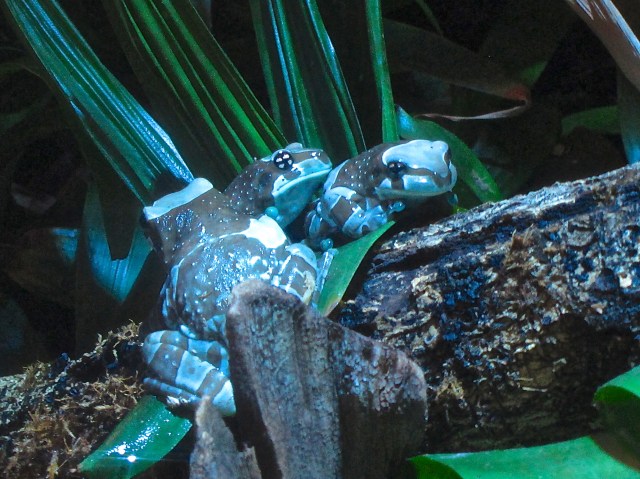
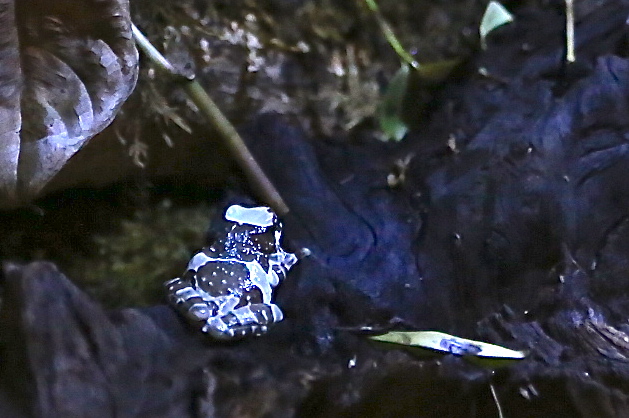
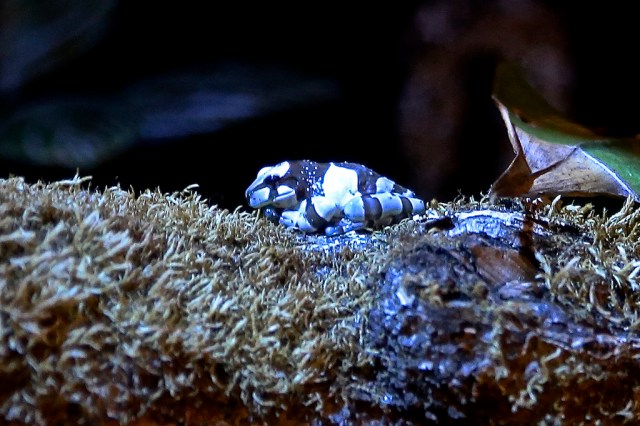
GENERAL CHARACTERISTICS: Light grey in color with brown or black banding,  Older frogs develop a slightly bumpy texture. The iris is golden with a black Maltese cross centered on the pupil. There is a vocal sac on each side of the head.  Reach 2.5 to 4 inches in length.

9830839556_f67b20a3fe_o

GENERAL CHARACTERISTICS: Light grey in color with brown or black banding, Older frogs develop a slightly bumpy texture. Reach 2.5 to 4 inches in length.

DISTRIBUTION/HABITAT:  Bolivia, Brazil, Colombia, Ecuador, French Guiana, Suriname, Venezuela.  Found in the canopy of tropical primary humid rainforests. They often inhabit vegetation which extends over permanent, slow-moving water.

IMG_0243

DIET IN THE WILD: Insectivorous

REPRODUCTION: Mainly in the rainy season between November and May. Clutches of about 2500 eggs form a gelatinous mass that floats near the surface of water or adheres to the inner wall of the tree holes. Tadpoles feed on conspecific eggs and vegetable detritus until metamorphosis in the tree holes.

IMG_4424

LIFESPAN Up to 25 years.

CONSERVATION: IUCN Red List; Least concern.

8353978767_29b24b4235_b

 REMARKS: The “milk” in the name comes from the poisonous milky-coloured fluid these frogs excrete when stressed.

References

Ron’s flickr  http://www.flickr.com/photos/cas_docents/8353978767/sizes/l/in/set-72157608456457315/

Ron’s WordPress Shortlink  http://wp.me/p1DZ4b-Mo

eol  eol.org/pages/1025259/details

Connecticut Beardsely Zoo  beardsleyzoo.org/amazonmilkfrog-fk1

TAXONOMY
Kingdom: Animalia
Phylum: Chordata
Subphylum: Vertebrata
Class: Reptilia
Order: Squamata
Suborder: Serpentes
Family: Boidae
Subfamily: Boinae

Genus/species: Epicrates cenchria

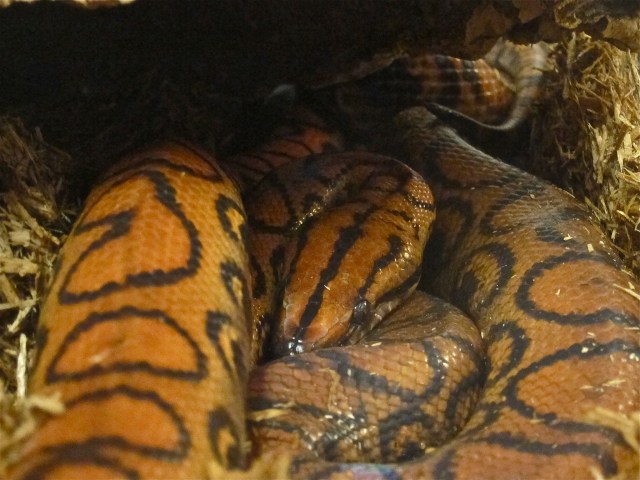
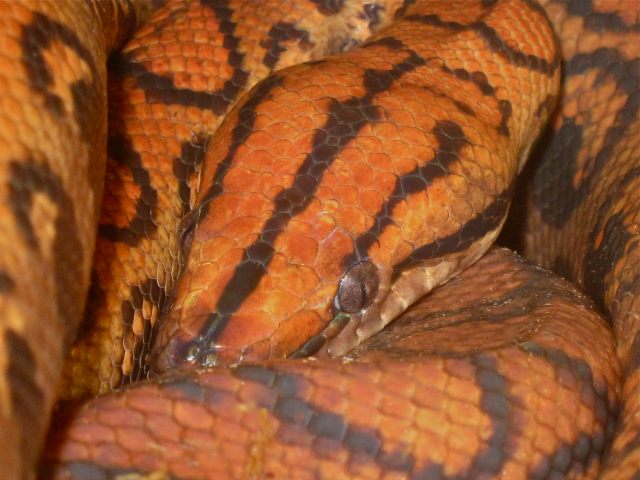
GENERAL CHARACTERISTICS: The Brazilian rainbow boa is one of about 12 named subspecies of rainbow boa. Color is brown or reddish brown with three parallel black stripes on the top of the head and large black rings down the back that give the appearance of dorsal blotches. There is a great deal of variation in color and marking among individuals of this species. Length is four to six feet (1.2 to 1.8 m).

Brazilian Rainbow Boa15580871426_15f0f85863_k


DISTRIBUTION/HABITAT: Found in the Amazon Basin, and in coastal Guiana, French Guyana, and Suriname and southern Venezuela most often in humid forests.

DIET IN THE WILD: Rodents, birds, and possibly some forms of aquatic life and lizards.

REPRODUCTION: Babies are born live in litters of two to 35 (viviparous). They are usually 15 to 20 inches (38 to 51 cm) long.

LIFESPAN: To 20 years in capativity.

REMARKS: E. cenchria is named because of the iridescent sheen imparted by microscopic ridges on their scales, which act like prisms to refract light into rainbows.

Brazilian Rainbow Boa15580871146_3fc18628e1_k


References

 National Zoo http://nationalzoo.si.edu/Animals/ReptilesAmphibians/Facts/FactSheets/Brazilianrainbowboa.cfm

The Reptile Database  http://reptile-database.reptarium.cz/species?genus=Epicrates&species=cenchria

Ron’s WordPress shortlink  http://wp.me/p1DZ4b-1nJ

Ron’s flickr  https://www.flickr.com/photos/cas_docents/15580871426/

TAXONOMY
Class: Potamotrygon henlei Elasmobranchii (Sharks and rays),
Order: Rajiformes (Skates and rays)
Family: Potamotrygonidae (River stingrays).

Genus/species: Potamotrygon leopoldi

2974039132_da5bb801a4_b

GENERAL CHARACTERISTICS: Width to 45 cm. Body greatly flattened and circular, composed principally of expanded pectoral fins. Tail is slender and longer than body, has venomous spine. Coloblack, white polka dots.

DISTRIBUTION/HABITAT: South America: Tocantins River basin. Freshwater, able to tolerate only a narrow range of salinities.

DIET IN THE WILD: DIET: Mostly benthic hard-shelled invertebrates, such as clams, mussels, and crustaceans. Also worms, insect larvae, and small fishes. Like most rays, flat teeth are used to grip and crush prey that is sucked into the ventral mouth. Note periscoping eyes which protrude from sand when buried.

REPRODUCTION: Ovoviviparous. Like all in the family, fetuses developing in the mother’s uterus first feed on their yolk sacs, after which filaments develop from the uterine wall and carry nutrients and remove wastes from the fetuses until they are fully developed.

CONSERVATION STATUS: A rare, poorly known river ray, possibly endemic to river drainages in Brazil where freshwater habitat degradation is occurring. Although this attractive freshwater ray enters the ornamental fish trade, life history and population data are lacking.

REMARKS: River Stingrays (Family Potamotrygonidae) spend much of the time buried in sand or mud with only their relatively large eyes protruding. This family is the only group of rays adapted exclusively to freshwater and is found only in Neotropical river basins. Potent venomous spine, used defensively, makes this a dangerous species. Like all stingrays, sheds spine periodically as the individual grows.

Flooded Amazon

flickr http://www.flickr.com/photos/cas_docents/sets/72157608376694453/

WordPress Shortlink http://wp.me/p1DZ4b-Ph


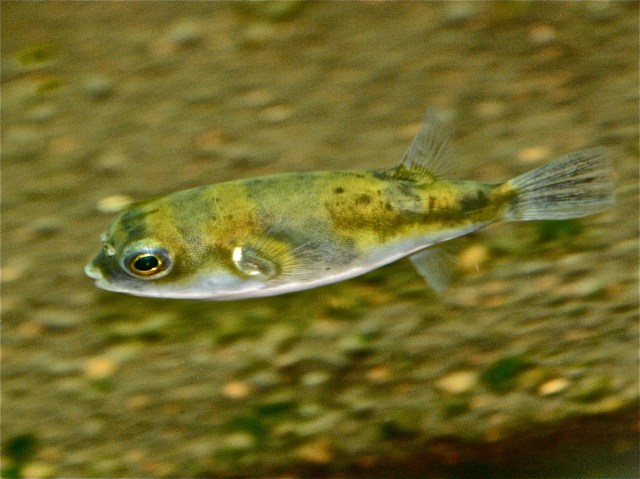
Colomesus asellus (Tetradontidae) Pufferfish

DISTRIBUTION: Peru, Colombia, Brazil. The Amazon Basin.

HABITAT: Mostly warm freshwater and coastal streams.

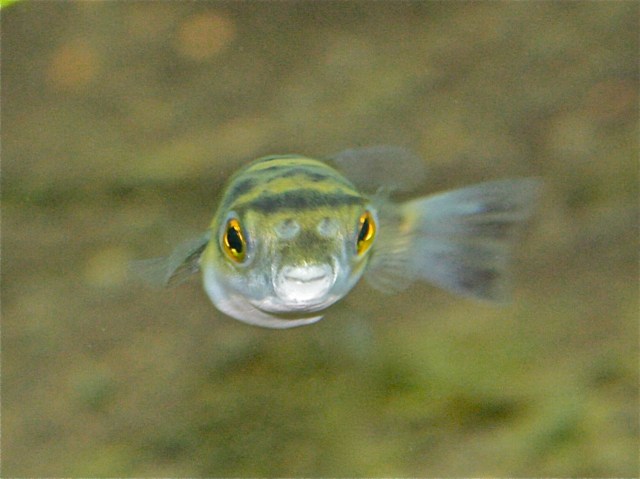
APPEARANCE: Max size: 7.5 cm, green above, white below, and patterned with black transverse bands across the dorsal surface.

DIET: An active carnivore, especially of snails.

REPRODUCTION: Pairs breed during the wet season, spawning in rivers. Small eggs are scattered on the substrate and hatched larvae are carried downstream.

MORTALITY and LONGEVITY: Life span: 10+ years.

REMARKS: Continuous growth of teeth keeps these fish ready for their crunchy and abrasive diet of crustaceans and snails. In captivity, these puffers should have a daily dose of snails to prevent beak overgrowth.

Like other puffers, can inflate themselves when threatened, presenting a much larger and spineladen body to suddenly disheartened predators.

Flooded Amazon Cardinal Tetra Exhibit.  AM14

WORDPRESS SHORTLINK   http://wp.me/p1DZ4b-d7

Metynnis sp. (Characidae) Characins

DISTRIBUTION: Tropical South America primarily Amazon and Orinoco basins.

HABITAT: Calm river reaches overhung by foliage.

APPEARANCE: Almost circular in profile; juveniles may be spotted or striped; adults solidly silver with anal and caudal fins edged in red or orange; grows to length of 30 cm (12 in) in wild.

DIET: Generally herbivorous, eating leaves of river plants; occasionally eats worms and small insects.

REPRODUCTION and DEVELOPMENT: Females release up to 2000 eggs; juveniles hatch in a few days.

REMARKS: A schooling species related to piranhas.  

LOCATION: Anaconda exhibit, AM3

WORDPRESS SHORTLINK  http://wp.me/p1DZ4b-ca