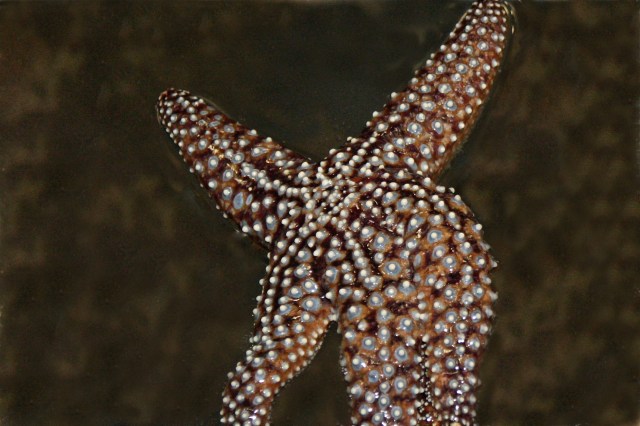
Category: ECHINODERMS


TAXONOMY
Kingdom: Animalia
Phylum: Echinodermata (“spiny-skinned” animals including sea stars, brittle stars, sea urchins, sand dollars, and sea cucumbers)
Class: Echinoidea  (sea urchins and sand dollars)
Order: Clypeasteroida
Suborder: Scutellina
Family: Dendrasteridae

Genus/species: Dendraster excentricus

GENERAL CHARACTERISTICS: Closely related to sea urchins, except for a more flattened, silver-dollar skeleton (test).
The tube feet, characteristic of echinoderms, are used for locomotion, respiration, sensing the environment, grasping and transporting food particles to the centrally located mouth on the underside of the test, and attachment to the substrate. The anus is near the edge of the test.
Very short spines which are covered with tiny hair-like cilia are closely packed together on the surface which feels like velvet.
Diameter to 8 cm (3.2 inches).
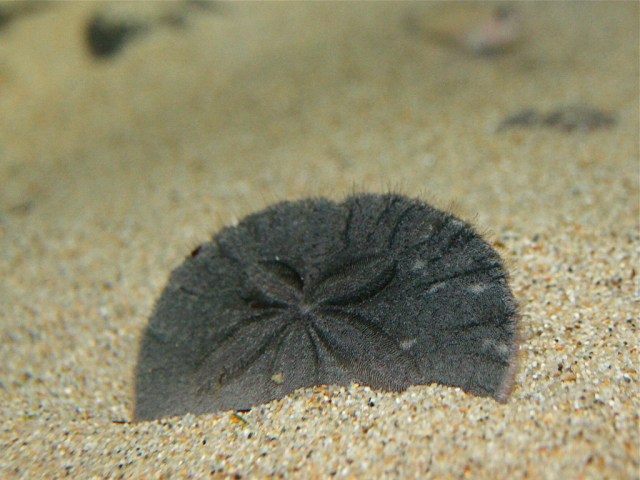
Eccentric Sand Dollar 3289660142_4458838cfd_b

DISTRIBUTION/HABITAT: Southeastern Alaska to Baja California. Found in subtidal to low intertidal zone on sandy or sandy-muddy substrates in cool water near the shore, but deep enough to avoid wave surge. Depth to 40 m (131 feet) but usually shallower.
Eccentric Sand Dollar 3427754072_18f944b159_b

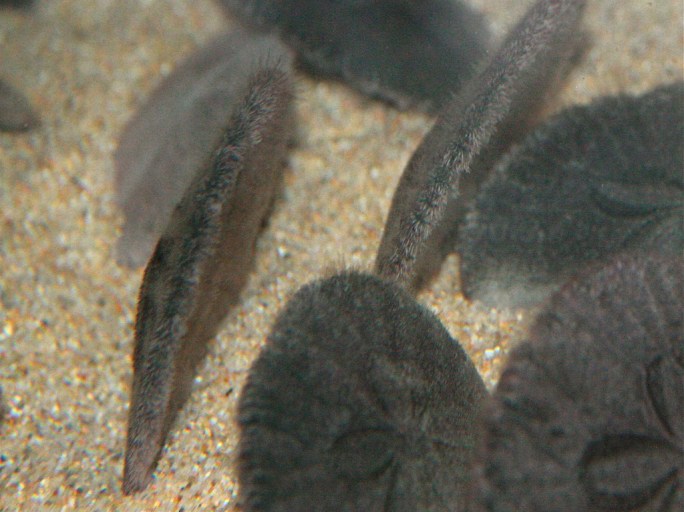
DIET IN THE WILD:  They are oriented flat or more often vertical with entire bed oriented the same way to catch phytoplankton detritus, diatoms, and plankton such as crab larvae and amphipods. They are captured by mucous-covered spines and pincers (pedicillariae). Food particles are then carried to the mouth in the center of the lower body surface by cilia on spines where it is broken up by jaws of a small aristotle’s lantern. The tube feet are also used for grasping and transporting food.

REPRODUCTION: Broadcast spawner. Sperm and eggs are released from separate individuals. After fertilization, free-swimming bilateral larvae form, which eventually change to radially symmetrical individuals that settle to a sandy or muddy substrate similar to sea urchins.

Longevity: averages 10 years.

PREDATORS: Fish, sea stars, crabs, humans.

CONSERVATION: IUCN; Not evaluated.

REMARKS:  Cilia covered spines are used in wave-like motions for movement and burrowing. Tube feet away from the mouth are also used for locomotion. 
Young sand dollars ingest large sand grains that act like a diver’s weight belt to help them maintain position.
The age a sand dollar can be determined by counting the growth rings on the plates of the exoskeleton.

References

U. of Michigan (ADW) Animal Diversity Web  http://animaldiversity.ummz.umich.edu/accounts/Dendraster_excentricus/ 

Walla Walla University  http://www.wallawalla.edu/academics/departments/biology/rosario/inverts/Echinodermata/Class%20Echinoidea/Dendraster_excentricus.html 

Monterey Bay Aquarium  http://www.montereybayaquarium.org/animal-guide/invertebrates/sand-dollar

Ron’s flickr  https://www.flickr.com/photos/cas_docents/3289660142/in/set-72157608501343477

Ron’s WordPress shortlink  http://wp.me/p1DZ4b-1mA
TAXONOMY
Kingdom: Animalia – animals
Phylum: Echinodermata Klein – echinoderms
Subphylum: Eleutherozoa
Superclass: Cryptosyringida
Class: Ophiuroidea – basket stars, brittlestars, snake stars
Order: Ophiurida – basket stars, serpent stars, basket stars, serpent stars
Suborder: Iohiura incrassata
Family Ophiodermatidae

Genus/species: Ophiarachna incrassata

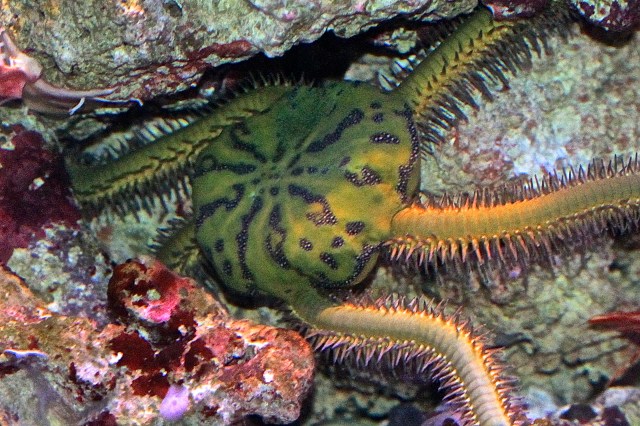
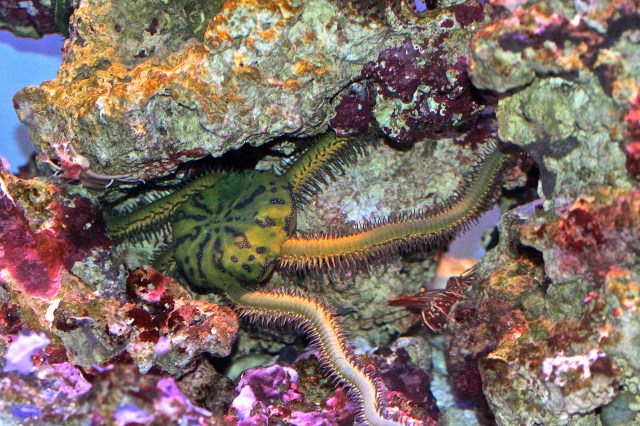
GENERAL CHARACTERISTICS: Green with yellow markings and dark-ringed white spots. Disc diameter to 5 cm (2 inches) and arm length to 20 cm (8 inches). Top of arms are wide and flat.

Stout Green Brittle Star8412648309_4004cdfca2_k

DIET IN THE WILD: Nocturnal feeder of  small organisms and detritus.

Stout Green Brittle Star4472769084_f4acdf93f2_o

DIET IN THE WILD: Small organisms and detritus. Nocturnal feeder.

Stout Green Brittle Star8282559749_1cb63a02d1_oReferences

Ron’s flickr  https://www.flickr.com/photos/cas_docents/8412648309/in/set-72157608501343477/

Encyclopedia of life  eol.org/pages/598310/details

Reef Creature Identification, Humann and Deloach 2010, page443

ADW animaldiversity.ummz.umich.edu/accounts/Ophiarachna_incra…

Ron’s WordPress shortlink  http://wp.me/p1DZ4b-1mb


TAXONOMY
Kingdom: Animalia
Phylum: Echinodermata
Class: Ophiuroidea – basket stars, brittlestars, snake stars
Order: Ophiurida – basket stars, serpent stars, basket stars, serpent stars
Family: Ophiodermatidae

Genus/species: Ophiothrix spiculata


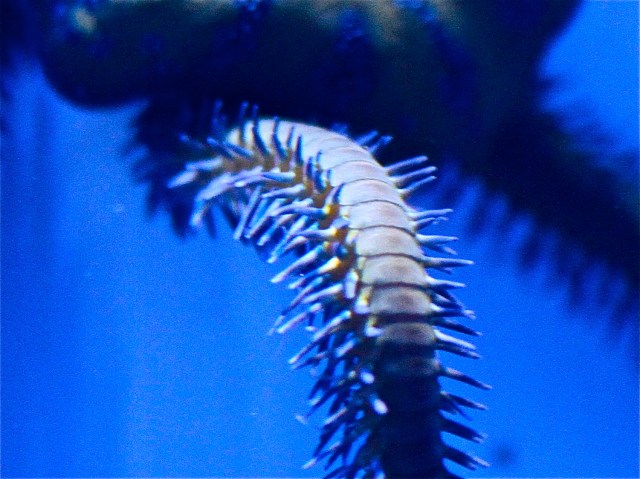
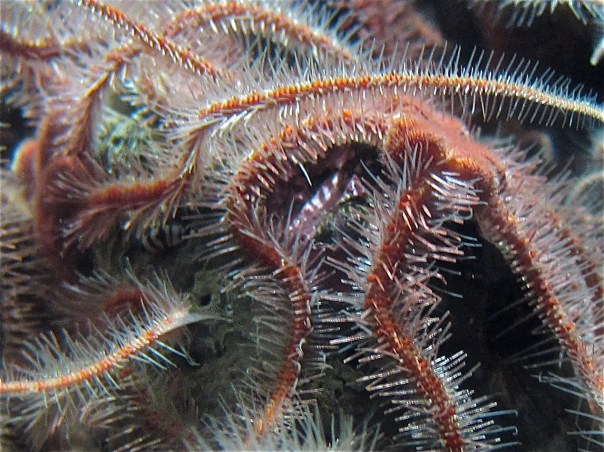
GENERAL CHARACTERISTICS: Color highly variable: green, green-brown, or green-yellow, and more or less extensively marked with white, grey, orange, red, brown, or pink. Distinguished by serrate or conspicuously prickly spines on the disk and arms. Up to eight serrated and hyaline arm spines with jagged edges, radial symmetry with 5 segments. Disk up to 18mm (0.7 inches) in diameter, arms up to 85 mm (3.3 inches) in length.

DISTRIBUTION/HABITAT: Northern California to Peru; also Galapagos Islands. Found on the continental slope, kelp forest, submarine canyons. sandy and rocky seafloor in shallow waters to great depths from the shoreline down to 2,059 m (6,755 feet).

DIET IN THE WILD: They extend their arms are upward to filter the water for organic particles, small animals. They are nocturnal stretching out to catch food particles, using their small spines to pass the bits down to the central mouth.

PREDATION: When threatened their best form of defense is to slowly crawl away.


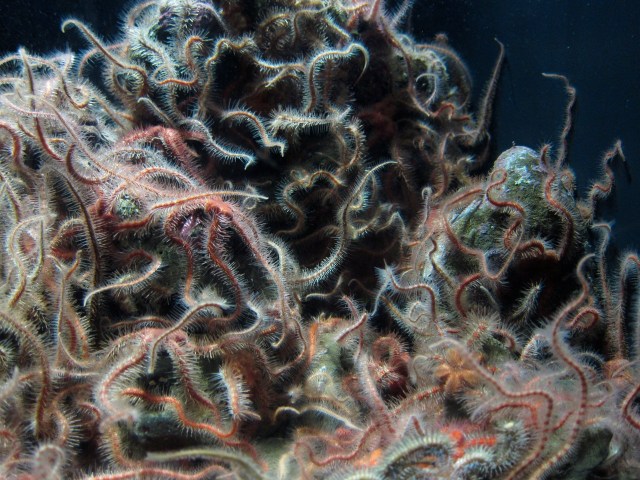
REMARKS: In kelp forests near La Jolla in southern California, millions of them may carpet the seafloor in layers up to an inch thick!

The arms of the spiny brittle star are very delicate and easily break off when the animal is disturbed. These echinoderms are able to replace lost arms in several days.

They are sensitive to light, and when disturbed can create their own light or bioluminescence.

References

Encyclopedia of Life eol.org/pages/598202/details

Monterey Bay Aquariun  http://www.montereybayaquarium.org/animal-guide/invertebrates/spiny-brittle-star

NOAA   http://www8.nos.noaa.gov/onms/park/Parks/SpeciesCard.aspx?pID=3&refID=4&CreatureID=151 

Ron’s flickr  http://www.flickr.com/photos/cas_docents/sets/72157608501343477/

Ron’s WordPress shortlink  http://wp.me/p1DZ4b-gs

TAXONOMY
Kingdom: Animalia
Phylum: Echinodermata
Class: Asteroidea
Order: Valvatida
Family: Goniasteridae

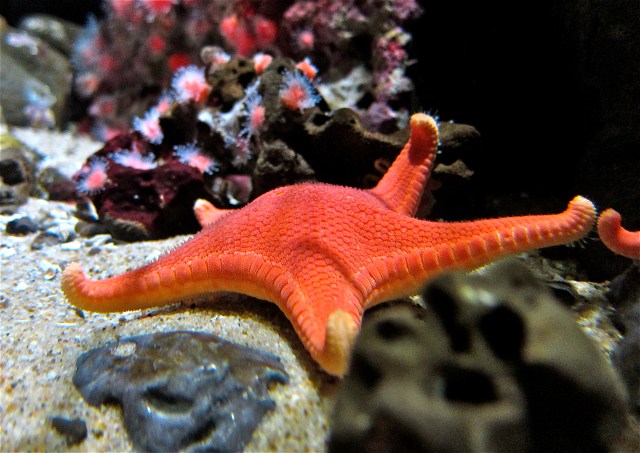
Genus/species: Mediaster aequalis

Vermillion Sea StarIMG_3431

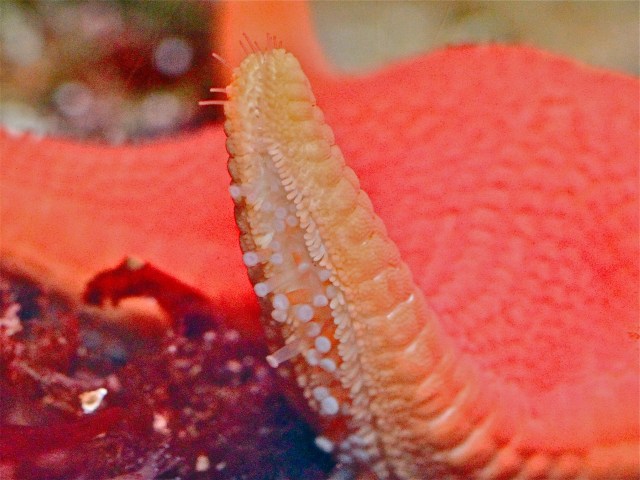
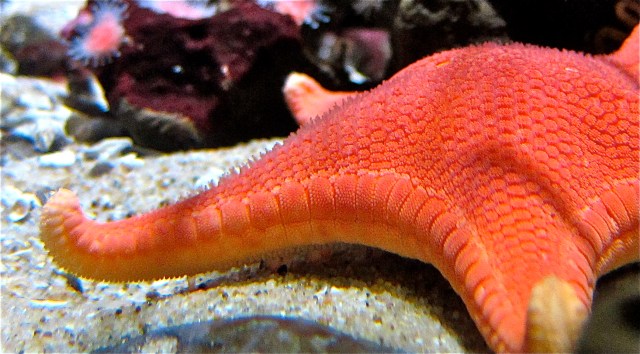
GENERAL CHARACTERISTICS: 5-rayed sea star has conspicuous marginal plates. Orange to vermillion red. Aboral surface covered with oval or flat-topped hexagonal plates (ossicles). Oral side lighter. Up to 20 cm ( 7.9 inches) diameter.

 Vermillion Sea StarIMG_5328

DISTRIBUTION/HABITAT: Alaska south to southern California. Common in subtidal waters; rarely exposed to the air. Found especially in rocky areas; occasionally on sand and gravel. Depth to 1,784 m (5,800 feet) max.

DIET IN THE WILD: Omnivorous: sponges, bryozoans, tunicates, algae, and detritus. Also known to feed on sea pens.

Vermillion Sea Star6182821598_7b9c9777d0_o

PREDATOR: Seastar Solaster dawsoni.

REMARKS: Moves more rapidly than most sea stars: up to 40 cm (16 inches) minute.

References

Encyclopedia of Life eol.org/pages/598026/details

Walla Walla University http://www.wallawalla.edu/academics/departments/biology/rosario/inverts/Echinodermata/Class%20Asteroidea/Mediaster_aequalis.html

Ron’s flickr  https://www.flickr.com/photos/cas_docents/3051541919/in/set-72157608501343477/

Ron’s WordPress shortlink  http://wp.me/p1DZ4b-1lP

TAXONOMY
Phylum: Echinodermata
Class: Crinoidea (Sea Lilies and Feather Stars)
Order: Comatulida
Family: Antedonidae

Genus/species: Florometra serratissima

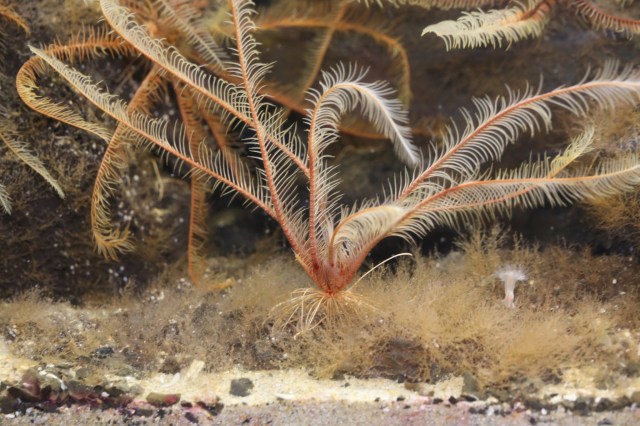
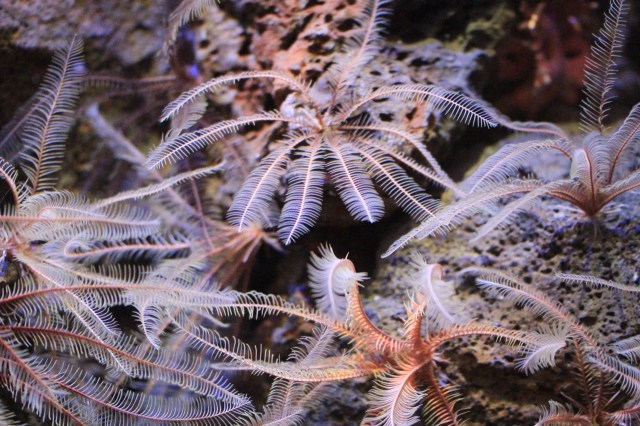
GENERAL CHARACTERISTICS: Tan to reddish tan. Like an upside-down brittle star. The 5 arms often fork near the base to form a total of 10 or more arm branches which are often around 10 cm (4 inches) long. Jointed appendages called pinnules branch from the side of the arms, giving the featherlike appearance. The upper (oral) surface of the arms has an ambulacral groove, and both the mouth and the anus are on the upper side of the central disk. The aboral side of the central disk has clawlike cirri which function somewhat like bird feet to grasp the substrate. Armspread to 25 cm (10 inches).

Common Feather Star8451815809_2bb6752f68_k

DISTRIBUTION/HABITAT: Alaska to Mexico or farther south to off South America in deep water in a current.  Depth 10-1252 m (32-4100 feet) 

Common Feather StarIMG_5193


DIET IN THE WILD: Suspension feeders of plankton  The food transport system of the crinoids extends out on to the arms, or the “feathers,” of the feather star.  It subdivides and continues out into the lateral small projections off the main arm and consists of a mucous-filled ciliated food groove which connects all the way to from the finest arm branch to the mouth on the upper surface of the body. Out on the fine branches, or pinnules, of each arm, the food groove has a row of tube feet on each side of it.  Crinoid tube feet neither work as independent units nor are they used in locomotion. Rather they are used only for feeding, and they work as groups of six, divided into two groups of three tube feet each, on opposite sides of the food groove. These tube feet extend directly up from the animal’s surface into the water.

PREDATORS: Various fishes.

REPRODUCTION: Comatulids are dioecious, each individual being either male or female. Gametes are produced in pinnules at the base of the arms, with external fertilisation. The larvae are planktonic settling on the seabed anchoring themselves with a stalk.
The stalk breaks and the juveniles can move around after metamorphosis.

REMARKS:  Possess the water-vascular system and tube feet that are characteristic of this phylum; however, unlike most other echinoderms, they do not use the tube feet for locomotion. If they need to move more rapidly, perhaps to escape a predator, they release the grip of the cirri and, using a particularly beautiful undulatory motion of the arms, they propel themselves up into the water, swimming for short distances. 

Crinoids, like all other echinoderms, lack even a rudimentary brain, and the nervous system is difficult to see. Nonetheless, they have good sensory capabilities, with millions of small sensory cells located throughout there skin.

LOCATION; California Rocky Reef

References

Encyclopedia of life eol.org/pages/597860/details

Walla Walla University http://www.wallawalla.edu/academics/departments/biology/rosario/inverts/Echinodermata/Class_Crinoidea/Florometra_serratissima.html

Ron’s flickr  http://www.flickr.com/photos/cas_docents/sets/72157608501343477/

Ron’s WordPress shortlink  http://wp.me/p1DZ4b-g7

TAXONOMY
Kingdom:Animalia
Phylum: Echinodermata
Class: Echinoidea
Order: Echinoida
Family: Strongylocentrotidae

Genus/species: Strongylocentrotus franciscanus

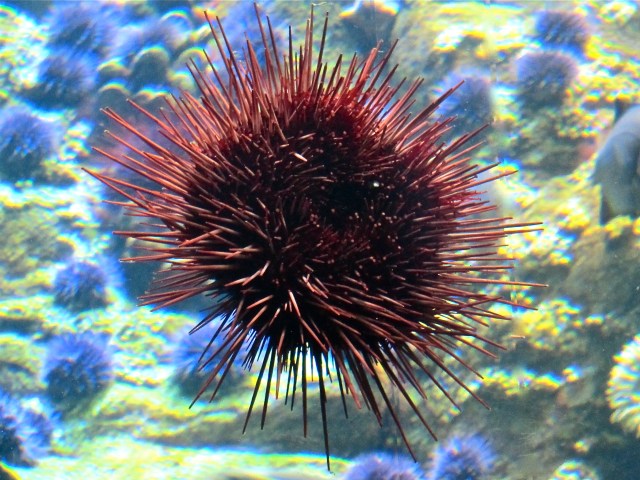
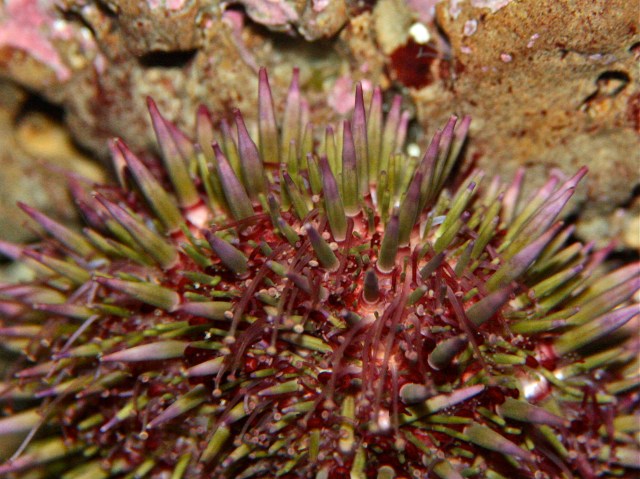
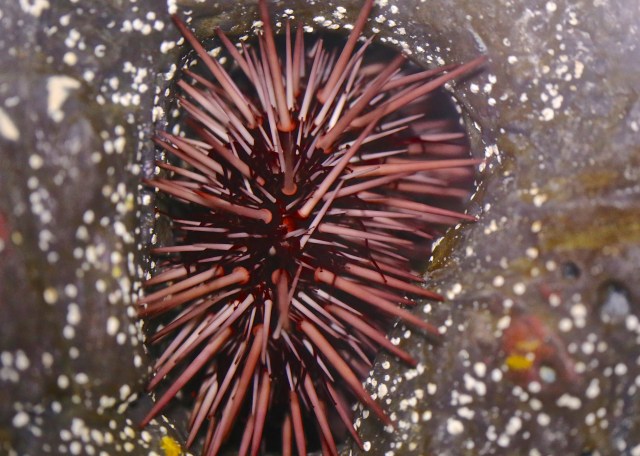
GENERAL CHARACTERISTICS: Largest urchin found in the Pacific Northwest. Color of spines varies–may be red, brick-red, pink, purple, or even maroon. Tube feet are dark, often wine red. The largest recorded test diameters approaching 19 cm (7.5 inches). Spines up to 7 cm (2.75 inches) long. (deters predators and facilitates movement).

(Strongylocentrotus purpuratus is smaller and a strong purple color. )

Strongylocentrotus franciscanus6063267260_280398b0bb_o

DISTRIBUTION/HABITAT: N. Japan and Alaska to Isla Cedros, Baja California. Found in very low intertidal on open, coastal rocky substrates; more abundant subtidally to 90 m deep. Juveniles often shelter among the rigid outer spines of adults.

Strongylocentrotus franciscanus3750941637_8fa3f8704a_o

DIET IN THE WILD: Herbivorous upon red and brown algae; preference is for the giant brown kelp Macrocystis. Their grazing can cause “barren grounds” in which no algae remain.

Strongylocentrotus franciscanus8519677227_2871028244_k

REPRODUCTION: Broadcast spawners. Fertilized eggs develop into planktonic larvae, known as echinoplutei, which go through a number of stages of development over 6-10 weeks then settle to substrate.

MORTALITY: Can live more than 100 years. A favored treat of sea otters. Other predators include the sunflower star Pycnopodia helianthoides, leather star Dermasterias imbricata, red rock crab Cancer productus, spiny lobster Panulirus interruptus and sheepshead fish. Starfish may swallow red sea urchins whole or split the animals open along their vertical axis.

CONSERVATION: IUCN; Not Evaluated

REMARKS: Raw gonads (uni) are considered gastronomic delicacies by some people. Removal of sea urchins promotes growth of kelp and thus improves habitat for many other species, including rockfish juveniles .

Small urchins (less than 5 cm test diameter) often hide under the adults.

Have been known to bore holes into metal pier pilings.

Tube feet of red sea urchins are chemo-receptive, allowing them to detect food sources and predators.

They may reabsorb their own tissues if no other source of energy is present. (“Red Sea Urchins”, 2013; Kato and Schroeter, 1985)

LOCATION California Rocky Coast

References

Ron’s flickr https://www.flickr.com/photos/cas_docents/6063267260/in/set-72157608501343477/

Walla Walla University www.wallawalla.edu/academics/departments/biology/rosario/…

Oregon State University fishbull.noaa.gov/1014/19ebertf.pdf

University of Michigan Animal Diversity  Web.http://animaldiversity.ummz.umich.edu/accounts/Strongylocentrotus_franciscanus/

Ron’s WordPress shortlink  https://fishoncomputer.wordpress.com/wp-admin/post-new.php

Family Poraniidae 

Dermasterias imbricate

DISTRIBUTION: Eastern North Pacific: Alaska to Northern California. 

HABITAT: On rocks and rocky reefs in subtidal areas.  APPEARANCE: Medium size sea star up to 5 Iin or 12 cm in diameter with disproportionately short broad arms with a smooth, slippery surface. Mottled coloring—bluish-grey with brown to orange blotches all over.  Oral side pale and smooth. Smells garlic-like.  

DIET: Mainly sea anemones, but also takes sea cucumbers, sea urchins, and other invertebrates. Leather stars, unlike many other sea stars, such as the ochre, bat, and pink sea stars, swallow their prey whole and digest internally. 

REPRODUCTION/DEVELOPMENT: Releases eggs and sperm; fertilized eggs float in plankton and develop into juveniles, which eventually settle out.

REMARKS: Known to eat the Plumose Anemone (Metridium senile and Metridium farcimen), and the Strawberry Anemone Corynactis californica.

Larger anemones have been observed to fight back by distending the mouth to envelope the attacking star. In the end the leather star often retreats and both the star and the anemone are none the worse for wear. 


LOCATION: Tidepool  CC15    **DisplayIntermittent 

WORDPRESS SHORTLINK   http://wp.me/p1DZ4b-u0

flickr    http://www.flickr.com/photos/cas_docents/sets/72157608501343477/

Phylum Echinodermata, Class Asteroidea, Order Forcipulatida, Family Asteriidae, 

Pisaster gianteus


DISTRIBUTION: Eastern Pacific coast from British Columbia to Baja California.

HABITAT: Rocky but also sandy substrates from middle to lower intertidal zone down to 300 ft or 90 m.

APPEARANCE: Five arms. Can be colored red, orange, brown, or green. Evenly spaced blunt white stubby spines surrounded by blue plaques.  Maximum arm span about 24 in or 60 cm.

DIET: Typical prey are hard-shelled organisms such as mussels, snails, and barnacles. May occasionally eat anything slow-moving enough to be caught, such as dying fish or shellfish, anenomes, or other sea stars.

REPRODUCTION and DEVELOPMENT: Individual sea stars are male or female. Broadcast spawners, both sexes release gametes into the water for external fertilization. Larvae are planktonic and have bilateral symmetry.

MORTALITY/LONGEVITY: Sea gulls and sea otters are sea star predators. Giant sea stars live about 20 years.

TIDEPOOL CC15  

WORDPRESS SHORTLINK  http://wp.me/p1DZ4b-tO

flickr  http://www.flickr.com/photos/cas_docents/sets/72157608501343477/