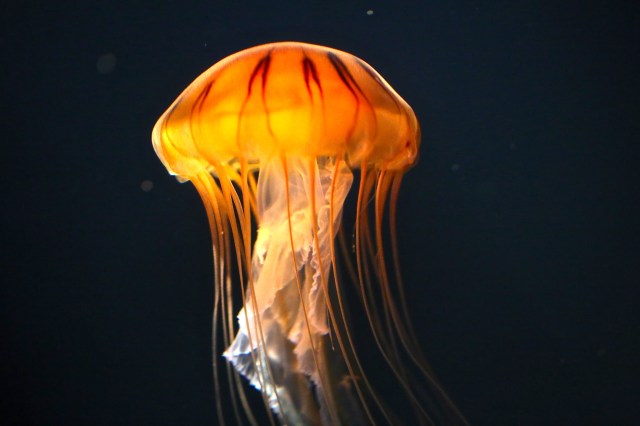
Category: CNIDARIANS


TAXONOMY
Kingdom: Animalia
Phylum: Cnidaria
Class: Anthozoa
Subclass: Hexacorallia
Order: Corallimorpharia
Family: Corallimorphidae

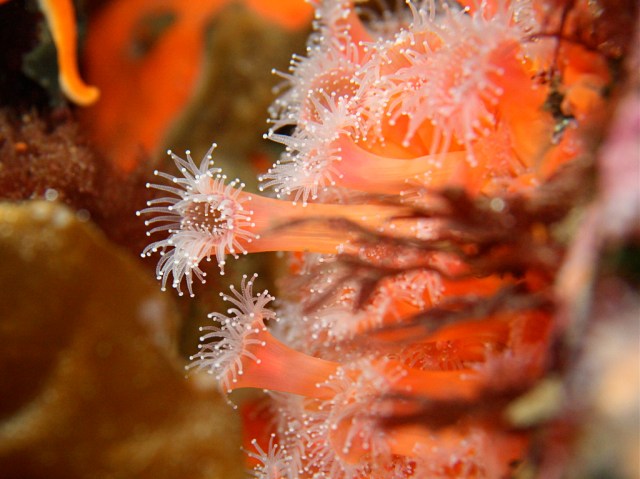
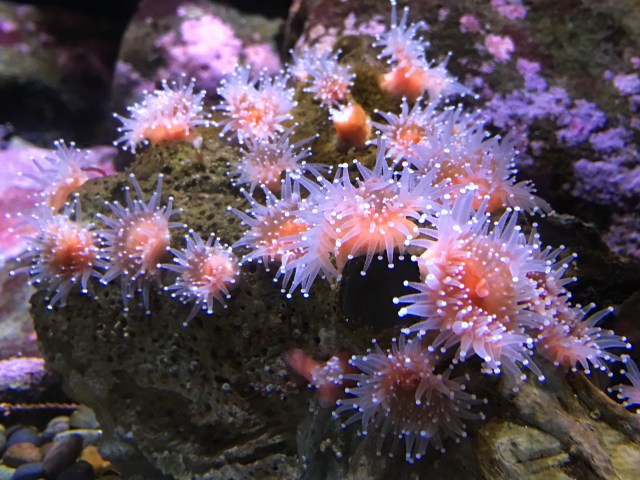
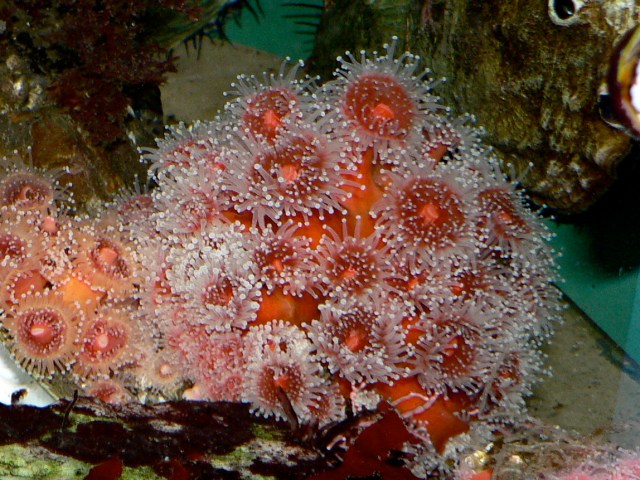
Genus/species: Corynactis californica

GENERAL CHARACTERISTICS: Typically red or orange-pink, occasionally purple, yellow, buff, brown or nearly white.
Corallimorphs are not true anemones. Tentacles end in knobs (club-tipped tentacles) and are not fully retractile, usually being white. Corallimorphs are also very similar to corals in some other characters, but lack the hard coral skeleton. Found in groups, with individuals up to 2 cm (0.8 inches) long (average height and diameter is 1 cm  (0.4 inches).
Northern Feather Duster Wormimg_5344

3395717381_112ffd5d87_b-2

DISTRIBUTION/HABITAT: British Columbia, Canada to Baja California, Mexico. Habitat: Colonies abundant from the low rocky intertidal to 30 m (98 feet).
3124837767_b890803df1_o

DIET IN THE WILD: C. californica captures prey by extruding mesenterial filaments onto its prey which are used for digestion and absorption of food in the coelenteron. If the prey is too large to take into the coelenteron, the mesenterial filaments are used to digest it externally. They are carnivores consuming  copepods, crustacean larvae and other zooplankton.

REPRODUCTION: Asexual by fission and budding resulting in a dense cluster of clones

REMARKS: The presence of aggregations of C. californica increase the density of rock oysters and mussels by protecting them from predatory sea stars.

References

California Academy of Sciences Steinhart Aquarium 2016

Ron’s flickr https://www.flickr.com/photos/cas_docents/2996776409/in/set-72157608597451452/

Ron’s WordPress  http://wp.me/p1DZ4b-1l0

eol eol.org/pages/1006944/details

 U. of Michigan ADWanimaldiversity.ummz.umich.edu/accounts/Corynactis_califo…

 Walla Walla Universitywww.wallawalla.edu/academics/departments/biology/rosario/…


TAXONOMY
Kingdom: Animalia
Phylum: Cnidaria
Class: Anthozoa
Subclass: Hexacorallia (includes stony corals, all sea anemones, tube anemones, and zoanthids)
Order: Actiniaria (sea anemones)
Family: Actiniidae (largest family of sea anemones)

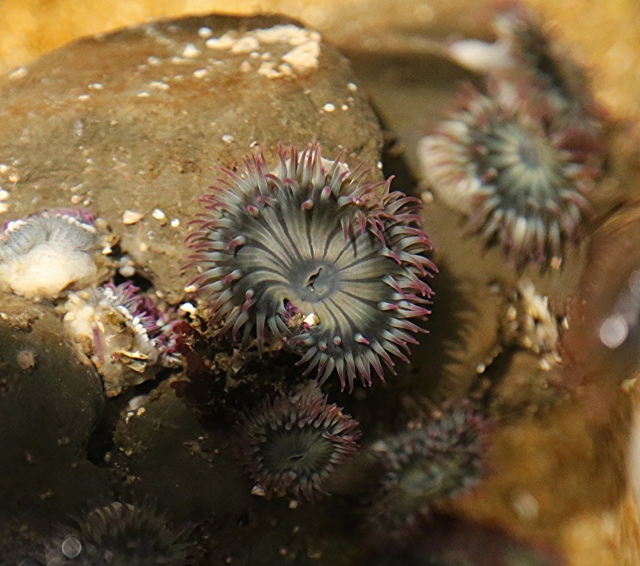
Genus/species: Anthopleura elegantissima

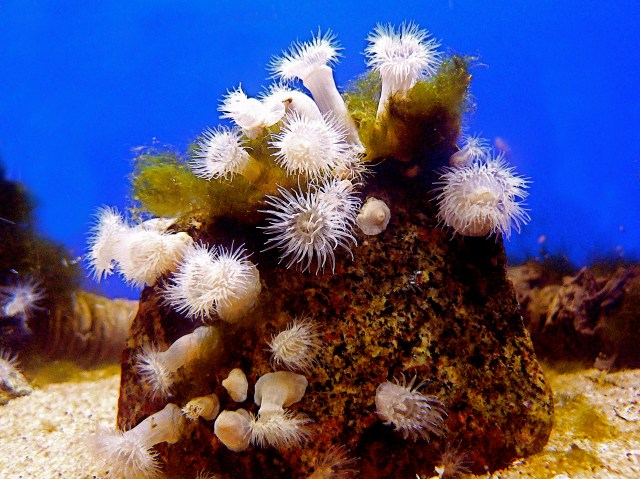
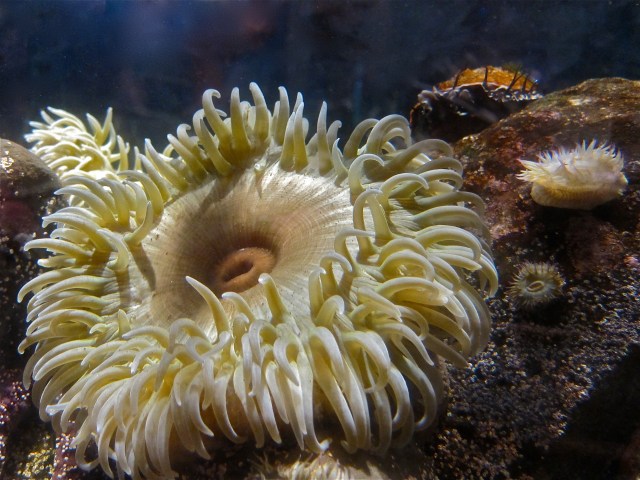
GENERAL CHARACTERISTICS: Most are olive to bright green (depending on the species of algal symbionts present) with tentacles tipped in pink. The oral disk has approximately 100 tentacles in three or four rows around its margins. Those that are deficient in photosynthetically active radiation, such as under docks or in caves, lack symbionts and are pale yellow to white in color.
Disc 2-3 cm (0.78-1.2 in) across, under water.

Aggregating Anemones23710001752_0cf3a8e808_k

DISTRIBUTION/HABITAT: Common in tide pools. The body of the anemone is firmly attached to rock substrate and detritus and sand adheres to the column almost covering them.

DIET IN THE WILD: Capture tiny crustaceans and other animals past their tentacles using their stinging nematocysts (also called cnidocytes) on the surface of their tentacles.

REPRODUCTION: To clone themselves, anemones split in half tearing themselves apart (asexual reproduction). Aggregating anemones also reproduce sexually by broadcasting eggs and sperm.

PREDATORS: Their are few known predators but include the nudibranch Aeolidia papillosa, leather star Dermasterias imbricata and mosshead sculpin Clinocottus globiceps.

REMARKS: When one colony of genetically identical polyps encounters a different genetic colony, the two will wage territorial battles. A. elegantissima has specialized tentacles called acrorhagi to deter non identical colonies from encroaching on their space. It extends the acrorhagi to attack the competing anemone with nematocytes leaving behind a ‘peel’ of the ectoderm and nematocysts that causes tissue necrosis in the receiving animal.

References

California Academy of Sciences Tidepool

Ron’s flickr  https://www.flickr.com/photos/cas_docents/23710001752/in/album-72157625127345346/

Encyclopedia of Life  eol.org/data_objects/27560182

Ron’s WordPress shortlink  http://wp.me/p1DZ4b-1D1

Monterey Bay Aquarium www.montereybayaquarium.org/animal-guide/invertebrates/ag…

Slatter Museum of the U. of Puget Sound www.pugetsound.edu/academics/academic-resources/slater-mu…

TAXONOMY
Kingdom:Animalia
Phylum: Molluska,
Class: Gastropoda
Family: ‪Aeolidioidea‬ (superfamily of sea slugs, the aeolid nudibranchs)

Genus /species: Aeolidia papillose

GENERAL CHARACTERISTICS: Its color appears to be quite variable, depending upon locale and food resources. This large aeolid grows to about 10 cm(4 in) in length and its body is covered with close obliquely arranged rows of flattened cerata.

Aeolidia papillose 6873953510_5aecc605bd_k

DISTRIBUTION/HABITAT: Common on the Atlantic coast of Europe and North America and the Pacific coast of North America. Also from  both west and east coasts of South America  Found on rocks, or may be on floats or docks often near its preferred prey. Intertidal to 380 m (116 ft) deep.

DIET IN THE WILD: Feeds almost exclusively on sea anemones.

MORTALITY/LONGEVITY: This species is famous for obtaining undischarged cnidae (cells which bear nematocysts) from its Cnidarian prey and moving to the tips of the cerata , where they are likely used for defense. If disturbed they sometimes wave their cerata. If one of the cerata is broken off, muscles within it contract, expelling the nematocysts, which then discharge . The chemical composition of A. papillosa mucus changes and does not trigger a discharge of nematocysts in the sea anemone.

REPRODUCTION/: Nudibranchs are hermaphroditic, and thus have a set of reproductive organs for both sexes, but they cannot fertilize themselves.

REMARKS: Their eyes are simple and able to discern little more than light and dark. The eyes are set into the body, are about a quarter of a millimeter in diameter, and consist of a lens and five photoreceptors.

Tidepool.

References

Ron’s flickr https://www.flickr.com/photos/cas_docents/6873953510/in/album-72157660640336765/

Encyclopedia of Life eol.org/pages/402852/details

Ron’s WordPress shortlink http://wp.me/p1DZ4b-1CP


TAXONOMY
Phylum Cnidaria
Class Anthozoa
Subclass Zoantharia
Order Actiniaria (anemones)
Family Actiniidae

Genus/species: Anthopleura xanthogrammica

GENERAL CHARACTERISTICS: A  solitary species and one of the largest species of anemone in the world. Column to 30 cm (12 in) tall and 30 cm (12 in) tentacular crown with 25 cm (10 in ) diameter mid base. The base bottom is only slightly larger than column diameter and adheres to rocks.  Tentacles are green, blue, or white without pink on the tips.  No marks or bands.  The oral disk is flat and usually green, but can be grayish-blue to greenish-blue.  Contracted animals form a green to dark greenish-brown, occasionally white hemispherical mound.

DISTRIBUTION/HABITAT: Alaska to Panama in prefers rocky areas and deeper tide pools of the low to middle intertidal zones to 9 m (30 ft), and wharf pilings. Usually solitary; in favorable locations can occur in numbers to 14 per square m.

DIET IN THE WILD: Detached mussels and sea urchins, also take crabs and small fishes. Zoochlorellae endosymbionts supplement host’s diet.

PREDATORS: Nudibranchs, snails, sea spiders and some sea stars, especially leather stars.

REPRODUCTION: A. xanthogrammica have separate sexes releasing sperm and eggs in late spring to summer. The larvae swim or float freely. They do not use asexual reproduction.


REMARKS: Some fishes and the hermit crab Pagurus samuelis develop protection from the anemone’s toxins by covering themselves with mucus that prevents them from being stung.

The bright green can be attributed to green pigment in the anemone epidermis and to symbiotic algae that live in the tissues that line the gut. Inside there may be zoochorellae (green algae) or zooxanthellae, which are dinoflagellates. The symbiotic algae are reduced in numbers or even absent (aposymbiotic) when in shady areas.

LOCATION: Tidepool and California coast.

REFERENCES

Walla Walla University

www.wallawalla.edu/academics/departments/biology/rosario/…

 eol eol.org/pages/704306/details#cite_note-Skiles-4

flickr  http://www.flickr.com/photos/cas_docents/sets/72157625127345346/

WordPress shortlink: http://wp.me/p1DZ4b-w4

TAXONOMY
Kingdom: Animalia
Phylum: Cnidaria
Class: Anthozoa
Order: Actiniaria
Family: Actiniidae

Genus/species: Urticina lofotensis

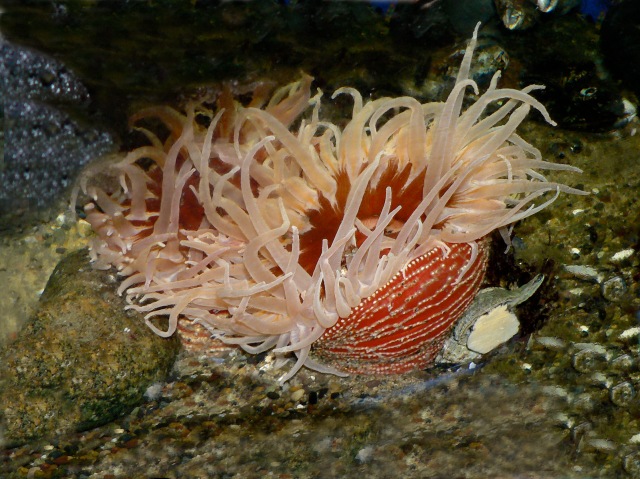
 GENERAL CHARACTERISTICS: Column diameter to 10 cm (4 inches), height to 15 cm (6 inches). Column bright scarlet or crimson with white warty spots in longitudinal rows; tentacles slender, elongate, scarlet to crimson.

 White-spotted Rose Anemone3005754146_b9c9c195c5_o

DISTRIBUTION/HABITAT: SE Alaska to San Diego, CA. Found on rocks and walls of surge channels, low intertidal to 15 m (49 feet) on exposed outer coast.

 DIET IN THE WILD: Carnivorous.

REMARKS: Shells or debris rarely found adhered to the tubercles. Juvenile painted greenlings and adults may sleep near its base.

References

 eol eol.org/pages/2549638/details

 Walla Walla Universitywww.wallawalla.edu/academics/departments/biology/rosario/…

 Washing state Universitywww.beachwatchers.wsu.edu/ezidweb/animals/Urticinalofoten…

 Ron’s flickr  https://www.flickr.com/photos/cas_docents/3005754146/in/set-72157625127345346/

Ron’s WordPress shortlink   http://wp.me/p1DZ4b-1ly


Location; California Rocky Coast, Giants, Octopus exhibit

TAXONOMY
Kingdom: Animalia
Phylum: Cnidaria
Class: Anthozoa
Order: Actiniaria
Family: Metridiidae

Genus/species: Metridium senile

GENERAL CHARACTERISTICS: M. senile is colored white, cream, tan, orange or brown. Height to 5 cm (2 inches). Tentacular crown diameter to 25 cm (9.75 inches), Up to one hundred small, slender tentacles give a feathery (plumose) appearance.

 Metridium senile 3074666433_ab584596e9_o

DISTRIBUTION/HABITAT: Southern Alaska to Southern California and both Atlantic coasts. Found live in groups of up to 500 specimens per square meter at depths to 166 m (540 feet). M. senile lives on rocks, shells, wood pilings and stony breakwaters in bays and harbors in the low intertidal and subtidal zones. Plumose anemones crawl slowly along the substrate by muscular waves of the pedal disk.

DIET IN THE WILD: Mostly small zooplankton, though they may also eat small benthic polychaetes, fish, and squid.

REPRODUCTION: Protandric hermaphrodite starting life as one sex and changes to the other when it is older. Eggs or sperm develop in the gonads embedded in the mesentery that lines the coelom. They are ejected through the mouth, and when fertilised develop into planula larvae which settle and become juveniles.

They also reproduce asexually by binary fission, budding and fragmentation.

PREDATORS: Nudibranch Aeolidia papillosa (on small individuals), and the seastars Hippasteria spinosa and Dermasterias imbricata, which can eat even quite large individuals.  Attacked individuals may detach and drift to a new location.

Location: California Rocky Coast and tide pool

References

Walla Walla University: www.wallawalla.edu/academics/departments/biology/rosario/…

eol  eol.org/pages/421495/details 

Ron’s flickr   https://www.flickr.com/photos/cas_docents/3074666433/in/set-72157625127345346/

Ron’s WordPress shortlink  http://wp.me/p1DZ4b-1ls 

TAXONOMY
Kingdom: Animalia (animals)
Phylum: Cnidaria
Class: Anthozoa
Subclass: Ceriantipatharia,
Order: Ceriantharia
Family: Cerianthidae

Genus/species: Pachycerianthus fimbriatus

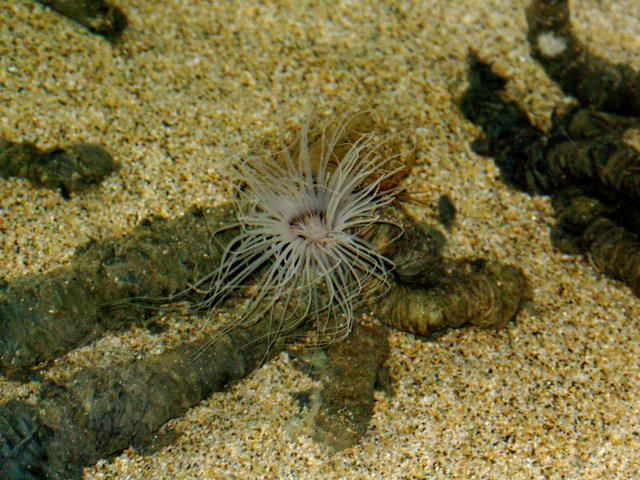
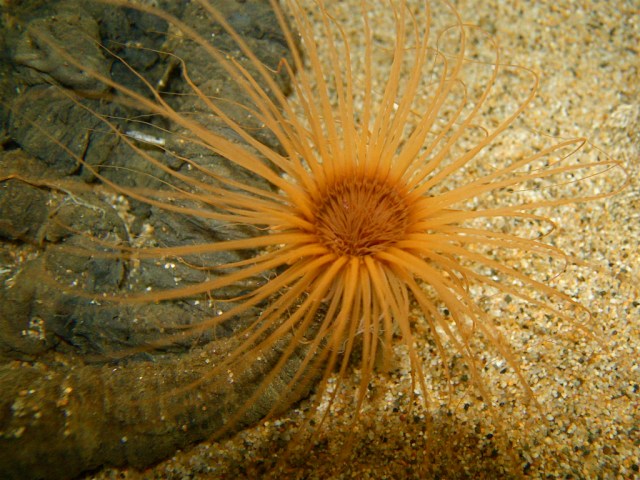
GENERAL CHARACTERISTICS: Solitary tube to 35 cm (14 inches) long when expanded. The tough, slippery, black, secreted tube projects above the mud substrate. Tentacular crown with two circles of translucent whitish to brown-gold tentacles. The inner
circle usually held over the mouth, the outer circle projecting up or out. Like most anemones, the tube-dwelling anemone contains stinging cells or nematocytes along its tentacles.

Tube Anemone  3236526239_4f6bd4f600_o

DISTRIBUTION/HABITAT: California (total distribution poorly known). Fairly common in soft mud bottoms of bays and harbors and protected sandy substrates of the outer coast. Low intertidal and subtidal in S. California; subtidal only in N. California to at least 54 m (177 feet).

Tube Anemone 3288842115_73a426d48d_b

DIET IN THE WILD: Small invertebrates, hydromedusae, small crustaceans and plankton

PREDATORS: Barber slugs clip off its tentacles, resulting in P. fimbriatus retreating quickly down the tube—sometimes pulling the slug in with it. The tentacles grow back after an attack.

REMARKS: Unlike sea anemones the anal pore is at the end of the body.

References

eol eol.org/pages/199417/details

 Walla Walla Universitywww.wallawalla.edu/academics/departments/biology/rosario/…
 Monterey Bay Aquarium www.montereybayaquarium.org/animal-guide/invertebrates/tu…

Ron’s WordPress Shortlink  http://wp.me/p1DZ4b-1kM

Ron’s flickr  https://www.flickr.com/photos/cas_docents/3236526239/in/set-72157625127345346


TAXONOMY
Phylum:Cnidaria
Class: Scyphozoa
Order: Rhizostomae
Family: Cassiopeidae

Genus/species: Cassiopea andromeda

3052389114_c2ebdbe533_o

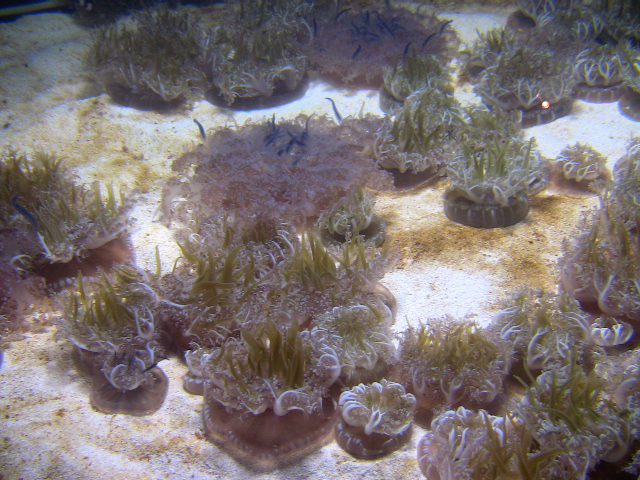
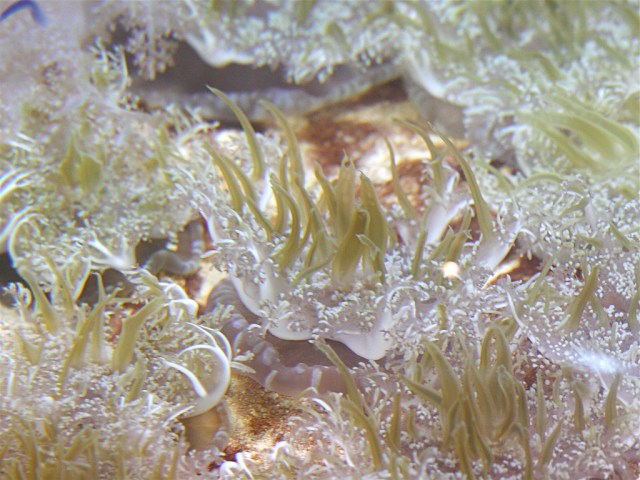
GENERAL CHARACTERISTICS: To 30 cm (12 in) diameter, disc-shaped bell has elaborately fringed oral arms. Coloration is gray, brown or green with triangular white blotches surrounding the bell. Zooxanthellae are the responsible for the color

DISTRIBUTION/HABITAT: Native to Indo-Pacific, but introduced in Caribbean, southern Florida, Hawaii. Upon shallow substrates, typically in calm sandy areas, often around mangroves. Intertidal to 10 m (33 ft).

DIET IN THE WILD: Consumes small marine animals after it paralyzes its prey with its mucous and nematocysts. Symbiotic algae in its tissues provide nutrition by photosynthesis, thus the upside down posture that allows algae, which live on the ventral surface, to receive maximum sunlight. The rhythmic pulsations create water flow that carries zooplankton over the tentacles to supplement the diet.

REPRODUCTION: Asexually (by budding) and sexually in the medusa form.

3279199519_42777fe55f_b

REMARKS: The sting is relatively mild, but may create an irritating, itchy rash; especially sensitive individuals can experience vomiting and skeletal pain.

Mildly venonomus.

Reef Partners Cluster PR35

WordPress Shortlink http://wp.me/p1DZ4b-PV

flickr   http://www.flickr.com/photos/cas_docents/sets/72157610031545571/with/3052389114/

TAXONOMY
Kingdom: Animalia
Phylum: Cnidaria
Class: Scyphozoa
Order: Semaeostomeae
Family: Pelagiidae

Genus/species: Chrysaora fuscescens

4330825373_e4d12ba6ca_b

GENERAL CHARACTERISTICS: The sea nettle is a giant, semitransparent jellyfish, with an amber-colored, swimming bell commonly as large as 30 cm (12 inches) in diameter, with some measuring more than a meter. In addition to four oral arms attached to the underside of the mouth, the sea nettle has 24 long tentacles around the perimeter of the bell that extend up to 4 m (13 ft).

DISTRIBUTION/HABITAT: Marine, found along the westcoast of North America from Mexico to British Columbia.

DIET IN THE WILD: Carnivorous; feeds on zooplankton, small crustaceans, comb jellies, fish eggs and larvae. Sea nettles sting their prey with their tentacles, which have millions of microscopic stinging cells that inject toxins to stun or kill tiny animals. The main oral arms then transport food to the heart-shaped gastric pouches in the bell, where digestion occurs.

PREDATORS: In the medusa stage, sea nettles live from 2–6 mos, usually perishing in rough waters or being eaten by predators— ocean sunfish and leatherback turtles are two of the most prevalent jellyfish predators.

4798725394_c1fc6938ab_b

REMARKS: Question: What has no heart, bones, eyes or brain, is made up of 95% water, and yet
is still a remarkably efficient ocean predator? (The jellyfish) Some jellies commute 1,000 m up and down in the water column daily! Sea nettle stings can result in extreme localized pain. Fortunately this jelly is not aggressive. The bell of this and other jellies is called a “medusa” because, with its long, fringing tentacles, it resembles the snake-haired Gorgon Medusa of Greek mythology.

Venomous

Plankton/Sea Drifters CC24

flickr http://www.flickr.com/photos/cas_docents/sets/72157610031545571/with/4330825373/

WordPress Shortlist  http://wp.me/p1DZ4b-PM

TAXONOMY

Kingdom Animalia

Phylum: Cnidaria (anemones, corals and jellyfish)

Classis: Scyphozoa
Order: Semaeostomeae
Familia: Pelagiidae

Genus/species: Chrysaora Pacifica

IMG_5334

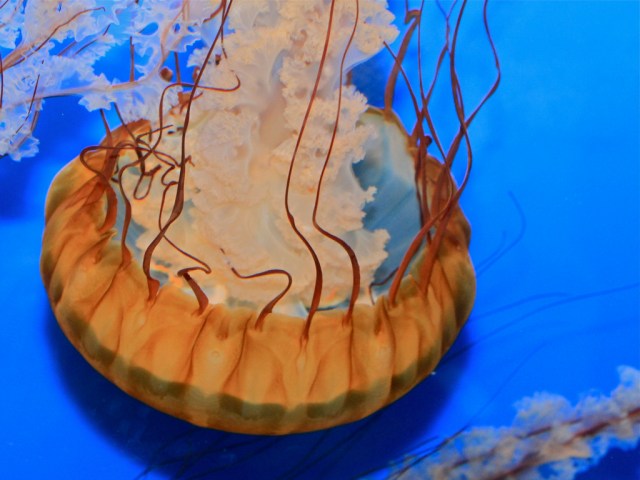
GENERAL CHARACTERISTICS: APPEARANCE: Bells can grow up to 12 inches across and tentacles can stretch 10 feet or more. Their bells are white with brown-to-orange stripes, containing up to 32 very long orange-red tentacles and four long lips. One of C. Pacifica’s most distinguishing characteristics can be found on their undersides, where they have 16 brown stripes and eight stomach pouches.

DISTRIBUTION/ HABITAT: Deep open waters of the northern Pacific Ocean, Arctic Ocean and the Bering Sea. Found at the ocean surface to 200 meters (650 feet) below the surface.

DIET IN THE WILD: Other jellies, small crustaceans called copepods, and small fishes.

REPRODUCTION and DEVELOPMENT: The life cycle made up of five stages. They go through a metamorphosis or change in shape as they grow.
1.lifecycle begins when males broadcast or release sperm into the water and the females catch the sperm to fertilize the eggs she has produced and is holding in her mouth.
2. The fertilized eggs remain attached to the mother’s oral arms and grow into a flat jelly bean-shaped planula.
3. The planula then grows into flower-shaped polyps and the mother releases them into the ocean.
4. The polyps attach to a solid surface and undergo asexual reproduction through which they make an exact copy of themselves without eggs and sperm. The polyp makes these identical animals by budding where the new polyp grows out of its side.
5.After the new polyp is fully formed, it is released into the ocean and starts to change shape, looking more like the adult nettle. The nettle develops a bell, arms and tentacles until it is a fully formed medusa or adult. (Shedd AQ).

IMG_5338

REMARKS: Like many jellies, Japanese sea nettles use stinging cells to defend themselves and stun their prey. While not especially poisonous, their stings can cause intense skin irritation and burning sensations in humans. Some people can have allergic reactions to their venom. If you see one in the water, stay away because there’s a good chance more of them are nearby. Japanese sea nettles travel in swarms, which increases your chance of being stung if you encounter one.

 Animal Attractions

flickr http://www.flickr.com/photos/cas_docents/sets/72157610031545571/

WordPress Shortlink http://wp.me/p1DZ4b-Ps