Category: ARTHROPODS


TAXONOMY
Kingdom: Animalia
Phylum: Arthropoda (Invertebrate animal having an exoskeleton (external skeleton), a segmented body, and jointed appendages). Includes the insects, arachnids, myriapods, and crustaceans.
Subphylum: Crustacea ( crabs, lobsters, crayfish, shrimp, krill and barnacles.)
Class: Malacostraca (Body plan comprises 20 body segments (rarely 21), and divided into a head, thorax, and abdomen). Crabs, lobsters, crayfish, shrimp, krill, woodlice, scuds (Amphipoda)mantis shrimp.
Order: Decapoda (“ten-footed”) crayfish, crabs, lobsters, prawns and shrimp
Family: Palinuridae (langouste or rock lobsters)

Genus/species: Panulirus interruptus

GENERAL CHARACTERISTICS: One of the largest spiny lobster species. The exoskeleton is generally red to orange in color with black markings. Spiny projections are located on the carapace (upper shell) and sides of the abdomen. Their two primary antennae may equal the length of their body. Panulirus interruptus lacks the large pinching claws of their Maine lobster relatives. Average mass is 908 g (32.00 oz) ranging from 454 to 2270 g (16.00 to 80.00 oz). On average, they are 30 cm (11.81 in) long, though they can measure as large as 90 cm (35.43 in) in length.
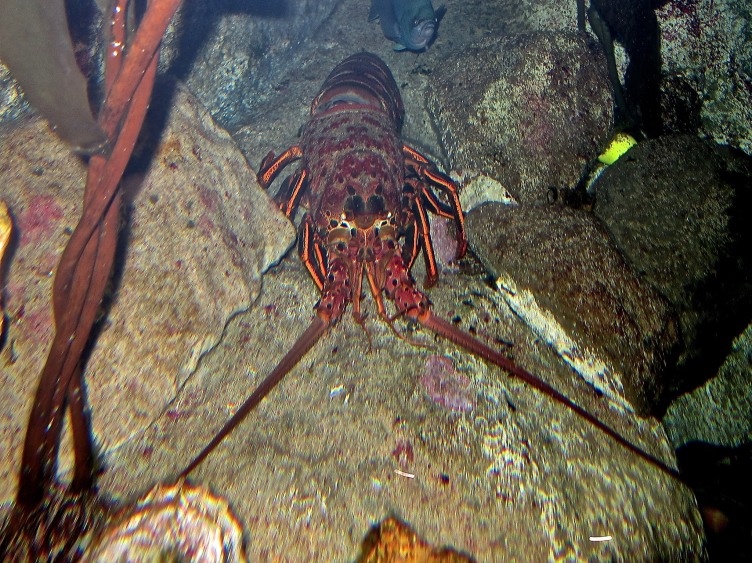
15790212682_b1f9460bd4_k

DISTRIBUTION/HABITAT: Monterey Bay, California to Baja California, Mexico. Found in rocky reefs in caves and rocky crevices. Maximum depth 240 feet.

DIET IN THE WILD: Nocturnal scavenging on sea urchins, small clams, mussels, algae and worms.

REPRODUCTION: Breed once a year during warmer months. Males attach sperm packets to females where she can produce up to 800,000 eggs which hatch into tiny young after 10 weeks. They reach legal size for harvest at 7-11 years of age.

LIFESPAN: In captivity 8 to 25 years.

PREDATORS: Giant Sea Bass, California Sheephead, cabezon, horn sharks, Leopard Sharks, octopus, sea otters and humans.

The photo below is a recent Moult ( shedding of the exoskeleton  typically to let the organism grow).
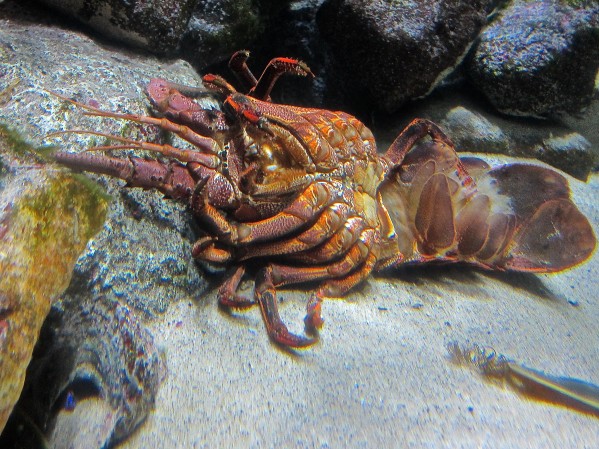
CA Spiny Lobster Molt15837588685_55717b70aa_k

CONSERVATION: IUCN Red List and CITES No special status. California fish and game regulates taking of lobster which requires a sport fishing license. In 2003 over 270 metric tons were harvested.

REMARKS: For defense P. interruptus has sharp spines on the body, tail and antennae. It also can use its powerful flexing tail to flee predators.

Southern California Coastal Marine

References

Animal Diversity Web ADW, animaldiversity.ummz.umich.edu/accounts/Panulirus_interru…

California department of fish and game nrm.dfg.ca.gov/FileHandler.ashx?DocumentID=36321&inli…

Ron’s flickr https://www.flickr.com/photos/cas_docents/15790212682/in/set-72157608602469734/

WordPress shortlink http://wp.me/p1DZ4b-1pi
TAXONOMY
Kingdom: Animalia
Phylum: Arthropoda (invertebrate animal having an exoskeleton (external skeleton), a segmented body, and jointed appendages
Subphylum: Crustacea (crabslobsterscrayfishshrimpkrill and barnacles). Distinguished from other groups of arthropods, such as insectsmyriapods and chelicerates, by the possession of biramous (two-parted) limbs
Class: Malacostraca  (crabslobsterscrayfishshrimpkrillwoodlice, scuds (Amphipoda), mantis shrimp and less familiar animals)
Subclass: Eumalacostraca
Superorder: Eucarida  (decapodskrill and Amphionides)
Order: Decapoda (literally “ten-footed”)  Includes crayfishcrabslobstersprawns and shrimp.
Suborder: Pleocyemata;  members of the Reptantia (including crabs, lobsters, crayfish, and others)
Infraorder: Anomura
Superfamily: Paguroidea (hermit crabs)
Family: Lithodidae (stone crabs)

Genus/species: Cryptolithodes typicus

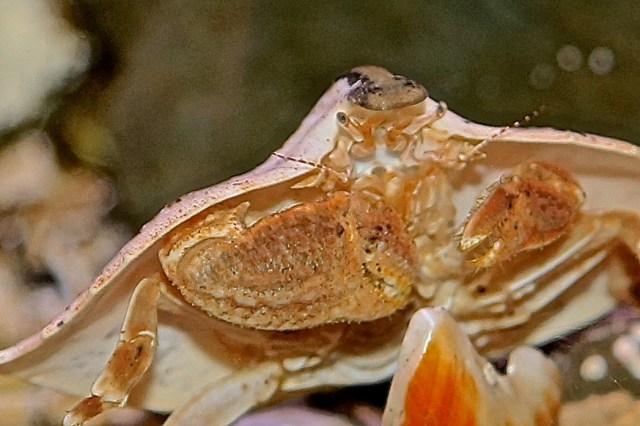
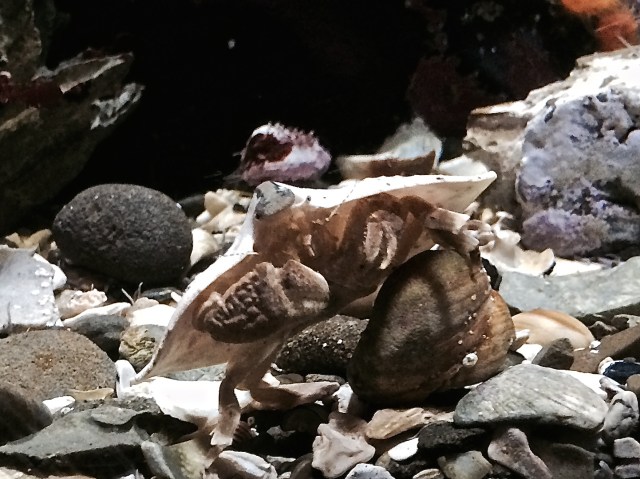
 GENERAL CHARACTERISTICS: The carapace covers the thoracic segments extending so far out covering the tips of the legs. The rostrum is widest at the base and narrower at the tip. Chelipeds are covered with rough tubercles. Carapace color is variable, from dark gray-blue to bright orange, white (especially in small individuals), or red (especially in males). The central part of the carapace is often a different color than the “wings”. Carapace width to 8 cm (3 inches).

Cryptolothodes sitchensis has a similar carapace but its rostrum is widest at the tip and its chelae are smooth.

 Butterfly Crab14453583299_3d6be76343_oDISTRIBUTION/HABITAT: Marine from Amchitka Island, Alaska to Santa Rosa Island, CA. Found in Rocky banks, shell rubble near rocky cliffs in open coast or inland waters, Depth Range: Low intertidal to 45 m (150 feet).

Butterfly Crab14453618558_e56e0e248d_o

DIET IN THE WILD: Feeds on bryozoans, coralline algae.

REFERENCES:

wallawalla.edu/academics/;  www.wallawalla.edu/academics/departments/biology/rosario/…

 eol eol.org/pages/342506/details

Ron’s WordPress shortlink  http://wp.me/p1DZ4b-1k8

Ron’s flickr  https://www.flickr.com/photos/cas_docents/14453618558/in/set-72157608602469734/

 Photo vetted, Margarita Upton Biologist II Steinhart Aquarium California Academy of Sciences

TAXONOMY:
Kingdom: Animalia
Phylum: Arthropoda
Class: Insecta
Order: Lepidoptera (moths and butterflies)
Family: Pieridae (Whites and Sulfurs)

Genus/species: Phoebis philea 

3201526951_715a363cc4_o

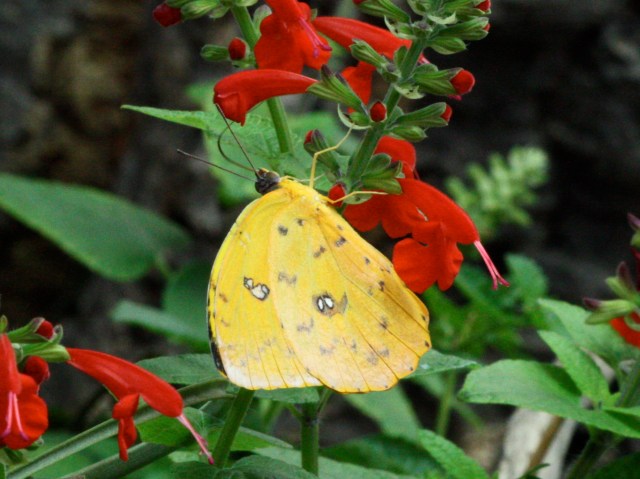
GENERAL CHARACTERISTICS: Upperside of male bright yellow-orange; forewing has red-orange bar, hindwing with red-orange outer margin. Female much larger than male with prominent dark spots along the upper forewing. Wing Span: 2 3/4 – 4 inches.

DISTRIBUTION/HABITAT: Resident from Brazil, north through Central America to peninsular Florida. Migrants appear sometimes along the Gulf States, in eastern Arizona and in New Mexico along the border. During dry years, some migrate to the Northeast. P. philea has been considered a transient resident of Southern California. Found in open lowland sites along forest edges. Also frequents gardens, parks, and road edges.

Orange Barr Sulphur 3128915093_cd28b8bf32_o

DIET IN THE WILD: Caterpillar: Cassia species in the pea family; adult: nectar from various flowers.

REPRODUCTION: Females lay single eggs on leaves and flowers of host plants during the wet season. Caterpillars feed preferentially on the flowers.

REMARKS: These swift, high flyers have been reported as rare migrants as far north as Canada.

flickr http://www.flickr.com/photos/cas_docents/sets/72157608449327886/with/3201526951/

WordPress Shortlink  http://wp.me/p1DZ4b-14i

TAXONOMY
Kingdom: Animalia
Phylum: Arthropoda
Class: Insecta
Order: Lepidoptera (moths and butterflies)
Family: Nymphalidae (Brush-footed Butterflies)

Genus/species: Heliconius doris

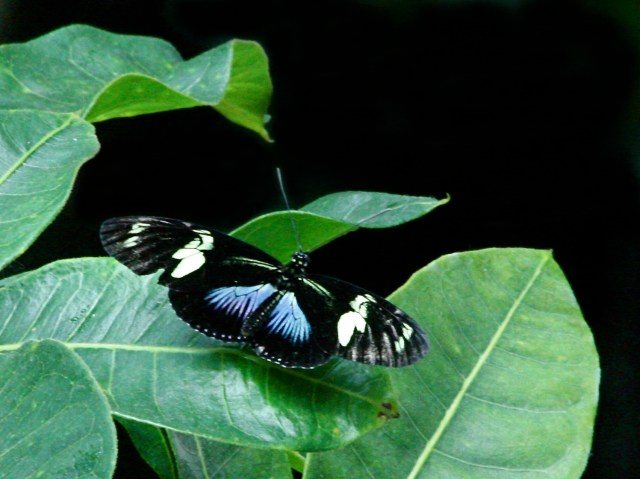
Blue morph

Doris Longwing (blue morph)  3267097210_300ac83016_o

GENERAL CHARACTERISTICS: Appears in several color morphs; hindwing markings may be red-orange, blue, or green. Two white markings on forewing.

Doris Longwing red morph Heliconius doris light sm text

DISTRIBUTION/HABITAT: Central America to northwestern Amazonia. Found from sea level to 1,800 m (5,900 feet) in forest clearings. Fly and feed mostly in the mid-story.

DIET IN THE WILD: Nectar and pollen.

Wing underside

Doris Longwing 4747129049_3c7123e657_b

PREDATORS: Eaten by birds.

REMARKS: Heliconians are unique. Unlike other butterflies, they not only sip nectar, but also use their proboscises to collect and absorb the protein from pollen. This amino acid-rich diet allows them to function and live longer than most other butterflies. Adults can live for up to 9 months.

flickr http://www.flickr.com/photos/cas_docents/sets/72157608449327886/

WordPress Shortlink   http://wp.me/p1DZ4b-13s

TAXONOMY
Kingdom: Animalia
Phylum: Arthropoda
Subphylum: Crustacea
Class: Malacostraca
Order: Decapoda
Family: Atyidae

Genus/species: Atyopsis moluccensis

Bamboo Shrimp IMG_0285

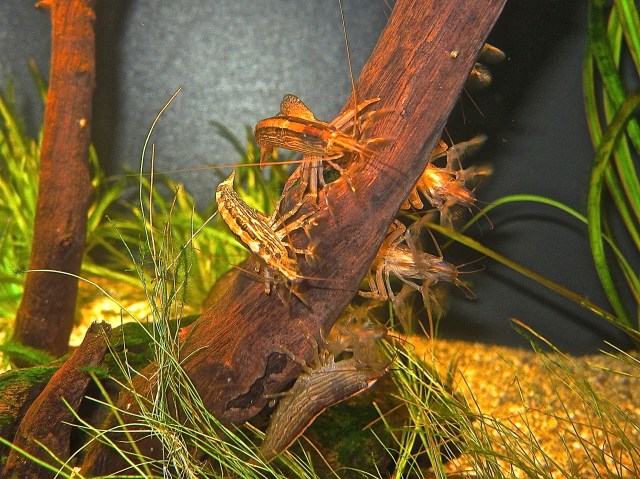
GENERAL CHARACTERISTICS: Most species are a brown base color with a tan strip running from head to tail. They vary greatly in color however. Some a greenish-yellow or even red as the base color. Clawless and 4-5 inches in length. Male bamboo shrimp displays two larger forelegs, while the female’s legs are all the same size.

DISTRIBUTION/HABITAT: Found on high islands from Sri Lanka to the Samoan Islands, and as far north as Okinawa, as well as on the Asian mainland from the Malay Peninsula in freshwater areas where their is high current..

DIET IN THE WILD: Filter feeder. using four fan-like appendages on the head to sweep food particles from the water.

Bamboo Shrimp  8724380835_382a2b1ec6_o

Water Planet

WordPress Shortlink http://wp.me/p1DZ4b-XZ

flickr  http://www.flickr.com/photos/cas_docents/8717355179/in/set-72157608602469734

TAXONOMY
Kingdom: Animalia
Phylum: Arthropoda
Class: Arachnida (Arachnids)
Order: Araneae (Spiders)
Infraorder: Araneomorphae (True Spiders)
Family: Theridiidae (Cobweb Spiders)

Genus/species: Latrodectus mactans

Black Widow Spider

GENERAL CHARACTERISTICS: Female is glossy, coal-black color with long, slender legs and round abdomen; her underside usually carries a characteristic red hourglass mark. Adult Female: Approximately 8-13 mm (~1/2 inch) in body length. With legs extended, the female measures about 25-35 mm (1 inch – 1 1/2 inches). Adult Male: Approximately half the size of the female

DISTRIBUTION/HABITAT: In the U.S. ranges north to New England, south to Florida, Texas, Oklahoma; west to California, and throughout the southwest deserts. Also found in Canada, Mexico, the West Indies, and South America. Found close to the ground, especially dark, sheltered spots, such as under stones, in woodpiles, crevices, barns, outbuildings. Usually not found indoors.

DIET IN THE WILD: Carnivorous, mostly on insects, but also on other small invertebrates. When prey becomes ensnared in the web, black widow wraps it in silken threads and injects venom.

PREDATORS: Probably lives, like most spiders, about one year. Preyed upon by wasps including the muddauber wasps.

Black Widow Spider

REMARKS: Adult males are harmless. Females have a highly venomous bite that rarely kills humans, though young children or the elderly are likely to have severe reactions that can be fatal. Improvements in plumbing have greatly reduced the incidence of bites and fatalities in areas where outdoor privies have been replaced by indoor flush toilets.

Swamp SW06

WordPress Shortlink http://wp.me/p1DZ4b-Tt

flickr http://www.flickr.com/photos/cas_docents/sets/72157608653175263/

TAXONOMY
Phylum: Arthropoda
Class: Arachnida
Order: Araneae
Family: Theraphosidae

Genus/species: Lasiodora parahybana

8274421702_51193cf844_b

GENERAL CHARACTERISTICS: Said to be the third largest spider in the world, this is a large-bodied tarantula with abdomen and legs covered with sensitive, long, and partially pink or salmon-colored hairs. Maximum size: body, 9-10 cm (3.5–4 in); leg span, 20-25 cm (8–10 in).

DISTRIBUTION/ HABITAT: Throughout northeastern Brazil on the tropical forest floor

DIET IN THE WILD: Lie and wait carnivore, eating large crawling insects and other invertebrates, small rodents, lizards, and frogs rarely seen eating birds like newly hatched chicks of ground-dwelling birds. Venom injected by chelicerae that liquefy the kill, which is then sucked in by the mouthparts.
Regardless of its name, the spider is rarely seen eating birds.

6962229601_2e288eea4a_b

REPRODUCTION: The male spins a small area of silk onto which he deposits his sperm. The sperm is then absorbed into the pedipalps, which during mating are inserted into the genital opening of the female, transferring the sperm, which remains viable. After insemination, the male makes a swift retreat as the much smaller males occasionally become a sacrifice to the female’s need to maintain the nutritional viability of a mother-to-be. The female lays up to 2000 fertilized eggs in a thick, silken sac which she guards fiercely. Young spiderlings are born about 3 weeks later. Voracious feeders, they grow quickly.

PREDATORS: Tarantulas have few enemies except the tarantula hawk wasps. Members of this wasp family use their sting to paralyze species specific tarantulas.

REMARKS: Like most tarantulas and some other spiders, if this spider loses one of its legs, it can regrow the lost appendage.
While not highly aggressive and bites are not fatal to humans (most tarantula bites are similar to a bee sting in toxicity), this big bruiser, because of its long fangs, can inflict a serious wound which one researcher defined as “capable of medically significant mechanical damage”! If pursued by a potential foe, the spider rubs its legs against its abdomen, throwing tiny, barbed hairs that become imbedded in the attacker. The barbs can cause significant irritation, especially if lodged in the eyes or nasal passages.
Venomous

Animal Attractions

flickr http://www.flickr.com/photos/cas_docents/sets/72157608653175263/with/6962229601/

WordPress Shortlink  http://wp.me/p1DZ4b-Qk

TAXONOMY
Phylum Arthropoda
Class Arachnida
Order Scorpiones,
Family Scorpanidae (Scorpions)

Genus/species: Pandinus imperator

6976512905_11a36f5ae1_b

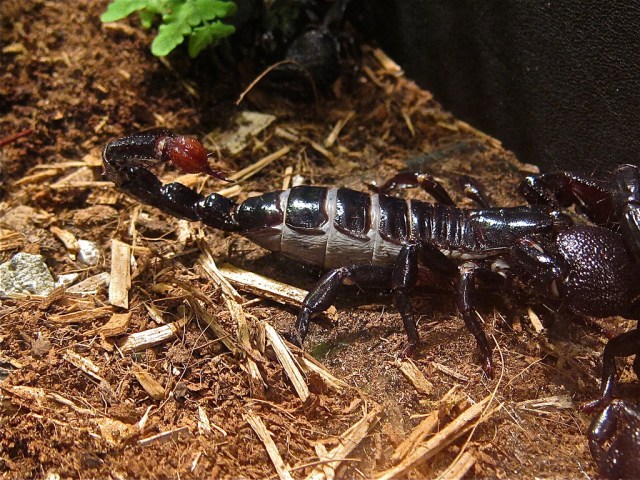
GENERAL CHARACTERISTICS: The largest scorpion known, (length to 20 cm (8 in); weight to 30 g (1 oz). Its black body bears large, blackish-red pincers with a granular appearance. The long tail, which arches back over the body, is tipped with a sharp curved stinger that delivers venom produced from a gland in the attached bulb.

DISTRIBUTION/HABITAT: West Africa Tropical forest and open savanna where it hides under rocks, burrows beneath the soil, or cohabits termite mounds.

GENERAL CHARACTERISTICS: The largest scorpion known, (length to 20 cm (8 in); weight to 30 g (1 oz). Its black body bears large, blackish-red pincers with a granular appearance. The long tail, which arches back over the body, is tipped with a sharp curved stinger that delivers venom produced from a gland in the attached bulb.

DIET IN THE WILD: It preys upon ground-dwelling insects, spiders, and other invertebrates as well as an occasional baby lizard, snake, or mouse. These large scorpions rarely sting small prey; instead they grasp the prey in powerful pincers and tear it apart. The venom is reserved for larger prey or defense.

REPRODUCTION/DEVELOPMENT: During mating, the male finds a suitable spot where he deposits his sperm packet, called a spermatophore. He then engages the female in an elaborate mating dance above the spermatophore with the male holding up the pincers of the female with his own, and carefully maneuvering her over the spermatophore, which she draws up into her genital pore. The eggs are fertilized, and the female carries them internally. After a 7 to 9 month gestation period, she gives birth to between 9 to 32 live young. The newborn climb onto the mother’s back, protected from predators by her size and aggressive behavior. Until the young are capable of hunting on their own, the mother feeds them by killing insects which are left on the floor of the burrow or other enclosure where the young can climb down and feed in safety.

PREDATORS: Predators include birds, bats, small mammals, large spiders, centipedes, large lizards, and other scorpions. Life span: 5 to 8 years.

7595589286_6713f5c418_b

REMARKS: Sensory hairs on the pincers and tail enable the scorpion to detect prey and danger through vibrations from the air and ground. Like all scorpions, it has poor eyesight (despite having 6 to 12 eyes), good hearing, a good sense of touch and is venomous.

ANIMAL ATTRACTIONS

flickr http://www.flickr.com/photos/cas_docents/sets/72157608653175263/with/7595589286/

WordPress Shortlink http://wp.me/p1DZ4b-Q4

TAXONOMY

KINGDOM      Animalia

PHYLUM        Arthropoda  (External skeleton, segmented body and jointed appendages)

SUBPHYLUM  Crustacea

CLASS          Malacostraca

ORDER         Decapoda  (ten legged)

FAMILY        Hippidae  (mole crabs or sand crabs)

GENUS/SPECIES  Emerita analoga


GENERAL CHARACTERISTICS

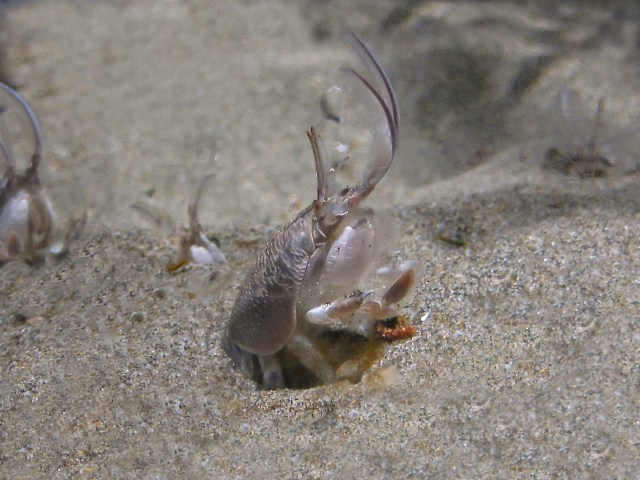
 Grey or sand colored exoskeleton without spines or claws.  The eyes are on long stalks and the antennae are also elongated so as to project above the surface of the sand. The legs and uropods have hairy margins to assist in digging and for use in collecting food and transferring it to the mouth.  The first pair of antennae reach above the sand for respiration, and the second pair, resembling feathers, are extended when the crab feeds. The female is nearly twice as large as the male up to 35 mm  (1.4 in) long and 25 mm (1.0 in) wide.

The sand crab always moves backwards when burrowing or crawling.

DISTRIBUTION/HABITAT

Pacific coast from Alaska to Baja California in the northern hemisphere and between Ecuador and Argentina in the southern hemisphere. E. analoga live in the swash zone (area of breaking waves) of the sandy beach intertidal zone.

DIET IN THE WILD

Antennae collect small organisms, mostly dinoflagellates which are brought to the mouth and consumed.

 REPRODUCTION

During the reproductive season (February-October), females can produce one clutch per month of 50-45,000 eggs, which take approximately 30 days to develop. Once the eggs hatch, the larvae are planktonic for 4-5 months.

PREDATORS

Fish, water birds, and shorebirds.

The barred surfperch is a very common fish in the surf zone, and sand crabs have been found to make up 90% of its diet.

Emerita analoga are  also used as bait by fishermen.


REMARKS

Sand crabs are known to carry parasites. They are an intermediate host of parasitic worms which are passed on to the predators of sand crabs. Sea otters and birds can eat many crabs per day, and the ingested parasites have been known to kill these predators.

Researchers monitor levels of DDT and domoic acid (a diatome neurotoxin) on a regular basis to assess the health of the ocean.

LOCATION Tidepool

WordPress Shortlink  http://wp.me/p1DZ4b-zq

flickr  http://www.flickr.com/photos/cas_docents/sets/72157608602469734/

Order Coleoptera

The largest of insect orders, currently about 350,000 beetle species are known.  One of every five animals on earth is a beetle!  The name coleoptera or “sheath wings” derives from sheath-like wing cases, called elytra, that provide protection to a second, underlying pair of more delicate flight wings. The elytra are not used to power flight, but help stabilize the beetle as it flies.  Some beetles, such as various ground beetles, have lost the ability to fly.

Stag, Hercules, and Rhinoceros Beetles

Family Lucanidae and Family Scarabaeidae (Subfamily Dynastinae)

DISTRIBUTION: Worldwide distribution.

HABITAT: Mostly woodlands. Adults live and breed in damp, rotting wood.

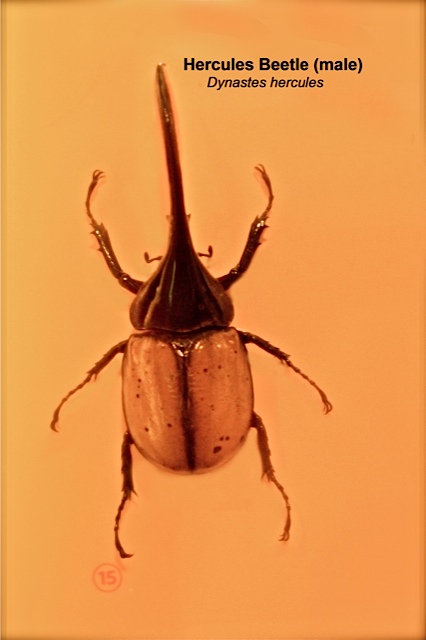
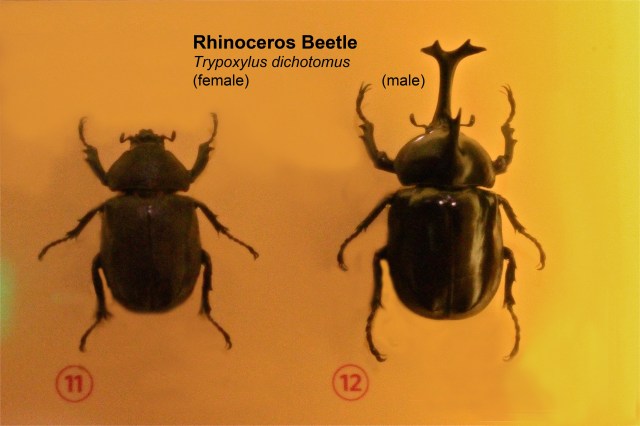
APPEARANCE:  Medium to large beetles, males of some species have spectacularly large jaws. Females are considerably smaller in size, and lack the impressive “horns.”

DIET: Larvae feed on decaying wood, probably getting nutrition not just from the cellulose, but from the fungi and microbes decomposing it. Adults of most species feed on sugary liquid food, such as sap from wounded trees, aphid ” honeydew” secretions, and ripe fruit. Adults are unable to chew.

REPRODUCTION/DEVELOPMENT: Males use their huge jaws to fight for access to females. Individual males play “king of the hill,” only in their case they are fighting to win access to control a dead stump or tree that a discriminating female will find highly suitable as a residence to feed and protect her offspring. The male-male contest involves each trying to maneuver his huge mandible underneath and overturning his competitor, ideally knocking him to the ground. Injuries are rare, but the victor, who is typically the largest and strongest, gains the female, or often multiple females, as he controls the best breeding property.

Stag beetles evolutionary development of sexual dimorphism, with males being significantly larger than females, repeats a miniature version of a sexual strategy familiar in the animal kingdom: to the victor (the largest male) belongs the spoils (reproductive rights to pass along his genes). Even better, this strategy is most often found in haremic groups, where the male wins not only one female, but many.

MORTALITY/LONGEVITY: Larvae live 3-5 years, adults a few months.

WORDPRESS SHORTLINK  http://wp.me/p1DZ4b-r7