Archive for March, 2014


TAXONOMY
Kingdom: Animalia
Phylum: Chordata
Class: Actinopterygii (ray-finned fishes)
Order: Perciformes (Perch-likes)

Family: Labridae (Wrasses)

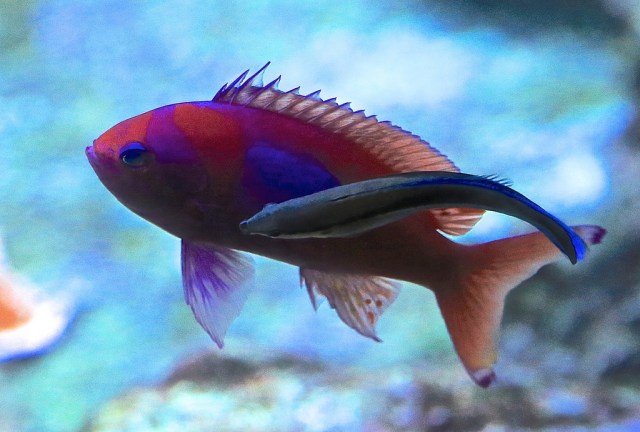
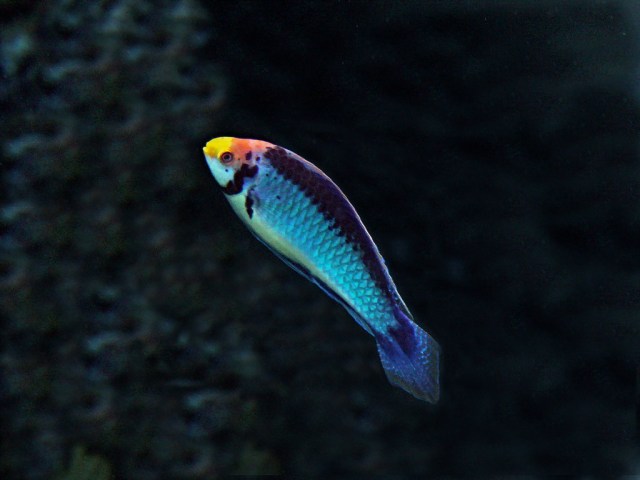
Genus/species: Cirrhilabrus exquisitus

Specimen below is a male
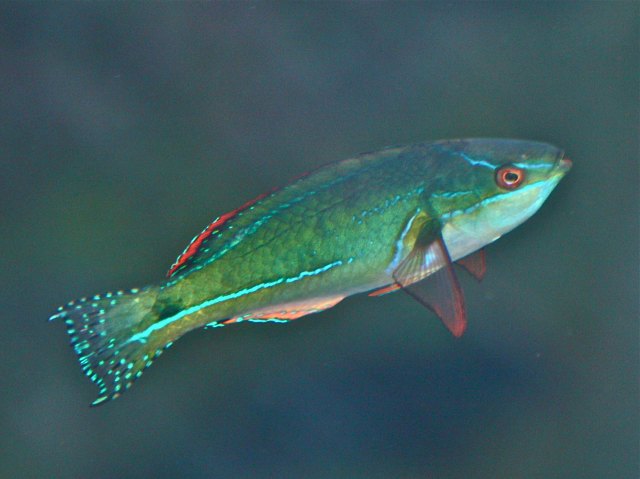
ExquisitefairywrasseCirrhilabrusexquisitusIMG_0091


GENERAL CHARACTERISTICS: Body shape is fusiform. Mouth is terminal.  Post-juvenile initial phase to 7 cm and colored shades of brown; large black spot on base of upper tail. Terminal phase individuals colored shades of green, bright red margins on dorsal and anal fins, narrow blue stripe from mid-body to tail, large black spot on base of upper tail, two or three blue line marks on head.  Maximum length 12cm (4.75 inches)

DISTRIBUTION/HABITAT: East Africa to Tuamotus, north to Izus, southern Japan and south to Great BarrierReef, Australia over rubble or low patch reefs in areas of current, also on reef edges and near rubble zones in 5–35 m. (16-115 feet)

DIET IN THE WILD: Zooplankton in the water column, well above the substrate.

CONSERVATION: Data deficient (DD) Philippine Coral Reef PR04

References

WordPress shortlink http://wp.me/p1DZ4b-1eS

flickr http://www.flickr.com/photos/cas_docents/4563757962/in/set-72157608208133134/

fishbase  http://www.fishbase.de/summary/Cirrhilabrus-exquistius.html
EOL  http://eol.org/pages/357163/details

Taken on January 8, 2009, 3-20-14

TAXONOMY
Kingdom: Animalia
Phylum: Chordata
Class: Actinopterygii (ray-finned fishes)
Order: Perciformes (Perch-likes)
Family: Labridae (Wrasses)

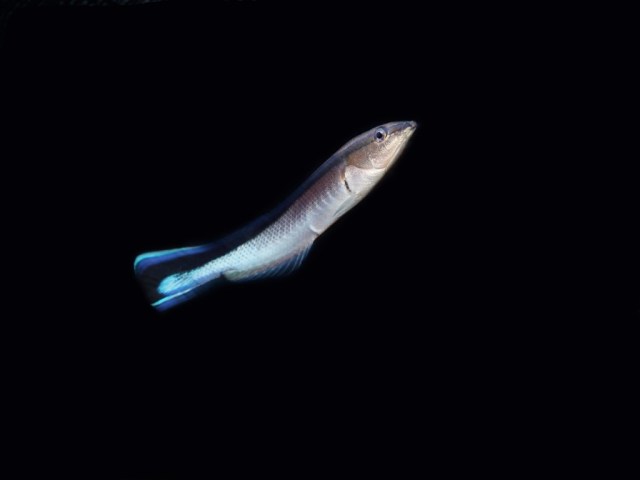
Genus/species: Labroides dimidiatu

GENERAL CHARACTERISTICS: Length to 11.5 cm (4.5 inches). Elongate body, tubular mouth. Blue to yellow above fading to white or yellow below. There is a black stripe from the eye to the caudal fin margin. The stripe widens posteriorly.

DISTRIBUTION/HABITAT: Indo-Pacific in virtually all coral reef habitats: inner lagoons and subtidal reef flats to seaward reefs, 0.5-40 m (18 in to 125 ft), typically near branching corals. Active diurnally. Aggressively territorial. Nocturnally retires to small crevices in the reef, enclosing itself in a mucus cocoon. Remains in stations where other fish come to be cleaned.

DIET: The most common cleaner wrasse on reefs. Pick external parasites from other fishes. Also clean the wounds of other fishes by removing scar tissue. Clean the gills and even enter the mouth of the host.

REPRODUCTION: Monogamous. A protogynous hermaphrodite.
Open water/substratum egg scatterers, non guarders.

CONSERVATION: IUCN, Least concern

Cleaner Wrasse13298334135_9737aa3d26_b

Philippine Coral Reef PR04

flickr http://www.flickr.com/photos/cas_docents/sets/72157608208133134/with/2977676226/

WordPress Shortlink http://wp.me/p1DZ4b-Kp

fishbase fishbase.sinica.edu.tw/summary/SpeciesSummary.php?ID=5459

EOL eol.org/pages/204814/details

Australia Museum  australianmuseum.net.au/Common-Cleanerfish-Labroides-dimi…

TAXONOMY
Kingdom: Animalia
Phylum: Chordata
Class: Actinopterygii (ray-finned fishes)
Order: Perciformes (Perch-likes)
Family: Labridae (Wrasses)

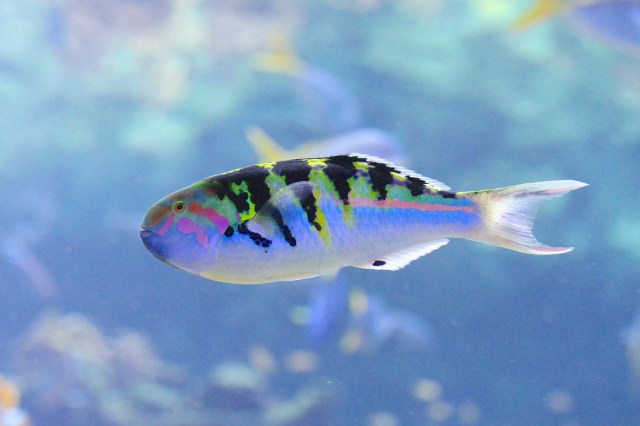
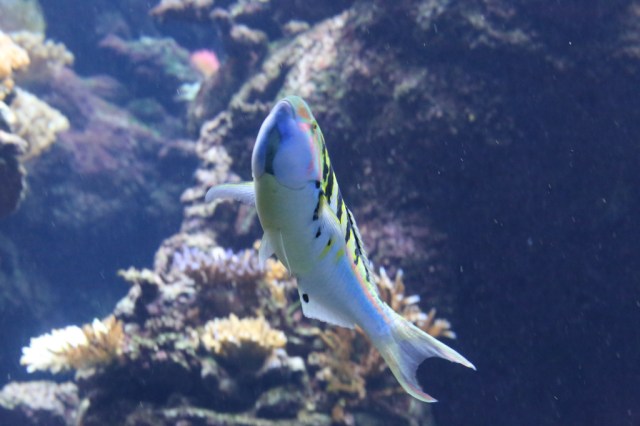
Genus/species: Thalassoma hardwicke

Sixbar Wrasse8410603333_678203e399_b

GENERAL CHARACTERISTICS: Adult is pastel blue to pale green with six dark, vertical bars on their body, the last two saddling the tail. The head has a distinct ‘daisy’ print around the eyes made of a few different pastel colors (e.g., pink bands radiating from the eye) in larger adults.  Max length: 20 cm (7.9 in).

DISTRIBUTION/HABITAT: Found in the tropical Indo-Pacific in shallow lagoons and seaward reefs. Depth to 15 m (50 ft.).

DIET IN THE WILD: Carnivore on benthic and planktonic crustaceans, invertebrates and small fishes.

Sixbar Wrasse8393609669_e1f3601c7c_b

REPRODUCTION: Protogynous hermaphrodite; Hermaphroditism occurs when a given individual in a species possesses both male and female reproductive organs, or can alternate between possessing first one, and then the other. The most common pattern is for a female to change into a male (protogyny). This often happens when a large dominant male is removed by a predator. Within a few days, the largest female in the harem becomes a dominant male and takes over the missing male’s function. This pattern is common in coral reef fishes, such as parrotfishes, wrasses, and groupers.
T.hardwicke is a pelagic spawner meaning water currents widely disperse the young. The eggs, embryos and larvae of pelagic spawners contain oil globules or have a high water content. As a result, they are buoyant and are widely dispersed by currents. The downside is that mortality is high, because they can be eaten so easily by pelagic predators. Pelagic spawners who live in or around coral reefs can spawn a small number of eggs almost daily over a period of months.

CONSERVATION: IUCN; least concern

REMARKS. Occur in small, loose groups.

References

flickr http://www.flickr.com/photos/cas_docents/4390962019/in/set-72157608208133134/

WordPress shortlink wp.me/p1DZ4b-nD

fishbase www.fishbase.org/summary/Thalassoma-hardwicke.html

EOL eol.org/pages/220102/details

Kingdom: Animalia
Phylum: Chordata
Class: Actinopterygii (ray-finned fishes)
Order: Perciformes (Perch-likes)
Family: Pomacanthidae (Angelfishes)

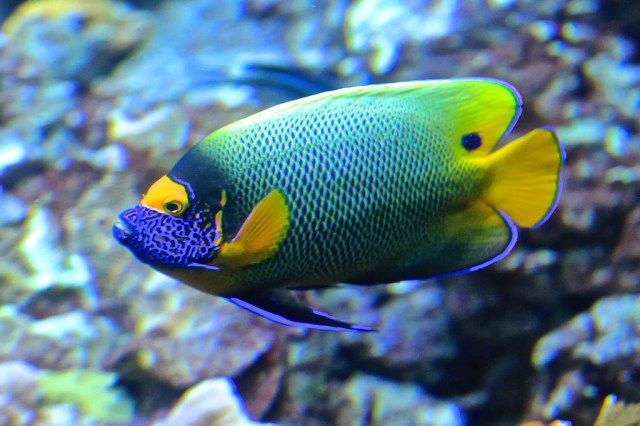
Genus/species:  Pomacanthus xanthometopon

Yellow Mask Angelfish13298710574_515d270046_b

GENERAL CHARACTERISTICS: The head is blue with a yellow eye mask. Scales are blue with a yellow margin creating a network pattern. The yellow dorsal fin has a spot black large posteriorly and the caudal fin is also yellow. Body depth 1.7-1.9 in. Length 6-9 inches.

DISTRIBUTION/HABITAT: Indo-Asian Pacific. Found in lagoons and coral reefs 5-30 meters (16-100 feet).

Yellow Mask Angelfish13298332785_879178297f_b

DIET IN THE WILD: Encrusting organisms such as sponges and tunicates.

CONSERVATION: IUCN Least concern

On exhibit at the Long Beach Aquarium 2016

References

California Academy of Sciences Steinhart Aquarium Philippine coral reef 2016

WordPress shortlink  http://wp.me/p1DZ4b-1et

fishbase www.fishbase.org/summary/Pomacanthus-xanthometopon.html

EOL eol.org/pages/994431/overview

Australian museum australianmuseum.net.au/Blueface-Angelfish-Pomacanthus-xa…

TAXONOMY
Kingdom:Animalia
Phylum: Chordata
Class: Actinopterygii (ray-finned fishes)
Order: Perciformes (Perch-likes) 
Family: Labridae (Wrasses)

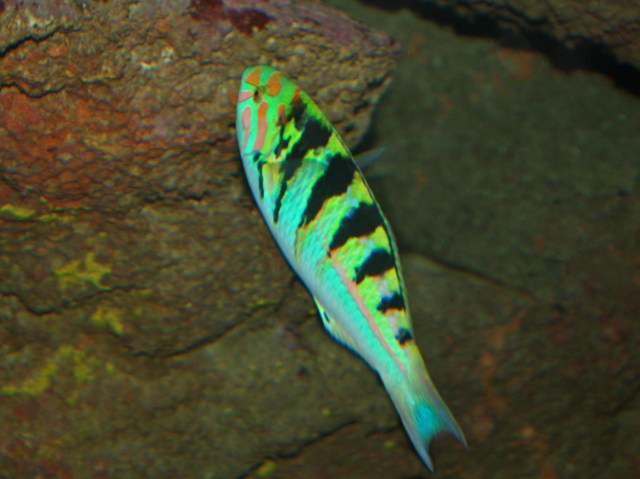
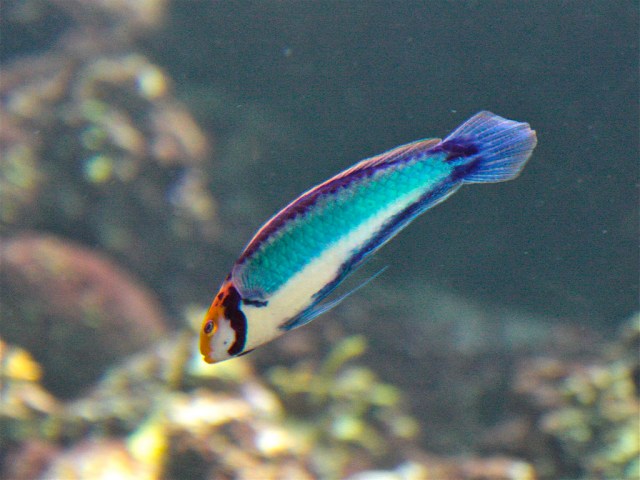
Genus/species: Cirrhilabrus solorensis

Cirrhilabrus solorensis3380013623_6c8c3e586c_b

GENERAL CHARACTERISTICS: Highly variable. The eye is bright red. Males usually have a dark band along the end of the gill covering. Change color and sex with growth. Females are able to change sex into an often brilliantly colored terminal male phase. Max. size: 11 cm (4.3 inches).

DISTRIBUTION/HABITAT: Found in the Western Central Pacific and Indonesia. in coastal to outer reef lagoons on rubble and coral habitats.

DIET IN THE WILD: Zooplankton.

Cirrhilabrus solorensis3813060378_a4f75890b9_b

REMARKS: The cornea of the eye of fairy wrasses is divided into two segments, essentially forming a double pupil. It is thought that the center pupil is a close-up lens that lets the fish have a magnified view of their small prey.

Philippine Coral Reef PR04

References:

flickr http://www.flickr.com/photos/cas_docents/3380013623/in/set-72157608208133134/

WordPress shortlink http://wp.me/p1DZ4b-1ef

fishbase www.fishbase.org/Summary/SpeciesSummary.php?id=60815

EOL eol.org/pages/210468/details

TAXONOMY
Kingdom: Animalia
Phylum: Chordata
Superclass: Osteichthyes
Class: Actinopterygii (ray-finned fishes)
Order: Perciformes (Perch-likes)
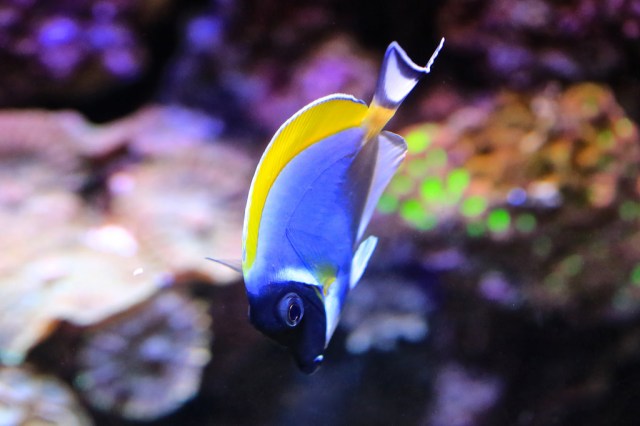
Family: Acanthuridae (Surgeonfishes, Tangs, and Unicornfishes)

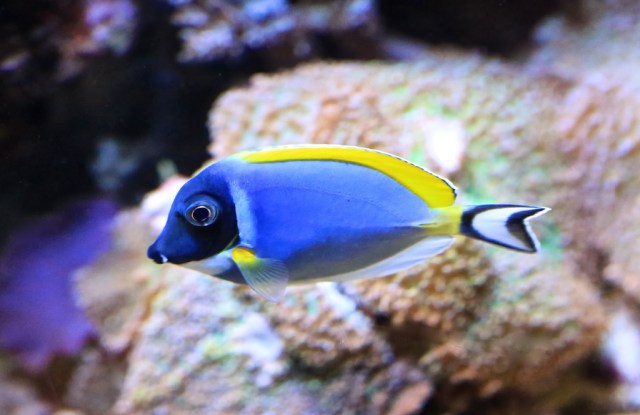
Genus/species; Acanthurus leucosternon

Acanthurus leucosternon 13140534045_d29f009b4f_b

GENERAL CHARACTERISTICS: Blue with a white chest. Head black with a broad white band from pectoral-fin base to throat.Also has a white band at base of lips. Dorsal fin yellow (except white margin and black submarginal line). Anal and pelvic fins white. Common length 19 cm (7.5 inches).

DISTRIBUTION/HABITAT: Indian Ocean in shallow, clear coastal and island reefs, 0.5-25 m (1.5-80 feet) . Usually on reef flats and along upper seaward slopes; sometimes in huge aggregations.

DIET IN THE WILD: benthic algae.

REPRODUCTION: Monogamous, open water/substratum egg scatterers

CONSERVATION: IUCN Least concern.

Acanthurus leucosternon13140818894_48010cf40c_b

Animal attractions Rich Ross

3-14-14

References

flickr www.flickr.com/photos/cas_docents/2978892415/in/set-72157…

WordPress shortlink  http://wp.me/p1DZ4b-1dQ

fishbase fishbase.org/summary/1257

EOL eol.org/pages/206882/details

Kingdom: Animalia
Phylum: Chordata
Class: Actinopterygii (ray-finned fishes)
Order: Perciformes (Perch likes)
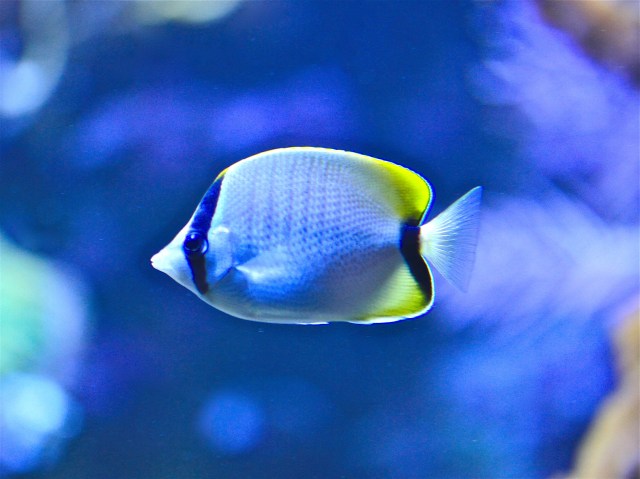
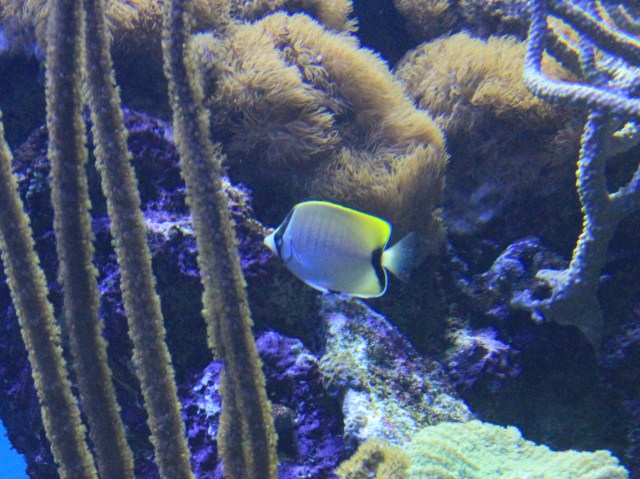
Family: Chaetodontidae (Butterflyfishes) The name “Chaetodontidae” means “bristle-tooth”.

Genus/species: Chaetodon sedentarius.

Reef butterflyfish  Chaetodon sedentarius ChaetodontidaeIMG_5652

GENERAL CHARACTERISTICS: Silver body, yellow and black dorsal fin, and yellow tail; two vertical black bars, one on the head through the eye and a black bar across the caudal peduncle. Max length: 6 inches (15 cm). 

DISTRIBUTION/HABITAT: a tropical western Atlantic species, found in the waters of the Carolinas to northern South America, including the Gulf of Mexico and the Caribbean Lives in the shallows and as deep as the light restricts coral growth. ( 48-130 feet deep).

DIET IN THE WILD: Coral polyps, polychaete worms, shrimps, amphipods and hydroids. Can be quite acrobatic in its feeding, often swimming upside down to get into crevices where prey might be hiding.

REPRODUCTION: Found in pairs, suggesting monogamy. The larvae of butterflyfishes are unique from all other species of fish. The head is encased in bony armor and large bony plates extend backwards from the head. These larvae, called “tholichthys,” grow to about 20mm, after which they settle on the bottom during the night.

PREDATORS: Preyed upon by larger fish, such as moray eels, snappers, and groupers. If it can’t find cover, will defend itself by facing its predator with dorsal spines erected, suggesting a sharply distasteful meal.

IMG_2594

CONSERVATION: IUCN:  Least concern (LC)

REMARKS: Gets its name from its flitting movements about the reef and its beautiful color pattern that resembles the movements and appearance of the insect. 

Caribbean reef,  Currently not on exhibit

References 

WordPress shortlink  http://wp.me/p1DZ4b-1ds

flickr http://www.flickr.com/photos/cas_docents/4329888679/in/set-72157625119200613

fishbase http://www.fishbase.org/summary/3605

Florida Museum of Natural History: http://www.flmnh.ufl.edu/fish/Gallery/Descript/ButterflyReef/ButterflyReef.htm

TAXONOMY
Kingdom: Animalia
Phylum:Chordata
Class: Actinopterygii (ray-finned fishes)
Order: Perciformes (Perch-likes)
FamilyChaetodontidae (Butterflyfishes)

Genus/Species: Chaetodon mitratus 

Chaetodon mitratus or Indian Butterflyfish SP07IMG_0103

GENERAL CHARACTERISTICS: Head and body yellow, diagonal stripes two very broad black from dorsal to ventral contour eye bar black to orange. Snout length 2.7-3.3 in. . Body depth 1.7-1.9 .

DISTRIBUTION/HABITAT: Western Indian Ocean. Found in deep tropical marine coral reefs. 22-80 meters (70-260 ft)

DIET IN THE WILD: Coral polyps, zooplankton

REPRODUCTION: Oviparous. Form pairs during breeding

CONSERVATION: IUCN Least Concern (LC)

Chaetodon.mitratusIndian ButterflyfishSP07low.IMG_0100.IMG_0100

REMARKS: Little is known of C. mitratus

References

WordPress shortlink  http://wp.me/p1DZ4b-1dl

flickr  http://www.flickr.com/photos/cas_docents/12918681523/in/set-72157625119200613/

fishbase www.fishbase.org/summary/speciessummary.php?id=8927

EOL eol.org/pages/215193/overview