
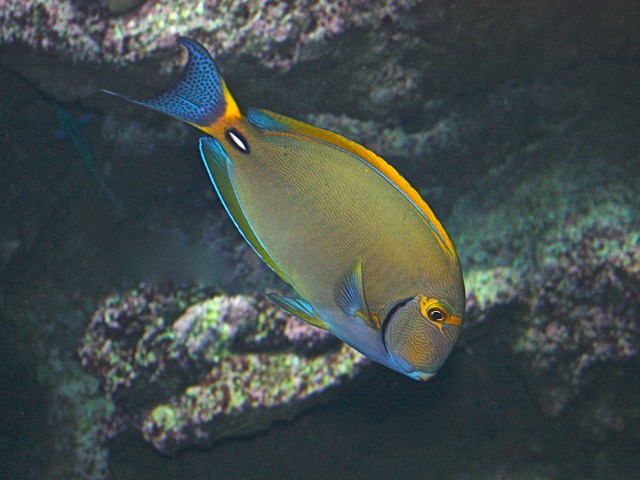
Eyestripe Surgeonfish
Acanthurus dussumieri (Acanthuridae)
Surgeonfishes, Tangs, and Unicornfishes
Distribution: Indo-Pacific: from East Africa to
Hawaii and the eastern Central Pacific. Also
from southwest Japan to the Great Barrier Reef.
Absent from most of the Central Pacific.
Habitat: Adults are found mainly on deep
coastal reef slopes and outer reef walls, often on
deep shipwrecks. Depth ranges from 4–130 m.
Appearance: Bluish to brownish body with
horizontal line markings; yellow stripe through
eye, blue tail with numerous black spots; white
caudal spine with the socket edged in black.
Typically seen as a solitary fish but may also
occur in small groups. Max. size: 50 cm.
Diet: Grazes algae from reefs and sand.
Reproduction and Development: Reported to be
a pair spawner; eggs are small and pelagic.
Remarks: Surgeonfish are able to slash other
fishes with their caudal spines by a rapid sidesweep
of the tail.
The eyestripe surgeonfish reputedly has a strong
odor when cooked. The Hawaiian name for this
fish is palani and a Hawaiian riddle based on this
name means “odor reaching to heaven.”
This species can quickly change its coloration
to a much darker shade that obscures the
yellow and markings.

 Ron's Critter of the Day