Archive for April, 2013


TAXONOMY
Kingdom: Animalia
Phylum: Chordata
Class: Actinopterygii (ray-finned fishes)
Order: Perciformes (Perch-likes)
Family: Labridae (Wrasses)

Genus/species: Semicossyphus pulcher
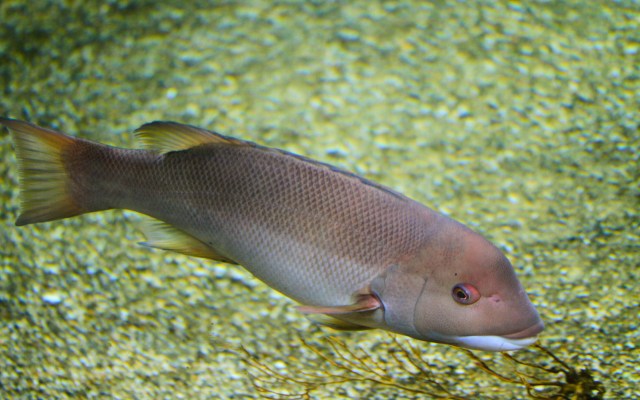
California sheephead IMG_5773

GENERAL CHARACTERISTICS: Length to 91 cm (36 in), weight to 16kg (35 lbs). Body is fusiform, deeply, compressed. Males are larger, with black tail and head sections with wide, reddish-orange midriff and white chins,. Adult females reddish-brown. Caudal fin almost square. Juveniles are brick-red on sides with white stripe and a black spot on its tail.

DISTRIBUTION/HABITAT: Monterey Bay, California to Baja California, Mexico on rocky bottoms or in kelp forests and shallow reefs to 55 m, typically 3 (10 ft)–30 m (!00 ft).

DIET IN THE WILD: Hard-shelled prey (sea urchins, barnacles, clams, gastropods, mussels, lobsters and crabs) crushed with tooth-plates in rear of mouth. Also take octopuses and various worms; can pry prey from substrate with canine teeth.
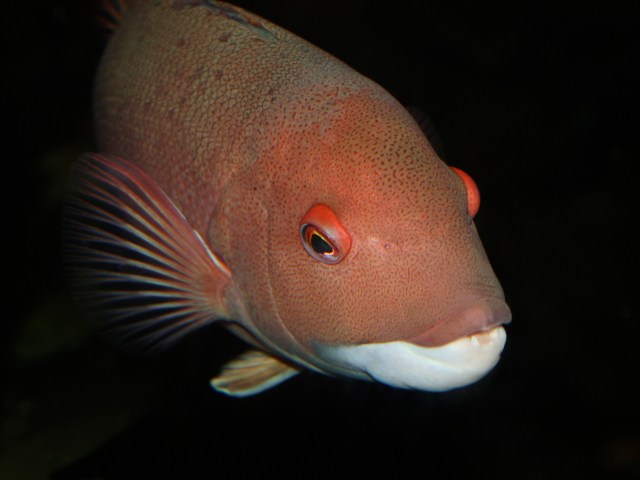
CALIFORNIA SHEEPHEAD 1

REPRODUCTION: Protogynous hermaphrodite. Individuals initially female, change to males at about 30 cm and 8 years old. Sex change metamorphosis takes less than one year.

PREDATORS/MORTALITY: Can live to more than 50 years, in ideal areas although this rarely happens now. During the night, they move to crevices and wrap themselves in a mucus cocoon so predators can’t detect them.

CONSERVATION: The California Department of Fish and Game restricts the catch size to prevent over fishing.

REMARKS: Large teeth can cause serious bite wounds.

California Coast CC19

WordPress Shortlink  http://wp.me/p1DZ4b-WZ

flickr http://www.flickr.com/photos/cas_docents/sets/72157608359804936/

TAXONOMY

Kingdom: Animalia
Phylum: Chordata
Class: Actinopterygii (ray-finned fishes)
Order: Atheriniformes (Silversides)
Family: Melanotaeniidae (Rainbowfishes, blue eyes)

Genus/species: Iriatherina werneri

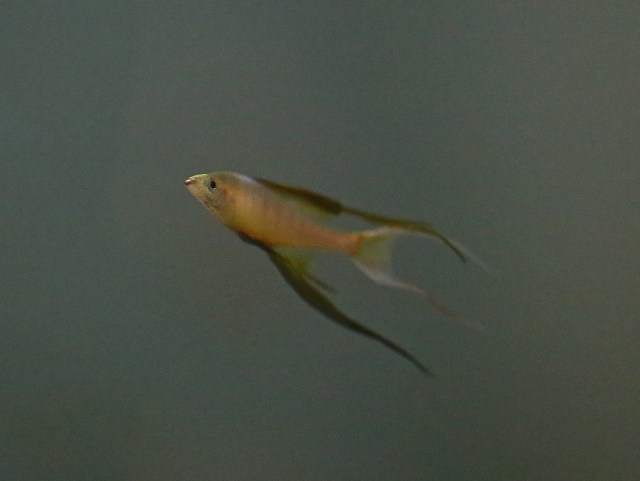
Threadfin rainbow fish, Iriatherina werneri IMG_7039

GENERAL CHARACTERISTICS: Length up to 5 cm (2.0 in) not including the long tail.

DISTRIBUTION/HABITAT: Northern Australia and Indonesia on the island of New Guinea in slow-moving streams, freshwater swamps, lagoons, and billabongs. It’s most commonly found in heavily vegetated, marginal habitats less than 1.5 m in-depth.

DIET IN THE WILD: Phytoplankton, diatoms, and other zooplankton.

REPRODUCTION: Egg-scatterer exhibiting no parental care and will consume its own eggs and fry given the opportunity.

Threadfin rainbow fish, Iriatherina werneri IMG_7044

Water Planet  In and Out of Water Cluster WP12

WordPress Shortlink  http://wp.me/p1DZ4b-VS

flickr http://www.flickr.com/photos/cas_docents/sets/72157608614099673/

TAXONOMY
Kingdom: Animalia
Phylum: Chordata
Class: Actinopterygii (ray-finned fishes)
Order: Perciformes (Perch-likes)
Family: (Labridae) Wrasses

Genus/species: Pseudojuloides cerasinus

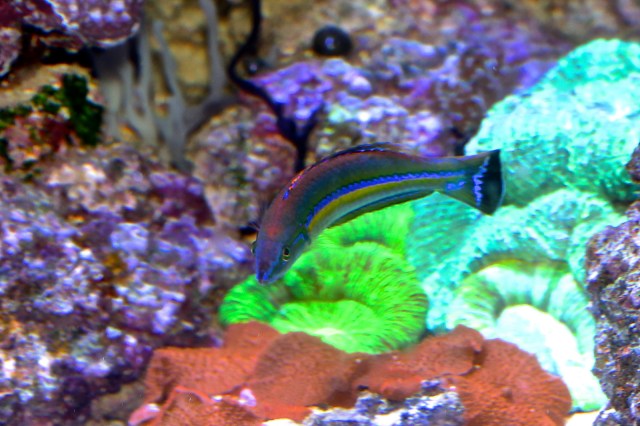
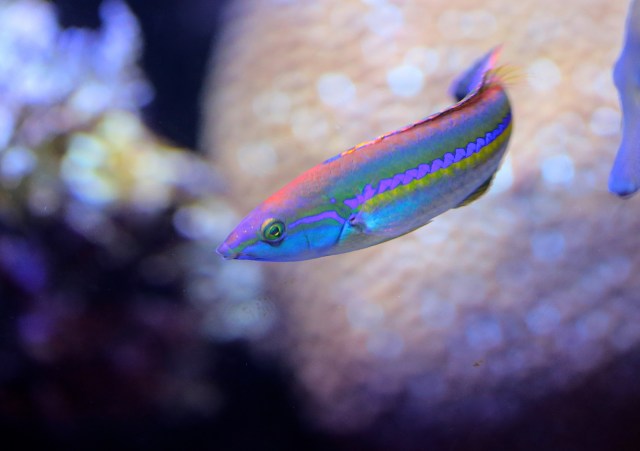
Pencil Wrasse  8362948295_4f3b9c4930_h

GENERAL CHARACTERISTICS: Long slender bodies and pointed snouts. Body color of males and females differ; geographic variation exists Initial phase (IP) fish are white with a copper-colored dorsum. Terminal phase (TP) green upper body, bicolor blue and yellow mid-body stripe; blue below. Length to 12 cm (5 in).

DISTRIBUTION AND HABITAT: East Africa to Samoa and Hawaii. S. Japan to Australia. Found among rubble, weed and coral areas of lagoon and seaward reefs to 61m (201 ft).

DIET IN THE WILD: Small benthic invertebrates (including fan worms, small crustaceans).

8644493886_4619144611_h

Reef Partners Cluster,  Shrimpfish Exhibit PR31

WordPress Shortlink  http://wp.me/p1DZ4b-VM

flickr  http://www.flickr.com/photos/cas_docents/sets/72157608208133134/with/8358672657/

TAXONOMY
Phylum: Mollusca
Class: Cephalopoda
Order: Octopoda
Family: Octopodidae.

Genus/species: Amphioctopus marginatus


GENERAL CHARACTERISTICS
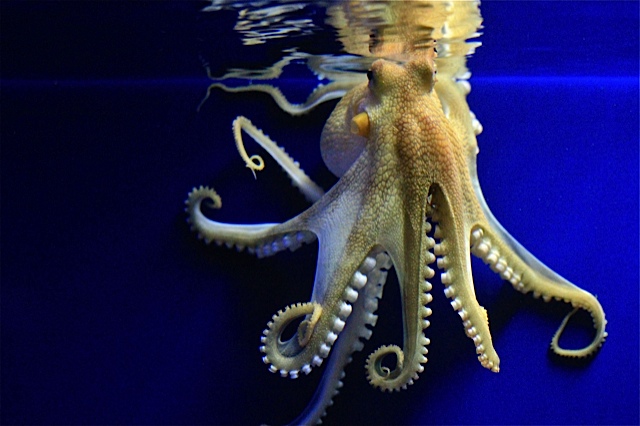
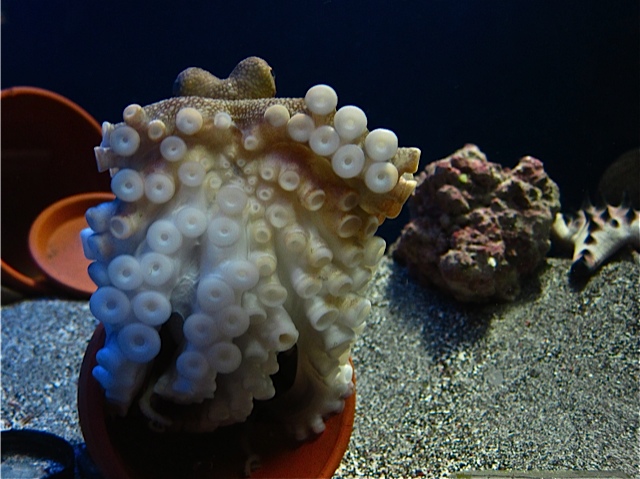
The main body (mantle) is small to medium-sized, 5–8 cm (15 cm [6 in] including arms) in length. The arms are usually dark with contrasting white suckers. They have only soft bodies with no internal skeleton with a hard parrot-like beak allowing them to hide in very small spaces.

DISTRIBUTION/HABITAT
The tropical western Pacific and coastal waters of the Indian Ocean on sandy bottoms.

DIET: Shrimp, crabs, and clams. A.marginatus uses its sharp parrot-like beak to crush the shells of its prey. Shells of prey that are difficult to pull or bite open can be “drilled” in order to gain access to the soft tissue: salivary secretions soften the shell, and a tiny hole is created with the radula (a rasp-like structure of tiny teeth used for scraping food particles off a surface). The octopus then secretes a toxin that paralyzes the prey and begins to dissolve it. The shell is pulled apart and the soft tissues are consumed.

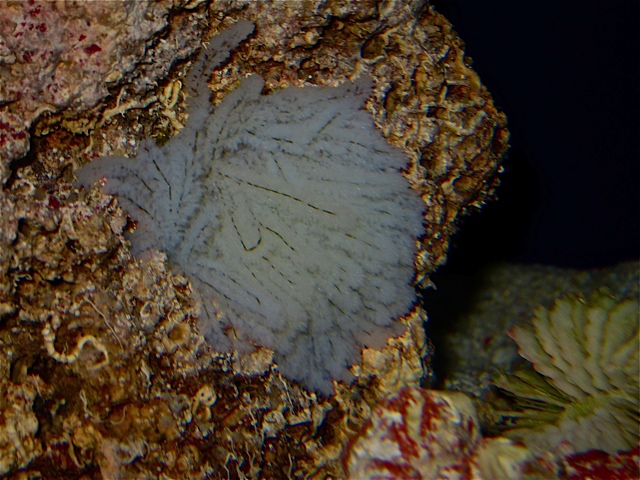
REPRODUCTION: Octopus reproduction strategy provides a counterpoint to the male sacrifice of the flower mantis and the bird-eater tarantula,  The coconut octopus female mates with the male, and retreats into a den where she lays her eggs. At this point, she no longer feeds, instead spending the rest of her now short life protecting her eggs from predators and continually cleaning and aerating them.  She dies shortly after the hatching of her eggs and their subsequent entry into the plankton.

Egg mass below

MORTALITY/LONGEVITY:  10–12 months

REMARKS: The species’ common name derives from this octopus’ habit of carrying around coconut shell halves, by fitting its body into the bowl and extending rigid arms from the coconut’s edge to the substrate and tiptoeing away in gait called “stilt-walking”  or bipedal walking.    

Below A. marginatus using a shell. 

IMG_0198

The Steinhart is the first public aquarium in the U.S. to display the coconut octopus.  Our octopus was collected by Bart Shepherd, Curator of the Steinhart Aquarium, during a 2011 research expedition to the Philippines.

flickr  http://www.flickr.com/photos/cas_docents/6776485376/in/set-72157608597736188

WORDPRESS SHORTLINK http://wp.me/p1DZ4b-pu


TAXONOMY
Kingdom: Animalia
Phylum: Chordata
Subphylum: Vertebrata
Class: Reptilia
Order: Squamata
Suborder: Serpentes
Family: Boidae

Genus/species: Python reticulatus


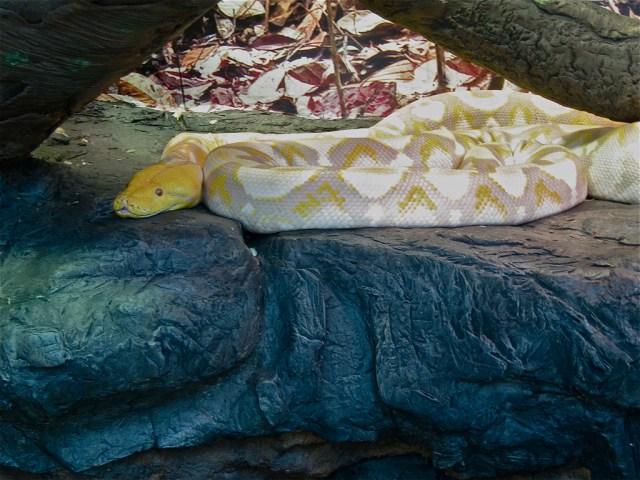
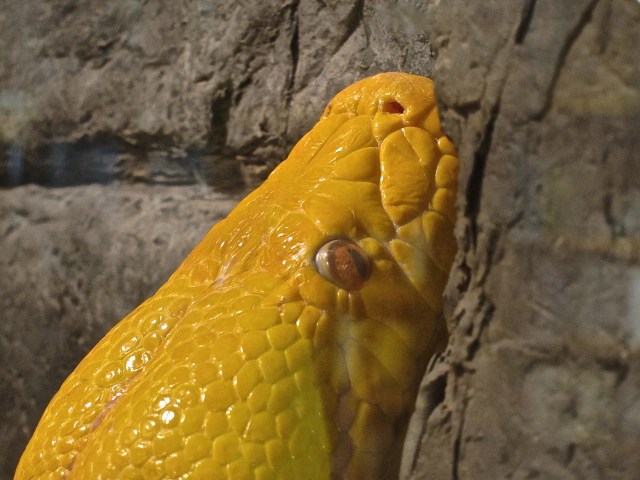
Albino Reticulated Python  6196134316_755d730e34_b

GENERAL CHARACTERISTICS: Largest species of python.  The giant South American Anaconda may grow  heavier ( 29 feet long & 550 pounds), but the longest snake in the world is the reticulated pythons (33 feet). Normally colored reticulated pythons have several pigments: melanin (blacks), and xanthins (yellows) amongst other more subtle colors. Lemondrop is a “lavender albino” which is the same thing as a “tyrosinase positive albino” (t-positive) which have the inability to complete the synthesis of melanin but can produce other melanin related pigments such as various shades of brown grey and red resulting the “lavender” color. A “normal albino” (t-negative) reticulated python is yellow and white with pink/red eyes. Melanin and other melanin pigments areas are pure white but non-melanin pigments are present giving alternate colors (xanthines produce yellows). To make matters more complicated different albino snakes may have mutations giving them additional color morphs.
Our albino American Alligator, (Claude) Alligator mississippiensis is a “normal albino” (t-negative) with no melanin or non-melanin pigments making him pure white. If you google “t-positive albino” or “tyrosinase positive albino” you can find more information on this condition. (Albino Appearance Ref. Nicole Chaney Biologist II, California Academy of Sciences for basic albino information).

DISTRIBUTION/HABITAT: Reticulated pythons can be found throughout Southeast Asia. Their range includes the Nicobar Islands, Burma through Indochina, and Borneo, Sulawesi, Ceram and Timor in the Malay archipelago. Found in steamy tropical rainforests near small rivers or ponds in tropical environments.

Albino Reticulated Python,  Python reticulatus  IMG_0184

DIET IN THE WILD   P. reticulatus is strictly carnivorous typically feeding on birds and mammals. This diet extends however to dogs, large deer, pigs and very rarely humans. Usually ambush predators, waiting in trees for unsuspecting prey.  They use their 100 curved teeth to capture their prey by biting then holding prey and they kill  by wrapping around them and squeezing them until the prey is unable to breath and its heart is unable to pump blood swallowing them whole.  The entire animal is digested in the snake’s stomach except for fur or feathers, which are passed with the snakes waste.

REPRODUCTION   Lays 25-80 eggs and guards nest but not hatched young.

REMARKS  Reticulated Pythons are heavily sold for their skin and meat. Also tourists visiting these areas often buy materials made from these snakes.
The largest P. reticulatus ever caught was 33 feet long in 1912 in Indonesia. The largest in captivity was from Thailand reaching a length of 28½ feet long with a girth of 37.5 inches and  weighed apron. 320 pounds.

This specimen below is a male, 14.5 ft long 60 lbs, 6 yrs old (6-22-12).

Albino Reticulated Python IMG_0182

WordPress Shortlink   http://wp.me/p1DZ4b-Vi

flickr  http://www.flickr.com/photos/cas_docents/sets/72157608449603666/

TAXONOMY
Kingdom: Animalia
Phylum: Chordata
Class: Reptilia
Order: Squamata
Suborder: Sauria
Family: Gekkonidae (Geckos)

Genus/species: Ptychozoon kuhlii

Kuhl's Flying Gecko IMG_9599

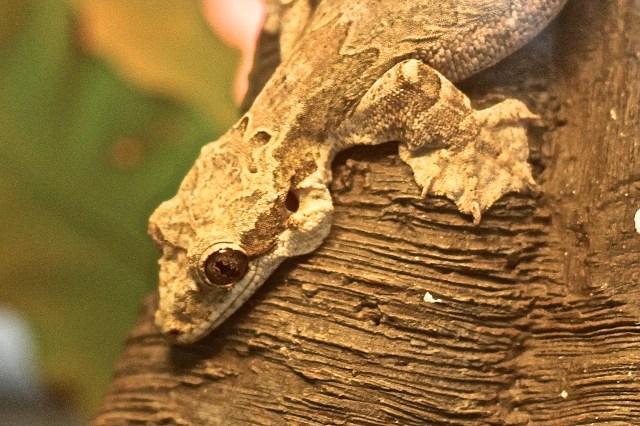
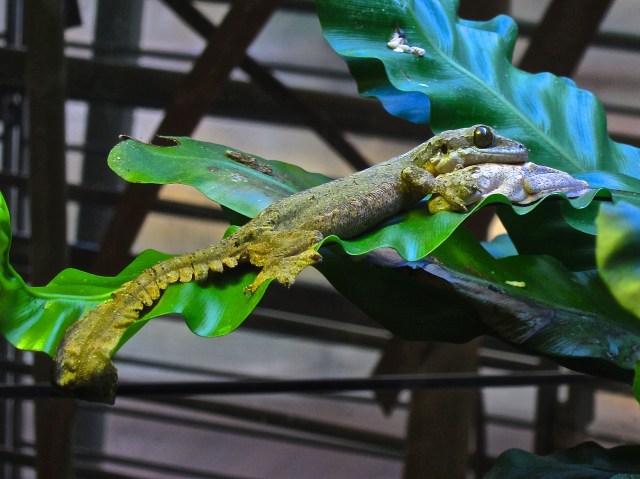
GENERAL CHARACTERISTICS Weird looking with big heads, bulging lidless eyes, and elaborate webbed feet. Gliding apparatus is composed of a large flap of skin along the flank. These flaps remain rolled across the belly until the lizard jumps off a tree. Then the flaps open passively in the air, acting as a parachute during descent. Additional flaps lie along the sides of the head, neck, and tail. These geckos are nocturnal and cryptic, and often go unnoticed in their natural habitat.

DISTRIBUTION/HABITAT Southeast Asia, including southern Thailand, Malaysia, Borneo, Indonesia, and Singapore. Nocturnal arboreal animals, found in lowland and mid-level rainforests.

Kuhl's Flying Gecko IMG_9650

DIET IN THE WILD Insects and arthropods.

MORTALITY Can live up to 7–9 years.

REPRODUCTION In captivity, breeding occurs when the animals are exposed to about 12 hours of daylight. The female will lay two eggs about once a month. She can lay five or six clutches per season. Eggs will hatch in 2–3 months.

Kuhl's Flying Gecko

Rainforest Borneo BO11

WordPress Shortlink  http://wp.me/p1DZ4b-UA

flickr  http://www.flickr.com/photos/cas_docents/sets/72157620567930293/