Archive for March, 2013


TAXONOMY
Kingdom: Animalia
Phylum: Arthropoda
Class: Arachnida (Arachnids)
Order: Araneae (Spiders)
Infraorder: Araneomorphae (True Spiders)
Family: Theridiidae (Cobweb Spiders)

Genus/species: Latrodectus mactans

Black Widow Spider

GENERAL CHARACTERISTICS: Female is glossy, coal-black color with long, slender legs and round abdomen; her underside usually carries a characteristic red hourglass mark. Adult Female: Approximately 8-13 mm (~1/2 inch) in body length. With legs extended, the female measures about 25-35 mm (1 inch – 1 1/2 inches). Adult Male: Approximately half the size of the female

DISTRIBUTION/HABITAT: In the U.S. ranges north to New England, south to Florida, Texas, Oklahoma; west to California, and throughout the southwest deserts. Also found in Canada, Mexico, the West Indies, and South America. Found close to the ground, especially dark, sheltered spots, such as under stones, in woodpiles, crevices, barns, outbuildings. Usually not found indoors.

DIET IN THE WILD: Carnivorous, mostly on insects, but also on other small invertebrates. When prey becomes ensnared in the web, black widow wraps it in silken threads and injects venom.

PREDATORS: Probably lives, like most spiders, about one year. Preyed upon by wasps including the muddauber wasps.

Black Widow Spider

REMARKS: Adult males are harmless. Females have a highly venomous bite that rarely kills humans, though young children or the elderly are likely to have severe reactions that can be fatal. Improvements in plumbing have greatly reduced the incidence of bites and fatalities in areas where outdoor privies have been replaced by indoor flush toilets.

Swamp SW06

WordPress Shortlink http://wp.me/p1DZ4b-Tt

flickr http://www.flickr.com/photos/cas_docents/sets/72157608653175263/
TAXONOMY
Kingdom: Animalia
Phylum: Mollusca
Class: Cephalopoda
Order: Octopoda
Family: Octopodidae

Genus/species: Octopus (No species name at the current time).

Note: octopus chierchiae is the lesser Pacific striped octopus and has been studied more extensively .

9830791415_f30b68b649_k-1

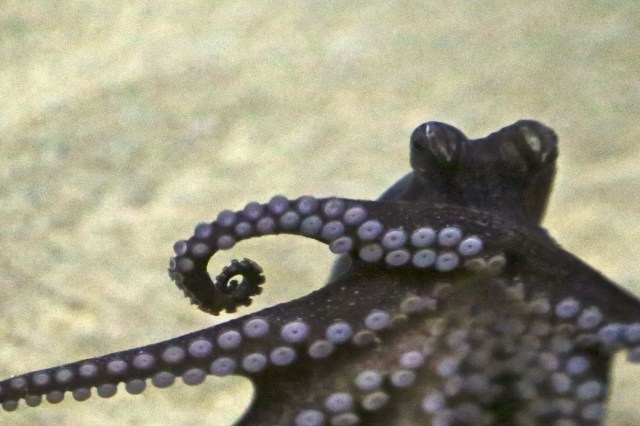
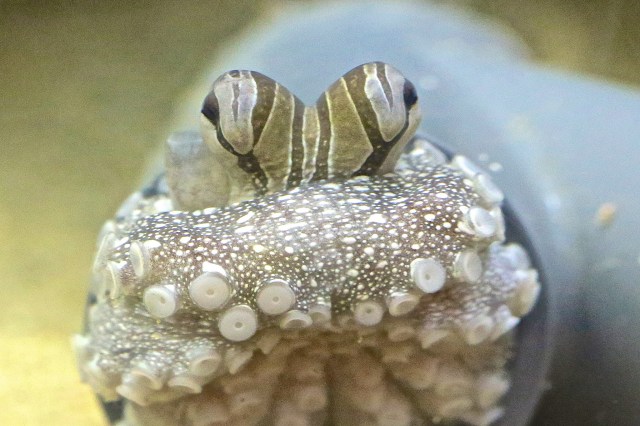
GENERAL CHARACTERISTICS: This pigmy octopus has arms spans of some eight to 10 inches, Color varies. It can switch from a dark reddish hue to black with white stripes and spots in fluid waves and also assume different shapes, both flat and expanded. Thought to live in groups of up to 40 or more individuals in the wild.

Larger Pacific Striped Octopus  8584026008_f1f86341db_o

DISTRIBUTION/HABITAT: Eastern Pacific off the coast of Central America. Found on sandy bottoms in intertidal areas.

DIET IN THE WILD: Shrimp, crabs and snails.Larger Pacific Striped Octopus IMG_6898

REPRODUCTION: Pairs of Larger Pacific Striped Octopuses live peacefully together in an aquarium, at times sharing a den. Mating is civil with a beak-to-beak, or sucker-to-sucker, position and their arms entwined for up to five minutes while the male inserts a sperm packet into the female. In contrast to other species which die after their first clutch of eggs this octopus lays many egg clutches in her lifetime.

REMARKS: Very rare, (Discovered 1991). Displayed only at the California Academy of Sciences.

Academy biologist Richard Ross, has spent the last 13 months raising and studying the behavior of this recently rediscovered species, along with Dr. Roy Caldwell of the University of California, Berkeley. They are currently studying the behavior of this species and working on a formal description and species name as well as are planning an expedition to observe them in their natural habitat in Nicaragua,

Reference:

California Academy of Sciences  http://www.calacademy.org/newsroom/releases/2013/rare_octopus.php

Ron’s WordPress Shortlink: http://wp.me/p1DZ4b-T5

Ron’s flickr http://www.flickr.com/photos/cas_docents/sets/72157608597736188/with/8562294939/

California Academy of Sciences  http://bit.ly/1pgpXLI

California Academy of Sciences    http://calacademy.org/explore-science/raising-rare-octopus

TAXONOMY
Kingdom: Animalia
Phylum: Chordata
Subphylum: Vertebrata
Class: Reptilia
Order: Testudines
Suborder: Cryptodira
Family: Carettochelyidae

Genus/species: Carettochelys insculpta

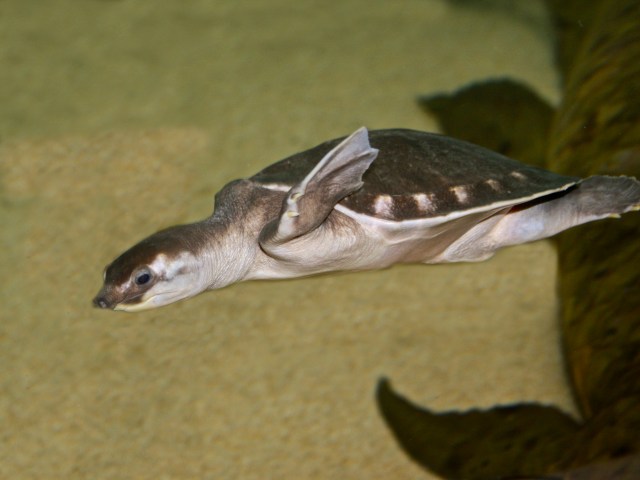
Pignose Turtle aka Fly River Turtle Carettochelys insculpta (Carettochelyidae) Pig-nose Turtles IMG_1388

GENERAL CHARACTERISTICS: Length ave. 46 cm (18 inches). Weight ave. 22 kg (49 lbs). Pitted, leathery,gray-green carapace and a white plastron. Limbs are clawed and paddlelike. Short head terminating in a broad, tubular, “piglike” snout. Carapaces of juveniles have serrated perimeters and a central keel. They have flat, broad limbs that have two claws each, with their enlarged pectoral flippers having a similar appearance to those of sea turtles.

DISTRIBUTION/HABITAT: Southern New Guinea and Kimberly Plateau of Australia in shallow, slow-moving rivers, lagoons, lakes and swamps with sandy or silty bottoms. Also in estuaries. Active nocturnally. Emerges from water only in order to nest.

DIET IN THE WILD: Opportunistic omnivores. Principal food is the fruits of shoreline trees. Eat other plant material: leaves, flowers that fall into river from banks, and aquatic algae. Also take insect larvae, mollusks and crustaceans. Scavenge fishes and mammals as carrion.

PREDATORS: Water monitors and humans. Eggs and adults taken for food by Papua New Guineans. Australian aborigines eat adults of this species. Have been reported to live 38.4 years in captivity.

REPRODUCTION: Oviparous laying two clutches of eggs, every two years. Males never come out of the water and females only come out when they are about to lay eggs. They don’t return to land until the next nesting season.

CONSERVATION: Vulnerable by the IUCN due to overharvest as a food source.

REMARKS: The only freshwater turtle to have limbs modified into flippers and swim via synchronous forelimb motions that resemble dorsoventral flapping, that evolved independently from their presence in sea turtles.

Secretive animals. Use forelimbs to burrow by scooping sand substrate over their carapace. Adults may thermoregulate underwater by lying over small thermal springs. Only extant species in its family.

 pignose-turtle-aka-fly-river-turtle- IMG_0316

Water Planet WP25

WordPress Shortlink  http://wp.me/p1DZ4b-SE

flickr http://www.flickr.com/photos/cas_docents/sets/72157608449490716/with/8547862948/

TAXONOMY
Kingdom: Animalia
Phylum: Chordata
Class: Actinopterygii (ray-fin fishes)
Order: Cyprinodontiformes (Rivulines, killifishes and live bearers)
Family: Nothobranchiidae (African rivulines)

Genus/species: Fundulopanchax avichang

Avichang killifish Fundulopanchax avichang IMG_5151

DISTRIBUTION/HABITAT: Africa: Cameroon, freshwater

CONSERVATION: IUCN Red List Endangered (EN)

Waterplanet

References

WordPress Shortlink http://wp.me/p1DZ4b-RA

flickr  http://www.flickr.com/photos/cas_docents/sets/72157608614099673/